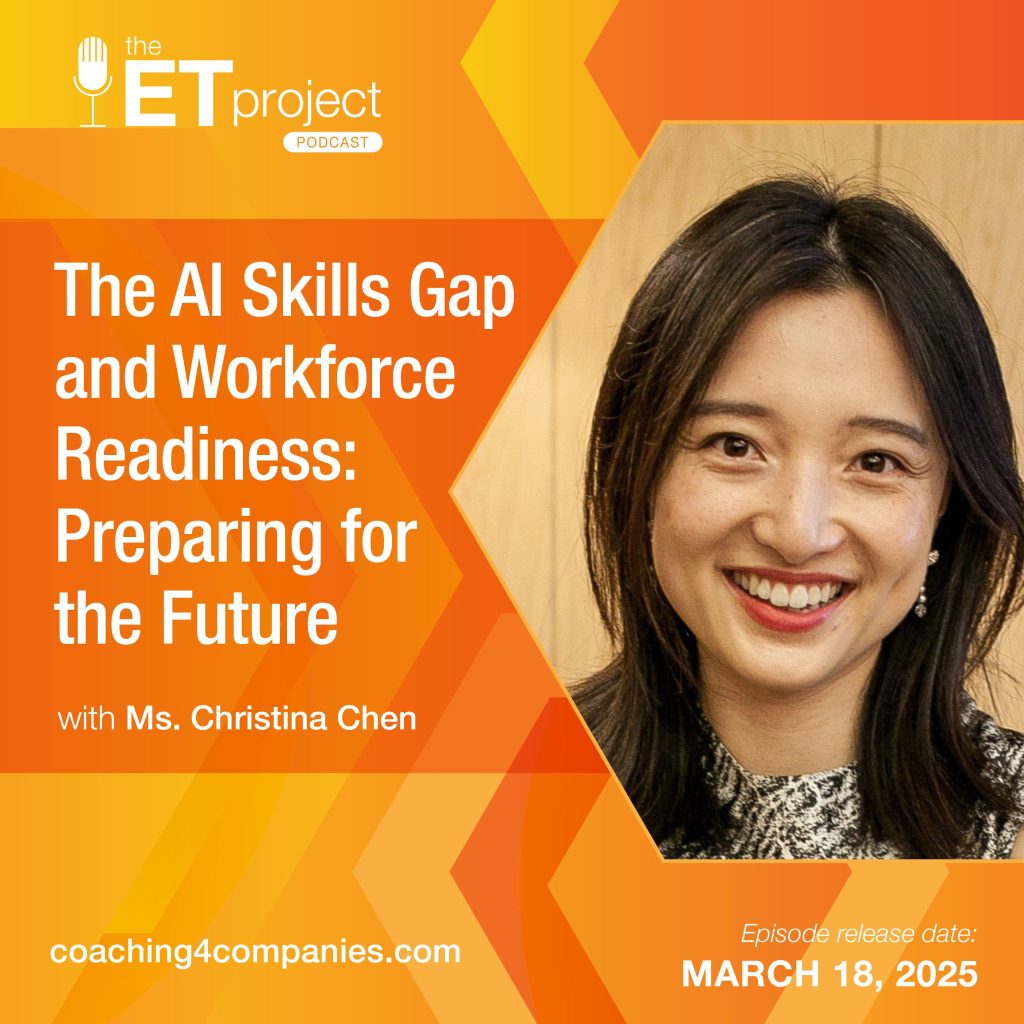
WAYNE BROWN: Hello, I’m your host, Wayne Brown, and welcome to the ET project. We’re delighted to be delivering this podcast for executive talent all over the world, whom we’re affectionately referring to as ‘Team ET.’ Today, we’re heading over to London and meeting up with the CEO of First AI, Ms. Christina Chen. First AI is a company dedicated to helping enterprises effectively adopt AI, and Christina, who has a computer science background from the University of Cambridge and over 20 years in technology, is a recognized thought leader in AI adoption as well as AI talent. She’s passionate about fostering diversity in AI, particularly in increasing representation and inclusivity for women in the field. Team, as you might imagine, with the daily developments occurring in this space, DeepSeek, Quin, Tulu, just to name a few examples in this one area alone, this is a very timely and interesting discussion. Christina and her team are witnessing firsthand the challenges companies and their employees are facing in adapting and keeping pace, and as you will hear during our conversation, Christina cautions that implementing AI solutions needs to be treated as you would any major initiative, and that is as a transformation and one that the workforce needs to adopt. So many insights coming from today’s episode, team, and it’s such a critical juncture in history. Don’t miss a minute, and as Christina says, “what a time to be alive.”
INTRO: Welcome to The ET project, a podcast for those executive talents determined to release their true potential and create an impact. Join our veteran coach and mentor, Wayne Brown, as we unpack an exciting future together.
WAYNE BROWN: Hello, team, and welcome to today’s conversation. I feel that it’s going to be a really interesting one to say the least because we’re going to be speaking about AI, and who doesn’t love a good conversation on AI? We’re going to look at the profound impact that it’s having on industry, on businesses, as well as on the workforce, and we’ll discuss the challenges, the successes of integrating AI technologies into our business, look at the influence on the workforce in particular, and the importance of an adoption strategy, and you’re going to gain insights into the evolving landscape of AI skills, the role of diversity even in technological success, let’s put it that way, and practical advice for both individuals as well as the organization looking to harness AI potential. Here to help us as we delve into the current and the future impact of AI, examining the revolution I want to say, is our guest and expert in the space, Ms. Christina Chen. Christina, welcome to The ET project.
CHRISTINA CHEN: Thank you, Wayne. Thank you for having me here.
WAYNE BROWN: It’s our pleasure. Now, you’re sitting in London, if I’m correct?
CHRISTINA CHEN: Yes, I’m in London, UK.
WAYNE BROWN: Always curious about different countries and their perception around the whole technological space and the advancement. What’s the situation in the UK? Is the UK business in general embracing technology or is there some degree of trepidation?
CHRISTINA CHEN: A great question, Wayne. There’s always a bell curve, I think, in any country, right? There’s a spectrum of where individuals or companies sit in terms of how advanced or how much they want to be an early adopter, so that early adopter mainstream leg art spectrum. So, we see it here in the UK as well. If I were to put UK in kind of a global setting, though, I think UK is behind US and China, to some extent, in terms of jumping onto the innovation, the adoption drive, but it may be ahead some of the other countries, because we do see businesses, especially some of the ones that are sort of early adopters who are investing in not only innovating building their own products as a tech company, but also non-technical companies using off-the-shelf solutions, customizing it in different spaces, like in professional service, in legal, in financial services, et cetera, using that technology to drive productivity, drive creativity, et cetera, we do see that, but it’s always a combination of different conversations around AI anxiety. We talk about AI anxiety for the workforce, and when companies that have a pretty advanced sort of forward-thinking culture, they also need to be very, very cognizant of how they communicate that to the entire employee base, because not everyone is as forward-thinking, and how do you bring everyone along in the journey? It is a big topic here.
[00:05:00]
WAYNE BROWN: To that point, you were recently part of a review group, I believe, for looking at the UK’s AI skills framework, and timing-wise, I have it right, it really was on the back of the Economic Forum discussions in Davos. What was your feeling coming away from that framework meeting?
CHRISTINA CHEN: So, that framework meeting is really to bring in people from the industry, like me, who is on the ground working with businesses adopting AI, and what the employers are saying, hey, this is the workforce that we need for the future, or for now, and in the short, medium term, really. A few takeaways from me. Number one is adoption is a key word. Everyone talking about adoption, and employers are really looking for that. And what this really… Adoption really means, from a business perspective, it’s really the cross-section between business sense and technology or AI understanding. AI has been around for a while, so this is not new news, but AI is now touching every worker, every employee, so it used to be probably more in the technology and the tech team or tech companies in the IT division, et cetera, where you’d be talking about data scientists, machine learning engineers, and all that. Now it’s touching everyone, so there’s a whole group that we sort of put into the AI skills framework who is working with AI. So, actually, if you think about a pyramid, you start with almost living with AI. You and I, as consumers, as citizens, we use apps and technologies that have AI in it. How do we differentiate deepfake versus not, and getting that awareness, and then you have a level up from living with AI is working with AI. Whether you’re in sales, marketing, HR, you are starting to interact with AI tools, and you soon will be expected to leverage those tools to be more productive. And then there’s the AI more professionals who continue to build technologies like the machine learning engineers and data scientists, et cetera. And then there’s a whole leader’s space at the top of the pyramid, whether you’re leading an AI company, and increasingly you’re not leading an AI company, you’re leading maybe an industry-focused non-technical company, but how do you lead with the AI technology in your culture, in your processes, et cetera? So, that’s what we’ve been looking at from a UK framework perspective, and it’s quite interesting. There’s a really healthy debate about how can we bring everyone along with us, so we want the entire workforce to really benefit AI, because that’s how you really drive true productivity across the board, so you kind of bring up the common denominator, but also you let the ones that can run fast run fast. Right?
WAYNE BROWN: Yes
CHRISTINA CHEN: So, you want the innovators to not be bogged down by lots of regulations, et cetera. But you want to also empower them, whether it’s funding, whether it’s policies, et cetera, to let them run fast and innovate. There’s a really healthy debate here about not letting people fall behind while the rest of the world is moving forward.
WAYNE BROWN: Let’s backtrack a little bit and talk for a moment about your career journey, and then we’ll move into the company’s formation. So, what was your inspiration? What led you to venture into AI?
CHRISTINA CHEN: Right. Well, so, many years ago, I was a computer science graduate, so I studied computer science, and even at that time, there was AI in the sense of computer vision, bioinformatics. We looked at how to use machine learning to really, for example, decode the sequencing of DNAs and RNAs. We used computer vision to look at a security piece, iris recognition when you go through passport control, all of that. That was always part of a fascinating subject for me. Fast forward, I’ve been in tech for 20-plus years, wearing different hats, being an investor, being a software engineer myself, growing businesses, and really just seeing that evolution came through the machine learning, or they didn’t really call it AI, in that case, what we talk about AI today or generative AI today.
[00:10:00]
CHRISTINA CHEN: It’s fascinating because it’s touching more, it’s permeating into industries. It’s not just a computer scientist, it’s not just a very small group who are building the AI models, building the AI technologies, apps, softwares, that is being impacted and it is everyone here. And this is really how I got to where I am today with First AI Group is I felt like I also wanted to build this company for my younger self. I say I built First AI for the younger Christina coming out of a computer science degree, coming out of university, I wanted to be at the cutting edge. What did that look like? And now we use our company to bring the younger generation also into AI so they can be part of this cutting edge as well.
WAYNE BROWN: I’m wondering back then did you have mentors or people that were actually influencing you along this journey?
CHRISTINA CHEN: Very interesting. I’ve met many mentors, official and unofficial along the way that really helped me get to where I am today. If I look back, there wasn’t a structured… I wouldn’t say there was… there wasn’t a structured way to get here. It was by luck, by fate, however you call it. I met people who came from the technical space and really understood where technology was going. For example, one of my advisors still at the company was an old professor of mine from Cambridge University where I studied and he’s very much in the AI space. So, that really influenced my journey here. And also, on the business side, entrepreneurs who have been very successful and to mentoring me, investors who have been very successful when I was in my technology investor journey, part of my career, and it’s really… that’s the reason why I thought, okay, I kind of got this by luck or by chance. Is there a way we can do this more systematically where a lot of people may not have the personal network or family network to get to these people but give them a platform? If we act as a platform, act as a community, then we can bring some more mentors who can influence really someone’s career, change their trajectory like it did to mine.
WAYNE BROWN: If we fast forward then to the company itself, I believe you’ve just had a name or a branding transition. So, it was First AI Talent, now you’ve shortened that to First AI.
CHRISTINA CHEN: Yes. Well, First AI is something that is a catchy name and we use First AI because really, it’s about being first. We are out there leading our customers, it’s all about helping businesses drive adoption, right? We are believers that AI should be accessible to all the organization. It shouldn’t be a black box, it shouldn’t be a myth, it shouldn’t be this really hard thing. So, we want to be first to learn it, to test it out, to build that experiences and we bring that expertise to all the companies who also want to leverage this technology. So that’s where First AI came from.
WAYNE BROWN: And when did you start the company?
CHRISTINA CHEN: It was in 2024, last year.
WAYNE BROWN: Oh, okay. So, it’s still quite new, I was wondering whether you’ve had to pivot at all with all the constant change that goes on with AI, whether you’ve had to do any pivoting since its inception, I’m guessing.
CHRISTINA CHEN: Yeah. Well, I’d say it’s an evolution, it’s iterations rather than pivoting, that’s what I say it is. When we first looked into AI in this current form, and as I mentioned, AI has been around for a long time, but how we came about was actually businesses, in my previous business, there were companies who asked, hey, we saw ChatGPT came around, different AI technologies come along. As the business owner, as the CEO, I’m starting to realize, hey, I need to build this capability in-house, I need to build this talent pool in-house. Where are they? I not only need AI people, as I said, I need marketers who can use AI technology, I need product managers who knows about AI, et cetera, and how to build that into our products. So, it’s a very different way of now doing business and building your workforce and capability. So, this is where the gap we realized, because also the supply of the talent, if you think about the supply and demand, employers are looking for really intersection between AI and all the business function already.
[00:15:00]
CHRISTINA CHEN: And then the supply, first of all, is very scarce, still AI or machine learning in itself, data science is still a fairly small group of supply coming into the job market. But also, that cross-section between the technology and the business, the intersection, you’d be looking for unicorns to do that. So that’s why we spotted that opportunity and really starting to look at, okay, what do employers really want in terms of AI talent? And back to your question about kind of pivoting and going with the market, started with, hey, ChatGPT came along, how do we use prompt engineering? How do we build custom GPTs? Et cetera. Two, Microsoft came along with Copilot, right? So that’s more enterprise scale. So, I’m a big corporate, we’re already on Microsoft 365 and using all the tools. How do we do it in a way that’s enterprise grade? It’s safe. It’s not just somebody trying it on a chat somewhere. How do we integrate in everything we do on Word, Document, Outlook, emails, et cetera. And that’s where we are finding the biggest demand right now is enterprises thinking, how do we leverage the existing off the shelf solutions that the big tech companies have built out there?
WAYNE BROWN: And I’m asking myself that very same question at the moment. Before we go too much deeper into that, what is it exactly that First AI is all about? What’s the purpose behind the company? What is it you provide?
CHRISTINA CHEN: Yeah, a great question, Wayne. So, First AI is all about making AI accessible to all the organizations or the businesses out there. We believe that AI shouldn’t be a myth, it shouldn’t be a black box. So, what we do is we are an AI adoption company. So, we go into businesses and help them drive adoption. What does that look like? Training your employees, building AI workflows, building your personalized prompts, building agents, that’s coming up. So let me give a live example. So, we work with for example a very large multinational law firm. So, across the law firm, we’ve worked with 18 departments that use Copilot, Microsoft Copilot is the technology they’ve chosen to roll it out in so many different ways. For example, we may be sitting down typically with lawyers or knowledge lawyers and it will be very personalized, long specific prompts to say, how do you get information? For example, knowledge lawyer, how do you get previous cases out? How do you get information out very quickly on a specific project, on a specific topic? Or it is all the business operations function. For example, we work with their HR department to say, hey, did you know you could build these agents? I mean, now people use very loose terms of agents, but use… prompts or agent, it doesn’t really matter, the conduit, but you can now start to screen five, you can compare side by side five top candidates in a specific, very specialized field quickly in a summary table, that’s just a very simple use case. We also help HR, for example, who are not data scientists and all that, to sort of query their pipeline data, their talent pipeline data, or their diversity inclusion data or employee data very quickly on Excel using natural languages rather than having to learn about, you know, Power BI and data tools. So, these are the types of things that we go in to do, basically train everybody so that they can use AI themselves and then build, hey, we know now your workflow, map out your workflow. And then did you know this part is AI-able and then we’ll build that for you. And that just drives time saved and productivity.
WAYNE BROWN: So, Copilot is really a productivity-based tool, if I understand correctly. I’ve not used it myself, but I know a lot about it. I was curious, is there any interface or API between Power BI and Copilot?
CHRISTINA CHEN: Yes, there is Power Automate, Power Apps, which allows to automate a lot of things, Power BI is very data-specific. There’s now ways that you can, again, use natural language to query your data. And Power BI is just a way to bring out the data from the database or link your kind of front-end query to asking a question in a very simple way to the backend where the data sits, yeah.
[00:20:00]
WAYNE BROWN: Yeah. When you’re working with your client, how do you measure success for the companies? So, you come in…
CHRISTINA CHEN: Oh, this is such a good question. And everyone is figuring it out as, as we go, let’s be honest here. And even, you know, the technology providers, whether that’s Microsoft, Google and, you know, OpenAI, et cetera. There are two, almost two schools of thought. I mean, there are many different voices here, but if I just want to simplify it down, there are two schools of thought. One is productivity, right? So, the simple thing is you write this chat or prompt, in the AI term, it gets information out to you faster. You’ve saved time, you have increased your productivity, quote unquote. So, time saved is what a lot of companies still use to measure. There’s another school of thought to say, right, okay, time saved is all well and good, but it doesn’t drive value to… it doesn’t make me more money, right? To put it very simply, it doesn’t, unless the employees have pool shrinks, but there is, you know, the… then the other implication, or do you put a dollar amount or a pound amount or a money amount on the productivity, you know, time saved. And some of the companies will look at not necessarily in that sort of employee saved sense, but how have they used… so the bigger question is, how are they using the time saved, right?
WAYNE BROWN: Yeah.
CHRISTINA CHEN: So, I have… you know, I no longer need three hours a day to write emails, only one hour a day, let’s say. How have they used the other two hours? Does it mean as part of the sales team I’m meeting my customers more? That’s where the KPIs start to see, or the success measures start to see, and that’s very departmental or company-specific, right? What are their KPIs anyway? Is it going through the candidates faster? Is it, you know, meeting my customers more? Is it getting sales proposals out? Is it getting more marketing content out? That’s more nuanced and people then can put a more tangible value amount on it. There’s, you know, going back to the first school of thought, which is, you know, around time saved, there’s also a big drive as to what the messaging is out to the employees. If you start to put pound, dollar, yuan values on it, doesn’t it mean they feel like their job is at risk? Is that a good communication out? And that’s why also there is… it’s two schools of thought, and we will need to see what kind of impacts, what suits the organization, what kind of success metrics they want to set themselves up.
WAYNE BROWN: It’s always part of the challenge of productivity improvements. You know, I don’t know if you’ve heard of the Parkinson’s theory, but essentially if you put a pool of time, then you can do it shorter, the tendency is for us humans to take that full pool of time to do the same tasks we could do in a shorter time.
CHRISTINA CHEN: Yeah.
WAYNE BROWN: Unless we adjust the goalposts to make people target that shorter amount of time, they will still use their full availability. And that’s the struggle we have with productivity, of course. And I can see that challenge. I’m also wondering about the quality aspect. Is there any measure from a quality point of view about, okay, we’re switching now to… we’re saving time through AI, but is there a trade-off within the quality of the output?
CHRISTINA CHEN: Yeah, well, such a good point, Wayne. In fact, a lot of companies haven’t gone that deep into looking at what the measurement, what the right measurement for quality is, but having said that, we do have some specific examples where, for example, we work with a very specialized consulting firm. They do environmental service consulting. So, think about big utility plants, you know, water plants, et cetera, where very specialized engineers can go consult, look at the plant’s safety, for example, and write reports about it and how you make it more safe and compliant. So, you think that… so, there’s a lot of human expertise still involved, right? It’s not just automatically generating some report based on some, you know, a bunch of information or data, right? And you could do that and you could do that probably for a certain percentage of it. So, we’re actually looking at some of the AI technology we’re working with them is, hey, if you look at the report, probably 30% of that is information filling, right? Name of company address, et cetera, or name of plant address, so that’s…
[00:25:00]
CHRISTINA CHEN: Well, then there is, you know, a big chunk of that is expert, human experts coming in and that’s still needed, but can we save that 30% of that for the human expert to then focus on the 70%, and that’s something that’s, you know, quality and it’s same in the legal case I talk about. Legal is very, very specific in terms of the output, right? It’s not just, hey, have you… you know, that you got information out there from the internet you can put. Their prompts and how they interact with AI it’s extremely precise and we test it over and over. Some of the instructions is 150 words, 200 words-long, right? To get some very, very specific information now, but you always have to check with, you know, with a human, with a human involved. And this is something that we talk about a lot is we believe actually it’s humans that make AI work rather than the other way around, AI is just a tool, yeah. It’s fast. Yeah.
WAYNE BROWN: Yeah. You have a process that’s called EEE, I think.
CHRISTINA CHEN: Triple E standard. Yeah.
WAYNE BROWN: Yeah. Triple E standard. Does that come into this discussion or is that separate?
CHRISTINA CHEN: Yes. So very much so. So, the Triple E standard is how we measure our own people, we call the AI adoption managers, before they go into clients, right? So, the Triple E stands for first E, expertise. Do they know their stuff, right? Like AI Copilot specific. Second E is enterprise-ready. So, we are working in enterprise environments. So, a lot around responsible AI, ethical AI, security, compliance, governance, et cetera. It’s very important. And the third E is empathy, it is all about the third E, it is about empathy is, hey, we are actually the human face of AI, right? We are literally the person who sits next to Sue, sits next to Tom, right? That helping them, “hey, did you know you can do this on AI?” and “tell me about how you work every day” and, “oh, did you know we can do this for you that takes the boring stuff out of your daily work or the tedious stuff?” That’s the human side. And this is how you really drive adoption from the grassroots. So that’s where we see it working really well. So, there’s both the top down and a bottom-up approach where the grassroots, you have people walking the floor and be that human face so you can actually help people start to use, change their work habits and start to use it. Yeah.
WAYNE BROWN: So, it’s very much a change process.
CHRISTINA CHEN: Mm-hmm.
WAYNE BROWN: So, you bring in AI to the business, reading some of your material is really about a transformation rather than just adapting AI. And so, you have to be able to transform the whole workforce towards leveraging and using it to its maximum. So therefore, for me, as I read it as a novice who’s looking in from the outside an AI, it’s really looking at that whole change process to make sure that I have change champions or in this case, AI champions who can work beside the business to help them really integrate all of the benefits.
CHRISTINA CHEN: Yeah. Yes. We use the analogy that when the company has say bought an AI tool, right, whether it’s Copilot or ChatGPT Enterprise, et cetera, it’s like giving employees a Ferrari to drive. So, every employee got their Ferrari and everyone thought, ooh, I know how to drive. You know, I’ve been driving my whatever car to work every day. What do you mean that I need a training on driving? What do you mean I need a training on how to write my email with AI, right? I’ve been writing email every day. But driving a Ferrari is very different. I mean, I’m not a racer, so I wouldn’t know which button to press, et cetera. So that’s what we, you know, see a lot is, hey, you just bought, as a business, you just bought, invested Ferrari for everyone. Let’s make sure, let’s help them actually drive the mileage out of it by teaching them how to do so. And that means to the users it is really… It is changing behavior of work, that’s why it’s so hard. So, that’s why we look at actually three areas. I talked about technical. I talked to our business sense, you know, how actually that works in my sales function, marketing function. And third is change management. It’s all about how do you run programs in a way… in a sort of big program in a big organization, you bring everyone along and actually drive usage rather than just blast, you know, switching it on, hey, you’ve now got this AI tool, Copilot, there you go. It does need change management for it to really drive our AI.
[00:30:00]
WAYNE BROWN: How agile or adaptable do your people need to be as I come into different industries or are you focused on specific industries to try and use that as a niche within your business or do you cover everything?
CHRISTINA CHEN: So, we follow where AI or generative AI in this case has the most use cases and most demand right now. So, think knowledge workers. So, think professional services, firms, financial services firms, lawyers, you know, legal firms, investment firms, et cetera, where knowledge workers that use document a lot, right? Documents and the Office, Microsoft Suite, at the same time, their cost is high, their value to the firm is also very high, right? So, you want the making… helping them to leverage AI technology has the biggest bang for the buck in a way. So, these are the areas where we’re really sort of niching and sort of specializing. So, we have people who are very specialized working with investment firms, for example, legal firms. But even just use, you know, my previous example, I was talking about this legal firm, we worked across 18 divisions, right? So, within 18, more than 50% of those 18 business functions, what they call business operations or business services, that would be across most companies, right? You would have, you know, HR, you would have sales, you have marketing, you have finance, et cetera, where a lot of that can be… best practice can be shared across industries and then there are specific ones, you know, the attorneys and the large lawyers will work differently, yeah.
WAYNE BROWN: Okay. If we look a little bit, polish the crystal ball, so to speak, and look a little bit to the future, I don’t want to get into the future just yet, but is there anything emerging from an AI perspective in terms of skill sets that you might believe as employees, entrepreneurs, somebody running a business, somebody working in a business, is there anything that’s starting to appear on the horizon that you think would be a useful skill adaption?
CHRISTINA CHEN: Yeah. I mean, there are so many, I have to say, because probably 90% of the job roles, job titles don’t exist yet today. You know, in two, three years time don’t exist yet. Some of the big… I mean, how much time do we have here? But I’ll just pick off two or three came to mind. Obvious ones are agents, so a lot of buzz and kind of hot air, depending on which side of the fence they’re calling you on about agents, but just understanding what that means, understanding how that works will be very relevant for, definitely a certain, a small percentage of people who will be into AI agent developer roles are very technical, but understanding that is really important. Second is everything around AI, ethical AI, responsible AI, AI governance, I’m backing them into one right now. Just again, as this field evolves, for big organizations… well, for any organization, but especially big ones, AI can have very, very big impacts externally, right? Whether that’s reputational damage, about internally how, you know, how bias or fair, maybe your AI model is, AI tools, et cetera, and how we use it, how we educate employees about it. There’s a whole, I guess, collection of topics and there’s emerging roles and there are already some companies have AI council, right? Responsible AI council for, you know, how they use it across the business. And that’s very much going to be an area that’s needed going forward. These are just two I picked off, but I’m sure there are 90% of the job titles we don’t know yet.
WAYNE BROWN: Yeah, for sure. For sure. And of course, in let’s say, even in the last two months, we’ve seen the open-source platforms create so much of a stir within DeepSeek and then I think we had the one from Alibaba. Now we’ve got Tulu, if that’s the right pronunciation. I see it as just the cap has been ripped off or the Band-Aid has been ripped off and now the floodgates are open, from that perspective, where does that take us?
CHRISTINA CHEN: Right. Well, what I was saying when I was reading the news is, “what a time to be alive,” isn’t it? To see this rapid growth, rapid innovation, everyone trying to outdo each other, outsmart each other. And it’s fascinating to watch as people sort of in the space.
[00:35:00]
CHRISTINA CHEN: It’s a classic Moore’s law. In computer science there’s the Moore’s law that every 18 months you double the… whether you make a semiconductor twice as… half the size or twice as fast, et cetera. So, it’s the classic Moore’s law and people are building, you can see people are building on top of… on sort of standing on the shoulders of each other, right? So we’ve kind of one step forward, working on specific large language models and then we now use mix of experts, a specific type of language models, I’m sure something else is being worked on right as we speak right now. One thing we can say, who knows what this brings, but one thing we can say is a lot of us are actually beneficiaries of this, is the AI technology as a whole basically is getting more accessible, whether that means cheaper, more open-source, more easier to use, lighter weight, et cetera, and that’s… it’s going to be a good thing for a lot of us.
WAYNE BROWN: Yeah. To this point, how do individuals in the workforce that are not like in your space constantly looking at these developments, how do the individuals stay current?
CHRISTINA CHEN: Oh, hard for everyone, if you’ve got a full-time job, do something else. I would say, there’s a lot of news out there and AI grabs a lot of news. It’s good to know where the general trends are going. If this is not your space, I don’t think it’s necessary to keep up with every news, every development for what you do anyway, it’s about knowing, I think it is good, it is useful to know roughly how AI works so that it doesn’t feel like a black box to you for the sort of general employee.
WAYNE BROWN: Yeah.
CHRISTINA CHEN: But which LLM is… large language model is coming on top versus the other is entertaining or is useful to know, but not a must, it’s also really… large language models tend to grab a lot of headlines, but there’s so much more development going on than just large language models as well, yeah.
WAYNE BROWN: Now your company First AI offers training, if I understood correctly, for individuals or for companies if they want to develop a deeper understanding about AI in particular, some of the nuances, I guess.
CHRISTINA CHEN: Yes, so training is part of it. We basically do adoption service. So, we come in, AI adoption as a service is how we call it or on-demand adoption managers, if you’re a bigger organization, you want someone in your team to do so. Training is very much part of it, but actually a big kind of value… biggest value creation is companies mapping out their processes so people will understand AI, as I mentioned, sitting next to the HR person, sitting next to the sales person, hey, what do your day-to-day look like? What can be done with AI? What’s AI-able? And then let’s use technology in this part, which drives the biggest, you know, ROI.
WAYNE BROWN: We work with small business as consultants and what we see is the fear, the uncertainty about the directions ahead, when to make that step, and what happens if I’m wrong. Do you have the weight at all within your organization to address those types of questions for small businesses as well as for the large businesses?
CHRISTINA CHEN: Yeah, yes. Yes. Well, so first of all, it’s very natural to feel like that, everyone does. Even the ones who have taken that leap of faith, you feel like, oh, they’ve done something that they have… they may know more than me to make that decision, why? Right? It’s actually very natural. I think there are two things here. One is practically, yes, we have a whole playbook of, for example, we have a 10-week adoption program that’s tried and tested, we can get you from A to B, right? So, for people who may be doing it, companies who are doing it for the first time, they feel right, okay, we’re getting the best practice here. They know exactly what they’re doing, that’s number one. Number two is regardless of that we always say it’s a different mindset. For a business owner, for a CEO, for a CTO, now we live in a time that we can no longer buy a proven solution, AI or not, right? There is a certain element of always going on the journey with the technology, with the solution, with the business model that you’re innovating, whatever that is, there is no longer, something has been built, I’m the mainstream buyer, the middle 60% of that and that’s your complete package and buy it, et cetera, it does not work anymore. And that’s the mindset CEOs or leaders need to be in to be able to take advantage of that new technologies.
[00:40:00]
WAYNE BROWN: And that’s a very hard mindset shift.
CHRISTINA CHEN: It is.
WAYNE BROWN: Particularly for… as gray as me, to be able to say, you know, I’ve established my whole career based on my ability to make the right decision, to take the right steps, and now technology has basically made that redundant and I have to learn… now I have to be flexible, agile, adaptable, to really bring that to the table. And that’s part of the fear, I guess, a lot of leaders are facing.
CHRISTINA CHEN: Yes. It’s very natural and it’s, again, it’s not only AI, it’s in business everywhere, right? How fast the market is moving, how fast the consumers are moving, our customers’ needs are moving. We see this, what we call the barbell personality, is for a leader to have simultaneously the optimism that in the medium to long term, we’re going the right direction to the very short term, being paranoid about risks, about making the right decision, about being responsible for a lot of that short term challenges, it’s hard, don’t get me wrong, but those who can have this barbell personality can really lead, it is the type of leader that can lead organizations through the fog, really is kind of where we are, the whole world is at right now, is there is no chosen path that you go exactly, you follow that path, you get there, you get to Rome, but the faith that you will get to Rome, many paths get to Rome and accept that there are challenges on the way, there will be investments that have been made that don’t work out well, there will be investment that have been made that do work out well and be okay with that and also encourage the team to do that. It’s hard, don’t get me wrong, it is very hard.
WAYNE BROWN: Yeah. Are you or the company engaged in the wider AI community or the industry, like how do you interact with your own industry?
CHRISTINA CHEN: Well, so we do, is the short answer, yes, we do. Our space is quite interesting that we… because we basically take AI technologies and we help businesses to apply it, really on the ground, boots on the ground, right? And it’s not just strategy, it’s not just consulting, actually making it happen, we do see, we tend to sit in the ecosystem of where a lot of new technologies are coming up, big and small, so whether that’s big players like Microsoft, Google, Salesforce, et cetera, and OpenAI, smaller ones will come to us and say, “hey, we’ve got this new technology, we want our own software as a service, we want to drive more adoption as well.” Right? And it’s all about… And people these days, users, they could be buying things, but not using it and that really hurts their, for example, renewals, upsell, et cetera, so we tend to work in the ecosystem between the technology vendors, what’s coming up, and the business side is, okay, what can we buy? What should we… and also, the talent, so you think about a triangle almost, the people and the business and the technology vendors, these are the three kind of touch points we have in the ecosystem.
WAYNE BROWN: If people listening to the conversation want to connect with you, Christina, or they want to connect with First AI, what’s the best way to find you and make that connection?
CHRISTINA CHEN: So, we are on firstaigroup.com, so that’s our website, for a more interactive, we are on LinkedIn a lot, so if you search for me, Christina Chen, C-H-E-N, and First AI, we’ll all come up, First AI, we have a team, anybody there, you can reach out to the First AI company page, we also talk about some of the latest, not only what we’re doing, what we see in the market as well, so LinkedIn and website is where you can find us.
WAYNE BROWN: Perfect, we’ll make sure we get those in the show notes. Thank you for sharing your insights, for your experience and everything in the conversation, much appreciated.
CHRISTINA CHEN: Well, thank you for having me, Wayne. This has been really a pleasure to speak with you and just to share what we see in the AI world. Thank you for having me on the show.
OUTRO: Thank you for joining us on The ET project, a show for executive talent development. Until next time, check out our site for free videos, eBooks, webinars, and blogs at ‘coaching4companies.com.’
[END OF TRANSCRIPT]