[music]
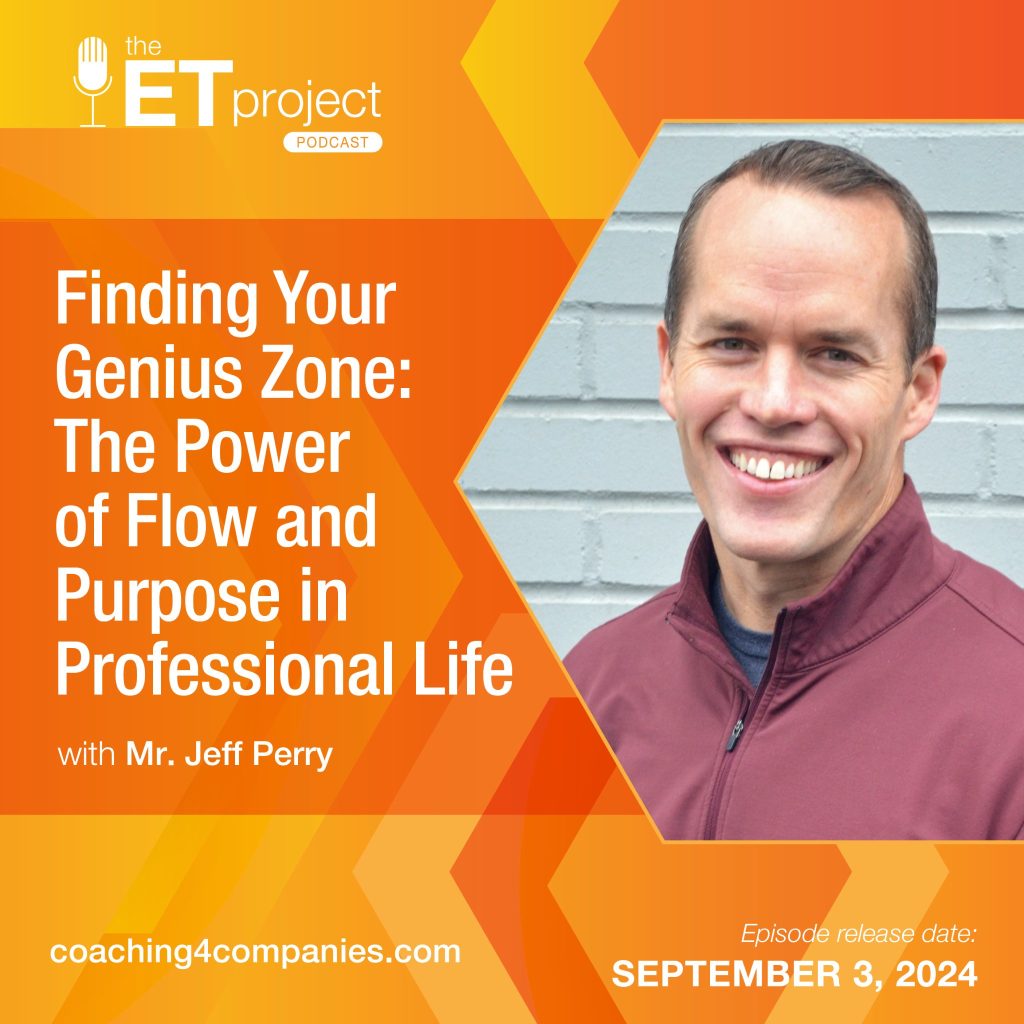
0:00:00.2 Wayne Brown: Hello, I’m your host, Wayne Brown, and welcome to the ET Project. We’re delighted to be delivering this podcast for executive talent all over the world, whom we’re affectionately referring to as Team ET. Today, we’re visiting the beautiful Pacific Northwest region of the United States and the city of Pullman, Washington, to chat with our guest, Mr. Jeff Perry. Jeff is a leadership and career expert, known for helping individuals, teams, and organizations unlock their potential in all facets of life. Given his background in engineering, business, and leadership, he specializes in working with engineering and technical professionals, but the principles he shares are universal. He loves to build people. He’s the author of the new book, The Intentional Engineer: A Guide to a Purpose-Driven Life and Career For Engineers and Technical Professionals. And the book, by the way, is the centerpiece of our discussion in today’s episode. Jeff received a Bachelor of Science in Mechanical Engineering from Brigham Young University and a Master of Business Administration from the University of Washington.
0:01:10.4 WB: A sought-after teacher and speaker, Jeff is happily married to Robin, and together they have four children. As mentioned, his obsession is in increasing productivity, innovation, and collaboration through fostering deeper human connection. As Jeff mentions, we’ve never been as technologically connected, yet more people are feeling lonely and disconnected than ever before. This causes many problems and has huge economic and health challenges for our society as well as business. Therefore, connection is the answer. So, Team ET, Jeff and I will be speaking today about a raft of leadership characteristics and skill sets as a prelude to reading Jeff’s book and going deeper on what makes great leaders.
0:01:56.5 Speaker 2: Welcome to the ET Project, a podcast for those executive talents determined to release their true potential and create an impact. Join our veteran coach and mentor, Wayne Brown, as we unpack an exciting future together.
0:02:15.4 WB: Welcome, Team ET. Today, we’ve got an assortment of core skills that we’re going to be touching on, but with a common purpose, and that is our aim to assist all of us to be better leaders, regardless of industry or present level. Let’s try some of these leadership characteristics and skill sets emphasized, just to get us started. Intentionality, networking, emotional intelligence, giving back, personal branding, risk-taking, career planning, resilience, adaptability. Sounds like we’ve got many of the ingredients for a great conversation, and I’m quietly confident that’s what we’re going to have. And we’ll unpack much of this under the guise of our guest’s book that he released back in October last year called The Intentional Engineer. So, I’m keen to jump into the conversation. Firstly, welcome, Jeff. Wonderful to have you visit us back on the ET Project.
0:03:10.4 Jeff Perry: Yeah, thanks for being with me. And so excited to jump in here, Wayne. And you really blew it open with all those different topics we can dive into. We can go deep into any one of those, but we’ll see where the conversation flows.
0:03:25.3 WB: For sure. I’m sure it’s going to be an interesting one. It’s been a while since we connected last. It’s almost two years if I look back. And it was on your podcast, which is The Engineering Career Coach. You’re still running and hosting that podcast?
0:03:41.5 JP: Yeah, so we’ve taken a little break here in the summer in terms of doing new episodes, and we’re going to revitalize it with a new focus. But, yeah, we’ve been running episodes. It typically comes out twice a month, and we’ve got hundreds of episodes out there on The Engineering Career Coach. That’s in coordination and partnership with the Engineering Management Institute that I love working with. So, yeah, I still get to be the primary host there and been up to all sorts of different things. So it was great to reconnect here. Yeah, it has been about two years.
0:04:14.2 WB: Yeah, it’s a great podcast if people haven’t tuned in The Engineering Career Coach. So I’d recommend. I noticed that you’ve also been working on your branding since we spoke last time. What have you been doing? What’s going on?
0:04:28.4 JP: Yeah, so for a lot of us who are out here in some sort of service-based business where we’re providing services to others, there are a number of different ways to go about it. But my approach over the last year, year and a half, instead of where I… When I started the business, I started with a brand name. I wanted to connect to the engineering industry. I worked with engineering and technology professionals, and I called it more than engineering for a long time, trying to expand like, hey, we’re engineers, but we’re more than that. We’re leaders, we’re people at home in our communities and different things, to expand the ways that we can identify with our identity beyond just that of what a professional life is. And so that was kind of the idea behind that.
0:05:16.3 JP: But as I’ve been leaning into things in a different way and was thinking about writing a book and then creating that, I wanted to lean in more into my personal brand of who Jeff Perry is and what Jeff Perry stands for, ’cause my messaging around what I’m standing for as time goes on might continue to shift and change. But it’s still always going to be me, right? So for a long time, I’ve been focusing on engineers. I still do that for the most part now, and engineering and technology leaders. But that could be different in the future. But Jeff Perry will always be the same person, right? So I’ve just kind of rebranded over to just Jeff Perry, jeff-perry.com and all my main stuff’s there, and then I can continue to change my messaging as time goes on. There’ll be more books and different initiatives that I do as time goes on as my interests and things change, and we run experiments and see what’s working and also where the energy and the passion flows. That just allows me to be able to pivot in a different way. I think we all do that, right? As we move through our careers, we have different roles and opportunities and things we’re considering. We all want to be able to pivot and say, hey, what’s next for me, and how do we prepare ourselves to be able to do that?
0:06:36.4 WB: Let’s dive into some of the topics, and I’m intentionally, I know we talk about intention a lot, but I’m intentionally starting with quite a broad question, right? So what are some of the common challenges that engineers in general, ’cause you focus on engineers, but people in general, I guess, what are some of the common challenges that they face in their careers?
0:07:02.6 JP: Yeah, a lot of different things, but I’ll characterize a few of them. One is so many people, and this is especially true for engineers, but it’s true for people in all sorts of industries, that there are so many things that they could do, that they’re multifaceted. They have many different skills and aptitudes and experiences that could be applied in many different areas, different types of roles, different types of companies or industries, and that’s fantastic that they can be so versatile. But for many, that also provides a sense of analysis paralysis. Like, there’s so many things I could do, but actually making a decision and choosing a direction and moving forward even one step at a time is quite an anxious endeavor for a lot of people. So getting clarity around, like, what’s important to me, what that intention is, is very difficult for a lot of people. And a lot of times they want someone else to tell them what to do, whether that’s a boss or a coworker or even a coach or something like that, to try and remove themselves from that responsibility of whatever happens, but really needing to own that responsibility and recognize that we need to move forward and get some clarity of what that intention is, of what we care about and who we’re trying to become.
0:08:30.3 JP: So that’s a difficult process for almost all of us to work through.
0:08:37.4 WB: So in your book, The Intentional Engineer, you have a lot of interesting expressions or phrases that you use in the book. One of them is Genius Zones. So could you explain that concept?
0:08:53.4 JP: Yeah. So I learned the concept of Genius Zone a few places. One of the places that I think is a great book that describes it is called The Big Leap by Gay Hendricks. But Genius Zone’s a little different from where there is an emphasis, if people are familiar with strengths, like Gallup organization, you have StrengthsFinder and stuff like that, and different things like that. And Strengths are fantastic, and I love them. But Genius Zone, we’d put it in a few different categories. There’s a zone of incompetence, like, hey, I’m not good at this. There’s a zone of competence, where for a lot of us, there are a lot of things that we do fine, like we can accomplish, we can do well, we’re competent at it. And then zone three, we’ll call a zone of excellence, like things that we are really pretty good at. But optimally, we would love to spend as much time as possible in this zone four, we call the Genius Zone. And there’s a couple different ways to look at approaching a Genius Zone. I mean, using just that word zone, I could think about people who are in the zone, maybe mostly we think about like professional athletes, like they get in this zone where like, hey, a basketball player, the basketball hoop just looks bigger, like everything seems to go in.
0:10:18.3 JP: Or a football player that they can just make any play that they need to make, and they just have this eye or this connection to the ball or whatever. Or a swimmer who is just dialed in to their stroke and everything is running fluid and everything, right? They’re in their zone. Well, no matter what our work context is, we have opportunities and times that we’re in that. And another word that is used from the research is the concept of flow, which came from research from Mihaly Csikszentmihalyi. I’m trying to pronounce that right. He passed away a couple of years ago or so. But just that state of like, there’s a challenge that we have to rise to, but our skills and our abilities have the ability to meet that challenge and it’s just hard enough that we’re not diminished by it, but that we love to rise to it. And you almost lose track of time when you’re in flow. And it’s a high state of contribution and of joy and satisfaction.
0:11:19.5 JP: So it’s a fabulous place to be for us to enjoy our work and for the value that we deliver for our employers or if we are self-employed or run a business, then for the customers and clients and people that we deliver value to. If we can operate in that Genius Zone as much as possible.
0:11:43.4 WB: I know I’d certainly like to trigger that state of flow or operate in that Genius Zone much more often than I probably do. Do you offer your clients any tips on how to get there?
0:11:56.5 JP: Yeah, so a few different things. I mean, consider it a step back like, hey, what are those activities, those environments, those situations, work or non-work related where you found yourself in a state of flow. Some people it’s hobbies. I talked to a few people like, hey, when they’re exercising or when they’re on a motorcycle and they just feel connected to the road, or for me sometimes when I’m facilitating conversations in a room or with a group of people in person or digitally sometimes, I can get in that state of flow where I can feel the energy and I can manage and change things and invite conversations. And that’s a fun state for me to be in and I get energized by that and have just a ton of fun facilitating conversations that need to be had and raising the energy in those situations. So it can happen in all sorts of different situations. So just step back and say, hey, when have I been in that state? What has been the activity, the environment is important around that, and the other elements that helped create that opportunity and that time.
0:13:14.4 JP: Another way to look at it is thinking about putting different of those strengths that you might have or things in unique combinations that might bring out some unique approaches that you take. So I think about three particular categories you can think about. One is like, do you have natural gifts? We’re all born a little bit different with natural tendencies and skills and things like that. So looking at your natural gifts, those things that you gravitated toward even when you were a little kid and continue to emerge sometimes. Second is experiences that we had, sometimes great experiences, sometimes real challenges that we face in our lives and how because of those we approach things differently, whether that’s physical or mental or family challenges, whatever, that we faced. And then third is learned skills.
0:14:13.2 JP: So just because of what you’ve learned over the course of time through education or through work experience or other things, you’ve learned all sorts of different skills. And then you can take those three categories, make big lists, and then consider trying to combine those in unique ways into like a Venn diagram, like a three-part Venn diagram and look at that intersection. Is that intersection of those things make me uniquely qualified to do particular things that maybe most people in the world don’t? And that is a Genius Zone for you, potentially, that you might want to explore more. So I mean, for you, Wayne, where you’ve got so many different leadership experience in different sorts of industries and companies and the ways that you approach building people and leadership and coaching and everything, you have a unique approach that allows you to deliver the type of work and the value that you do now in the international experiences and things that you’ve had and everything. And so some of those combinations are part of what allow you to do the great work that you’re doing now.
0:15:21.3 WB: When I was in the corporate role a couple of years back, we did a number of interventions. And one of them was using the eight random times during the day, setting an alarm on the phone and recording our state when that alarm went off. And what we found was over a period of a month or so, as we reflected back, and we recorded this, of course, as we reflected back on what we were doing, we identified the times of day and the activities we were involved in where we were most in flow. We were able to find collectively as a group, so double loop learning if you like, collectively, the best time of day for us to be doing meetings, the best time of day for us to do proactive activities, etcetera. Just out of identifying this, I like what you’re talking about. I think it’s a very powerful tool. And if people learn how to harness this, they can really maximize.
0:16:23.4 WB: We used it primarily for habit creation and routine building, but you can do so much with it, as you’re explaining. So I think that’s a great example.
0:16:33.5 JP: And we could go down deeper rabbit holes and other approaches to some of that stuff, but we could be here all day with some of that stuff.
0:16:38.4 WB: Yeah, for sure, for sure. Let’s jump across to career planning. You mentioned already about alignment and looking for alignment between work-life and finding that balance, but preferably looking at how you align those two. When you think about career, and I know you talk about this a lot with what you do, is there any suggestions you have for your clients to help them navigate their career more smoothly and make that transition? Most of us are going to change roles as leaders at least multiple times throughout our career, and this transition phase is critical. Is there anything you talk about with your clients in this regard?
0:17:26.4 JP: Stepping back and getting that clarity of intention around if you’re going to have some sort of transition or transformation, what do you want that to look like? How do you want things to be different? And what’s the area of growth? ‘Cause there is kind of a times and seasons, over the course of a year, but also I think about times and seasons of life and where priorities want to be or need to be and where we want to prioritize certain times and energy and focus as things continue to change. So stepping back and kind of looking at that big picture and being introspective of some of those things so that it helps you make determinations around the types of opportunities that you’re considering where if you’re making a career transition, you consider like, hey, what’s the work experience going to look like? Do I care right now about being in person?
0:18:32.0 JP: ‘Cause that’s what I care about hybrid remote work. That’s just one of many factors. Location, do I need to be there? Am I gonna travel a lot or a little? Do I love the travel? Do I not want to be a road warrior? What does that look like? What’s the level of responsibility and the stress I’m gonna take? The level of hours and the expectations around that. Is there a particular industry or a skill that I want to learn, right? Or a type of challenge that I wanna face where maybe I’ve been focused on maintaining existing programs and I really want to have an opportunity as I make a transition to start something brand new, whether that’s in the midst of a startup or a larger company that’s doing a new initiative or something. And I wanna have that sort of experience to round out my skillset and things.
0:19:22.0 JP: So considering what I want to learn. So all those, these are just a number of examples. We’re trying to get clarity and will you necessarily find a role and opportunity that’s gonna align with all those things perfectly? No. Probably not. It’s hard to check every single box of the ideal. But the more you can consider the different factors and where some of those might be, hey, these are non-negotiables, right? That like, have to be met if I’m gonna make a transition. And then you have another set of things that like, hey, these are nice to haves and I’d like to meet as many of those as possible. It just helps narrow the scope and the focus of where you’re putting energy, and do you need to skill up for something to make a transition like that? And that can help you consider if there’s training or educational things that you might need to dig into, or just mentoring you might need to seek out. It helps you focus and narrow, like, who are the types of people I need to be talking to, to explore this new realm that I’m unfamiliar with, but I wanna consider, right? And have some conversations there. So it really helps dial in the actions that you take as you get that clarity.
0:20:44.0 WB: Do you also work with them on values? Their core values as part of that transition?
0:20:51.1 JP: Yes. Mm-hmm. Absolutely. And I have an exercise to uncover some of those inside the book. So yeah, I mean that’s part of that alignment as well. Anything about your values and your own personal purpose. Does the company and the types of products or services you’re going to do, does that align with your own values, your own purpose, right? Because, just to use one example that’s really easy, I have some clients in the engineering industry that they really align with and love working on things like in the defense industry, right? And they align with and they find great value in creating things that protect others in that way, right? And others look at an industry like that and they say, hey, I don’t wanna make missiles that are gonna blow things or people up.
0:21:42.3 JP: It’s not how I wanna do. Now, it’s the same thing, but it’s different people and their own value systems and how they align or don’t with that, that’s an easy one to look at. But like you think about all sorts of products, some people would love to work on social media programs, other people see social media companies as terrible and they don’t want anything to do with them, right? And so everyone has their different value systems, and that’s part of for us to decide in terms of our… What our core values are and how we align with those things in different ways.
0:22:18.2 WB: Yeah. Is there any mindset, if we use that word, that we should be thinking about or we should adopt specific to career transition, career success, like Carol Dweck talks about, growth mindsets as an example.
0:22:37.2 JP: Yeah. Yeah. So Carol Dweck’s growth mindset, fantastic. I referenced it in my book. Hugely important, especially we think in a few applications. And real quick, if people are unfamiliar with the growth mindset, the opposite is what we call a fixed mindset. And all these mindsets, we’re always on some sort of spectrum. We always have some of each in all of us, right? But a fixed mindset suggests that I believe that both me and the other people around me are relatively fixed. If there’s something I’m good at, it’s just something that I’m always gonna be good at. If I’m bad at something, it’s pretty much how it’s always going to be and I believe that same thing about others, right? The growth mindset suggests that we believe that people can grow and change given effort and focus and energy, right? So just a personal example of mine. I used to have a very fixed mindset that I had natural proclivities towards Math and Science and the hard sciences, which kind of led me into engineering. I of actively avoided anything that was creative or subjective, right? It didn’t have like a right answer. And so I hated writing, I hated art and all that sorts of stuff. I’ve shifted some of those things. I write a lot now. I wrote a book. And so I’ve had to grow in that growth mindset approach to saying, Hey, I can be a writer instead of where previously I used to avoid that as much as possible, right?
0:23:56.3 JP: That’s just a personal example there. But we can also apply it in terms of like, hey, if something isn’t going right, what can I learn from that? How can I grow? Is there something that maybe I’ve been neglecting to put in the effort that I need to there instead of saying, hey, this isn’t working out, this is never gonna work out. The growth mindset suggests that I can look for opportunities to change and learn from any experience, whether it’s a success or I mean something we might deem a failure, we can grow through that.
0:24:32.9 WB: What’s the importance in career transitioning with your personal brand?
0:24:39.1 JP: The personal brand takes all those things around. Like what are your Genius Zones and your intentions and all that, and then it turns in how do you then communicate that and showcase the value to people that care? Whether that is you’re looking for a new job or opportunity within your own company, or you are a business owner and you’re communicating the types of things that you do. Whatever that is, you need to be able to take who you are and the value you deliver and communicate that to people who care and can see that value and obviously compensate you for that. And so that takes form in every form of communication, whether that’s written form, if you are a content creator, or even just like what’s on your LinkedIn profile or your resume, or those sorts of things to the conversations you have.
0:25:33.1 JP: How do you introduce yourself? How do people see you? And so I think about a personal brand, if we were to think about a Venn diagram again, and you think about one circle, just a two circle Venn diagram. One circle is who you are, and it’s like broad picture of who you are, right? And the other circle is what people know about you. And your personal brand is the intersection of that. Like what are you helping people know about you, right? And so if you’re a strong personal brand, there’s gonna be more overlap because it’s your responsibility to share about who you are with the world and the people that care, right? And if they don’t know, that’s your fault, not theirs.
0:26:22.4 WB: Yes.
0:26:23.9 JP: I talk to a lot of people who are moving through career transitions and they’re like, oh, I see so many jobs that this would be perfect for me, right? I look at all the things on the job description, whatever, like I’ve done all these things. Like this would be perfect. Yeah. But the way that you’re presenting yourself, I have no idea that that would be perfect for you, if I was a hiring manager recruiter or something, right? Because you’re doing nothing to tell me about those things, whether in your profile or your resume or how you introduce yourself and reach out to me, right? So it’s your responsibility to communicate those things so that I know, right? And does that mean it’s gonna work every time? No, but the more clearly we can share those things, obviously in a way that is relevant to the problems that other people are facing, the skills that they care about, the more likely we’re gonna be able to find that alignment across people and what we’re trying to accomplish that obviously that’s another form of alignment. I want what I’m trying to do in my career to align with whatever my company or client is trying to accomplish as well.
0:27:33.0 WB: There’s a couple of other points that I wanted to touch on before we move off the topic. I’m curious about how much self-reflection, the other part is seeking feedback, play a role for individuals during this transitional phase. So self-reflection first perhaps?
0:27:53.1 JP: So, I mean, to talk about both, I think it’s a yes/and situation. We do need both, right? So we wanna look inside for ourselves, but sometimes we get stuck on our own heads, and that’s a difficult place to be. And so it’s really nice to have those trusted friends, leaders, mentors, coaches, those people in our lives that sometimes can see things or maybe just speak things that maybe when we hear it we’re like, oh yeah, that’s true. That we might be blind to, or just not be willing to believe until someone else acknowledges that as well. And so I love that… That just opportunity to do some of that introspection and find ways to connect with ourselves, which is important because we… Like I said earlier, I think we can’t expect that someone else will just provide the answers for us, right? We need to make the decisions for our own life, our own career and take responsibility for that, right? So the introspection and the decision making, that still needs to come from us, but we can absolutely ask questions, get insights, get feedback from other people who know us, love us, trust us, and can share some things because they’ve worked with us, because they’ve lived with us, because they’ve interacted with us in some form or fashion, and we see things.
0:29:18.0 JP: And we’re… If we can ask questions and invite that feedback and invite that insights and or ask questions because of their expertise and their experiences around things, to see if that aligns with where we might wanna go. All those conversations can be hugely insightful to help us then take that into our own introspection approach to go and make decisions.
0:29:43.9 WB: If we stay with the career transitioning theme for a moment and we look to the future, we already touched on technology and the advances, but I’m wondering how you see it, coming out of that area and focusing heavily on engineering. How do you see the future in engineering and for the engineers as a profession with the changes that are occurring? How do engineers stay current? How do they prepare for that future?
0:30:10.9 JP: So no doubt, like you need to stay up with the latest technologies. They continue forward and no matter… And that’s gonna be different for every particular industry that people are in and how things are changing. The thing that I find that most people though, when we’re talking about staying current in that space, we focus so much on the technical skills, and that’s important. We need to be able to do that, right? The really practical things that need to be accomplished and the skills to be able to accomplish the work. We sometimes do that to the detriment of missing out on how we need to develop people in their capacities, right? And I think about, especially with the growth of AI and different things like that, like yeah, more and more things are going to be automated and you need to learn how to use those tools for your benefit and for your company’s benefit in all those things.
0:31:07.4 JP: But more and more of the types of technological analysis and other things are being automated or streamlined with some of these technologies where, we saw with knowledge workers and more of that knowledge is that much more easily available and not… And so our specialized knowledge isn’t as valuable as it used to be. So I think it’s that much more important to lean into the things that AI, in my personal opinion, will never take away. And that’s our ability to connect as humans, the human only types of skills and how we relate with people and we solve problems together and collaborate in those sorts of things that everyone needs to lean into those things that are never going to be able to be automated with AI because they’re still humans making decisions and relating with each other, right?
0:32:04.0 JP: And I think that’s something that isn’t being talked about nearly enough, but something that I’m trying to build out as I have this focus on building people, not things, right? We wanna build people and then the people will build the things that need to be taken care of. But as leaders, especially, our responsibility is to build the people. And they’ll take care of the things instead of focusing so much on the thing that needs to be accomplished, the task, the project, the product that we’re working on, whatever that is, let’s build the people.
0:32:37.1 WB: So true. Are there any takeaway points if we were to look at the book or we to look at what you’re doing with careers and with the people you’re coaching, any key takeaways they can leave here today with and put into action that’s going to help them?
0:32:53.1 JP: Yeah. Thanks Wayne for asking that. Like I said, if people wanna grab the book, the intentionalengineer.com, they can go find that or find it on Amazon. But, so three main takeaways that we’ll talk about. So that I feel like are foundational to… We’re focusing a lot on career transition. We’ll just stay with that theme. So one is to seek to gain awareness of mindset and where your thinking patterns are right now. There are a number of mindset assessments that you can take to and I think about those differently than like a personality assessment because they’re a snapshot of how you are now. They’re not a saying, this is your personality now and forever. Like a lot of personality assessments, just a snapshot. And help you gain awareness for where you’re at now, and then how you can shift that over time as you move through this process, right?
0:33:49.3 JP: And how you show up as a leader, how you’re gonna show up with the people that you’re interacting with and whatnot. Second is to take that time through that personal introspection and having conversations with others to seek, to get clarity of what’s your intention and who you’re trying to become. What are those things that are most important to you? Spend time in that ’cause you don’t just wanna be… Let your career happen to you and let your life happen to you. And then a few years down the road, you’d be like, what have I been doing? Just whatever others told me to do. And sometimes that works out okay, but you wanna be more intentional and deliberate about that. So get that clarity so that you can use that intentionality as a filter for the decisions that you make.
0:34:37.1 JP: And then third, is start then intentionally sharing your personal brand, both internally to your company and externally to showcase those Genius Zones and those skills and those strengths that you have in a way that you deliver value so that people can see you and find you. And sometimes then those opportunities might find you, but only because you’ve purposefully shared those things. So I find those things where people are trying to make intentional career transitions. They work on their mindset, the clarity and the personal brand. Those things provide a foundation for then all the real practical things you do to move through a career transition. But those three things are foundational and where I love to work with building people in their capacity and move through that space with intention.
0:35:25.2 WB: Where can people go to follow or engage with you?
0:35:29.0 JP: Yeah. So three things. Jeff-perry.com, the intentionalengineer.com to go check out the book. There’s also free companion digital workbook that you can get if you get the book. And by the way, anyone who’s not an engineer in the technology field, we’ve had dozens of people who have read the book and say, hey, this is applicable to all of us. So you don’t need to be scared by the engineering title if that’s not you. And the third place is find me on LinkedIn. Very active there. If you search Jeff Perry, you should be able to find me.
0:35:57.1 WB: Very nice, Jeff. Great catching up again. Hopefully it’s not another two years before we reach out to base again. Thanks for being our guest on the ET project. It’s been really enjoyable.
0:36:10.0 JP: Yeah. Thanks for having me, Wayne.
[music]
0:36:12.9 S2: Thank you for joining us on the ET Project, a show for executive talent development. Until next time, check out our site for free videos, eBooks, webinars and blogs at coaching4companies.com.