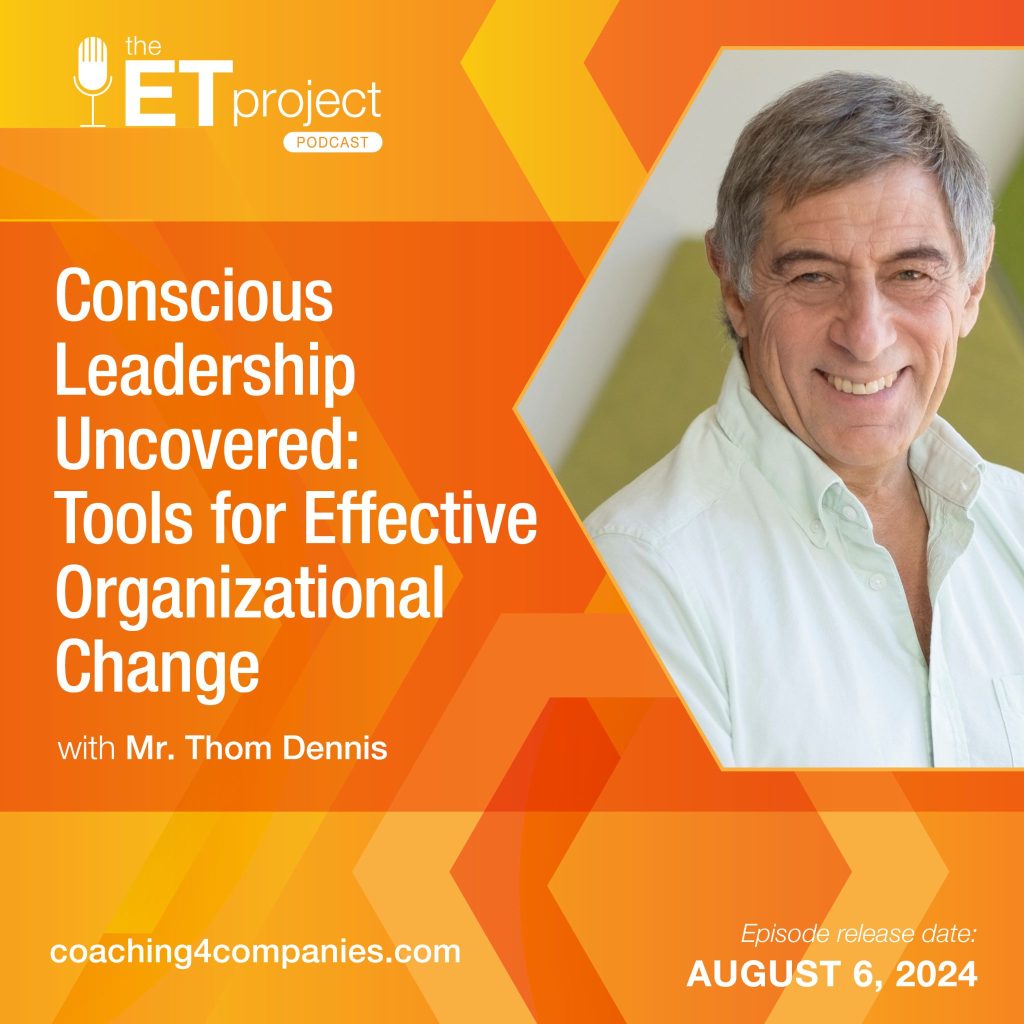
0:00:00.1 Wayne Brown: Hello, I’m your host, Wayne Brown. Welcome to the ET project. We’re delighted to be delivering this podcast for executive talent all over the world, whom we’re affectionately referring to as Team ET. Today we’re starting with a short geography lesson by visiting West Bergholt, which is in the parish of Colchester and the county of Essex in England. Can you find me on the map? And we are here to chat with Mr. Thom Dennis. Thom is a facilitator, speaker, consultant, change agent, as well as educator. And for more than 30 years, he’s led companies dedicated to bringing out the best in people through coaching, training, and increasing self-awareness by defining strategy and working through MNAs all the while improving communication. He’s been at the forefront of new thinking around conscious leadership, development and culture change, and has extensive experience in blue chip, multinational companies working in the US, emerging markets, Europe, South America, and Asia Pacific, across a variety of sectors, including energy, oil and gas, water, banking, PR, pharmaceutical, and luxury goods.
0:01:11.3 WB: Through his company, Serenity in Leadership, Thom’s specialties lie in the design and application of successful change projects and the delivery of cutting edge leadership and communication skills training. He has an innate ability to design and lead retreats and strategic planning workshops for executives, as well as transformational development workshops for individuals and senior teams using a variety of approaches that include equity and guided experiential learning and systemic constellation techniques. Naturally, we dig deeper during our conversation on what exactly these two methods are all about. So Team ET, please join Thom and me as we embark on a wide ranging discussion into conscious leadership and organizational change.
0:01:58.1 Speaker 2: Welcome to the ET project, a podcast for those executive talents determined to release their true potential and create an impact. Join our veteran coach and mentor, Wayne Brown, as we unpack an exciting future together.
0:02:11.8 WB: Hello Team ET. Welcome to today’s podcast. We’re about to explore the world of conscious leadership and organizational change. And as you know, everything in life, in leadership, particularly seems to be accelerating outta control. Globalization, technological advancements and unprecedented global challenges, all of which of course means effective leadership has never been more critical. And I’m happy to say that in our conversation today, we’re likely to delve into a whole raft of different topics, but we’re gonna look at things such as cross-cultural complexities. We’re gonna talk about psychological safe workplaces. We’ll talk about inclusion to some extent, I guess, as well as some nuances, some things that I had never heard of until I started doing a little bit of research, ready to speak today with our guest, Mr. Thom Dennis here. So Thom, welcome to the ET Project. As you can hear, we’ve got a broad scope to cover. Hope we’re up to it.
0:03:17.5 Thom Dennis: Wayne, thank you very much indeed. It’s a delight to be with you. And thank you for speaking to me. I think probably a less civilized arc for you than it is for me.
0:03:27.6 WB: What’s brought you in particular to where you are at this point in your career?
0:03:32.2 TD: I tried a number of things that didn’t quite work for me. I tried to be an airline pilot, and they threw me out when I scared the instructors too much. And then I was, in engineering. Well, I’d been brought up as an engineer, really. My father was an engineer, and I worked in his factory on the shop floor. After a number of years of working in different factories and stuff, I joined the Royal Marines and that took me 17 years on a journey of adventure and experiences. But it also put me in the front of a classroom quite a lot, and I hadn’t really expected that, but I ended up talking about leadership in all different guises. And so that sort of really informed me when I came out of the Corps in 1991, at the end of the first Gulf War.
0:04:29.8 TD: And I looked for an organization that could help me do what I’ve been doing, which I subsequently found out had a name called coaching, but nobody had sort of called it that beforehand. And then I started on series of undertakings, which took me through really different aspects of leadership and really understanding leadership from a civilian point of view as opposed to from a military point of view. Although all the services I think they would all say are very different. And so I did a master’s in essentially the psychology of change, and that really informed a model that I still use today, which is working individually, one-on-one with, it tends to be executives, working with teams and developing leadership skills in teams, and then at an organizational level helping change cultures, because cultures are really what drives an awful lot of the behavior that happens in organizations. And that really brings me up to today, I’ve specialized in some industries probably more than others, in particular banking, pharmaceuticals and energy. And that’s taken me all over the world, particularly around facilitating offsites and the key team meetings, which is a fantastic practice. And I’m so glad that if for not any other reason, the pandemic is over and people are beginning to travel and in spite of the power of Zoom and Teams and Webex and all the rest of them, getting actually people in a room together, you can’t beat it.
0:06:18.8 WB: Fully aligned with that. Your company is called Serenity in Leadership. When you use the word serenity, does it have any special meaning for you?
0:06:29.0 TD: Yes, I think it does. I think that things are moving so fast these days and leaders are having to attend to so much more, so many more different pressures, and they’re becoming much more stressed. And where can, and are they good at prioritizing? Where do they spend their time? It’s just so hard for leaders. And what they tend to forget is that there is this small voice inside. We all have it. And if you can hear it, it guides you. It leads you it helps you make really good decisions. You need a bit of quiet to hear it.
0:07:11.9 TD: So for me, serenity, if your leadership is coming from a place of serenity, the judgments you make, the decisions and the way that you see the world is much more refined and probably much more realistic. It has all sorts of benefits. I mean, I can tell you stories of rafting down the Grand Canyon and having these, some of these inspirations. But fundamentally, we don’t give ourselves the space to reflect. And if we do, it makes a big difference. Let’s try for that place of serenity.
0:07:46.6 WB: No, I love it. To be honest, Thom, I mean, we’re kindred coaches and our careers overlap to some extent in different areas. Not from the military side, but from different aspects, facilitation, education and some of the things that I read while I was doing my research around what you do, I resonate with strongly, and that explanation is part of what I liked about it. You mentioned your background started, after working a little bit in factories, you went into the military, into the Marine, 17 years. I’m wondering, did the military experience shape your approach to leadership and organizational change? Now, I know you touched on that a little bit, but if you could expand on that would be, I think, helpful. So how much did that 17 year experience really guide you when it comes to leadership and organizational change?
0:08:52.1 TD: In the Marines I met some extremely good leaders, and I met one or two rubbish ones. But I think from the really good ones, I learned a lot about leadership. I learned that really good leaders are not driven by ego at all. They tend to be very humble human beings who don’t make a big fuss of being a leader. I think sometimes the louder a leader is, the less you should trust them. I think that’s one thing. Another thing is the amount of preparation that we used to put into doing things was enormous, huge. And I remember after the Falklands conflict, good friend of mine was the brigade major who essentially it was his plan that got everybody from the ships to shore. It’s a big job. It was a super responsible one. And he said to me, you know, because we practice this so often, we had the basis of a plan. All we then did was adapt the plan to the current circumstances. Also, knowing that the moment the balloon went up, the whole plan would go to rats.
0:10:04.7 TD: But nevertheless, having that baseline and everybody knowing what their objective was, note objective rather than task, but their objective. When everything went haywire, which of course it did, people still could carry on and lead within their sort of microcosm of the whole macro situation. And I think that’s something that I’ve encountered in organizations quite a bit, is that people don’t do that. They don’t do that depth of planning. They don’t do the depth of risk management that they well should be doing.
0:10:39.3 TD: And I think, and a real example of that today is cybersecurity and how organizations go to these experts and say, Oh my God, we’ve been hacked. And the guy always says, “Well, yeah, if you’d come to me last week and talked about it, I could have helped you stop this.” But for so many leaders, it’s like, ah, that’s an expense. I’ve got other things to worry about. So, the whole sort of planning going into risk management, I think is a particular aspect, which I have a view on because of my time in the Marines.
0:11:27.9 WB: You mentioned that you’ve done your master’s in some form of change. You also have your NLP, your neurolinguistic programming master practitioner certification. How much do your qualifications or the fields, those fields of study, influence your day to day when you’re working with clients? Do they play a large role?
0:11:53.6 TD: Probably. And the reason I say that is because I’ve done loads of training in loads of different ways. And so when I go into a client, it’s like I’m carrying a large toolbox and for a particular moment I’ll bring out a particular tool, but I don’t plan that in advance by having just talked about planning. From this point of view, it’s the reverse. It’s like, I need to let the organization wash over me. Because so often when an organization says, well, that’s the problem, that’s what we want you to fix, it’s not the problem. It’s just the presenting problem. So I’m more interested in saying, Yeah, and where does that problem come from? So if we’re gonna put some resource and time and effort into this, let’s deal with the real problem, not the one that just is sort of sticking its finger out of the water or whatever. So I think that’s an important aspect, really.
0:12:56.6 WB: Right. So getting to the root cause rather than putting the band-aid and treating the symptom. Conscious leadership. I know this is one of your pet subjects, you emphasized the need for conscious leadership. What does it actually mean when we talk about conscious leadership? What do you mean by that?
0:13:19.9 TD: Well, I think in the old days we used to train leaders with certain models in mind, and it was a very structured approach. It doesn’t work anymore. As I’ve said, when I go into an organization, I want to say this very overused word, agile. But I’m trying to do a little bit of a dance to just be aware of possible inputs from wherever. And so, for me, it’s less using my head and it’s more using my heart. It’s more about feeling what’s going on. The point about being a conscious as a leader is that sense of awareness of what’s going on. It’s like our bodies are extraordinary expressors, and yet most of us spend our life completely ignoring what the body is telling us. But if I’m in a particular situation, and I don’t profess to be really good at this.
0:14:30.1 TD: It’s something that I’m always trying to develop as a skill. But what I’m trying to do is to be sensitive to the soft voices, the soft sensations which actually are trying to inform me at a deep level of what’s going on. That’s conscious leadership. At a more simplistic level, you could say, well, I come across you in the corridor and office. My whole system from millennia, from before sort of cuts in. So I have to assess you. I judge you. I make decisions about who you are and how you are, and whether we’re gonna get on just based on, at some level there’s some good information that we’re getting energetically, but some of those decisions are gonna be completely wrong. If I’m conscious, then I’m going to challenge those things.
0:15:27.3 TD: I’m gonna say, “Ah, I notice he’s got glasses. I don’t like people with glasses.” Why do I not? Because when I was 16 years old, I got filled in by a guy who had glasses. So I have this natural antipathy to people with glasses. Obviously I’m making all this up, but if I notice and say, “Ah, okay, he’s got glasses.” I noticed that I am now bringing an old belief into this. It has no relevance in this moment. So I have to override it, but I have to do it consciously. And the thing is that we are driven by so many of these biases through our conditioning, through our lives. And it really warps the way that we interrelate. And of course, that’s the basis of inclusion and diversity, which so many people are talking about. Most inclusion is being put down in most people because of unconscious biases and processes going on that have no validity in the moment. So we have to challenge them. That’s conscious leadership.
0:16:41.5 WB: I think you also talk about self-awareness. And I can see you’re leaning into that topic there with your answer. I always have one question around self-awareness. And that is, and this is just my own view, I’d be interested in yours. I see self-awareness as our starting point, like step one, that we need to become more self-aware. Where I struggle and what I talk with my clients a lot about is the awareness is fantastic.
0:17:27.0 WB: It’s a given. We must become more self-aware, but then learning to do something with the awareness is where I find a lot of people fall over. So we become extremely self-aware. I could use myself as a case study for whatever reason, we don’t take the actions to modify or to change. So we don’t regulate. What are your thoughts around that? I’m just curious.
0:17:39.0 TD: We run an online leadership program, and the first module is sort of titled Know Thyself, and the second module is Lead Thyself. And I suppose in a sense, what you are talking about now is the lead bit.
0:17:57.3 WB: Yes.
0:17:57.9 TD: So I have all this information, so what am I gonna do with it? How am I going to apply that? I think the two go very much hand in hand, but sometimes I guess one aspect of this is self-discipline. So I get all these prompts, I get all these thoughts. I get all this information. What am I gonna do with it? Do I want to do anything with it? You look at social media today with Instagram and Facebook and all these things, and people spend hours just flipping from one image to the next. You see it particularly in kids, but also in adults. Perhaps what defines an adult is the ability to say, I stop now because this is not actually my priority.
0:18:46.0 WB: You also talk a lot about psychological safety. I’ve recently done a trip through Europe and America’s delivering leadership program. I developed the program myself. So included in that program was a topic on psychological safety. I was extremely surprised how many people had no idea what that term was or meant. Is that your experience at all, or are you finding people more understanding?
0:19:17.6 TD: I think for you and I, Wayne, it’s quite easy to get sort of sucked into the communities that we dwell in, where conversations can be quite sophisticated. But if I look at an organization, somebody who’s running a department, or in the C-Suite, they have their things that they’re doing. For a lot of leaders, the whole concept of what they call, with great disdain, soft skills.
0:19:52.0 WB: Yes.
0:19:54.2 TD: Is it’s just a pain. It’s just something we have to spend money on. I don’t wanna do that. Whereas actually some of these things are supremely important, but unless they’ve been in that environment, it’s perhaps not reasonable to expect that they have heard of some of these terms. I think it’s quite possible to judge some of these people. And actually it’s not fair. They’ve just got their own focus points. I remember working with some patent attorneys in New York a few years ago. What an extraordinary group of people they were. Patent attorneys have a doctorate, a PhD in two totally different areas. One is law, another one is a kind of science. These are people who, their whole life is full with the expertise they’ve got. So if you started talking to them about psychological safety, I’m quite sure would look at you and say, Well, what planet do you come from? It’s just not in my thought process.
0:21:07.0 WB: When you’re working with clients, do you introduce the concept and if so, are there any immediate practical steps that our listeners who are predominantly leaders could take away and put into place from a psychological safety perspective?
0:21:23.2 TD: I think the first question is, do I think that I’m getting unbiased and honest input from my team, each person? I wouldn’t just make the judgment myself. I’d ask around, because if you’re not getting the full spectrum if you like, of communication from each person in your team, there isn’t psychological safety. Without psychological safety, you have low levels of trust and trust is the fundamental baseline for the good functioning of a team. So, I’d check that out. And, because I would be bringing my own biases on this, I would get input from other people, not least the team itself. You could say, well, do people feel safe to express themselves here?
0:22:27.6 TD: Now, of course they may say, Yeah, yeah, we’ll feel fine, but they don’t because you’re not actually… It takes a brave person to say, well, actually, no, I don’t think you are getting the best from us.
0:22:36.0 WB: Exactly.
0:22:38.2 TD: But that’s where you wanna get to, because when you begin to have that honest communication, then you’re getting somewhere. You need the honesty that leads to something real, something authentic.
0:22:55.4 WB: What about a couple of topics that sort of run in parallel to psychological safety and they are topical, as you mentioned a couple already, diversity and inclusion. The broader topic is social responsibility and then tagged on to diversity and inclusion. We now have equity or equality and belonging. Where do they fit for you within this whole psychological space, if you like, and trying to bring them to bear in that organization?
0:23:33.9 TD: I think inclusion is super important. And when I’m helping an organization change its culture, I will talk about inclusion because if people feel included, then the likelihood that you’re going to have a diverse group is great, greater. And where you have diversity, you’re going to have more creativity. You’re going to have more creative conflict, which you really need because you’re getting different input, from different people, from different backgrounds.
0:24:10.0 TD: So that’s really, really important, I think. And it’s without that lot, equity you can forget really. So that’s sort of on that side. And the corporate social responsibility, it’s just down to those dynamics. If you have a leader that’s encouraging that level of trust and safety, then the conversations that might come out and say, “Hey boss, let’s spend an afternoon next month and go to the local school, give our services, doing whatever it is digging a trench or painting a wall.” I don’t know, whatever. I think that organizations today really need to be challenging themselves, particularly in terms of what is their footprint on this earth. In other words, are they here just to make money or is there something deeper and more meaningful that the organization is involved in doing?
0:25:15.1 TD: And if that’s the case, what is that? I think young people coming into organizations today are much more concerned and interested in the purpose of the organization. And interviews tend, not all around the world clearly, but in a lot of places, to be much more two-way. So it’s not just about, oh, well we’ve got 10 people to interview and we’re gonna make the choice. There’s also, well, those 10 people are much more likely today to say, Well, are you the employer that I want to work with rather than work for? And so there’s this mindset, and I think a lot of leaders, particularly older ones, are finding that whole, that whole concept of challenge really quite difficult to deal with, but it’s actually very healthy. Organizations need to be thinking about their footprint.
0:26:14.9 TD: They need to be thinking about what effect their doing their business is having, and also if they’re producing products or whatever, what effect the products are having. You look at microplastics now, they’re finding microplastics in pretty much every human being on the planet. And nobody knows what the effect of that is gonna be yet. But you could say that plastics firms really need to be exploring that and doing their thing rather than burying their heads in the sand and looking at, well, how do we mitigate this? How do we reduce this? Because we have a social responsibility, not just a responsibility to shareholders to make money.
0:27:00.3 WB: I’d love to get into cross-cultural challenges and understand a little bit about your thoughts. One of the things that I see in the world today is that we have such a globalized workforce, particularly for the larger organizations, and there seems to be a huge gap with the cross-cultural intelligence of a lot of leaders. I have my own thoughts, but I’d love to hear how you see that situation.
0:27:30.9 TD: There’s the old story of, if you give a person a hammer, everything will look like a nail.
0:27:41.2 WB: Yep.
0:27:41.9 TD: I think that, for leaders who haven’t been internationally socialized, they do have this challenge quite often of judging everybody by the limited experience they’ve got of human beings. And the fact is that, and you must know this better than most, I guess, ’cause of your time in the far East and China, and people are very different and their cultures are very different.
0:28:18.7 WB: Yes.
0:28:20.1 TD: I think that what is incredibly important is to honor that. So that you are bringing a level of curiosity rather than judgment to any interaction with someone from a different culture. And as I’ve already said when I talked about meeting you in the corridor and not liking you because you wear glasses. We do have all these beliefs and limiting ideas, which actually cripple our ability to get the best out of people from all different backgrounds. And we go back to self-awareness, the whole sort of idea about really understanding what the conditioning that we bring, it’s like you could, you can only see somebody through the lenses of your conditioning and experience, and that act can be incredibly limiting. And so finding ways to drop that and to, as I said, be curious, learn about other people, learn about other different cultures, and then not to apply that learning indiscriminately, ’cause in the West, you think about the Japanese, and Japanese are always bowing and they’re all doing this, that. And the way they deal with a problem, some of that might be true, but it’s not always true. And so again, just being open, opening ourselves to difference. That’s the thing ’cause we are naturally hardwired to be scared of difference.
0:30:20.6 WB: Yes.
0:30:21.0 TD: Because we come from a tribal background. And you hear people talking in organizations, tribes, it’s great in one way and it’s very damaging in another, as the French would say, vive la différence. [chuckle]
0:30:39.0 WB: Which means?
0:30:40.1 TD: Long lived the difference.
0:30:41.3 WB: Long live the difference.
0:30:44.0 TD: Let’s honor that and be excited because somebody is different. Rather than saying, oh dear, that person’s different, therefore I can’t or won’t engage with them.
0:31:00.6 WB: Oh, I think we have a long way to go in that regard, but it does lead me into the next area that I know you’re also involved in, which is conflict mediation. This misunderstanding or the biases we carry with us often lead us down that path of then having conflict with these people. And you spoke about risk, becoming more risk adverse and understanding. I’m wondering about, is there any key pointers that you would talk with your clients about, that our listeners could benefit by? When it comes to a situation when you’re in conflict, how can we go about minimizing the damage that we’re potentially going to create? Is there anything that you normally advise people to do as a starting point?
0:32:04.0 TD: The first thing is to breathe. I think when people are in conflict and if you monitor their breathing, it’s very tight and it’s very high in the chest. So all the oxygen that needs to get down to the parts of us where some common sense might reside, isn’t happening. So actually, just taking a moment to breathe is a very good start. The next thing, again, I’ve said it before, is encouraging curiosity. If you can get people to be curious about the other side, what’s making them say this, what’s making them dig their heels in? And if you can do it to get people to just cross the room and be the other party, that can be enormously powerful.
0:32:52.9 WB: Yes.
0:32:53.7 TD: Because what we tend to do when we’re angry and defensive is we close down the ability to be empathetic to the other side.
0:33:06.9 WB: We often introduce the Thomas-Kilmann model to help people understand what their own style is. And then we have another tool that we use for managing conflict, which is the IBR approach, that interest based relational approach. I’m not sure if you’ve seen that one, but that’s very similar, step one, to what you just mentioned there. What advice would you give to an aspiring leader? Let’s say they’re just beginning their journey, maybe focus on conscious leadership and how to deal with change within their organization, any pieces of advice you would offer them?
0:33:47.9 TD: Well, I think that the greatest gift that one human being can give to another is their full presence. So if you’re a young leader and you’re responsible for some people, just practice that one. It’s so obvious when you’re on the phone and you’re doing something as well as talking to, it’s obvious. If you’re doing an email or you’re deleting one or, it’s obvious. So stop it. Put down your phone, close off the screen of the PC or whatever, and just be with that person, ’cause the amount of time that you need will be much less and you will hear them and they will feel that they are heard. And when people feel like they are heard, they will do all sorts of amazingly positive things.
0:34:43.5 WB: Very, very sound advice. Thank you, Thom. Where can people connect with you if they would like to learn more about what you’re doing or they’d like to follow you?
0:34:52.6 TD: Well, thank you, Wayne. We have the website, which is serenityinleadership.com. Please visit it. There’s stacks of blogs and links to videos and there’s all sorts of resources there. We have this leadership program going. And that’s part of the, it’s an online program, not totally suited to people where you are in that we tend to run it sort of the early evening in the UK, which makes it a little bit late for the…
0:35:27.6 WB: A little bit late. Yeah.
0:35:27.7 TD: Well, we’ve got people from the US through to Africa on the program now, which is exciting because people are so different and they bring such different ideas. And that’s what I love, so we can learn from each other. We have a YouTube channel. If you search for Serenity in Leadership or you look for Leading Responsibly with Integrity and Purpose. That’s the title of the series on there. We’re on Instagram. We’re on Twitter or X and a bit on Facebook. But I guess the biggest is LinkedIn. Look me up, link up with me. Give me your comments. Tell me what you like. Tell me what you didn’t like in what I’ve been saying. I’d love to learn. So that would be amazing. Thank you, Wayne.
0:36:29.4 WB: Yeah, great discussion, Thom. And thank you very much for being a wonderful guest on The ET project.
0:36:35.3 TD: Brilliant, Wayne. Thank you.
0:36:37.8 S2: Thank you for joining us on The ET project, a show for executive talent development. Until next time, check out our site for free videos, ebooks, webinars and blogs at coaching4companies.com.