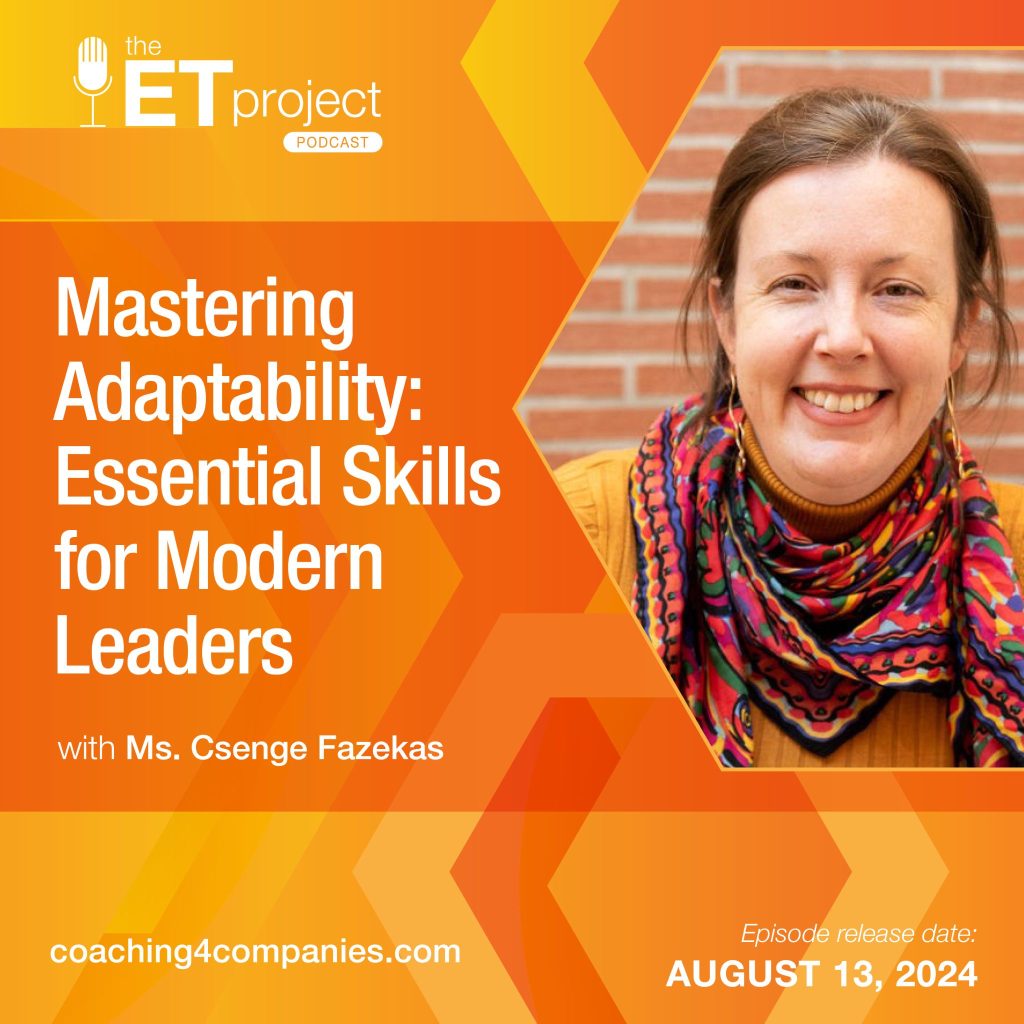
0:00:02.5 Wayne Brown: Hello, I’m your host Wayne Brown, and welcome to the ET Project. We’re delighted to be delivering this podcast for executive talent all over the world, whom we’re affectionately referring to as Team ET. Today I’m back in Madrid and chatting with our guest Ms. Csenge Fazekas, who is a freelance intercultural and skills facilitator. She specializes in intercultural training, experiential learning, facilitation, and training for youth organizations. Csenge has extensive experience in both corporate and nonprofit settings, and she’s a global DISC and growth zone licensed practitioner. She’s also fluent in English, French, Hungarian, and Spanish, and has worked with various international teams and organizations. Her educational background includes degrees in international relations and certifications in various training methodologies. In her career she’s worn many hats, from team assistant to leader, and has managed large projects across borders. Csenge grew up as a third culture child, living and working across different countries, and you’ll hear that term defined during our conversation. Csenge and I share many common ideals, including the professions of instructional design and facilitation.
0:01:19.2 WB: So, Team ET, please join Csenge and I as we discuss some of the challenges experienced through intercultural relations and delve into what she terms cultural fluency.
0:01:31.5 Speaker 2: Welcome to the ET Project, a podcast for those executive talents determined to release their true potential and create an impact. Join our veteran coach and mentor, Wayne Brown, as we unpack an exciting future together.
0:01:49.5 WB: Hello and welcome Team ET. I’m pleased that you’ve chosen to join us for another interesting conversation today, or at least I believe it’s going to be interesting. This time we’re going to be exploring our fascinating world that we live in and discussing some of the challenges we experience through intercultural relationships, and we’ll probably delve into what our guest likes to call cultural fluency. I’m quietly confident that we’re probably going to go down the path of talking about cultural diversity, global team dynamics, perhaps even taking a sideways glance at some of the likely causes to our geopolitical tensions that we’re experiencing on so many of the world fronts at the moment. And you heard me introduce our guest, but here to help us embark on this journey and unpack some of these challenges is our guest, Csenge Fazekas. It’s my Australian accent.
0:02:48.1 Csenge Fazekas: No, it’s perfect.
0:02:50.1 WB: Thank you. You’re sitting over in Madrid at the moment. Welcome, by the way, to the ET Project, but you’re sitting over in Madrid at the moment, I believe.
0:02:58.4 CF: Thank you so much for having me. Yes, I am sitting in Madrid, but I’m originally from Hungary. So this is why I have this slightly strange sounding name, unusual name.
0:03:07.5 WB: As we record this, it’ll be released later, but as we record this, last night, Spain won the UEFA European Championship against England, they defeated England 2-1. I can only imagine what the atmosphere in Spain or in Madrid at the moment is like. How are you finding it?
0:03:29.3 CF: It’s very, very hyped, I would say. Already the game experience, I’m not so much into football, but even so I always follow what’s happening because everybody else is following what’s happening. And Spanish are very expressive in their support. And they’re very vocal. So even if I’m at home, I can always hear the shouting and you know, the goal and you know, these things. And yeah, yesterday night, I was like, I was sure in the moment, but it happened that Spain won ’cause it’s just all of a sudden got very noisy and very loud and very happy around me.
0:04:05.3 WB: Well, congratulations to all my Spain friends and colleagues over there. I’m sure they’re celebrating hard. What I found interesting was that the tournament is a wonderful backdrop for our conversation today on intercultural relationships. It brings together such a diverse European mix of countries. And of course, every country has their nuances, they all have their own cultural way of dealing with things. From a professional perspective, I’m sure there was many observations from you or from your side on as you watched or listened to commentators, the media, even the teams themselves. Was there anything that stood out from an intercultural perspective as the tournament rolled on?
0:05:00.4 CF: Something that always fascinates me when I watch games is to see the difference in the nonverbal communication. Like we always see like these close ups of the coaches, like looking at their teams and how they communicate while the teams are on the field. And I find that fascinating to watch ’cause I find that in some cultures, it’s all very about the gestures. And then you can see that they are just really like waving and make all these wild hand moves and their faces look very expressive. Whereas for other cultures, like the coaches are very, very like, not necessarily calm person, but it’s much less expressive and much less facial expressions. Or they just like lead the team differently or give the instructions differently. And I always find the difference quite striking.
0:05:47.3 WB: Yeah, yeah, that’s very true. I’m really interested in watching intentional or maybe unintentional mind games that a lot of the coaches and even the media gets on board with the coaches and they play all these games in the media. It’s quite fascinating. Before we get too deep into the topic, I think you have a very rich history and backstory. I wonder if you want sharing a little bit about your journey early in life. But there was something I read, it was called Third Culture Child. And I’m fascinated to know what that means. So if you don’t mind sharing a little bit about your background and what that actually has a role in this discussion.
0:06:40.7 CF: Sure. So I work as an intercultural trainer and team development expert at the moment. And it wasn’t really a linear journey to get into the field. But yes, I did grow up as a third culture kid, which is, which basically means that I wasn’t born in the same country where I grew up in. And in my case, it even took me a very long time to realize that this made a difference because so my family’s originally from Pennsylvania, which used to belong to Hungary before the First World War, or like yeah. Before the Trianon agreement. And so it’s, it used to be a part of Hungary, it’s the same language. So when we moved to Hungary when I was four, the shift didn’t seem as big because the language was the same.
0:07:24.4 WB: Right.
0:07:25.0 CF: But somehow I always felt, ’cause of course I went to school in Hungary and then yeah. Like I was part of the system there, I guess. But I always somehow noticed that I was somehow a little different. Like even though it’s the same language and all that, there were still certain words that we used in the family that others didn’t, or there were some foods, or there were just some dynamics in my family that I didn’t really see anywhere else. And it really just shaped the way I see the world, I guess. And then, yeah, once I got into the field of intercultural training, I realized that, okay, this is really something that actually shapes someone’s journey. But I did, it wasn’t really a conscious thing until I started working as an intercultural trainer. And then of course when I was at university, I lived abroad, I lived in Belgium for a brief year, and then I got back home and I traveled a lot and I moved to Spain 10 years ago. So I’m still on this intercultural journey, but it’s also, it was an interesting discovery even for me to understand that being a third culture kid actually shaped me more than I would imagine.
0:08:28.5 WB: What sort of impact did it have on your perspective around the whole cultural diversity and how you see things, let’s say throughout your career? Do you think it had a big impact?
0:08:42.1 CF: I think it had a bigger impact than I realized because I didn’t really feel that it had an impact for a while. But I just noticed that I saw things slightly differently. I think that was, that actually was the impact that I just realized that okay, I have different perspectives on things and it was, it just felt easier for me to shift between different perspectives because of this.
0:09:03.4 WB: Okay. Right. And you speak a number of languages. I’m guessing, in the work that you do and in the countries that you’ve moved around, this has been a huge benefit for you?
0:09:18.0 CF: Yes. I speak four languages. Also, I always say because I’m Hungarian, Hungarian is not really a useful language outside of Hungary because it’s a small country, and it’s one of those magical languages that doesn’t really sound like any other language.
0:09:32.4 WB: Okay.
0:09:33.6 CF: But yes, but I did learn English, French and Spanish. And it really is an added value because I also, and I also tend to really recommend this to those clients of mine who move abroad to learn the language. Because once you actually learn the language, it also gives you a different access to a different layer of the culture. And I think that’s very enriching when it comes to cultural experiences.
0:09:56.2 WB: So I’m embarrassed to admit it, that I’ve lived or been based at least in Shanghai for almost 20 years, 19 years. And I don’t speak Mandarin. My wife is Chinese. So you would think I would, but I don’t, and I 100% agree with you. It’s my biggest regret that I didn’t put in the effort and the time to learn the language because it would’ve given me such a deeper understanding of the whole culture and the way society operate. So yeah.
0:10:36.5 CF: Even the interactions are slightly different. I noticed that a lot in Spain because, well, I don’t look Spanish obviously, so people sometimes look at me and they don’t really know what language to talk to me. And they sometimes start in English, like Spanish also very like modest about their English. They always say that they don’t speak English well, which is not always true. But then they are quite shy about this, and then they kind of start in English, and then I respond in Spanish and they’re like, oh, oh my God, you speak Spanish and your Spanish is so good. And it just totally changes the interaction and it just changes everything. So that’s why I tend to recommend.
0:11:10.9 WB: Do you have an accent?
0:11:12.7 CF: Yes, I do. I have an accent in every language I speak. I think at this point. But it also, it makes a good conversation starter, I guess.
0:11:20.6 WB: Oh, for sure. For sure. But you’re 100% correct. When people hear you, even if you can’t speak the language very well, when you make the effort to speak in that country’s language, people really endear to you. And it changes the whole dynamic in the relationships.
0:11:38.6 CF: Yeah, they also really appreciate it. Like they, if they see that you make the effort, they help you on and they really try to like make also more effort to understand you, which I think also makes things a little easier.
0:11:49.4 WB: Yeah, very true. I’m wondering if we go back to earlier in your career, the experience within the corporate world. How much did that feed in or shape your understanding around the cultural dynamics? Was it something that played a big part?
0:12:08.8 CF: Yes. I would say yes, because I always, even in my first job, I worked internationally, so I worked with different cultures and that was, and we worked remotely with them. And that was before remote work was even a thing. Like we didn’t have Zoom and Teams and all these, like we had phones and we had all these conference phones and yeah. So it wasn’t even as visual as it is. And I remember because I didn’t have a cultural preparation for this, like I had a lot of shocks, especially at the beginning where I also didn’t know my colleagues as well…
0:12:39.5 WB: Yeah.
0:12:40.8 CF: From the other countries. And sometimes the communication was just very, well, not shocking, but it was just, it didn’t really flow. And it took me a while to figure out why. So I think these experiences, they all added up to the point where I realized that, okay, like this is something, there’s something about this fear that I want to figure out more.
0:13:04.2 WB: What was the catalyst then for you to transition, so out of the corporate environment into more freelancing or running your own business and working by yourself? Was there a catalyst that really you can put your finger on?
0:13:23.5 CF: Well, I started it as a side gig at first.
0:13:25.8 WB: Okay.
0:13:26.4 CF: Because I had the idea that, oh, okay, I want to do intercultural training. And I, first, I of course, wanted also to know more about the field and just find out whether there is something to it. And then I discovered that there’s a whole field to it, which was also new for me ’cause it’s not new for my experience, but I didn’t know that there was actually a service like that. So that took some time to figure out. And of course, I also wanted to educate myself and see what tools I could use and how I could go about this whole thing. So that took some time. And then it, I kept going with this as a side gig for a while, and I think the catalyst was more, I don’t know, with like the dynamics around the pandemic and then after just to see like all the things happening in the world. At some point, I just came to the conclusion that, okay, like there will never be a perfect moment. So I either just pick a moment and go with it and see what happens or I can keep, try to drift with it, but then I will be stuck in-between sort of place for a while.
0:14:25.4 WB: Yeah. I’m just curious about, you studied intercultural relationships at university.
0:14:33.1 CF: International relations. Yes.
0:14:35.2 WB: International relations. Sorry. How much does that play a part in your activities in your career at the moment? Was it useful for building a base or what’s the relevance for that study and what you’re doing?
0:14:54.5 CF: I have to say, I got into international relations at first, ’cause while I was 18, but I had to choose it, and I had no idea what I wanted to do. And it sounded interesting. It was a little bit of everything, and then I basically just went with that and with the languages. But now that I think of it, it helps me more than I realized because it also gives me a lot of historical background, for example, of the countries. And that is something I always build into my work because a lot of the cultural differences we have also are based on historical events.
0:15:23.3 WB: Yes.
0:15:23.7 CF: And they really impact generations and they really impact a lot of the behaviors that we see. So I think from that sense, it’s definitely something very helpful. And I even remember I had a couple of communication classes or like these cultural differences classes that I always found very fascinating.
0:15:40.2 WB: Right. Yeah. It truly is quite diverse. And this was the reason for my question, and I could imagine it played plays a big part even today. You do a lot of work with, if I’m correct in my research, you do a lot of work with Erasmus, the European…
0:16:01.8 CF: Erasmus. Yeah.
0:16:03.5 WB: Yeah. Erasmus. Okay.
0:16:04.7 CF: Erasmus, yes.
0:16:06.0 WB: So this is the European Commission and their program for education, training and health. I’m really fascinated by how you are able to build a program across such a diverse mix of country. Well, how do you start off with this?
0:16:24.5 CF: So basically my story with Erasmus Plus was that I moved to Spain through an a Erasmus Plus volunteering program. ‘Cause, so Erasmus Plus has different pillars, and then one is aimed at universities. I think that’s the most well known in Europe with the student exchanges. But then I found out at some point that there was also a part of it that that helped NGOs get more help. And then it was also about like the exchange, but it’s slightly more on the, like the practical side of things. And then I went to volunteer. So I came to volunteer to Spain. And then my organization, we also, I helped them write different projects, organize youth exchanges. And I also even had some trainings as a participant when I came here, like to kind of welcome us to Spain and have like a little bit of preparation for what we can expect and these kind of things.
0:17:14.0 CF: And then I discovered that it also has a training side to the program, which is also primarily aimed at NGOs. So it’s something that NGOs can apply for different funding. They come up with different projects and so there’s a whole world to that. And then I was lucky enough to come across now also very good friend of mine, but also fellow trainer who is a member of an organization who’s very active in Erasmus Plus. And then we just had this amazing connection and we started doing trainings together. And then that’s how I got into this whole world. And then we always, because it’s all very practical, it’s all centered around non-formal education. So it’s more about practical learning and building different competencies, and really trying things out and not just focus on the theory.
0:18:00.4 CF: That always gives us a very nice open canvas to really build from different things and take different approaches. And then of course, there’s always a huge mix of culture, which are like, these are usually like five, six days training courses. And then on the second or the third day, we always have like some clashes because that’s when the team starts to come together and then all these differences come out and we need to wait for some people more to start a session and then the others get already anxious and so there’s a whole part to this as well.
0:18:31.0 WB: What were some of the challenges you’ve come across?
0:18:35.0 CF: Usually the perception of time, which is very different across cultures. I think that tends to be quite a challenge in most group settings, I would say. But even the communication. So communication in the sense that some cultures are way more direct and outspoken and what you say is what you mean. Whereas in other cultures it’s much more about keeping the group harmony and keeping, staying kind to everyone so it’s not as direct and then it can be misunderstood. So I think these are the two things that usually stand out quite a lot.
0:19:07.8 WB: You’ve lived in different countries and I’m wondering how living and working in those different countries has contributed to your approach when you talk and teach intercultural relationships.
0:19:22.0 CF: It helped me a lot, both from the sense that like, I can really empathize with the experience of my clients because I’ve been through those challenges myself.
0:19:31.6 WB: Yeah.
0:19:32.4 CF: And it also because I worked with so many different countries and then I also had flatmates from different countries and I had all kinds of life experiences with cultural diversity. That also helps me come up with like more concrete examples and it helps me explain certain concepts easier, I think.
0:19:50.1 WB: Yeah, yeah. I can imagine that. I think you made the comment somewhere that you came to the realization at some point that different, just as different countries have unique cultures, so do organizations. I found that absolutely true in reflection myself, thinking about the different countries and different cultures I’ve been engaged with in different organizations and almost to the point where every organization is somewhat unique. If you bring together people from different organizations and different countries, how do you bridge that divide? How do you start with that?
0:20:34.6 CF: Yeah, I agree with you. Every every team has its own culture. That’s why I actually tend to say, because I work with cultures in like the country sense, but then I also work with corporate teams, like culture in a sense is group behavior. And it’s basically a set of rules that the team sets out for itself. So this is why organizational culture in a way is also, yes, it’s culture because they set the rules and they set their way of functioning. And yeah, that is different across not just organizations, but even within the organizations, depending on different teams, there can be massive differences. And then, yeah, if you bring them together to like an all company thing, that could come with some challenges. But I usually like to approach this the same way as I usually do with any kind of cultural training.
0:21:22.4 CF: Like just really become aware f the differences, and have open conversations about, about this because yeah, like the thing with communication is there’s this quote that goes that, I don’t remember how exactly it was, but it’s about like there’s this perception of communication that it took place when it didn’t.
0:21:42.6 WB: Oh, right. Yeah.
0:21:43.0 CF: Because people just live in their own or like work in their own little team and they just assume that, okay, the culture they experience there must be how it is everywhere, because that’s their experience. Just openly talking about these differences can already be a good start to just understand that, oh, okay. So we’re not really dealing with the same perception. We don’t all understand the same thing. We don’t all go through the same experiences. So already opening, that could be a good start, I think.
0:22:10.5 WB: Right. You had a real-life experience yourself moving to Spain, you said about 10 years ago. Is there anything that stood out during that transition yourself that you had to adjust to or accommodate that you didn’t expect?
0:22:29.3 CF: There were quite a few small things, I would say. Like overall it didn’t feel like a very different place. But then as I started living here, there were small things that just kept coming up. Like, for example, like I remember the first time I went out to a social gathering with Spanish people. And so where I come from, like if you go out with a social group, like you just sit down at a table, usually one person talks at a time and you wait until they finish. You react, there’s one topic of conversation and it’s all very easy to follow. Whereas here in Spain, you go out with a group, it’s normally more people talking at the same time. You either interrupt or you don’t talk. There are several topics going on in parallel. So it’s a very different experience.
0:23:11.3 CF: And I remember the first time I went out with Spaniards, I was in shock. I was just sitting there looking at people trying to keep up with the conversation. I barely spoke ’cause I was waiting for my turn, which never came. And I ended up with a headache at the end of the evening. And one of my friends who was sitting next to me, she just kept asking whether I was okay because she couldn’t really interpret my silence. So it was a very different experience and this is just one of the many small things that I had to learn to adjust to.
0:23:40.7 WB: I have to ask you, in Hungary, what time do you have your evening dinner?
0:23:45.8 CF: Ooh, that’s a good question. I would normally eat at like 6:30, 7:00, I guess. And yeah, here in Spain it’s like 9:00 was the earliest.
0:23:58.1 WB: I had dinner with one of my friends and they had to apologize to the restaurant because we were so early and this was like 8:30 in the evening.
0:24:07.5 CF: Oh yeah.
0:24:08.3 WB: And I’m thinking, in China, we quite regularly sit down for dinner at 5:30 in the evening. Just one small example of cultural difference. You have this term that you refer to, cultural fluency. I’m curious to understand what that means specifically.
0:24:28.5 CF: So, basically I say that that cultural fluency is really the superpower of understanding others and our differences. It’s my term for cultural intelligence or cultural agility. There are many terms for it. But I like to call it cultural fluency because for me, it’s this closer to a concept of learning a language. That you start with certain concepts and words and then you add the grammar and then you keep building the layers. And then some concepts are harder to digest than others. And it’s also because I think it’s not a skill that is linear. I think it’s something that you just keep learning over and over again. So it’s not something that you just learn and then it’s there like similar with the language. There’s always days when you just feel that, oh yeah, I could do this and I can do whatever in this language. And then the next day it just, your brain crashes and you just don’t really know. So I feel like it’s similar to that, it’s constant trial and error, constant experimenting, because also of course we have cultural differences, but those are mostly statistical averages. Of course there are also the individual differences to it. So it’s always comes with exploration and also exploring our own preferences. So it’s something that is very dynamic and it’s very, yeah, it’s not… It’s definitely not a linear process, I would say.
0:25:43.6 WB: I fully agree. If we were to try and narrow down some of the, let’s say, essential skillset that we need as individuals to try and thrive in diverse cultural environments. So I’m sure you come across a lot of people that work in multicultural environments. Is there anything that jumps out as an essential skill that people really should be aware of?
0:26:12.3 CF: I tend to recommend not to make assumptions immediately. Because our brains are just wired that way. We have our own experiences and then our brain just learns to interpret everything through that. And then when we go to different places or go to new environments, it just jumps to conclusions for us, even without us consciously doing that.
0:26:31.2 WB: Yes.
0:26:32.0 CF: I would tend to recommend to really ask questions. I think it is like my top tip, just really like if you see something and then you’re not sure, or you even just have the slightest doubt, it’s just much better to clarify or ask back again or confirm or really just, yeah. Make it verbal, because it’s just easier to get on the same page faster than just making assumptions and then just go the wrong way all together.
0:27:02.0 WB: In your experience, how difficult is it in a classroom setting for people to really pick up on these types of skillsets?
0:27:11.8 CF: Well, I would say it’s based on my own experience, because I come from a school system where it’s very theoretical and it’s much about memorizing things and not so much about using them in practice, that I find that the schooling I had didn’t really prepare me for these kind of experiences. But also, I have to acknowledge that I’m also the kind of person that learns more from practice. So this is also something as a trainer, of course, I keep in mind when I design my courses that yeah, people learn differently, so I usually include a little bit of everything. So just to make sure that everybody can pick up the way they want to learn.
0:27:45.7 WB: Yeah.
0:27:45.9 CF: But I do think this is definitely something that is a much more practical skill and it really just requires more awareness and then just having the courage to really put it into practice because it’s so different depending on each context and each team and each culture, that it’s hard to get really a solid theoretical background for it.
0:28:09.5 WB: I’m a very pragmatic person, so that’s part of the reason I ask the question because I have to be able to put my hand on it. It has to be something that I can really simplify in my mind and put out in practice. To that point, I always go, I like to do little role plays within the conversation. So if you’re open to it, I was gonna introduce the concept of a global project team. So imagine you and I are working in a global project team. It’s a new team, it’s just been formed. We’re all relatively senior in our roles outside of the project team, and therefore we’re exposed to some local agendas and needs and expectations. And the project itself is quite ambitious. It’s got a tight deadline. It’s like most projects, and it’s going to require quite a lot of operational change for a number of countries as we conclude this project. As a result, I’m sure you can imagine there’s gonna be a lot of pushback. There’s gonna be a lot of potential challenges within the group dynamic. Based on your own experience and what you’ve seen, how would you go about getting the team to work effectively as quickly as possible? Get them all on the same page perhaps.
0:29:31.4 CF: I would definitely set aside some time just to really get to know each other better and to allow space for the team to really get to know each other. Not necessarily just the experience or the typical introductions, but also in terms of how they prefer to communicate or what are their working hours if they’re spread across, or really just to have this basic expectations and rules and preferences out in the open. So they would really know upfront that, okay, let’s say I have to do this and this and this, if I have to work with that other person so that I would know that, okay, that person prefers to, I don’t know, set up a call two days in advance or just to kind of know the dynamics already a little bit. And then of course, when they start working together, that’s, and there’s always some hiccups on the way because that’s how it works.
0:30:23.7 WB: Yes.
0:30:24.3 CF: But it helps if we already have like a reference system. I do like to do this exercise called fast teaming passport with the teams, which is basically, I just have a long questionnaire where everybody can put their preferences and then I can just put it together as like a team chart in a way that really contains all kinds of information about every team member. And then they can use this when they work together. And then it also saves some time if there’s no time to really do proper team building or really discuss these things in more in depth. That can already be a strong starting point just to avoid the initial typical misunderstandings.
0:31:01.6 WB: My own experience is it takes multiple iterations and trying to break down those barriers, and trying to get a level of comfort even for many of the cultures to feel that they can speak. I often work with a lot of leaders who are expressing frustration and getting really agitated by certain members within their team, primarily because they don’t understand their culture and the way that they approach people that they’re not comfortable or familiar with. I think it’s a really interesting dynamic in the world that we live in today where there’s so many cross-cultural global teams working on projects.
0:31:48.9 CF: Absolutely.
0:31:49.7 WB: I touched on geopolitical challenges at the very beginning as a professional in intercultural observations. Is there anything you are seeing out there in the world at the moment where it’s clearly not being helped? The situation, the geopolitical situation is not being helped, let’s say by the lack of awareness around a different culture.
0:32:17.1 CF: I think a lot of the conflicts we are seeing are really at the bottom are stemming from the lack of awareness and really all this polarity, which is just also the lack of understanding or even just realizing that there are more sides to one truth. So there’s no ultimate truth in every situation. It’s just the perspectives. And I find that this, or at least in my opinion, this is really just my personal opinion. Like I think what is really missing is be able to shift our mindsets to just see these different perspectives and not just stick to what we know and then keep sticking to that because that’s not always the ultimate truth, I would say.
0:32:57.1 WB: I have another scenario for you. This is back to our conversation around understanding self-awareness, but also understanding this global cultural differences that. Let’s say that, and this is a two-part question, but let’s say that we’re mid-level, or I’m a mid-level corporate executive. I wanna advance my career, but unfortunately locally there’s not many opportunities. And I only speak one language and I’ve never worked abroad. An opportunity happens to open up, but it means relocating overseas as an expat. What are some of the considerations that I should be thinking about in the first instance?
0:33:39.3 CF: I would certainly, like from a logistics point of view, just to know more about how the country works in terms of paperwork or finding accommodation. Of course it all depends on whether the company will take care of that part or not. But it’s still something I usually recommend just discovering a little bit because, well, we know every country works differently. The bureaucracy is painful everywhere, but it’s differently painful.
0:34:00.7 WB: Yes.
0:34:02.3 CF: Especially if you have a family to relocate, like checking the school systems or like, there are a lot of information that you can gather about the country. And I would certainly recommend that. Maybe even reading a little bit about the history. ‘Cause I think that also helps.
0:34:16.8 WB: Yeah.
0:34:17.6 CF: And then of ‘course if there’s a chance for you to get some cultural training, I would always recommend that because I just understand what culture is or how we function in cultures or just have this awareness that yes, what we are used to right now is not necessarily how things will work there. And just be aware of those value differences that can occur behind these culture differences. Communication is just one thing, but for example, uncertainty avoidance or the concept around risk or hierarchy.
0:34:54.4 WB: Yes.
0:34:54.4 CF: And whether the culture is more people focused or test focused. So there are like so many different layers that I think definitely having some kind of training around just knowing where these differences can exist is already can be very helpful.
0:35:10.7 WB: I’m in China at the moment. Let’s say I’m about to move to Germany. This is a past experience, a personal, actual experience. Where would I be able to go and find out that type of information?
0:35:25.5 CF: I would say for this, I think social media can be very helpful. ‘Cause there are a lot of groups with like expats who live in one country from another. So there are many, many groups where, which are actually very helpful to get this kind of information. There are also relocation professionals who could also help with these kind of things. Also, I tend to recommend the book, like if you’re new to the topic of cultural fluency, there is this book from Erin Meyer called The Culture Map, which I think is a very helpful first read ’cause it’s very practical and it usually goes from the, with corporate examples. So if you’re moving for work, that’s something very helpful to see how these differences manifest.
0:36:05.8 WB: Yeah.
0:36:06.1 CF: Of course, I also offer different services for people to help them prepare for these culture differences, yeah. If anybody needs those, I’m of course also happy to help with this. And yeah, it’s also worth approaching embassies ’cause sometimes they also have like some kind of database or some information where they can just at least point into some direction to find this information.
0:36:28.9 WB: Yeah. I can imagine it’s a huge source. And you just reminded me, I need to ask, are you working on anything at the moment? Is there any new projects in the pipeline? Are you thinking about writing a book yourself or what’s happening for you?
0:36:43.1 CF: I’m not really the writer type of person. I do write newsletters though. I send two a month and then I have some blog posts. So it’s, if someone wants to keep up with that, I’m always happy to have them in my world. Currently I offer corporate programs for teams which usually encompass this like cultural fluency, cognitive diversity together with psychological safety and motivation. That’s something that is always available. And then for individuals at the moment, I offer one-on-one packages, whether it’s to work better with international colleagues remotely or whether it’s to move abroad. I have different packages for each ’cause the approach is slightly different. And then in the autumn I will probably launch a group course, a bootcamp style just to understand cultural fluency better. So I always have a lot of things going on, so it’s definitely worth keeping up with.
0:37:35.4 WB: Where can people sort of follow and connect with you if they choose?
0:37:40.6 CF: So they can either find me on LinkedIn, that’s where I’m most active. It’s also Cultural Origami, my business, it has also a LinkedIn page, but also if you head over to to culturalorigami.com, then there’s all kinds of information there on everything. And also option to sign up to the newsletter. And then I also offer free consultation calls. So if anybody has any question or just unsure how to go about their cultural situation or needs, I’m always happy to jump on a call and just clear whatever questions they have up.
0:38:14.7 WB: The work that you are doing and other people in this space are doing, I think it’s so important for the future of our global cooperation, if you like. It’s really important. So thank you for that. And thank you also for being a guest on the ET Project.
0:38:31.9 CF: Thank you so much for having me, Wayne.
0:38:35.4 S2: Thank you for joining us on the ET Project, a show for executive talent development. Until next time, check out our site for free videos, eBooks, webinars and blogs at coaching4companies.com.