[music]
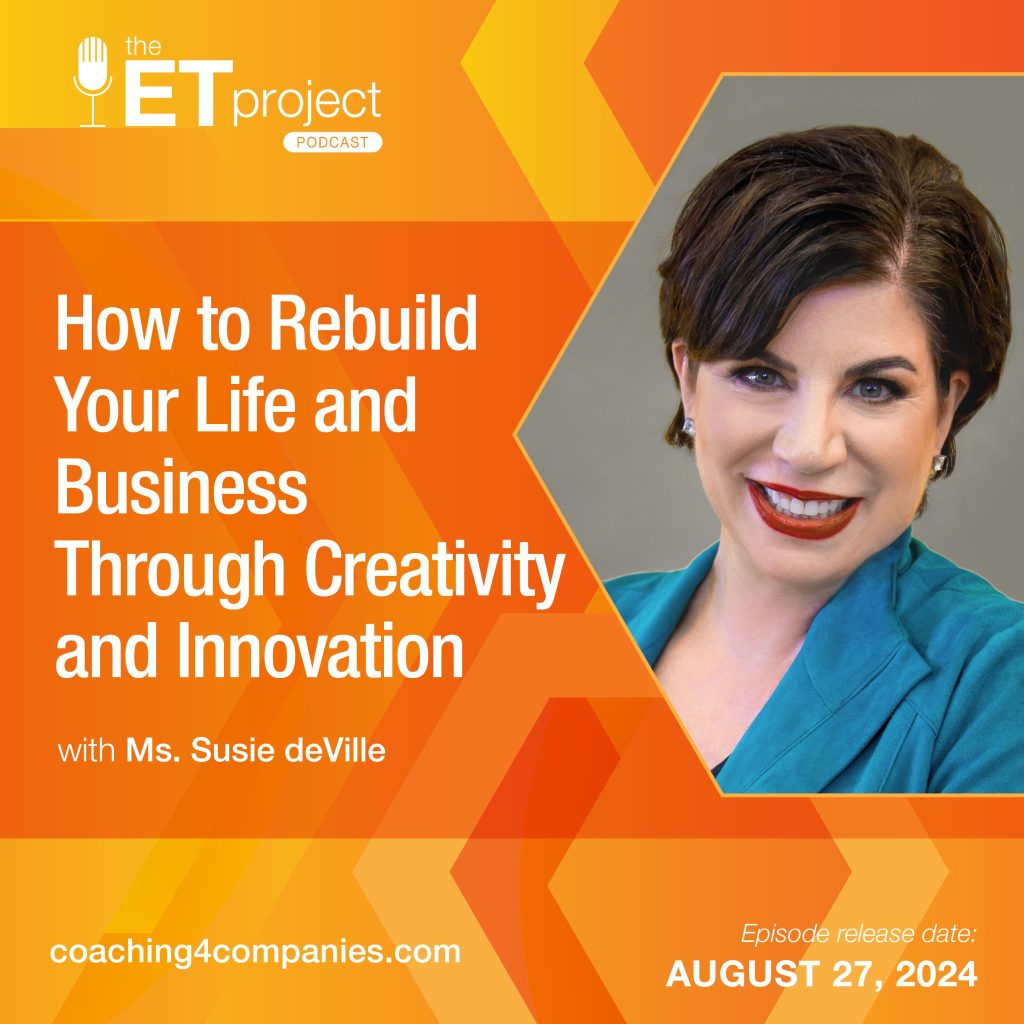
0:00:08.6 Wayne Brown: Hello, I’m your host Wayne Brown and welcome to the ET Project. We’re delighted to be delivering this podcast for executive talent all over the world whom we’re affectionately referring to as Team ET. Today we’re visiting North Carolina and the township of Highlands to chat with our guest, Ms. Susie deVille. Susie is a dynamic founder and CEO of the Innovation and Creativity Institute, a trailblazing business coach, and an accomplished artist. With over 30 years of entrepreneurial success, including the creation and sale of a highly profitable real estate firm, Susie is on a mission to empower individuals to tap into their innate creativity, discover their true selves, and unlock their full entrepreneurial potential. Susie combines a rich academic background in anthropology and a master’s degree in entrepreneurship with an ongoing commitment to lifelong learning from the world’s leading experts.
0:00:58.3 WB: Since 2005, she’s been dedicated to researching innovation and creativity, continuously refining her methods to remain at the forefront of her field. As a human behavior specialist and creative strategist, Susie leverages her expertise to help clients achieve extraordinary goals, build the life and the business of their dreams, and weave indelible threads of impact into the social fabric. Her award-winning book, ‘Buoyant: The Entrepreneur’s Guide to Becoming Wildly Successful, Creative, and Free’, is a must-read for entrepreneurs.
0:01:33.5 WB: And having read the book myself, I’m happy to endorse that statement. It’s filled with a number of wonderful exercises, and you’ll hear us speaking about some of them during our conversation. So team, if you feel your leadership journey is becoming a little overwhelming and there’s simply no way out other than putting in more hours, then listen in today, and you may well find the tunnel light starting to shine brightly once again.
0:02:00.9 Speaker 2: Welcome to the ET Project, a podcast for those executive talents determined to release their true potential and create an impact. Join our veteran coach and mentor, Wayne Brown, as we unpack an exciting future together.
0:02:14.3 WB: Hello, Team ET, welcome back. Great that you’ve joined us once again. And today, before we dive into our conversation with our guests, I wanna offer a couple of questions for you to ponder as we start to unpack this conversation. Here’s the first one. Have you ever felt stuck in your creative or entrepreneurial journey? Do you find it challenging to stay resilient and maintain a positive mindset, particularly when obstacles start to pop up and get in your way? And are you looking for practical strategies to become more innovative, more buoyant in both perhaps professional and personal lives? So if you are nodding along to any of those questions, then I’m very happy to let you know that during the next 40 minutes or so, we’re going to be exploring some of these as well as more.
0:03:11.1 WB: And to help me with this, I’m thrilled to have Ms. Susie Deville, founder of Innovation and Creativity Institute, as well as author of a highly successful book called ‘Buoyant: The Entrepreneur’s Guide to Becoming Wildly Successful, Creative and Free.’ Susie, great to have you on the show. Welcome to the ET Project and really looking forward to our conversation.
0:03:38.7 Susie DeVille: Thank you so much. I am so delighted to be here.
0:03:42.0 WB: Maybe you could share a little bit about, in particular your business background and the journey that has led you to where you are today.
0:03:48.7 SD: Yes. So I grew up in an entrepreneurial household and learned directly from my father from a very young age, all of the joys and tribulations of what being in business means. And so I was somewhat prepped long before I went out and tried this on my own. But I got into being my own boss and being really keen on being an entrepreneur when I moved back to the United States after being in London for a couple of years in the academic publishing industry. So I came back and I live in a very small town in the mountains. And so there aren’t or there weren’t at that time, certainly a lot of opportunities for professional development. So I began exploring how to become a consultant and coach as well as a leader of a non-profit organisation.
0:04:50.5 SD: So I did both of those things together. Then I got into real estate work, which I have been doing for the last 23 years, started to transfer and transform my coaching and consulting enterprise into something that was much more focused on innovation and creativity. And in the middle of all of those things, I had a personal experience that very much woke me up and shifted my focus again professionally and really helped me understand the keys to entrepreneurship in a much more positive and healthy framework, because I was definitely a subscriber to work your tail off and hope to get a nap at some point.
0:05:46.5 WB: What was the trigger? Was there a specific moment where you had that awakening?
0:05:49.0 SD: I did. And it was not a kind moment, as most transformational moments tend to be. This was when the markets crashed in 2008. And I, of course, was in the real estate industry, which was hit the hardest. The second industry that was hit the hardest was the construction industry, which my husband was in that industry. So the household had quite an upending financially, emotionally. And it turned out that this was going to be my sort of heroine’s journey going through an odyssey of trying to rebuild my life from what was completely an ash heap, because after the financial devastation and the businesses going, the marriage dissolved and my health followed suit. So I had to figure out how to extricate myself from all of these messes I was in. And I realized pretty quickly that my go-to move, which is to just work myself to a nub, was not gonna work this time. So I went on this very interesting journey to completely rebuild my life and rebuild my business from scratch.
0:07:21.6 SD: And what I found was some early sort of theories that I had learned from researching innovation and creativity several years prior to my nuclear winter period. I started to clue in that there was something in the world of innovation and creativity that was gonna help me. And so I started to pursue it more and more and test concepts out both with my own life and with the lives of my clients who are my consulting and coaching clients.
0:07:56.3 SD: And what I learned, much to my great surprise, was that the more I tapped into my innate creativity, the better I could problem solve, the better I could intuit my next step, the better I could reach the clients that I was so eager to reach. And so I began doing a very deep dive both on the research side, but then also my own personal experience being schooled and tutored in the world of sketching and painting and collage and mixed media, all kinds of different artistic expressions. And I could see that something was continuing to unlock within me and at the same time refill the well of energy for me after having been so depleted and so lost for so long that I felt like I was being reborn into a completely new energetic state.
0:09:07.9 SD: So it is… And honestly, even though I grew up in a household with art surrounding me and having so much value within the culture that I grew up in around creativity and around art, I did not consider myself an artist because I believed the lie that most of us believe, which is if I can’t make something that looks like something in the real world, then it doesn’t count as art, which of course, is absolutely nonsensical. But I bet a lot of people listening today are kind of thinking, well, I don’t know, I’m not an artist. I can’t create anything. I can tell you it is as quick as a three-minute exercise and you can learn not only, yes, that you are an artist, but that the experience of making something is profoundly and deeply transformational and healing.
0:10:16.5 WB: I was trying to make the connection, I guess, between the art and the creativity release, how you came about to using art as a mechanism.
0:10:29.3 SD: So the art that I grew up with, my father was absolutely a huge fan of all things Asian culture and art. And he was trained as a ceramic engineer and also had an MBA from Harvard. So he loved beauty and art and nature. And he also loved understanding how things work. And he loved business. And that had a huge impact on me. All of those things had a huge impact on me. And what I discovered was that this world wasn’t walled off to me. As I started to do this research, I was looking for clues that I could just bring some ideas into some consulting and coaching relationships and workshops that I was doing. But then I started to get this clue about actively doing the work of making something. Not just theoretically talking about the importance of innovation and creativity and what the keys to those things are. I suspected that there was something else about what it’s like to go through the process, because I had seen it my whole life in terms of the things that my dad created. And how much fun and how much absolute joy that he had doing these kinds of things.
0:12:14.8 SD: And so I thought, you know, maybe it’s not just an intellectual exercise. Maybe I should be learning this myself and forgetting how hung up I am on perfectionism. And this concern about making something that I’m going to hate. Or not having any “talent”. All of those worries that we have, that were kind of fed through culture and how we are exposed to the world of creativity and art throughout our lives. All of those falsehoods are so hard for us to initially disbelieve. Because it is so prevalent. And if you go into a classroom of kindergarten, first grade students, and you ask them to whoever here is an artist raise your hand, they will all raise their hands. This is how we begin. We believe in our art at the beginning. If you go into a fourth grade class and you ask the same question, you’ll probably get three or so people raise their hands. And so it’s not like 27 kids were sucked out of a classroom via a UFO, all the artists were just taken out and then replaced.
0:13:42.7 SD: It is what’s happening is the phenomenon of what Brene Brown calls creativity scars. Where we share something tender and personal that we have made, whether it’s a picture or whatever it is, and then we get the ridicule. Or the belittling somehow that making art is foolish, a time waste. You never can make a living doing this or the thing that you made is hideous. And I’ve had several experiences where that happened to me in both the classes and camps and so forth. Where I just thought, well, this is just… I’m going to stick with what I know because it’s too painful to fail at something. And so there’s lots of us. Actually, the vast majority of us have had these art shaming experiences in our lives, and I have a lot of 40 and 50 year old clients who are still scarred painfully so. So that when we start to do this work, initially it can be very emotional to go through this process, but then it becomes completely delicious.
0:15:05.8 WB: I’m visualizing that in a corporate or an entrepreneurial environment. How some of my colleagues, myself included probably at the times, would struggle with the ideas, the concepts of creative expression as a meaningful business ideal. And I guess you come across that a lot with many of the clients you engage with.
0:15:35.5 SD: And I come across it in my own brain. Because it is such a part of us. It is so in us to think, oh, I don’t have time for that today. I got stuff to do. I’m an important, hard-charging entrepreneur or a C-suite executive. And I’m not retired and I don’t have time to kill. And crafts, oh my God, are you kidding me? I don’t have time. So I get it. I so get it. And it’s so interesting that when we give ourselves five minutes to make something, and we don’t get all hung up on the outcome, there is a little pocket of energy that goes with us throughout the day that is not like anything else that we do. You can’t meditate your way there. You can’t lift weights your way there. It’s only… And those things are wonderful by the way. But there are certain things that we can access within us that propel us in ways unlike anything else that we can do, that has to do with this journey of going into this portal of the unknown, that’s riddled with uncertainty, and just seeing what happens. And we don’t do it in any other aspects of our lives, but when we have the courage to do it, what comes out of that process, is bold action and a sense of self that propels us into places that we might not otherwise have dared to trod.
0:17:23.8 WB: Is the means of how you become creative the critical aspect or isn’t taking the steps to becoming the person that allows yourself to open up to that creativity more the point?
0:17:35.8 SD: It’s really both and they both feed into each other. So I have a process that I talk about in my book called the five M’s. And it’s a series of ways for us to inspire ourselves to do different things that help us get into this state, that activates what’s known in our brain as the default mode network. Which is the home of all of our creativity that comes out of our noggins. And so the five M’s and I’ll just talk about a couple of them. But there are certain practices that you can have. One is called morning pages. Which is the brainchild of author Julia Cameron who wrote The Artist’s Way. That’s just three pages of longhand writing. The opportunity here is to just dump out everything that’s in your mind that’s distracting or causing you anxiety. Or muddying the waters of your clear thinking. The next is moments of inspired learning, this can be two minutes. And I do this every morning. I have a very easy hack for you. Just get a journal, a notebook of any kind, it does not have to be fancy. And you can look up inspirational quotes and write them in your journal. It takes you all of two minutes.
0:19:18.6 SD: But what happens is that something is unleashed when we’re in this state that is not typically a part of our morning routine. It’s an expansiveness, and it is an opportunity to feel like an electric current and connection to whomever stated this inspirational thing. And it kind of rolls around in our subconscious mind for the rest of the day. The third is, of course, making something, which is the one that everybody fights me on. But here you can just get out a post-it and a pencil and doodle, set a timer and doodle for five minutes. Give your subconscious mind a question. So if you’re stuck on, oh my gosh, I don’t know how to bridge this gap on the sales copy for my website, or I don’t know how to do this pitch for the next meeting at this big company that we’re presenting to, or give me some ideas for the family vacation, whatever it is.
0:20:30.7 SD: You can ask your subconscious to help you out, but then you can help your strategic left brain that’s always focused on going, doing [laughter], running around you can help it take a nap and you can just doodle on a piece of paper. The trick is to just keep your hands moving, and then at the end of the five minutes, flip your paper over and see what your subconscious has to say and just do some free writing for about three minutes and see what comes up. It’s kind of miraculous [laughter] and magical how it works. Our subconscious minds have so much rich material to give us. And we’re so great at ignoring it, stuffing it down, blowing it off, because we got stuff to do. Right? So this very act of moving the hands ignites creativity centers in our brain and wakes up the subconscious mind, puts the judging, grasping, logistical focus of the other part of our brain into a kind of a sleep.
0:21:46.7 SD: And then there’s some juicy things that come out of it. So if we want to enjoy wonderful change and transformation and success, it requires a decision to make a change to some of the things that we do in the morning. To get to that point, you need to have more energy than you typically do because it requires a willingness to go against your habits, and it takes a focus and an energy to just add a couple of new things in. So if you focus first before you try to create a new habit, if you focus first on, okay, I wanna bring back something that I used to do before life got busy, what was that? And schedule that. Begin to feel yourself, inspire yourself, breathe in things that bring you alive, and you do those things, this tops off your willingness and energy tanks and gives you a sense of possibility, which is the perfect state for beginning new habits. Don’t try to do a bunch of new things. Try one of the M’s and then just see how it works on you and starts to very subtly and powerfully accumulate and put you on an entirely new trajectory.
0:23:19.2 WB: Yeah. I enjoyed the five M exercise I was gonna speak to, and so I’m pleased you mention it. We might as well mention the other two M’s while we’re at it. So if I’m correct, the other one was movement and meditation, mindfulness or?
0:23:39.0 SD: Meditation and movement. And we don’t have to fall into the trap of thinking that if it’s not an hour of [laughter] meditation, it doesn’t count. Again, five minutes in a quiet room is great and is enough to reset your central nervous system if you have time for a longer session that’s fantastic. There’s all kinds of guided meditations that you can have online you can get trained in. I mean, you can take it as far as you want, but you can start very simple with nothing except for you in a dark, quiet room.
0:24:14.2 WB: There’s a area in the book where you talk about multiple passes, the approach of multiple passes. I find that’s important for me when I create something the first time, I need to be able to step back from it and then come back and revisit it, add to it, improve on it. Is that the intent behind that concept or that approach of multiple passes?
0:24:40.6 SD: Yes. And you know what’s interesting? We have kind of a different brain when we show up. So let’s say that we create a blog post, right? A 750 word blog post, and we write it on a Monday and we put it away and we come back and we have another look at it on Thursday, because Friday it goes out. Who you were on Monday, [laughter] is not who you are on Thursday. And so what’s fascinating to me, of course you’re gonna pick up language improvements and punctuation and different things that you can really flesh out and elaborate on or tighten things here. I mean, there’s all kinds of things that fall under editorial bonuses when you have multiple passes. But there’s to me the… I mean, and that’s important because as a former copy editor, [laughter], I can’t poo poo that for sure, but I do want to emphasize what I think is more interesting and more powerful and more sort of fascinating, really, is that when I come back to something at a different time from a different energetic state, having lived different hours, I will spot something in the original creation that my subconscious mind kind of took and started playing with over the last several days.
0:26:18.7 SD: And pulling it and stretching it, like you would pull and stretch a piece of taffy and sort of taking it into a new place. I’m not thinking about any of this consciously. It’s all rolling around back in the air. And so I come to the work fresh and from a new mind, and the subconscious has a whole bunch to say all of a sudden. And then I can take that and fold it in. And what’s so fascinating to me is that a lot of people who struggle to write or create anything because there’s just this block, because it’s fear-based, that it’s not gonna be any good or that it’s gonna be too painful or too hard.
0:27:03.1 SD: I want to impress upon folks that this kind of all chemical thing that I’m talking about, about having multiple passes and you come back to what you had originally created and then you’re this newly informed soul with these other experiences, even if it’s just been a few days, that feeling in your body when you show up and you start to play around with the first draft of whatever, or the first pass has such a delicious, fun, experimental, joyful, freeing feeling attached to it. You are now standing in the kitchen with your sauce pan and all of your fabulous French ingredients and you’re just playing around. I wonder if I put this in there, or if I add wine to it first before I put the other spices in, what happens? And so rather than just having a furrowed brow, somebody who’s just like I’m gonna make this sauce, [laughter] it’s not gonna be any fun for you, and it’s certainly not gonna taste great for anybody else, [laughter] because we can feel you in your work for better or for worse.
0:28:27.8 SD: And a lot of us entrepreneurs who are trying so hard to reach bigger and bigger markets, or those of us in the corporate world who are trying to scale, we forget that the biggest marketing elixir is who we truly are. And we try to white knuckle our way to success rather than having fun with something. And so these multiple passes that I talk about in the book is not only a wonderful way to improve the work, but it’s a delicious way to play more and really kind of see what the work can be. So I highly recommend it. It’s something that my publishing and editorial mentor taught me when I was going back through and editing the book with her.
0:29:23.0 WB: Yeah. You have a diagram early in the book and I don’t know if it’s labeled, but I think you refer to the diagram as part of the creative rebels forage. And it’s quite an interesting diagram. It sort of illustrates a journey, if you like, that we start with the inspired action and then we transition around and we reach this freedom and success moment. Is that the synopsis of what it is you do within the Innovation and Creativity Institute? Is that essentially the journey that you take your clients on?
0:30:04.3 SD: It is. And so much of what we have to kind of unlearn at the beginning of a process is to reclaim what it is that we love and reclaim the things that bring our energy way up and bring our sense of adventure back and embrace the notion that I don’t have to chase perfectionism and I don’t have to hide anymore because I’m so terrified of being judged, or I don’t have to work myself into a state of near delirium in order to prove to someone that I have value. So we unlearn a bunch of things at the beginning of the process, and I have a lot of clients who will come to me and they will say, I’m so excited because I know you’re the person who’s gonna help me scale my business to a million dollars. And that’s true. I do do that.
0:31:17.2 SD: But how we get there, [laughter] is not anything close to what they believe this path is gonna be. So they arrive, typically very stressed, very disconnected. They haven’t done anything fun in forever. The last vacation that they took was maybe four days around Christmas. And they’re just cranking through, barreling through their lives, and they come to me and they say I’m just so burned out. I don’t have any ideas. I just can’t quite get out of the rut that I’m in. We have great business, but I want better business and I want a better way to operate. I have lots of tension, [laughter] my relationships aren’t great. But let’s get to a million dollars. And so I can totally… And I will say to them, look, we will get there. I promise you we’ll get there, but it’s not gonna be along the route that you normally will take.
0:32:27.1 SD: And you’re going to be frustrated initially, and you’re going to be very suspicious, because I’m not going to agree with the wiring that you have, that you have to be miserable almost in order to be successful. And play is going to feel very unsettling and weird because it opens up the experience of time. And when we’re not running and doing so hard and we slow things down, well, A, not only do we have access to our subconscious and intuitive minds, but whoa, here come all the feelings that we have been ignoring and buffering and overworking our way to numb out very successfully. So that puts people on a very unstable footing initially. And it’s not long. I give people the skills and the methodology to put themselves back on a much healthier, sort of centered stable ground and also engage more in fun and play.
0:33:52.5 SD: And I have to, I assign it like home… I mean, it is literally, I call it homework, [laughter] and they have to do it, and they’re just fighting and fighting. But then they finally will do the thing and all of a sudden they show up the next coaching session as a believer because on the heel of the fun thing that they did, [laughter] came some kind of fascinating understanding, transformation, new idea, new connection. And it’s uncanny really how it works, because we fire up this magical synchronicity into our lives when we are connected to ourselves, calm and very excited about what we can create and the influence and impact that we can have in the world. And that is just a giant magnet for serendipity, for interesting connections, for your own ideas. And all of a sudden you have left this sort of feverish state of working nonstop, and now you’re in a very spacious state of wonder and curiosity. You’re still working, but you’re working at a capacity that feels hardly like the work that you used to know, but your efficacy and your impact goes up by times 10 times a 100. So the scaling part that everybody is after, they think I just gotta do more, [laughter] work harder. And I have to… My biggest job is to change that mindset to less and better, then we’re off to the races.
0:36:11.4 WB: Is there any cautionary starting point with your clients that you talk about with self-awareness? Because this is such a catchphrase today. With many coaches, with many consultants and experts, we’re all talking about self-awareness. Yours is the first book that I’ve read that flags the potential negative towards it as well. So I’m just wondering how you handle that with your clients.
0:36:43.7 SD: Sure. Well, I just… I always share what my own experience is because I tend to attract people who are very similarly wired to me. And we’re all sort of products of a similar kind of training through culture and through influences. So it’s always easy for me to say, well, let me tell you [laughter] because there is this interesting sort of two ends to the continuum where we are starting to get awareness of, I need… I wanna make some changes, right? I’m an over doer, I’m an overachiever. I don’t have any joy or fun or color in my life. Life was meant to be more, I don’t need to work myself to prove that I have value. So we start there, now, think about this propensity of that kind of training.
0:37:52.9 SD: Which is, if I do a little more certainly must be better. [laughter] And that there is some kind of ultimate outcome that looks a certain way. So if I start the self-improvement, self-help journey, and I treat it… And I don’t change the underlying mindset, then my journey to “self-awareness” self-help and transformation is going to look identical to being in the hustle and slay trying to achieve my way out of burnout old self, because I’ll take it to the same kind of nth degree as I would have with the other mindset. So that means that if I get great results six months in, then I should just do more and more and more and more. And just my whole life can be about, as I refer to in the book, bleaching out defects, [laughter] things that we perceive are defects about us, right?
0:39:09.4 SD: That we’re never whole. That it’s always around the bend, the perfect self. That that’s a worthy endeavor to try to just uplevel ourselves into like a spark of light. [laughter] We evolved to this place that we’re just this perfect little atom of energy. Well, of course that just is gonna… That is just another way to beat ourselves up. It’s a prettier package, but the underbelly of that is still a lack of self, is still a lack of intrinsic value and worth. It’s still all about self-doubt. If we’re just always looking to be better, better, better, better. Now there is a balance that we can enjoy. I wonder if I do this, I will have a different kind of an outcome or an outcome that I like more from a place of wholeness, not from a place of, I am not enough, which is what the prevalent imposter syndrome brain barks at us 24/7. That there’s not enough and you are not enough. So we have a brain that is fabulous at survival and scarcity and certainty, which is the polar opposite of the state that I’m advocating for, which is to embrace the unknown, to stay in a state of creation. And that connects us much more readily to abundance and to peace and to a state of flow.
0:41:08.6 WB: Yeah. Your book is filled with quote, filled with exercises, filled with insights, and I would really encourage all listeners to grab a copy. Where can they buy it? Just while I’m on that topic, where can they buy the book?
0:41:24.5 SD: Well, if everyone has access to Amazon, that’s the go-to place to get it. I have the book offered at a 55% discount, which is going to remain in effect for at least several weeks. So you can enjoy the audio, the ebook or the paperback. But you can go to… If other outlets carry it too. But I just know that Amazon has a special running right now.
0:42:00.4 WB: Anything you’re working on at the moment? Any new book in the pipeline? Perhaps, any new program?
0:42:07.6 SD: Yes. [laughter] I am working on my second book. And this one is really what happens after you’ve read Buoyant and have done those exercises and you’re now sort of welcoming the next part of the adventure, and this is I’m tying creativity to courage. And so I have begun writing those bits and pieces of chapters. I’ve also started a podcast that’s a very short form inspirational podcast that run anywhere from five to about eight minutes. And the name of that podcast is ‘The Courage to Live a Big Life’. And so I’m writing the content and speaking the content and putting it out there to try to see what lands for people. I’m curious where people are stuck. And so this is all going into the cauldron of my next book.
0:43:15.2 WB: Where can people go to find you and perhaps engage with you?
0:43:18.9 SD: Sure. You can go to my website, which is innovationandcreativityinstitute.com. And there you can connect with me on all the social media platforms if you like. You can sign up to receive my toolkit for entrepreneurs, which is a free download. It has all kinds of goodies in it. And also you can reach out if you would like to have a 30 minute consultation, I do those for free. And sometimes that’s enough to make a big difference and you’re off and going. Or if you wanna talk about a longer coaching engagement or participate in any of my workshops, you can do all of that from the site as well.
0:44:00.6 WB: Fantastic. Well, Susie, it’s been an absolute pleasure having you on the show. Thanks for the insights.
0:44:06.9 SD: Thank you so much for having me. I’ve loved our conversation.
[music]
0:44:11.8 S2: Thank you for joining us on the ET project, a show for executive talent development. Until next time, check out our site for free videos, eBooks, webinars and blogs at coaching4companies.com.