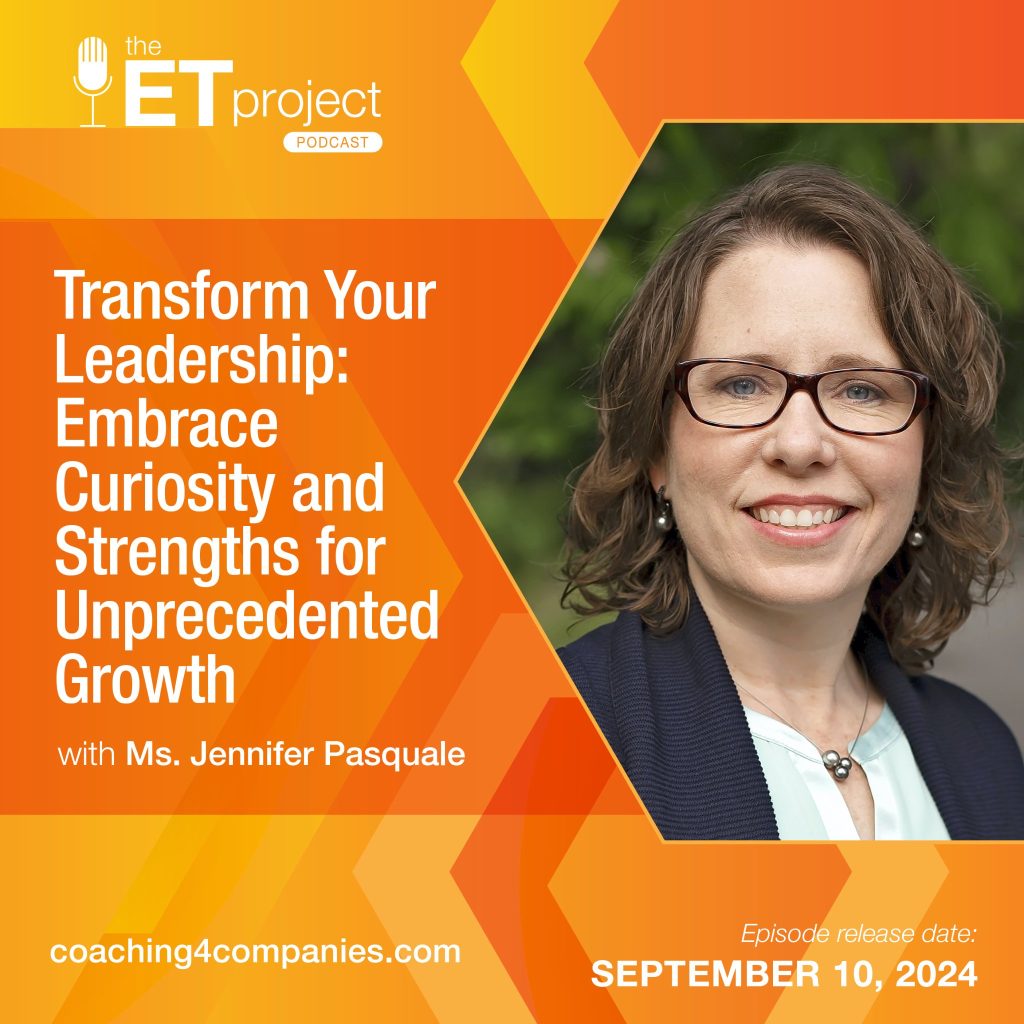
0:00:02.3 Wayne Brown: Hello, I’m your host Wayne Brown, and welcome to the ET Project. We’re delighted to be delivering this podcast for executive talent all over the world, whom we’re affectionately referring to as Team ET. Today we’re visiting Washington, DC, ahead of the presidential election in just over a month from now, and we’re here to chat with our guest, Miss Jennifer Pascual. Jen is the visionary behind Lead with Curiosity, and brings over two decades of experience working with international organizations from diverse backgrounds. As a facilitator of corporate training and development, Jen’s experience in instructional design has allowed her to help organizations of all sizes to build smart while achieving long-term success. Spending the majority of her career as a corporate trainer, facilitator, and curriculum designer has allowed Jen to support her clients in their unique goals by helping them to realize long-term success with critical initiatives.
0:01:03.9 WB: As a creative problem-solver, strategist, and analytic, Jen favors evidence-based tools like Gallup’s CliftonStrengths or Q12 Engagement Survey to provide a baseline for individual and team awareness, curiosity, and development. Her unique background makes her an alchemist of leadership and personal development, adept at creating environments where individuals feel seen, loved, and heard. Jen’s compassionate and curious approach empowers teams to thrive, leaders to excel, and organizations to flourish. So team, in our episode today, I’ll be leveraging our guest Jennifer Pascual’s expertise to explore ways that you as leaders can utilize curiosity and strength to release the full potential of yourself and your team. Ready? Let’s do this. We’re about to begin.
0:01:58.4 S?: Welcome to the ET Project, a podcast for those executive talents determined to release their true potential and create an impact. Join our veteran coach and mentor, Wayne Brown, as we unpack an exciting future together.
0:02:15.9 WB: Well, hello, Team ET, and welcome back for another week’s podcast. Today’s episode, though, is, for me at least, no just joking with our guest, it’s gonna be quite interesting. We’re gonna be looking at some of the ways that leaders can leverage two topics. One is curiosity, and the other is their Strengths in helping them to unlock, not only them, helping their team as well, unlock their potential. And as many of you will probably be aware, this is an area that I love to play around in, so I’m pretty excited to explore how curiosity and a Strengths-based approach can transform team dynamics as well as performance. And joining us today is our esteemed guest, Miss Jennifer Pascual, a team builder, facilitator, certified Strengths coach, and instructional designer. Jennifer brings a wealth of knowledge and experience in optimizing team potential through innovative strategies. So, Team ET, stay with us. I’m pretty sure we’re gonna have an inspiring conversation, and it’s probably packed with a lot of actionable insights for you. So with that, Jen, welcome to the ET Project. Fantastic having you here.
0:03:29.4 Jennifer Pascual: Looking forward to it. Thanks for having me.
0:03:34.5 WB: Well, let’s start as we typically do. Let’s start with a little bit of a background understanding of who you are, where you come from, what’s your career background?
0:03:44.9 JP: Sure. So my career background is, as you mentioned, primarily in kind of the training and development space. So I spent over about 20 years in a variety of roles under that umbrella. So I started out in corporate training very accidentally and then fell in love with that. Moved eventually into instructional design because it gave me a little bit more stability at home and some kind of flexibility with hours and loved both of those places. And then a couple of years ago, decided to really get introduced to Strengths and fell in love with it as just a tool for growth and development and decided to kind of lean back on that history in corporate training and start doing workshops for organizations and teams in that space. So that’s where I am now.
0:04:34.5 WB: Excellent. And your business is called Lead with Curiosity, if I’m correct?
0:04:37.3 JP: You are correct.
0:04:38.4 WB: What is it that you focus on within the business?
0:04:42.0 JP: Yeah. So part of the, I guess, the thought around the name, which will sort of answer your question, is really wanting to kind of frame these conversations that I’m having with organizations and with teams and with leaders around how do we foster curiosity and connection within an organization or within a team or within ourselves. And so often I think of that curiosity as a self-awareness. It can look some other ways as well.
0:05:10.8 JP: So what I see as my role is really just to help people and individuals and leaders start to think about how they’re contributing to the organization, be curious about what they bring, be curious about what they don’t, and start to understand that too so that they can better identify who they should be partnering with as they learn those talents within their team and find, you know, “Who are the people that are the best partners for me because they have some things I just don’t?” And so there’s some honesty, some reflection, and some curiosity around how we get there.
0:05:46.7 WB: I mean, we could spend the rest of the time just talking about that. That’s an interesting topic in itself. You mentioned when you were introducing some of your background, you mentioned a few roles that you fill or you filled in the past, some of which align with my own background, by the way, as we mentioned prior to hitting the record button. I thought it might be good because not everyone will be familiar with some of those terms. So I thought it might be good just to create some clarity up front with a couple of them, the first of which is instructional designer. So what the heck is that?
0:06:23.6 JP: [laughter] So instructional designer, at least the way I was sort of ushered into that space was I had been in the corporate training space, which is really just doing kind of the standup instruction for programs within organizations. And I started to want to be behind the scenes a little bit more. I had an interest. I love writing. And so me, it was a way to blend kind of that natural talent and interest in writing with being able to help set the tone and set the kind of the agenda and the approach that we take in how we develop learning. So instructional design is really about the development of the learning programs. So that was what I really did in my space, was help organizations figure out, “What do I wanna talk about? How do I need to talk about it?” And then what are the materials that need to be developed in order to get that message across?
0:07:14.8 JP: Sometimes it was like a systems implementation, right? We implement a brand-new technology, and so we need to explain what this technology does, how it’s gonna change our processes. So sometimes it’s a very kind of technical approach, but then sometimes it’s more of like a soft skills approach of, “Okay, how do we improve market share based on our sales numbers? What does the training need to provide our sales team to help them really move the ball forward?” So it can really span the gamut in terms of what kinds of skills our employees need, but it’s having a partner to help you create the training that is rooted in adult learning and rooted in… How is it really going to come across the way you need it to. That was part of my role.
0:07:58.2 WB: Right. And how much are you involved today in that area? Like, technology is starting to find its way into instructional design. Are you finding a lot of technology is changing the application or changing the way you design programs?
0:08:18.1 JP: Yeah, no, great question. I will say I have, in many ways, kind of, I wouldn’t say I moved out of the instructional design space, but the point to which I’m still touching that space is more in like developing my own workshops and not so much in what I consider the more technical. When I was doing like e-learning and developing web-based trainings, then it was all about the softwares and technologies. And that isn’t a space I’ve been kind of had my hands in as much recently. And to your point, part of it is that it changes so fast right now.
0:08:49.3 JP: And so if… You take your foot off the gas for a few years and all of a sudden, the platforms that you used to know and love have really changed how they approach the production of those programs. So now my instructional design is more about developing the perfect agenda for the objectives that we have and being able to figure out how to get my… The message across that the client that brought me in wants me to get across. How do we help that team meet the goals of that training? I’m not so much on the kind of the technical side, if you will.
0:09:21.7 WB: The other word that you used was facilitator, or I used at least, was facilitator. And I tend to clump instructional design and facilitation under the same umbrella. I know they’re very different. I use the three D analogy. I call it design, develop and deliver. Facilitator, however, is a word that has quite a broad connotation. But how do you define or what do you mean when you refer to facilitator?
0:09:53.7 JP: Yeah, I think it is a really important distinction. And I don’t know that organizations always fully kind of understand that, right? So the difference between a trainer and a facilitator is dramatic. If they are sort of skilled appropriately, it’s a very big difference. And so to me a trainer is more someone who’s going to come in and present the information they’re given. A facilitator is really about someone who’s comfortable in the gray in terms of being comfortable with wherever the discussion might go, wherever that content is gonna lead us to in terms of, “What are some of the challenges we’re gonna have with implementing this new process?” Being able to kind of almost bring like the human side, the emotion side, like be able to handle all of the things that can come up as we are presenting information versus a trainer, in my mind, really just presenting that information. Does that…
0:10:48.6 WB: Yeah, for sure. That’s clear for me. I’m sure our listeners will be happy with it. The final thing that I wanted to clarify was, I know you’re a certified Strengths coach, I know that that refers to CliftonStrengths, many people may have heard the term Strengths coach, which doesn’t necessarily relate to CliftonStrengths, so I just wanted to make that distinction as well. So you’re a certified Strengths coach through Gallup with CliftonStrengths, right?
0:11:19.3 JP: Yeah, that is correct. And so what that really means for me is, is having that additional training in that particular tool and understanding how that tool can impact an individual and impact a team. To your point, like the concept of Strengths is really about focusing on those things that we do well and trying to grow those. That can be done without that particular tool. I just find that tool to be incredibly effective in that particular goal, if you will.
0:11:49.7 WB: Perfect. I think that clears up any opportunity for misunderstanding from our listeners on what we’re going to be talking about or what your background is. I read somewhere, sticking with the CliftonStrengths for the moment, I read somewhere your top five restorative, relator, strategic, gosh, intellection and analytical.
0:12:14.0 JP: Correct, you are.
0:12:16.5 WB: I tried to memorize them. Interestingly, we share a couple of strengths in the top five. Mine are strategic, futuristic, achiever, maximizer, relator. So we have the strategic and relator in common. I know we spoke the first time we connected. How much do you feel that those top five really resonate with the person you are?
0:12:47.7 JP: No, it’s interesting. When I was exposed to CliftonStrengths, what I thought was the first time, which wasn’t the first time, which I’m happy to talk about, but I didn’t recall the first time. But the more recent time that I was exposed to it, what I found is what I find in a lot of folks I work with, which is just this really significant connection with not just the labels, but the language within the labels. So I think for me, the coach that I was working with, her advice was, “Go through your report, underline all the phrases that really just connect with you,” and you feel like, “Yeah, that is absolutely who I am.” And it was just, “Yeah, I might as well have highlighted the whole report,” right? It just felt like so much of it resonated with how I show up at work and at home and in my relationships everywhere. But it gave this language to it, which was really fun for me and really impactful, I think, because there were aspects of how I showed up that I just couldn’t quite put language to. And so to have that in front of me was, for me, it was super helpful and really validating, I guess, in terms of what my value to a team or organization might be.
0:13:57.7 WB: I have a technical question, which might not be of interest to our listeners, but I’m curious about it. So when we look at CliftonStrengths, they list 34 in total different strengths, and you have the option of doing the top five, where you can do all 34, if you do only the top five, does it change much the report that you receive about those top five versus if you do all 34 and you read the top five report?
0:14:29.8 JP: So the answer is sort of yes and no. So the questions themselves are the same. So no matter which report you’re taking, the questions are the same. It is how it’s then reported that’s different. So when you get a top five report, it is a much slimmer version. They did go through recently and make some massive updates to it that are fantastic. And it actually has some aspects of explanation that is not present in the top 34. So it actually does have some nuance to it. But then to your point, the 34 is like 26 pages. It’s lots of information. It’s a lot more depth, but it’s actually the same results just reported in two different ways.
0:15:12.7 WB: Okay. Yeah, it was just a point of curiosity for myself, because as you read through it, I can imagine if I read my report on Relator and Strategic, there may be a different response about me versus if I read yours on those two points.
0:15:30.2 JP: Yeah. So if that was your question, that is absolutely the case. What I love about how Gallup does this is when you get your top 34 report, you’ll have these kind of colored boxes that give you some language about each of those talents. And to your point, like your boxes and my boxes aren’t necessarily gonna be the same because mine is based on everything else that’s around it. Which is a different collection of talents. And so it really is a lot more customized than I think people realize it’s going to be because it’s really taking into account kind of your whole person and giving you information about how all of those talents interact with each other. The top five report has started to kind of do a version of that. They have a really nice section that kind of intersects. So it’ll tell you your strategic kind of connected to your futuristic. What could that look like? And so it gives you that phrasing. So you kind of start to see… Because none of us exist as just one thing, right? We’re all a collection of all of those talents. So what I love about the top five is it gives you that really succinct perspective on what could it look like if your strategic and futuristic kind of work together on a challenge, maybe that lands for you, maybe it doesn’t, but at least it gives you a starting point to see what those intersections could look like.
0:16:51.4 WB: Right, right, yeah. Now thanks for that clarity. I mean, that answers my question very nicely. So I’m happy with that. There’s a number of Strengths tests or assessments available in the market. Clifton have one version. VIA is another popular one, Strengths profile. There’s a whole number. And I’m wondering, are they all suitable for every application? Or, like, would I do CliftonStrengths for a particular reason or different aspect or when I’m trying to identify my Strengths?
0:17:27.7 JP: Yeah, it’s a great question. What I… I can probably only speak surfacely to the differences between them. I know a little bit about the differences. What I find tends to drive the choice is more around budget. So what is… Just a fact is that like VIA is a little bit less expensive to get the full report than if you’re getting a full report from Gallup. I think why I tend to prefer Gallup is partly because of just the robust nature of the research that went into the creation, into kind of further developing people who have taken the time and money to be in that community. There’s just so much that they pour into folks who want to use their strengths more often and really kind of cultivate those skills. And so sometimes I think that’s, to me, that’s being part of the community is also part of what people are sort of signing up for. They don’t necessarily know that. But then also I think all the resources they provide to coaches in order to help us help others really use this information is the other part that I kind of find valuable. So I think it’s like everything else. Sometimes you may get what you paid for in terms of depth and background and research and history. And so then…
0:18:42.0 JP: I think at the end of the day what I would love is for folks to just have an interest in their strengths whatever way they go about that I think is that decision that they can make.
0:18:56.4 WB: Yeah. Yeah. No, great. So let’s imagine I now know my top five strengths. What do I do with this information? How is it going to help me?
0:19:01.7 JP: Yeah. So I mean there’s lots of ways that I see it show up for people, right? So if I’m doing a workshop what I will often see is I will have someone who as in, like, I can’t think of an example recently but Harmony is one that shows up a lot. So folks will have high Harmony. And so Harmony is a talent where it and like every talent there’s this amazing part of it and this part of it that’s wonderful. And there is this what we call blind side of it or blind spot where if we’re not aware of how that could potentially look to others or how we could be held back by it then it doesn’t necessarily work for us. And so for Harmony the blind spot of Harmony is this perception that I am conflict averse or I’m not going to stand up for my team. I’m not going to kind of wade into the discomfort of a situation because I want things to stay harmonious. And so that’s a blind spot that’s important for me to be aware of. But what I find is often individuals will latch on to that as part of their identity. And what they don’t necessarily do is also see what is the inherent value of that on a team, right? So if I have someone with high Harmony on a team they are exceedingly good at making sure people are getting their needs met.
0:20:18.9 JP: They’re good at noticing when people are off. They’re good at keeping kind of the temperature of a situation down because of just how they communicate and how they think. And so there’s a huge amount of value to having someone with high harmony on a team. But I think as individuals what we often do is go to the negative side of that talent and think that’s who we are without being able to see the positive. And so part of the use is helping people really have a lens for all of it so that they can kind of leverage the best of it and have the awareness to sort of temper the parts that could hold them back through just use and intention and just… I often talk about it like yoga, like strengths is a thing that you can’t just learn and then think, “Okay, I did a three-hour workshop and I am good. I know my strengths, I can use them everywhere.” It is iterative. We have to keep practicing it in order to get really good at being intentional in a moment and saying, “Oh, in this challenge I really want to leverage my Strategic ’cause I know it’s going to help me and I’m going to leverage it in these ways.” That takes time and it takes practice. And so I think that’s the other thing that people really don’t always do.
0:21:38.1 JP: And I think that’s ’cause our lives are busy and our work is busy and finding the time for that can be challenging. But I love seeing people go from thinking that this talent they have is actually a hindrance to really starting to step into the value of it. I had someone else with communication once and her observation is she’s like, “I’ve been… My whole life I’ve been told I talk too much. And now I’m being told that my communication is my superpower. I don’t know what I think about that. I’m going to have to sit with that for a minute to really start to change my internal monologue about what my value is to this organization,” which… That to me is part of the power is to really get people to stop. And that’s the curiosity, right? Stop and think about who you really are and how you really want to show up and have some tools and language to do that.
0:22:32.9 WB: No, excellent. Okay, so I can see that. So, now if I put my leaders’ cap on, I can imagine that this is going to be quite a useful technique or set of knowledge points that I can use with my team. And probably there’s a lot of value in getting the whole team to do their own Strengths Assessment so that collectively you can sit together and you can do just as you suggested, find out the strengths of those around you and how can you cohesively bring this whole team together and release, I don’t know, its untapped potential, I guess.
0:23:14.4 JP: Yep. For sure. Well and then my favorite projects are ones where we have the time and the space and the support to be able to do exactly what you said, right? It is really combining the individual learning with the team learning. And so that would look like having everyone on the team do the assessment but then being able to meet with some individuals first, right? Helping them really start to understand their strengths, helping particularly the leader of the team understand not just what their strengths are but how those strengths show up in a leadership role. So that’s a whole learning that’s of value. And then being able to get the team together so that they can sit across from each other. And I see it all the time where you can see the light bulb that goes off where someone says, “Oh, I have really misjudged you because I thought you were asking these questions because you didn’t trust me.” Now I understand really where the root of this kind of questioning or this process is coming from. I know how to mitigate that. And now we can have a completely different kind of relationship.
0:24:22.9 JP: So it just opens people’s eyes to the tendencies that their colleagues have that because of their own biases they might have assumed it meant X and then they find out, “Oh it actually means Y, and we can actually work together but we need to focus on working together in these specific ways not in these other ways that we have been.” And so that’s the part I think it’s so valuable for teams is to just really that’s the curiosity and it’s that understanding of each other while we’re also kind of learning that about ourselves.
0:25:01.6 WB: Yeah, that’s the beauty of being a team coach as well is being able to sit back and give the team that space to really come to those light bulb moments and draw those conclusions. And if you see them struggling just say, “Hey, what did you notice that just happened?” Or, “Did you see something?” And this is a beautiful opportunity that comes out of having these types of assessments for people to really start to understand. One thing I want to say and I know you already mentioned it indirectly, but I just want to highlight Curiosity is not one of The 34 CliftonStrengths, right?
0:25:36.6 JP: No, it’s not.
0:25:37.6 WB: You mentioned self-awareness is somehow curiosity; is that how you read that term, that word?
0:25:47.8 JP: Yes and no. I think… I mean yes I think it is a piece of the work that I do for sure. But I think where I also see curiosity from a leader perspective is really about being willing to pause long enough to allow things to unfold. So as an example, as a leader, if you’ve got a challenge and you’ve got your team assembled and you’re trying to assess the challenge sometimes what leaders can do is kind of, “Here’s what I’m thinking,” instead of starting with, “What does everyone see?” And being the last person to sort of offer your perspective. There’s a level of interest and curiosity that I think exists in recognizing, “I might not have the answer. Just because I am the leader of this team doesn’t mean I have the best answer for this.” And I think the curiosity can also mean being willing to not be the person with the answer, being willing to kind of let the team come to that on their own and making the space for that kind of curiosity to develop and to build on each other. I think that’s kind of another way I see it showing up. But for me it’s really about creating some space for questions. You know it’s really getting…
0:27:01.4 JP: It’s almost like being a coach. It’s being good at questions and not so much good at statements. I think that’s where we see curiosity start to cultivate on a team is when we have a lot more questions being asked where we don’t have an agenda and we don’t have an expectation of what the answer is going to be. And we’re prepared and comfortable with just, “Whatever comes up comes up,” and then we can figure out what to do with that.
0:27:27.2 WB: I love that. I have three philosophies that I try and live by. And the first is that I try and be a curious listener. That’s essentially what you just said, I believe. And what I find is that has a major impact on exploding my assumptions and personal biases when I am in the zone to be able to just stop talking, open the floor to everyone else, and just listen and be curious in the same moment. So, yeah, I’m 100% on board with what you just said there. So thank you. I guess regardless of how we classify it I think we both agree that curiosity is one of the must-haves that we all need to have in life, right? And for leaders no exception. How does curiosity show up in leadership? Like, if we were to categorize a leader’s behavior how would we see that they’re curious?
0:28:25.2 JP: I mean I think you’re right. We’ve touched on a few things but I think the questioning is one. I think a certain level of comfort with sort of the discomfort that comes with us as a team like processing and thinking out loud and throwing out ideas and just sort of being in the messiness of decisions and being okay with that space. I think there’s… The other part of curiosity that I haven’t mentioned that I think also plays in is I think we’re in a time where we see attrition as a challenge, right? You know we certainly have trouble keeping the people that are our best people. And one of the things that we often hear is, “I want an environment where I can have a purpose. I want an environment that values me. I want an environment where my ideas matter.” There’s an engagement survey that I do with companies around these, and these are some of the questions. And so part of being curious is also I think figuring… Being comfortable with hearing the hard things. Hearing how we’re not doing it right, hearing how we are not letting your voice be heard, hearing how we’re not setting proper expectations or helping you feel valued in the organization.
0:29:42.2 JP: So sometimes that curiosity means I’ve got to be, as the leader, I’ve got to be comfortable with the discomfort of someone saying we’re getting it wrong. Not be defensive. Not present all the ways. I think we are trying to accomplish those things but just stop, pause, listen. I think those are some ways we help cultivate that curiosity as a leader on a team is make it safe for all of that curiosity to kind of come to the surface or the answers to all of those to come to the surface.
0:30:15.1 WB: Yeah, no, it’s very true. I like to associate curiosity with learning and growth mindset. In a lot of our programs we sort of make that connection. But you’re 100% correct. One of the things I see a lot in our clients when we’re talking around this area is that they may be curious and they may invite the feedback. And when the feedback doesn’t come because it’s too early in the relationship, the trust is not there and everything, they get frustrated and they lose that curiosity and they move past the opportunity. It’s one of those areas where you have to be patient as well as being curious. So it can’t just be, “I’m going to go into this meeting today, and it’s the first time that I’ve been in this group. I’m going to be curious and wait for everyone to talk with me,” because that may not happen, and then they come out frustrated. So I can imagine there’s a lot of situations that you experience in that area as well.
0:31:21.4 JP: I also think that we can’t underestimate the power of silent curiosity, right? That looks like observing what’s happening observing the dynamics. The more we start… The more we understand and have some of this strengths language for who people are the more we know, “Oh, right those are our folks that tend to be thinkers.” And so them not talking in a meeting is not necessarily them not being interested, not being engaged, not contributing. It is them processing at a rate that I don’t do, right? As someone maybe who isn’t that strategic thinker. And so sometimes there’s also, I think, curiosity in just what’s going on that isn’t being said that matters. I think the other thing I was thinking as you were talking is I was reading something recently about a kind of a study. There’s some back and forth on chicken or the egg for psychological safety or trust in an organization, right? Which comes first?
0:32:13.3 WB: Which comes first.
0:32:15.7 JP: And I think it’s a really interesting and valid question. And to your point that psychological safety is gonna matter if you really wanna cultivate a curious environment. It’s going to be hard to do that if there is no safety. And so I think leaders it is important to really be honest with yourselves about what are the things that you do as a leader to cultivate trust? What are the things that you might do as a leader unintentionally maybe somewhat driven by kind of your strengths run awry? What could that be that could kind of erode trust? And being willing to ask those hard questions so that you can really make the team better.
0:32:54.3 WB: I suggest to teams that we do our programs with that they should never go in with a target of one time and everything’s going to be perfect. It needs to be something that they practice consistently, continuously, and eventually people will start to believe that we’re genuine and that we’re authentic and wanting this environment, whatever the environment might be. So, yeah, very interesting. Digressing a little bit here from that conversation but I’m curious how much you incorporate so if you put on your instructional designer cap now and you’re looking at designing a training program. How could you build in curiosity into a training program to ensure that the end recipient, the user of the program, is stimulated to be curious? Is there anything that you practice? This is just me asking as an instructional designer now but…
0:33:54.7 JP: No. I mean I think in some ways it comes back to training versus facilitation. I think a well-facilitated session is going to have some inherent curiosity in it, because we’re going to give an opportunity for folks to talk about what is their biggest concern about implementing this new process? Where do they think this process could go off the rails? What do we think we want to be aware of? And so I think a well-facilitated session should include some of those things naturally. So I think to some extent it is the training versus facilitation answer. But I think mostly it is how do we include it in a program? We make time for the hard conversations. We ask those questions and we welcome what comes from it. It is not, “Well, we’ve already thought of that.” It’s not, “Well, we’ve already mitigated that by doing this.” It is, “Okay, we’ve told you where we are and you still have a concern about that. We need to talk… We need to think about that. We need to talk about that. We need to understand that.” And so, I think, making sure there are opportunities in any program particularly like with process changes, right? That’s where I think of it the most, right? If we’re implementing something new we know that change is hard for people. That’s just a fact.
0:35:16.5 JP: And so no matter how good of a job we’ve done to try to explain where we’re going, we have to be willing to accept that we might have missed something and someone in that room may see something we didn’t. And if not if it is weighing on them it will impact their willingness to be an advocate and a champion for what that process is. And so it is absolutely worth our time to make sure we are making the space, taking the pause to understand where everyone’s head is so that we don’t have as many surprises down the road. So I think the curiosity integration is really about questions, conversations, discussions, making all of that safe.
0:35:58.8 WB: As we look at the future and technology and the role that it’s playing it’s starting to play the role of thinking and acting for us. How relevant do you believe strengths and remaining curious is going to be in the future? Is it something we just transition and we palm off to AI and we say, “Okay, well, I don’t need to worry about my strengths anymore. I’ll just dial up ChatGPT and it can tell me what I need to be doing.”? And do you see there’s a risk, somehow, with all of what we’re doing?
0:36:36.0 JP: Yeah, no, it’s actually interesting because I was at the Gallup Summit earlier this year and at the summit they previewed a tool, an AI tool, that they’re working on within sort of the Gallup space around strengths. And so a lot of coaches had this conversation, “What does this mean for us? What is the impact?” And consistently kind of how I think a lot of coaches see it is there’s… The parts of a workshop that really have the biggest impact cannot be duplicated by technology. It just can’t. It is the human interaction. It is the light bulb going off because I’m looking in your eyes and I’m understanding you in a different way. So could AI help give me some guidance if I’m going to walk into a meeting with my boss and I know he has these top strengths? Could I leverage AI to tell me how is this information best gonna be presented to him? Absolutely. That’s where I think it becomes a great partner. But the learning that we need and the self-awareness that we need I just am not… I’m not convinced that we can replace that with AI but I think it becomes a really significant partner to helping us with that iterative process I mentioned earlier because now we have tools at our fingertips to tell us what it looks like. And how that strength could show up and how I function with my particular set of talents in an organization.
0:37:55.7 WB: Yeah, I’m on board with that as well. If you had to leave our leadership listener base with some wisdom, some words of wisdom from Jen, related to what we’re talking about, so if they were to think about leveraging their own or their team’s strengths and encouraging both to become more curious. Is there anything you would share with, well I guess you do it with your clients, but is there anything you would share with our listeners?
0:38:32.7 JP: I mean I think the thing that comes to mind is really looking at the longer game than I think we’re looking at right now. I think what often happens is we look at the short game. So it’s, “I want to do one strengths workshop and then we’re good. We’ve done some professional development, we’ve checked the box… ” And yes that can be impactful for a time. But I think what we’re seeing is that, again going back to what people want from their work where they spend the majority of their hours of their life, they want a space that they want to be in. And cultivating that kind of space takes intention, it takes time and commitment. And I think that is really the thing I would leave folks with, is consider where you can watch the long game for how you’re investing in your people, whether you’re doing it with strengths or not, but how are you investing in your people in the long-term? Because those are the things that are gonna help them feel seen and heard and valued. And we know the data is unequivocal that that is what is most likely to keep them there longer. Because sometimes we think, “Oh, well, generations have changed, nobody stays anywhere.”
0:39:52.5 JP: But if we can keep two people on our team that we might’ve lost otherwise we have now punted all those recruitment costs to two years down the road. So the more we can continue to kind of leverage the people we have now and keep them the better it usually is for the organization but we’ve got to invest in them and we’ve got to develop them in whatever way works for us. But watching the long game I think is the part that is hard right now because there is so much demand and so much on our shoulders as leaders. I get that it’s hard. Figuring out how to carve that out I think has a ton of return and is worthwhile in the end but we might have to kind of go against the brain a little right now.
0:40:29.8 WB: So, where can people head to follow the work you’re doing and connect with you?
0:40:35.9 JP: Absolutely. So I am on LinkedIn. That’s kind of my primary sort of social source, if you will. And then our website is just leadwithcuriosity.co. And so they can certainly contact me that way and ask any questions. I love to talk strengths so I could do that all day long.
0:40:56.6 WB: Great conversation Jen. Thank you so much for being a guest on the ET Project. It’s been great.
0:41:00.2 JP: Happy to be here. Thanks so much.
0:41:02.4 S?: Thank you for joining us on the ET Project a show for executive talent development. Until next time check out our site for free videos, eBooks, webinars, and blogs, at coaching4companies.com.