[music]
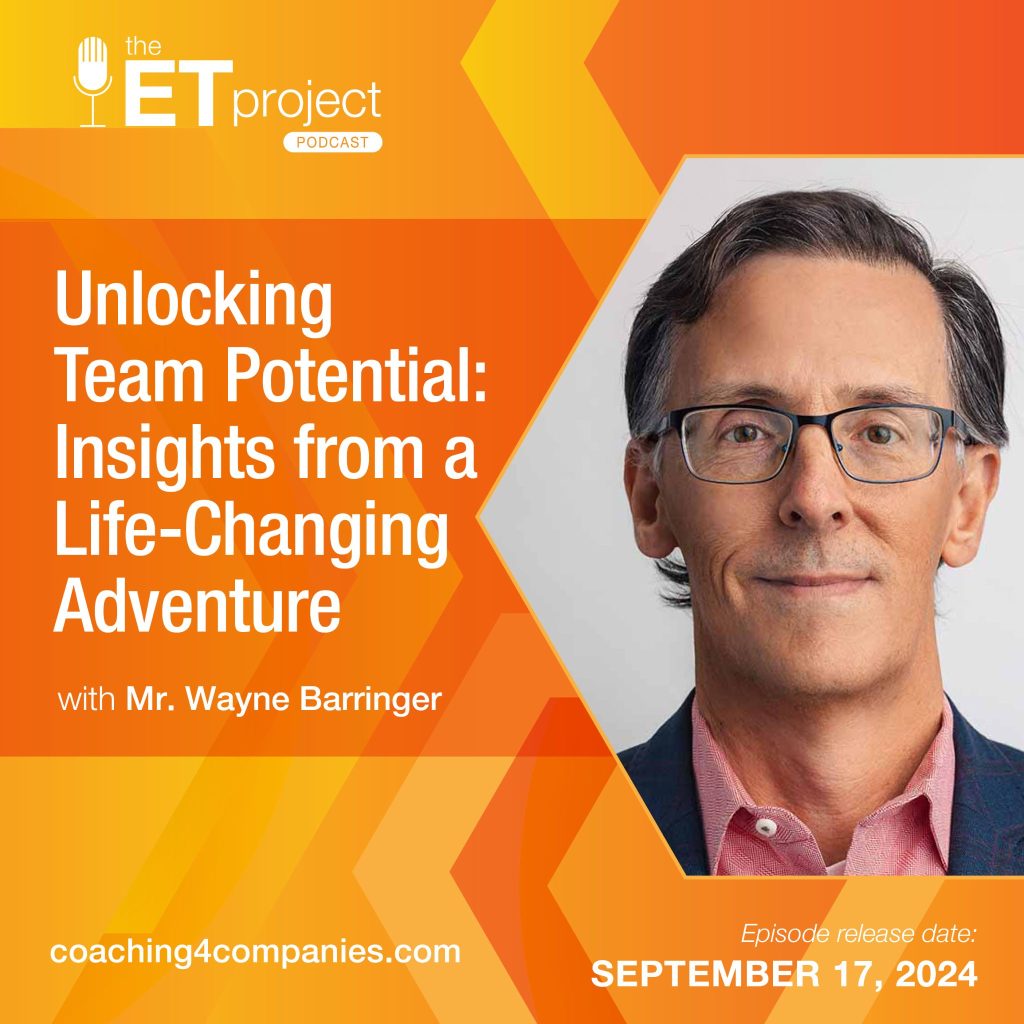
0:00:00.0 Wayne Brown: Hello, I’m your host, Wayne Brown, and welcome to the ET Project. We’re delighted to be delivering this podcast for executive talent all over the world, whom we’re affectionately referring to as Team ET. Today we’re visiting Seattle in the state of Washington and chatting with Mr. Wayne Barringer, the founder and CEO of Jaro Group.
0:00:22.9 WB: Wayne’s known for his unique approach to leadership and team dynamics, drawing from his personal experiences such as his challenging climb up the side of Mount Kilimanjaro in 2018. He uses these insights to help leaders unlock their potential and improve their team’s performance. Team ET, you’ll hear us exploring this mountaineering topic a fair bit during this conversation.
0:00:46.8 WB: Part of Wayne’s leadership philosophy centers around authenticity, resilience, and team empowerment. He emphasizes the importance of facing challenges head on and learning from them. He believes that true leadership involves being genuine, transparent, and fostering a culture where team members feel valued and motivated to contribute to their best.
0:01:08.9 WB: Empathy is another cornerstone of Wayne’s leadership philosophy. He believes that understanding and valuing the emotions and perspectives of his team members is crucial for building a strong, cohesive team. Wayne also advocates for continuous learning and adaptability, encouraging leaders to stay open to new ideas and approaches.
0:01:30.3 WB: He often highlights the significance of understanding individual strengths within a team and leveraging those strengths to achieve collective goals. So team, in this episode today, we dive into Wayne’s insights on improving organizational communication, fostering strong team dynamics, and achieving effective leadership. We hope you enjoy.
0:01:53.7 Intro: Welcome to the ET Project, a podcast for those executive talents determined to release their true potential and create an impact. Join our veteran coach and mentor, Wayne Brown, as we unpack an exciting future together.
0:02:10.7 WB: Welcome, Team ET, to today’s episode of the ET Project podcast. I’m excited to introduce our guest, Mr. Wayne Barringer. He’s the founder and the CEO of The Jaro Group. Wayne has a remarkable background in corporate communications and leadership, having transformed a 300-person creative team at Boeing, and I’m sure we’ll touch on that a little bit, as well as summiting Mount Kilimanjaro, and we’re definitely going to dive into that adventure more during our conversation.
0:02:40.3 WB: In addition, however, we’ll discuss Wayne’s insights on improving organizational communication, fostering strong team dynamics, and achieving effective leadership. So whether you’re a seasoned executive or an emerging leader, I’m pretty confident that you’re gonna find some valuable takeaways from the conversation. And with that, Wayne, let’s get started. Welcome to the show.
0:03:05.7 Mr. Wayne Barringer: I do a few of these podcasts, and I’m not sure I got an introduction quite like that, Wayne [laughter] That’s very nice and I appreciate that. And it is great to be here with you.
0:03:14.9 WB: Yeah, thank you. And you’re sitting over in Seattle, I believe. How is Seattle at the moment?
0:03:20.3 MB: Seattle’s beautiful. The summertime here is paradise, and we just love it. So it’s really nice.
0:03:29.4 WB: I’ve spent some time in there, more so in Redmond with Microsoft. In my corporate life, we partnered with Microsoft on different things, but one of them was the HoloLens. So I got to experience Seattle, so I can take that off my bucket list, but very nice location.
0:03:47.4 MB: As long as you’re here between June and September, it’s fantastic. Otherwise, you have to take what nature brings. Which the advantage is we’ve got trees and lakes and rivers that you don’t always have elsewhere, so we love it.
0:04:03.2 WB: Yeah, it’s some beautiful territory up around that area as well. So, let’s get started with the company and the story behind the name, The Jaro Group. What inspired the whole thing?
0:04:18.5 MB: Yeah, well, I’ve been in marketing and advertising, as you mentioned, my whole career and had an opportunity at Boeing to take a team that was really lost and needed some help to get itself righted. And we wanted to be able to do that. When I started, the employee satisfaction was 52%. When I left, it was 90%. A great team helped do that. But in the middle of that experience, I had an opportunity to climb Mount Kilimanjaro. And that was a transformational experience on a number of levels. Obviously, physically, it’s fantastic. But also from a leadership mindset perspective, there was a moment on that mountain where I turned to a friend and said, wow, “We have over trained for this. I feel really great.”
0:05:21.1 MB: 20 minutes later, I stepped off the trail to get a drink and refill my water, and I almost blacked out, 20 minutes later. I just got very disoriented, the vision became blurry, all the things that happen in altitude and fatigue and all that. Just then, the head guide of our trip showed up seemingly out of nowhere. I was like, “It’s time for me to turn around and go back, I can’t do this.” And he showed up and he took my backpack and put it on his back. And he said, “Wayne, just follow my footsteps and we’ll get you to the next camp. You’re not turning around and we’re gonna do it.” And three days later, I was at the top of the tallest mountain on the continent of Africa.
0:06:10.5 MB: So, we’ll get into all the nuances of that, but that’s why I named the company, The Jaro Group after I left Boeing in 2020.
0:06:20.3 WB: Yeah, fantastic. We’ll definitely dive deeper into that. As you mentioned, there’s so many parallels, not just for companies, but for us in our life in general, I can imagine, but particularly from a change and a mindset perspective…
0:06:36.1 WB: I can only imagine it’s transformational. I never achieved one of my bucket list items, which was to get to the base camp for Everest. I had some issues arise just as we were about to take off, unfortunately.
0:06:53.0 WB: But I can imagine that there’s so much preparation that must go into it. Maybe a little bit of background on Kilimanjaro itself. So you mentioned it’s in Africa.
0:07:04.5 WB: We’re about to get to it’s in Africa.
0:07:06.7 MB: Yeah, so it’s in the country of Tanzania. It’s very close to the equator so geographically, it’s very close to the equator. So the weather is relatively moderate. But the nearest big city, if you could call it that in Tanzania, is a town called Arusha.
0:07:28.4 MB: And there’s an international airport there. You can fly right there. It’s about 45 minutes to town.
0:07:33.3 MB: And then it’s about an hour to the trail.
0:07:38.3 WB: How high is the mountain roughly?
0:07:39.3 MB: Yeah, so it’s about 19,310 feet or so. It’s the tallest mountain on the African continent.
0:07:48.4 MB: Yeah, you’re probably doing the meters calculation. I should have done that first. It’s probably, well, it’s 6,000 meters or something like that. And so it’s not like Everest where it’s the depth zone, as they call it. Right up above 24,000 feet, I think, is that place where you really can’t do it very without oxygen. Kilimanjaro, there’s no oxygen.
0:08:15.3 MB: There’s none of that sort of oxygen tank stuff. But the preparation is certainly a challenge.
0:08:23.7 WB: Yeah, I would imagine oxygen is still very thin though, right?
0:08:27.0 MB: Yeah, I think the day that I started this story off with it, I felt like I had over-trained.
0:08:36.7 MB: We were approaching 15,000 feet. And then when we just passed 15,000 feet is when I sort of got that sickness situation. So yeah, really over 12,000, you start to really do feel it.
0:08:53.9 MB: And the higher you go, the thinner it gets. And you have to do some things to mitigate it.
0:09:00.8 WB: So you mentioned you’re halfway through the Boeing transformation. Where’s the idea come from to go out over to Africa and climb this crazy mountain?
0:09:10.1 MB: Yeah, I had the benefit and maybe the curse, but certainly the overriding benefit. I had a great coach that was helping guide me through the Boeing situation.
0:09:20.3 MB: I’ve always valued coaching or sports or business or other things that I just did. I’ve always coached my kids and I’ve always just kind of been that person that like to sort of give and assess in that way. And that coach took eight of his clients from around the country on a rock climbing trip.
0:09:44.7 MB: To Joshua Tree National Park in California. And he used it as sort of a coaching ecosystem and an environment to get some points across.
0:09:56.9 MB: And one evening on that trip, he took us to dinner. We had a great dinner. Steaks and the wine was flowing and all that.
0:10:05.1 MB: And in the middle of dinner, he pulled out his laptop and pulled out a white, a slide projector and said, Hey, before we break up today, I wanna let you know I’m taking a group of people to Mount Kilimanjaro in the fall. Showed these beautiful photos, like just spectacular photos. I’d like each of you to go.
0:10:30.3 MB: Would you like to go? And of course we were drinking wine and having a great time and said yes. Well, the next day I woke up and you could probably hear my voice is raspy. My breathing is loud and I have a small airway and things.
0:10:46.3 MB: And so I woke up and sort of thought, what did I just agreed to? And then I just sort of assessed it all and decided I’m not gonna chicken out. Like, let’s do this. Let’s figure out how to do this.
0:11:00.0 MB: And so that’s how I wound up on that journey.
0:11:03.5 WB: Spectacular. We do a three-day retreat over in Colorado and we do a small climb around the rockies of Southern End. So I can imagine the atmosphere sitting around the campfire, perhaps, enjoying a nice beverage. What was the preparation? You mentioned at one point you felt you were over-prepared. What was the lead-up like after you make that commitment before you actually get to the mountain, what did you have to do?
0:11:39.0 MB: Did… Was I emailed everybody I could think of, all my friends that I’ve ever met, and said, hey, I’m going on this trip. Would you like to go? I’d love to share it with you. Out of those 30 or 40 people, one person responded yes. I strong-armed my oldest son to go.
0:12:01.4 MB: My youngest son was just starting college one week, so that didn’t work out for him. In retrospect, I wish I had just said, hey, start college a semester later. But at the moment, so I had a training group that we could together, the three or four of us, sort of work on.
0:12:22.8 MB: So the things I did, I did some running. Certainly, I live in Seattle, and anybody who’s been here or seen here, we’ve got lots and lots of places that we can go climb, not 19,000 feet, but around 4, 5, 6,000-foot elevation climbs that will really help get prepared.
0:12:45.5 MB: My wife gets embarrassed when I tell this story of when I did it, but I filled a backpack with 50 pounds and found the steepest road hill nearby, and we had lunches and hikes, just all kind of dramatic, right? So just try to stress yourself and eat and get stronger as best we could.
0:13:07.2 WB: So what was the duration? Like, how long did you prepare for before the actual assault on the mountain?
0:13:13.8 MB: Yeah, the drunken agreement to do it was in February, and the trip was in September, so we had about six or six and a half months to get ready to do it. And I definitely am a hiker. No, I didn’t have any equipment for anything like this. So part of the preparation was the equipment, the learning of how to hike, what to do, about altitude, how do you prepare for that, what’s the hike going to be like, why is it seven days? Yeah, so that six and a half months was a massive education.
0:13:48.8 WB: I can imagine. How much mindset preparation did you do, or did you do any mindset preparation?
0:13:56.6 MB: Yeah, a ton I think. Part of the mindset preparation is just getting over the initial fear that I mentioned, like, wait a minute, you can’t do this with your phone over, and you’re this scrawny guy that I’ve never really climbed a mountain before so I climbed before I… So getting past that was a big one. Deciding or having divine intervention to ask friends that I had a group to train with and look forward to and help each other, that was a big one. And then the third is just, I think, the commitment to doing the work fairly, to get strong enough to where I wouldn’t just tap out when I was there, even though I was almost did that. I’d say those are the three big mindset things that worked in my favor, for sure.
0:14:50.1 WB: So as you’re reflecting on it, and you think now back to the moment where you were ready to tap out, how did you have to work on the mindset step by step, I guess?
0:15:03.0 MB: Yeah, so I think at the moment where I was like, what am I doing here? And Boney, the guy I still remember to this day, his name was Boney, or that’s what we called him anyways. That’s what he asked us to call him. He gave me such tremendous ease and confidence that he would help me get to the next camp, not turn around and go back. He didn’t force me. He didn’t convince me. I just felt it. And that’s the feeling that I tried that really caused me to change my name on my company and start to think about how does all this fit together was that moment. So my mindset was guided for me. And then that was just like, hey, yeah, I’m going to eat and do the right things and slow down. ’cause part of it in altitude is if you go too fast, you know this, you fight in Colorado and around the world, altitude comes up quickly. And so the key is a steady pace. And so I think those were the keys as he helped me. He helped me feel at ease. And then I was able to kind of keep a steady pace after that.
0:16:27.6 WB: What’s the biggest highlight that you can recall? I’m sure there was many, many, but if you had to just name one, what’s one of the biggest highlights?
0:16:37.4 MB: I have never before or since seen a sunrise. Like the sunrise that I saw at the top of that mountain, we got up there right before sunrise and when you’re at the top of any mountain at the very very top, you can see 360 degrees. And so earlier in the trip, the one moment that I could still use my cell phone, I talked to my wife. She was that, that phone call that I made. And I was sort of emotional. Like, this is an amazing experience. I don’t know why I’m tearing up. And she said, Wayne, you’re on a mountain in the middle of Africa. Like, and so that all came back to me as I’m looking over the East at the top of the mountain and just seeing that purple and yellow and orange and red. And just for as far as you could see, it was just, that was a great.
0:17:33.0 WB: Obviously it was somewhat life-changing or it shaped the company. How did it impact? So you’re still a Boeing. How did it impact your approach within the corporate world?
0:17:46.7 MB: Yeah. Well the first way it impacted it is people got tired of hearing me tell the story. So that was when you come back from something like that, someone like me just wants to get it out and share and I still don’t know anybody who has done it since I did it, but so I haven’t been very good at recruiting, I suppose. The next way is as difficult as that challenge was at Boeing. When we, when we arrived, it was 52% employee satisfaction. When we left, it was 90%. The organization was in complete disarray, structurally, functionally, technically, stakeholder perspective wise, and then employee satisfaction wise. It was very very challenging as a business challenge to overcome. After Kilimanjaro, those challenges got into a different perspective. Didn’t make them any less difficult, but far less daunting. And I think maybe the third is just the knowledge that if I’ll just take a step forward and just keep taking a step forward and don’t worry about going too fast. There’s an illusion that we have to go so fast, especially in the West.
0:19:05.0 MB: And the reality is the most important thing is to be prepared and take steady steps and have a guide. You see things you can’t see.
0:19:13.9 WB: Yeah, there’s so many great pieces of advice just in that single statement. You’ve mentioned a couple of times about the team, and I know communication is big on your agenda. The process of climbing the mountain correlated back to the corporation, and the team environment I can only imagine on the mountain must be incredibly tight.
0:19:43.8 MB: 100%. So, the most amazing thing, I’ve told you the story about Boney and the guide, but there were more guides than him, every day, so, the law in Tanzania is if you wanna climb up Kilimanjaro, you have to use a guide. And as a result of that, more people get to attempt it, and more people succeed. And so every day the guides would carry our stuff and help us with whatever, and they would obviously hike faster than we did. And we would arrive after a day of hiking at the camp, and they would greet us with song and dance and cheering and just unfettered joy. And these guys were just brushing the hiking every day, and they helped you… And they still have the energy and the desire to just genuinely celebrate that. That’s one of the things I try to take back. And I’ve never really been that guy to just celebrate stuff. Just do your thing and you solve problems and you… And that’s not a great way to be, actually, all the time. Celebrating those moments is huge. So that’s one thing that we really took back and tried to just celebrate them just a little bit more and barely do that.
0:21:07.6 WB: How do you actually communicate? Do you have two ways, or what’s the communication process?
0:21:13.3 MB: I think that the line of people that you see really is correlated with the Mount Everest.
0:21:20.4 WB: Okay.
0:21:21.4 MB: It’s also correlated with the last couple of hours of Kilimanjaro. Most of the time, you’re able to kind of hike in a group, most of the time, and so there’s a lot of great conversations, a lot of great bonding and connecting happens on the trail. And then when you go to eat, and in the evenings when you sleep with your tent mate or whatever. So, it’s more like a seven-day hiking trip that’s very steep and very long and very devoid of altitude and oxygen at the top.
0:21:56.5 WB: We shift across to the corporate and we think about some of the challenges within the corporate space, team dynamics, communication, always two that are at the top of any corporation summit if you like, how do you go about dealing with those?
0:22:15.7 MB: I think that the team dynamics and communication are everything. If we’re gonna go back to some of the stuff that you asked me that I learned, one of the things I mentioned is, I asked a group to go with me. A lot of times what we see, well, first of all, let me tell you a stat. In the US, 70% of corporate change efforts fail to achieve their objective. Being one of the greatest business economies on the planet in the history, we fail more than two-thirds of the time to achieve big change. On Kilimanjaro, 70% of the people that attempt Kilimanjaro succeed. The team dynamic and communication, I believe, is the reason why that is flicked. So at Kilimanjaro, we’re always communicating. We have guides. We have colleagues, light minded, going in the same direction.
0:23:08.1 MB: On the corporate side, as VPs and C-levels, we think our job is to know how to make change, but we’ve never really planned for, or been trained to do that. So we haven’t been trained. We haven’t really planned for it effectively, we don’t have a guide and we don’t want anybody doing this. We close ourselves off into a room. We try to figure it out ourselves, and there’s this barrier. So, all those parallels really come into play, and what we try to do either with an individual through a one-on-one performance coaching, or with an organization through this turnaround change effectiveness and performance, is to help them understand the value of a guide, understand the value of actually landing out this track, not like you know what it is, but like you don’t know what it is. So you approach it with curiosity and then create a coalition to advocate and go on that journey with you.
0:24:10.9 WB: You have this thing called the one, two, three on your calendar as a formula. What is that about, sir?
0:24:17.4 MB: Yeah, so all of this Kilimanjaro stuff, all this change stuff is really what I wake up every morning wanting to do. I wanna help to increase the number of success. And as I’ve gotten into it, what I’ve learned is, 100% of the hundreds of people that we’ve worked with and coached and trained over the years, 100% of them, as we start in the engagement, one of the barriers for them has been time. “Wayne, I don’t know if we can do this. I have 250 emails every day. I have Slack channels and Teams instant messaging beyond the emails. I have my own texting and social media and whatever that people connect through me. And oh, by the way, we haven’t even yet talked about, I have meetings scheduled back to back to back to back to back all day every day. I go home and have dinner with my family. I get back on email and Slack for an hour and then I go to bed and I get up and I do it all again the next day.”
0:25:27.9 MB: Okay. It’s no wonder that 70% of chain failing. When peers are literally just only able to see what’s directly in front of them. They don’t have time for the big picture. So, we created the one, two, three on your calendar, and it comes from the premise. Do you own your calendar or does your calendar own… And the system is really simple. Take your calendar from last week, this week and next week and categorize your meetings. One, two, three, meeting level one is meetings you have to go to, you’re contributing heavily, you’re the leader or a big part of it. Double down on those meetings, prepare for those ahead of time and have an aspiration and an intention for how you show up and what you want out of it. I’m going to skip level two, it’s easier to go back to that.
0:26:27.3 MB: Level three are those meetings that are on everybody’s calendars. You don’t know why you’re going, you don’t even know why you were asked. You tend to multitask during that meeting anyway, and then you get off the call and you’re like, “Why was I even there?” Label all those threes and then in between is a two. And what we teach people is how to get rid of those threes and most of the twos and they’re saving three to five hours of just completely wasted time a week. Our best client has saved 12 hours a week just with a single exercise. It’s not for everybody to keep it at that level every single week, but what we try to teach is if you have a mindset where you own your calendar as opposed to all the meeting requests owning you, you can then have agency over how much of that free time you have every week as opposed to being victimized by it.
0:27:30.7 WB: Very powerful activity. I can well imagine in my past life, we ran an intervention with a group and we adopted the know how you can set the phone for random interruptions during the day and we did an exercise where we identified when people were most productive, when they were in flow, when they were least productive and we asked them to then go back and try and restructure their routine during their day and obviously the meeting portion that they really were able to see and reduce helped them enormously. So I can well imagine the importance of the exercise you’re doing. I’m thinking about the mentors now and coaching. I know we’re in this space, but how important, you’re talking about the leaders that took you on the mountain. How important is having mentors and coaches in your life as a leader, not necessarily just within the organization, but in your immediate space, if you like, throughout your career, what’s your feeling on that?
0:28:48.1 MB: My feeling might be different than a lot of people’s. I think it’s the rare executive or person that asks someone else for consistent, constant advice, accountability, and perspective. And a lot of people that I come across see that as a weakness. Like, “Oh, I know how to do this. I’m gonna do it myself. I don’t need help.” And that’s great. In fact, I think there’s entrepreneurs like Elon and Jobs and Gates that if they didn’t have that mindset, they could have never achieved a multi-billion dollar world-changing companies that they did. There’s a special person where that works for. I think most of the rest of us are, let me just speak for myself. The perspective and the guidance when I was off track that mentors, coaches, and guidance guides helped me with has been infinitely valuable. I can’t even put a price tag on it.
0:29:47.3 MB: I had coaches all through the Boeing experience. We had a game-changing situation, life-changing for me and other people there. And we had guides, mentors getting ready for Kilimanjaro up the mountain. And then we try to provide that for our clients now and try to flip that percentage of winning in their favor and people tell us all the time they never understood how valuable it could be until they got into it and the first day they started to see and it’s just because it’s just a different perspective than the 250 emails and the Slack and the back-to-back meetings. Where you can pause and get a different viewpoint on that. It allows you, it gives you permission to kind of see what the rest of the world looks like.
0:30:44.5 WB: One of the areas that we do a lot of work with our clients, particularly the more senior executives is helping them transition from a 20th century leadership mindset through to where we are today in 21st century. And it’s that realization that we no longer have all the solutions and we can’t expect to have all the solutions and that expectation that we brought with us through our career has really become the noose around our neck and the burden and mentors, coaches, advisors really can help shine a light on that, my own experience. So I’m on board with you. Another area that’s starting to become more prominent, at least in my experience, is the sense or the need for a sense of community within a team and within the organization and around you as an individual. Do you have a feeling on that?
0:31:50.4 MB: I mean, 100%. I mean, I 100% agree with you, especially since COVID where I don’t know what the percentage is of business that gets done like this on Zoom or Teams or whatever. Much more convenient and perhaps somewhat healthier for individual employees. The group dynamics are very different because we don’t have those connection, we don’t have those natural, spontaneous connection moments by the water cooler to your office, et cetera. Now that’s done all electronically, which means it tends to be much more transactional. And transactions don’t usually create the kind of connection that, just a purposeful moment to connect can create, even if it’s actual by happenstance. Right?
0:32:51.2 MB: So, I think that sense of social connection in community has been an additional challenge for teams to overcome. Or they’re trying to either make change or just get better. It’s not about a reorg and a lot of upheaval. It’s just, “Hey, we wanna be 1% better every day as a team.” Where’s the team to understand the North Star together? And by off on that North Star, that requires the leader to communicate that North Star clearly. And in a way that connects with people as opposed to, like you said, 30 or 40 years ago, this is what we’re going to do every like, it doesn’t work outside the military very well in the 21st century. So, yeah. I agree with you 100%, Wayne. I think that’s really, really critical.
0:33:49.3 WB: You mentioned the North Star there, and I’m just wondering, you prompted me to think, what are some of the factors that you experienced with Boeing or you experienced other locations in aligning the team and getting alignment between, let’s say the team’s goals and the organization’s goals and mission. Are there some key factors that you focus on when you’re working with clients?
0:34:13.6 MB: Yeah. I think the number one unlock for that kinda connectivity between the leader and his or her team is the leader’s ability to look inside themself. So many leaders, I used to be the leader, I have been the leader that said, I’ve said this to my team 10 times. Why don’t they understand this? That is not looking inside yourself. That is blaming everybody else for perhaps your inability to tweak the message so that those, you’re meeting those people where they are. And we do that by entering the relationship with a discovery exercise. We have six, 10, 12 peers, colleagues, and reports. And we interview them and then we reflect that feedback back. That’s not a groundbreaking tactic. We’ve all heard and done that, but it is a groundbreaking result to help the leaders see things that they can’t see they’ve been unable or unwilling to see before.
0:35:16.7 MB: And we do that in a very supportive way. One of the things, on Kilimanjaro, there’s no judgment. There was no judgment on that mountain. Those guides do not, they did not judge me because I almost passed out at 15,000 feet. They helped me. They supported me, they guided me. As a result, I became a better version of Wayne than I would’ve if I would’ve tapped out and turned around and went back down. The same is true that a discovery process can create is that unlock that ability to have a guide, help you without judgment, see where you can so that you can connect better. We have the Jaro alignment scale, it’s a more empirical way to do that, like it’s open up the eyes of the leader so that they take agency ownership, not just of the direction, but of the connection as well.
0:36:13.9 WB: If you go through that exercise and you identify that part of the issue, which is a large group now around the world of leaders who are feeling overwhelmed, how do you then go about supporting that?
0:36:28.8 MB: Yeah, I love that question. ‘Cause that is 100% of the people that we talk to, and 100% of the people that we work with, obviously. Right. One, two… Something as simple as one, two, three on your calendar, it’s a huge unlock. Once they start to just experience that like, “Oh, I can squint now and see a little bit of light.” Even if it’s just three hours a week. Because before you start, if you ask anybody, you have any free time. They’re like, “I don’t have any free time.” I don’t have any free time when I go home. So the notion is that they can start to squint and see something once they start to realize that they do have a little bit more agency than they thought they did. The next thing we help them see is we all, this is my belief, and this is what we started teach.
0:37:16.4 MB: We all have traits that are core to who we are. Those traits are objective. They’re not meant to be judged. Some of us are funny, some of us are visionary, some of us are detail oriented, et cetera. When those traits, when we’re at our best, those traits are our superpowers. But when those traits, those objective core traits are over expressed or left unchecked, if they run amok, those same traits are our kryptonite. And so if we allow people the space to see that without judgment, and then learn, want to learn, of course someone wants to stay out of the kryptonite. How do you recognize that and get back to superpower as soon as possible, as opposed to wallow and spin and churn in the kryptonite.
0:38:09.8 MB: And then the third is, okay, we’ve got you a little bit of space in your calendar. Okay. We’ve got you feeling balanced about what you do well and where you can… How you can recognize getting back to that. Who’s the leader you wanna become? 100% of the people we work with, when I ask them, “Have you ever thought about the leader you wanna become?” They say, “Well, I wanna raise you a promotion.” No, that’s not what I’m talking about. [chuckle] How do you wanna show up with intentionality? Once they start to realize that, “Oh, I’d have permission to do that?” The walls start to really come down and really start to engage in helping themselves be better and then aligning better with their team so their teams can be better. And they can align better with their bosses too, which is a huge factor that we haven’t talked about but is probably the key factor for their ability to be successful too.
0:39:07.7 WB: I’m curious about, you mentioned COVID. And we all know it was a major transformation and transitioning period. One of the biggest areas that I see is the way that we communicate, and you alluded to that already when you were talking about the virtual communication. How did you and your group pivot in that situation?
0:39:32.5 MB: Well, we tried to be very conscientious about learning how to communicate online. Yes, before COVID, we were on the Webex like twice a year maybe or something, and it was usually on weekly right onto me, or a conference calls. This wasn’t that long ago. So we had to educate ourselves on some of the best practices while everyone was sort of learning together. So that was one thing. And I would say that early on, we were probably not very good. We probably are a lot better now is probably a better way to say it. [chuckle] I think after all of the restrictions and more normalcy sort of came to the stage in like 2022 or so, we tried hard to get back in person as much as possible. And so we really doubled down on in person, but certainly, your clients all over the world might no longer be US right now. You can’t just be flying all the time. So I think the combination of in-person still matters. And we’ve been attentive to how to do better originally. I think those are the two things that have helped us the most. We’ve had the intention of bridging those two pieces.
0:40:56.5 WB: Yeah, yeah, which is excellent suggestion. I like what you said earlier about it became very transactional. And we lost that ability to create the relationship that we used to build through the water cooler conversations. And I think this has really added to the burden of leadership over this period, and it’s just been an extra weight on leaders’ shoulders. And many of them haven’t made that transition still today, in my mind. And this is really weighing them down, which is a segue into the final question I had related around this, which is self-care and trying to strike that balance, whether you’re looking for work-life balance, whether you’re looking to synergize between both, whatever it is. What’s your experience with leadership and finding how to create self-care as a leader?
0:41:58.5 MB: I love that question. And I’ll try to keep it short because I know we’re on time but we could go on. We have a whole new podcast on just that…
0:42:05.6 WB: Yeah. Yeah.
0:42:06.8 MB: I was the kind of person, and many leaders are, where you think that you don’t deserve self-care. My responsibilities are to everybody else. First, and then I’m so exhausted from all that. I’m just gonna veg in front of the TV or go to sleep or whatever. A lot of people out exercise, so that’s part of what some people do to create self-care. That’s just the beginning, in my view, or at least it was for me. For me, self-care is the simplest notion that we’ve all heard of if you’ve ever been on a plane. You gotta put the mask on you before you put it even on your child next to you. And the whole idea is, being open to what self-care actually truly is. There’s exercise. Is that self-care? Well, in my view, it’s an element of, it’s not the whole piece. So that’s how we really look at it. That’s how we try to help people see it. And again, we go right back to the very first thing that we roll out. If you can have agency over your time, then you can schedule self-care into your time until you create the habit where you don’t have to schedule it anymore. So that’s how we look at it. There’s a whole list of things that we teach and do. That’s generalities.
0:43:38.1 WB: Yeah, I know it’s a huge question. It’s a very prominent topic right at the moment. So thank you for that. Wayne, some great insights coming out of this conversation. Thank you for that. Where can people find you and connect with you if they’d like to know more?
0:43:54.3 MB: I have Linkedin. It’s Wayne Barringer on Linkedin. Jaro Group has a website. It’s jaro.win. So J-A-R-O dot W-I-N. We want people to win. And then you can email me, wayne@jaro.win. And we’re super ravage. Anybody have general conversations. We don’t charge for any of that upfront. And just love to hear from folks and make connections and see how we can help.
0:44:23.8 WB: Thanks for being on the ET Project. Been fantastic. And hope you enjoyed.
0:44:27.8 MB: Thank you, Wayne. I loved it very much. Thank you.
[music]
0:44:30.8 Intro: Thank you for joining us on the ET Project, a show for executive talent development. Until next time, check out our site for free videos, ebooks, webinars and blogs at coaching4companies.com.