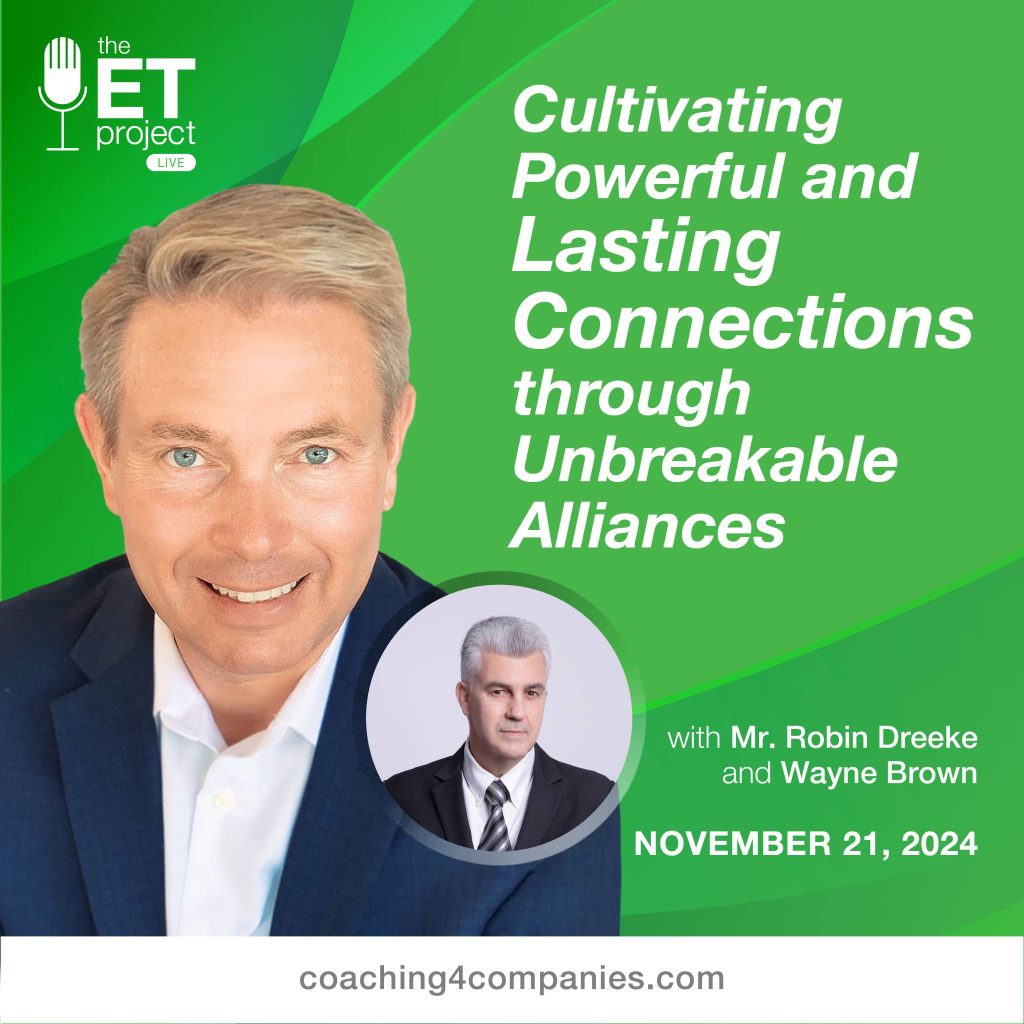
0:00:02.5 Wayne Brown: Hello, I’m your host Wayne Brown and welcome to the ET Project. We’re delighted to be delivering this live episode for executive talent all over the world whom we’re affectionately referring to as Team ET. Today we’re back in the USA and the city of Fredericksburg, Virginia to speak with our guests and my good friend, Mr. Robin Dreeke. Robin is a unique character for many reasons, not the least for his career, and you’ll hear us speaking extensively about this during our conversation, but as a spoiler alert, Robin has gone from recruiting spies for the FBI to recruiting unbreakable alliances in business. He is a human behavior expert, best selling author, professional speaker and podcast host. Starting out as a Marine Corps officer and now retired FBI Special Agent, he served as chief of counter intelligence behavioral analysis program, where honed skills in recruiting spies in behavioral assessment.
0:01:01.7 WB: Serving in New York City, as well as Norfolk, Quantico and Fredericksburg, Virginia, Robin received advanced training, as well as experience in the area of social psychology and the practical application of the science behind relationship development and trust, ultimately leading to the FBI’s elite behavioral analysis program. Today, Robin has translated his expertise into his unique interpersonal communication strategies that focus on recruiting allies in business. Since 2010, he’s been working with executives, corporations, entrepreneurs, military and law enforcement to help them forge trust, solve challenges and lead. Robin’s people formula has helped countless individuals as well as teams achieve quick measurable results and maximum success. Whether you’re a newly promoted leader, executive, sales team member or customer relationship specialist, Robbin’s proven strategies will help you excel.
0:02:03.1 WB: So team, in this episode, Robin and I had the opportunity to take an early dive into his recently released book. It’s truly incredible, by the way, it’s called Unbreakable Alliances. We really hope you enjoy this conversation. And go out purchase the book.
0:02:22.0 Speaker 2: Welcome to the ET Project, a podcast for those executive talents determined to release their true potential and create an impact. Join our veteran coach and mentor, Wayne Brown, as we unpack an exciting future together.
0:02:40.2 WB: Welcome Team to another ET Project live. I have to say today, I’m feeling quite blessed because I have the opportunity to do two things that I enjoy immensely, the first is to catch up with an old friend, and the second is to talk about a new book that I’ve just had the pleasure of reading. So perhaps first to the book, this particular book guides us through the art of cultivating powerful lasting relationships, and it does it through the lens of unbreakable alliances, which by the way, just happens to be the title. And to help us unravel the core messages that are woven through the book is the author and my good friend, Mr. Robin Dreeke. As you will have heard me introduce Robin, he has a really interesting background, and I personally would go as far as to say in terms of careers, at least in my circle, very unique, the background itself lays the foundation for much of what we’re gonna be speaking about today in relation to the book. So Robin, it’s been way too long, but finally, we’re back together again on the show. Welcome back.
0:03:47.7 Robin Dreeke: Thanks, Wayne. It’s a great pleasure to be back with you again, like you said, there’s nothing better in the world than having a great conversation and catching up with a friend, so thanks for having me back and yeah, great conversations are the core of everything and creating those great unbreakable alliances.
0:04:02.8 WB: 18 months, I was just doing the maths. 18 months, May 2023 that we were together on this show. Apart from the book, what have you been doing?
0:04:12.1 RD: So when you’re living your life’s purpose, it’s really just learning… And actually it’s so funny ’cause it’s part of the book, it’s when you trying to live mastery, as I call it, you fall in love with the process. I don’t really have… Someone asked me this the other day, so what’s new for you in this year? I just turned 56, and they said, “So, what big goals you have?” I go, “You know, my only goal is to make it 100.” And so my magic number is 2068, ’cause that’s the year I hit 100. And other than that, it’s really just embracing every day and making every day, what I call a great rep, a great repetition, and a great repetition is a day you remember. The ways our brain work are really simple, we don’t remember average things, we remember things that are really, really awesome, that stand out, or we remember really, really challenging days, and so I always tell everyone, go out and make a day you’re gonna remember. So I really embrace things that are going to make a great rep.
0:05:07.5 WB: I mentioned during that short intro that by most people’s standards, you have somewhat of an extraordinary career, and I wonder if you’d mind filling in the blanks for our listeners, what exactly have you been doing throughout your career and why is it so extraordinary for most of us?
0:05:26.5 RD: The best way I like to frame it is, so my primary job that I focus 100% of my effort on that I love more than anything, is father. And now everything I’m gonna tell you that I did professionally gave me the skill set to even be a better father every single day and I’m still practicing. And that is… So I went to United States Naval Academy, I graduated from the Naval Academy, became Marine Corps officer. I spent five years on active duty with the Marine Corps at Cherry Point, North Carolina, Parris Island, South Carolina basically in charge of boot camp for a while, drill instructors. And then I came in to the FBI, I came in the FBI 1997, was a special agent, got assigned in the New York field office, Manhattan, New York where I was assigned to actually recruit spies. My job was working counter intelligence for all of my career and was in charge of recruiting spies in New York, Russian military intelligence officers specifically.
0:06:12.3 RD: During that time, I got on a behavioral program, ’cause every program has a behavior aspect to it, and so is counter intelligence, so I became a team member of the counter intelligence behavioral analysis program. From New York, I went to Norfolk, Virginia, did the same thing down there. From there, I went to FBI headquarters, I took over a national program for the FBI for counter intelligence, then I got asked to go to Quantico, Virginia where the FBI Academy is at, I was instructed there for advanced courses for recruitment operations, double agent operations, interview and interrogation stuff, and then I took over our team, the behavioral analysis team for a number of years. I consulted on cases all over the country, on all the, as I called, the hooky spooky spy stuff, and then my last couple years I was doing it back on the street again by choice, and then I retired in 2018. I’ve written four books, this is my fourth, and I just accumulate knowledge by a lot of humbling moments, and my next job is to pass that knowledge on, so no one else has to have as many humbling moments.
0:07:14.2 WB: I’m curious, Tom Cruise walking down the aisle at the FBI headquarters, what’s the vibe as you turn up to work, you’re in the spy business. It just sound so mystical.
0:07:28.1 RD: Yeah, you know, it’s a great question. I haven’t been asked that question before, and every time we get asking a new question as a behavioralist, you just love it. It’s an interesting vibe, I’m gonna differentiate. I’m gonna start with the first vibe I had in New York ’cause New York is where it was really, really high intensity, great operations. The vibe was intense. It was… It was really… I’m with you. It was really cool stuff we were doing and it’s a lot slower paced than the movies make it out to be. Recruitment operations take years. There was one recruitment operation I worked for 15, 20 years of my life.
0:08:03.0 WB: Wow!
0:08:03.6 RD: Because of that slow in developing… Because these are trusted relationships you’re developing with people that you’re hoping are gonna betray their country and cooperate with yours, but we did the whole dead drops, fake rocks with double agents, meeting with sources that were in touch with our GRU officers or military intelligence officers that were spies, we’re pitching them or trying to recruit them or interdicting them or kicking them out of the country, were operating ones that had defected and were working for us, so the vibe every day was one of… I likened buying a lotto ticket, like taking a chance because to get… Our job every day was to buy a lotto ticket ’cause it’s a chance that someone’s actually gonna say yes, it’s very rare, but when it is, the worlds align and we protect the National Security of the United States and all our allied partners, like like everyone, pretty much.
0:08:54.3 RD: It was a high intensity, potentially high reward, and luckily though, we had amazing people on my squad that were there for 20, 25 years, and the thing that was really fantastic when I came in, in most organizations and including the FBI in different areas, in different departments, when you have 20 or 25 years, and that’s when the older guys are kind of sitting back and relax and then let the young guys get it. No, when I got to my squad, you had to keep up with them, they set the tempo, they set the pace, and they were doing the coolest high speed operations, and if you were humble enough, had enough humility and energy, and are willing to put in the time, they might bring you along and they might give a little nibble here and there, so it was great. My first bunch of years in New York, it was… I probably lived about four or five lives, and of course about 10 years in New York.
0:09:49.2 WB: And now is that group of people you were just talking about, the 20, 25 years of service, how many of those became the mentors that you speak about in the book?
0:10:00.3 RD: The main one in the book, his name is Jesse Thorn, in the back of the book and the acknowledgements, and by name, his name is John. And my other ones are Joe Navarro. The world renowned non-verbal expert on what everybody is saying in multiple other books, he’s a very good friend of mine. He’s the first trainee I met on my behavior team in 2002 when I met him. Jack Shafer is another one. He wrote a great book called The Like Switch. And what’s this latest one is sitting right there, the truth detector on elicitation, and so they were in other field offices, but they were my mentors and guide on the behavioral team, but John was my teacher, mentor and guide on my squad in New York. An amazingly successful recruiter of spies, and he set this model that became the framework for everything I did in the aha moments in my life. Really.
0:10:51.3 RD: I had a lot before that point, as I came in, I was about 28, 29 years old. Not a lot of experience in the Marine Corps and humbling moments there, but his desk at work had nothing on it. When you were walking to our squad area and we’re to 25th floor in the big 26 Federal Plaza in Lower Manhattan. Only five blocks from the World Trade Center. You would look at our squad area, his desk looked like it was a vacant desk, look like no one even sat there, he didn’t have a name plate. And only after 9/11, we lived close to each other, we commuted down to ON Ground Zero together. We became closer and I went to his house with my kids and his kids got together for pizza one night, and my son is down the basement playing with his kids, and they’re playing floor hockey, and they’re playing floor hockey with his glass puck, looked like a round hockey puck. And my son says, “Dad, hey, this glass puck slide is really good on the floor, much better than this medal puck.” I said, “Let me see that glass puck.” And I picked it up and it said, the FBI director’s award for the number one counter intelligence investigation in the entire FBI with John’s name. Like, “Holy cow, where hell did you get this, Kevin?” He points a dirty old shoe box in the corner, I go to dirty old shoe box, I pick on another glass puck, with another year on it. And the med puck said CIA director’s Award on it. John desk at work had nothing, no accolade, no look at mes.
0:12:16.0 RD: His walls at home had nothin. His wife decorated the house, his entire ego is in the shoe box in a corner. Meanwhile, in the 22 years John had been in the FBI, he always gets so angry. I saw him for lunch not too long ago. And every time I say this, he gets so angered me, because I said, “You recruited 14 intelligence officers.” He goes, “No, no, no, no, it was a team.” I said, “All right, you were the single point of success for a team that did that.” I mean, think about that. It’s like hitting lotto 14 times in your career. He was profound, because he knew how to make it about everyone else but himself, he knew how to do the most important thing, if you’re gonna recruit a spy or sell something in business or be a great leader, he knew how to identify the challenges, priors and friction points in people’s lives, be a resource for them overcoming those things and inspire people to trust him with great open, honest communication, transparency and vulnerability. It’s literally that simple.
0:13:11.9 WB: That’s such a wonderful segue into the book. Let’s get into it. The full title of the book is Unbreakable Alliances: A Spy Recruiter’s Authoritative Guide to Cultivating Powerful and Lasting Connections. This is not your first book. This is your fourth book. How was writing the book in comparison to the previous three? Was it a simple labor of love or was there a reason/purpose behind it?
0:13:38.2 RD: All of those things. It’s a great question too. My fourth one, my first one, I self-published and actually we’re re-publishing my first one, it’ll be out next year under this publisher, I love this new publisher of mine. They’re fantastic, so re-pubbing my first one next year under their brand, and The Latin next to where I do… Well, I had a writer with them, Camp South, amazing writer, and then this one was all me again, and it’s an evolution, so the first one is rapport and trust and assessing to others, and this one is about putting all those things together and creating these great unbreakable alliances and basically healthy relationships. It was an evolution of me with again, my number one job in life as a father, and my number one job as a father is, every time my children… They’re grown, my son’s a Marine Corps pilot, jet pilot and my daughter’s a nurse. And every time they faced an obstacle in life or a challenge, the first question I have is, “All right, what are we gonna do about it? Who do we need to talk to? What relationships do we need to have in order to move through this challenge or problem?”
0:14:39.2 RD: So you get enough reps doing that, people started saying, “You really need to get this content out because it’s what you do,” ’cause this is what I did for my entire life. This is what we all do. We strategize how to solve problems with people, and so it was a labor of love to do, it wasn’t… Hit those moments in life where you just feel compelled. It was compulsion. I had read a tremendous amount. So what went into this, what I tried to do with this, I consume a lot of books every month, I’m an Audible freak, I’d probably do about… It depends on length that I do, I generally read lengthier books, about four to six a month.
0:15:13.2 RD: And I listen to some amazing authors. As a matter of fact, one of the things I try to do in this book, I had a lot of citations of other great books that I drew from that I absolutely love. Whether it’s Ryan Holiday and all his books on stoicism, Robin Green’s books on human behavior, where it’s Laws of Human Nature, 48 Laws of Power and Mastery, I have Robin Sharma and his Monk Who Sold His Ferrari and Who Will Cry When You Die, then I have some biographies I mentioned in here because biographies are great tellers of human behavior as well, so a lot of great citations because a mark of a good book is when you get other books to read from it, so I want to make sure I did that, and then just the content itself was driven by just the easiest revelation in the world; that all problems are personal problems. I was lucky enough that I had worked with a writer on two other books, and what the writer did with me was it was all my content, he would interview me to answer questions that were relevant for the book, and then he would take that, he’d get a transcript and he edited the transcript, and then he’d have a draft and we went back and forth on the draft, that’s how you partner with a writer.
0:16:12.0 WB: Yes.
0:16:14.4 RD: And so what I did with this one was I came up with my content and table of contents of the topics I wanted to cover that I thought were very important to form Unbreakable Alliances. I then created about 8 to 10 questions, which became the sections of each chapter that need to be answered for that main chapter, I then interviewed myself, I recorded it, I’m recording my own answers to myself, then transcribed it. I made a transcript of my… Basically, I interviewed myself and then edited the transcript into the chapter. So basically, I partnered with myself to write the book like I did with a writing partner.
0:16:52.4 WB: Incredible. I’m going through a high house program at the moment to pick up some finer points, and they talk about partnering with writers and some of the approaches, but you now apply that to doing it through yourself, which is fantastic approach.
0:17:12.8 RD: Yeah, and one last thing on that too, Wayne, you know what actually helped also was doing the podcast because I use a program in the podcast called Descript, Descript takes audio and makes a transcription of it really, really accurately. So I took my audio of myself, I put into Descript, made the transcript, and then I edited the transcript.
0:17:30.1 WB: I’m gonna steal that if you don’t mind, Robin.
0:17:32.9 RD: Please do. It really made it fast, it was… Because once I had it in my mind what I wanted to do. Like you’re seeing now, what you do, too, you can really say what we mean really easily, sometimes it’s hard to get it down on paper, so I skip that process, putting it on paper by pen or keyboard, and I spoke it while I walk, ’cause I also learned my process. I’m what’s called a kinetic learner and a kinetic thinker. I need to move while I’m thinking. And so the entire book was written or narrated while I was outside walking.
0:18:02.9 WB: You mentioned the sections and within the book, you’ve got 8 key chapters, I guess, that really set the scene and paint the picture of the storyline. Without going too deep into all of it, and giving everything away, we want people to go out and buy the book. Could you give a high level overview of the book itself?
0:18:22.5 RD: Yeah, so we’ve talked about the high level, the super 50,000 foot level, which is the book is all about how to create healthy strong alliances. And someone asked me this earlier today, so define what an alliance is according to you in the book. It’s really simple. I’m all about… Another great author cited in here last Jocko Willink and Leif Babin talking about Extreme Ownership, and also the book, The Dichotomy of Leadership and everything is a dichotomy.
0:18:44.0 RD: So everything needs to be in balance. Healthy relationships are in balance. A strong alliance is a relationship in balance. Both people are given and taken pretty much equally, as long as they feel emotionally that it’s equal. And what a good healthy relationship and alliance is, is people then discover your priorities, challenges, pain points, and they proactively offer you resources without an ask to overcome ’em, and it thereby builds up trust credits in that bank of trust. And then if you need to make a withdrawal, well, the bank’s already full. There’s no need to ask. I mean, so think about this, you and me are a great example. We’ve only talked a couple of times, but we’ve always been there for each other. So if there is an ask, you don’t even have to finish the question. Of course I will. Because that’s what a good healthy relationship is.
0:19:29.1 RD: That’s what an alliance is. And so that’s what the premise is at the 60,000, but here’s an arc that goes throughout every chapter. And that is what I call the keys of communication. ‘Cause the keys of communication are really what’s going to unlock all healthy relationships. And these keys of communication are what shifts the focus from you to the other person. It packages that core content of your intent, your mission, the things you wanna say, the things you wanna share, or the ask you have, not in terms of you, but in terms of them, because if when you make a conversation in terms of the other person, the big four are going in the brain, endorphins, dopamine, serotonin and oxytocin, ’cause you’re basically saying, I’m present for you, I see you, this is organic, it’s sincere, and I’m making it about you ’cause I’m doing the number one thing we seek in all relationships.
0:20:15.1 RD: And that is, we wanna feel safe. And so here’s what the four keys are, ’cause this will then be our throughout, is number one, is we want to ensure we seek the thoughts and opinions of others, instead of pontificating about our own, we wanna make sure we’re talking in terms of their challenges, their priorities, their pain points, their friction they’re having in life, instead of complaining about our own. We want to validate them nonjudgmentally with what I call active curiosity. And active curiosity takes curiosity to the next level. Curiosity is a beautiful thing to have. It’s an anchor for all of us. We’re born with it. Then our parents tell us to shut up after about 6 years old. And we never, and we lose it for a while. And then we’ve got to get it back again. And so what active curiosity is, is not just being curious about what it is you wanna know, being curious about what it is someone else wants to share. It takes you to have to listen with what I call active listening and active listening is also simple because it’s… And there’s lots of great definitions. You got to do this. You got a mirror, you got a match, got paraphrase and all that. I’ll make it even easier.
0:21:17.8 RD: Active listening is actually listening and paying attention, free of an agenda, no agenda. So you’re going to hear their words. You’re going to hear the things they’re putting out that they’re willing to talk about, then you employ the active curiosity, which is you explore what it is they wanna share. So that’s the third step. And the fourth is you empower people with choices. So if you do any one of those four things, you build that into your words, actions, deeds, texts, emails, the entire shift of the content goes from you to them and it makes it all about them. And their brain says, “Wow, I like this person.” And not just that. Now, when you back it up with the behaviors of trust, those are the actions of trust, these are behaviors of trust where you have open honest communication, transparency and vulnerability and vulnerability is nothing more than owning what you’re great at, but also owning what you’re not so great at and being open and secure enough in yourself to share it, those are what empower people to feel safe with you.
0:22:08.6 WB: Do you have a favorite part or favorite section in the book?
0:22:14.1 RD: I gave an answer earlier today on mastery. And I’ll talk about that in a sec, because mastery is really important. And that is falling, like I said, already falling in love with the process. Since I talked about that already, I’m actually gonna hit on something a little more unique that is very unique to me in this book, I think. And it’s a very different way to look at things. And that is the chapter, chapter four called inspire, because I take an entire chapter and I dedicate it to moving beyond. And this is at that, again, we’re talking about moving into the world of an art form where interpersonal relationships need to be about other people… Well, not making yourself a carpet, but learning how to communicate in terms of others. And it’s taking the idea of influence, persuasion, or even making someone do something or convincing someone of something, think about all those words, influence, persuade, convince, who’s that about?
0:23:12.0 RD: It’s about me. It’s about what I want someone to do. It’s what I want someone to think. It’s about what I want them to listen to. So where’s the focus? It’s on me. So the chapter inspire is about others. So this is the way that I think all the time, instead of thinking in terms of how can I influence someone to do this? How can I persuade them? How can I convince them? You can’t, because that’s about you. How do I inspire them to want to? That is something that you are here to communicate in a way that helps it unlock it from within them. This is why in order to unlock what’s from inside someone else, you have to understand what their priorities, goals, dreams, and aspirations and friction points are. If you offer yourself as a resource for those things, now you’re going to inspire them to want to be with you, to cooperate with you, to partner with you, become an alliance with you, because it is all about them. You’ve put yourself in their life.
0:24:08.8 RD: If they want it, again, it’s empower them with choice as a resource for them in things that are important to them. And so that’s why that chapter of inspire, I think is really key and critical ’cause it’s taken those concepts that people will flow by. And there’s, there’s also no bad to those things. It’s fine. Influence, persuade. That’s fine. I mean, this whole book, you know, Robin Cialdini’s book on persuasion. It’s a fantastic book. But I think if you wanna move to a, down that path of mastery, you can move beyond those things, move beyond what it is you want and think and focus on what it is they want. And then if you’re going to have a healthy, balanced relationship and a balanced ally, they’re going to become aware of your needs, wants, dreams, and aspirations as well, and they will proactively become part of your life without the ask. That is a healthy, balanced relationship.
0:24:57.6 WB: Early in the story about your colleague, John and his, let’s say, lack of ego or total absence of ego, to that point, it’s all about the other person, not about, about him or the individual.
0:25:12.1 RD: Here’s a great example of it from the spy world. Again, it was a great question I answered earlier and it goes along the line of, so when you’re recruiting a spy, how do you do that? What’s the first thing you say? Do you say, “Hey, give me all your secrets.” So think about this. So here you are, you’re in one of the first couple of meetings with a potential confidence human source or an intelligence officer that you’re trying to bring on board, or they’re at the point now where you’re talking about exchanging information. If I’m trying to persuade them, if I’m trying to make it about what I want, I will ask them, “Hey, here’s a list of information. I think would be very valuable for us to have. May I please have that?” “Who’s that about?”
0:25:55.2 RD: It’s about me and what I want. As opposed to where do you think you’d have a greater value? You could ask this instead, “You know, Sergei, Sergei Ivanov. I know you’re in a position of great authority, great knowledge, and you probably know our blind spots better than we do. Before I even get to my list that my analyst gave me, what kind of things do you think I need to know in order to protect my country?” I’m seeking his thoughts and opinion. I’m empowering him with choice and I’m validating his expertise above my own. Every time we open a conversation, asking them what we thought we should know that we don’t know now, as opposed to us having our list of what we thought was important. We found out profound information and they felt more part of the team because we valued their thoughts and opinions and who they were more than we valued ourselves.
0:26:38.9 WB: That’s really an interesting point, Robin. I mean, I can apply that in my own life and career as a facilitator. One of the things I found facilitating is when you go into a room and you portray yourself as the expert, people sort of, their mind shifts to what’s on their phone and here we go again, but when you open with, “I’m so, so happy to be here in this room of collective genius and I’m looking forward to what I’m going to learn as much as, what we can share.” You set the scene for an entirely different environment and event, right? And so to your point, making it about the other person is so powerful. What intrigued me as I was going through the book and you talk about many FBI instances, how common every day those instances are rather than the mission impossible version that I had in my mind. As a leader, the things you talk about are everyday events for leaders and you’ve just crystallized it so beautifully in the book to help people understand it is that simple, but you have to be able to apply it and understand it.
0:27:53.7 RD: Yeah. It’s the reps we get on what we think is complicated today. You know, you start walking down that path of mastery when things become simpler because human interaction really is simple. Remember, we’ll go back to the simple concept of all human beings are motivated to wanna feel safe. And so going back to Jocko Willink and Leif Babin’s book on Extreme Ownership, this is about owning our behavior in what we are doing to not allow people to feel safe with us. Probably the greatest, most challenging questions I get all the time, and this relates to everyone. I did this in the FBI nonstop, but it relates to everyone. Most of everyone’s frustration at work comes from what? The boss not telling me, yes. People around me not agreeing with it. People around me not supporting me. All these things that grind at us and give us the most toxic behavior or feeling emotion we can have. And that is, anger and resentment. Resentment is a horrible emotion we have ’cause it just, it’s toxic inside our own bodies. Let alone, when you start propagating out. So this is what next time you start getting frustrated because you’re not getting your way. No one’s listening to you.
0:29:07.2 RD: Your boss isn’t telling you yes. Which most of my time when I did my behavioral consultations for case agents in the FBI, most of my time was not on coming up with the strategies for how to recruit a spy. Most of my time was spent with how do you inspire your bosses to say yes to this operation? And so here’s what’s gonna inspire them to say yes. This is what’s going to make everyone’s life calm. This book, this is a book about how to calm the chaos in life, because when you have healthy relationships and allies, there is no chaos. And so chaos is created when people don’t feel safe. And so if you’re not getting yes, if you’re getting resistance for things you wanna do or the way you wanna do them, you know why? You didn’t present it to ’em in a way they’re comfortable and feel safe with. You are not being transparent.
0:29:50.0 RD: If they’re saying no, it’s because you’re not being transparent enough, you’re not providing enough information, you’re doing it in a way that doesn’t allow them to feel safe with either the operation or their career. Whatever it is, you are not doing something that inspires them to feel safe. And if you start judging what they think feels safe, like, “Oh, well, he’s just a careerist ass.” Good. You’re gonna lose. Again, what was the third tenant? Nonjudgmental validation and curiosity. That’s their path. That’s what they’re choosing to walk. If you want to be able to move forward on yours and you need them to cooperate, you need their support, you need that alliance, that’s what you have to do. You have to be a resource for them feeling safe with your choices.
0:30:31.0 WB: You mentioned it in the book as well. There’s a example you give. I’m trying to recall the exact wording and scenario, but I think it’s in the Starbucks somewhere and you’re trying to recruit a potential agent and you have to prepare for that conversation in many cases. So it’s not just something eventually, I guess, after the reps, it becomes fairly natural. But for many of us, to get to that point where we do get the yes, we have to do the preparation upfront and focus intently on making it about the other person so that they feel part of this conversation, they feel the pull towards what it is that you’re hoping to achieve, and I think there’s a number of stories in the book that sort of illustrate that the coffee one stands out to me at the moment.
0:31:27.3 RD: The key in the preparation for everything we do is, how do I prepare to be present? I think that’s really the core essence because the more present I am, the less scripting I’m doing, the more I know about them and their priorities, the less I can stress, because if we enter a conversation with someone and we’re a little bit stressed about what is I have to say? What is I have to do? What do I have to do to look right? Where’s the focus? It’s on me again.
0:31:56.4 WB: It’s on me, yeah.
0:31:58.8 RD: Every time, as much as people would like to say we can multitask, no, we can’t. As a species, hundreds of thousands of years of evolution. We don’t multitask. We have some things we can do by habit and repetition, but when it comes to focus, we can only focus on one thing at a time. And if we try to divide that focus, you’re gonna have 50/50, and then it goes to crap. So it’s one thing at a time. Focus on the other person, the way we do this so that you inspire them to feel safe with you is they have to feel comfortable with you. The way they’re going to initially feel comfortable with you is if you have beautiful congruence, I talk about this a lot. In congruence between your words, actions, deeds, and body language. You wanna have good, open, accommodating non-verbals, smiling, head tilts, all the ventral… They’re called ventral displays that says high comfort, eyebrow elevations, flashing.
0:32:46.1 RD: When you see someone, you just light up inside. And the way that this becomes congruent is your words now, if you’re going to use those four keys of communication, making about the other person and your non-verbals are also open and accommodating about them, that’s congruence. That inspires someone to feel safe. And the way we do that… Here’s our prep work. Enter the conversation, enter the dialogue free of an agenda. You know in the back of your mind, which, when you’ve done the prep work, when you’ve done all the things, it’s in the back of your mind. Keep it back there because when someone says something, it’ll trigger, “Oh yeah, now we can go down this path.” You don’t have to think about it. It’ll just be there. You’ve already done the pre-work and that’s where the preparation comes in is you got to know your content. You got to know what you’re doing. You have to be a professional in all aspects of what you’re doing ’cause professionals prepare. Well, once the preparation’s done and your mindset’s set, you know the things, you push it all aside and it’s time to be present. You engage with active listening, active curiosity, and you just be present, free of agenda. And naturally your body and language and everything will become very congruent.
0:33:56.7 WB: In coaching, we refer to it as dancing in the moment.
0:34:02.4 RD: Yes. I love your phraseology you have. You have great terms. That’s a great one.
0:34:07.9 WB: But that’s all about what you just said, right? It’s being present. It’s letting go of trying to strategize in that moment. It’s just being there and it’s being engaged and yeah, whatever comes up, you’re ready for it. And…
0:34:22.3 RD: It those, words you just used. There is no trying to, right? ‘Cause you don’t have to try anything. ‘Cause if you have to try, that’s gonna create stress. Stress does not look good on the person. So there’s no try. There’s just do, there’s just be, as Yoda says.
[laughter]
0:34:36.8 WB: You also talk about emotional intelligence, within the context of different aspects. How much is things like empathy contributing to what you’ve just mentioned, like if you’re more empathetic, does that also play a big part in building that relationship?
0:34:57.0 RD: Yeah. So, boy, lots of unpacking there. So I do talk about, EQ and emotional intelligence. And I touched lightly on it. I do my little light, light finger things here because I don’t go into depth and I give lots of great references, to the Goleman who came up with an EQ, which is a fantastic resource I cited in here, but the big thing I love about mentioning EQ in here is that we’re all a balance. And I love the concept of emotional intelligence, because if you have one thing that’s out of balance, you don’t have to stop being anything. ‘Cause it’s hard to stop being who you are. It’s hard to stop a behavior. What you got to do is add a little bit more over there.
0:35:33.3 RD: So it’s about adding to bring things in balance, which I love. And so that’s one aspect of that. And one of those things is empathy, our ability to understand others. My chapter that really talks about empathy, I give it a different phraseology, kind of like I do the chapter of inspire. So the chapter is called context. Because some people can be off put by the word empathy ’cause they misunderstand what it means. And what empathy really is, is deep active context, seeing the world through someone else’s optic, lens, experiences, generation, ethnicity, orientation, I don’t care what it is. It’s literally as Brené Brown puts in one of her great books. I quote this in there too, is, “It’s not just walking in someone else’s shoes. It’s learning how to take yours off first.” And so this is… And I did this all the time when we were doing our behavioral consultations, recruiting a spy.
0:36:21.4 WB: Right.
0:36:23.0 RD: Before we told someone how to do something, we said, now, listen, I’m going to give you what we would recommend for how to engage with this human being in a very productive, healthy way. But before you actually exercise any of these things, you’re going to have to role play. And what I mean by role play, this is you’re going to try to the best of your ability to live the person’s life that you’re going to approach for at least one week, if not two, their same schedule, their same stressors, their same tempo of life, and then have someone walk up to you and engage you the way you plan on engaging them and see how that feels. In other words, do a deep dive to get the context or empathy of the person you plan on approaching and making a life decision on.
0:37:06.0 WB: You’ve just given me a deeper angle. I do sales training and we talk about situational fluency, which is all about the other person and understanding their business, understanding their challenges but doing the role play and really living that is a deeper level. So thank you for that one.
0:37:27.7 RD: Yeah. So I mean, think about this, when you’re doing these sales calls the person you’re going to be engaging, ’cause here’s what we did with intelligence officers, I would ask the case agent said, so what time does this guy get into work in the morning? What’s the first thing he does. So for our intelligence officers, they generally got in around 7 o’clock, From 7 o’clock to 9 o’clock, they’d sit there and they’d read, read all the newspapers. They’d read all the tasking coming in from Moscow center. So they’re making their agenda for the day. Then they actually have to go to the United nations for their fake job. And so from 9 o’clock until around 11 o’clock, they’re over at the United Nations, attending conference meetings, doing all the things they need to do for their double job they’re having. And then around noon time, they’re going out to lunch. Now they’re starting to meet with sources to accommodate the requirements that just came in from the higher up bosses at headquarters to do that. Now they’re trying to weave these two lives together.
0:38:11.5 RD: Then after they go out to the meetings, they’re coming back. And then they’re writing up all the reports at 3 o’clock in the afternoon. At 3 o’clock in the afternoon, they have 3 until 7 to write up all the reports. At 7 o’clock all the reports got to be sent into back to Moscow or they’re kicked back to them by the bosses. And sometimes they get home at 10 or 11 o’clock at night. And they do that six days a week. And they have wife, three kids, their kids are failing out of school. The wife is trying to divorce them. Their brothers are in alcoholics. So you put all these factors in there now walk up to someone and say, “Do you want to listen to me right now?”
0:38:38.5 WB: It totally changes the whole perspective, right? It puts a entirely different spin on the entire process. But that level of understanding is not something that the average person does very often.
0:38:51.5 RD: But we could, and Wayne, here’s what’s beautiful about it. Like you said, it’s not what the average person does. So anyone can be massively successful at life and success to me is a life filled with good relationships that make us laugh, that give us great joy, right? ‘Cause when you have that, everything else flows from there. And so since so few people are doing any aspect of this, and I know, ’cause when you become very situation aware to these behaviors, the rare occasion someone’s actually doing their best to do it to me, I’m in like heaven. I’m like, go brother, go. It’s so rare that if you just take, again, this is this like James Clear talks about in Atomic Habits. This is about going from zero to a hundred. Take one of the things we’re sharing with you today, make one of those things an aspect of who you are and cascade that over time. You’re going to be doing better than 99% of the people out there.
0:39:43.3 RD: ‘Cause other people are just reacting to the world around them, not thinking about the world around them and how to interact with it. And so that’s why it is so easy to do ’cause no one else is doing it. And then when you see a beautiful person that is actually doing these things or even one little tinge of it, you grab on and hold on tight, that’s an alliance, especially, and here’s the easiest thing to see that someone that gets it does. When someone takes time to do those four keys of communication with you, especially when there’s seeking with active curiosity, what’s important to you? What’s going on in your life? And then out of the blue in a week or two, you get an email, you get a phone call, you get a text, “Hey Robin, I was thinking of you in our last conversation, I happened to bump into this person today, they think might be good for that thing you’re working on. If you want, I’ll do an introduction for you.”
0:40:32.3 WB: Well, what I did love about the book and to this point is at the end of each chapter, you give a set of actions that people can, it’s like a summary, but it’s also a set of actions and was there a particular hope that you had in putting those there related to that story? Like, is that…
0:40:52.9 RD: Yeah, I probably overdid it as I looked back at those, each chapter has 10 actions. After I… So when I’m doing the narration for the audio book, I’m reading each of these 10 again, I said, man, maybe I should have cut it down for about five. So every chapter has 10 actions at the end that are behaviors that help you reinforce. And every chapter has a 10. And at the end of the book in the chapter mastery, you have four exercises related to each of the chapters. The way, the intent I wrote this was not to do these things sequentially, not to do them all. This is about discovering what you resonate with, something out of those 10. Maybe you like one. Practice it.
0:41:33.6 RD: At the end of the book, one of the exercises, they’re not sequential. If you like one, take it, grab it, make that your one mile an hour change of what you do and practice that every day. When you think you got one down, go back and get another one. And so I tried to put as much in there to give people choice. Again, empowerment with choice thing for, I wanted to give lots of choices because I wanted to be able to hit as many different types of personalities and different comfort levels for people ’cause I don’t want… ‘Cause remember, even when people start an exercise routine that, again, from the Atomic Habits, if you start out and you say, all right, you haven’t exercised at all for the last couple of years. Now I want you to go and hit it hard for an hour a day for the next five days, you’ll never do it. You’ll fail because anytime you have to rely on discipline, discipline will fail. You want to rely on, “I get to do this every day.” And if you pick one of those exercises or one of those key actions that you think this might be enjoyable to try, that’s the one you’re going to keep repeating. So go through there, pick one that you think, you know what, it’s a little bit of a push, but I think I’ve enjoyed trying that. Give it a try.
0:42:37.8 WB: I found it really powerful as a form of summary to start with for each chapter. But also just as you said, just to put some of the guidance that you introduce into practice. And like you say, it’s a reference source for the future. So don’t try and do it all. Take it piece by piece and build or stack habit type of things. So you talk a lot and the last chapter is about mastery. So maybe, maybe as we come towards the end of the conversation, you could wrap up the book in essence with this last chapter. What is it you’re trying to get across through the mastery discussion?
0:43:17.1 RD: I got my goosebumps. I love this chapter. I love this chapter on mastery so much because it’s probably the hardest thing I had overcome. And because mastery requires, like I said earlier, it requires you to fall in love with the process and not the destination. And that requires patience. It requires humility because everyone who doesn’t want to think they’re already a master at something? But the chapter mastery talks about true masters never considered themselves masters. True masters are, are constant, humble learners. They’re confident about what they know, but they’re also humble enough to know what they don’t know. So the books that, cause there’s a few, there’s three books that really inspired this chapter that I absolutely loved Robin Green’s book on mastery. They talk about the master and apprentice. It’s a fantastic read. The other one I absolutely love is basically anything by Ryan Holiday on stoicism and how to problem solve, but on Joshua Medcalf’s two books. One is Chop, Wood, Carry, Water. That’s fall in love with the process. And the same thing with the other book he wrote called Pound the Stone.
0:44:20.1 RD: And the whole concept of Pound the Stone is all about, you can swing a pickaxe or a hammer at a stone a thousand times, and you don’t think you’re making a difference and all of a sudden, a thousand and one time thing cracks right down the middle and was it that one shot? No, it was all the reps along the way. And so all these books talk about falling in love with the process and the process takes time and mastery is, there will always be someone better and there will always be someone behind you. But as my other good friend Alden Mills says he’s a veteran Navy seal and he’s a book called Unstoppable Mindset, talks about this concept that they have in the Navy seals called the swim buddy, and what his swim buddies in life, he always picks people that are better than him at the things he’s trying to do because they will constantly set the bar higher. They’re constantly push you, they constantly encourage you. But that gives you a bar to reach for.
0:45:12.8 RD: At the same time, you’re a swim buddy for someone else that you’re going to bring along. And so the mastery chapter is all about falling in love with the process, getting your reps in, having a concept, an overall concept that you’re not a victim ever. You’re not a wound collector. You have a positive aspect and positive aspect is you just solve problems. The world’s not out to get you. The universe is just being what it is. What are you going to do about it? Just take action and have allies. ‘Cause that’s what will move you through it.
0:45:42.8 WB: Do you think that that’s also one of the biggest barriers that the majority of people face is they expect things to happen too quickly and they’re not prepared to take the time to build that alliance and build this picture that you’re explaining?
0:46:00.7 RD: Yeah. And that’s why it was so hard for me. I’m a want it now kind of guy. I’m very impatient and this mastery requires patience. That’s why those books I mentioned are very good. And that’s why this chapter is about that, is realizing that… And that’s why reading biographies is also really good. Whether… Walter Isaacson is one of my favorite authors, whether it’s Leonardo da Vinci, Einstein, Benjamin Franklin or even one of my favorite Australian authors is Peter Fitzsimons ’cause he talks about James cook and all these other great explorers. Even Raul Amundsen right now, the great Norwegian explorer that was the first of the South pole. And I mean, I love all these people because every one of these people that have done all these amazing things that all of us recognize, it didn’t go like this, we’re talking years and years and years of patient reps.
0:46:51.0 RD: They loved what they did every day. They didn’t have a destination in sight necessarily, except some of the explorers maybe, but these other people, they just loved the process. And so it encouraged me to slow down and encouraged me to let go of the destination I thought was going to be the all about the greatness of Robin. And just really fall in love with the process, be more like my Jedi master John and just make it about everyone else. And just, that’s the process of creating those unstoppable unbreakable alliances.
0:47:17.0 WB: It is truly a great read. And I’d encourage all the listeners to go out and grab a copy. Speaking of which, where can they find the book?
0:47:25.0 RD: It is everywhere, Barnes & Noble, Amazon or anything like that. Different countries. I know we’re getting more and more every day, audible. I did the narration for this. I’ve narrated all my books. This is hands down my best only because I had a fantastic director. She was on me. So like every 20 minutes I had to stop and redo things. So I did the best I could. Matter of fact, if you’re watching this show right now or even listening, I use exactly the same mic. I’m in exactly the same spot. I was able to do the entire recording from home remotely. So they did a great job with the editing. My website’s easiest place to get everything. It’s robindreeke.com. And most importantly on there, whether you buy the book or not, that’s great, but I have… My YouTube channels on there. I have lots of behavior videos. I have videos that correspond to most of the chapters, the book on there. If you’re into true crime at all, I am a true crime commentator on a couple of podcasts. So there’s a lot of true crime on there as well. If you want to watch me apply my behavioral skills to the world of crime. And just a lot of other resources on there too, as well as, I have a program on there called Self Mastery, which is basically a big book list of things I also recommend.
0:48:33.5 WB: Robin, great conversation, excellent book. Hopefully it’s not another 18 months before we come back together. It’s been a real pleasure. So, thank you so much.
0:48:45.1 RD: My pleasure, Wayne. And also, for everyone listening, my last major thing you have to do is Wayne puts an awful lot of time and energy behind what he does for the podcast. He has a lot of amazing guests on here with the only intent to bring value to you. So make sure you hit like, subscribe and most importantly, pass it on to others so they can benefit from his wisdom as well.
0:49:04.3 S2: Thank you for joining us on the ET project, a show for executive talent development. Until next time. Check out our site for free videos, eBooks, webinars, and blogs at coaching4companies.com.