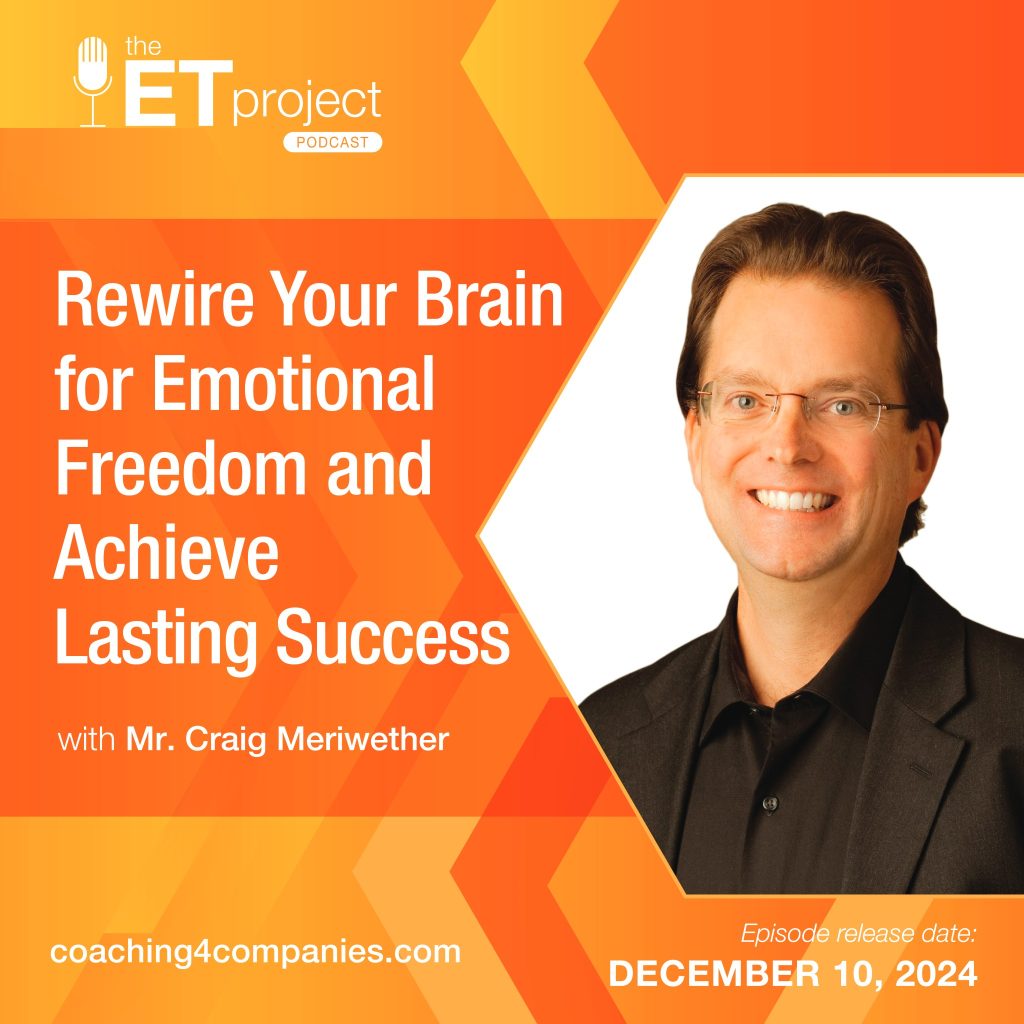
0:00:01.3 Wayne Brown: Hello, I’m your host Wayne Brown and welcome to the ET project. We’re delighted to be delivering this podcast for executive talent all over the world whom are affectionately referring to as Team ET. Today we’re heading to Arizona and interestingly, not the hot plains we hear the most about, but a city in the northern ranges of the state called Flagstaff. And we’re connecting with our guest, Craig Meriwether. Craig is a mindset coach, helping people eliminate negative emotions and trauma so they can reach their full potential. Craig is a certified clinical hypnotherapist, medical hypnosis specialist, neurolinguistic programming specialist, and founder of Arizona Integrative Hypnotherapy, helping people eliminate the limiting beliefs that may be keeping them from reaching their true potential.
0:00:53.8 WB: For over 12 years, Craig has been helping people heal from early childhood trauma, helping cancer patients with pain control, veterans with post-traumatic stress disorder, students with test anxiety, children with nightmares, entrepreneurs with confidence, athletes with peak performance, and anyone who may be dealing with overwhelm fear and anxiety. One of the many very comprehensive and successful programs that Craig has created is called Ace Any Test. It’s for test anxiety relief so people can eliminate stress around exams, auditions, job interviews and public speaking, as well as increased confidence and self-esteem.
0:01:38.6 WB: Team, during our conversation, you’ll hear Craig provide practical guidance from this program which is sure to be a hit for anyone who wants to learn simple methods for reducing the stress in pressure-sensitive and testing times. Make sure you check out the show notes on our website as well, because Craig has provided you with a wealth of material that you can either access to explore further or, in some cases, download and start practicing immediately. Craig is a real wealth of knowledge in this field and willingly shares plenty during our conversation, including busting a number of myths around hypnosis. So it’s time now, team, to get yourself ready and tune into this enthralling episode with Craig Meriwether.
0:02:23.8 Announcer: Welcome to the ET Project, a podcast for those executive talents determined to release their true potential and create an impact. Join our veteran coach and mentor, Wayne Brown, as we unpack an exciting future together.
0:02:40.6 WB: Hello, team, welcome to today’s episode. We’re going to explore the theme of mind mastery for achieving the life that you want. There’s this famous person by the name of Albert Einstein, who once said that you can’t solve a problem from the same consciousness that created it. You must learn to see the world anew. And as our guest shares, in other words, you can’t see, or you can’t create your new life with the same mind and thinking patterns that created the life you have now.
0:03:51.0 WB: It’s a powerful insight and it serves as our foundation for our conversation, and we’re going to dive into the art of reshaping your thought patterns and the consciousness to break free of the limitations of the past and craft that future that’s aligned with your deepest desires and aspirations. Now, you’re probably sitting there listening to me and thinking, man, that’s way above your pay rate. So you’d be pretty right about that. We’re fortunate that we have Craig Meriwether with us. He’s a certified clinical hypnotherapist and medical support specialist. Craig’s gonna guide us through this discussion. Craig, welcome to the ET project. Great to have the opportunity to connect as well as to learn about this critical subject.
0:03:51.6 Craig Meriwethe: Yeah, Wayne, I really appreciate you inviting me on to the show. I’ve been looking forward to this conversation. I know we’ve kind of gone back and forth with family issues and schedules and calendars and things, so I’m glad we’re finally here and have been able to sit down and talk ’cause… It’s actually, you brought up that quote ’cause it’s a really powerful quote. What’s interesting about this work is oftentimes the real issue of what’s keeping us maybe blocked from the success we’re looking for, or blocked from even moving forward, or blocked from gaining the health we want, or just maybe the hurt and pain we’ve been sitting with, or that malaise or the anxiety or the depression or the anger. Is oftentimes maybe something we’re not even aware of, something that happened when we were a child. And so the consciousness that created it may have been the consciousness of a child. And certainly, you’re not gonna use the consciousness of a child to heal those.
0:04:51.4 CM: But imagine how much more powerful you are where you sit as an adult with all the wisdom, knowledge, and understanding you have. And maybe, yes, there’s some issues in life that you wanna take care of. Maybe you’re not exactly where you want to be in your relationships, in business, in health, in finances, but imagine how much more wisdom you have just in how the world works than when you were a child. And oftentimes, we create these instructions on how to protect ourselves through a great deal of trauma or maybe just being bullied at school or being embarrassed or humiliated. But sometimes people go through awful trauma, or maybe a natural disaster, or maybe a car accident or something. We install certain instructions, certain suggestions on how to feel safe in our world.
0:05:46.5 CM: And sometimes if somebody has grown up in an abusive household or not a very safe household, the best way to have kept us safe was to hide or to dim our light, if you will, or to keep ourselves small. And that was the best thing you could have done when you were a child, especially if you’re in a really angry household, and shining your light… Focus the attention on you, you don’t want that. So you wanna keep yourself small, keep yourself hidden. That’s a great way to keep yourself safe as a child, but that’s not gonna work when you’re an adult. But if you’re still using the consciousness, if you’re still using the instructions you set up as a child, why would anything change? You can’t change anything until you change the instructions. That consciousness that is creating maybe the blocks to moving forward, or the blocks to health. Mental health, emotional health, physical health, spiritual health. And so it’s a great way to start this conversation…
0:06:50.4 WB: Craig, that’s a fantastic setup for our conversation today, and we’re gonna definitely dive deeper into the things that you’ve touched on there. What inspired you to get into hypnotherapy and the whole medical scene?
0:07:04.2 CM: I was going through in my life. I struggled a lot with depression and anxiety growing up, especially in my teenage years. And this is back in the 1980s. So of course, the internet’s not there for easy research and discovering tools and techniques. They didn’t even have those SSRI drugs like Prozac and things like that. Those didn’t come out till the late 1990s. So it was just one of those things you dealt with. You struggle with it. It was just like wearing an uncomfortable coat that didn’t fit very well. You just maintained and carried on because what else could you do? There was, I guess talk therapy and whatever book you could find in the library or the bookstore or something. But teenage boy is not gonna do any of that kind of stuff, and you just carried on and it just seemed like, Well, this is the way it is. Certainly most everybody else feels like this too. And it’s like describing color to a blind person.
0:08:09.3 CM: How do you describe just the peace of mind and body and just feeling joy and happiness if you don’t experience that? And so just kind of maintained and moved through life as I went to university in the ’90s and just got married and building a life. And it was really the birth of my son in the year 2001 that I really got that centeredness of mind to think I gotta do something about this. And luckily at that point, the internet’s out there. It’d been out there for a few years, and so there’s information you can research certainly about more techniques, a lot of information about the medications that are out there, different exercises and techniques and tools and strategies to learn. So I just started working on myself, started doing the heavy lifting. And of course we moved from Santa Cruz, California to Flagstaff. So there was a big move of new careers and jobs and new baby and all these things.
0:09:08.8 CM: So life would interrupt. It was definitely an on again off again kind of process as well as some trial and error of what’s gonna work for me, but I kept at it. There’s a certain relentlessness to this work, even when you feel good. Just like your physical body, just don’t get to go to a personal trainer once and work out twice at the gym and you’re in great shape for the rest of your life. There’s a relentlessness to your physical health with what you eat, with what you put in your body, what you’re drinking, on top of the exercising you’re doing.
0:10:34.8 CM: And so what about your mental health and your emotional health? There’s a certain aspect to that too, but I was working on myself for a while, doing the tools, doing the exercises, doing the healing work. And one day I woke up and was just kind of had a lazy morning lying in bed, and I was thinking about myself and I was like… You know what? I haven’t felt depression and anxious in a long time. And I realized I had reset my nervous system. I’d sort of downloaded a new operating system, if you will, because I changed how my brain was working. I’d rewired my brain. Probably literally, if you had taken a picture of my brain before I started the work and after work, you’d probably see new wiring, new neurons firing together and connecting together.
0:10:35.8 CM: And I realized I had this toolbox full of tools, and one of the tools was hypnotherapy. Because when I was doing the work, I was reading the books, I was reading the articles, blog posts, watching interviews of people. And oftentimes they’d have the bullet points at the end of the book or end of the article. Here’s what you can do to change your life. And usually there are different, but there was one that was always the same. They always mentioned hypnotherapy because what it is, it’s not somebody else trying to figure you out and analyze you and telling you what’s wrong with you and here’s how you’re fixing yourself. And that’s the big misconception about therapeutic hypnosis. Is that nobody’s taking control of you. Nobody’s turning you into some sort of voodoo zombie and some sort of trance make you go… I don’t know, assassinate the prime minister or whatever, or rob a bank. Nobody’s taking control of you.
0:11:36.7 CM: They’re giving you back control. ‘Cause really, control is already gone. If you’re getting anxious, if you’re literally changing your physiology, your heart rate blood supply moving to the big muscle of your arms to fight your way out of this dangerous situation creating that adrenaline cortisol. That’s a lot of work for your mind and brain and body to do. And if it’s doing it automatically, you’re not even sure why you’re out of control already. You’re basically already hypnotized. You have hypnotized to literally change how your body is operating to an unconscious threat in your environment. Maybe you know exactly what the threat is, but a lot of times this anxiousness or this anger, this overwhelm, this worry comes at us, and we it drops in our lap. We don’t know what is happening. We don’t know why we’re angry all over a sudden or why we’re feeling so anxious. So really you’ve hypnotized yourself already, quite possibly as a child and how to relate to your world.
0:12:35.2 CM: With hypnotherapy, it’s not that I fix anybody. I’m not gonna fix you. And hypnotherapy in and of itself is not gonna fix you. You’re gonna fix yourself. You’re gonna get back control and you’re going to heal the wounds and the hurt and the pain, even if that was 50 years ago when you were a child, you’re allowed to do that. And you can do it in a safe and gentle way and you can do it rather quickly. This is not long-term talk therapy kind of situation.
0:13:05.1 CM: That kind of stuff can be very useful, very healing, very helpful, but that’s not what this is. Change happens in an instant. Now, there may be some lead up to that healing and to that change, maybe months maybe years, but there will come a point where you say, It’s time, I want to heal now. And change happens in an instant just as that… Let’s say somebody has encountered some trauma and some real deep hurt and pain growing up. Just as that trauma, just as that anger and that anxiety, that fear can be installed instantaneously, maybe through abuse, maybe through a car accident, or there’s refugees in war. There’s natural disasters. Just as that trauma can be installed instantaneously, why wouldn’t you be able to heal it instantaneously?
0:13:54.2 CM: Who told you that you couldn’t? And what is it to their benefit that it takes you 70, 80, 90 sessions over two years to heal this? And so really this is giving you back control. I can’t make anybody do anything they don’t wanna do. That’s why smoking sensation is not a 100% guarantee because I can’t make anybody quit smoking if they don’t wanna quit.
0:14:14.1 WB: Right.
0:14:14.6 CM: You know sometimes husbands may get forced into smoking cessation sessions because their wife doesn’t want the smoking anymore. They expense the smell. It’s gross, it’s disgusting. Not alone the health issues or the other way around. Husband wants the wife to quit smoking. If that person doesn’t wanna quit smoking, they’re not quitting. They don’t want to. So it’s really all about your intention. What do you want?
0:14:44.1 CM: And even if you don’t understand what the problem is, it can be as simple as I want healing. I want healing from this anxiety. I want healing from this anger. Perfect. Because we’re not using the conscious mind. We’re using the unconscious to do this healing work. And just as you know, I can’t make anybody quit smoking if they don’t wanna quit smoking. I can’t go into Las Vegas casinos or comedy clubs or bars or whatever and snappy, snappy, wavy, wavy make everybody quit smoking. I can’t go into prisons and hypnotize everybody to be upstanding law abiding citizens. I can’t hypnotize Elon Musk to write me a billion dollar check. And the reason why I don’t have a billion dollar check from Elon Musk is ’cause he doesn’t wanna write me one. And so if you come to a hypnotherapist, if you come to me to quit smoking, you’re gonna quit smoking.
0:15:37.8 CM: Not because I’m taking control over you and brainwashing you or anything. I’m not. You’re gonna quit smoking ’cause you want to. And you’re ready for that change. And you are powerful and you are strong enough to make that change. I however cannot give you suggestions to go rob a bank, later that afternoon and we’ll split the money, ’cause you don’t wanna rob a bank, that’s against your morals and against your ethics. You don’t wanna go to jail. So this is all about your intention. And of course a lot of people know hypnosis from the shows. They may see. Here in the United States, we have Las Vegas and they have a lot of those hypnotist shows or comedy clubs, or people probably maybe seen on YouTube or late night talk shows or something.
0:16:23.9 CM: And they see people up on a stage and they’re singing like Elvis Presley, or they’re dancing like Michael Jackson, or they’re pretending they’re on a really steep rollercoaster, or they’re clucking like a chicken or barking like a dog or whatever the the skid is. And the reason they’re doing that is because they want to do it. Now, that’s not my idea of a good time. It’s not something I wanna do. I’m guessing, Wayne, it’s not what you wanna do, and probably a lot of your listeners, it’s not what they wanna do. But there are people out there who think that’s really fun.
0:16:52.5 WB: Right.
0:16:52.6 CM: It’s a good time for them. They’re exhibitionists, they’re extroverts, they’re entertainers. They want a silly video to put on YouTube to go viral. They just wanna have a fun time and watch ’em as they get off the stage after the end of the episode, they have a big smile on their face because they had a great time. They wanted to do that because they volunteered to do it. Nobody’s making them go up on that stage ’cause that’s not gonna make for a good show. Las Vegas shows are really expensive especially like even an an unknown hypnotist doing a show in a unpopular casino is still like 70, $80.
0:17:31.0 CM: So they have to entertain the people otherwise he’s not gonna have a show for very long. And so the show starts. The first thing that person does is ask for volunteers who wants to come up on stage and have a great time? And there’s people who go to that show specifically to hope that they get on stage and they wave their hands. Pick me, pick me. They want to go up there. They want to be hypnotized to the point where they just have a fun time. And they do. And so their intention is to entertain. Their intention is to have fun and have a good time. So what if your intention is to heal? Dr. Irving Kirsch wrote a lot of books about Prozac and the mind and things in the early 2000s.
0:18:12.4 CM: He called hypnotherapy a non deceptive placebo. Of course we know about the placebo effect, mind healing the body. We see this when a pharmaceutical company is doing research on a new medication, maybe for high blood pressure medication let’s say. Half the group is gonna get a placebo, the sugar pill, because they know mind will heal the body. They literally have to account for that in their research because let’s say 30% just for the process of this. Example, let’s say 30% of the people getting the sugar pill lower their blood pressure to levels that are significant. They did it through their mind. They were tricked into healing themselves. Let’s say on the real medication, 40% get better. Well, they have to subtract 30% because maybe they got healthy and heal themselves through mind as well.
0:19:09.7 CM: So really only 10% got better through the medication, and that’s good enough. And we’ll put it on the market at 50 bucks a pill. And so, But nobody looks at, well, yeah, but more people got, better through mind for, from healing themselves because there’s no big money in that. There’s no billion dollar payout for teaching people how to heal through mind is very satisfying. It’s a very joyful and wonderful way to make a living and have a career in the world, but it doesn’t make you rich. There’s no way to patent somebody’s subconscious mind. There’s no way to copyright somebody’s subconscious mind and their healing potential.
0:19:49.2 CM: So, you know, pharmaceuticals, it is. There was, talking about Dr. Irving Kirsch does. And then since we talked about mind and it is all about, mental health and emotional health, as we’re talking about today, what was interesting about Dr. Kirsch’s work is he wrote a bunch of books about the health effects of Prozac back in the early 2000s. Here in the United States, and probably the rest of the world, I’m guessing, but there’s no law that says you have to publish your research. You can just do research. You don’t have to publish it. It could be just for your own needs. But, there’s no law that says you have to publish your research.
0:20:32.0 CM: However, some of that Prozac research and those other SSRI drugs research was funded by the National Institutes of Health. That’s a government agency. So our taxpayer money was being used to help fund research on how to, you know, relieve depression. And so you can’t just throw that away or shred it if it doesn’t give you the results you want. You have to give it back to the government, and they put it in that big warehouse that you see at the end of Raiders of the Lost Ark that goes on forever and ever.
0:21:01.2 CM: And so it’s there. And so, doctor and here in America, we have a process called the Freedom of Information Act. Meaning, assuming it’s not top secret, highly classified information about where we keep our nuclear weapons and all that, you can have that information as a citizen and as a taxpayer. So he did a Freedom of Information Act request for all that research that wasn’t published. And one of the research studies that wasn’t published showed that the placebo effect group, that the group gained placebo, the control group, 90% cured their chronic depression all on their own just using mind. And I’m not talking about Monday morning blues because your team lost yesterday or your TV show got canceled or Monday morning, you gotta go back to work.
0:21:53.1 WB: Right.
0:21:53.9 CM: This is chronic depression of years. These are who they got into the trial. 90% healed themselves of their chronic depression because they were tricked into thinking they were taking a pill that was gonna help heal them. So there’s a long kind of road back to Dr. Irving Kirschs’, quote about hypnotherapy being a non-deceptive placebo. We’re not gonna trick you into doing this. You’re gonna do it on purpose. And even if you’re not even sure what the problem really is, that’s fine because you do unconsciously.
0:22:27.3 CM: And that’s what we’re gonna use. The uncut. This isn’t talk therapy. We’re gonna spend weeks and weeks, months and months and years and years, digging through your pain and your hurt, hoping to find the root cause. You know what the root cause is. That’s why you’re armoring yourself with anxiety or anger or overwhelm or fear. You know why you’re doing that. Okay. Not consciously, but that’s why we put that to, you know, quiet that down. We don’t analyze. We don’t use our logical mind.
0:22:57.4 CM: We use the unconscious mind, which is steeped in keeping you safe and protecting you. It just may be doing it with very un-resourceful instructions, maybe set up by a child, but you know why you’re doing it. Again, it takes great effort for your brain, your mind, your body to turn on the stress response, to create anger, to create anxiety and panic and fear. It creates great effort.
0:23:25.1 CM: I mean, your brain has to turn off the oxytocin, serotonin, the dopamine, all those feel good chemicals, especially if you’re having a good day, to turn on that adrenaline and that cortisol and adrenaline. Probably heard the crazy stories of grandmothers lifting cars off of babies. That’s adrenaline doing that. That’s now being dumped in your bloodstream. Your brain is creating neuropeptides, molecules that send the message of emotion to the cells of your body.
0:23:48.8 CM: That’s why you feel like that. You can differentiate anger from anxiety, from depression to joy to happiness. These are literal molecules of fear, molecules of anxiety, 100 of millions being dumped in your bloodstream. 300% more blood is moving to the big muscles of your arms to fight, this threat. 300% more blood moving to big muscles of your legs to escape the threat. This has to come from somewhere, so it’s turning down the power on your immune system. That’s why people get sick when they’re stressed or the volume and, of the power of their immune system is dropping. The power of their digestive system is being turned up. No need to digest that sandwich, so you have energy in 7 hours. You’re in danger right now.
0:24:28.0 CM: That’s why people get irritable bowel syndrome, IBS. And so that’s huge effort. So, you know why you’re doing it and it just, ’cause it just doesn’t turn on automatically. It’s a very rare case that somebody’s anxious 24 hours a day, 7 days a week. Very rare. There’s something seriously wrong there. So most of us feel anxious here, there, maybe a lot, maybe angry a lot, maybe anxious a lot, but it’s not all the time. So, you know, when to turn it on unconsciously, maybe not consciously, you may, you’re not aware. Maybe you are, but you know why you’re doing it. You’re trying to protect yourself from something.
0:25:09.3 CM: And so if you know what the problem is unconsciously, that means you can fix it within the unconscious as well, ’cause you’re the one who did it. And it’s not to blame the person, blame the child or anything, but it’s not to blame the victim or say it was her fault. But if the child put on those instructions on how to keep themselves safe, did the child then the well, not the child anymore, but the person can change it. They’re the one who entered those instructions so they can change it. It becomes very empowering.
0:25:34.2 WB: You started at the beginning by talking about how you healed yourself. What sort of timeframe are we talking about here? We’re talking years, I’m guessing.
0:25:43.7 CM: In my own journey, it took a while just because I didn’t know what I was doing. So it was a lot of trial and error, on and off again, where we moved from one town to another, from one state to another. Starting new jobs, got a new baby, all this stuff. So it wasn’t like I was spending five, six hours a day working on myself. But, you know, there’s books to read. There’s research to do.
0:26:08.9 WB: Sure.
0:26:10.4 CM: And then trying these techniques and tools and, okay, that didn’t work so well, I still feel awful, and then finally, you know, everybody’s talking about hypnotherapy. But it’s probably the hypnotherapy that helped me change the most… That’s what helped me do the deep healing work I needed to do. But then there’s kind of two parts to this. There’s the deep healing work you wanna do to heal that hurt and that pain. And then there’s that strengthening and empowering work you wanna do to increase the joy, the confidence, the happiness, the peace of mind and body. And there’s a certain relentlessness to that kind of work.
0:26:47.7 WB: Okay.
0:26:50.2 CM: Because, you know, to master anything, whether it’s getting a black belt in taekwondo or judo, whether it’s learning a foreign language, or certain musical instrument, it’s gonna take practice. And, just like your physical health, though, it’s not just do it once or twice and then you’re happy for the rest of your life. You know, life is full of challenges. Our parents get older, our children get older. They go into school, they get out of school, they go to work, they get divorced, we get divorced. You know, life is full of challenges.
0:27:19.2 CM: And so there’s a certain relentlessness not only to your physical health, but to your mental health and your emotional health. I mean, the Dalai Lama still meditates every day. You know, this guy’s 90 years old, I think, at this point. And, you know, being head of the Tibetan Buddhist spiritual community has, one, got to have a lot of responsibility. But he’s also been dealing with the issues of Tibet for the last 80 years or so. And, you know, the Chinese government is still arresting his monks and torturing his monks and still bulldozing down his monasteries in Tibet to build roads and buildings and probably primarily to give him the middle finger.
0:28:01.0 CM: And you read his books. He talks about the anger and the sorrow and despair. He’s a human being. This is an extraordinary situation, a very sad situation. And it causes him grief and sorrow and despair and anger. But he doesn’t want that to be who he is. So every day he practices loving kindness and compassion. 90 years old, and he’s still practicing loving kindness and compassion ’cause there’s a relentlessness to this.
0:28:25.0 CM: Yo-Yo Ma, considered one of the greatest cello players alive today, if not the greatest classical cello player alive today, practices every day. You know, any 10th degree black belt in martial arts is still practicing every day. Bruce Lee still practiced every day. No matter how masterful you get, there’s still practice. There’s still maintaining and strengthening and reinforcing.
0:28:48.0 CM: And so there are two parts to this work. It’s sort of like I heard this great metaphor or analogy the other day on Instagram and someone was saying, you know, you have a glass of water. And if you put a teaspoon of dirt in your glass of water and mix it around, it doesn’t matter how much sugar you put into that water. It’s not gonna taste very good. You know, so you need to remove the dirt. And that’s kind of key one. Even if you don’t know what that hurt or pain is, again, it’s within the subconscious mind. So if it’s affecting you, it’s because your mind, your body is trying to protect you from ever experiencing it again. It’s for you. You know, it may seem like that ’cause it hurts or there’s a lot of anxiety or anger. But unconsciously, you know why you’re doing it.
0:29:36.2 CM: So when you heal that hurt and pain, that’s great. But sort of like nature pours a vacuum, you pull out all that anxiety and that anger. It’s like, well, what if you wanna fill yourself up with? Just because you pull out the anger and you heal the wounds and you heal the hurt and pain and the anxiety is gone, doesn’t mean you’re filled with happiness and joy. Maybe you are, but more than likely, you have not wired yourself for that happiness and joy. So now it’s time to strengthen. I mean, there are two parts of getting healthy. It’s losing the body fat that you need to lose and then strengthening the muscles. Those are kind of two different things that both improve your health, but you have to focus on both.
0:30:15.3 CM: And of course, that combination of building muscle will burn fat. That’s maybe not the greatest metaphor, but you have to heal the pain and the hurt. Just by throwing tons of happiness and joy on top of it, it doesn’t mean you’re gonna cure that child who was dealing with so much trauma. But that was the case if that’s what was the, I mean maybe it happened to you as an adult, you know, certainly we can hurt and be wounded as adults. But sometimes this happens when we’re children, and we don’t even remember or it’s too scary, we don’t want to remember. And so we, you know, put it behind the curtains, so to speak, of our unconscious minds. But you’re still allowed to heal. Even if you don’t need to discuss it if you don’t want to, just heal it. It’s computer programming. And I don’t wanna make it sound like it’s so simple and easy, but sometimes it’s that simple and easy.
0:31:13.8 WB: Yeah. Having the awareness that it’s possible, I guess, is a great starting point, right?
0:31:20.0 CM: Oh, yeah. And I think because of people’s maybe past experience with talk therapy or maybe some healing modalities, they think, well, maybe I’m just stuck with this. And the issue with some of these modalities is you look outside of yourself for healing. And sometimes you need to do that. You know, if my appendix is about to burst, take me into the hospital and take me to a surgeon. If I’m in a car accident, if I break my leg, take me to the hospital. And certainly, you need a second pair of eyes on things. You know, every athlete, every champion has a coach. Every gold medal, silver medal, bronze medal, every Olympian has a coach. Certainly, musicians and, I mean, Pavarotti, one of the greatest opera singers of all time, was going to a vocal coach every year.
0:32:08.3 WB: Yeah.
0:32:10.1 CM: So you need that second pair of eyes. But sometimes I think we look outside of ourselves ’cause we don’t know why we hurt, we don’t know why we’re in pain. And we think, oh, this person will tell me what’s wrong with me and tell me what to do about it. And they don’t know. They don’t know you. That’s why it takes months to get to know you. That’s why they ask all those questions. They want to get to know you and maybe start figuring out what’s wrong with you. And we look outside of ourselves thinking we don’t have the ability or the power to heal. So we look to somebody who has, training in this kind of work and they will heal me. It doesn’t really happen that way. You, and there’s some great therapists out there who will tell you that, but sometimes when doing that work, you can’t get your wheels spinning in the mud and you’re not moving anywhere.
0:33:00.8 CM: It’s ’cause you’re not working on the core issue. ‘Cause you don’t know what it is. ’cause it’s unconscious. So I, when I work with people, first off, we generally start off with a phone call just to chat consultation call, just to make sure it’s a good fit. Explain a little bit more about hypnotherapy is all about, but if we, they wanna move forward, I’ll send them an intake form. I understand they, we talked on the phone, we understand a bit about what they wanna work on, but I want some more details if they want to give it. And on the intake form, I have people who write seven, eight very detailed, very specific paragraphs of what they’ve gone through in life and what they want to heal. Perfect. That is wonderful. I have other people who just write one word anxiety.
0:33:45.6 CM: That’s fine too. That is what we’ll work on. I’m not here to fix you, nor am I here to tell you what you need to fix. So if you just wanna work on the anxiety and that’s what we will work on, that means something to you. And that’s what we will work on. And that’s what you are here to heal. So you know what the problem is and more importantly, you know what to do to fix it. That’s how powerful you are. Again, maybe not with your conscious mind, but we’re dealing with the, that unconscious part of mind. Neuroscience says conscious mind, that analytical logical goal-oriented planning part of mind only makes up 5% of mind. That highly emotionalize and automatic part of mind that holds onto our habits and runs our immune system and our digestive system and holds onto that heart and pain.
0:34:36.4 CM: That makes up 95% of mind. And so why would that 5% conscious mind be able to create deep healing if it doesn’t know what the problem is, if it’s hidden within behind the curtain of the subconscious mind. But what was so fascinating about this and what’s so powerful is you’re the one who hit it behind the curtain. So open up the curtain or just wrap it up in the curtain and throw it away. You don’t, we don’t have to do big analysis around this sometimes like a great analogy is like sometimes we hold onto a pen in our hand very tightly and sometimes we hold onto a pen so tightly for so long it starts feeling familiar to us and then we’re holding onto it. It’s so familiar. It starts feeling comfortable. It’s comfortably miserable, but it’s comfortable. And we hold onto this pen for so long and so familiar, so comfortable that sometimes we think that this is who we are.
0:35:32.3 WB: Correct.
0:35:33.0 CM: But it’s not, just drop the pen and you don’t need to know how a pen is made. You don’t need to know what color ink it is. You don’t even have to know what ink is and what’s made of just drop the pen. Maybe it’s useful to know what color ink it is. Probably it’s not. It’s like hiking out in the wilderness with a 25, 30 pound backpack on after a while. It’s just like, yeah, this is familiar. This is uncomfortable, but it’s just the way it is who I am. Until you get to that spot where you want to camp and you take it off, it’s like, oh, this is freedom.
0:36:06.0 CM: Just the back. Do you need to know what’s in the backpack to take it off? No, just take it off. You know, maybe you know what’s in there. Maybe you don’t. Maybe somebody else packed it for you. Just take it off. You know, and again, I don’t wanna make it sound that it’s so simple and easy, but sometimes it’s can be that simple and easy.
0:36:24.0 WB: Yeah. True.
0:36:25.3 CM: You know, it’s powerful word. You are that powerful. Change and healing happens in an instant. Again, so why not use that power you have?
0:36:35.7 WB: Right. Clearly anyone listening to this conversation can see that you have a wealth of knowledge and ability to help people. If that’s what they’re looking for, where’s the best place people can go to to…
0:36:50.4 CM: Probably the best place. Again, I live in Flagstaff, Arizona, so I titled, I called my practice Arizona Integrative Hypnotherapy, though nowadays I work around the country, around the world, work with a lot of people in Australia, New Zealand and England and Vienna and around America. Just go to Google, type in Flagstaff Hypnosis and you’ll see me, Arizona Integrated Hypnotherapy or aceanytest.Com.
0:37:15.9 WB: Perfect. Well, Craig, absolutely enthralling conversation. Thank you so much for being on the ET project.
0:37:21.9 CM: Oh, you’re welcome.
0:37:22.9 WB: I’m sure our listeners have got so much out of this. I think that we probably have to come together again for another…
0:37:29.2 CM: Yeah, absolutely. 100%. Yeah.
0:37:32.2 WB: Yeah. But really appreciate it. And, yeah, look, all the best for Christmas, which is coming around the corner.
0:37:38.3 CM: Coming soon. And, appreciate you too. God bless you for doing this work. ’cause, I know doing a podcast is a lot of work and kind of a thankless work. So appreciate you inviting me on to the show and yeah. Let’s do this again at some point.
0:37:54.5 WB: Thank you.
0:37:56.2 Announcer: Thank you for joining us on the ET project, a show for executive talent development. Until next time, check out our site for free videos, eBooks, webinars and blogs at coaching4companies.com.