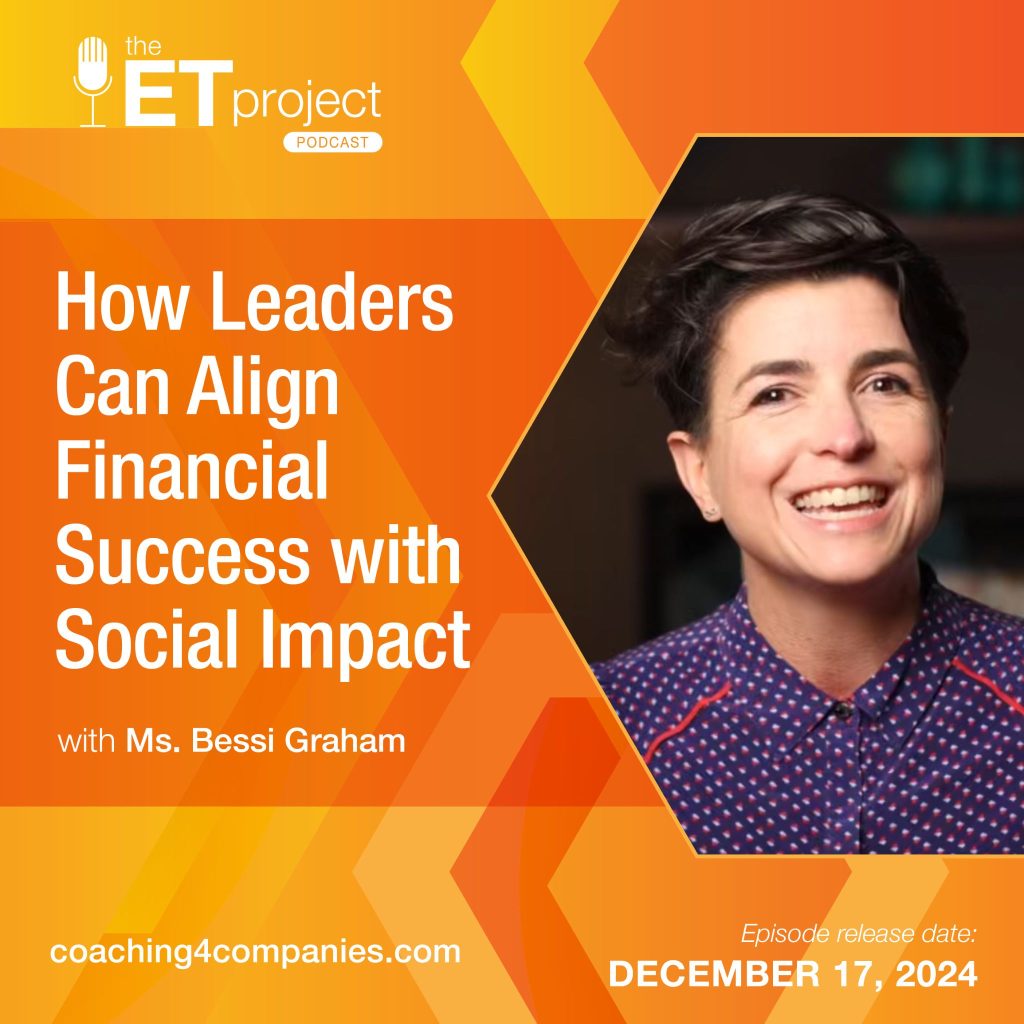
0:00:03.6 Wayne Brown: Hello. I am your host, Wayne Brown, and welcome to the ET Project. We’re delighted to be delivering this podcast for executive talent all over the world, whom we’re affectionately referring to as Team ET. Today we’re heading back to Melbourne, Australia and meeting up with our guest, Ms. Bessi Graham, and chatting with her about a subject she’s more than just passionate about, she’s invested in. With nearly 25 years’ experience working with business owners, governments and large funding bodies to merge money and meaning, Bessi’s experience spans from the grassroots of sitting in the dirt, working with business owners across the Pacific Islands through to the United Nations in Geneva. This has given her an unparalleled perspective as an entrepreneur, business owner, angel, venture capital and impact investor, philanthropist, coach and advisor, Bessi has done everything. From being a decision maker on Grant and Investment Committees, driving over $1 billion of capital into small and medium sized businesses, to using her own capital for grants to dozens of organizations and investing directly with both debt and equity in 42 businesses.
0:01:12.9 WB: Bessi has been engaged by governments and leading financial institutions to design capacity building funds, servicing multiple countries to build investment readiness in businesses in emerging and established economies. And setting up and being the cornerstone investor in the first impact investment fund focused on the Pacific. Much of our conversation will be centered around impact investing and the term that I’ve come to understand more fully, blended value. With investors and businesses alike, turning their money, as well as attention to this concept of finding the right formula to drive financial results while doing business in ways that benefits the society. This is a hot topic which needs our focus as well. So please get yourself ready as we embark on this journey of discovery together.
0:02:05.8 Speaker 2: Welcome to the ET Project, a podcast for those executive talents determined to release their true potential and create an impact. Join our veteran coach and mentor Wayne Brown as we unpack an exciting future together.
0:02:23.7 WB: Hello team. Welcome again to another great week. I’m going to throw a challenge at you from the very get go here today, and it’s tied into our discussion, of course, but I’m wondering how many of you would know the meaning behind some of the following abbreviations? Well, we’ll start with an easy one, I think. I’m guessing most of you are going to be familiar with. If I said the initials ESG, what immediately springs to mind? So that was a warmup. What about SRI? CSR? And perhaps even GIIN, which I had never heard of until I was doing some preparation for today’s conversation. So how are you going so far? What about if I asked you to define the activity of impact investing? Or perhaps even go a little bit deeper than that and discuss the strategies that sit behind this concept?
0:03:19.9 WB: Well, I’m guessing some of you by now have already realized that today we’re going to be speaking about what I feel is a truly powerful catalyst, which is starting to drive a shift in focus for many businesses. And that’s the union between the financial return that we’re all after. And a fostering of a more positive social and environmental impact through what we do. So, listeners, hopefully you’re on board. Today, we’re going to try and discover how this approach can not only benefit investors and you as companies, but also contribute to a more sustainable, even equitable future. Of course, this is not my forte. So here to help us with this conversation, and I have to say, and share her considerable insights, is our industry leader in this field, Bessi Graham. Bessi, welcome to the ET Project. Wonderful to have you with us today.
0:04:21.8 Bessi Graham: Thank you so much. You’ve dropped lots of little pebbles there that we’ll have to pick up on. [laughter]
0:04:29.5 WB: This is a fascinating topic around this whole impact investing, and I know you’ve been involved in it so heavily for a long time and I’m excited to learn more about it myself. So, as we always do, if you don’t mind, before we dive into that topic, if you can just share a little bit about your own backstory.
0:04:49.6 BG: Absolutely. Yeah, I think there’s lots of ways you could describe it. I often say that it’s about merging money and meaning. You could talk about it as you did in that element of doing good while doing well. Really at the heart of all of my work, and this does take us right back to the beginning of how I began to come into this space. It is about saying, “Ah, two things that seem like contradictions can be equally true.” And when we sit with and just be honest about ourselves as individuals and go, “Oh, I’m more than one thing. You can’t just put me in a neat little box.” And that describes me in my entirety. That exploration, that desire to have a broader sense of my own person if you like, me as a leader, me as a business owner, being able to show up more fully in my work was really what I was always looking for.
0:05:51.1 BG: So, if we go right back to when I was still at school, I was someone who was raised in a family where there was a strong sense of social justice. And wanting to contribute, that old saying, to whom much is given, much is expected. So, I was always interested in and actively involved in wanting to make a positive difference in the world. But what I realized very early on, was that I didn’t fit neatly or naturally into that charitable space or the nonprofit sector, and felt kind of boxed in by it, ’cause I was like, “Ooh, but there’s different ways we could do things and there’s elements I love about business and what if we thought about it in this new way?” So, I was wanting to push those boundaries. So that was one element of me. I was really involved in and studied in my undergraduate and postgraduate. Studied politics, international relations.
0:06:49.5 BG: My masters was in counter-terrorism, so I was interested in both the leadership angle of how do we get people to think and act in certain ways? How does a movement come about? So, I saw that role of both leadership and government as really important too, if we wanted to make a change in the world. And as I mentioned, there was this underlying interest in business and being innovative and solving problems. So really, if I look at the different businesses I’ve built and certainly the common thread across all of my work from a career perspective, it’s been sitting in that space of where can I work on projects or work with companies or design different interventions that tap into the best of the nonprofit social sector, that tap into the best of government’s role and the best of business. And that has been, really where it’s led.
0:07:49.9 BG: So, my… The clients and the people that I work with, tend to be in that space of business leaders. So privately owned small and medium sized businesses who really have the opportunity once they tune their mind to it, to make a difference, to make different decisions in their business, that mean that they can strengthen the financial stability of the business, but do it in a way that’s actually having a more positive impact in the world. And that brings us kind of full circle to that desire to how do we merge money and meaning, which for me is more important than any particular label you use. So if someone felt put off by the word impact investment or thinks, “Well, I’m running a business.” You’re still totally going to get things out of this conversation, ’cause it’s a pragmatic conversation that is in no way kind of saying, “Making money’s bad, you should give it all away.” That’s not what we’re talking about here. It’s really strengthening both. It’s a self-reinforcing loop if you like.
0:08:52.3 WB: You mentioned a word there before that took me a little bit out of the left field. Counterterrorism. You mastered in counterterrorism. Please elaborate more on this and what happened to that journey.
0:09:06.1 BG: Well, I still see it, it’s interesting ’cause a lot of people say, “Tell me the connection there, how do we make the leap from from there to where you are now?” When I mentioned those elements of leadership, how does a movement come about? How do you inspire and engage people to think and act differently?
0:09:25.6 WB: Right.
0:09:26.3 BG: There’s always two sides to every coin. There’s a reason why people are drawn to extremes and to really charismatic people who may end up having very negative impacts in the world. There’s still things we can learn in terms of the psychology and the style of how that comes about. And for me, in wanting to make sure I had as broad an understanding as possible, really seeing what makes people tick, how they are making those decisions was critically important. And I would say, that much of the work that I now do and how I work with companies is still informed by the thesis I wrote in my masters by understanding different leadership styles, understanding what goes wrong when we really misread the audience of who we’re trying to influence.
0:10:19.2 BG: And we end up kind of not being able to get traction. As business owners and business leaders, that’s critical. If we are talking up here and either our team or our customers just don’t quite get it, we’re not going to get that cut through. And so all of the elements around leadership, followership, charisma, psychology, all of those pieces that are key elements of understanding something like terrorism and then the counterterrorism piece of trying to shift that to a positive space are very transferable into both the leadership elements and definitely the business elements of running a solid business over time.
0:11:05.6 WB: How much would you build into that leadership discussion then? Narcissism, machiavellianism, psychopathic, the dark triad if you like, that they talk about in psychology. Is that also part of that factoring when you think about the counterterrorism or the terrorism and bring that to leadership?
0:11:30.8 BG: Yeah. So, I’m not actively going out trying to find and convert the worst possible business leaders and convince them to change. I’m very selective of who we work with and who we’re trying to strengthen and build their businesses. So, I wouldn’t say all my energy is going into those elements you’ve just described. What I would say is that we all have shadow elements. All of us have intended and unintended elements of how our leadership styles and our behaviors are having impact in the world. And where it comes down to the conversations that I have with individual leaders, a lot of it actually goes even further back into many of the different ancient thinking traditions, whether it’s ancient Greek philosophy or it’s the eastern traditions of, there’s this common element that I think more leaders need to sit with, which is around really where we all start.
0:12:32.5 BG: And the most important foundational question is around, “know thyself” was the older ancient Greek way of saying it. But that level of self-awareness as a leader, being honest and tuned in to your own shadow sides, to those spaces where you might get pushed into behaving in a way that is neither helpful for the company or aligned with your identity of who you wanna be and how you wanna show up in the world. Those are all conversations that we need to create space for leaders to have because I’m sure that you’ve found this and probably is part of why you have this podcast. As leaders, very rarely are we regularly surrounded by or supported in a genuine way of having people who will call us out, people who will say things that we may not wanna hear or that will be a sounding board for us. And so I take really seriously that privilege that when there’s trust and rapport there with a leader, part of my job is to put a spotlight, if you like, on things that might be uncomfortable, but that need to be addressed if that leader wants to actually break through to the next stage in their business.
0:13:49.9 WB: I’m guessing a number of listeners aren’t so familiar with the term impact investing. Do you have a simple definition for how you introduce what this is?
0:14:01.6 BG: I always think about it. I mentioned before that I worked with the first ethical investment advisors in Australia. Probably the first thing to say is that different people use different terms. Some people talk about responsible investment, some people talk about ethical investment, impact investment. So often they’re all kind of smooshed together and thought that they’re the same thing. For me, having been involved and exposed more than two decades ago to ethical investment, when I moved in about 2010 into the impact investment space, I was very clear on the difference between the two. So, here’s how I would describe it. Ethical investment in those early days, which has now been around for like 40 years or so, was about intention. So, it was saying, I’m actively thinking about and being conscious of where I put my money to work, whether that is about the bank I put my savings in and knowing where they’re investing that capital, or if it is in the shares I buy on the stock market or the companies I back if I’m doing direct investment.
0:15:06.5 BG: So, it had this intention, you were being thoughtful about where you put your money to work in the world. When we moved and impact investment started to become more popular in the kind of 2010 onwards place, and over the last few years has become more of an interesting topic that people are talking about. But the transition in the way I would describe it is that it was moving from having good intentions to having intention and measurability. So, it was about saying, “I’m actively choosing where I put my money to work, but I don’t just want to hear a hopeful good story that it’s having a… Making a difference in the world. I wanna be able to actually explain and see and manage that impact.” So, I can say, “This is what I hope to do and now I know that’s what my work’s doing.” So that’s kind of the distinction I would make is the impact investment is looking for the intention and measurability of the investments that you make with everything from savings in a bank, where you’re spending your dollars with you know, what you are buying et cetera through to something like a direct investment in a company.
0:16:16.0 WB: So that’s definitely the impact side and then the investing, what I find interesting is a lot of philanthropy, if you like, is providing the capital to do something. But this is investing and this is expecting that there is a return.
0:16:32.1 BG: Absolutely. That’s right. ‘Cause the critical word that otherwise you’re ignoring is the investment word. So, it’s not saying make a grant, it’s saying make an investment.
0:16:40.0 WB: Exactly. Yeah.
0:16:42.2 BG: And you’re absolutely correct that for many people there’s still a struggle with that. So, our work from a benefit capital perspective, constantly we’re talking to people about, there’s these unconscious beliefs we have about the purpose of business. There’s a discomfort for many people when you start to bring into the same conversation these ideas of contribution or making a difference in the world and then talk about making money, they’re like, “Ooh, hang on a minute. That doesn’t feel right.” So that piece that you’ve just spoken about is really important and it’s why I always say to people, there are a lot of writings and thinkers out there if you look up impact investment that talk about it as an asset class, I don’t think that’s helpful because it’s not one type of investment.
0:17:28.5 BG: Just like an investor has a portfolio and you’re gonna have different criteria you’re looking for depending on certain asset classes. Impact investment is a lens. So the way we think about it is you can look at anything through that lens of impact investment. So, you can be saying, “Okay, with the percentage of my portfolio where I’m willing to be quite speculative and if I lose it, that’s okay. I might make a really high risk investment in my impact investments.” But then if I’m doing something that really needs to be secure or needs to be liquid, then I can still take an impact investment lens. But I’m looking for something that’s lower risk that might just be a debt piece with a set return. So thinking of it as that lens, not one asset class you can invest across asset classes as an impact investor is really important.
0:18:18.4 BG: And then the other distinction I’d make when you mentioned say philanthropy, we have always kind of tried to point out to people that even a philanthropic trust, so even if someone is talking about their philanthropy, you wear different hats. So philanthropic foundations or trusts have what we in Australia would call a corpus. Whatever you call that bucket of money that you invest. Usually as soon as someone talks about their philanthropy, all they’re talking about is the granting, which is just a percentage of the money they make off those underlying investments. The granting dollars is a small part of the leverage that you have to play with as a philanthropist. Impact investment allows you for the first time as a philanthropist to be more conscious of what are we doing with all of that capital and now not just say our contribution in the world being with that small percentage of, depending what country you’re in, you have to give away 2%, maybe 5% of what you’re making.
0:19:20.8 BG: Well, okay, that’s nice. But the piece I always challenge people with is, if you’re ignoring what you’re investing, let’s say that with that 5% you’re granting to environmental projects, that with the millions of dollars sitting on the stock market, you’re investing in companies that are creating all that environmental degradation. You’re having more negative impact than positive. So, let’s be honest about that. You need to think about where you’re investing those dollars, and that’s why this conversation is really important, whether we’re looking at it with our investment dollars, our philanthropic dollars, or as business leaders with the decisions we’re making in-house.
0:20:03.2 BG: Wherever that conversation goes, or for anyone listening, you need to be able to go, “What are the decisions I have control over? And how do I look at the whole rather than just biting off this little bit and saying, I feel nice because I’ve made this donation or this grant here but ignoring all of the levers that were at your disposal.” I want people to be pulling on every element where they could be having a bigger impact in the world.
0:20:32.0 WB: Well, what I was really surprised by even preparing for our conversation was, I was reading some reports, and I think the Global Impact Investment Network.
0:20:43.2 BG: Impact investment.
0:20:43.9 WB: GIIN has recently released it’s 2024 report. If I’m correct, they were saying something like $1.5 trillion, through impact investing, which is a record that that’s a considerable year on year compounding improvement over the last five years. So, this is something that is really gaining momentum, I was totally taken back by that because I have read other reports, particularly with a number of companies in America, where the topic of ESG is starting to lose it’s shine. Businesses in particular were starting to push back and say, “We’ve poured a lot of money into ESG, but we’re not seeing any benefit and return, and now we’re going to commit less of our next year’s budget to moving in that direction.” And so, I see that there’s a little bit of a dichotomy there between the direction. I wonder what your take on that is.
0:21:48.4 BG: So those companies that are making the calls and decisions around pulling back from ESG, there’s two pieces I’d say related to that. For some companies where there’s been almost a sense of being disappointed by, or feeling like, “Well, that was a waste of time, effort, money.” For some of those, it is a decision that’s being made because they actually went about it in a token way, so it was kind of superficial, tick the boxes, say, “Oh, okay, if we have three women on our board, that means we’ve ticked the box of, we’re doing governance properly.” So, they’re doing things in a token way and they’re not seeing the results or they’re saying, “We have to show diversity, so we’re going to say that’s one of our values, and this year we’ll sponsor this event.”
0:22:37.0 BG: And so, they’re doing pieces performatively that look like they are ticking a box of either environmental, social, or governance pieces, the ESG. But they’re wondering why they’re not getting the win. So, to me it’s because it’s transactional. All of the work that I do with companies around saying, “I’m actually not interested in a performative transactional approach, that’s ticking boxes. I’m interested in understanding the levers you can pull in your business where you have decision-making rights and actually fundamentally making sure what we’re designing strengthens your business and plays out in how you behave and operate so that we create a win-win.” That embedding it into the operations of your business is a totally different approach. So, for some it hasn’t given the results they hoped for, because it didn’t actually fundamentally change how they operated. It added in layers of complexity, or cost, or just surface level pieces, but it was seen as an add-on not the core strategy. So that was one group and why they are struggling.
0:23:46.0 BG: For a whole bunch of other groups that are very verbally pulling back from ESG, it’s ’cause they were never committed in the first place, and actually what they’re going back to is what they fundamentally believe. Like so, they were using it as a green washing piece, the moment they could get away with not having it, they’ve just gone, but so nothing’s actually changed again in their fundamental underlying beliefs or values as a company. So that’s how I would respond to the elements that are pulling back from ESG, and I think it’s a misunderstanding of how you could use it as a competitive advantage in the first place in a genuine way.
0:24:21.7 BG: Related to the stats you quoted and the pieces around, that most business leaders are quite surprised when they actually hear the level of investment dollars that are going into being more conscious now of some of these things. Whether it’s environmental social governance or other impact investment things, where they’re looking, for example, at a particular theme or problem in the world, so they might be actively looking for investments that are contributing to a certain issue, like a gender pay gap piece, or that they’re contributing to ending homelessness. So, there may be a theme behind their investments.
0:25:00.2 BG: The piece that I love business leaders to think about is, even if for you, the driver of your business never seemed like it was this big social or environmental issue. You said, “We just make these amazing, let’s say water bottles like my water bottle here, we make this amazing product that we’re really passionate about, and we do that really well, so even if it feels not at that level of social or environmental.” The fact is that as you grow that business, either you might wanna take on private investment, you’ll certainly have insurance in the mix, you’ll have all of these different elements that play into the financial market, and those external players are now asking different questions to what they asked before.
0:25:54.4 WB: Yes.
0:25:54.6 BG: Your insurance companies are pricing the risk of your business, now considering the fact that the access to raw materials is gonna change based on drastic environmental elements of floods or fires, all of these pieces are playing into your business in a way they never did before. And from an investment perspective, I want business owners to be thinking about, “How do I have a sellable asset here? How do I, when I at some point do not want to be working at the level I am, how do I have something that if I wanted to, you don’t have to, but if I wanted to, I could sell this business.” Those kinds of conversations then lead us down that road of saying, well, “What are investors looking for?”
0:26:39.8 BG: And some of the research that I love talks about, say the environmental, social and governance pieces. If you actually have genuine, not those token bits we talked about before, but if you’ve embedded into the way you’re making decisions, how you actually track elements in your business around the environmental impact of your supply chain or your power usage or whatever is relevant for you, if you’re looking at those aspects of how your company is perceived in the community, when you look at how you treat your employees, the provisions that you have for them, your thoughts about their well-being and the safety of their work environment. And when you look at elements around governance, and making sure there’s not corruption and making sure there’s some diversity there. When we then look at how that plays out for investors, people who have embedded these practices have quicker deal time, which is really important, ’cause if anyone’s gone through being bought before, the due diligence and all of the work that goes into selling a company, that is drastically sped up when you have these pieces in place because it gives trust. It means you already have easily accessible data to back up systems and processes and what’s in place.
0:27:56.5 BG: And it also is shown through the research to increase the sale price, because there is value in a de-risk sense of how your business is set up for the long-term success, not just a short-term exploitative win. So even if someone isn’t driven by the social and environmental side, those questions are being asked of you by external investors, by banks who are gonna invest in you, by your insurance, by your customers. All of those pieces now, there is incentive, so you just start thinking about how you’re gonna approach that and do it in a way that’s not a distraction or a cost to your business that isn’t connected to actually strengthening the business long-term. I want people to think about it in a way that means, you don’t have to justify it, you actually can say, “Well, in doing this, we are strengthening that financial stability of the business, we’re de-risking it long term, and we’re now spotting opportunities quicker.”
0:28:58.9 WB: Well, one of the challenges that I’ve experienced myself working at an operational level, versus sitting on a board, is that disconnect. So, on the one hand, we have to satisfy the investors through that financial return. In some industries in the early days, the cost associated with being a socially responsible organization, tends to be a little bit prohibitive against their bottom line result in some instances. Now, as it matures, and solar panels are an excellent example, or wind turbines, now as that industry matures and the costs come down, then the excuses are stripped away. Now I’m sort of breaking my question in half here, but there’s two elements for me. One is that pressure that the operational group fail to perform and achieve the requirements of the board and the investors. And therefore to spend effort and energy fulfilling the need to be more socially responsible and have the right governance becomes a big challenge. And on the other side, the ability to adapt and be flexible enough to accommodate these often new technologies, new areas, is also a considerable challenge and very much so for large organizations. I’m on board with the whole movement and the direction, but I also see the challenge that businesses face in moving that way.
0:30:40.6 BG: Yeah. And look, I think that it feels like more of a challenge if you’re still sitting in that unquestioning acceptance around, there’s these two options and it’s all or nothing, is it all in on we’re just giving this purist idea of contributing and not only taking away the negative impacts, but we’re massively contributing to environmental improvements, etcetera, or we’re just doing that short-term profit maximization. If we stay in the unquestioning of like, “We have to go to one of those extremes.” It is, as you said, very prohibitive to engage in some of these conversations early on.
0:31:27.5 BG: The reason why it’s important to therefore start with breaking down that mindset and those approaches about the beliefs of business, and about what contribution actually means, we have to start with that, because if we do that first, then we can have really real conversations with either investors or customers or team members that say, “Look, we’re not trying to go from zero to 100 in one hit, but we have thought about this and we can explain how over X amount of years, here are the steps we’re gonna take.” We want to get to a place where we’re operating like this, but without breaking the whole business in the process, that has to have horizons if you like, we have to come at this in a staged approach. And people respect that if you are honest.
0:32:16.2 BG: If we go back to some of the push-back around something like ESG, where people get tripped up is by thinking they have to present this completely unrealistic sense of perfection straight away, but then they’re not delivering that. If I’m buying your product, so say for example, there’s a company here in Australia called T2. All I drink is their tea. I love it. And I had conversations many years ago now when they brought on… So they’re a B Corp, a B Corporation is a type of status that you can take where there’s some external accounting for and looking at are you actually doing the things you’re saying around environmental social governance issues.
0:32:57.1 BG: And I had a conversation with them around, okay, but there’s a lot of plastic in your packaging, talk me through some of this bits. And they were really honest, and they said, “Look, we know that, we have the challenge of in order to keep the tea fresh and sealed, we don’t have an alternative at this point, but here’s what we are doing, and over this.” So, they explained the logic. Now, multiple years later, all of the plastic inside is biodegradable. They had to get to that place. But they were honest with me, they didn’t pretend and then, me feel tricked as the person engaging.
0:33:33.8 BG: So, I think part of it is just about that being honest of, here’s what we’re doing, and I can answer your question, we have thought about it, but I’m not promising the world and then disappointing you. It’s also then this element, one of the main tools that we train people in is using the Business Model Canvas. I’m not sure if you’re familiar with it, the one page. Now, it’s a tool that is deceptively simple, and most people only use it in a simplistic way. When you master business modeling, one of the best places to innovate on your business model is in what’s called the back stage, which is when we look at key activities, key resources and key partners.
0:34:17.5 BG: What’s interesting is most people, when they feel that pull that you described of like, “I would love to do this. But it’s too expensive or too time-consuming. I’ll get to it one day, when we’re bigger, when we’re more profitable. If you learn to business model well, in the back end of your business, the opportunities to innovate their move you out of just feeling like your only options are to raise prices or do a massive cost-cutting exercises. And it allows you to start doing things like saying, “Okay, if we’ve identified that because we produce a certain product, if we’re having a massive negative environmental impact here, we don’t have to straight away go to a really expensive solution, but we have to look at all of the elements we can play with.” There’s a great company here in Australia called “Who Gives A Crap.”
0:35:07.2 BG: Please excuse my language. It’s a toilet paper. Great company, have a look at them. They did this innovation really well by actually looking at the broader system and realizing that keeping their manufacturing in Australia was actually increasing their environmental damage because they couldn’t get access to enough already used recyclable materials, and they were using trucks for freighting things around. And when they found what would, for many people, seem like an option that would have worse environmental impacts. When they found particular angles where they could produce in China, they actually found an ample supply of recyclable materials, and now were able to ship direct from China to the international markets, and shipping was much more effective in terms of it reduced their environmental damage than using trucks, and they could now have ships taking it to Europe, to the US, to Australia. In the process of improving their environmental impact, they reduced their costs in the back end.
0:36:21.8 BG: And it wasn’t a matter of, “We have to make sure we’re taking all plastic out of our packaging regardless.” They could take all of that out and drop their costs, because they worked the business model until they found the win-win. And I think in many instances, we’re too simplistic of going, we need to reduce plastic, so that means we need to go for a more expensive option rather than thinking like zoom out a bit and figure we’re not finished playing with designing the business model until it stacks up on all of those sides.
0:37:01.8 WB: If you’re now putting your cap on as an impact investor, what’s the criteria for you making an investment into a company from a measurable successful outcome?
0:37:14.4 BG: So again, because I see it as a lens, not an asset class, each investment is different, so if I’m investing in a really speculative piece, I’m only investing money I’m willing to lose. ‘Cause I know it’s speculative.
0:37:28.5 WB: Right.
0:37:30.0 BG: That’s very different to if I’m saying, “I’m gonna put a debt piece into this, so I have some direct investments with companies that are dip, so lower risk.” My expectation of return is lower therefore, and I’m looking at that in different ways, so I think I have to clarify that piece first, that each investment, it depends on the type of investment.
0:37:49.7 WB: Yeah, absolutely.
0:37:50.9 BG: If I go to kind of a high order answer to that question of what does success look like? What I’m looking for in every investment, is that we’ve incentivized the right behavior. And what I mean by that is, from a business model perspective, can that business explain to me how in increasing their revenue, their profitability, the money that they’re going to be able to therefore pay back to me as an investor, is the way that they’re doing that, is their understanding of their own business connected to, that it will only grow and make more money if it’s actually doing the elements on the business side that are improving that social or environmental aspect of what I’m looking for.
0:38:42.1 BG: And I wanna clarify that I’m not just talking about, “Oh, it’s creating no plastics in the ocean. Or it’s ending poverty.” I’m not talking about dramatic things, it can be down at that level of that the social element of what they’re doing is that they’re paying their staff well, is that they’re ensuring there’s safe conditions and that the well-being of their staff are taken care of. That’s a really important social element. We sometimes romanticize and think that it’s only having a positive impact in the world if it’s huge and it’s at the level of poverty alleviation. All of us know the impact that is had if we are working in a organization that is toxic and stressful, and we go home angry and agitated and have that kind of infect all of our families and relationships.
0:39:35.0 BG: So depending what that business’s focus is, whether it’s something internal like team and culture, or whether it is about making their products accessible to a certain group in society. It can look very different, but whatever it is that they’re trying to do in the world and hang their hat on, I wanna understand that the business model is built in a way that it’s only growing and making more money if it’s delivering on that. I don’t wanna see a mismatch where we’re incentivizing them to, “Please make as much money as you can. And maybe if there’s a little bit left over, you can do more good.” I want the business model to show me they’re connected to each other.
0:40:19.9 WB: Let’s say I’m a small investor, I want to go down this path, where can I find this level of detail? Do I find it in their annual reports?
0:40:32.8 BG: So it depends. Some of these investments, if you are, a lot of the investments where I’ve made direct investments, I’m having conversations with those that are running the business, so that’s a very distinct piece. If you’re at the level of what’s called a retail investor and you’re just one of many, or you’re investing on the stock market, you only have what’s publicly available. And so that element is gonna take a different level of research or due diligence of choosing these companies. Part of it, is sort of sitting back and looking at some of those pieces we talked about before of trying to check, “Am I feeling a dissonance between what they’re saying and then how they behave?”
0:41:18.3 BG: “Am I seeing a difference of like, there’s this token kind of nod to environmental aspects, but when I look at, I’ve ordered their product and when it comes, I’m a bit off put by the amount of plastic or by… ” Think through, where do I see a disconnect? So don’t just take what they say on their website and then believe that. As you said, when we look at something like a publicly available report, people can say whatever they want in those things. So you’re gonna have to do a little bit of digging or talk to people who are invested, look for interviews with the owner, find those elements where you go, “I’m really loving that it seems like there’s consistency here between what they’re saying and what they’re doing.” So you can still look for that through things like even look up past employees and what they say about the organization.
0:42:14.6 BG: You’re always gonna have to be discerning in it, because sometimes someone might say something horrible just ’cause they felt ripped off ’cause they got fired and actually the company did nothing wrong. Nothing is gonna be perfect even when you do the conversations yourself as a direct investor. I’ve made plenty of investments directly where I absolutely backed those people, and they screwed me over. You get it wrong sometimes, but you can’t allow that to make you do nothing. I think it’s that piece that I spoke about in those early days of ethical investment.
0:42:49.9 BG: Intention still matters. So your desire to go, I’m looking to actively invest in and pick what you care about. If you’re thinking about a particular issue in the world that is important to you, you can start. You don’t even have to go straight to the investment, you can just start with the dollars of where you’re spending money and look for companies. If you really care about youth or education, then look for companies where you go, “I really like the way that they behave or support this bit or how… ” So look for aspects that you respect, start small and just start asking questions. You’re always looking for, “Okay, is action matching rhetoric?”
0:43:33.0 WB: Yeah. Where can people go if they want to learn more about what you’re doing and connect with you?
0:43:39.9 BG: So, if they wanna connect and actually have a bit of back and forward, LinkedIn would be my favorite platform for that. And then if people are wanting to head to a website or dig around a little bit more, and we can share links either benefit.capital, so that’s our Benefit Capital site or bessigraham.com, so they would be from a website perspective, the places to go.
0:44:02.3 WB: Bessi, great conversation. Thank you and I look forward to staying in contact.
0:44:07.7 BG: Thanks Wayne. Really appreciate it.
[music]
0:44:10.8 S2: Thank you for joining us on the ET Project, a show for executive talent development. Until next time, check out our site for free videos, e-books, webinars and blogs at coaching4companies.com.