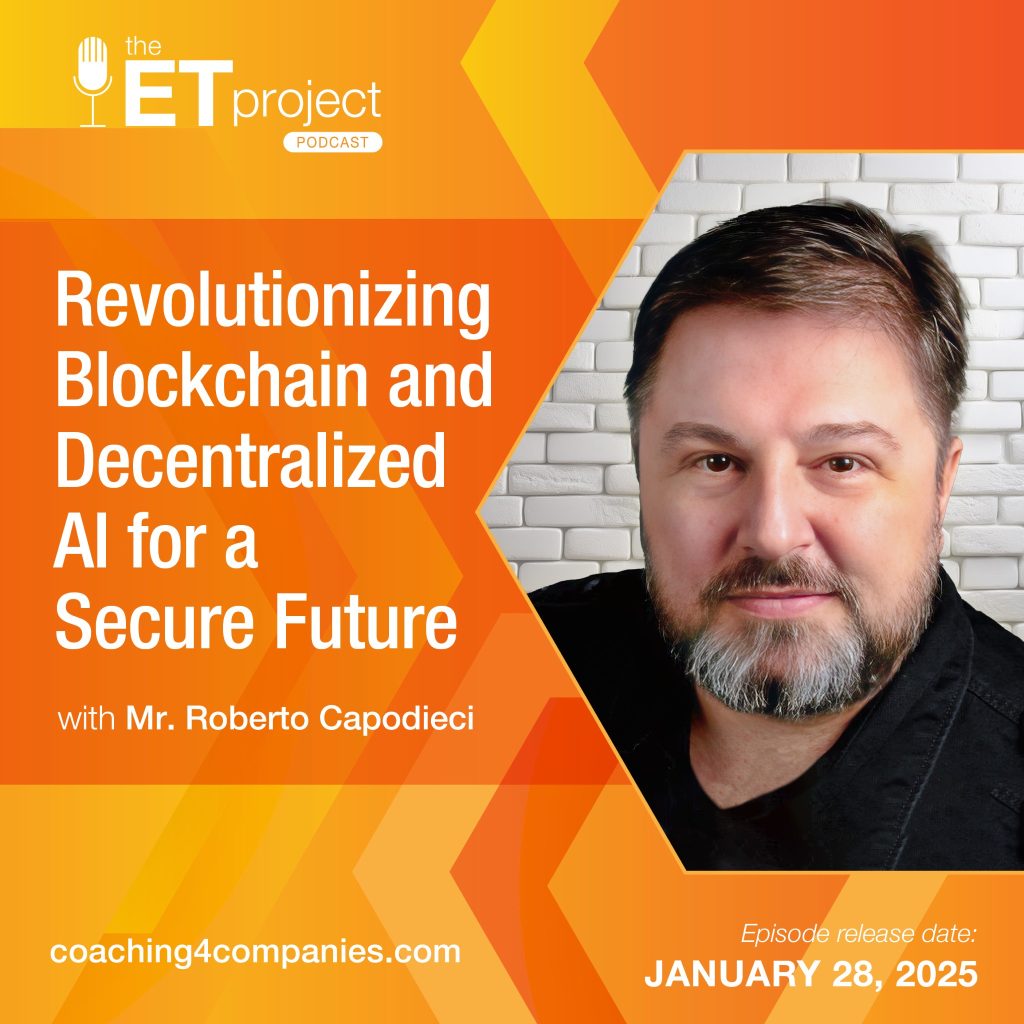
0:00:09.4 Wayne Brown: Hello, I’m your host Wayne Brown and welcome to the ET Project. We’re delighted to be delivering this podcast for executive talent all over the world, whom we’re affectionately referring to as Team ET. Today we’re visiting the shores of Bali, Indonesia to chat with our guest IT and Blockchain legend, Mr. Roberto Capodieci. Roberto is a true powerhouse in this technology space, having sold his first software program at the age of 10, later commissioned to assist the FBI and the NSA and being recognised for his contribution by President Clinton. However, it’s in the field of Blockchain where Roberto has really made his greatest impact. Starting in 2013 by founding ventures to explore its application in secure document management and international trade to creating systems that leverage Blockchain for secure online agreements. Roberto has been pivotal in designing decentralized solutions across multiple sectors. His strategic insight is driving the advancement of layer 1 Blockchain technologies and secure custodian ecosystems. Today, Roberto is at the forefront of developing a play to earn platform within the Metaverse game and leads the charge by decentralizing AI focusing on creating an ethical, sustainable and precision driven AI platform. He’s also pioneering a Level 3 AGI designed for autonomous operation across various industries.
0:01:41.0 WB: Team, if you’re anything like me, when it comes to the latest developments in technology, I find them fascinating. But I’m miles away from grasping the mechanics behind the applications. And as you’ll hear in our conversation, Roberto is the maestro in simplifying the complex and creating a vision that’s both compelling and easy to grasp. With the first month of 2025 coming to a close, this is a subject where we all need to establish a baseline understanding and Roberto certainly helps us to achieve just that. Please get yourself ready to learn and grow while enjoying this conversation with our guest, Mr. Roberto Capodieci.
0:02:21.4 Speaker 3: Welcome to the ET Project, a podcast for those executive talents determined to release their true potential and create an impact. Join our veteran coach and mentor, Wayne Brown, as unpack an exciting future together.
0:02:38.2 WB: Hello team. Welcome to another episode. We’re having a fascinating discussion ahead today and a topic that I feel at least is often seen as puzzling for many of us. And that’s the mysterious world of Blockchain technology. It’s a revolutionary force and it’s been around for a while, but it’s still revolutionary and it’s spread its wings across industries from its origins in finance and through our guests. Today, we’re going to be exploring the current Blockchain landscape, its unique security features and future possibilities that I’m sure will be intriguing for you as well as me being leaders and innovators. So please join me in welcoming Our guest, Mr. Roberto Capodieci to the ET Project.
0:03:23.8 Roberto Capodieci: Hello. Hey. Thank you for having me. It’s a pleasure.
0:03:26.7 WB: You’re sitting in an enviable location for many people and I wonder if you’d mind just introducing or painting a picture of where you are at the moment in this world.
0:03:37.0 RC: Absolutely. Is 20 years, 21 is going to be this 2025, 21 years that I live in the tropical island of Bali, Indonesia. And…
0:03:47.9 WB: Is it warm? Sunshine?
0:03:51.3 RC: Oh, it is always, it is always nice. I spent 10 years in Florida, which was also a very beautiful place. And I born and grew up in Venice in Italy. So all touristic destination. My idea is people take the bother to travel around the world to go in a place, why not just live there? So that’s why I am here.
0:04:10.4 WB: And we were just talking before we hit record about your shirt. So this is the original Pac-Man game or the Space Invaders game or something, right?
0:04:19.4 RC: Yeah. I am a little bit nostalgic with technology. I like some retro stuff. So when I saw this T-shirt I couldn’t not get it. It’s brilliant.
0:04:31.4 WB: Well, I think it’s very apt. I mean you’ve been in the industry more than 30 years, right? In the technology industry. I can only imagine the change that you’ve witnessed over that period. Is there anything that really jumps out at you as I asked you that question? Like a highlight over that period that you’ve seen happen and probably been part of, I guess?
0:04:54.6 RC: It is interesting. There is a very funny story and a very analogy. When I got my first home computer was a Commodore VIC 20. This computer was really like, I think a wristwatch today is million times more powerful. It was really. And a classmate of mine came to my home and see, he wanted to see this computer and he wrote inside a farmer has to cow. Each cow makes 5 liter of milk per day. Blah blah, blah, blah. Enter and the computer says syntax error because it wasn’t, you know, code for computer. And it’s funny that now in 2025 I can finally put this into an artificial intelligence prompt and I get real responses. So I can show finally to my 6 years old friends that came to my house that finally I have the computer that if you ask about their cows and their milk, it can give you a correct answer. It took 45 years, but we got there.
0:05:57.0 WB: Very nice. You’re recognized internationally as one of the leading experts in the technology field, but particularly in the area of Blockchain. And you’ve been instrumental, I imagine, with so many other people during your reign. You’ve been CEO, CTO, you’re an independent consultant. Most of our listeners are leaders. And I’m wondering, how would you describe your leadership style? Like as you work with other people, what sort of style do you take on board?
0:06:32.4 RC: In an industry where intellect is the machinery that produce the product, people are to be taken care in the best way as possible. Right. I always explain to people, if you have a printing company where there is a printing machine and you just need Omer Simpson to press a button once in a while is very easily replaceable, not a big deal. But when you’re serving client and the product comes from a team of people sitting at the office, it’s better that these people is performing well, is treated well. So leadership toward people that need to squeeze their intellect is a very particular thing. Sometimes I think I am a perfect candidate to be a kindergarten teacher. Other time I am the psychiatrist and psychologist. You know, for very difficult cases is very interesting. But you also have to deal with very intelligent people. But very good developers sometime have a personality trait that is not the easiest to deal with. So it is an interesting challenge, I have to say. In fact is a computer and humans the skill set that doing this job puts in life.
0:07:49.4 Speaker 1: Over there, you know, three decades plus period, has there been any really significant pivotal moments that has influenced you and your career directory?
0:08:00.7 RC: Well, I’ve been loving telecommunication way before the Internet, way before many things. Even just the fact that I can pick up the phone and dial a number on the other side of the planet. It was an exciting things, you know, reaching far distance without moving physically with the body. And so all the things connected with the communication or communication obviously when Internet came out was something so amazing. But even before that I was navigating through packet network and other things. Sure. Peer to peer network are fascinating things and I am happy to explain very fast why they’re important, why Blockchain is important and how they work. Mostly because they are like an animal that lives his own life. So they are something that is undestroyable and supported by these networks that there are. So I think really the important milestone in advancing technology that have shaped me or pivoted a little bit my directions are for sure the Internet, the peer to peer network. And now with artificial intelligence, the game is going to be completely put upside down, which is an interesting aspect.
0:09:16.2 WB: Yeah, I’m fascinated by what your perspective will be and it will come to that a little bit later about AI in the future. But at the moment, reading through your bio and looking at everything that you’ve done up until this point is quite incredible. At the moment, from what I understand, you’re working on a number of different areas or projects, but there was one that I read about that I’m puzzled by. So I’m going to ask you to explain if you don’t mind. Decentralizing artificial intelligence. So I understand the whole concept of decentralizing, et cetera, but what does it mean to decentralize artificial intelligence?
0:10:01.2 RC: Well, artificial intelligence is something that is fascinating, scary. At the same time, you think that we already pass human intelligence with artificial intelligence. So this is something quite scary and is happening. And you have this machine that practically has all the knowledge of the world, which no human can have ready and can think million times faster than a human. It’s like if you think maybe trees can think and communicate, but they do it so slow that to us they seem, you know, like something no moving. Probably we look like trees to artificial intelligence in a certain, in a certain way. I do believe that leaving such a power all in the hand of a single company where 10 people even less decide what it is, you know, like. Humans are very easily gullible.
0:11:01.7 RC: We can be taken for a ride very easily, mostly from somebody that is, you know, think if you meet somebody, that is what we can call it, a very simple person, you can take this person for a ride, telling some stories and this person will believe you. Okay? We are that even less than that to artificial intelligence. So it would take nothing. And there is a lot of people that rely on their life now. So AI became their confident, their place to go for suggestions. So there are some scary parts. Leaving everything in the hand of little few people is dangerous. Decentralizing it means that 10,001 million people, they all contribute a little bit and nobody has the full control of the system. So it grows with very different inputs, so it grows healthier. And at the same time, there is no way to address this thing in one particular direction.
0:12:03.2 WB: So that sounds very similar to the strategy originally with Blockchain.
0:12:09.8 RC: Yeah, that’s correct. In fact, with the centralization, the paradigms change. When there is a middleman in a transaction, which can be even a conversation with AI transaction of any sort. I’m not talking financially. When there is a middleman, there is on one side, they need to trust this middleman in reporting, in making things in an honest way and correctly. But on the other side, if I make a mistake the middleman can help me avoid the trouble. When things are decentralized, you remove the middleman, 100% of the responsibility of what they do falls on me. You know, on every party that participated to this thing. Financially means I send the Bitcoin to the wrong person and I hope this person return it to me or is forever lost with the bank, it would bounce or something like that. I can call them and stop a transaction. With many other transactions that are not financial, but are human is consultation, is whatever else. You don’t have, for example, all the censorship that there is now. Censorship is applied and the emitting of any information. So they stop people from posting, or they shadow ban people, meaning that whatever they post, nobody see it.
0:13:31.1 RC: So people think they posted, but it’s like they didn’t. While when you have a system like social media that is decentralized is hard to stop, but you can decide what you don’t want to see. So the paradigm shift. So there is everything good, bad, the criminal, non criminal. And I’m now supporting criminality. Somebody does something criminal, police should go get them, you know, but meaning that the filter is on the other side. The filter is on the receiving part. And this is an interesting aspect also when you see how many other applications can be deployed in a decentralized manner.
0:14:09.1 WB: If we then start to focus our discussion around Blockchain, how would you introduce or explain the functioning of Blockchain to somebody unfamiliar with technology, somebody like himself? Is that the way you would explain it or how would you introduce it?
0:14:28.4 RC: In 15 years? I explained it a million times. So I learned how to. And this is the interesting aspect. We are in the information era age, call it as you want. We went to the Bronze Age, industrial era, whatever it is. Now the commodity is information. And it’s very clear in many cases it’s really the commodity information. And the information started to be just a printed newspaper on paper. I’m not talking about digital, I’m talking about really information in the meaning of espionage, of whatever it can be. But we are shifting into the digital moment, the sub phase of this year at this age. And when information was analog, it was very easy to identify an original, to sell an original. You know, like if I have a painting, I can sell you the painting. I can try to make a copy, but can be seen that is a copy. If there is a document with all the jobs and stamp, you know, you know that this is the original rather than not. As soon as you make it digital, you can copy and paste the bits and bytes and the copy is one to one, identical to the original.
0:15:45.9 RC: And this, without realizing, is really slowed down the evolution of this bridging or this moving from analog to digital, because we still had to rely on a lot of analog things, you know, when they could have been digital. If you think the power of the Blockchain, cryptocurrency is one of those millions of cases that can be obviously interesting because people love money, you know, but unfortunately also because the destruction with all that. But with Blockchain, you can make something digital, you know, unique singularity. I cannot copy and paste my Bitcoin and give it to you, because if I could do that, Bitcoin will be worth zero. So once I give it to you, I don’t have it anymore. And seems a silly things, but in the digital world, this is an amazing revolution because once you have the capacity to create something that is unique, think about the NFTs, all these people buying, you know, images of monkeys for millions of dollars. Like, to me, it’s crazy. But the excitement part was the fact that they can own a unique piece of digital something. They can show the ownership, they can resell it to somebody else, which means that beside the monkeys, which is crazy, in practical life, I can represent an ownership title in a digital format.
0:17:11.8 RC: My car is mine because the certificate is digital, and I can sell it to somebody without the need of the middleman just transferring the digital certificate. And if you think all these things use cryptography, which is way harder to tamper or fake or falsify compared to a signature on a piece of paper, which, you know, is opinionable if it’s the original or not. So in reality, we have an advantage now to move a lot of functions that are, you know, still analog in the digital format without the need to think that this PDF was the original one, because we can certify it as original and we can also control the flow so of information, because Blockchain has rules. So when somebody does a transaction, these rules, if they are not followed, the transaction bounce back.
0:18:13.2 RC: I cannot transfer, I don’t know, 10 Bitcoins to you if my balance is 5. Okay? And this is a simple rule, but if I had the doctor to issue a health certificate for me in digital format and the government certified the doctor as an actual doctor that can sign a health certificate and I go to the gym to register, and they want my health certificate and I can share with them. You know, this has the guarantee that nobody faked any document. And if things are not good, the flow can automatically stop something from happening. Think about corruption, think about the speed of things that can happen. Because you know, digital things can travel electronically. Don’t have to be shipped with the courier somewhere. So the Blockchain has a huge potential in making our life much better. And it’s getting applied. Yeah.
0:19:09.3 WB: You’ve touched on something I was curious about as well. Is when Blockchain first was the buzzword. It was really focused around the cryptocurrencies. The financial industry if I’m correct. But today it’s so broad. I feel it’s still in its infancy, but I’m not close to it. What’s your feeling about where it is today and how much further do we have to go with the technology? Like are we just at the beginning or are we advanced already?
0:19:43.8 RC: We are advancing. Consider that the Blockchain as not being invented as an end to itself. It was a simple solution to create Internet money, Bitcoin. So it’s not being developed thinking in absolute terms. Has been implemented making a big mistake actually in the concept. The conceptual mistake just to do the Bitcoin thing, is being applied for other uses without being drastically changed from bottom up. So eventually new modified but is a slow process because it’s much more convenient to take out of the shelf something. You know, people don’t want the artisan to take three months to build the table. People go to Ikea and it’s mounted in a second. And this is limiting the quality of the products that there are. But slowly we need to have… That’s why I call it Blockchain but not because it’s such a term that is not really defined precisely. They call the centralized ledger, which is not true. There is decentralization systems that work on a peer to peer network or federated networks that allow to do many many interesting things in a secure way compared to the Bitcoin one. As technical solution. Bitcoin is a brand is going to be there forever with the engine to run it maybe change with time, I don’t know.
0:21:14.4 Speaker 1: If we look at the whole process, one of the big advantages that I used to hear about were how much more secure the process was. What were or what are some of the unique security features? I know you touched on a couple of it at the beginning there. But what are some of the unique features that make this whole transaction process so secure?
0:21:41.4 RC: The peer to peer network is one of the basis mean that the uptime which is in computer system one of the important things. So if you set up a server to provide the service around how many hours of downtime the server had. Once something is replicated 10,000 times, maybe some of the servers go down, but all 10,000 together is impossible. So the fact that is 100% of time, okay, I think in the Guinness world of record, the Bitcoin network is the longest peer to peer network. Or maybe the BitTorrent network, if it’s considered as well, is even longer than the Bitcoin network. And this is one, second is the practical application of cryptography. Because cryptography is a science of mathematics that does beautiful fascinating things and is fully applied for cryptographic signature. So you sign in a cryptographic manner. Those things with the quantum computing put at risk some of those old things. But we evolve also to be safe from quantum computing. But it is at the moment, so if applied correctly, it is one of the safest things in the world. So people need to come to me and point a gun on my head to make me say something.
0:23:00.3 RC: But another thing is the method in how data is managed. When there is a centralized place, for example, a big chain of shopping malls have all the data of all the customer in a central server. If an hacker breaks in that server in one only break in, he has millions of data of millions of people. Once you have data distributed in peer to peer network, where there is impossible to use username and password we use cryptography. The data you need to, if you want a million data of million users, you need to go and hack 1 million people. There’s no single hacker there. So in these terms, the old systems are way more secure. Obviously, at the end of the day, the humans are the weakest, you know, moment of the old system when they come to security. But.
0:24:00.5 WB: Right, and is that the biggest limitation or vulnerability the human interface with the whole process?
0:24:07.8 RC: Yeah, actually, yes. It’s complicated and even experts get fooled. One guy sitting next to me lost a lot of money because opening a website to access the Blockchain was clone copy, identical to the original one. He didn’t realize, he puts his sensitive information inside and lost the funds. So it is risky. And because there is no regulation, there is no laws, et cetera, et cetera. Now there are start putting them on. But you consider it’s [0:24:43.8] ____ 10 years, go ahead. It was a safe crime to commit. Meaning that I remember the first case where I chased stolen cryptos in 2014, I think, and I was in Italy. I went to the police station and I tried to, you know, file down a complaint of stolen cryptos. This guy was, what did I… They didn’t Understand what was going on. But that was funny.
0:25:13.0 WB: You had a company, I’m trying to remember the name of it now in Singapore, and you were working, I think it was, gosh.
0:25:21.5 RC: Blockchain Zoo. SimFly.
0:25:25.3 WB: Well, SimFly you still have, I think. Right.
0:25:27.6 RC: But yeah, also Blockchain Zoo I still have it.
0:25:30.5 WB: Yeah, yeah. Anyway, you were working on a lot of those areas of vulnerability with this group. Based on what I saw in the video. I can only imagine that over time, like everything, you identify a weakness and then you find a solution towards it. And I imagine that’s what’s been happening with Blockchain and with the whole process. Would that be accurate?
0:25:55.6 RC: Yeah, absolutely. Is illiteracy. Consider there are two aspects. Software developers, it’s like learning a language if you want. It’s a mental model that you need to implement a software. And I don’t know how much Cs apply anymore because with ChatGPT or Claude AI, the code comes out like a fountain from AI. So there is no more [0:26:20.2]____disrespect of coding. But as soon as the mechanics of what you’re coding change, the paradigm of how you need to think change. I saw the very good developers from the day they start working the centralized system to the day they start understanding a little bit how they need to implement things take six months. And people after one year and a half who came to me say, and now I get it. Now I get it. It is that complexity and the fact that there are so many tools that help you to do everything without really understanding how things works. Create a lot of vulnerabilities later. So. And we saw so many cases that are [0:27:02.3]____Does it go large company that had software that you know, in terms of cryptos as well, that was not well done.
0:27:12.5 WB: I think the name of the company was Blockchain Zoo or Business Zoo.
0:27:16.8 RC: My company, Blockchain Zoo. That’s correct.
0:27:20.0 WB: Talking about that. Like you mentioned SimFly, from what I can read about it, it sounds very futuristic and very interesting. Is it easy to introduce?
0:27:34.1 RC: Let me add this is something very interesting because is a play to earn. Play to earn are this strange concept that you play video game and you make money while doing so, which sounds like a ponzi scheme because how can somebody produce money to give to somebody if. And in fact, I always refuse to work in projects like this and also ICOs and other things which I never found ethical. But this SimFly is something that is very interesting because if you think it correctly, the power of creating an ecosystem where people that has an interest navigate through and giving these people two roads. One the need to purchase into the ecosystem assets to make their experience better. And on the other side do something that takes real work and hours in order to produce one coin if you want. And this coin has a value because the value is the work they have to do to make it is not pulling for free from the sky. As it is when I go to my work and they give me the salary is not so different. And so this creates a mechanics where you have a need or request.
0:28:55.2 RC: So the user is going to purchase the asset to stay in the in the ecosystem. People that has money want to buy this token from the others. So I can take a sit in my simulator fly the airplane. I need to do perfect landing. So I mean and I talking about it’s not easy. Fly simulator is not a game because you need to really know how to fly an airplane in order to to use it. And if this make me produce some coins 8 hour of flight. So not something that you know. And these coins are of value because I can buy an airport in the system. But there is somebody that doesn’t want to spend it on flying but want to you know a shortcut and give me $50 for these coins. And then I earn some money playing a game. And it is incredible how these mechanics create a sort of a vortex. I am mind blown when I started when I because I took a Sabbatic because I was very stressed with a big project. And I started mentoring startup. This startup that came to me asking me to mentor them. And I end up becoming a business partner and a full time for a period, now I’m off.
0:30:08.4 RC: Now I’m working with them. Because it’s been the shift to make me understand the mechanics of a play to earn that is ethical. There is no ponzi scheme or pyramidal scheme of any sort. But is the mechanic of the ecosystem that creates need, offer and demand. And it’s beautiful. We have 13,000, 14,000 subscribed users. The machines work. People are fascinated. I am mind blown by the experience. I learned so many things in this past two years that I that I’m part of this. Has been really an amazing. It’s still an amazing experience and outside my normal kind of work. So it’s been quite fun.
0:30:55.0 WB: Is this the next generation of the gaming era? Is that what this is?
0:31:01.1 RC: In fact, if you think about it, the way we said about Blockchain before. You can have a unique asset. So when we’re talking about Web1, Web2, Web3 if you want to know the real definition of this. Because people think Web3 is the virtual reality, et cetera, et cetera while no, it’s the interaction between us and the network. So in Web1 you go in HTTP so there is links to go and visit. In Web2 you start getting services that you can purchase. But every place you go you have a username and a password. You are a different person. So I am a user at the bank. [0:31:43.0]____user at the bank has nothing to do with the user at the Gmail. There is nothing to do with the user at the other system because each one is different. With Web3, the identification, the login system is cryptographic.
0:32:00.8 RC: So my persona is the same everywhere I go. And because things can be attached to my persona. If, for example, because in the gaming industry means that if I purchase this sword I can use it in three different video games. Because and if I’m wearing a green jacket, I appear with a green jacket in three video games. But if you think about it, in the real world, in the real life means that if I go to the dentist and he makes an X ray, this X ray belongs to me and stay with me. If I’m traveling on the other side of the planet and the tooth aches and I go to a dentist, I can pass them or they can see with my authorization my X rays. Because you are the same identical signature and you know, persona everywhere you go.
0:32:49.9 WB: It’s fascinating. It’s a different world that I grew up in. Probably you’re involved in it, but for people outside looking in at my age, it’s an entirely different landscape to what I’m used to. So I find it extremely fascinating.
0:33:05.7 RC: And it is.
0:33:09.5 WB: Where do you see the future going with maybe not only Blockchain, but with Blockchain in particular?
0:33:17.1 RC: Well, in the moment that the application of this technology, artificial intelligence and Blockchain are done in a way I think they should go more bottom up than top down because the interest of SAMs and time can be like, you know, an obstacle to share. But I think that if you think Zuckerberg meta start making important model of artificial intelligence cost them a lot of money and they give them for free around a lot of other people. And the fact that they want to fill up the planet with copies and copies and copies. These stupid expensive models that you know, I run in my computer means I don’t need the Internet. And I can do incredible things with these models. I don’t need to pay ChatGPT or Claude, which I do anyway.
0:34:08.7 RC: But it’s because before it can be stopped it will be non stoppable anymore. You know, so in the way that everybody can approach it everybody can build, everybody can train and create and apply. Because one of the most incredible things going to happen is we had robotics for what, 50 years, 60 years. But these robotics were limited to the capacity of the developer to make it work pretty much okay. When you let the AI control the robot, you get something out of a movie or sci-fi movie, right? And Tesla is one classic example, is a robot that drives around itself. But it can be applied to many, many, many other things. Then we’re going to see the risk of the technology being used for good and for bad. Right. In both science and both direction also when it comes to, you know, but it’s always been like that. I hope that the good wins.
0:35:12.7 WB: Sure, if there’s listeners out there, leaders in particular listening. What can they do or what should they be thinking about when it comes to the future and Blockchain and bringing it into their own operation within their own organization. Are there any specifics that they can be learning about or thinking about that will help them prepare for moving forward?
0:35:39.7 RC: I suggested to try to think back to Blockbuster, for example, to Kodak. You know, there are companies that didn’t understand that times was changing and they didn’t do the pivoting that they needed to do. And they died when I was young because it was what even 15, 20 digital cameras are coming out. All the photographer, I mean, I’m living in Venice. Can you imagine on the land side on the mainland of Venice, how many photographers there are that develop their role? You know, they had this huge machine, they put it all inside and press a button that I was telling before about Homer Sims. And as soon as the digital camera came out, one photographer started becoming specialized in digital magic printing, digital photo touching, et cetera, et cetera. And it’s the only one that remain open. All the other closed because no more client went there with a role to develop. And the fact that people can understand that they need to put in discussion their business that was good for the past 20 years because technology is changing things, is brave, is wise as well and is what can make or break. So we are in a very pivotal moment now when it comes to technology. I would say AI being the leadership of it is change. And if people don’t realize how their business can be affected by competitor applying technology, they don’t. They’re gonna regret it, I guess.
0:37:24.4 WB: So you’re working now as a freelance consultant. If people want to connect with you, Roberto, after listening to the conversation, where’s the best place for them to find you and have that conversation?
0:37:39.1 RC: Well, the LinkedIn handle is RC10. Very simple. R like Roberto, C like Capodieci. And I said it right, 1 0. And the short link to my website is RCX where x is the numeral for the 10. So RCX.it because I work in IT because I’m Italian. So there you go.
0:38:03.5 WB: That was going to be my last question, RCX. Now I understand RC10.
0:38:09.4 RC: And my WhatsApp number is +39X computer. So if you follow the old advertisement in the United States, you need to type the letter of the phone x computer or xx computer plus xx computer and you get my WhatsApp.
0:38:28.1 WB: I know you’re a lifelong learner, you love learning new things. Where are you focusing your energy at the moment? What are you learning about in relation to technology? Is there anything on the horizon that you…
0:38:42.3 RC: AI is inevitably something that I want to understand bottom up and pay attention. I go down the rabbit hole when I go to technology, meaning that even Blockchain, a lot of people can develop on Blockchain, doing smart contract or using whatever. When I did Blockchain and deeply I went really on the layer, the bottom layer, you know, and understanding the mechanics from bottom up. And with AI, I’m doing exactly these things from the neural networks, mechanics, all the learning procedures, how. And it’s way more complicated than Blockchain, but it’s super fascinating.
0:39:24.8 WB: Roberto, fascinating topic, fascinating conversation, great to connect with you. Thank you for the opportunity.
0:39:31.7 RC: It’s been a pleasure and thank you for having me on your show.
0:39:35.8 Speaker 3: Thank you for joining us on the ET project, a show for executive talent development. Until next time, check out our site for free videos, ebooks, webinars and blogs at coachingforcompanies.com.