0:00:01.3 Speaker 1: Free audio Post production by auphonic.com.
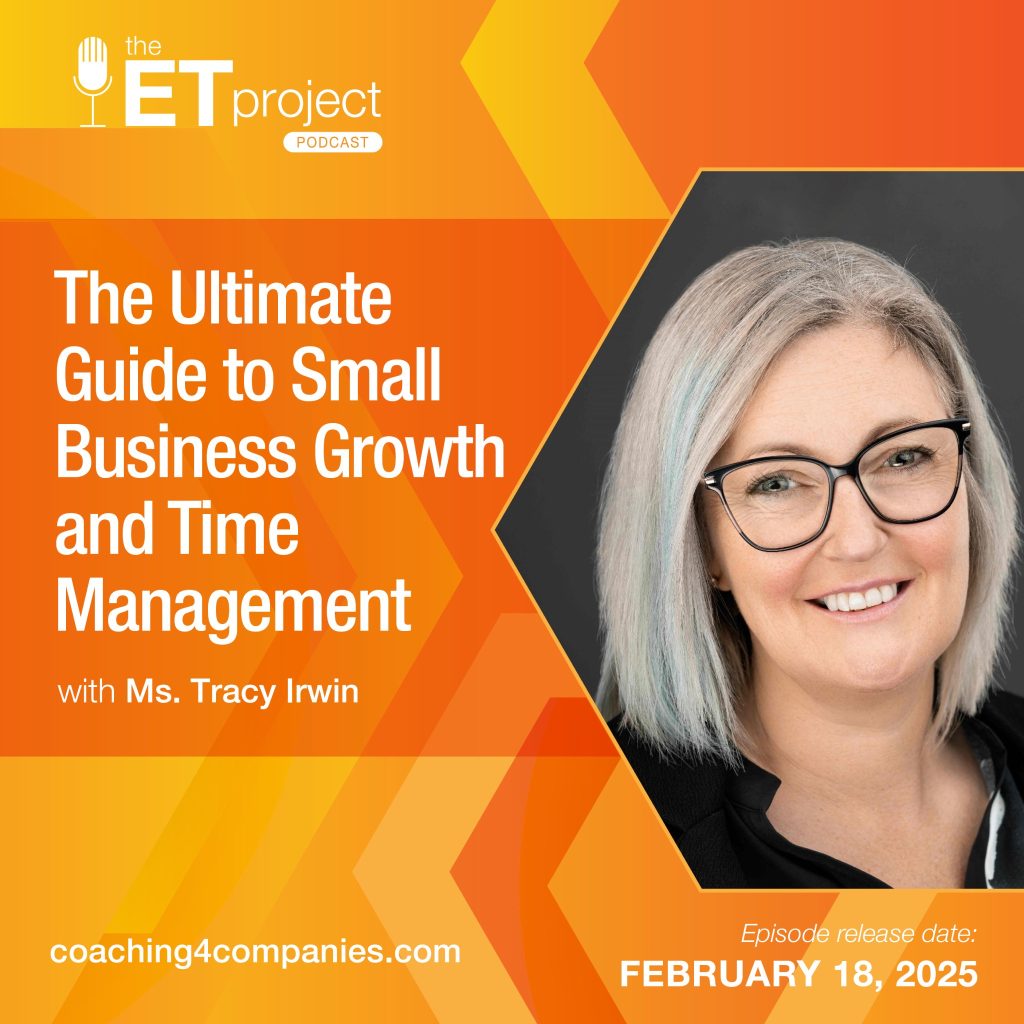
0:00:08.0 Wayne Brown: Hello. I’m your host Wayne Brown and welcome to the ET Project. We’re delighted to be delivering this podcast for executive talent all over the world, whom we’re affectionately referring to as Team ET. Today we’re back to one of my favorite locations and chatting with our guest, Ms. Tracy Irwin in the area of Volotea, Valencia, Spain. Tracy is a best selling author, entrepreneur, coach, business mentor, world traveler, lover of all things crafts and anything salted caramel. In 2002 Tracy founded an award winning bookkeeping and accounting practice in the UK and then in 2016 after moving to a Spanish home, she oversaw the practice from a more hands-off strategic level, eventually selling the business in 2024.
0:00:53.5 WB: Taking this experience, knowledge and insights from the highs and lows of building and running this operation, Tracy has written a transformative guidebook for all small business entrepreneurs. It’s titled One, Two… Free: The Ultimate Business Blueprint To Gaining More Time Freedom Without Losing Your Sanity. Whether struggling or succeeding in your business endeavor, there’s plenty shared in this book to satisfy everyone’s needs for ongoing improvement and during our conversation we will deep dive into some of those core elements. Team, during this conversation, Tracy shares a sneak peek into what’s coming next and the value this new venture is going to provide. I, for one am excited and looking forward to monitoring this space to watch as it unfolds. Please grab your notebook and pen and get yourself ready to learn and grow through the considerable experience and insights from our guest, Ms. Tracy Irwin.
0:01:49.5 Speaker 1: Welcome to the ET Project, a podcast for those executive talents determined to release their true potential and create an impact. Join our veteran coach and mentor Wayne Brown as we unpack an exciting future together.
0:02:06.5 WB: Hello team. Welcome to another inspiring episode of the ET Project where we’re going to dive into the mind of an industry leader and an innovator who has spent a large portion of her life redefining success in her field. So today we’re going to explore the journey of a passionate entrepreneur. You can probably see my guest smiling in the background there. She’s dedicated a large part of her life to transforming the lives of small business owners much like myself, and this episode is going to dive into the intricacies of achieving time freedom, which we all struggle with, probably a little bit around mastering accountability and leveraging proven strategies for sustainable growth. Our guest will also share some insights from her latest book which was released just over 12 months ago and offers some practical wisdom and actionable tips, I’m sure. So please prepare yourself for a captivating discussion. I’m sure we’re going to challenge your perspective on how well you’re treating your customers, your employees, as well as running your business and managing your time. So here to help us unlock many of the secrets to success in those areas is the Time Freedom alchemist herself, Ms. Tracy Irwin. Tracy, welcome to the ET Project.
0:03:32.3 Ms. Tracy Irwin: Thank you, Wayne. Can I take you to all my speeches, please, so that you can do that amazing introduction for me when I get on stage. That was great. Thanks.
0:03:42.1 WB: Perfect. Perfect. Now, just before we hit record, we’re having a little bit of a joke about where you’re currently sitting and where you come from. I have to say I’m envious about where you’re sitting ’cause it’s one of my favorite areas in the world. But where you come from is a little bit cooler. So I wonder if you could sort of introduce where you are and what your background is, what brought you there.
0:04:08.4 MI: Yeah. So I was born in Cumbria in England, in the Lake District, and I lived there up until 2016. And in 2016, my granddad passed. It wasn’t a tragedy. He was 94, but it was one of those switches, one of those moments in your life where you sit and you look. And at the time, I was… Anybody else would have said I was happy and successful. I had an amazing business. We’d outgrown three premises. I had an amazing team. I got married. We had a nice house, lovely cars, lovely holidays. But I wasn’t happy. And it was just that realization that things needed to change. I was like the first person that went into work. I was the last person that went home. Everything came through me. So my granddad passed on the 13th of January, just a couple, anniversary, a couple of days ago in 2016. By the 23rd of December, I had got a divorce. I had processed my entire business, I had started working from home to give my team the ability to make decisions of what I paid them to do. And with two suitcases on my own, I moved to Spain. So I’m in Alicante, well, near Alicante in Spain now. And I’ve been here for the last eight years.
0:05:34.6 WB: You’re such a passionate person about your business and everything you do. When we met the first time, I learned that after 23 years, you sold the business.
0:05:46.2 MI: I am passionate. Every time I do my values and ethics, helping others always comes in my top three. It’s never gone out my top three. It will always be in there. I’m passionate about helping other people and I think that’s what a lot of accountants do is they’re passionate about helping people to understand and things. And yes, I was very passionate about TI accountancy and it was a roller coaster. I won’t say I enjoyed every minute of it because I didn’t. There was parts of it that made me feel really, really proud. But I loved helping the clients and I could have carried on doing that from my home in Spain, but a few things happened. So I had employee issues with a member of my long standing team which kind of put me on the back foot a little bit. Somebody, I thought they were very good at masking things ’cause they would tell me that they tried to mask… They said they shared my value and ethics, but they didn’t. They just wanted to be part of this amazing company. But when that happened, it kind of put me on the back foot.
0:07:00.2 MI: I felt I’ve been a bit too trusting, which is another lesson to learn. But also once I’d written the book and people started to… ’cause the book came because once I moved to Spain, people started asking me how did I do that? How did I run a business in the UK while I worked in Spain? So that’s where the book came from. And I actually wrote it in 2017, ’18. But then I got imposter syndrome and it didn’t actually get published until 2023 ’cause my imposter syndrome was that bad. I was like, why would anyone want to read this? But then once it was published, I realized that lots of people wanted to read it and lots of people had aspirations to do similar things. And I think what it was, it’s admitting that even though I was head of a successful business, I wasn’t happy. And what I found was a lot of people after reading the book came to me and said, “I’m not happy either. I need my business to work for me rather than the other way around.” And everyone’s happy isn’t moving to Spain, by the way, with two suitcases and getting divorced, I get that.
0:08:09.0 MI: But now I’ve been starting to help other people find their happy and it was just as we get older, we grow. So like when I started the TI accountancy, I loved bookkeeping. I absolutely adored it. Now I wouldn’t wish to do it again, but not because I didn’t enjoy it, ’cause I did. It’s just that I’ve evolved. So I think the book made me evolve to want to help people in a different way. And then there was an announcement in 2024 so there’s a huge company in the local town that I’ve always been, they were my biggest competitor for staff, which seemed crazy ’cause they make submarines by the way, nothing to do with accountancy. And they announced in January 2024 that they had to employ 3,000 more people in two years. And over the 23 years that I’d been in business I’d lost 17 people to them by people would come in, they would do their apprenticeship with us and as soon as they got their accountancy qualification they would go to this big company who had big infrastructure, were able to pay a lot more for a lot less responsibility.
0:09:29.4 MI: And I tried to make the company as attractive as possible which made it attractive to those who wanted responsibility and didn’t want to work for a big corporate company. But I couldn’t keep the ones that didn’t. And when they’ve made the announcement I just thought, do you know what, it was already been in the back of my mind about wanting to help people with their Time Freedom and it just felt like the right time. It wasn’t an easy decision Wayne, it really wasn’t. It was the probably the hardest decision I’ve ever had to actually make. But I felt like it was the right time to do it so that I could help people in other ways rather than just by running an accountancy.
0:10:08.7 WB: Let’s go all the way back if you don’t mind to the beginning of the business. And I’m curious, you mentioned that you love bookkeeping and accounting but was there a particular trigger that you recall that took you into setting up your own business?
0:10:27.1 MI: When I started my business I was a single parent, 26 year old single parent of a 7 year old. I was never meant to be entrepreneur and I’d gone to Bingo. In the front of the book there’s a dedication to one of my great friends who we lost in our 30s. And I’d gone to Bingo with her and another friend and she just got given a job role as an after school club manager and she could do everything that the role that was given to her but she didn’t know how to pay people. And at the time I was an office manager for an electrical contractors up at Sellafield. I was paying 150 electricians every single week. So she knew I could help her but I didn’t know how to help her. And then the other friend who owned a beauty salon and she still does, she said actually I’ve been paying my staff cash too because I can’t afford to go to an accountant. She said, so if you can help D, you can help me. And I was like, okay. So I went to work on the Monday and I was like, “can I borrow our sage payroll disc please so that I can help my friends pay their team?” And my boss went, “no, she can.” I’m just like, “give it to me.” And I was like, “thanks.” Very not the dumb thing to do ’cause you only had to buy a license. But he let me take it home and actually it was a total accident. And that’s how TI accountancy was born.
0:11:52.6 WB: Incredible. Sometimes they come out of Sella Field and totally unexpected. Right? Yeah. And you never look back, I guess. I mean, as you said, there are highs and lows, as there are with every business. And in the book you highlight a lot of those situations and we’ll go through that in more detail. But I’m now jumping a little bit ahead in my thinking and if we talk about leadership, and you speak a lot to that, are there some key ingredients to maintaining your dedication and commitment to the business while being a leader and looking after employees? Like, do you have anything that jumps to mind about what do you require to be a good leader running a small business, which is time consuming, energy sapping, how do you maintain that dedication and commitment?
0:12:56.1 MI: I think to maintain your passion and your motivation for your business, you have to have the right team in place because I think it’s the wrong people that zap your energy. So if you’re like fighting against, like I said before about ethics and principles and values and things, and the only way for a small business to get the right people is to articulate their values and their vision for the business very well to their team. Because it’s about communication and it’s about repelling the wrong people to work within your business and have the right ones. I think a quality that I found that probably served me well, that I didn’t realize served me well was empathy. So I’m a very empathetic person and I would never have dreamed of asking somebody to do things that I would never have done myself. I was never a top down leader. It was always like, I want a team around me and I wanted to find ways in to give them the inspiration to want to come on the journey with me. And I do think that you get it out of the right people, but you are never going to get it out of the wrong ones. And being able to not take things personally and be able to draw a line under stuff when it doesn’t go quite right, really good things to have as a leader.
0:14:32.2 WB: There’s always a lot of debate, particularly with leaders in smaller businesses about family versus drawing a line in the sand and saying, I need to be removed from that relationship with the team. Sounds like you were more on the relationship side rather than standing aside from it.
0:14:57.7 MI: Yeah. I wanted us to be a team. I never wanted to be the person who dictates. It’s just not in my nature at all. I wanted to make those people better. One of the biggest things that made me proud over 23 years is what, I employed seven people who while they worked for me, were able to buy their first home. And for me that was something as a single parent, by the way, when I bought my first home, I knew how that felt for my stability and in my life. So actually to be able to facilitate seven people’s first ever mortgages and I don’t think many business owners would think like that. I don’t know, it’s something that’s like. But that it was one of the proudest things for me was every time somebody bought their first home because they suddenly had the ability to do that, I was like, I created something that gave them the ability to do that. That’s something to be really, really proud of.
0:16:06.8 WB: Let’s jump into the book. The book’s called One, Two, Free… Not One, Two, Three, One, Two… Free: The Ultimate Business Blueprint To Gaining More Time Freedom Without Losing Your Sanity. It’s very aptly titled. I have had the opportunity to read the book. It’s transformative. I have to say I’m a little bit older than you, Tracy. I’m a 45 year old veteran of the corporate world. 42 year entrepreneur. And there are things in the book that are transformative to me in hindsight. Let’s dive into the book. What inspired you to write it? You touched on it a little bit, but maybe we can go back over that.
0:16:54.2 MI: I think a lot of it was the questions. I was getting the same questions asked me all the time when I was working with businesses. And even though I was an accountant and I was just helping them with their finances, obviously ’cause of my situation, it gave them the ability to ask me different questions. And yeah, I just kept getting the same questions. And I knew I had this knowledge. I’d already been in business for nearly 20 years at this point and I was like, can I share that? So I took an August off. I literally took the entire August off when it was really hot over here anyway, ’cause, I mean, your brain’s a little bit frazzled by 2:00 PM in the afternoon over here in August, even with air con. And I just spoke into a dictator for a lot of it. I just kept telling my stories. I hope it’s one of the most practical books you’ve ever written. I tried to make it as practical as possible so that people could actually take bits and pieces out of it and implement it into their business. Not all in one go. It wasn’t a follow through, step by step. It has got blueprints in it, but you don’t have to do everything at once. It was always like, this is appropriate for me right now. And I just wanted it to be practical and helpful and to help other people to find their happy, really.
0:18:24.0 WB: One of the threads that weave through the book is that practicality as well as the fact that you’re an accountant. I say that in a very nice way because I’ll give everybody listening an example. You start talking about goal setting. Now, I’ve been coaching, training, educating, working as a leader using goal setting my whole life. And I have to say, you’re the first person that brought it down to a financial level. I wonder if you would mind just explaining your approach to goal setting and how you bring the financial targets into that raft of setting goals.
0:19:14.1 MI: Yeah. So when I talk to business owners, if we try to talk numbers, quite often it doesn’t compute in their brain to what that actually means to them. So there’s a formula that you can find that tells you how many new clients that equates to. And there’s only a couple of numbers in your business that you need to know to actually make that happen. But once you know just like how many new clients you need for a business owner, that’s a much easier process for them to facilitate. So I talk about in the book when I wanted a Range Rover and I didn’t wanna put my prices up. I didn’t wanna be one of those accountants. And so I just decided I was going to do it on new clients. I worked out how many. I worked out our average client spend. Loads of people tell me, by the way. Oh, but mine’s so different ’cause I have different services. I’m like, average is always average. It averages out of the year. I did it four years before I totally trusted it. I was like, it really does average out and I found our average.
0:20:24.3 MI: And then I worked out how many new clients I needed before I could afford to purchase the car. And then I just turned it into a fun thing. I was like, we got a jigsaw piece on the wall. And every time I got a new client, I colored it in. And then we’d start to joke saying if it was a small client, it was like, “oh, that’s a windscreen wiper,” or if it was a big client, it was like oh, “that is my wheel of my car.” And it just became so much easier because it’s tangible. So even though I talk about it, is it in a monetary purpose, I never actually talk about like pounds and pence or dollars and cents. I talk about number of clients because it’s so much easier for the business owner to comprehend that and to be able to achieve it as well because they just know. And especially if you understand your rhythmic acquisition of a client. So if you know that if you needed say 10 new clients, if you know you need to speak to 20 people to get those 10 clients you try to get that in your diary. Well, if you’re speaking to 20 people, if you know what marketing you need to do to get those 20 appointments in your diary, you’ve solved a business. Like literally you could run any business if you just know that little routine and it’s done. So it’s kind of just making it fun and tangible so that it’s achievable.
0:21:47.8 WB: One of the things you spoke about was you went to a convention, I think, or a trade show. It turned out being very successful for you and you had an influx of new clients, which on the surface sounds great, but what you hadn’t factored in was how you were going to deal with all those new clients and serve them to the level that you were accustomed to or that you wanted to maintain. Could you speak a little bit more to that at the moment?
0:22:16.8 MI: Yeah, of course. So we did a two day convention where we knew that the speaker was going to stand up on stage and talk about the importance of knowing your numbers on a regular basis. And TI accountancy was always a bookkeeping company first and an accountancy second. You know, the year end accounts as a government only just to tell you how much tax to pay. The important bit is the bit in between. It’s like knowing your numbers. So we designed our stand everything around this and yes, we got, I think it’s 23 new clients on the day, which doesn’t actually sound like a lot, but it was worth 77,000 pound to us a year. And we hadn’t prepared for that. We’d prepared to draw the list. That’s what we’d prepared to do. We went to the exhibition thinking we’d get lots and lots of people on our list and then we’d be able to sell to them slowly. But that didn’t happen. And it was awful because it didn’t just affect the new clients, it affected my current clients too. So we got to the point where our turnaround time for bookkeeping was 14 days.
0:23:28.6 MI: Had gone up to being over a month. I was sending out chocolate bars to everyone saying, I’m really sorry we’re so behind. Because what we hadn’t done was thought about processes in enough time. Like did we need to advertise for somebody? Should we be taking somebody on? Then, by the time I sold the business, the processes that were there weren’t online. So not only were the team, the current team, doing all the bookkeeping for all these new people and the current people, they were also trying to teach the new person how to do their job. And it was just like. And our customer service did slip, which kills me to say, by the way, because I built that entire business on how good my customer service was, but it slipped. And there’s people out there even now that would say that they had a bad experience with us. And that kind of kills me inside a little bit because it was my fault. When you’re a business owner, everything is your fault. And yeah, it was a tough time, but we got through it.
0:24:39.1 WB: And like all good leaders, we’re always looking for the learning that comes out of those challenges. And you spoke in the book about as a result of that, you now limit the number of new clients you bring. Well, not now, but when you’re in the business.
0:24:58.7 MI: Yeah. So when the business did, we only ever took on five. So we had like an oversubscribed type business that if we ever more than five people came towards the end, we kind of changed it a little bit and we just had a waiting list. So what we would do is rather than saying, no, we’re not taking anybody on, we changed it to we’re not taking anyone on this month. And we put a stop because we had a facility online where they could find their own price. And I always push transparency. I feel like you should be able to get a price without having to speak to somebody and be sold to. So we got the thing where we did an automatic proposal, but in the months where we’d taken on too many in a month, say like gone up to six or seven. We would just stop for a month. We literally just put a stop on everything for a month while we brought in everybody apologized and said we’re onboarding people. I hope you feel that if you can wait till next month, that we would do the same kind of customer service for you. And that worked really, really well.
0:26:10.4 WB: Which is a fantastic outcome. And even coming up with the idea of a waiting list, you’re not turning away the client. You just say yes, we do want to, but we can’t cope right at the moment. And the transparency that brings, which then leads into another point that you highlight is the need for planning and learning how to anticipate those types of issues in advance. How important did that become for you overall as one of the success factors?
0:26:46.3 MI: I think that was primarily my role was planning quarters. So I did everything in 90 days so that it was never too much, too little. It felt like a really good chunk. I mean there’s books written about it and everything now, isn’t there? It’s like 90 days there’s a lot of research been done into it and just making sure that we didn’t do too much marketing to make it more popular and we kept our limits to where they needed to be. If we were getting it a little bit slow, then we’d look at why that was happening and then tweak things and push it back up a little bit again. So it was like a tap of turning it on and off and the only thing you can say it was practice really, ’cause you just didn’t know, something shock you, like they do really well and then you think you’ve got an absolute no brainer and it just doesn’t go anywhere and you’re like, oh, I’ll try. And to tweak knowing what you’re saying is valuable, then you just tweak it and see whether it’s the wording or the wrong market. So yeah, I think that’s what a business owner should be is looking forward and tweaking things to make sure that the cycle of new clients is coming in well.
0:28:03.3 WB: One of the areas that’s dear to my heart, I’ve had the opportunity to introduce in three different companies a complete quality system. You talk about procedure, standard operating process or procedures or whatever you wanna call them, but you found early in company’s life the value of having procedures to bring people on, to get people up to speed quickly, etcetera. Could you step through that process, how that came about for you and what your experience was?
0:28:38.5 MI: I read the E-myth quite early on in my business and I totally understood it and I was like, oh, this is brilliant. But then I did the old thing, which a lot of people do by the way, is like, oh, there was only me and my mum working in the business at the time. Can’t really push procedures on my mum and I didn’t do it. And then as the business grew and I got more, I was like, oh, let me revisit the emails ’cause like, I was getting lots of questions and I was like, I don’t wanna be doing everything here, but I tried to do lots of videos and things so that people knew what they were doing, but I couldn’t get them on board. It was kind of a bit too late. So we struggled through and we did a lot of procedures. But then I found my payroll manager was going on maternity and everyone else was going to have to do like, we were bringing somebody in to do her role and it was the perfect opportunity to. So one year I set it as a goal that I did the organization chart.
0:29:42.9 MI: I worked out what responsibilities was everybody’s like the big things that were mine and then listed all the responsibilities and things that they did. And then I gave them time, so I gave them time in their work time to then make their own procedures. Like some were better than others, by the way, doing this, some people don’t want to, they’re not into… It was harder to make some people do it, but I forced it because it was so important that we needed a procedure manual and we did it on Dropbox for a while and it was hard to, ’cause you had to tell people every time you change something sometimes it slipped your mind if you change the procedure. And so even though it worked 80% of the time, it wasn’t perfect. And then I found something called Waybook and it’s an online platform that does it everything and it’s still in there like our entire accountancy.
0:30:44.4 MI: And when you changed procedure, it would inform everybody that the procedure was changed so that if you knew that that was something that you also did. You could read it and if it wasn’t part of your remit, it didn’t matter because if you had to do that job, you’d have gone to the system whilst you were doing it, to check it anyway. So it just grew over time. But the best thing, the best thing I did was to get the team to write their own procedures because the document became their responsibility and that brought them. They played ball then, rather than the time that I tried to write it on my own.
0:31:24.5 WB: Another area that I know for small business operators, whether they own the business, whether they’re running the business, is this ability to, it’s not pushing back, but it’s the ability to say no. If I say yes to this, something else is going to suffer and I need to be able to say no. As simple and straightforward as that sounds, the human psyche, particularly for people who are passionate about what they do, struggle to do this. How did you bring that about as part of your toolkit?
0:32:02.4 MI: A lot of it is structure. So I am the entrepreneur that loves the shiny new object. I’m not going to deny that. I learned a long time ago that if it’s not a hell yes, it’s got to be a no, because there is so much out there that we could do that we can look, I’ve also got like a policy that I have to go to sleep on something for a week and if I still think it’s a good idea after a week, then I’ll start to research it because there’s so many ideas I’ve had in the past where I have thought, oh, that’s a good idea. And then I just started over ’cause. And it’s like, distracts me from everything else that I’m meant to be doing. And then I’m like, oh, that didn’t work. That was rubbish. Why did I do that? So a couple of things, I have a could-do list. So every year I got down everything I could do and then I pick the goals that I’m going to do for the next 90 days so that the could-do list is there.
0:33:03.7 MI: I’ve not forgotten about it, but often when I come back to it in the next quarter, I’ll take some of the stuff off because I’m like, I’m not interested anymore. And all the time’s past having a structure. So my diary is very color coordinated, it’s very structured and I put time in my diary for when I do my work with myself, I’m a big believer that you are your most important client. And when you turn up at a meeting with a client, like I turned up with you today, I would never have let you down. So when I make a meeting with myself, like, why would I let me down? I’m my most important person. So in my diary is chunks of time when I’m actually going to get work done. And every Friday I go through what I need to do next week and I actually write the titles into those time brackets. So I already know what I’m working on next week. And that as well, the unconscious brain, when we go to sleep, gives me ideas. So because on a Friday, I leave, my brain is, I’m walking the dogs, I’m crocheting over the weekend, I’m painting. And whilst I’m doing that, the ideas are forming because I already know. And I think that planning and that kind of structure is very necessary for people with really active entrepreneur brains, because we can get distracted so, so easily.
0:34:38.0 WB: Absolutely true. And even worse these days with technology and the rapid introduction of that new shining object, right? It’s every day there’s something new on the market and it’s so easy to get so distracted. You taught me something new. I mentioned at the beginning, you taught me a number of new things. You speak in the book about keeping a separate list of costs for you, the leader, the boss, the director, whatever the role is that you’re playing, so that as the owner of the business, you can isolate that cost and you can show the real expenses to the business if you were to take yourself out of that expense. And I love that concept. Where did that come from? How did you come up with that idea? Or is that just something that you should have taken.
0:35:34.5 MI: I’ve got a client who I’ve worked with for well over a decade now, and I act as their financial director. And they were looking into selling their business. And there’s two directors in this business. And we called it ground zero. And he said, what would the company look like without me in it? And his question made me go, “oh, that’s going to take a long time for me to take it out.” Because all the employers, national insurance was all clubbed together, all the suspense was all clubbed together. Everything was clubbed together. And so me and the bookkeeper who looked after the bookkeeping split everything from the beginning of that year. And we just had two lines for everything company pension, director’s pension, travel costs, directors, the subscriptions that would leave with them.
0:36:29.1 MI: ‘Cause we as business owners we put subscriptions through the business that help us but actually the next person might not want it. So we separated everything and we continue to separate it. And then whenever somebody else comes along when they say to me my ideal ’cause I have a conversation with them first to see whether they’re false exiting their business or they’re really exiting their business in five years, say then we implement that straight away ’cause I never wanna have to do that work again to be able to split it out. So actually it came from a client who wanted to sell their business and understand what their business was worth without them rather than just giving the entire P&L and Balance Sheet to an investor.
0:37:16.8 WB: Your website has a time freedom quiz and my, my Overall score was 78.
0:37:25.7 MI: Oh, well done that was awesome.
0:37:30.6 WB: It’s in the average range so I’m guessing…
0:37:33.6 MI: It is in the average range.
0:37:35.5 WB: I’m guessing you have to be 80 or higher to get in that green color zone.
0:37:41.0 MI: Which ones were in green? Which ones did you do well in?
0:37:47.2 WB: Team and marketing. So I had 90% in team, 85% in marketing. Dare I say my worst however was 53% in finance. So for all of my team, if you’re listening, stop listening. We will be talking about finance on Monday team. And for all of my friends who know me over my career, they will be saying how is that possible then? ‘Cause in my career I’m so focused on money. But anyway, all right, but very interesting quiz. It’s a quick quiz but it gives you some great insights. So there’s what, six different areas that you break the result down into and it gives you a nice snapshot of what you could be thinking about that maybe you were blindsided by, which is great.
0:38:45.6 MI: It is. I really enjoyed creating that quiz. A lot of thought went into it because it helps me to help other people. So I look for things that where a lot of people like, one of the biggest things from that quiz that came out was I am shocked at how many people don’t know their break even point. And I think that’s such an important number to know in your business because actually if you don’t know you have to turn over £13,000 before you even go into profit, then how are you setting your goals? So that’s one thing. So it’s not just helping my clients, it’s also helping me to know what to teach as well. So we did the first my Q1 goals for this quarter is we’re actually making the Time Freedom quiz into a course. So actually what we’re doing is putting it onto there so that people can actually, once they realize where their blind spots are, they can actually go into the course and actually I’m there in video to help them. So that’s my next step.
0:39:55.2 WB: I like to ask the guests, do they have any tips for the listeners in your case, Time freedom tips, small business management tips. Any tips that you would offer?
0:40:08.9 MI: Yeah, lots, A lot. It’s picking which one to say. So I think the calendar thing definitely is book appointments with yourself to be able to get your work done, especially if you’ve got a team and tell them that you’re busy so that they know you’re in a meeting because you need to do that. Like having that chunk of time to work on your business every single day is so important or it’s just not going to grow. Another one is to separate your bank accounts into separate sections. Especially even if you can’t do it all just by having a tax account where you put a percentage of your cash into your business into the tax account every single week so that you never ever have to worry about own the government every money will be a huge thing for you when the accountant tells you how much tax bill is ’cause you can be really smug and go, I’ve already got it saved up. It’s already there. So that’s kind of definitely one. And this is the hardest thing for me, by the way. It’s taken a long time to do this, but not taking things personally in business, trying to be able to see in the other person’s perspective and kind of not compensating for it but actually just acknowledging it.
0:41:22.5 MI: And I’ve got a great one. As if anything happens to me bad during the day when I walk out of this office, I draw a line. I physically pretend to draw a line across the door and I physically step over it. And that whole mindset thing of stepping over it and then leaving it in here means I don’t come back into it in the morning. So that’s like there’s my three things that’s in the top of my brain right now.
0:41:58.0 WB: Excellent. Where can people connect with you, Tracy, if they’d like to learn more about what you’re doing and keep in contact?
0:42:05.3 MI: So my website is tracyirwin.co.uk or timefreedomalchemist.co.uk, they’re both linked together. I’m usually on LinkedIn every day, so if anyone wants to find me on LinkedIn, it’s Tracy Allen Irwin. So it’s all the same. I’ve got a green little circle around me. The easy way to find me, it’s the same green as the book. Everything’s the same green as the book, by the way. So, yeah, that’s probably the easiest places to find me. And I’d love to be contact with anybody. I’d love to speak to new people.
0:42:37.9 WB: Thank you for being on the ET Project. Wonderful conversation.
0:42:41.6 MI: Thank you for having me, Wayne. It’s been an absolute pleasure. I’ve loved it.
0:42:46.3 S1: Thank you for joining us on the ET Project, a show for executive talent development. Until next time, check out our site for free videos, ebooks, webinars and blogs at coachingforcompanies.com. Free audio post production by auphonic.com.