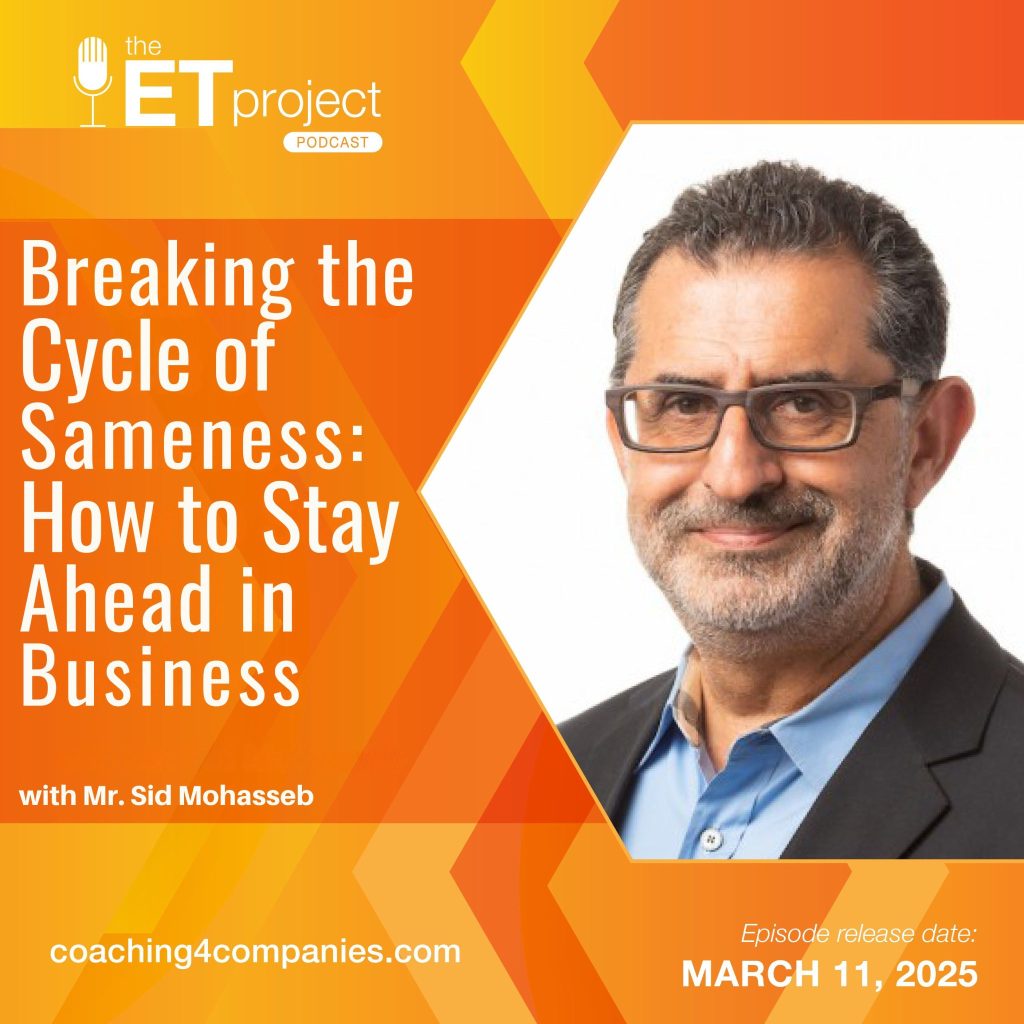
WAYNE BROWN: Hello, I’m your host, Wayne Brown, and welcome to the ET Project. We’re delighted to be delivering this podcast for executive talent all over the world, whom we’re affectionately referring to as ‘Team ET.’ Today, we’re heading to Los Angeles to chat with entrepreneur and philosopher, Mr. Sid Mohasseb. Sid is a best-selling author, serial entrepreneur, venture investor, university professor, and innovation leader. Following the success of his books, ‘The Caterpillar’s Edge’ and ‘You Are Not Them,’ he has been actively involved in high-level advisory, early-stage investments, and speaking engagements. An adjunct professor at USC Marshall Business School and the Viterbi School of Engineering, Sid focuses on AI, data analytics, and dynamic business strategy. He shares his expertise through TEDx talks, articles in Harvard Business Review, Forbes, and other top publications, and as a mentor to entrepreneurs. With a track record of founding and selling companies, advising Fortune 500 executives, and serving on boards of cutting-edge AI and tech firms, Sid continues to shape innovation and leadership across industries. As you will hear in our extended conversation, Sid calls on his considerable experience and expertise to offer listeners a wealth of insights and thought-provoking questions. Team, you’re in for a wonderful discussion ahead, so get yourself ready as we dive in.
INTRO: Welcome to the ET project, a podcast for those executive talents determined to release their true potential and create an impact. Join our veteran coach and mentor, Wayne Brown, as we unpack an exciting future together.
WAYNE BROWN: Hello, team, and welcome to another great conversation. We’re going to be exploring the intersection of philosophy, entrepreneurship, leadership, and all through the lens of constant change. We’ll dive into mindset shift and what’s required to thrive in a changing business landscape. And look at the importance of balancing agility with a degree of business stability and how to harmonize the needs of customers, employees, partners, investors, and society at large. Not much of it is all on it, right? So, we’re going to discuss the art of reprogramming how we perceive the world, the business world, and why true success as leaders lies in provoking rather than motivating, and I’m borrowing an expression from our guest. All in all, we’ll be uncovering practical insights and a huge amount of timeless wisdom I’m sure as we navigate the constant churn of modern business through the clarity of our guest, Mr. Sid Mohasseb. Sid, welcome to the ET project.
SID MOHASSEB: Thank you so much. It’s great to be with you, Wayne.
WAYNE BROWN: I thought we’d begin our discussion again with a couple of rapid-fire questions just to warm us up a little bit. Most influential figures, anyone stand out for you as you look back over your career?
SID MOHASSEB: When I sold my first company, when I was in college, I then started a job at a company called SGS. The first S stood for the main founder, who was the president, a fellow named Jim Steinman, Jim was an interesting character. He provided me with the opportunity to… at the age of maybe 24, he would take me to board of directors meetings at Union Bank or use a helicopter and have me express things, and he taught me that my opinion matters. He did something that probably if anyone does to an employee today, they’ll be fired, but I appreciate the hell out of him. I was at the job for maybe six months, eight months, and I believe the client was Motorola at that time and I was doing a project for Motorola. And in those days, we would write reports, and there wasn’t any Word processors or anything, and we would write it, and then somebody would type it, and if there was an error when you edit it, they’ll cut it and paste it on a piece of paper. It was a complicated process. And when I did my first report, and Jim read every report that would go to the client before it goes to the client. So, one night at about eight, nine o’clock at night, I was going home from the office, and Jim’s office was glassed in, and he could see anybody who goes in and out, and he did this, he says, “come on in.”
[00:05:00]
SID MOHASSEB: So, I went in, he took that report, threw it at me, and he says, “you can’t write piece of your… you will never make it as a consultant.” This report was filled with red marks, and he said, “you are a brilliant, a brilliant analyst. You’re a great thinker, but you can’t write.” And as you know, now I have probably 100, 200 articles, I’ve written a couple of books, and no nobody else wrote it for me, I did it, but that motivated me to see and know what the problem I had, and he was right, I couldn’t write worth of dime. Again, you can’t do that today to anybody, but in those days, it was perfectly fine, and I didn’t take it as a, you know, as anything but constructive. So yes, he had tremendous amount of impact on my life. I don’t even know if he knows it or not.
WAYNE BROWN: The fact that you weren’t able to write very well might be an interesting sideline to you, because if we think then to what you were also doing around that time, and you know, timeline, you can correct me, but I believe you were also teaching comparative Eastern and Western philosophy around this time.
SID MOHASSEB: Yes, I was, that’s true, that is true. I got into an organization with some fellow that was… introduced me to this organization, and it was a kind of a Socrates, I don’t know if you are familiar with that, the setup, a setup of discussion and learning. And very quickly, I got very, very interested in it, because it was challenging all sides of my mind, if you will. Now, most of the people were a lot older than me, because philosophy is not something that appeals to a young kid.
WAYNE BROWN: At the age of 25, teaching philosophy, how were you received? Not only by the faculty, I guess, around you, but how were you received by the students?
SID MOHASSEB: I don’t know, we have to ask them. Nobody quit, so I would assume… One memory I have, in those days, I would pick a Rumi poem and we would begin with that, and then say, “okay, now, how do you see that, and how does it link to…” and we’ll see where it goes. You know, it’s either to the conversations about the Plato’s seed or change or, you know, the meaning of truth or whatever, whatever some… you know.
WAYNE BROWN: Yeah.
SID MOHASSEB: And there was one woman, a young lady, who came to me and says, “you know, the first time you asked me this, I couldn’t sleep for three nights. I was so afraid what you would ask me next.” I don’t know what I would ask you, I just randomly picked this thing, there’s no magic to it. But, you know, it’s interesting when you are put in a teacher’s role, people believe that you are better, and that is not true.
WAYNE BROWN: Yeah. Yeah.
SID MOHASSEB: That is not true at all. I may come from a different perspective, with more intelligence in terms of data and pieces or a more refined thinking in terms of coming to a conclusion, but that does not make me better. You know, it’s not a race of who gets there faster.
WAYNE BROWN: You do a lot of writing today, you’ve got a couple of books out, I think the first one was ‘The Caterpillar’s Edge,’ Embracing Change, what? About 2007, ‘08? Could you introduce the book just very briefly?
SID MOHASSEB: Sure. The book came out of… see, I had worked with entrepreneurs, I had worked with CEOs of very large organizations, Fortune 100. I’ve worked with private equity in terms of buying and selling companies and so forth, and I saw one common trend, which was this idea about change being bad. You know, in every organization we have this thing called ‘change management.’ Why the hell do we need to manage change? It’s like it’s the enemy. So that kind of intrigued me, and as I was talking to people, I noticed that we’re… a lot of companies are addicted to sameness. And if you go back even in the S&P 500 and look at that and look at all the different companies, you see that only 15% of those who were really great in 60 years ago are now part of S&P 500, they don’t exist anymore. What happened to these people? They had great companies, they had great leaders, they had great ideas, and when you look deeper, it’s just addiction to sameness and not evolving.
[00:10:00]
SID MOHASSEB: Now that the world is moving a lot faster than it used to, global connectivity, technology, all of that has kind of fueled this… you could become obsolete a lot faster. And most of the problem begins in our mind, and in our addiction to this sameness. We think this is good, so why change it? I mean, we have phrases like, ‘if it ain’t broke, don’t fix it.’ I would say, if it ain’t broke, why isn’t it? Because if I’m doing something for 10 years or 5 years, and there’s a trillion ways of doing it better, if I’m still doing it the same way, I’m a fool. So, the idea came from there, and then obviously it talks a lot about using data and analytics, which is one of my passions. It talks about this notion of really three pillars, one is aligning with uncertainty, that nothing in the world is certain, risk is woven into everything. So, if we wait for certainty, we would never get there, we can never make a decision. The second is appreciating our reality, and that is, I’m not against big goals or things but… and this is where the name comes from, this notion of caterpillar becoming a butterfly. It takes lots of stages before it becomes a butterfly. Somewhere around 7,000 muscles are moved and changed before this thing becoming something entirely different, a different species that can fly. And this requires us appreciating our reality, that, hey, nothing… life is not like a switch, you can’t throw it, and boom, you’re there. It’s how do you get there? That means incremental things. That means understanding and appreciating the reality of life, whether you’re running a big company or you’re just starting out or you’re a student or whatever. And the third is this notion of constantly looking for more, and I call it more ahas. You say, “aha”. That’s when the solution to a problem becomes clear to you, you know, when you say, “I got it. Aha.” So, we have to constantly look for more ahas, more insights, more, “oh, this doesn’t work, oh, this is better.” And if you’re constantly doing that and it’s not an annual event in a big company, we can adjust our course, and that got to the book’s core element of getting to a dynamic strategy, which is erasing the line between execution and strategy and dynamically doing that. As a matter of fact, I know you have a lot of audience in India, but the book was actually introduced to a fellow, Ravi, we’ll skip his last name, who is the chairman of the board of I think six or seven rather large organizations in India, very, very big organizations. And a friend of mine, Dev, who was with Cisco at the time and was on their board, met him in India and gave him my book. And he apparently… and this is a story that he told me, he wrote me an email saying, read the book on his way back to India from London. The meeting was in London. And he made copies of it, you know, in those parts of the world we hate buying things. So, he made copies of the book and distributed it to his management team of one of his companies. And apparently, they initiated this thing, ‘The Caterpillar Project,’ and after one quarter they became profitable, after I believe five quarters that they were usually in negative. And then he applied it to all of his other companies, he even changed some of the logos to a butterfly or, you know. The point is that it’s about mindset. I don’t ever provide do A, B, C, and D because I don’t think we’re all… I don’t think life is like going to IKEA and buying a bookcase. You’re very different than I am, your employees are different, your family is different, everything about you is different. So, you mentioned about practical advice and I’ll say practical is what’s practical to you. Practical to me maybe running five miles a day, practical to you is not running five miles a day, you have a bad leg. So, it may be a practical advice because I think it’s practical.
[00:15:00]
WAYNE BROWN: There are so many tangents we can go down based on the book itself. Just to continue on the journey though, from the book, and now I can see where a lot of the ideas stem from with the TED Talk
SID MOHASSEB: Yes
WAYNE BROWN: The artist or the entrepreneur, you talk about saying this is crazy, never leave change to chance, there’s a progression is what I’m seeing in your thinking.
SID MOHASSEB: Of course, of course. If I preach to evolve, I have to evolve myself, right? So, the first book was more corporate, if you would, because that was the universe that I was operating in. But the second book, and there was a couple of TED Talks, one was in I believe 2010, ’11? Where I talked about, hey, this notion of we’re flipping the corporates, defining how things work from where the society is defining through social media and all of that, which came true actually. Back then, there was no Twitter and all that. And the second one was the one that you mentioned, which led to… actually, I don’t know if the second TED Talk was before or after or during the same time that I did the second book, which is called ‘You Are Not Them.’ And ‘You Are Not Them’ was a bestseller both in philosophy and business, which is you will see my philosophical side in there a lot more. There’s even poems that I’ve written in there that are all focused about our mindset. And I introduced a different definition of entrepreneurship, which is actually the original definition of entrepreneurship, which is different than what most people believe. And that has now led into some other things. You mentioned my beliefs about the view of customers and interactions in business and the five pillars, which is some of my new writings, which we can talk about. But basically, Wayne, I believe that we’re all entrepreneurs.
WAYNE BROWN: Your definition of an entrepreneur is quite interesting, you break it in half and you look at entrepreneur in a different picture.
SID MOHASSEB: There’s two ways to look at it. There’s one way that you break it into entre and preneur, and it literally means grabbing knowledge, grabbing knowledge means entrepreneur. There’s another definition that a guy in 1700s, for the first time, introduced the word entrepreneur. It was altered about 50 years later with one minor thing. And that definition is entrepreneur is someone who has something, notice that something is not defined, who wants to exchange it with something of higher value, knowing that there is risk. So, I have something, I want to exchange it with something better. But I know it may not be necessarily 100%. Let’s give an example. You take any student that goes to college. They spend money on the college, if it’s not free in some countries in U.S. we pay a lot of money. There is late nights and lots of hard work and homeworks and this and that and there is hope. And we give our time and we give our life, four years of our life or whatever it might be, to get a degree in the hopes that that degree will make our life better. So, we’re exchanging our time and money to get to a degree knowing that, hey, because I have a degree, that doesn’t necessarily mean that I’m going to be happy or super wealthy or super successful or any of that. But we do that. So, we are an entrepreneur because that gene to thrive is actually in all of us. It was built 500,000 years ago. So, I believe that we are an entrepreneur and the book kind of goes through this proving this point that we are an entrepreneur. Now the question, though, is what do we do with this talent? It’s not the talent of entrepreneurship, it’s the spirit of entrepreneurship that gets us from place to place, right? We can all see, but what we see is different. We can all hear, but how we hear and how we filter it is different. We’re all entrepreneurs. That spirit of using that entrepreneurship has something to do with our mindset and it has to do with what we have and what we want to exchange it with because we think it’s higher value.
[00:20:00]
SID MOHASSEB: So, was Mother Teresa an entrepreneur? Go back. She went around. She raised money. She did all this work, went to India, went all over the world to deal with poverty. She defined that as higher value for her. And there was a risk. She knew that. She wouldn’t be able to solve it. Was Martin Luther King an entrepreneur? I guess you bet he was. Is Elon Musk an entrepreneur? Of course, he is. But entrepreneurship is not about money, it’s about an exchange of what you have for something better based on your definition, reasons, and how you define satisfaction.
WAYNE BROWN: So pretty much in other words, we’re all entrepreneurs, whether we acknowledge it or not?
SID MOHASSEB: Most of us don’t. Part of it is because the definition has been kind of corrupted in a way. You know, “oh, that guy is an entrepreneur,” and everybody thinks, oh, that’s a fast talker, bullshitter, you know. That’s not the case. That guy is an entrepreneur, therefore, all he thinks about is money and it’s about money. No, it’s not.
WAYNE BROWN: And that was something I was going to lead into, but the term has been heavily linked to business. You know, you’re talking, you know, very, very generically with the term, but the term is heavily linked to business and not only business, but to capitalism would be my thing.
SID MOHASSEB: Absolutely. Absolutely. Not only capitalism, but everything that we do in life. Again, I’m using Indian examples today, let’s say all those who believe in the Jain faith. I don’t know if you’re familiar with it, for some of the audience that may not be. The belief is that we can’t eat anything that, you know, everything, even the dust has some life. They’re exchanging the pain of going through that because they believe that not doing that is of higher value.
WAYNE BROWN: Yeah.
SID MOHASSEB: They may not think they’re… they are in a village, they’re working somewhere, but they are an entrepreneur because they are taking a risk and they believe that this is better than that. And that’s perfectly fine. That’s perfectly fine. As long as we understand the talent, now how we apply it gets into our mindset. If you want to apply it to a business, if you are a CEO, let’s first figure that out, that you’re an entrepreneur, not because you’re after money, because you’re exchanging this thing. Then we’ll go to something that we’re going to talk about a lot at the academy, which is not only are you an entrepreneur, everybody you deal with is an entrepreneur. Your customers are entrepreneurs, your employees are entrepreneurs, your partners are entrepreneurs, the people in your community are entrepreneurs, the investors are entrepreneurs. And you know what they’re trying to do? To exchange what they have with something better. And they are in complete control of defining what is better. It’s their reason. So, we say, I have a sales team, my sales team made $2.1 million this year. Your sales team had zero decision-making power in making $2.1 million, zero. Who made that decision? The buyer did. Based on what? Their own reason. Reasons that would do what? Help them exchange their dollar with something better. Who decides what’s better? They decide what’s better. So, let’s change the mindset. Let’s figure out not how my sales team is doing, let’s figure out what the reasonings are of the people who make a decision to buy from us, the decision of the employees who want to bring me productivity, or the partners who would want to work with me, or for those early-stage startup people, for those who want to invest in my company. What drives them? Why do they… and it’s not all about money, it’s not about money. Employees work for a company, yes, they need to pay the rent, obviously. But some want options, some want the curiosity and the creativity, some like the buzz, some like the distance that they travel every day, some… there’s a thousand reasons that people go in there and at seven o’clock or eight o’clock in the evening, they make a decision.
WAYNE BROWN: Yeah.
SID MOHASSEB: Do I bring productivity and new thought and creativity, or do I push the button?
WAYNE BROWN: Sid, the five pillars that we’re sort of bouncing around now, if I’m the leader and I’m looking at these five pillars, and I’m looking at it from your perspective, it sounds almost like a utopian dream.
[00:25:00]
WAYNE BROWN: I mean, how can a leader pull these strings to keep what is often seen as opposing demands or conflicting demands between those five pillars, how can we balance all these five at once?
SID MOHASSEB: You’re absolutely correct, it is a challenge, because they’re conflicting. I can give my employees a little more money, two days off, but then I have to increase the price for my customer, or impact the delivery time, or I can give my partners less money and they will give me quality of work that’s no good, and it would impact my customer, or… they’re all created. I can reduce the price of my customers so that they’re happier, and then my investors wouldn’t be happy. So, there’s a few things that you have to consider here, and I’ll get to them. I’ll get to the discussion of the leader’s role. But first of all, these reasons are not static, they’re dynamic, meaning the employees of today are very different than employees of five years ago.
WAYNE BROWN: Yeah.
SID MOHASSEB: The easiest thing is work from home, the young, the generation, the expectations, they’re all different. A woman today is different than a woman 10, 15 years ago. So, to say my target market are women between the ages of 18 to 24, the 18 to 24 is not the same, and the woman is not the same, their expectation, their reasons for engaging with you is very different. Okay? So, the reasonings, for an investor, a 3% return on the market was perfectly fine five years ago, 12% is risky today. These reasons that people engage with us is always changing. So, it’s not like I am solving a multivariable formula and optimizing it based on constant… see this is the engineering part of me that’s coming out now, we’re not optimizing based on constant variables and constant constraints. That even makes what you asked even more complicated. And companies push on different fronts, which would make the body of the organization kind of lumpsided at a time, and we see this. For example, General Motors and Ford and the Chrysler folks tried to focus on electric vehicles, and they paid their investors pretty nicely because they made like $20 billion a quarter or some huge number. But then they ignored the employee, and they ignored the employee, then it was the union issues and they went on strike. And in a span of two weeks, there was $9.5 billion of economic impact because they went on strike. And then they had to scratch a lot of the profits they were giving to investors, and they had to put all of their EV dreams, modify it somehow, because people were saying, “hey, you’re eliminating jobs” and yada yada, right? So, what they did is on one front for a period of time, they had, ‘success.’ But because they ignored the other part, this became lumpsided. So, if you’re trying to become an Olympic player, and I assume that every business, every company we make, we like it to be the best. We don’t want to have a, you know, a half-optimized company. We want it to have the best product, the best investors, the best return, the best everything. If that’s what we want to achieve, like an Olympian who wants to win the Olympics, that Olympian must work on their mind. They must work on their nutrition. They must work on their upper body or lower body. It’s the whole body that makes them an Olympian. It’s not that just they’re strong up here, they’re going to be able to win. They won’t, because it’s just not possible. An organization is the same. You have multiple pieces to an organization, and if each one of these begins to be less optimum, less than best, then you’re not the best. The key is… but we do this all the time. I gave you an example, I’ll give you another example, when Toyota tried to, not long… a long time ago, they had this big recall about, you know, the brakes or something. They lost $57 billion. Now, they did that because they tried not to originally create a big deal, not have a lot of recalls, but then people died, and it became a big deal, and they lost.
[00:30:00]
SID MOHASSEB: It’s because they wanted to maintain their margins. They tainted who Toyota was, the brand, the safety, all of that, and they lost a lot of money for it. This is normal that people begin to go in one way or another way, going back to your leader’s position. There is no balance, never, there’s no balance. Balance is an illusion. You know, when people say, “I’d like to have work-life balance,” it’s like we’re two parts, and if they put us on a scale, you know, this is 72 pounds, okay, 36 and a half here and 36 and a half here, and okay, this is work-life balance, but that’s not us. If as an employer, I think at, you know, 10 o’clock in the morning, if you’re not thinking about your sick kid, I’m a fool, you’re not human. And if at 10 o’clock at night, you’re sitting there and all of a sudden you have an idea about the work and improving your family’s livelihood, and you don’t think about it, you’re a fool. So, we’re blended. So, it’s not work-life balance, and it’s not leadership balance. It’s about harmony, and harmony is different than balance. So, if you listen to music, balance would be, let’s play 10 minutes of guitar, 10 minutes of drums, 10 minutes of piano, right? And then the guy comes in and sings for 10 minutes. Harmony is, you can’t tell. That’s harmony, right? And that’s what makes the music. So, a company is the same thing. Look at it as a living entity, look at it as a symphony. The role of a leader in this context is a conductor who sees that, hey, the reasonings are changing here. So how do I work all the sides to satisfy you? And this is interesting about people, this is interesting about people. You may live in, let’s say, Singapore. You may have a BMW as a car. You may make, I don’t know, $10,000 a month or $20,000 a month. You have certain things. You have a kid. You have this. You have that. Okay. You may think, hey, I would be satisfied if, as opposed to the BMW, I would have a Mercedes. The difference is $10,000, $100,000. And then you think, you know, but I’d like my kid to go and do horseback riding. So, you do an exchange. I’m still… you’re not dissatisfied now because you did this, you just made a choice of how you would be satisfied by allocating things properly. Does that make sense? So, my customer, my employee, if they’re educated, if they’re of the same reasoning, consistent, coherent, we can manage a suboptimal, it’s not optimal. It’s a satisfaction level that is at a level that I’m meeting their reasons. But guess what? If I meet all of your reasons, Mr. or Mrs. Employee, and then I lose all of my customer, then you don’t have a job, that’s a significant dissatisfaction. So, the ability to manage this and conduct this is the leader’s role. Is it hard? Well, you wanted to be a leader, and it’s not just about playing golf.
WAYNE BROWN: Yeah, absolutely. You mentioned a little bit earlier about this flux that we live in and how technology is really increasing the rate of change all around us. If you put on your multiple caps, right? Consultant, advisor, investor, professor, philosopher, whatever role you’re playing, how do you see that future, be it short, medium…
SID MOHASSEB: So, let me put the philosopher hat on first, and then we’ll drill it down on real life parameters. There was 40 years ago, 40,000 years ago, I’m sorry, 40,000 years ago, an era began. It’s called the explosion era. Explosion era began when people, human beings, began to understand math, the additions and subtractions. They also began to clothe themselves, some basic stuff. That era after it began, obviously we see all the stuff that happened, you know, agriculture came and this came and that came, and then they began to look at microscopes, to look at within the telescopes, to look at without, then printing, then all that sort of stuff that has happened.
[00:35:00]
SID MOHASSEB: Up to this point, the evolutions have been from a mostly physical perspective. That is, you and I were shorter, taller, we had different look and face, we created the knife and therefore our teeth began to not be as long. We had babies in certain ways, we stood on our two feet, all of that stuff has been basically physical. Something external has come, call it a new fire, and we call this AI, that allows us to have the processing power of 10,000, 100,000 people next attached to our head simultaneously. So, I’m not just a unit of one, I can access any book ever written, I can think of any calculation anywhere that could have taken years and it would be done in seconds. So, I have now been given a processing power unlike I have ever had in the past 500,000 years. I believe that we are, and again, when I’m saying we are, this is not this afternoon these are… when we talk about 40,000 years, give or take 100,000 years, you know. I think we’re at the cusp of a new explosion era, I call it explosion era 2.0, where our evolution is going to shift from physical to mental. That is, we’re going to be moving as humans, and I believe in… I have faith in humanity that we can make this transition, but we’re going to have some casualties in between and we can talk about that. That we would be able to focus more on innovation and creativity than the mundane tasks that we do now. Somehow, we think driving is good, driving is a waste of time, I could have done something else. Yeah, I may drive because I have fun, but staying on some freeway two hours a day to get to a work where I just punch things and put numbers in a spreadsheet is not… yeah, I’m getting paid for it and I respect that, but if that could be done then I don’t have a job, but it’s a stupid thing to do. It’s a mechanical thing to do. It’s taxing my intelligence on something very repetitive that I can do a lot more, right? So, I believe that from a philosophical perspective, we are at the verge of a new explosion era and this is an evolution of our mind. Now, as Lyndon Johnson would put it, there’s a painful meanwhile that we have to endure. This is people being afraid of AI replacing their job. Would it? Yes, it would.
WAYNE BROWN: It would, yes.
SID MOHASSEB: It’s a fact. Why? Because economically there is $15 trillion of economic benefit every year. The economic impact as calculated, I have the numbers from three, four years ago, I can’t keep up with the new numbers. A few years ago, it was $33 trillion, trillion with a T. That is twice the size of GDP of China. That is 1.4 billion people create a GDP of about $17 trillion. And AI by itself through productivity, RPA and all that sort of stuff is generating $33 trillion of economic impact. You can’t ignore this tsunami, this is coming. Change is not our enemy, it shouldn’t be managed, it should be embraced, maybe it should be made.
WAYNE BROWN: It’s in some ways a nice segue to talking about the new venture that you’ve just embarked on, the Anabasis Academy. Could you share a little bit about what you do with it and what that’s all about?
SID MOHASSEB: Of course. So, by now I guess you have a little bit of a sense of your audience, your listeners would have a little bit of a sense of who I am and how I think. Over the past many few years, I’ve helped a lot of entrepreneurs, I’ve helped a lot of students and I’ve had a lot of people come to me and say, “hey, Sid, I did what you said and I’m doing this now and…” And some of them have been pushing me saying, “hey, what you say and the way you say it…” and all of that, “this philosophy of seeing the world in this way should be shared.” And I kind of pushed back because I’m horrible at marketing myself, to be honest with you, Wayne.
[00:40:00]
SID MOHASSEB: But I was talking to somebody in Philippines and this young lady said, “Sid…” I had no idea who she was, but she said, “I’ve read all your…” somebody out of the blues in Philippines and said, “I’ve read all your books, I’ve read your… I see your TED Talks, I see your writings and you should be doing that. How can I help you do that?” And that triggered essentially a few months ago the idea of the Anabasis Academy. Basically, the core of it is this, there is a lot of nonsense out there in the social media world and people selling nonsensical motivational things that makes no sense. That is, go, go, go, get, get, get, hire things, fear not, all of that stuff that if we’re all different, we can’t … they’re not practical for us, they’re just stuff. And I may get excited, oh, somebody else did this, good for them. But I live in the projects or I have an IQ of this or my father isn’t his father or I’m not seven foot tall to go to NBA. All of those stuff isn’t me. It doesn’t make any sense. There is so much stuff out there around these nonsensical motivational things and there’s so much stuff out there about do one, two, three how-tos and you’re going to become a trillionaire, which is not the case. You know, entrepreneurship things that works on mechanical things. What do I mean by mechanical things? If I give you, Wayne, I’ll give you the best meat, the best spices, the most wonderful parts, the best oven, I’ll give you a great kitchen, opened outside, wonderful, airy, great. That does not… none of those makes you… none of them makes you a chef. You have all these books about leadership, about accounting, about marketing, about… but they’re all mechanical things. Are they important? Yeah. I’d like to know how the people, you know, react to… yeah, they’re important. Accounting has to be done right, so it’s important, but they’re not what makes you you. They’re not what makes you… those motivational things are not making you you. These one, two, three how-tos don’t make you you. They don’t make you the entrepreneur that you deserve to be. They don’t define what you want. They don’t define what is better. They don’t define the level of risk, you do that, and they are not practical for you. The way that we can use this entrepreneurial talent that we all have, which we talked about, and turn it into an entrepreneurial spirit, begins in our mindset and begins with an understanding of reasons, satisfactions, and understanding the factors that impact us, from fear to nervousness to courage to leadership to all of this stuff. The way we define it is who we can become, and all of that is creating our own philosophy.
WAYNE BROWN: That sounds fascinating, Sid.
SID MOHASSEB: So, let me ask you… I know we’re at the end. I would encourage your audience to drop me a note,
sid@anabasisacademy.org
or go to Anabasisacademy.org and they can apply, get on the waitlist as quickly as possible because the 1,000 is filling up, so that they can be… and if they’re not interested in being committed, I hope they’ll be intrigued enough to say, “hey, let me see what the hell you’re all about.”
WAYNE BROWN: Sid, a fantastic conversation. Thank you.
OUTRO: Thank you for joining us on the ET project, a show for executive talent development, until next time, check out our site for free videos, eBooks, webinars, and blogs at ‘coaching4companies.com.’
[END OF TRANSCRIPT]