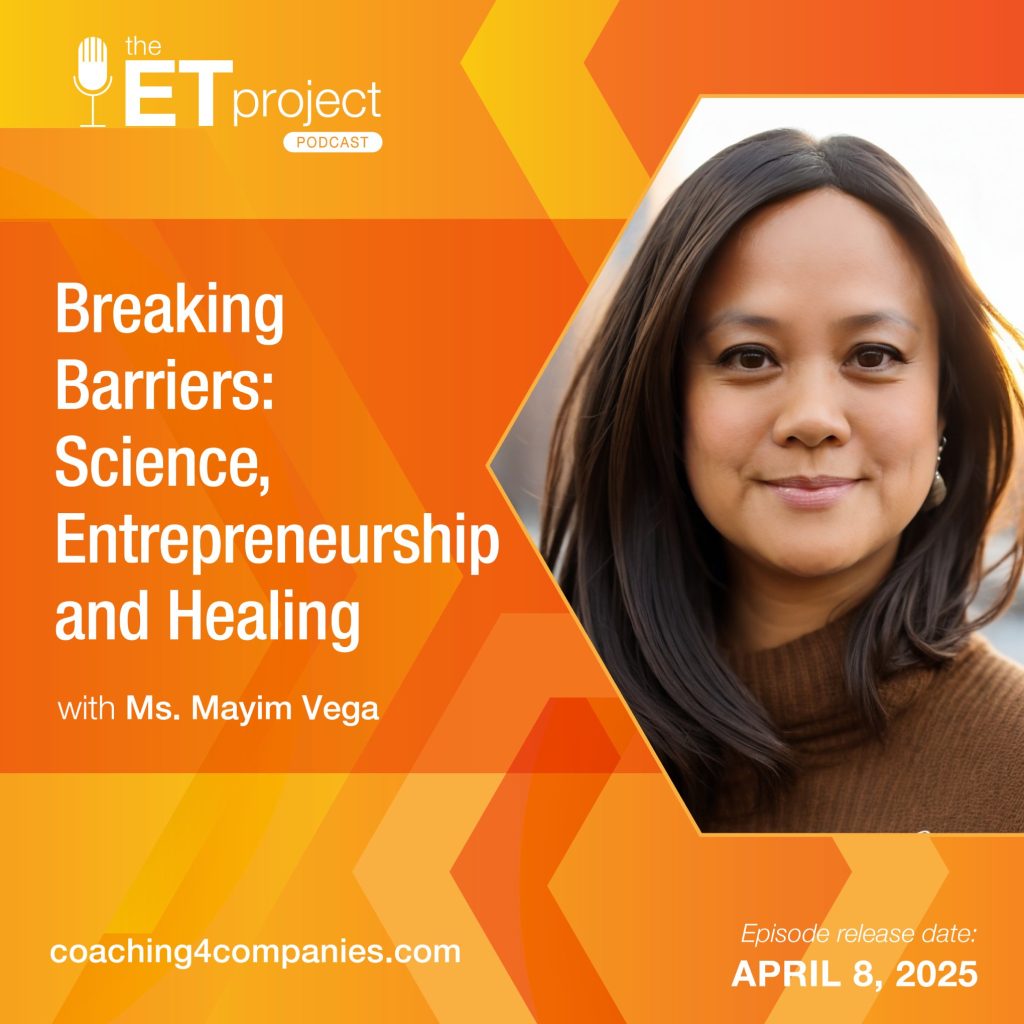
WAYNE BROWN: Hello, I’m your host Wayne Brown and welcome to the ET project. We’re delighted to be delivering this podcast for executive talent all over the world whom we’re affectionately referring to as ‘Team ET.’ Today we’re journeying to Dallas, Texas and we’re connecting with former NASA computer scientist Mrs. Mayim Vega. Mayim transitioned early in her career to devote more time to being a mother and in parallel commenced an entrepreneurial journey helping businesses with their digital product needs. Later, after facing a personal health crisis that conventional medicine could not resolve, Mayim pivoted again to found Arukah.com. During this leg of her journey she studied everything she could find on natural medicines for healing the body and in the process curing her health issues and establishing a holistic healer certification program. Mayim is a self-proclaimed workaholic and perfectionist and combining her scientific background with natural healing methods now empowers others struggling with their own challenges. An incredible testament to what’s possible when we refuse to accept anything other than the right outcome. Today, as a mother of a large family running a small practice, Mayim’s mission is to educate and support those seeking alternative health solutions. Team, as always there’s plenty to absorb from this conversation and understanding through Mayim’s display of self-determination and resilience what can be achieved. We can all learn from this and apply it to address our own daily challenges and so with that I’m excited to jump in and get started.
INTRO: Welcome to the ET Project, a podcast for those executive talents determined to release their true potential and create an impact. Join our veteran coach and mentor, Wayne Brown, as we unpack an exciting future together.
WAYNE BROWN: Welcome team. Today we’re diving into a conversation about resilience, reinvention, as well as the power of turning challenges into opportunities to explore what it’s like to work at NASA, firstly as an intern and later as a computer scientist, and look at the realities of pivoting to entrepreneurship. I think starting out in digital marketing and then pivoting again to other things and how health challenges can lead to discovering a deeper sense of purpose. We’ll also discuss the art of building a business from the ground up, looking at the role of technology and how it’s shaping modern ventures and strategies for creating high-ticket offerings that truly serve others. Whether you’re navigating your own career transition at the moment or you’re looking for inspiration to take that, let’s say, bold next step, I think today’s conversation with our guest, Ms. Mayim Vega, is sure to leave you with a long to-do list of actions that you’re going to want to get started on straight away. So, with that, Mayim, great to have you on the ET project, it has been a while coming but it’s wonderful that you’re here now.
MAYIM VEGA: Hi, yes, thank you.
WAYNE BROWN: I mentioned NASA and I’m sure a lot of our listeners are really interested to learn a little bit about the goings-on at NASA, for whatever purpose you can tell us, but initially you started as an intern, and I’m wondering what was the attraction, why intern at NASA?
MAYIM VEGA: Well, it was an opportunity that I had through college and, well, why not? I couldn’t imagine a better internship to have. I mean, I did have friends that ended up working at, for example, Netflix and Google and other companies, but yeah, I’ve always loved astronomy and outer space and things like that, so. Yeah.
WAYNE BROWN: I heard in one of your conversations on the podcast, you described yourself as a workaholic and a perfectionist. Did those traits influence anything in your decision to pursue computer science as one of your studies or your interests?
MAYIM VEGA: As a programmer, we had to work until the program worked, right? It wasn’t like an eight-hour thing and then you leave, really. It’s like eight hours, sure, if you can get the project finished. If you can’t get the project finished, then you put in extra hours because you want to hit those deadlines, those milestones. And then if it takes shorter than eight hours, well, that’s great. Then you can work on other things, right? And it’s not so much stress or pressure.
MAYIM VEGA: So, I think certainly being a workaholic, it did help me because I didn’t mind putting in long hours if I had to. I didn’t mind forgoing, for example, social activities or something like that, so long as I got the work done, the problem done, the code made.
WAYNE BROWN: The environment in NASA, I can imagine there’s a big waiting list for people who are interested in being involved in that market and just to be able to say, “I work at NASA,” but is it a competitive environment once you’re on the inside?
MAYIM VEGA: I think it’s more like a who-you-know type of environment. I don’t know how it’s like now because this was a very long time ago, right? I left in 2004. I’m 46 years old right now, and so I left in 2004. It was a very long time ago, and I knew it was hard to get into because when I just had my internship, I heard that sometimes people get hired on afterwards, and I was asking people about it, and they were like, “well, that’s very rare, there’s a very slim chance,” but I guess I got it. I got connected with the right people who hired me for an internship, and they liked my work, so they hired me full-time, and then they also helped me with college afterwards, so it was a really great deal. And it was so fun working at NASA. I worked at the Moffett Field Airbase near Mountain View, California, and we had at that time I believe the largest wind tunnel, so we would test various aircraft there. And our specific application that we were developing, that I was a co-developer of, it helped to test virtual prototypes of technology before they actually built it. It was used for anything and everything from nanotechnology, let’s say AI robots that would be injected into your bloodstream. Before that was really a thing, before you really heard about it on mainstream media like we do now, scientists were creating prototypes and our application was helping to test that and it was also used in new aircraft and spacecraft. It was used to test one of the aircraft that was able to break the sound barrier, I believe it was, so it was really fun. And then we also had a lot of scientists, guest speakers that would come maybe let’s say once a month, once every month or two, and they would just tell us their theories and different things that they were working on, so it was a really exciting environment to work in. And it wasn’t profit-driven, it was research-driven, so that added to the creativity and it wasn’t about making sales, it was about helping the scientists, helping the researchers, it was a lot of fun.
WAYNE BROWN: I can only imagine, and therefore it must have been a very hard decision to pivot and transition out of that environment.
MAYIM VEGA: No, not really, it wasn’t. I enjoyed it while I was there. And also, one of my co-workers, he was working on the Mars Land Rover and he coded it and he would monitor it while it was there and then he would gather the data and send it off to the scientists, so that was a cool kind of being there as he was doing that. But no, I got married and I had my first child and I went back to work after my six-month leave but then I felt like really unnatural leaving my son to… it was in like a NASA-sponsored daycare, right outside the gate, right outside the security gate, so it was really convenient. I could breastfeed him during my lunch break and things like that. But it didn’t feel right and I just felt like I’m ready for the next stage of my life, which I wanted to spend as a stay-at-home mom, because I made a lot of money and we lived in the Bay Area, it’s even worse now, it’s one of the most expensive areas in America at least, and so my husband was concerned that we couldn’t afford to live there if I just stopped working.
MAYIM VEGA: So, I started my business doing website and app development mostly for high-tech companies, which was a very easy transition from coming from NASA, working for big data, big storage cybersecurity firms, things like that.
WAYNE BROWN: What was the biggest challenge in that transition? What was the most challenging thing for you?
MAYIM VEGA: I think the hardest challenge was… because I was in research and non-profit government, I think that environment going to… it was mostly startups that I would work for. Sometimes I’d work for some big, well-known tech companies and have a contract here and there, but most of my clients were startups, and so they were very much profit-driven, and I had to jump into marketing, not just programming, but also the marketing aspect of it, and so that was really different, but that was fun also. I enjoyed learning all that, and that really helped me with just all of the rest of my entrepreneurship journey.
WAYNE BROWN: I’m visualizing as you’re talking, and I’m looking at the digital marketing world that we have today. How much different was it back then, 20 years ago, let’s say?
MAYIM VEGA: Well, when I got started, we didn’t really have social media. I think we had MySpace and Facebook was brand new, and so it was mostly just websites and SEO and paid advertising, so not as much activity, and then there was a lot of sales calls and things like that to go with it. It was easier back then. There wasn’t as much to do, so now it’s like you’ve got to be everywhere and things like that, so.
WAYNE BROWN: How has that transition been? With that background, I find it challenging. Is it as challenging for you, coming out of that background to where you are now today with digital marketing?
MAYIM VEGA: Well, you know, I think even in the programming world, you always have to stay on top of the latest emerging technology because technology changes so rapidly. I mean, most people see that now with AI, but even before that, you couldn’t really see it, but the programming languages were always evolving and changing and being replaced with different ones, and so I was used to always having to sharpen my axe, so to speak. Even at NASA, I would spend maybe half an hour every morning or so just getting more knowledge on the latest technology or advancing my programming skills in whatever languages I was using, learning new languages, things like that. So, I think that just comes with every trade I’m thinking, because even now, as a holistic healer, after I transition from that, I make sure that I stay on top of different trends, and there’s all kinds of trends that are going on. There’s new diets, there’s new supplements, there’s new drugs that I have to look up for my students and figure out what are the side effects, things like that. So, I think in all the professions that I’ve been involved with, you have to continue to sharpen your axe and stay on top of emerging trends.
WAYNE BROWN: It’s a great message for everyone listening. Hopefully people absorbed that. It’s one of the messages we share with our clients that it’s so important, particularly in today’s world, that you’re continually evolving your knowledge, your skills. You mentioned that you’re now in a different career or looking at a different field. Was there a trigger or a pivot point that created that transition from what you were doing in digital marketing to the direction you’re in now?
MAYIM VEGA: Yes. So, in my first business, I had a health crisis where I had really terrible migraines. And people who don’t really struggle with migraines, they think that, oh, it’s just a bad headache. But there are people who really understand what a debilitating migraine is when you can’t function, you can’t work. At first, I couldn’t work, then I couldn’t even take care of my children. And then it got to the point where I couldn’t even sleep because it was too painful.
MAYIM VEGA: And so, I went to the hospital and the doctor thought I had a brain tumor. But after some tests, a CT scan and things like that, she ruled that out. But she also said that she didn’t know how to really help me except for some strong painkillers which didn’t really work any better than the over-the-counter stuff I was already taking. So, I had to figure it out myself, basically, because as a computer scientist, I believed that there was always a way. There’s always a way. There’s no way that there’s something that I couldn’t do. If I could imagine that it could be done, then it can be done, I just don’t know yet how. And I look at our bodies much like a machine. I’m a spiritual person, I do believe in a spiritual soul and mind, body, spirit when it comes to holistic health. But even though I still think very rationally, very logically, and I’m like, “there’s a reason why this is happening to me, and I’m going to find out why.” And I did, and I healed myself. And it was shocking that I could do it with no medical background, yet the doctors couldn’t. Like they couldn’t even point me in the right direction, I had to do it by myself, even after thousands of dollars that I spent on them. And so, when I realized this, I was like, “the system is broken.” And I felt like this is where I’m needed, and I need to go into this industry because there’s just such a lack of knowledge of holistic health and healing. And I just felt like this very rational scientific method of approaching health and healing, it was not difficult to learn, to apply. And so, I just started teaching it to others.
WAYNE BROWN: Tell us a little bit about the journey then. You decide to find your own cure, your own solution, which is incredible. And to start, what happened? What transpired during that journey?
MAYIM VEGA: Yeah, well, you know, there are some really quick fixes, like you could try peppermint for a headache or a migraine, but that doesn’t really deal with the root cause. It is an herbal sort of like a band-aid, it’s like an herbal sort of a temporary fix. For me, one of the first things that I found out was that when I took B12, my migraines would go away, and it worked better than Tylenol, Diazepam, you know, Valium, anything that I would get over the counter or from the doctor. B12, vitamin B12. So, for some people, this is the cause of their migraines. It could be a vitamin or a mineral deficiency. Magnesium is another common deficiency that causes migraines. So, it could be B12, it could be magnesium, it could be a specific toxin that you are regularly consuming that you don’t know about. And it could be something that you’re eating, like MSG does it for some people, or additives, artificial flavors or colors, it could be those things. So, for everyone, it’s different. But I had an okay diet, but I realized… so then I’m like, “okay, B12 makes my migraines go away better than any kind of pharmaceutical drug.” Then I said, “well, why? Why does it make my migraines go away?” And I realized that it was because, one reason was because of my diet at that time, I thought I was healthy, I was a very health-conscious person and I was vegetarian, aspiring to be vegan. And that actually caused me to have a B12 deficiency. So, I had to stop trying to be vegan. And I had to start incorporating eggs and fish and cheese back into my diet. I didn’t want to do meat yet at that time, but I did eventually do that later. So that made it so that if I was eating basically dairy and eggs and fish, I didn’t have to take B12 anymore. So, I was getting closer to the root cause. And then, with my scientific mind, I said, “well, there are a lot of people out there who are vegetarian or vegan. Why are they not experiencing…”? Because I had friends who were following the same diet that I was in, in my social circle. And so, it’s like, “well, why are they not getting these migraines?” And so, I realized that it was due to stress.
MAYIM VEGA: It was due to me basically going from a scientific, non-profit research background to an entrepreneurial lifestyle. And staying up even later hours and also sometimes dealing with very difficult clients. Along with juggling being a mother, I had two children at that time, babies, basically a zero and a two-year-old. And so, all the stress and worry about my business and balancing motherhood, this caused a lot of stress. And so, I had to just relax more, trust more, and not worry so much. And then that’s when I got to the root cause. So, all that together, that was my holistic cure. So first it was just a vitamin, then a diet change, and then it was de-stressing and modifying basically my lifestyle.
WAYNE BROWN: You make it sound easy. I can imagine the journey itself to being able to de-stress wasn’t something that happened overnight. There would have been a phase-in period, I would imagine.
MAYIM VEGA: Yes, and also just studying all the different aspects and realizing how they fit in together and trial and error. It’s not like I didn’t try other things, I’m only telling you what actually worked, just the journey to the solution, which sounds very simplistic. It’s like, “yeah, that makes a lot of sense,” but how many people suffer and they don’t realize why?
WAYNE BROWN: So, this led to the founding of Arukah, which is arukah.com, which is your business, your organization?
MAYIM VEGA: Yes, I did enroll in some certification programs for nutrition, herbalism, and holistic health, and then I started arukah.com. I just started helping people, sharing the information. During the COVID years, that’s when I started a certification program. People had been asking me to teach for a long time, but I was like, “no, I just want to help people.” I wasn’t interested in really teaching. But when COVID hit, I’m like, “wow, people really don’t understand how to deal with this crisis, and it’s so important at this time, right now.” And I do believe that it’s just so much more important now than ever because health and medicine have become politicized, and so we really need to be empowered with knowledge to combat that.
WAYNE BROWN: What do you recommend? So, you have your certification program. How does somebody find out? Let’s look at the nutritional side for a moment. How do you find out that you may have a deficiency in some particular mineral or dietary need? Do you do a blood test and they test, or how do you do it?
MAYIM VEGA: You could do blood tests. But blood tests only test for what’s in the blood at that time. So, I do a different kind of test, which involves hair samples, and that will show you what your status is for a longer time frame. I think that as much testing as you can do is good. I also believe in kinesiology; it has helped me discover a lot of sensitivities. But then if I know what someone’s diet is like, I can also see where they might be lacking in something and what kind of supplements they are taking or not taking. Also, if they’re taking certain types of medications, we can look up what that might deplete you of. So, it’s really a very holistic approach, and I take it from different angles. I also take a look at what the symptoms are that you’re experiencing, because that’s also an indicator of what you might be lacking. But there are some things that universally a lot of people are deficient in. Magnesium, copper, which is a not very well-known one, but copper, and also iodine. Iodine is something that we’re very deficient in.
MAYIM VEGA: Now, I know there’s a lot of controversy when it comes to iodine. Some people say quite the opposite. They say, “no, no, no, we’re too overloaded with iodine,” and I think that that is misinformation. And also, a lot of times people will diagnose and say “we are deficient in iron” or that “we have too much iron,” when the truth is actually that we don’t have enough copper to regulate the iron that is already in our bodies, in our tissues, and in our bloodstream. So, there’s a lot of different things that it could be.
WAYNE BROWN: Thank you for reminding me about the exploration through taking hair samples. I’ve spoken with a guest who does something similar a couple of years back. I forgot about that, but she also uses that as a means of identifying deficiencies or where there’s an oversupply. How long does that type of testing take? Is it a quick process? And once you identify it, then is it a case of supplements, or how do you then move forward?
MAYIM VEGA: Yeah. Usually there’s supplements that you could take for imbalances. It’s also a sensitivity test, so you can also cut out some foods, but not only foods, but also environmental things that could be affecting you, chemicals or just different things that you could avoid. And then you can retest every few months, every six months or so, to see what your current state is.
WAYNE BROWN: So, you pivot, you go into this new world. You do a lot of study, I’m sure. I read somewhere that you are a naturopath, if that’s correct. But you also then include coaching. What was the reason for bringing coaching into the practice?
MAYIM VEGA: Well, like I said with my first health crisis, there was some supplementation and diet changes involved, but the root really was the stress. Right? And then there was another time in my life when I had a health crisis, and it was severe hypothyroidism, where it got so bad that I was not able to control my temperature. It was a very hot Texas day, like 105 degrees outside, and I was outside in my down jacket drinking hot tea, sitting outside in the 105-degree Fahrenheit weather, trying to get warm because my body just couldn’t keep myself warm. Again, I got the terrible migraines and also extreme fatigue, lack of energy. I was just bedridden for weeks after I got that, I call them hypothyroid attacks. And it was very scary. At that time, I thought that I was on my deathbed again because I couldn’t function. And as a naturopathic herbalist, I was able to figure out that I was severely deficient in iodine, and then I also was able to actually use the carnivore diet for a few months to nurse me back to health as well. And then that’s when I had to get coaching because I knew there was an emotional, spiritual aspect to my health issues, just like the first time, stress is a big factor in a lot of disease. And especially for me, because I knew that my diet was pretty clean, I knew that my environment was pretty clean because I was already very conscious of that, I mean what things I put in my body and on my body. But there were new major life changes that I didn’t know how to navigate on my own. So, we got both marriage coaching and also, I got personal life coaching to help me through that, and it really helped me. And that’s how I really help people with the mental, spiritual aspect of health and healing.
WAYNE BROWN: And what is hypothyroidism? I’m not familiar with that at all.
MAYIM VEGA: Well, basically, it’s when you have an underactive thyroid, and mine was due to an iodine deficiency. And iodine deficiency is actually very common because our modern world uses a lot of chemicals that deplete our bodies of iodine or prevents our thyroid from absorbing it. A lot of things that they put on our clothes, in our food, on our furniture, et cetera, have certain chemicals, bromide especially, that will deplete our iodine stores or prevent our thyroid from absorbing it. So that and the stress, all of that was just too much for my body.
WAYNE BROWN: Interesting. I’m visualizing a lot of people out there who are listening, who are in a situation of high stress. Our world is just driving that outcome at the moment, and…
MAYIM VEGA: You know, I was also experiencing, I’d like to add, I said the major things, which was not being able to control my temperature and the fatigue and also the migraines again. But other things that I was experiencing through hypothyroidism was my eyesight started to get weaker, my hearing started getting weaker, and also my mental clarity, I started becoming very forgetful. Like, I had to take pictures of where I parked my car, for example, in order to remember. And so, the iodine supplementation really, really helped with that. I thought I was going to have to get glasses, but then I reverted that. My hearing improved, and what else? Oh, and the memory. The memory also, I don’t have to do weird things to remember where I parked anymore, I can just remember where I parked, that was one of the biggest things. So yeah, iodine is really, really powerful. I forgot which country it was, but when I studied that, I believe it was an Asian country, when they realized how important iodine was and how much it could help, especially with mental focus and clarity, mental fortitude, they started supplementing the water supply with iodine. And they also did a propaganda campaign all over, in their mainstream media, so much so that even schoolchildren, they were using it as an insult. Instead of calling each other stupid or dumb, they’d be like, “Oh, what are you? Iodine deficient or something?” Because mainstream media was pushing iodine so much.
WAYNE BROWN: Gosh, I know in Australia, they use a lot of chlorine in their water supply, and there’s a lot of debate about the pros and cons of that, so I can imagine what’s…
MAYIM VEGA: Yeah, I remember when I was working at NASA, and we got this warning in the area, in the Mountain View area, California there. We got an email from the government. No, I think it was from NASA, I don’t remember who it was from. But it went to my NASA email, and they said, “Okay, we used to use this other chemical. Now we’re going to start using…” I think it was chloramine. “We’re going to start using chloramine in our water now.” And they’re like, “Don’t worry, it’s perfectly safe for human beings, but don’t put your fish in this water, because they could die.” And I’m like, “Excuse me? I’m not going to drink water that my fish might die in. Thank you for warning me, but I’m also going to avoid it. Thank you.”
WAYNE BROWN: Very interesting. So, you’ve included the herbalist’s route, the naturopath and now the coaching, but then you go a pillar farther and you bring in business into your business. So, you start helping people to set up their own businesses and promote their business.
MAYIM VEGA: Yes. Well, I mean, that was a natural addition because of my programming and marketing background. And that’s really…
MAYIM VEGA: I felt like that was where a lot of holistic health schools… well, I think the other holistic health and healing programs, they fail in many areas. One area is their lack of business training. It’s kind of very generic and they don’t really help you, they just kind of give you very generic information in terms of starting your business. And as a holistic healer, unless you’re a licensed medical doctor also, which I do, some of my students are licensed medical doctors or nurse practitioners or nurses or things like that, but most of them are not. So, they have to pave their own way, create their own path. And you do not need a license to heal. I don’t diagnose, prescribe or treat disease, I educate and empower people. And that’s also part of the program is setting up the online business and the marketing aspect, but also how to do this legally as a non-licensed practitioner, that’s a very important part of the program. And another thing I feel like too, where other holistic health schools fail at, is they often teach just one method and they’re very dogmatic and religious about it. For example, my holistic health school that I signed up for in the beginning, they taught that vegetarianism was optimal. And I knew that that was wrong because that was why I suffered my first health crisis to begin with. So, I learned a lot from them, but I kept going until I found better answers than that.
WAYNE BROWN: As you look to the future now, I mean, not too far in the future because it’s so dynamic in the world today, but where do you see yourself? Where do you see Arukah.com?
MAYIM VEGA: Yeah. I’d like to add one more thing to what I said earlier. Another thing is, I think as a woman and a mother, having to kind of multitask and do many different things, wear a lot of different hats, it kind of comes natural, I feel, to women because they have to do that just being a mother, you’ve got to cook, you’ve got to clean, and if you already work, you’ve got to do that too. And you’re already managing people because you’re managing your children, so. I think managing my children is harder than managing my contractors and my employees and whatnot. I think it’s harder to manage my children. So, for me, I’m like, that’s the easy part. But anyways, as far as Arukah goes, my hope and my prayer is to really be part of or influence a greater movement to independence, independence from the modern medical system, truth, freedom, health, and all of that. And I am a religious person, and I do believe in the messianic prophecies of the Bible, that there will be a time where evil will be gone. And with that, corporations that have no accountability to actual people, but just to making as much money as they possibly can, that kind of thing will be eliminated. And I think that it’s not going to happen magically, but it’s going to take people who care and who are awakened and who dedicate themselves to this cause. And so, I really feel like there’s a great need, but I feel like this is a necessary part of the evolution of humanity.
WAYNE BROWN: For our listeners, any suggestions or advice, I mean, there will be a large number of them who are experiencing some form of trauma in their career, whether it’s stress or stress inducing. Any suggestion on what they can look to as an action out of this conversation to try and help them going forward?
MAYIM VEGA: Yes. Well, I would encourage them to do two things. Number one, is believe that there is a Creator who is good and who wants the best for them, and that every challenge in their life, even though it may seem bad and it is bad, that it can be used as a stepping stone for your growth and for change quite possibly.
MAYIM VEGA: And to realize that if someone tells you that something can’t be done, whether it’s this program can’t be built or your business goal is impossible or too difficult or your disease can’t be cured or you can’t heal from this or anything like that or your marriage can’t be saved or whatever it is, or there’s no hope for your child or whatever it is, all that means is that they do not know how to make it. They don’t know how to achieve it. They don’t know how to succeed in the goal that you are looking towards. And that doesn’t mean that it doesn’t exist. It doesn’t mean that success is impossible. And you have to keep, I believe, searching and have faith that God will direct you in the right way and to walk with integrity in everything you do and to remember that there is a greater purpose to why we are here and that we’re not just flesh and bone. We are spirit and soul also. And I believe that when we walk in our divine nature that we will find divine answers to all of the problems that we face in life.
WAYNE BROWN: Are you working on it at the moment in terms of projects, books, any new courses, anything that we should be aware of that we need to keep watching you and watching your space?
MAYIM VEGA: Yeah, I mean, I’m constantly authoring. I don’t really publish it on Amazon or Kindle or anything. I just kind of self-publish usually, but I just finished one recently on rheumatoid arthritis, and I’ll create a landing page and probably a video for that soon. And then I am also writing another one about the ‘Arukah Method’ and discovering your purpose and becoming a holistic healer. My journey and my philosophy in all of that is based on a Kabbalistic understanding of the five levels of the soul. This is a Jewish thing, I’m Jewish, so we have our Nefesh, which corresponds more to our physical body, and then we have our Ruach, which is our emotional selves, and this is where we have to take care of our emotional health, then Nefesh is our physical health that we have to take care of. Neshamah is our intellectual health, and that’s pursuing knowledge and wisdom. And then there’s Chayyah, which has to do with our actions that we do in our lives, serving humanity and walking with integrity and things like that. And then the fifth level of the soul is our Yechidah, which is being connected to our Creator and being one with our Divine Creator and walking in that oneness and realizing our Divine nature. And so, this is what my holistic health and healing method is based on, that’s the one I’m working on currently.
WAYNE BROWN: Where can people follow you or connect with you?
MAYIM VEGA: So arukah.com, A-R-U-K-A-H dot com, and if you press on the button that says ‘Become a Healer,’ that’ll get you on my email list. And also, YouTube, I post everything there. So yeah, I think those are the two main places.
WAYNE BROWN: I noticed you have a huge number of videos on YouTube.
MAYIM VEGA: I do. I’ve had my channel for a long time.
WAYNE BROWN: Yeah. Great to have you on the ET project. All the best with everything from the future.
MAYIM VEGA: Thank you so much for having me.
OUTRO: Thank you for joining us on the ET project, a show for executive talent development, until next time, check out our site for free videos, eBooks, webinars, and blogs at ‘coaching4companies.com.’