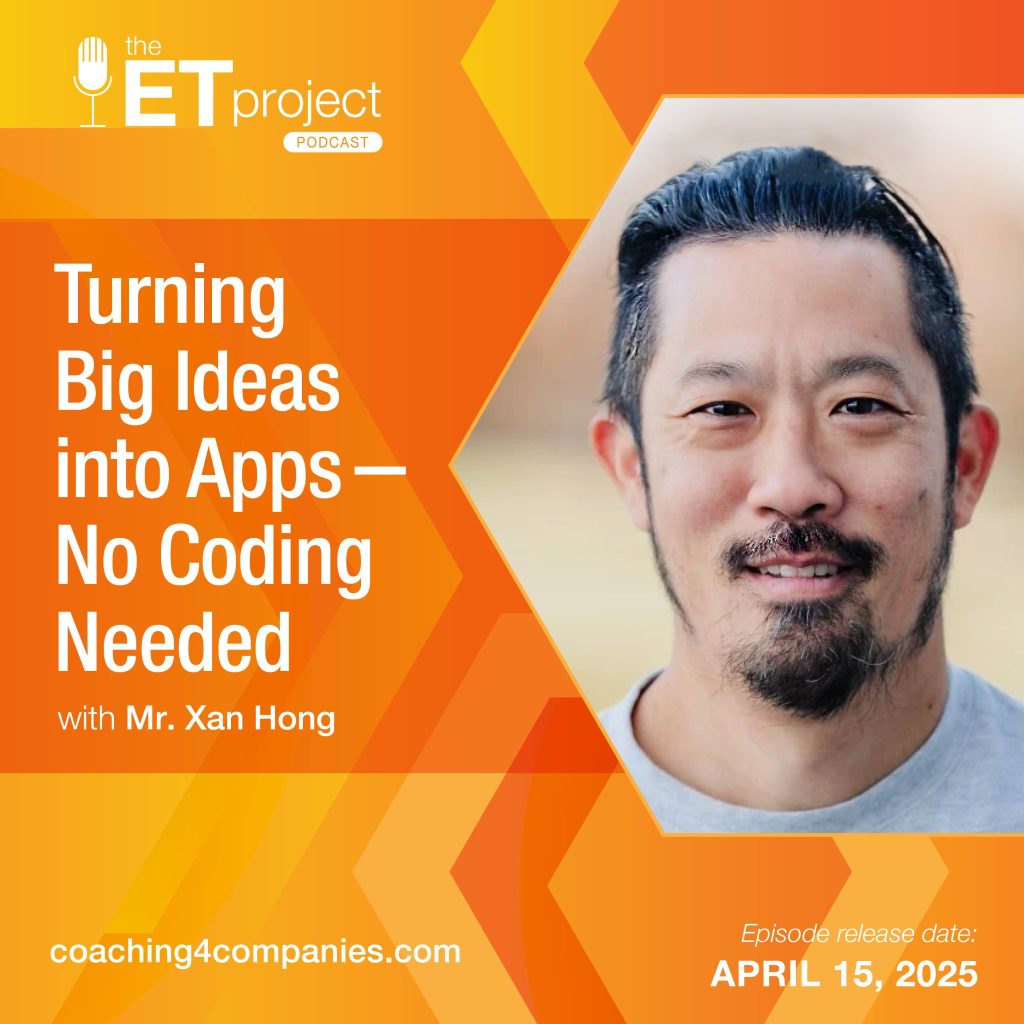
WAYNE BROWN: Hello, I’m your host Wayne Brown and welcome to the ET project. We’re delighted to be delivering this podcast for executive talent all over the world whom we’re affectionately referring to as ‘Team ET.’ Today we’re journeying to Middletown, Delaware and chatting with Mr. Xan Hong, the lead consultant for Drive Phase Consulting. Xan helps clients leverage no-code and artificial intelligence technology to scale their companies. He’s a start-up veteran with over 15 years of experience and helps other founders with their start-up idea validation. During that time, he has generated over $15 million in revenue in a variety of industries including marketing, communications, food and beverage, e-commerce, financial services, real estate development and technology. Xan received his Bachelor’s in Biology from the University of Pennsylvania where he competed on the Varsity Men’s Track Team for four years. He later received his Master’s in Education from the University of Pennsylvania during which time he served as a student teacher and volunteer track and field coach at a university high school in West Philadelphia. He has since served as an adjunct professor in entrepreneurial finance at Lincoln University. Xan regularly volunteers his time mentoring and speaking to youth from inner-city schools. Team, as we all know, AI and this concept of no-code are big business and growing rapidly. During our conversation, you’ll get a true feeling for why we need to take notice and how no-code can become a valuable ally in our constant search for more from less. We can all learn from this and apply it to address our own daily needs and challenges. And so, with that, I’m excited to get started and jump in.
INTRO: Welcome to the ET project, a podcast for those executive talents determined to release their true potential and create an impact. Join our veteran coach and mentor, Wayne Brown, as we unpack an exciting future together.
WAYNE BROWN: Hello team. We have a really fascinating and highly relevant discussion ahead of us today as we’re going to explore a digital world that no longer requires deep technical expertise for bringing innovation and efficiency to life. And I’m sure all of you are going to be excited by that fact. What are we talking about? We’re talking about no-code platforms and applications where anyone with a little bit of vision and ingenuity can build apps. You can automate workflows, scale businesses without writing a single line of code. So, I know I’m excited by that, I’m sure many of you are. These are really powerful tools that are democratizing technology, they’re enabling entrepreneurs, marketers, and even children to turn their ideas into realities hence we go from streamlining operations to driving customer engagement. And no-code is really one of the things at the forefront revolutionizing how we approach business in general, the business growth, business performance. So, in our conversation today with our guest, Mr. Xan Hong, we’ll explore the potential of no-code applications, the benefits, as well as the real-world use cases, and what the future holds for this game-changing innovation. So please get yourself ready for rethinking what’s possible as we welcome Xan to the ET project. Xan, wonderful to have you on board, looking forward to our conversation.
XAN HONG: I am as well, Wayne. Thanks for having me. I appreciate it.
WAYNE BROWN: Maybe we start with, just getting today a little bit better, and if you don’t mind sharing some of your background, perhaps what first sparked your interest in technology, entrepreneurship, as well as eventually the no-code solutions.
XAN HONG: Sure. You know, I think it’s important to kind of start with the fact that I don’t have any kind of coding background, I’ve never kind of coded anything.
WAYNE BROWN: Oh.
XAN HONG: So, I think that’s important to kind of, you know, give context to this conversation today.
WAYNE BROWN: Yeah.
XAN HONG: I’ve been an entrepreneur though for about, it’s going to be over 20 years now in a variety of industries. So, I’ve been in real estate, healthcare, e-commerce, technology. And so how I got started, I always share this story because it’s one of my favorites and people always love to hear the story. So, during the pandemic, my daughter was about eight at the time. She’s now 12. And she was an only child, so generally, the pandemic was a tough time for her because she lost a lot of her social interaction. And so, the highlight of it was the ice cream truck. And it was a daily kind of ritual where we would hear the ice cream truck music and she just kind of just go crazy like a chicken with her head cut off. She had to find her shoes, find her birthday money, and then she couldn’t go by herself. So, dad had to go find her shoes.
[00:05:00]
XAN HONG: So inevitably what happened is she kept missing the ice cream truck. So, what she said is, “hey, dad…” you know, as an entrepreneur, this is like music to my ears. She said, “hey, dad, can we build an app to track the ice cream truck?” And I said… you know, and what dad is going to say no to that, right? And so, I said, “yes, of course.” And so, I started looking at how much it would cost to pay someone to build that. I was like, “Whoa, that’s quite a bit.” You know, I was like, “well, I have to make this happen somehow.” So, what I ended up doing was taking a boot camp, it was about an eight-week boot camp to learn a platform called Bubble, which is probably the most popular no-code platform, there’s quite a few more now that we use. But so, I actually took an eight-week course, built that app over the course of that program, right? With no programming experience. And you know, what was kind of cool is in addition, like once we launched it, we actually, you know, I was kind of trying to teach my daughter entrepreneurship. So, we actually did some cold emails to ice cream trucks. So, we actually had one write back and it happened that they were in a food truck association. So, we actually had that association license that app from us for about three years. And it was my eight-year-old daughter’s idea. So that’s a long way to answer, but I do like to share it because it is kind of a cool story.
WAYNE BROWN: Did you end up tracking the ice cream truck? That’s the most important thing.
XAN HONG: So, in that food truck association, there were a couple. So, the issue was we needed to have ice cream trucks use it or else the app doesn’t work, right? Because they needed to share the location. So, we never got an ice cream truck locally to do it. But in that food truck association, there were some ice cream trucks in there, so.
WAYNE BROWN: And how has that whole thing influenced and evolved for you?
XAN HONG: Yeah, so I tell people all the time that taking that boot camp was like getting a superpower, right? Because you go from not being able to make anything digital, you know, no programming experience. So, you know, there’s all things you always want to make and then all of a sudden with no-code, I could build virtually anything I wanted to, right? And so, I got in this trap where I was just looking for stuff to build, you know, that had no commercial value whatsoever, just to build it. But beyond that, you know, I actually built a platform for one of my own businesses, an e-commerce business that also exploded over the pandemic. And so, you know, kind of a quick story on that, it was a ‘Paint By Number.’ So, it’s just paintbynumber.com, we were selling their custom ‘Paint By Number’ kits. And so, most of what we were selling was people uploading their photo, and we would convert it into a ‘Paint By Number’ kit and sell it to them. So, you know, during our peak, we were selling about five to 8,000 per year of that, right? And so, our process to start was they would submit their photo through our e-commerce site, which was Shopify, we actually ended up on WooCommerce. So, we’d have to download that photo, send it to our vendor, vendor would convert it, we would get that proof back, send it to customer, and they would approve it, you know, and then we would let the vendor know, “hey, it’s approved, you can go ahead and send it to production.”
WAYNE BROWN: Yeah.
XAN HONG: I timed it, so per order, it was taking about five minutes per order to do that whole process. Over five to 8,000 orders, you can imagine that that adds up very quickly. So, what I did is it was one of the first apps I built that had like real value. Well, no, I take that back, the food truck one had real value. But it was kind of a first business application, where we basically integrated that with our e-commerce platform. So, the photo got pulled in automatically. We gave our vendor access to it so they could log in, download the photo, they would then upload the proof to the system on them. And once it did that, it would automatically email and text our clients a link to approve it, then the vendor could go and see that it was approved and send it to production. The other thing we did that was really kind of an under-looked kind of feature of that is, when they approved it, we would say, “hey, do we have permission to post this on social media?” And then if they did, we would automatically actually post that on Twitter, Instagram, Pinterest. We grew our engagement on social media exponentially with completely automated content. So not only did we cut a five-minute per order process down to zero, because actually our team actually no longer needed to touch it at all. And then we also then improved customer experience because our customers loved that process. You know, they got to see it, you know, it was very easy to do. And then in addition to that, we grew our social media following and it literally didn’t take our team any time at all. So that was a complete game changer.
[00:10:00]
XAN HONG: And then from there, I built some for our own businesses, but then we started getting people saying, “hey, could you do that for me too?” And then that turned into our current business, Drive Phase Consulting, where, you know, we basically build our clients custom apps. And I will tell you that with no-code, we’ve been able to build apps very quickly. But for the clients that have gotten another estimate before we built the app for them, we have saved them over a million dollars in app development costs by using no-code versus what they received with other estimates. So that gives you kind of a dollar amount to kind of the scope of what the savings that can be.
WAYNE BROWN: I’m guessing you’ve probably got everyone’s attention now with the story, with the savings. Our listener base tends to be mainly leaders, so, you know, you mentioned dollar signs and everyone’s ears open very quickly. Perhaps we backtrack a little bit, because I’m sure you’ve seen there’s a lot of people like myself who are not technical and, you know, apps have been around the app for a decade or so, they’ve grown exponentially, but the concept of no-code, how do you define that easily or how do you explain what that means?
XAN HONG: I think the best way to explain it is it’s actually visual programming, right? You know, if you look at most business applications, you know, every business application looks different, but if you break it down into the fundamentals of what it is, you’re creating data, you’re reading data, you’re manipulating data, you’re displaying data, right? And so, there are some basic, you know, fundamental building blocks that are in every app. So, with no-code platforms, they’re leveraging the fact that, “hey, the building blocks are the same in a lot of these applications.” So, they pre-build these modules, for lack of a better term. And so, in no-code, you’re basically taking these pre-built modules, combining it in very unique ways, and then there’s layers that you can add on top of that. So, it really is just, you know, kind of creating logic, you know, translating the workflows into logic. So, it is ultimately programming, and I tell people, “You still have to think like a programmer.” Like the logic is still very similar, and that’s why not, you know, that’s why a lot of people come… that’s why businesses like us exist, is that some people just try and just can’t do it. But for those that kind of are able to think like that, it allows them to not have to know that language, you can basically just logically build out step by step, this is what happens. And so that’s… I don’t know, does that answer your question? I mean, that’s really what it is. I mean, so I tell people it’s like Wix or WordPress, what they did for websites, no-code is doing for full-on applications where they’re, you know, Wix and… well, Wix has a little bit of automation, but WordPress, like those are for the visual elements of a website, but a lot of times they don’t have… you can’t really customize the backend workflows and build a full application. No-code platforms really add that second layer to it where you’re able to add logic to the visual components of an application.
WAYNE BROWN: So, is it as simple as drag and drop, which is kind of like the Wix and the WordPress example, right? Is it that kind of approach?
XAN HONG: Yeah, I mean, think of it, you know, I don’t know if you’ve ever used a platform like Zapier or something like that, where you’re building… yeah, it’s that times 10, where, you know, and Zapier is actually kind of moving in this direction as well, where it’s becoming more. But yeah, you’re using those kind of branching kind of visual diagrams to then map out your logic. And so, yeah, a hundred percent, I would say, yeah, it is drag and drop from that standpoint.
WAYNE BROWN: You mentioned Bubble, and I know looking at your website, you use quite a range of different platforms.
XAN HONG: Yeah.
WAYNE BROWN: What are some of the more common ones that people may have heard about?
XAN HONG: I don’t know if they’ve heard about it, but the main ones we’ll use right now, Bubble is definitely one. A combination that we’re using more often is a combination of WeWeb and Xano. So WeWeb is a front-end only tool. So that’s just kind of the visual components that you, you know, when you open up a browser, you know, it’s that component. And then Xano is a back-end where it’s the database plus a lot of back-end workflows, a lot of logic is happening, kind of run in the back-end with Xano. So, you’ve got WeWeb and Xano. Another one is FlutterFlow. WeWeb is primarily for web-based, FlutterFlow is best for kind of native mobile app. And so, you know, and that doesn’t… that needs like a back-end, like a Xano as well. So, you could pair FlutterFlow with Xano or some people do it with… Supabase is another no-code back-end as well. So those are some of the main ones that we work with currently.
[00:15:00]
WAYNE BROWN: Right. Just recently I can imagine it’s applicable across industries that there’s no one industry where it doesn’t work or no one industry where it’s more popular, I guess. So, it’s definitely a game changer for everybody.
XAN HONG: I would say just about, just about. Yeah. I mean, there might be some really heavy applications where maybe, you know, you maybe outgrow it. But I would say the technology is to the point where you can do most things in… I will tell you… I tell people this all the time that we’ve never run into an app yet that a client has asked us that we have not been able to build in no-code, that doesn’t mean that we won’t. And that doesn’t mean that some of the ones, and I actually had one the other day where I was like, we could probably do this, but I actually, this is one where I would tell you that code is probably a better solution just because just because of the use case and… you know, where every millisecond was going to count for them. And, you know, I tell people that no-code at the end of the day still outputs code. So, I tell people it’s like programming with a translator, right? And so, it works really well, but if milliseconds matter to you, like, it’s still like having a conversation with the translator in between, you know? And there are certain cases, but in 80 to 90% of the cases it would be applicable to just about any industry.
WAYNE BROWN: So, I can only imagine, therefore, there’s a huge number of advantages and benefits that come out of using no-code. You mentioned cost, obviously, speed, I can imagine is one of the…
XAN HONG: 100%. Yep.
WAYNE BROWN: What are some of the other benefits that come to mind?
XAN HONG: Yeah, so I would say speed is the top one. Cost is a by-product of speed, right?
WAYNE BROWN: Yeah.
XAN HONG: But I want to go a little bit deeper on the speed aspect of it, because it’s one that I actually see that not everyone else sees, right? And the fact is 90% of the time when you build a product, and it’s why most startups fail, right? You’re wrong. You know, when you have a startup idea… you’re making an assumption that A, you’re solving a problem that’s painful enough that people will pay for, and B, that you have a solution that’s best for that problem, right? The reality is 9 times out of 10, you build it and you find your assumptions are wrong.
WAYNE BROWN: Yeah.
XAN HONG: Or the other thing that you see is users use it in a way that you just didn’t imagine they would use it, right? And so, you’ve got all these different things. And so, what I tell people is the first version of what you build, you’re about half a percent done. And so, the magic happens when you get user feedback, you incorporate that user feedback, and then you release that next version, then the next version, then the next version. I will tell you that I believe that’s really where no-code shines because the speed at which we’re able to incorporate user feedback and release that next version is incredibly fast. And so, you get to a really usable product in a fraction of the time versus code requires a lot of planning, a lot of resources, a lot of cost, right? And so, it’s just, you know, that’s where I really see no code shining. And then just, you know, I think there’s kind of existing businesses and startups, you know, think about it from a startup standpoint is, as I said before, most startups fail because their first bite of the apple is wrong, right? And the problem is if they spent too much in that initial version, they don’t not have enough kind of, they’ve shot their load and they don’t have enough to kind of take another bite of the apple or maybe three or four or 10 more, right? So that’s why they end up failing, they run out of resources right then. If no-code gives you another five to 10 bites of the apple, right? You increase your chances of success that much more, and then you also decrease that learning time exponentially, right?
WAYNE BROWN: Yeah.
XAN HONG: So those are just, you know, you do these conversations all the time, so I hope you appreciate like what that means to a startup or a business, you know, even existing business, what that can mean for a business.
WAYNE BROWN: Yeah, absolutely. And I was thinking while you were talking, so from a scalability or growth point of view, this would also be a wonderful, a revolutionary element that would help people be able to scale, you know, just based around what you were saying earlier about being able to do those iterations and improvements.
XAN HONG: 100%. Yeah, I’m sorry. I’m sorry. There was one more thing that came to mind as well as you were talking is the other kind of benefit that people kind of overlook is programmers was such a specialized skillset at the time, and it takes a very special person to do it, right?
[00:20:00]
WAYNE BROWN: Right.
XAN HONG: What you found was there was often a disconnect between the business people and the builders, right? The builders didn’t necessarily understand… didn’t appreciate the user experience. What you’ve done with no-code is you’ve basically removed the barrier where the users and the business people can now build directly. And now the people that know the audience the best, know the needs the best, can become builders and that, you know, I’m sure you could appreciate that as well, that’s just another thing that can really be a huge benefit.
WAYNE BROWN: Absolutely. Most of my career was done without the no-code platforms, so I’ve experienced from both sides. We do a lot of development with IT companies, but we also work a lot with the other side, which is the operations side. And, you know, typical exposure is operations come along with an idea. They talk with the IT team, the IT team sits down and prepares, starts preparing it. And then the next shiny object appears on the horizon. The operation team loved the idea, come back, and of course it changes everything in the process for the IT team. And, you know, you can imagine the frustration, the cost, the delays, et cetera, that evolve as a result and I can imagine that no-code addresses the…
XAN HONG: Yeah, 100 percent. I was at BubbleCon, so Bubble, one of the main ones, so their annual conference. So, Seagate is a hard drive manufacturing company, a massive company, kind of, you know, I’m sure very large. And so, they, one of the guys presented a great case study where he was a product team manager and it just so happened that he had Bubble experience. What he did is they had a kind of a product that originally, they had a, you know, external code, you know, a traditional coding team that was costing about $2.3 million a year. What he did was he brought in Bubble, they used the enterprise version of Bubble, so it was very scalable. He actually taught his product team how to use Bubble. So, they were able to completely eliminate that external team. The team built it themselves. So, they saved the $2.3 million in the external team, but they also reduced their launch timeline from about 15 months down to three to four.
WAYNE BROWN: One of the offshoots of that story, I can imagine, is the team often is the isolated party and they, like you just said earlier, they’re the end user and quite often it’s their knowledge and experience that’s missing in the development stage.
XAN HONG: Yeah.
WAYNE BROWN: And so, if I understood exactly what you said, you’re now involving the team in the development phase and therefore you’re bringing that use case into the development, which I can only imagine is so powerful and engaging.
XAN HONG: It’s kind of a soft benefit of it, but it’s 100% one of the benefits of no-code, yeah.
WAYNE BROWN: When we first spoke, I remember you were talking about you are working on social listening and lead generation applications. How did you get on with that?
XAN HONG: So, the short story behind that is social listening has been one of our most effective lead generation tools. So, for those that don’t know, I don’t know if there’s a more precise definition, but I’ll give you my definition in my head. So, it might not be the Webster’s dictionary version, but basically what we do is we have certain keywords that we’re interested in that we monitor primarily right now on Twitter, LinkedIn, and Reddit, which Reddit has actually been highly effective. So, I was using an external tool and I just didn’t like the user interface. So, it just so happened that I was like, there was a new no-code tool that was interesting. And so, I wanted to learn it and I’m of the mindset of, I don’t like to waste any minute of my time, right? So, I’d be like, “well, if I’m going to learn this platform, I’m going to build something that is useful.” So, I built the platform in about three weeks and that’s only because I hadn’t used that platform before, it probably would have been faster. And so, I built the workflow, the user interface exactly the way I wanted it. And so, we’ve actually generated a ton of really high-quality leads because with the social listening, similar, you know, I do a lot of digital marketing and I always tell people like Google ads leads are going to be a little bit higher quality than a Facebook lead because it’s about intent, right? You’re targeting people that are looking for what you want and then you provide it to them. And of course, it’s going to be higher quality versus on a Facebook ad, you know, they’re not on Facebook to pay you for something.
[00:25:00]
XAN HONG: But in this case, you know, people are using social media to look for recommendations on X, Y, Z. And so, what this tool has allowed me to do is to inject myself into the conversation at the right time early on while they’re doing research. And so, it’s just a higher quality lead and it’s really highly cost effective. So yeah, I mean, that has been a really… yeah, so that has been kind of a cool tool that we have built and now we’ve got other… you know, it’s also generating income for us as well because we have other users using it as well. Yeah, so that’s the one that brings a smile to my face because that’s a win all the way around, right?
WAYNE BROWN: And is it applicable across industries or is it specific?
XAN HONG: I mean, what I would say is with those social media platforms, like if you’re a local home services type business, it’s probably not going to be as effective for you, you know, versus we’re a consultant that can do business anywhere. So, it’s easier to find, you know, leads that are looking for, you know, versus if you’re geographically limited, then it will be a lot tougher to find quality leads. But yeah, so it’s called signalboard.io is the website, but yeah. But for those that are not geographically limited, like it’s a consultant or, you know, anything like agency or anything like that, it’s a great way to generate leads.
WAYNE BROWN: So just explain the social listening concept a little bit more if you don’t mind, how do you listen to a social conversation?
XAN HONG: I won’t give all the secrets on the backend, but basically, I can put in certain keywords in and every day on the signal board, it comes in all the mentions of the keywords that I look for come in to one place. And then what I also did was we used AI to score those because some of them aren’t going to be relevant for what I want, right? So, it’s going to score those. And then in addition to that, we also have it so AI can generate a response for you. And then I still usually edit it, but it generates a response, like for instance, I’ll use ‘Paint By Number.’ So, if we were monitoring ‘Paint By Number,’ I would put that into the system. So, every day it would pull in every mention of ‘Paint By Number’ on Twitter, Reddit, and LinkedIn. LinkedIn is probably not as relevant for that one, but Reddit is a good one. And so, then I can go and draft a response. So, someone is saying, “hey, does anyone know any good ‘Paint By Number’ companies?” I can go in and be one of the first to respond and say, “hey, we have one.” And then you’re engaging in that conversation of people that are starting that conversation. So, it’s really listening to relevant conversations to you so that you can be one of the first to participate and engage with that poster. And what I’ll find is half the time the leads aren’t coming from the original poster, half the time it’s coming from someone else that hopped into that conversation and then read through and saw my comment. And so, Reddit has been effective because the SEO on Reddit is so effective that half the time when you’re searching for something, Reddit posts are among the top conversations. And so, they’ll come in doing research on an X, Y, Z topic, and then they’ll see that Reddit post and they’ll do it. So, it’s really an effective tool. And so… but at the end of the day, we built the platform to automate that process quite a bit.
WAYNE BROWN: You know, social media is such a large part of any sales initiative, or should be at least such a large part of any sales strategy. Sales like this app really gives you the ability to pick up on potential leads and give yourself a better than even chance of making that sort of conversion.
XAN HONG: Sure, absolutely.
WAYNE BROWN: In many ways, we’re still at the infancy in where we’re heading with AI developments and I’m sure no-code growth is somewhat exponential, like where do you see the whole process evolving to?
XAN HONG: That’s a great, great question what you just asked. AI has definitely changed the conversation. And so, I will give you my take on it, right? AI-generated code is definitely a direct competitor to no-code, right? But I tell people that the output of AI-generated code is still code, right? So, if you don’t have a technical background, you still have to deploy that application. You need to have the technical knowledge to deploy that application. You need to maintain that application. You need to then get user feedback and iterate on that application, right? And so, if you don’t have a technical background, yeah, you can build that initial product, you know, in AI-generated code.
[00:30:00]
XAN HONG: But then I still feel like there’s a challenge for someone that is non-technical to then, you know, I think there’s still issues for someone that doesn’t have a technical background. If you have a technical background, you’re going to love AI-generated code, right? Like you love it. You know, it’s kind of like, you know, ChatGPT to a content writer, a blog writer, right? Like it gives you a really good foundation then you can go in and edit them. If you’re not technical, I still think no-code is better for you long term. And now you’re seeing the intersection of AI with no-code. So, Bubble, WeWeb, Xano, I just saw an email from FlutterFlow that they just launched an AI component to it where now you can generate an application with a prompt, but it’s in the language of that no-code platform. So now if you don’t have a technical background, you’re not worried about deploying it. If you know the platform, you can still then go in and edit that application, you know, without having to write code. I think that is the winner for someone that doesn’t have a technical background, AI-generated code might be the winner for someone with a technical background. So that’s kind of where I’m at right now. But the technology is changing so quickly, that answer might be obsolete six to 12 months from now.
WAYNE BROWN: Is it going to get to a point where IT businesses or IT divisions within a company don’t need to exist in the future? Do you see that as a reality?
XAN HONG: I see that for… I always feel bad about these conversations because I feel like I’m such a doomsdayer. But I see that for most businesses, you know, like when you take what’s happening to its logical end, I don’t see another outcome if I’m being honest with you, you know, and then if you add kind of this component of robots to it, robots with AI, you know, the limitation right now is AI doesn’t have a physical connection with the world. If you add that physical connection, I see virtually no business that wouldn’t become obsolete. Now, is it going to happen in 10 years? No, I don’t think so. Is it going to happen in 20 years? Maybe not. 30, 40, 50 years? It could. And so, I don’t know what the answer is. But, you know, I do think if you take it to a logical end, we’ve never seen the technology, you know, there has always been disruption. And people make this argument, “oh, the web did X, Y, Z.” The difference is two things in my mind. Number one is we’ve never seen a technology evolve this quickly and by a massive amount, right? Like, we’ve never seen technology evolve this quickly. And then we’ve never seen a technology where, by definition, it’s meant to improve itself, right?
WAYNE BROWN: Yeah.
XAN HONG: And so, I don’t think we’ve encountered anything like this, you know, from that standpoint. So, I got to be honest, I mean, I’d love to think otherwise. But when I play that out, I don’t see… I see there’s basically every job that I can think of as of today would be kind of replaced. And the issue is going to become… you know, I had a conversation where someone said, well, you know, humans will always evolve and will always kind of create these new jobs. Well, the issue is, at some point, the change is going to happen so quickly that humans aren’t going to be able to pick up that new skill set quick enough to then not be outsourced by, you know, six weeks later. So that’s, you know, and again, I don’t know what the answer is, but I do think it’s got to be something on our radars because it is going to become an incident at some point.
WAYNE BROWN: For sure. If we’re talking now about a startup, right, and I know you work a lot with startups, if they’re at the launch stage, and they’re unsure about… they’re listening to this conversation, they’re unsure about exactly how to capitalize on the advances that no-code is offering. What sort of recommendation or how do you advise those companies?
XAN HONG: It’s going to be different than you expect. You know, I honestly, and I say this because I probably made this mistake myself. I think number one is, because I also mentor, a startup accelerator as well. So, I talk to a lot of startup founders. And you know, you’ll be surprised that half the time, and I do feel like this is… I take pride in this, that I will always give… as a consultant, I will always give someone my recommendation. And in some cases, it’ll cost us money, right? But I will always give that recommendation as far as what I think is best for the clients, right? And so, what I find with a lot of startup founders is number one, is I actually think they’re building products too soon, right?
[00:35:00]
XAN HONG: I think, you know, they’re… now no-code makes it where you could build it earlier and it’s not a big deal, right? But what I find is like a lot of times I’ll tell people, I tell people for a startup founder, your number one job to start with is to validate that you are working on a problem that’s painful enough that people will pay for, right? And I tell people, and I’ve made this mistake as well, is paying for doesn’t mean asking them on a survey question, would you pay for this? Paying for it is making them… putting something out there to make them pay for it, right? That’s the survey question, is the credit card information is the survey question, right? And so that could mean a product with no-code that could make it a little faster. Or sometimes I tell people, it could mean a consulting service. And the benefit of that is you can get something out there tomorrow with no cost, with no knowledge, and you provide it as a service. And then what we’ve done in the past is in providing that service, you learn the problem, you learn the customer really well, right? You get that feedback instantaneously. You figure out where the pain points are, you figure out what the bottlenecks are. And then what I’ve seen, you know, done myself is, okay, well, let me build a tool for myself to be more efficient in delivering that consulting service, right? I’m the first beta user, I’m now using it to deliver this service more effectively, more efficiently. I’m making tweaks to it because I’m like, “oh, this would be better.” You can then kind of transition that into more of a SaaS solution. And again, this doesn’t work for everyone, but I think this can work for a lot more startups than you realize. So, I think just that validation of the pain point is, you heard people say it when you’re a startup founder, but you just, you know, you don’t realize it until you’ve lost a lot of money, what that really means. And so that’s what I would tell people is that sometimes you don’t start with trying to build product right away, right? But when you’re ready to build product, that no-code is a really great way to do it, where again, you may not need to raise money. You know, the longer you have to wait before you raise money, the more that you control equity-wise, the stronger you make and then you’ve got negotiating power with those investors when you do raise money. So, I mean, that I would say no-code really kind of brings the power balance kind of back to the founder a little bit, potentially, if they know how to do it.
WAYNE BROWN: Where can people find you? Where can they understand more about what you’re doing? Where can they get hold of some of these apps?
XAN HONG: The best place is our website. We have really turned that into a resource. You know, we’ve got information on different no-code platforms on there. So, it’s drivephase.co. So, it’s D-R-I-V-E P-H-A-S-E dot C-O, not dot com. Actually, I have a QR code on my background. So that’s a good place. You know, we’ll do a free consultation. So, on that page, you know, people can schedule a free consultation. Our blog has a lot of great information on there. Like I said, we have information. We’ve got our case studies on there. So yeah, it’s a great way to kind of get a lot of different information on us and what we do and what we’ve done.
WAYNE BROWN: Perfect. We’ll make sure it’s in the notes. If you could give a piece of advice or an insight for the audience, if they’re considering no-code or some other form of innovation tool for a business, where would you start?
XAN HONG: I think you’d first have to kind of make a decision. Do you want to try and do this yourself or do you want to outsource it? And I don’t think there’s a wrong answer there. And obviously, you know, I have a bias of what I would love people to do, but you know, I think there’s going to be plenty of people that have that mindset, the right kind of logical thinking that they could do it themselves. And as I told people, you know, I think that bootcamp was something like seven or eight hundred dollars, that was probably one of the best investments I’ve ever made. And now the YouTube content and kind of online content has probably evolved pretty significantly since I took that bootcamp. So, it might even be less than that now. But there’s a ton of YouTube content out there. But here’s what I would tell you, though. If you do decide to build it yourself, the best way to do it is to learn by building something. Like don’t go read a book chapter by chapter, I tell people, figure out a project and it could be a simple project, it doesn’t have to be something that’s going to make a million dollars, but find a project that you care about, right? I also have an education background, the caring about is going to push you through because there’s a learning curve and there’s humps that you’re going to, you know, peaks and valleys you are going to run into. And if you’re doing it because it’s something that you care about, like in my case, it was my daughter’s app, right? Like, you’ve got that extra motivation.
[00:40:00]
XAN HONG: You know, you care about the lessons more and it’s more targeted, right? Because it’s like, “Okay, here’s my goal. Let me go find out what I need to know to achieve that goal.” And it’s just a better way to learn it. And so, I would tell people, like, you know, maybe your first go-around isn’t like your ultimate app, you know, that you want to build, but just build something that you care about. It could be a recipe app, you know? Just something that would be helpful in your everyday life that’s like, “hey, I would be better because I built this app.” Then there’s an extra level of motivation. You go and you do your research on YouTube. You do your own research on whatever like Bubble. If you went to Bubble, you could you can go on their site. But I would say that by far is the best way to learn something.
WAYNE BROWN: Great advice, it has been great conversation. Thank you so much for sharing.
XAN HONG: Thank you, Wayne. I enjoyed this conversation very much and I appreciate you having me.
OUTRO: Thank you for joining us on the ET project, a show for executive talent development, until next time, check out our site for free videos, eBooks, webinars, and blogs at ‘coaching4companies.com.’
[END OF TRANSCRIPT]