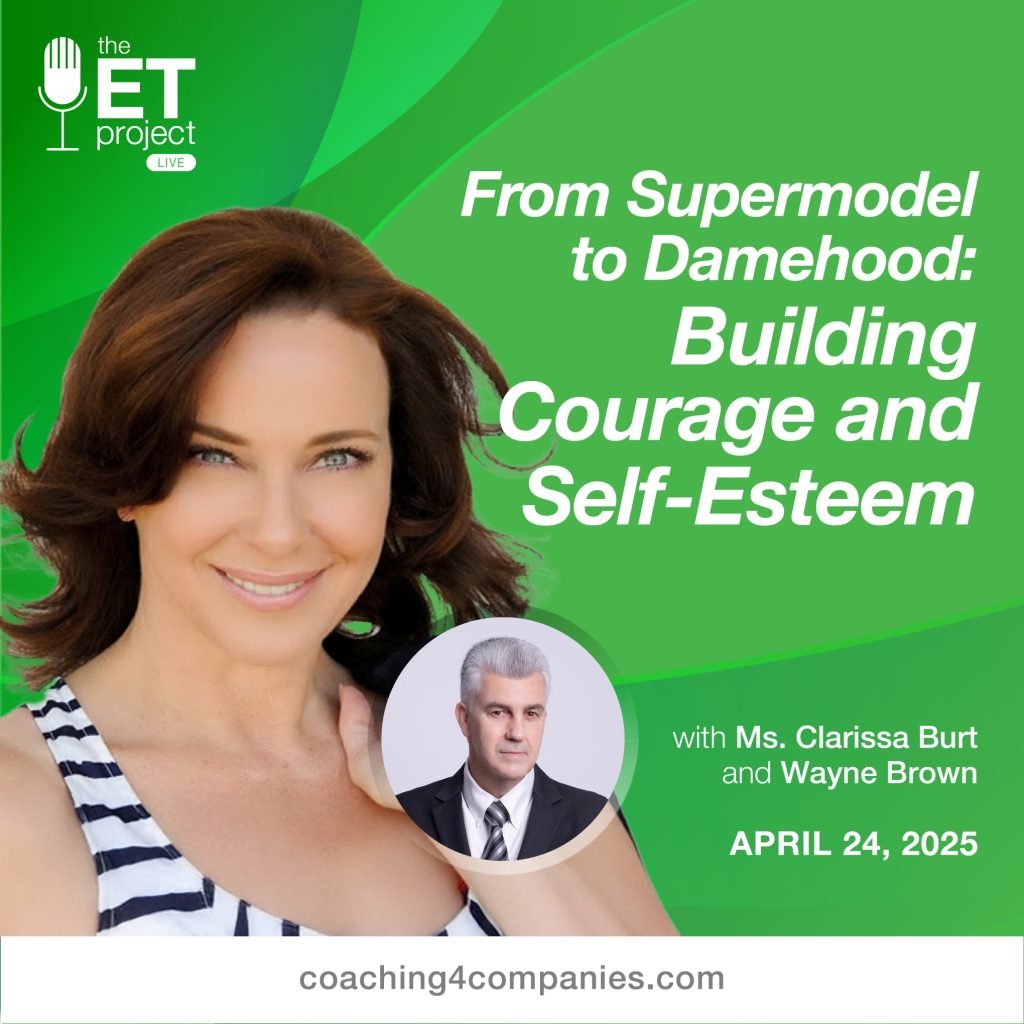
WAYNE BROWN: Hello, I’m your host Wayne Brown and welcome to the ET project. We’re delighted to be delivering this live episode for executive talent all over the world whom we’re affectionately referring to as ‘Team ET.’ Today we’re visiting Phoenix, Arizona to meet with an extraordinary individual, Dame Clarissa Burt. Clarissa is an internationally acclaimed award-winning media personality, producer, director, writer, author, public speaker, former supermodel and winner of Celebrity Survivor. With hundreds of television and film credits to her name, this who’s who of international American women brings over 35 years of entertainment industry experience in both international and American markets. Clarissa is the founder and CEO of In the Limelight Media, a multimedia platform consisting of TV, video, a podcast and digital magazine. Her shows can be seen on Roku, Amazon Fire, Apple TV, et cetera. and her podcast is heard on 15 different distribution platforms. Her internationally plenary award-winning best-selling book entitled ‘The Self-Esteem Regime’ is published by Rowman & Littlefield and the audiobook by Recorded Books is changing lives one chapter at a time around the world. She was the first American to present Russian TV at the Kremlin. She has had two private audiences with Pope John Paul II honoring her social work. As the ambassador to the United States, she actively helped African women win the Nobel Peace Prize. And in June of 2022, Clarissa was knighted by the Royal Order of Constantine the Great and Saint Helen, joining the ranks of 350 dames worldwide. So, team, this is truly a conversation you do not want to miss. If you’re looking for inspiration, wanting to learn what it means to practice resilience and demonstrate courage, or are looking to boost your confidence and live a fulfilling life, then I encourage you to join us right here, right now.
INTRO: Welcome to the ET project, a podcast for those executive talents determined to release their true potential and create an impact. Join our veteran coach and mentor, Wayne Brown, as we unpack an exciting future together.
WAYNE BROWN: Hello and welcome team to this week’s ET project. Today we’re going to welcome a true global icon and trailblazer, I want to say, Dame Clarissa Burt, whose extraordinary career pans across modeling, acting, producing, what else? Writing, entrepreneurship, and there’s another dozen things I haven’t included there. Clarissa is an internationally acclaimed media personality for those who have children, perhaps, and ever watched ‘The NeverEnding Story,’ I think number two, right?
CLARISSA BURT: Number two, yeah.
WAYNE BROWN: Clarissa was the evil sorceress.
CLARISSA BURT: I call her the mean queen.
WAYNE BROWN: The mean queen, there we go. So, she’s an advocate for women’s empowerment and has inspired, I want to say, millions of people around the world, gracing the covers of Vogue, Harper’s Bazaar, and founding transformative ventures such as ‘In the Limelight,’ which is one of your productions, Clarissa. So, we’ll talk about all of these things as we go through our conversation today. One of the things we do want to touch on is ‘The Self-Esteem Regime,’ which is a book you released, I think, gosh, several years back now.
CLARISSA BURT: Yeah
WAYNE BROWN: It really embodies resilience, innovation, as what was purpose-driven leadership back to, you know, our audience. Well, first of all, welcome to the show.
CLARISSA BURT: Thank you. Thank you so much. It has been a long time coming, this appointment, you and I, I had to put it off for reasons of oral surgery. You might hear I have a little difficulty still, but I’m here, I’m much better.
WAYNE BROWN: Yeah. It’s really a privilege to have you with us. You’ve done so many things, I’m not sure we’ll get through everything today, but we’ll do our best.
CLARISSA BURT: It’s all right, we’ll do our best.
WAYNE BROWN: You’re sitting in Sedona, in Arizona, if I’m correct.
CLARISSA BURT: I’m in Phoenix in Arizona, about an hour away from Sedona, but I get there frequently. Yeah, I mean, the New Age capital of the United States, one of the most beautiful places on the planet.
WAYNE BROWN: Yeah. Is there a purpose for choosing that location? I mean, you’ve traveled and worked all around the world, but why Arizona, any reason?
CLARISSA BURT: Well, I was born in Philadelphia, graduated high school in New Jersey, and while I was living in Europe for 30 years, the family that was on the East Coast moved out here. And so, when I decided after 30 years to leave Italy, on very good terms, but it was time to come home, my family was here. So, I said, okay, if I’m coming home, I’m coming all the way home. And I’ve been calling Phoenix, my home, now since… well, I bought the… in 1996, but really 2005.
WAYNE BROWN: Wow. Incredible.
CLARISSA BURT: Yeah.
WAYNE BROWN: I mean, throughout your career, a supermodel, I have to start with that, I’m very excited to be talking to a supermodel.
CLARISSA BURT: It was quite a while ago, Wayne, quite a while ago.
WAYNE BROWN: And an actress as I’ve already mentioned, but not only in ‘The NeverEnding Story,’ you’ve been in movies for a long time, right?
CLARISSA BURT: Yeah. A lot of Italian pieces when I was living in Italy, ‘The NeverEnding Story’ was the only one that really went worldwide. It was a Warner Brothers worldwide release in 1990.
WAYNE BROWN: Incredible. We’re talking, you know, three decades ago and here we are, and you still look as…
CLARISSA BURT: Oh, thank you.
WAYNE BROWN: And fantastic as you did back then, but you’ve done so many things, correspondence, I believe, for one of the Olympics, 1996.
CLARISSA BURT: Yeah, 1996 in Atlanta. I was in the, I think it was called Centennial Park, I forget what it was called, the park where the bomb went off.
WAYNE BROWN: Yeah.
CLARISSA BURT: I was there with the Italian, the Rai 1 team, we were all there, and had left not 10 minutes before that bomb went off, and we got really lucky, yeah.
WAYNE BROWN: You were also the winner of a ‘Celebrity Survivor.’ So, most people probably know the American version of ‘Survivor,’ I think there’s also the Italian Survivor, so the Italian version.
CLARISSA BURT: Yeah, Italian one.
WAYNE BROWN: Yeah. You managed to win ‘Celebrity Survivor,’ congratulations. How did you…
CLARISSA BURT: Yeah. Thank you, that was an interesting go, maybe for another day, but again, leadership skills just meaning know the terrain, know how to navigate it even if it’s new. We were living on an island, which meant we were on the island’s rhythm, it wasn’t on ours. So, up when the sun was up, down when the sun went down because there was no electricity, no lamps, and then we had one flashlight between 20 of us, and learning how to cope with the elements was very difficult, it was horribly tropical, a lot of tropical rain fell on our heads. I mean it was brutal, from a physical standpoint, I lost 20 pounds on the island in three months, which was great, but just knowing how to navigate all that, staying really really strong, I think the one thing that really kept me together was knowing that it would end. I wasn’t there forever, this wasn’t my life for the rest of whatever, but it was a really good teaching moment and learning moment at the same time because I was one of the elders, which meant I was in a leadership role for the kids that were really scared. And so, notwithstanding the fact that maybe my days were, I could be a little iffy about how the day was going, I still had to be strong for them. So, I think that was a really good point about leadership is you may feel sometimes the imposter syndrome coming on, right?
WAYNE BROWN: For sure.
CLARISSA BURT: And just navigating your way through that, just pulling on your strength, knowing that it’s always there, trusting in yourself, we call it self-confidence and confidere in Italian, it comes from Latin, it means ‘with trust.’ So, when we talk about self-confidence, it means trust in self. So that’s… because pulling on your self-confidence, trusting in yourself and knowing that at the end of the day, you know that you can always trust, you really, I mean, very rarely do we ever let ourselves down, right? Because we always, as leaders, we’re always looking for the way out, a way in, a way out, a way around, a way, one way or the other, we will find it.
WAYNE BROWN: Mm-hmm. So, it’s very, very, I can imagine at least I’ve ever been in that situation but I can imagine it’s really looking inwardly, but also understanding how to navigate that social connection with the other people.
CLARISSA BURT: Yeah, very difficult. I will say not the easiest because again, as the elder, you’re dealing with younger, you know, some of the younger kids. And you know, the other thing that I will remember is that there were two other things I can bring up, I think that would be… of maybe of use. I am terrified of crabs, anything that’s a crustacean family, crabs, scorpions, lobsters, they’re just not my gig, it’s not my vibe. Let’s just put it that way, they terrify me.
CLARISSA BURT: And we were on a tropical island, which was in Nicaragua. And you know, it’s a lone island, there’s nothing there. So, when the tropical rains would come out, all of the crabs would come out of the mangroves from around the island. And so, the island would be overrun with these crabs, and some of them were as big as… I mean, you know, the arms are as big, you know, as long as yours are, and they’re huge. And that was a little bit hard for me, you know, I had to really, really reel it in, if you will, to I keep myself as calm as I possibly could. The difficulty more than anything is that we were sleeping on the ground, right? We were sleeping on the actual ground. And so, on the sand, I mean, we had a little towel down or something, but in the sand were what they call the no-see-ums or sand mites would come up. And so that had my body ablaze. I mean, they would come and they would bite me. And physically, I was in grand difficulty. Emotionally, I was in difficulty because of the crabs. And I had to sort of, at a certain point, come to grips with the fact that some of the smaller crabs might be climbing over me at night, and they did. So, you really learn how to reassess, if you will, that fear, right? And say, okay, at least it wasn’t one of the huge ones. It was some of the babier ones. And so maybe that’s not so bad because what was the worst case? Well, the worst-case scenario would have been of these gigantic, you know, so you sort of, you know, you learn how to, when given the chance, the possibility, the opportunity or you’re confronted with one of your greatest fears, you can work yourself out of that as well. And it was really important for me to do that for myself and for, you know, not, you know, because you don’t want to be looking like, you know, you don’t want to be looking weak in front of the others. Let’s put it that way.
WAYNE BROWN: And all the while this is being filmed for TV, right? So.
CLARISSA BURT: Yeah, yeah. I mean, yeah.
WAYNE BROWN: There is that pressure as well. But I’m sure there were people that didn’t cope as well as it seems you did. And did you, as you said, you were one of the seniors, the elder people, how do you console somebody in that moment? Because I now as a leader, we come across this on a regular appearance as well.
CLARISSA BURT: Well, you know, the kids were calling me aunt, so I was Aunt Clarissa, right? So that made me… immediately, I was an elder. Immediately I was to put… you know, not because I had asked for it, but just because A, the age, you know, you are in the position that they’re putting you in. So, you know immediately that these kids are looking up to you, not maybe up to you and looking to you for guidance and for a hug, for kind words, for whatever it might be. And so, notwithstanding the fact that, you know, maybe you’re having an uncomfortable moment or a difficult day, it’s not about you at that point, you know, when you’re a leader and you’re in that position, it really isn’t about you anymore. It becomes about the team and what you can do to make their day a better day. You know, in that instance, obviously we’re talking about corporate, you know, you’re a leader and you want to be able to give your team all of the tools that they need to make it through their day, their week, their month, their year. And so, you know, I think as leaders, we also have to, you know, come prepared. We have to come, what is what I call, you know, tools in the shed, all those resources that we need. And I think one of the most important resources is we’re here to talk about personal development and, you know, continually doing the work. I say it’s our… I think it’s everybody’s sacred duty to be working on their personal development and their self-improvement, but especially in leadership roles, whether you’re the leader of a family, you know, you’re the leader of yourself, you know, you’re the leader of the local boy scouts, or you’re a leader of a, you know, you’re the CEO of a global corporate organization. I think that, you know, the rules are always the same, right? So, there you go.
WAYNE BROWN: Any other traits that you see from a leader’s perspective that showed up during that challenge?
CLARISSA BURT: I think knowing when to take a mental break is really important. And that may not be when you need it or you want it, but you know that, you know, you got to get that on the to-do list pretty soon. And so, I would take a walk and go all the way down the end of the island and leave the group back at base camp. And this is where I would be able to just go down, sit on a rock, take a look out over the ocean and pull myself together. And it’s really a great time also for pondering and for wondering and for the thinking that you need to do when you’re in that kind of a situation to regroup. Okay? You know, what would make sense? What doesn’t make sense? You know, what am I going to do now? And what can I do tomorrow? Kind of thing.
WAYNE BROWN: Right.
CLARISSA BURT: While always pulling yourself back into your happy place so that you’re the best leader you can possibly be. So, I think that is a self-care moment. And I think that… you know, I think… and it’s not for just women, obviously, this is for guys too, right? Men also need the same kind of decompression moment. So, I think that’s extremely important.
WAYNE BROWN: What year was this, roughly?
CLARISSA BURT: 2010.
WAYNE BROWN: 2010. Okay. So, this is 30 years into your career. How much do you think your prior engagements during your career helped you prepare mentally as well as physically?
CLARISSA BURT: I am, first of all, I’m a loner, but I’m never lonely. I’m a leader, and I know that about myself. I know that when I was five years old, the kids in the neighborhood would say, “we don’t want to play with you anymore, you’re too bossy.” You know, and I was only five. And so, I knew that I was born to lead and I knew that sometimes it pissed people off and they didn’t like that. But I was only five and I learned that message. But at the same time, when I was five years old, I’ll show you a real quick picture of me when I was five. Do you see that?
WAYNE BROWN: Wow. Yes.
CLARISSA BURT: That’s mom. And I usually… I have this picture here normally for another reason when I talk about my mom. So, that little girl right there was Mary Poppins in the kindergarten play. Now there were many different classrooms, for kindergarten. There were two in the morning and two in the afternoon, I remember. And I had… my teacher’s name was Mrs. Bailey, and she had the piano. And I sat right behind her on what we would call our sit-upons, which were like little mini cushions. And I sat right behind her and I knew every song and I belted them out and I just loved it. So, I was chosen to be Mary Poppins. Well, that was a big deal for a five-year-old, you know, but the bigger deal, Wayne, was this, I think it was after I got done singing Supercalifragilisticexpialidocious and I got a standing ovation, I was hooked. I was like, you know, I really liked this stage thing, I think I could do this for a lifetime. Yeah. Give me a microphone, I’m good. And that’s really kind of how it started. I was a great girl, you know, I was a vivacious child, a gregarious child. Apparently, I was quick as a whip and really, you know, smart and fun and funny. And that’s kind of where that all started. So, you know, the leadership role. So basically, if you will, I was leading the play at five years old and I was leading these kids, you know, in the neighborhood when we would play house and somebody would be the mom and somebody would be the dad and I always loved to iron, you know, all the things. And they didn’t want to play with me because I said, “you do this and you do that.” Anyway, I don’t do that as much anymore because I learned my lesson.
WAYNE BROWN: As you pivot between different areas in your career, modeling through to acting, to producing, and then coming up with that, what was the prompt to make those transitions? Was there a memorable moment that you said, “okay, I’ve had enough now in the modeling, let’s try, let’s go back to my five-year-old acting.”
CLARISSA BURT: Yes. When it’s not fun anymore.
WAYNE BROWN: Ah, okay.
CLARISSA BURT: When it wasn’t fun anymore. When I wanted to do it so bad, I could taste it, I did it. And I did it for years and I aced it because I, you know, there are a few things I did really well at. And the other thing, if you asked me to balance a checkbook, I might have some difficulty. I am not left-brained at all, but right-brained, you know, my creative was pretty strong. So, when it wasn’t fun anymore and after the modeling years, I wanted television and movies and so, I went and I did that and I, you know, did very well with that. And then I said, okay, I’m getting a little bored of this, I want to produce. So, I started, I was doing three-hour live broadcasts in prime time for Italian television with the Miss Universe pageant. So, there I had… my last production, I had a hundred girls, a hundred press and 2000 people sitting in water in front of a castle in Calabria, these were my mega productions. So, and then I aced that and I went, “you know what? I’m good. I’m ready to go home. I want to go back to the States.” And that’s where I did a couple of different things, I took a lot of time off because I could, and I had worked really hard, I started working when I was 10 as a babysitter. So, I took a little time off and then after I turned 60, that’s when I said, I want to start ‘In the Limelight Media,’ which was a television podcast and a digital magazine for entrepreneurial women so that they could, you know, promote their own businesses. And so, yeah, I mean, there was just always a moment where you feel you kind of… you’re hitting a wall and you’re a little more sluggish and you’re not as motivated. It’s not as fun, that’s your next moment.
WAYNE BROWN: Mm-hmm.
CLARISSA BURT: And sometimes the transition, it didn’t always happen overnight, Wayne. You know, a couple of my transitions took a year, two years.
WAYNE BROWN: Each transition has a degree of risk. How do you calculate or deal with that? Do you throw caution to the wind and back yourself?
CLARISSA BURT: Yeah, because I think risk is the motivator. I do believe that risk is the motivator and there have been some terrifyingly scary moments in my life. I’m a woman that, you know, there was no family that I could turn back to. You know, there’s nobody who’s going to really take care of me in any way, no rich daddy. There was no husband ever, you know, that I got married. I say, listen, if my… you know, at least I have that little cushion, if you will, in my transition period, I know I’ll still have a roof over my head kind of thing. You know, none of that, it was always the absolute… again, the self-confidence, if you will, even though sometimes that doesn’t necessarily show up because in the book, I talk about the daily demons. You know, those demons that come along and they’re always the naysayers and they’ve got something to say, and they’re going to make sure that you second guess yourself, right? And I write about the daily demons in my book and the conquering of the daily demons and, you know, it’s kind of like, you know, not today, Satan, go away. It doesn’t work anymore. It used to work on me. It doesn’t work anymore. So, it’s a lot of mindset and, you know, some of the, I think one of the most important, funnily enough, one of the most important exercises in the book that kind of helps with that. And it’s going to look weird. It’s going to sound weird. It’s going to feel weird. And people are going to go, “you really do that?” But it started with Louise Hayes, that’s at least where I learned of it first. And then Jack Canfield, who is the other half of the Chicken Soup for the Soul series. I’ve met both of them, by the way. Actually, Mark Victor Hansen lives half an hour from me here in Phoenix. And Jack, I think is still out in California. But it’s mirror therapy, what you call mirror therapy. And that’s when you go and you give yourself that rah-rah session pep talk in the mirror. And some people have a very difficult time doing that. So that is one of the things that, of course, again, you might want to do it when no one else is home. You start with one minute because five minutes might seem overwhelming to look at yourself and tell yourself how amazing you are because a lot of people don’t believe that they are. And so, you start slow, you start with the two things. And then at the end of those 21 days, when your game gets stronger and you do that for 21 days, call me and let me know how you’re doing, because I guarantee you’re going to be doing amazing.
WAYNE BROWN: How did you deal with depression? Was that one of the outlets for you?
CLARISSA BURT: You know, I think you get… you learn very early on, especially in modeling, there’s a lot of, you know, some people loved you, some people didn’t love you. You know, there was always a lot of, life is full of rejection, if you will. I mean, you’re rejected right and left, but especially in a career that I chose. So modeling, acting, you know, production, it’s not easy. It’s not steady work. Right? So, yeah, there was quite a bit of that. I think you just, as you go and you learn from… especially the reading material that I was taking in, and I’ll get back to that in a second, the reading material, the tools that I was putting in the shed for the moments in life that were going to be uncomfortable, to say the least, were the ones that I pulled on when I was feeling uncomfortable. I think I might’ve told you when we had a pre-show is that when we were kids, here in the United States at least, we had three bookstores. It was Walden Books, Borders Books, and Barnes & Noble. There were no computers. We didn’t have cell phones, none of the internet, none of that, but we did have bookstores and I would go into the bookstores and in the very back there’d be a little section and it was called self-help and boy did I say, well, I needed direction, I needed assistance, guidance, support, a way in, a way out, the reason why, what I needed, I wasn’t getting that at home. And by the way, when I was a kid, there really wasn’t very much talk of self-improvement and personal development. It really wasn’t a thing yet, I don’t think, you know?
WAYNE BROWN: Yes.
CLARISSA BURT: I mean, if you were to follow down Napoleon Hill, the Edgar cases of the world, if you were getting deeper into psychology, you might’ve heard of it. But it wasn’t as mainstream as it is today. So those books and on those shelves, Wayne, there might’ve been 40, 50 books, not a whole lot, but it was something at least.
WAYNE BROWN: Yeah.
CLARISSA BURT: Today, the only bookstore that we have still standing in the United States is Barnes & Noble and you can now walk rows upon rows, upon rows, upon rows of what they now call the personal development section and now it’s a billion-dollar industry, which goes back to the point that we’re all always looking for guidance, support, assistance, a way in, a way out, you know, the reason why all the things, right? Because life will trigger. We know one thing for sure. There’s going to be a life and then there might be death that come along in your existence, your family members, then you could have divorce, separation, you could have betrayal, it could be at work. Things are, you know, it’s the way things usually go. So, the triggering point, I talk about standing strong in your stead, just like a well-rooted tree.
WAYNE BROWN: Let’s jump deeper into the book. I mean, you have a four pillars philosophy in life and around self-esteem. Would you mind sharing and stepping in sort of that way?
CLARISSA BURT: Absolutely. So, ‘The Self-Esteem Regime,’ the regime is an organized way of doing things. So, the book for me is a manual. It’s a mission and it’s a movement. I really would love to have people understand the importance of having happy, healthy self-esteem, you know, because it’s that important. You know, people with low self-esteem, they suffer more depression. They’re usually unhappy at work, unhappy with their appearance, there are so many different variables about what having low self-esteem entails. But the book is broken down into 12 chapters, easy to read. Everything you need is a little, every chapter is its own microcosm. So, we start with release, which is a huge one. And that’s where we’re really letting go of the things that aren’t working anymore. You got to make a list and you’ve got to… I walk you through all the steps. We’ve got Clarissa’s Corner. We’ve got the clarion call in there. We’ve got exercises. We’ve got case studies. Every chapter is really very robust. Short chapters, because again, you’re not going to read about self-esteem. You’re going to do the self-esteem, that’s what I love about the book. The second chapter is a rebuild. So now you get to build, right? It’ll say, what is the kind of life you want to be living? Not what your mom said, not what your dad said, not what your boss said, not what your pastor said, like, what’s the life you want to be living, as long as you’re not hurting anybody, where’s the life you want to live, right? And so, then the third chapter is…
WAYNE BROWN: Responsibility?
CLARISSA BURT: No… yeah, responsibility, thank you. It is responsibility, so where are you shirking it? Where are you taking responsibility for your life? Where do you really need to be stepping into your power, your place, your space, and not letting things fall through the cracks, right? Because a lot of times procrastination for us is what will do us in. And procrastination is just really another name for fear. People think it’s laziness, it’s not. Procrastination is really an unknowing. It’s really not knowing what you want to do, where you want to go, or why you want to go there, because once you’ve got fire lit under your butt and you know all those things, there is no procrastinating, right? So, yeah, that’s the book. The book ends with reciprocal, which was always a difficult thing for me in my life. I remember we were in a group session at work for university. And I said something about, I feel like I’m doing it all. And somebody, I think it was my assistant or my secretary, said, “well, Clarissa, you don’t understand. It’s so hard to do anything for you because you do it all.” Okay, so that was a big life lesson. It was like, okay, I got it. I got the message. And so, I let go a little bit of that. In other words, I allowed myself to receive as opposed to always giving, right?
WAYNE BROWN: Right.
CLARISSA BURT: And so, yeah. And that was a learning moment for me because I am a type A personality. I am the giver. I am the caregiver. I am the doer. I am, you know, because, you know, I’ve always been convinced, so, this is another thing as a leader I had to really be careful with is, you know, if I want it done right, I have to do it. You know, and that’s one that I think is, you know, that leaders really do need to be mindful of. And that was also a teaching leadership moment for me when they said that, you know, and they said, “you do it all.” Okay, got it.
WAYNE BROWN: You talk about look good, feel good, be good, and the greater good.
CLARISSA BURT: Look good, feel good, be good and the greater good, those are the four pillars, yeah. So, look, we all know what that means. You know, Wayne, we get up, we, and it’s what I call preening, right? So, we preen, we, you know, we do the thing and we have a little tune in ourselves. We look in the mirror, you know, and say, looking pretty good today. I love that outfit. You know, all the things that we tell ourselves before we walk out of the door.
CLARISSA BURT: And it’s not superficial. It’s just being… it’s pride in self. Feel good, diet, exercise, nutrition, and wellness, really important stuff. And knowing what that means, for you and for your body. And keeping up on your health, because especially for, you know, those of us that are starting to age up a little bit, you know, stuff starts to creek. And, you know, we’ve got to be a little bit more mindful of how we’re, you know, we’re treating our bodies and see to it. Look good, feel good, be good. Finances, relationship, business, you know, the things that keep our lives running. Right?
WAYNE BROWN: Yeah.
CLARISSA BURT: And so just being, you know, what does that mean? Does it mean reading another book? Does it mean taking another course? I mean, there are plenty of things we can do online. I don’t know if you have Udemy, you probably have Udemy there in where you are. At Udemy, Coursera, Lynda, all the different places that we can go and take courses that I absolutely love. I mean, I’m taking a course every two minutes. I’m learning something else, especially now that we’re coming up on this whole era of AI, which is changing everything and things are moving at warp speed now. So, keeping up on that has been challenging because there’s so much to it and it’s all so new. Right?
WAYNE BROWN: Yeah.
CLARISSA BURT: And then greater good is, you know, is volunteering, tithing, paying it back, paying it forward, and just doing all around the right thing. And sometimes you’ll say, geez, I really don’t have a lot of money to be… sometimes it’s a smile. Sometimes it’s holding an elevator door open for someone. Sometimes it’s a compliment. It doesn’t have to be broad stroke. It doesn’t have to be a grand gesture. It can be something as simple as that, that can help somebody, you know, it could really make or break somebody’s day. Just a nice, gee, that top looks really nice, I do it on the supermarket. I know I do this. Oh, that looks so nice on you. I’ve never seen the woman before in my life and I’ll never see her again, you know, but it, you know, it makes me kind of feel good to do it. And I know she felt very, you know, she felt good about it. So, it’s a win-win, it costs nobody anything. And, you know, I think the message there is, can we just please be kind? Can we remember that notwithstanding the fact that we’re all super stressed, we’re all running the rat race where, you know, we’ve got a lot on our shoulders, you know, can we take a deep breath, count to 10 and just be kind.
WAYNE BROWN: What does a normal day look like to you? Like, how do you put on your time and live that life?
CLARISSA BURT: That is so funny because you’re the second person to ask me that today. And you’re the only two people in all of the interviews I’ve ever done that have ever asked me that question. Like nobody has ever asked me that question before and I had somebody asked me not two hours ago, the same question. Wake up, I wake up very early. So, I’m up between four and 4:30. Um, yeah, I wake up real… but I go to bed very early as well. And I think that again, when I was talking about, you know, it’s the… living in the desert, we normally will go with when the cooler you wake up, you know, and then you go to bed and then… because the cooler hours are in the morning, the early morning and we are looking at… we’ve been looking at now we’re still in April and we’ve been looking at almost 98 Fahrenheit.
WAYNE BROWN: Wow.
CLARISSA BURT: Yeah. So, we’re like… yeah. And that’s the Sonoran Desert here in Phoenix, Arizona, so. You know, we’ve got that going for us here. But I wake up very early, open up the house because I close it at night, but I open it up the house so that it can cool down a little bit, because it’s a little cooler as I said, in the morning, go in and make my matcha latte, which is what I absolutely love, that’s green tea. So that green tea is really good for antioxidants, I start with that. And then I’d usually jump in, you know, right onto the computer with email. And then courses or building, you know, some of the classes that I’m pulling together. I’m pulling together another book. Uh, and I really am very keen about starting retreats for women where we will talk about the look good, feel good, be good, greater good concept.
WAYNE BROWN: Is there a new book coming?
CLARISSA BURT: Yeah. You know, I talk a lot about toxicity and living a non-toxic life. Uh, and it’s something that I absolutely adore. People say to me, “Clarissa, what do you do for fun?” Well, I go to the kitchen and I make yogurt. I go to the kitchen and I make cosmetics. I make creams. I make salves. I make lipsticks, ChapSticks, toothpaste, mouthwash, laundry detergent. I make it all because I don’t want to be buying as much plastic anymore. I don’t want to be bombarded with the chemicals anymore that are coming in through the door that I’m paying for at the supermarket that are really making us sick and sicker. So, I’ve done a lot of research. You know, it’s really simple to do, by the way. You can just go on YouTube and say how to make this and how to make that. I go onto Amazon, I order what I need as far as the butters and the oils, the essential oils and the things that I need.
CLARISSA BURT: And there’s stuff out on my kitchen counter right now. I just made applesauce today so that I take the apples. I throw them in the cooker. Boom, within an hour and a half, I just blend it all up and now I have absolutely clean applesauce that I can now eat straight from the apple. None of the stuff in the jar, none of those preservatives, none of that. I’ve also made two batches of yogurt, which is just the milk and the inoculating starter, that’s it. And that’s what I love to do. I’ve baked three or four cakes this week called yogurt cake with the yogurt that I make, I could be here all day with the stuff that I love. That is usually what my day is, it’s about the book, the non-toxic philosophy. Under the look good, feel good, be good and greater good concept. So, look good, we have, you know, what are we putting on our skin? What are you know, all that, right? All the things, making sure we get the toxic out. Feel good, the same thing, that’s diet, exercise, nutrition, and wellness, get these toxins out. Be good is what we’re thinking. Remember I said, leadership, finances, relationships. So, this is perfect. The book is perfect for the be good concept.
WAYNE BROWN: Right.
CLARISSA BURT: And then the greater good concept is whatever you choose. However, you decide you’re going to be a better person more than you are today and who you’re going to affect by doing that.
WAYNE BROWN: It seems like a lot of what you do today is around empowering women, ‘In the Limelight’ is really about elevating women entrepreneurs if I understand correctly, right?
CLARISSA BURT: Yeah, that’s how ‘In the Limelight’ was born. It was so that they would be able to promote either, you know, through me, through an interview with me, which means they would be on Roku, Amazon, Amazon Fire, Apple TV, and a whole bunch of other, you know, online digital platforms, the platform for the podcast, which we were on 15 different podcast platforms, and then the digital magazine that I would come up with every three months, and this was a way for the women to come in and promote themselves, whether they wanted to write for the magazine, everybody got their interview, and then after that I created…I pivoted just a little bit into also a mastermind for some of the women that wanted to get together every two weeks. So, creating that community so that they would be able to get more of… a little more of me and certainly more of themselves. And it was very interesting because it started out as a business. It was only a business platform and a business mastermind. But as women do, and we get to know each other very quickly, I think, you know, I could be on a plane from California to New York and sit next to a woman and know her entire life story in those five hours, her entire life story. And we’re best friends and we’re calling each other the week after that, you know, that’s how women are. And so, some of these times I was on the mastermind, the women were coming on and they were having personal problems. And so, they said, listen, “I don’t have anything really to talk about business this week, but can I just say…” “yeah, of course you can say whatever you want.” “My son tried to commit suicide this week.” “My husband has stage three or four prostate cancer.” And so, it started to morph into what one of the women called the… “Clarissa you’ve created for us to safe space,” right? where we could talk about… So, if a personal problem came up, we all put our business things aside, because we come with business questions, right? And we would focus in on her for basically the rest of the mastermind time and give her tips, advice, resources, a hug and a lot of them would call each other afterwards. So, it was a place for women to come to and find one another and find good friendships as well. So, I was very proud of that moment. And again, it was a leadership moment that in that moment I had to decide, listen, you’re having a personal problem? I’ll call you after the mastermind. Or I decided it might be best that we all kind of, you know, the 20 of us, 19 of us came in and sort of loved on her so that she felt really like she had some real power behind her, you know, shoulders and everybody had her back. And it was one of the best things that I could do because I also… with the 12 weeks of the mastermind came the 12 chapters of my book. So that was, yeah, it was really cool. Very cool.
WAYNE BROWN: And even though it’s not directly business-related, the impact flows through the business anyway.
CLARISSA BURT: Absolutely, because you are only as good during your business hours as you are in your personal life.
WAYNE BROWN: Yeah
CLARISSA BURT: I wholeheartedly believe that. For me, at least, it’s almost impossible to leave my personal problems at the door when I walk, let’s say, into the office or into my work, it’s really difficult.
WAYNE BROWN: Yeah.
CLARISSA BURT: It can be very, very difficult. I mean, yes, can it be done? Of course. But in the back of your mind, you know, you’re either having a really great day because your personal life is on point or you’re lagging a little bit because you’re having some problems at home or your health isn’t good for the different reasons that, you know, there can be.
WAYNE BROWN: Yeah, and I think that’s a great message for leaders to be aware of as well. You know, we’re all so focused on engagement and we’re trying to beat the drum to get everyone engaged but then we forget about we have a life and there could be issues outside of the 9 to 5 or whatever time they’re in business that we have a….
CLARISSA BURT: Yeah
WAYNE BROWN: And unless we are aware of that, we miss tremendous opportunities as well.
CLARISSA BURT: Yeah. I think that some of the best leaders are also very empathic when they need to be and not for too long, because I definitely think that, you know, you don’t need to be coddling too much, right? But maybe, and I use this term, you know, loosely, but I like to say a little less coddling and a little more cuddling, right? So, stop fixing everything for them, but sometimes they just need a hug and then send them back and let them work out their own, you know, but be empathetic as well. I think it’s important because the pressure builds up, I think, sometimes and people really becomes like a pressure cooker and that’s not good for anybody, not good for their health. It’s not good for the health of the company. It’s not good for your health. It’s not good for the outcome of whatever it is that’s going on, whatever you’re working on.
WAYNE BROWN: To that point, you talk a lot about resilience, directly or indirectly, through the conversations. I see failure as part of life, we experience it progressively. People deal with it very differently, of course, but resilience is one of the key foundations for me, at least. How do you see that perspective, or what’s your perspective around that?
CLARISSA BURT: I think resilience is really… yeah, tenacity, resilience, I think they’re really two super important words when it comes to… But I think another word that I like to use especially in the whole self-esteem sphere, and obviously for leaders, is the courage. The courage that it takes, because we can talk about the extra mile, you know, as much as we want. But the funny part of the extra mile is there are really very few people on it with you. Like you can go the extra mile and you know, you got up to that extra mile and you turn around and you think you’re with a group of people and all of a sudden you’re standing alone and you’ve got one more mile to go because that’s your extra mile, and that extra mile is cold and it’s blustery and it’s dark and there’s probably wolves hiding behind the trees and there’s a little teeny, teeny, tiny white light all the way down there and you think you see it, but you’re not sure because it’s like raining real hard in your eyes, and you know, so you get this like that last mile is really a tough go. And so that’s where, yeah, you need the resilience, you need the tenacity, you need the discipline, but you really need the courage to say, “I could do this, I know it’s cold, I know it’s rainy and I know I don’t care about the wolves, I’m just going. And if I encounter a wolf, I’ll deal with it when I get there. I’m going.” Because every step that you take, the light at the end of the tunnel gets bigger, bolder, brighter, and more beautiful. So why not? You know, why not, you know, I see no reason why that extra mile shouldn’t be the most glorious of them all.
WAYNE BROWN: To that point, is there a period in your career where that was a real-life situation where you’re very proud of that situation because you pushed yourself that extra mile?
CLARISSA BURT: I think some of the most courageous times are the times that I was keynoting on stage, probably, you know, that’s always… it’s a scary moment, you know, and again, you know, I’m used to microphones, television, stages, I’m used to all of that, but when you’re keynoting on stage, it’s about, you know, what you want the audience to take obviously away from it, but it’s usually your personal life experience and you don’t want every kind of be boring or redundant or, oh, ho, hum, we’ve heard this all before because, you know, self-esteem and personal development, a lot of people think that, ugh, it’s, you know, whatever, it’s okay, it’s fine, you know, and they call it what they call the soft skills, those are the soft skills, but may I remind you that the soft skills are also some of the hardest skills. It’s not easy to take a deeper dive into yourself. It is not easy to take a look at yourself and do the work that needs to be done in order to be living in happier, healthier self-esteem, in order to garner the courage that you need to get through and in order to be able to put an end to any toxic relationship you may have in your life.
CLARISSA BURT: It’s tough work. And so, you know, the toxic relationships are the ones that are really some of the most difficult of all, because, you know, when you’re cutting somebody off, or at least you’re backing them off in a big way, it’s a hard thing to do because you may really love somebody a lot that you don’t recognize you’re in a toxic relationship with, but that’s not good for you. You could be a narcissist, the whole thing, we can be here all day, but, you know, or God forbid it should be, you know, a domestic violence kind of situation and women stay for fear or they stay for the financial aspect or not, you know, get up, move on and never look back is what I say. And there are definitely lots of tools and resources out there also for anyone that’s being abused. But these are the kinds of things that you have to really have immense courage to get past. And you do, and you will, and it’s all good. But I think at the end of the day, it’s always our responsibility. It’s our responsibility to take a look at our emotional pain and it’s our responsibility to work on ourselves. And sometimes that might be… you know, we might have to go to a professional, maybe books and courses and classes and what it might not be enough, but whatever it means for you and whatever you can do for yourself is what you should be doing. And again, you can either conform or you can transform. There’s two ways in life, you know, it’s as simple as that.
WAYNE BROWN: You certainly are a very inspirational person. I’m just sitting here and listening and soaking it all in. You worked with a group of African women who somehow went on to win the Nobel Peace Prize.
CLARISSA BURT: A Nobel Peace Prize, I know.
WAYNE BROWN: What’s the story?
CLARISSA BURT: That was another ‘pinch me’ moment. You know, I have to say, I was asked by the organization that was running a campaign, it was called ‘Walking Africa.’ And it was the difficulty that many African women encounter by finding, you know, clean, fresh water, potable water, drinkable water. And so that was the basis of the campaign. And they asked me if I would help them. Again, remembering that I was, you know, working on television, I was in Italy for many years. So, the Italians, when I was here, they called me, “will you help?” “Absolutely.” So, you know, that was really what that was all about. And I pulled together as best as I could. This is even pre-Facebook. And this is pre, you know, we’re just about coming into Facebook, I think, it was 2001, if I remember correctly, 2001-ish. And there wasn’t really a lot on social media yet, most of them hadn’t come out. Anyway, long story short is, yeah, that was the deal. And I went to Brussels and we were at European Parliament and the women came in and they were lovely and beautiful and colorful and we… you know, I did a speech about women’s empowerment there and there were, what I didn’t know at the time was, you know, we got closer to October when they were going to say who won and who didn’t win. So, I called the Italians. I said, “what do we know? What’s the news?” And they said, “Clarissa, well, you know, we won’t know for another week because they tell us on October 7th” or whatever it was. “But I just want you to know there are another 210 candidates this year, the Nobel Peace Prize.”
WAYNE BROWN: Wow.
CLARISSA BURT: And, you know, I have to say it was probably the only time in my life, Wayne, where my heart didn’t sink. I went, “okay, that’s fine. We’re good.” Because I knew it was the perfect timing and I just knew it was… So, a week later they called me and said that our girls won the Nobel Peace Prize and that was really cool. It was another one of my crowning moments. You know, I did what I could, I was the ambassador to the United States, but again, I did what I could and it has been a really… it’s just a cool, cool thing.
WAYNE BROWN: Did you have a specific mentor or coach at any stage during your career?
CLARISSA BURT: I went down with… Napoleon Hill was one of my very first ones. And it was, you know, I think it grew… But Rich series. And that, by the way, also became like a super billion-dollar industry because it has been translated into basically every language in the world. I read a lot of subconscious books, superconscious books, a lot of shadow workbooks. I’ve got all kinds of books back there and I’ve got 10 of them on the couch right there that every once in a while, I’ll stop and I’ll pick up. Another thing that I started to do when I started to do the research for the book, there are two other doctors, two other books that I came across. One is Dr. Elaine Aron, who has a PhD and she came out with something called the extra sensitive person.
CLARISSA BURT: And it’s a thing. And about 30% of the world has this, what they call dis-ease, where they are extra sensitive to the stimuli. So, we can go down all kinds of neuro diverse situations here. And that’s okay. It’s great. It’s a great book. And they even made a movie. It’s on Netflix. It’s all over the place. She’s great. And the other book is a book by Rudy Simone called ‘Aspergirls.’ So, girls with Aspergers, right? And there’s a whole spectrum and the whole… Well, as I was doing the research on the book, I read both of those books and it will all be torn if I didn’t… and I’ll tell you something about that, Wayne, and that is I found so much relief in these two books because I found myself in these books. I went down the Asperger’s list and checked off every damn box. And it’s funny because when we’re looking at each other, talking to each other, interacting with each other, there are so many levels underneath, right? Who we’re actually looking at interacting with the levels underneath can be many, they can be vast. And so, it was such a relief to me to read these books because in my lifetime, I’ve been told that I was so difficult and such a pain and so bossy and so this, and so that, and I always kind of thought I was a delightful little person, but I guess a lot of people didn’t think that I was. And the idea that there were actual and absolute reasons that I was the way that I was, let… apart the whole tribal family thing that they sort of thrust upon you in childhood, but the other things that might make you, that comprise you, that form you, right?
WAYNE BROWN: Yes.
CLARISSA BURT: Reading is a very powerful thing. And that’s another thing that I say, continually educate yourself because we are always a work in progress. And the more you learn and the more you know, now I live a different existence because I’m not down on myself anymore, like people can be really cruel, but now I know why I’m the way I am and it’s cool. It’s great. I love it. Because I was custom-made, Wayne, I was custom-made.
WAYNE BROWN: I know you talk in the book about your vision board. How big is vision and purpose in your life?
CLARISSA BURT: Yeah, I have two vision boards. One vision board is the physical vision board, the thing, I want a Bentley and I want that villa and I want, you know, the vision board. And I will tell you that many of those things have come true, not the Bentley yet, we’re still working on that. But then I have a spiritual vision board, which is really, really very important too. So, there are two different ways that I can take a look. I look at the physical in life and then I look at spiritual, which is life, but in a different way. And so, the vision boards are, I think, really important and you can do those online, by the way. I talk about vision boards in the book, but you can do really good, something called ‘mindmovies.com’ and you can put it all in and it creates a video for you of all the things you want. You pull in the pictures you want, you pull in the sayings that you want. If you watch that every day, that’s another thing that’s pretty powerful. As far as what you, you know, it’s like a reticular activating process, or it’s the reminder that the vision board, you know, if you continually remind yourself, right? It’s the repetitive, right? That whole repetitive process. It’s amazing, amazing what will happen in your life. You know, like the things that will actually happen that you want to happen, it’s like, wow, okay, this stuff really works.
WAYNE BROWN: A final question, because we’re out of time, but just to close off the conversation, Dame, you were awarded the title of Dame, how did this come about?
CLARISSA BURT: Well, I was nominated. It’s the sovereign and royal order of Cappadocia, Constantine the Great and Saint Helen. Saint Helen is Constantine the Great’s mother and Cappadocia is in Turkey. And so, as many of the royal orders will have it, you know, there are many offshoots right from royal orders, and especially in Europe, and so I was nominated to this royal order, the prince, obviously he lives in Spain, but he obviously has to go through it and okay everyone. And so, I was given a royal title, I think it was five years ago? Four years ago? Four or five years ago in Las Vegas, everybody went up to Las Vegas, it wasn’t far for me because I could drive up.
CLARISSA BURT: And the prince came in and he knighted us with the thing, and I’ve got a cape and I’ve got the scepter and I got a whole thing, and it was lovely, it was a lovely recognition. It hasn’t changed my life in any way, but because it was a title that was bestowed upon me, I use it in my signature, in my email, and in my social media, but outside of that, I mean, you don’t have to say, “hey, Dame,” you don’t have to curtsy when I walk in the room, you know, none of that.
WAYNE BROWN: And they give you something, they have the sword and they actually…
CLARISSA BURT: Yeah. Oh yeah. Yeah, yeah.
WAYNE BROWN: I thought it was just the movies, okay.
CLARISSA BURT: No, no, no, it’s a thing, it’s a real thing. The guys get a sword, the women get a scepter, and then you are knighted with the sword, the prince does the thing. It’s very nice, and it’s a lovely group of people, and it was an extraordinary honor, let’s put it that way.
WAYNE BROWN: You’ve had a fantastic career by many people’s standards, probably your own as well, and definitely mine. Any final word or a piece of advice for our listeners?
CLARISSA BURT: I think, yeah, sorry to interrupt you, but here’s what comes to mind right away, and that is, walk away from this wanting to be a better person more than you are today, that’s my mantra, I said it before. Don’t be a jerk, be a nice person. I think that’s always like top of… it really should always be top of mind. What would be the right thing to do? What is the honorable thing to do? I think honorable is a word that we kind of let go by the wayside, kind of like with manners, having good manners, honorable is, what is the honorable thing to do? Loyalty, being loyal. Loyalty is when I have your back behind your back. Loyalty is when I have your back behind your back. Be loyal, be loyal in your actions, be loyal in your words. And I know that for a lot of people, this is like, “ah, what the heck? I don’t know, that’s too much, that sounds…” but I will tell you that when you walk in life with honor and you are loyal and you are doing the right thing and you are saying the right things and you’re really beating from the heart… and look, I’m human. I don’t always get it right either, but I do aim to always get it right. And I think that’s the least that we as human beings can ask of ourselves.
WAYNE BROWN: Very great advice, thank you for that. Anywhere that people can follow you or connect with you, if you would like people to connect with you.
CLARISSA BURT: Of course, yeah. I’m on all social media, all the social media, I’m not on Snapchat. But just Clarissa Burt, B-U-R-T, and then the book is just on Amazon, basically. I think you’re in Australia, right?
WAYNE BROWN: Well, I’m Australian, I’m in Shanghai though.
CLARISSA BURT: Shanghai, that’s right, you’re in China. I’m pretty sure it’s in English, but I’m pretty sure it’s on Amazon there as well.
WAYNE BROWN: Great connecting.
CLARISSA BURT: Thanks, Wayne.
WAYNE BROWN: Thank you so much for taking the time out.
CLARISSA BURT: Thank you so much.
OUTRO: Thank you for joining us on the ET project, a show for executive talent development, until next time, check out our site for free videos, eBooks, webinars, and blogs at ‘coaching4companies.com.’
[END OF TRANSCRIPT]