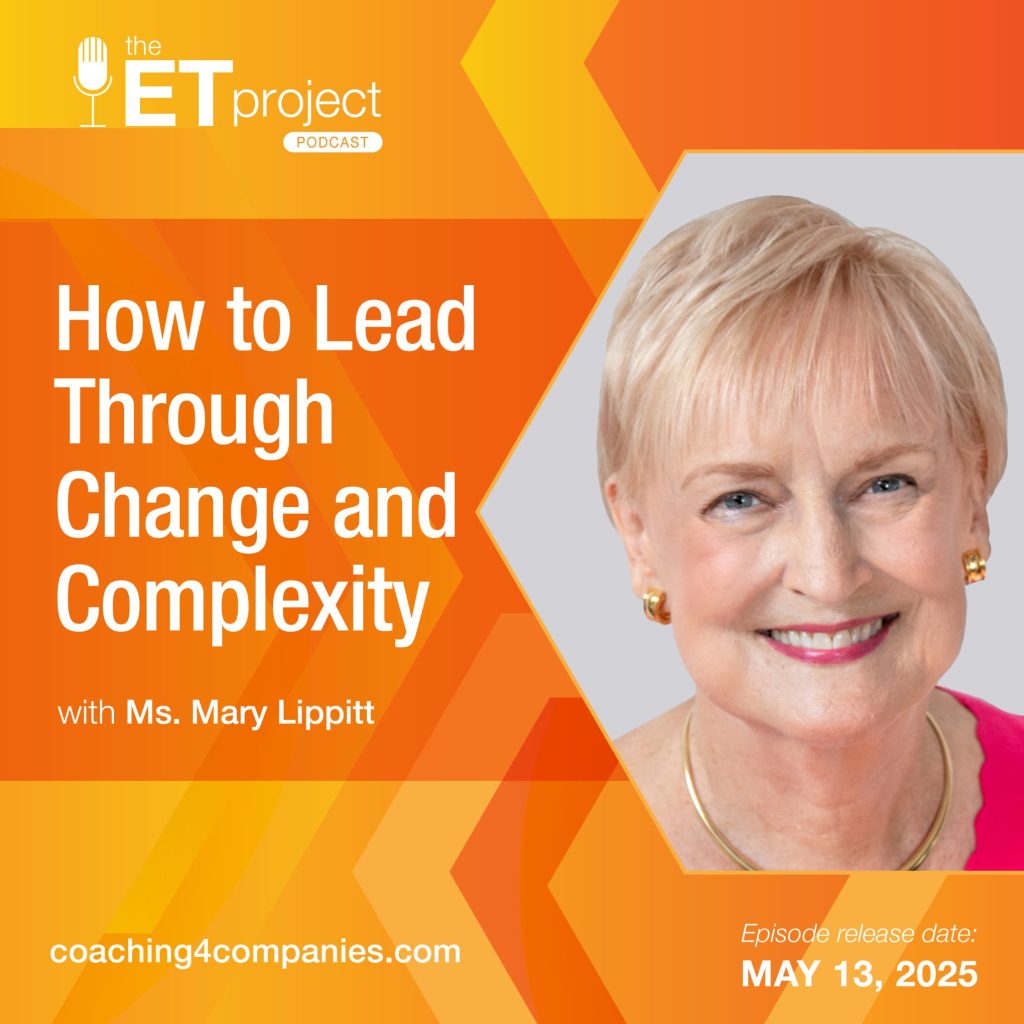
WAYNE BROWN: Hello, I’m your host Wayne Brown and welcome to the ET project. We’re delighted to be delivering this podcast for executive talent all over the world whom we’re affectionately referring to as ‘Team ET.’ Today we’re back in Tampa, Florida, chatting with the acclaimed author, dynamic speaker and insightful consultant, renowned for her groundbreaking work in leadership, critical thinking and change execution, Dr. Mary Lippitt. Dr. Lippitt has a passion for empowering organizations and specializing in guiding clients through today’s most pressing business challenges, delivering innovative solutions that drive success. Her extensive research encompassing insights from over 6000 leaders has unveiled the critical business mindsets essential for overcoming blind spots and fostering effective leadership. Team, over the past two decades, Dr. Lippitt has written multiple books and you’ll hear us discuss the lessons from her two most recent. The first is titled ‘Situational Mindsets, Targeting What Matters When It Matters’ and her latest award-winning book, ‘Leadersheep: Saving the Herd,’ where Dr. Lippitt skillfully weaves a compelling fable that highlights the pivotal issues in executing change. The narrative is designed to equip leaders with the essential questions that ensure their initiatives deliver the desired outcomes. As we all know in business today, faced with rapid change in almost every aspect of industry, acquiring the skills to guide multiple generations in our workforce through any initiative has significant challenges. So, to find out what you can do to overcome them, tune in and learn how.
INTRO: Welcome to the ET project, a podcast for those executive talents determined to release their true potential and create an impact. Join our veteran coach and mentor, Wayne Brown, as we unpack an exciting future together.
WAYNE BROWN: Hi team, welcome to your weekly dose of the ET project. I’m going to guess that you’ve probably heard the ever-growing chorus of people telling us about leadership and the fact that we need to be adaptable, we need to be critical thinking, we need to have the ability to navigate change and there’s probably a likelihood that you’ve heard about two of the critical elements for success in this area, your mindset as well as change skills. So, we thought on the show it would be a great opportunity to bring some context to the subject and explore some frameworks and tools that may equip you to be able to tackle today’s complexities. We’re going to examine a couple of areas; one is situational mindsets and the other is the art of executing change. It’s a lot I know, however, I’m really confident that the insights you’ll gain from the conversation will greatly aid with your strategies and probably add a dash of inspiration in the mix. So, with that said, let’s join our guest, Dr Mary Lippitt, as we dive into the heart of leadership excellence. Dr Lippitt, welcome to the ET project.
MARY LIPPITT: Thank you for the opportunity to share ideas with you.
WAYNE BROWN: I think we both agree that leadership is evolving and it continues to evolve. What trends, if any, are you seeing at the moment that’s shaping the future of leadership?
MARY LIPPITT: I think that leadership is changing in the direction of being more egalitarian, more engaging of people. I think that leadership is no longer thinking that they could come up with something and then say, “this is a great idea, this is a vision, you guys carry it out.” This idea of being able to delegate and expect smooth execution without your participation I think is changing and needs to. But I also think that we’re asking leaders to not be as single-minded as they have been in the past. Because things are changing so fast, there really is a need to collect more information, which means you need to confer, consult, and pull information from more sources. So, the idea of being in the ivory tower, sending out a dictate of some type and having it executed is outdated.
WAYNE BROWN: 100% I agree. We talk a lot with our clients about the need for that transition, particularly for the older leaders, transition from the 20th century style of leadership into the 21st century, which is all about that collaboration, that unison of ideas and coming up with that agreed solution, I fully agree with that.
[00:05:00]
WAYNE BROWN: We were just talking before we hit record about the incredible works that your father and your uncle have done in contributing to the space of leadership in general. Maybe we can start there, if you don’t mind, and you can introduce who they were and how that sort of brought you into this space.
MARY LIPPITT: Well, I will give my uncle credit first, Ron Lippitt. He worked with Kurt Kurt Lewin and they developed the ‘Unfreeze-Change-Refreeze’ model. My uncle Ron also developed the process of projecting into the future and describing what the future is rather than being the tortoise. Leadership now has to have a hair aspect to it. So, I think he did a great deal of work in terms of helping people understand, prepare for the future, and again, include people. My father, Gordon Lippitt, wrote the first book on organizational development and taught OD at George Washington University for 30 years. But that was after he worked on the Marshall Plan, and I think he did some good work there. So, I have the name Lippitt, and what I do for a living is talk, so I think I’m well named.
WAYNE BROWN: Looking at the work you’re doing as well is carrying on in the footsteps, for sure, and I think you’ve contributed enormously as well. So, very modest. One of the areas that we’re going to talk about is situational mindsets, and you have a company, enterprise management?
MARY LIPPITT: Yes.
WAYNE BROWN: And part of the work that you’re doing there is with this framework. Perhaps that’s where we start with this whole conversation. So, what is situational mindsets? How do you define that, and then what is the framework you talk about?
MARY LIPPITT: Mindset is a business priority. I think we’ve done a lot with leadership style. I think we’ve done a lot with leadership competencies and sometimes traits. But what I’m trying to focus on is on their ability to make wise decisions. Dr. Paul Nutt found that 50% of executive decisions fail, and the reason they fail is because people at a leadership level latch on very quickly to a plan that they fall in love with, whether it’s intuition or whether it’s something that they just thought of themselves. But the reality is they don’t collect sufficient information. And again, I think that’s part of the changing role of a leader. The leader in many organizations says, “I’m in charge, I’m making the direction.” And they don’t engage. And so, what I did is I studied 6,000 leaders and asked about their priorities, and there are six. And one is innovation, new products and new equipment. The second is customer focus. The third is coming up with the structure and systems to have an effective organization, whether it’s going to be matrix, whether it’s going to be more of a project process. After that, we take a look at quality and return on investment. And that’s the fourth. The fifth is culture, people and developing your talent. What is your bench strength? If you ignore that, you won’t be prepared for the future. And the last one is taking a look at the strategy. Are there strategic partners out there? What can we do in terms of expanding globally? Which is what has happened in the last couple of decades. But it also is taking a look at what are the trends that we need to be prepared for. If we don’t, we’ll find ourselves in an unpleasant place of being surprised. So, it’s innovation, customers, system structure, quality, return on investment, culture and people and strategic thinking. And I am encouraging leaders to collect information in each area before they jump to a conclusion because knee-jerk reactions are very rarely successful.
WAYNE BROWN: How do you change their thinking to get them to recognize the need to step back and perhaps delve a little bit deeper rather than have that knee-jerk reaction?
[00:10:00]
MARY LIPPITT: Well, I think that the pace of change is showing us that we cannot expect things to go slowly. And the only way to be prepared is to be aware of the situation. So, I call it situational analysis. After we collect the data, and again, that data needs to come from internally, externally, all the levels. If I just go off and have my retreat and come back with an announcement of what we’re going to do, I will have missed a lot of key input and I will probably start off poorly, which means out and poorly. So, I’m a firm believer that we have to stay alert constantly to what’s going on around us.
WAYNE BROWN: Mm-hmm. You talk a lot about critical thinking and blind slots within this context. And you have the SMI, the Situational Mindsets Indicator, to help with that. If somebody comes to you and they’re struggling with this concept, what’s the process that you take them through as a client to bring them out the other end?
MARY LIPPITT: Well, they take the Situational Mindset Indicator on one project. So, the premise of the work is not that it’s a consistency within you, that you’re not always in this mindset. But we do then take a look at, if this is what you’re focusing on, here are the questions you may be ignoring, the data that you may need to collect. So, what we’re trying to do is to indicate you may have over-focused, and it’s interesting that three of the mindsets believe in rapid change and they believe that you should do it quickly, which is the innovation, the customer service, and the strategic thinking. And the other three want managed change, and they want to hold on to their track record. I mean, a lot of entrepreneurial founders have this trouble with what made them great they want to hold on to. So, part of it is also helping people understand how do you get support from others who are operating with a different mindset. And we actually collected the data by gender, by different levels, and it was really interesting to see that by gender, at each level of an organization, the men and the women had different priorities. And again, it’s to our benefit to collect and be aware of all the facets that we can take in to better prepare us for making the smart decision. So, it’s insight on one when you take the inventory, but it’s encouraging you to ask the questions. I am a big believer in the power of open-ended questions that aren’t defensive. You could say, “are you going to support me?” Well, of course the answer is going to be yes, because you’re my boss. But yeah, I could also ask the question, “how can we improve on this plan? What could make it better?” And then I will get some very effective responses and I’ll be able to incorporate them and again, reduce the blind side. To me, it’s like a kaleidoscope.
WAYNE BROWN: Yes.
MARY LIPPITT: I mean, our world is changing so fast that one tiny turn and everything alters. And if we don’t keep aware of how those things can change so rapidly, we are going to have a more difficult time.
WAYNE BROWN: Right. We talk a lot, and somehow related I guess, we talk a lot about systemic thinking and being able to step back, see the entire ecosystem or picture, but not only the big picture, but also see the interaction or the interplay between the parts within that ecosystem and the ripple effect when something changes with one item and how that impacts multiple other areas. And I guess that ties with what you’re talking about also, right? With the kaleidoscope and turning the kaleidoscope, you know, a small distance completely changes the pattern that you see.
MARY LIPPITT: Yes. But it’s also… well, it changes rapidly, I’ll also add that the colors that were there in the first picture still are there, they’ve just been rearranged.
[00:15:00]
MARY LIPPITT: And so, it is not like everything is starting over with the dinosaurs or something like that. We have the ability to identify the ingredients and what we need to see is the new pattern.
WAYNE BROWN: How do you incorporate critical thinking as an element into the program? We do a lot of work in Singapore and the Singapore educational team and the government have three clusters. And one of those clusters that they’re trying to educate people about is critical thinking. And they have five subsets that sit under that. It’s a big area, I guess is my point. How do you narrow the focus for critical thinking within your program?
MARY LIPPITT: Well, I try to switch it to mindsets because the word critical thinking has a connotation of being negative. And it also implies that maybe some people have the IQ for critical thinking and some people don’t. And I am very convinced that everyone can analyze things if given the information and the time. It’s interesting to me when I started out many years ago, I was told that the key to success was to walk fast and haul and carry paper because then you’d be visible. There was truth to that, there was, but there’s also a great deal of truth to the idea of identifying a new solution, identifying a new opportunity. It was interesting. I was working with Harvard’s women’s group and we were talking about mindsets. And one woman said the way to get ahead in most organizations is to start your own business within the organization. So, you’re not competing for a slot that’s already filled, you’re actually building a new line of business. And since you came up with it, you can grow it. I thought that was an interesting comment because it does show that if you want to think out of the box, there are some real rewards for that. And I just felt that it was a wonderful observation and one that I think is valid.
WAYNE BROWN: One of the areas that I was reading about is the team dynamics and the increased effectiveness, I guess, of the team as a result of the agility program and the mindset program. How do you go about improving things like collaboration and trust within a team? Do you have a specific methodology?
MARY LIPPITT: The work that I do really focuses on making sure that everyone on the team isn’t seen as a leader. It isn’t just the person with the title. I also build trust by encouraging people to look at their last project that they did together and identify, you know, what should we have started to do earlier? What should we have stopped doing? Should we have done more often? What should we have done less often? So, I find that just asking basic questions is more likely to develop the trust rather than just assuming that the person with the title has the answers. And I will also say that there’s some research that shows that many of the leaders in teams and organizations have actually not had leadership development. They’re called almost accidental leaders; they’ve been thrown into something. And, you know, the mindset framework helps them, but it also encourages them to be the engaging, listening person. I also, we all talk about active listening, I talk about reflective listening because active listening has become, I’ll be quiet, I’ll listen to you. Wait a moment. Okay. Now I’m going to tell you what you just said. But it isn’t really what we need. I need to listen to you, leave. Think about ways to bridge what I can, and then come back and have, you know, bridge building sessions or ways that we can combine ideas, you know, whether you want to call it fine tuning or whether you want to call it a major adjustment, I don’t care.
[00:20:00]
MARY LIPPITT: But this whole concept of reflective listening, it encourages people to be as open and if the leader isn’t open, the team won’t be open. So, we have to keep the discussion going but there needs to be time for that pause between input and recommendations later.
WAYNE BROWN: A moment ago, you were talking about different leaders and you don’t have to have a title essentially to be a leader. How do people create influence when they don’t have that authority?
MARY LIPPITT: Well, I think that influence, again, comes from communication and two-way communication. It also helps when what I said turns out to be true. I mean, so it’s not that you, I said something that was distorted, then you could feel more comfortable. I mean, trust is about comfort. Can I rely on you? Am I comfortable with you? Do you give me the information I need? There’s two theories of trust and one is that I trust you 100% from the get-go and the only thing you could do is go down. And then there’s the other approach for us, which says, I don’t trust you because I don’t know you and the only place you can go is up. So, I think we need to understand that trust is a living thing and we cannot destroy it because it’s very hard to rebuild. So, the question would be, have I trusted you? Because if I don’t trust you, I’m projecting somehow some sense of superiority or excellence that you don’t have. So, it starts with the leader showing trust, helping people be successful. Anytime someone is willing to help me, there’s a bond there, whether it’s called loyalty, whether it’s called respect, but that bond actually is a form of trust. It’s hard to measure, maybe, but critical to have.
WAYNE BROWN: I had the pleasure of reading your latest book called ‘Leadersheep’ and I saw that very nice Freudian slip that you had earlier in the conversation where you said ‘Leadersheep’ instead of Leadership, I liked it, it’s great. In the ‘Leadersheep’ book, you introduce another five-component framework, which are essentially stepping stones, I guess, to a successful change initiative. Would you mind just talking us through the framework, if you could, please?
MARY LIPPITT: The framework starts with vision and vision in this definition is a evolving concept to be implemented. And it has to evolve because some people make it too grand. And I think we’ve found out that multitasking really is something that we can’t do. And sometimes I find… I had a client which was implementing an ERP program, which is great, but they also at the same time wanted to do IPO, those are conflicting goals and outcomes. So, the idea of keeping it clear, keeping it in a way that actually can be implemented and tailored to the organization becomes very important because what works in one organization will not work in another. But yes, parts will, but every organization has a uniqueness to it. So, the vision is the first piece. And if people can’t understand the vision, then you’ll read in the culture, there will be confusion. So, after you have the vision, then people say, “okay, we want to do this. Gosh, darn, I don’t have the skills.” And if I don’t have the skills to be successful, I’m not going to jump on board. So, the importance of skill development, which I think is overlooked in many change efforts, becomes critical. And that’s not just the technical skills. It’s the soft skills. It’s actually change management, how to do that, how to do project management. So, if you don’t have the skills, I become anxious because I may fail. So, if we know what to do, and then we know how to do it, the next question is, why should I?
[00:25:00]
MARY LIPPITT: So, it looks at the incentives that are in place. And I purposely am using the word incentives versus motivation. I know that there are a lot of different definitions for these words, but I’m trying to stop the use of charisma on the part of a leader to get people on board. Our attention span is much more limited than we might believe. I mean, I made some New Year’s resolutions, they were broken by February. I had the motivation, I had the desire, but I wasn’t really committed. So, I’m talking about incentives as a way to gain commitment. And I’m looking particularly at the intangible incentives, the growth, the sense of mission, the sense of respect, autonomy. Those are the kinds of things that will keep me acting toward the goal. Motivation is great. It feels wonderful. It unites a group in an auditorium, but it does not get people to actually take action. So, without the incentives, there is just going to be a lot of resistance. Why should I get on board? I had someone actually say, “I’m on the B team.” And I said, “what’s the B team?” “I be here when it starts. I be here when it ends. There’s nothing in it for me, I’ve just got to exist.” And so, the incentives have to be listened to. And what I found is that there are three fears that stop people from getting on board. First, they disagree with the goal, they think something else should be done. They disagree with the implementation plan, or they have fear that this is the slippery slope into something negative in the future. And so, the leader needs to ask the questions to find out which fear is dominating a group. And if you have them commit, then you have to have the resources. And the resources that may have been available when it was launched can usually get reassigned or something. So, ensuring that the resources are available as necessary and as of time becomes important. And I think we’ve both seen this with organizations, governmental organizations. You know, they make a decision, this is what we want to do. But if they don’t fund it, it doesn’t get done. So, if you know what to do, you know how to do it, you want to do it, and there are no resources available, you’ll have frustration. And then the last one is if you have the resources, you can act, but now do we have an action plan that makes sense? Sometimes more time is allocated toward the launch than it is to the execution process. And, you know, quality testing can get dropped because we’re behind the schedule. And so having the critical path in the action planning means that we’re not going to get sidetracked, delayed, surprised later. So those are the five; it’s the vision, it’s having the capabilities to do the job, the incentives that I want to do the job, you know, what’s in it for me, the resources, and then the effective action planning that will make change successful. So, it’s more a how-to than some other models are.
WAYNE BROWN: These are all dynamic. Just as you said at the beginning, the vision was constantly evolving. But so too are the capabilities or the need of certain skills as they work through the change. The incentives, the resources, all of these things to me are very dynamic because I’m yet to see the perfect change strategy. Is there one of those five elements that you feel is the greatest contributor to initiatives failing?
MARY LIPPITT: I think the inattention to incentives and engaging the people and listening to the people is the most often overlooked area. There was a concept back in time, if I’m the leader, you do what I tell you. You know, I announce, you salute and execute. And I think there’s a lot of that that’s still left. Even if it’s dampened some, to go all the way from salute and execute to, oh, you’re a valuable partner, that is a leap that not every leader has made.
[00:30:00]
WAYNE BROWN: Yeah.
MARY LIPPITT: So, my experience has been the incentives and the whole concept of support and the misuse of the word resistance. If I mentioned that there could be a different way, you can see me as a creative contributor or you can see me as a problem resistor. I think that we need to be careful how quickly we jump to the word resistance because sometimes people just don’t know and they want more information so they can decide, again, what’s going to happen here? Is this going to be beneficial? I mean, the introduction of AI has caused some individuals to be concerned about their job security or their future. So, I think that the incentives piece is overlooked because I think most leaders are in a rush to get it done. But there actually is a, I’m not sure where it came from, but it says, if you want to go fast, go alone, if you want to go for success, create a village or work with collaboration.
WAYNE BROWN: Yes.
MARY LIPPITT: So, it needs to be rethought.
WAYNE BROWN: Mm. One of the things that I side with the leader and we’re using the leader as the change catalyst or however you want to position the leader. But I often feel for them as well, because just as you mentioned earlier, quite often leaders have never been trained or educated on how to approach any of these initiatives of change, of leading teams, and yet they come under enormous pressure to make it happen. And therefore, their reaction is probably not the scripted action that you would hope for when something goes wrong. So, I often wonder how do you help them or how do we as the consultant or the mentor help them to understand and create that balance for themselves and deal with those pressures in these situations? Have you had much exposure in dealing with that?
MARY LIPPITT: I think the goal for me is to help them understand that they’re the coach. They’re not, you know, the executive in the tower. They need to be on the field. They need to be helping people. It’s hard for some people to do that because they aren’t confident enough in their skills. And so sometimes I find that leaders won’t let people ask questions because they don’t know the answers. And that whole sense of confidence needs to be built up by redefining what the leadership role is. I think it was Eisenhower who said the role of the leader is to make the people in the organization want to do what you want them to do. And, you know, that means influencing. It means taking a look broadly at what will happen, but it’s also important to tell people what will stay the same. I once had a client and over the weekend they changed the office layout, the computers, and the software system. And when the employees came in on Monday, they were less than enthusiastic, after all the money we spent on them. And it was really interesting. One of the things I do is I do lateral meetings, not a town hall, but a lateral meeting to find out what was going on. And what was really interesting was their major objection was that their lunch hours had changed and they couldn’t have lunch with the people that they wanted to have lunch with. And when they changed the lunch hours back, things went smoothly. We never know what is important to somebody unless we ask.
WAYNE BROWN: How can leaders cultivate their ability to adapt their mindset as the circumstances are evolving during a change initiative? Is there any particular exercise you work on or provide?
[00:35:00]
MARY LIPPITT: One of the things that we do is stress the need for all six, because otherwise you have group-fake. There was a story about a CEO who was going to have a merger and he said, “can anyone think of anything that would cause problems?” And everybody said, “nothing.” And I like the fact that he said next, “we’re not moving forward until we know what the risks are.” So, what I try to do is to encourage people to identify how can we look at the customer better? What systems are sidetracking us? I mean, I still find organizations that say they want teamwork, but their performance appraisals are all about individual effort. And I know some people who do team, I mean they can’t get as much of their work done because they’re helping so many other people, and it impacts their standing in the organization. There was one executive a couple of decades ago who created an alternative. He said, “unless you have demonstrated that you’re coaching your people, you will not be seen as someone we can promote.” And so, I mean, we have to look at all of these issues. I really believe that most people don’t recognize how smart they are. I think that if you ask the questions, people get answers. I mean, that’s the whole benefit of what is usually called brainstorming. There’s a whole lot in the room. Getting that out and recognizing it and supporting it, rewarding it, is really one of the, I think, critical roles that leaders must perform. So, in an exercise sense, we have all the questions for each mindset. Can you ask those? What are the answers? And then obviously take a look at the risks and benefits. Cost-benefit analysis is great, but so is a system re-evaluation and so is customer expansion. Leadership is juggling, and we’ve got to make sure we know which right ball to pull down, but we’ve got to see what all six of them are.
WAYNE BROWN: Right. And one of the things I did enjoy about the book, the ‘Leadersheep’ is for each of the five elements, you provide a list of 10 or so questions to ask to really dive deeper into understanding, do we have all the information we need? Do we have everything in place to really help support that journey? I was just thinking while you were talking then about one of the challenges for change initiatives or for anything in business today is our globalization of the team that we’re leading, whether it’s through culture, whether it’s through language, whether it’s through political agendas in different countries, whatever the nuance is. This has brought a, primarily since COVID, but even prior to COVID, it has brought a new challenge to the leadership role when it comes to managing a team, but also when it comes to change, are you seeing this as a big issue with the clients you work with?
MARY LIPPITT: Yes, it is cultural differences or backgrounds, it’s also age. There’s becoming a lot of labels by how old you are. And we talk Gen X, Gen Y, whatever, baby boomers or whatever. So, the reality is we judge a lot and we label people because when I label people, I don’t have to think about it because they’ve already been given a label. And I do think it’s the responsibility of the leader to make sure that those labels are crushed, I’m sorry, really. I mean, we can’t. I worked for a large electronic manufacturer and it was a manufacturing center and they had seven different cultures and they didn’t even speak the same language. And they had problems, but they couldn’t work together to resolve them. So, I have a process where I ask people to identify all the issues. Every issue goes up, every issue. And then I ask them to identify which one is critical, which one is urgent, and which one has a trend that’s getting worse rather than getting better. And we recognize those, the cut, critical, urgent and trend. And then we say, “what are we going to do to address these?” And again, it’s an open process. Everybody understands the foundational information.
[00:40:00]
MARY LIPPITT: They understand what has to be a priority for now. And then we can work together to solve it. And what was really nice in this situation was the client had told me that if they came up with a proposal, they could make it to the executive team. They actually got up and made it to the executive team, which got implemented. And I believe it was $3 million saved in the first year. I mean, they could quantify it because management and the people, frontline workers, were working together. Again, it’s just helping them with a process where they can recognize their contribution and see the larger picture really pays off. And that’s what I’m trying to do with the vision, the skills, the incentives, the resources. I’m trying to help people learn it so they can use it to their advantage.
WAYNE BROWN: You mentioned the leader supported the whole movement. And I think that’s often an area where we overlook that genuine intent of the senior leadership to act upon or realize any of the potential changes that could come through and have this type of impact. So, I think that’s a critical factor as well. Mary, it’s a wonderful conversation. Great books, by the way. For all the listeners, please get out, get hold of ‘Leadersheep,’ I think it came out October last year? From my memory.
MARY LIPPITT: Yes.
WAYNE BROWN: Anyone that has ever read ‘Our Iceberg Is Melting’ from John Kotter, the fable is on a similar path, but with sheep and a sheepdog rather than penguins. But it’s a great book and the change framework is simplistic and very implementable, would be my takeaway from it. And I think that’s the core to any successful change is to keep it as simple as possible, but do the things you have to do well. And I think the book really reinforces that message. So, a great book. Please get out, get a copy of it. But Mary, thank you so much for being on the ET project.
MARY LIPPITT: It has been my pleasure, I enjoyed it very much. Thank you.
OUTRO: Thank you for joining us on the ET project, a show for executive talent development, until next time, check out our site for free videos, eBooks, webinars, and blogs at ‘coaching4companies.com.’
[END OF TRANSCRIPT]