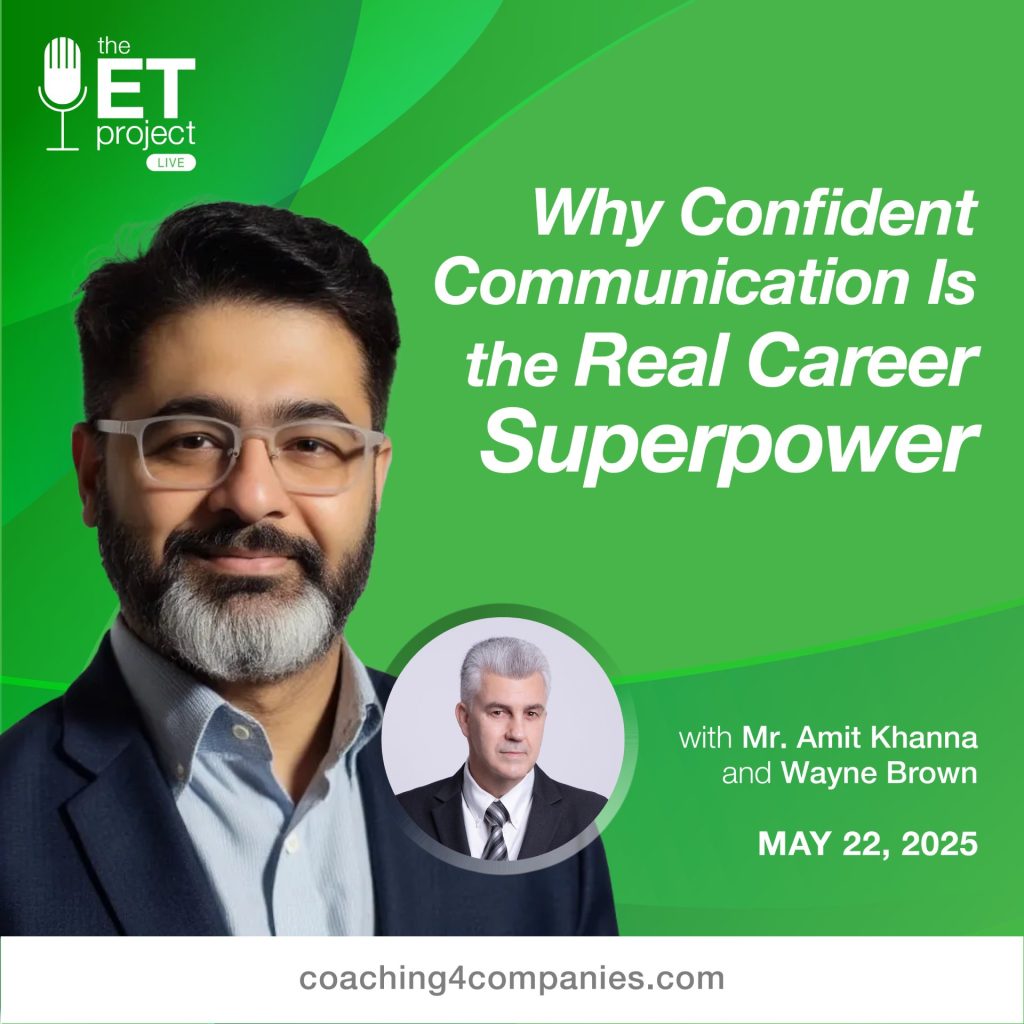
WAYNE BROWN: Hello, I’m your host Wayne Brown and welcome to the ET project, we’re delighted to be delivering this live episode for executive talent all over the world, whom we’re affectionately referring to as ‘Team ET.’ Today, we’re heading back close to home, landing in Melbourne, Australia to chat with Mr. Amit Khanna. Losing his father at the age of 14 with only 425 Indian Rupee, that’s close to five US dollars in the bank and huge debts to clear off, urged a young Amit to work odd jobs as a factory worker, salesperson, cashier and bartender to bring in cash until graduation. Struggling to speak fluid English and battling with facial paralysis multiple times throughout his life was no cakewalk, early into his IT career, he realized his affinity towards people management and transitioned to corporate leadership roles by mastering the communication game, now with over a decade of experience as a certified project manager working in seven countries, today Amit is an international TEDx speaker, thought leader, master storyteller and mentor in leadership and communication, during our conversation we explore Amit’s book, ‘CORPORATE CIRCUS,’ which offers proven personal strategies to become confident as a corporate communicator, enabling you to win big in your corporate career, the step-by-step techniques introduced enhance your communication skills, allowing you to articulate your ideas with clarity and impact, as well, there’s a host of insider tips and practical exercises to conquer your fear of public speaking and deliver compelling presentations that captivate any audience. Amit provides expert advice on navigating complex corporate environments, managing office politics and resolving conflicts that thrive in your professional career. Team, before we wrap up this conversation, we visit that most challenging of subjects, handling office politics. So, with so many practical tips from a person who has devoted his life to learning and applying those lessons, this is truly a conversation not to miss.
INTRO: Welcome to The ET project, a podcast for those executive talents determined to release their true potential and create an impact. Join our veteran coach and mentor, Wayne Brown, as we unpack an exciting future together.
WAYNE BROWN: Hello, team. Every now and then we get to sit down with somebody whose journey is as compelling as the insights they share and today’s ET Project Live conversation is with a leader who didn’t start his career with all the advantages but rather built his path through resilience, through hard work and I want to say an unshakable belief, his true passion really lay in working with and helping people, specifically in how they communicate, how they lead and ultimately grow as individuals. We’re going to chat around the power of communication in particular looking at storytelling, looking at his book which is called the ‘CORPORATE CIRCUS’ and probably one of the more interesting topics in recent times, we’re going to be having a conversation around how Amit is helping leaders to navigate something that many leaders avoid talking about and that’s office politics. Amit, it has been a while coming, but I’m very happy to welcome you to the show.
AMIT KHANNA: Hi, Wayne. Thank you very much and thank you to all the listeners as well. It’s a pleasure to be here.
WAYNE BROWN: If we look at your career, I mean, you had a number of starts in different areas that really helped to give you a grounding but then you found yourself in IT. I’m quite interested in that transition from what you were doing to getting into IT. How did that come about?
AMIT KHANNA: I was actually forced to do many things prior to getting into IT. So, I’m a single child to my parent, so, no siblings and I lost my father when I was 15, and when I lost him, we realized that we didn’t just lost a human being, we lost a lot of other things, like, lost a home, we lost all the money and everything. So, we were like literally broke and my mother being a patient as well, and she was uneducated so she is not somebody who will go out and do any work. And so, at that age of 15 I started to work on my own and with my education because I also realized that I should get graduate, I should become a graduate.
[00:05:00]
AMIT KHANNA: This is like mid ‘90s that we are talking about. So, I started off in a restaurant as a bartender, I worked in textile industries, I worked in banking sectors, in sales and stuff. And soon I did my graduation, this is where it struck me, and one of my aunts actually helped me out. So, I was connected with a guy from a company called as Aptek. Now Aptek in India used to be a very famous computer group. So, he suggested to do a course that will help me to get into IT and it had an entrance exam across India, I gave the entrance, I cleared it. Once I graduated basically, one of my aunts actually helped me to connect with a person in Aptek. Now, Aptek like NIIT, these were the two big brands in India back then into computer and training and stuff. He suggested me to get into IT by doing a certification that… it’s not a certification, I’m sorry, it’s a common entrance exam across India level. I did that and cleared it to my blessing and that’s my step into IT in a way.
WAYNE BROWN: What was that early entrance? Like you started as a programmer or what was it you were doing in IT?
AMIT KHANNA: Yeah, the reason I smiled is because when I got into IT and I was learning, it was during this time when I was learning Java and while learning Java, I learned one thing, that I cannot code for the rest of my life; it’s too hard for me. And so, one of the other traits that I realized because I was studying in a different city than my home place, you know, and this is the first time I had ever moved out as well, but one of the traits that I learned there is that I can… I love to talk to people. I became the head student of the class and things like that, you know? So, I realized that I can talk, I can communicate and I can… I love that. So, I went into… and interesting part is that I did my post-graduation and the 9/11 plane attacked just a month after my graduation. So, I was one of the victims unknowingly who was impacted because when that plane crash happened and the dot-com industry failed, there was just too many people but no jobs. So, the same thing happened with me so I landed up with like a Dell hardware technical person first and then I got into something called as a data warehousing industry. So, I started as a developer but not a hardcore coder. So, we already have tools and yeah, we’re going to move data from point A to point B and put logic in it; that’s how I started.
WAYNE BROWN: So, you moved I guess progressively then into more leading people or working with people, and how did that all come about? Like, what was the leadership transition?
AMIT KHANNA: It was very nice for me in the sense of, you know, soon when I joined a company called Astera Data in 2006 and back then starting from 2007 I got leadership opportunities. You know, you become a little like 3-4 years’ experience now so you’re like a senior guy a bit.
WAYNE BROWN: Yeah
AMIT KHANNA: But I was fortunate enough that my company realized that I can handle people better and because my technical lead wasn’t doing that well, you know, he was a technical lead, like, a very brainy chap. So, I was very fortunate that since very early time I started to get team management handling, and that started with me doing my work but also seeing that, all right, how Wayne is doing, how X, Y, Z is doing, you know, making sure that you do it and stuff. So, that was the transition for me and I think it was 5 years down the line and then I did my project management certification, I got into project management and I’ve always been a technical project manager, it means like I understand the issues, I will ask you the question that I know of and things like that.
[00:10:00]
WAYNE BROWN: Mm-hmm
AMIT KHANNA: I’m not a person who will sit on the tool and do it to know every checkbox in that but, hey, I understand how to move data from point A to point B.
WAYNE BROWN: And as we’ll talk shortly about your book, you obviously know how to communicate very well?
AMIT KHANNA: Yes. And one thing that I just wanted to share is that I was also very lucky because my manager actually used to sell me out. So, here’s how he used to do it, if there’s no project in my area, he used to go to other departments and ask, “hey, do you need help in this tool? That tool? Even if it is basic, no problem, Amit will do it for you.” So that gave me an exposure of working from the source to database to frontend to backend to testing to architecture, every bit of it. So, I was blessed to have an end-to-end project and many of them.
WAYNE BROWN: Right. We were just talking before we came on air, talking about our experience as project managers and I never did my PMP certification although I’m very familiar with it, we were just talking about the new PMBOK seventh series is radically different to when you and I were involved with project management and it has changed a lot, but I can imagine in IT for you at that time there was somewhat of a hybrid working between Waterfall and Agile and today I think PMBOK has even shifted in that direction as well. So, I think the whole world from a project management point of view is also somehow coming together. So, it’s very interesting, at least interesting for me, maybe not so much for other leaders. So, what period of time are we talking now? When did that first happen and what are you doing now in terms of your job and leadership?
AMIT KHANNA: So, I started… like I said, I was in IT doing my regular things, and every now and then I say this, there are people who come into your life and can influence you in a better manner, right? So, one such person happened with me as well in 2015 he entered into my life and he projected me towards a different growth mindset. You have something outside your 9 to 5 and that’s where my life started in because I became PMI volunteer and to that extent that my name is right now in the Agile book as well as one of the contributors. I used to sit with the PMI folks who were part of the exam who used to give questions to that. We used to enter in debates for Waterfall versus Agile world. I took the first three batches for the chapter in Mumbai for Agile certified practitioner certification, that gave me a very different exposure altogether. You know, it’s not just now my company, I’m not confined in one place, now I’m like spreading my wings, if I may say so. But that gave me opportunity to meet amazing people, to meet different projects, I realized how petroleum projects work, how other projects work. And it also gave me one more information, is that how small in many times the IT projects are, when you talk about construction projects and those big petroleum projects and stuff. So, that exposed me to a different side of the work, that it’s not just my work, my things and stuff. That gave me an exposure of I should go and seek more and there are different leaders, different ways of handling things and stuff.
WAYNE BROWN: Mm-hmm
AMIT KHANNA: And I’m happy that I use that a lot in my projects as well. So, moving from there I think… so, most of the projects were always Agile because if you don’t use the word Agile it seems the shareholders are not going to be happy. So, I realized that… I have worked in a lot of projects, big company projects where it was just the name Agile, there was nothing in it about that.
[00:15:00]
AMIT KHANNA: So, I ran some first scrum master projects where I failed miserably, I did scaled-Agile projects with one of the biggest car manufacturers in Sweden. So, I overall learnt I guess is that it’s two things matters a lot is what the company’s vision is, like really, if they can define that very well, and their ways of working, you know, the top management ways of working. So, from there it has been the same journey, I’ve always been into delivering things, that’s what my goal has been, whether I am tagged as project manager, delivery manager, you know, there’s a lot of designation tags right now, I call them as tags. My core job has always been, get the problem done and resolve it, get it towards the next side and move on.
WAYNE BROWN: Okay, very nice. So, as time evolves your competence and your exposure continue to expand, in reading the book, ‘CORPORATE CIRCUS,’ you know, it’s clear that you identified some core areas that are challenges for many leaders in particular in the IT space, but my expertise is not in IT so I can confirm for you that this is not isolated to IT. It is very much a technical introversion problem that you talk about in terms of the ability to communicate and the whole gamut around communication. So, in the book you very nicely identify a whole series of challenges that people who are leading may be facing when it comes to communication, without giving the whole book away because we want people to buy the book, but maybe you could speak a little bit to what was the inspiration for the book and what’s the general theme that you hope people take out of it
AMIT KHANNA: This is my seventh country of work right now and what I have realized, first, when I was in India and I was working with the team, I have brilliant technical folks working with me, but when you ask them to present or share information it’s always not up to the mark, they’re boring, basically, okay? And no offense to all of you, you guys are smart, but it turns out to be like that or they’re not able to showcase themselves well. Then I moved to different countries and I realized, oh, my God, that’s a problem everywhere, it’s not just with India anymore, it’s everywhere. And that was the inspiration for me in 2020 to really understand how can I help, because people always say, “oh, Amit you can talk freely, you can talk fluently,” blah blah blah and stuff and I said, “no, you can do it too,” because believe it or not Amit Khanna couldn’t speak fluent English till age 18. Like, literally, I couldn’t. So, if I can do it, you too can, and that’s where it started. So, the whole essence of the book or what I’m trying to focus here is that there are three core things that anytime happens when you have to… wherever you go. So, the first is, the choice of words that you’re going to speak out, right? So, that’s like a bit of written, your vocabulary and other things, right?
WAYNE BROWN: Mm-hmm
AMIT KHANNA: The second is when you say something it is your tone that comes into picture, are you a monotone or are you using some sort of fluctuations in your voice? Where you can emphasize things and stuff. And the third thing is your body language, like, are you using your hand and gestures and other things in the right manner, in the right place, so that it gives the right vibes to the people, correct?
WAYNE BROWN: Mm-hmm
AMIT KHANNA: So, the fundamental is it’s not what you say or how you say, it’s how you make me feel is important, that’s the core fundamental of the book. So, to begin from there, we work on people’s communication skills and then we help them, all right, now you understood this, now let’s take you to a meeting, imagine if your boss is taking over the meeting, how are you going to get it back without insulting that person, right?
[00:20:00]
AMIT KHANNA: How are you going to make sure that everything is taken care of? Then you take it into conflicts, a lot of people avoid confrontations and conflicts, so, it doesn’t work. So, then there’s a whole gamut of things around all of this, but first is, how do you take care of yourself?
WAYNE BROWN: You introduced a framework and it’s a very nice or a very simple framework called BIG, I wonder if you could sort of speak to that for a moment and we’ll take it from there type of thing
AMIT KHANNA: Sure. So, BIG is believe, improve and grow. So, the course starts again in the same thing. A lot of… I have… just to share, okay? I haven’t been a very bright student during my childhood days and that was because of… one of the fundamental things was my parents and many people just kept telling me that I’m not a bright student because I was compared with a bright one, okay? So, that put a limiting belief in my head, it took me 13 years and after 13 years it broke and after it broke, I realized that I can do anything. So, I did my master’s from US in Project Management, I did like 11 certifications in IT and Project Management, Agile, everything, right? And interestingly, I’m still studying, okay? I just did my diploma in human psychology right here in Australia. So, the core is that it doesn’t matter what happens if you don’t believe you will not do anything, like, even if I give you all the books and knowledge it will not work. So, belief happens through learning these basic skills, and we have to go back to the basics, because one of my actual clients told me, “You know what Amit? This I learned 20 years ago,” I said, “yeah, but you’re here with me because you’re not doing certain things, so, we’ll have to take…” so, that’s the belief part, right? So, once I believe in me, once I know my voice tone patterns, once I know everything about the way I present myself, then it’s time to improve. And this is where we help people to now, all right, how do you improve? Just take your day-to-day work, what’s your day-to-day work? Time management, basically? Delegations? How do you do that? How do you handle meetings? How do you handle conflict, right? And how do you do presentations? Basic, very basic stuff, that’s your day-to-day life. Then once you are good with that, then we help you to grow now, so grow is now getting into leadership roles, you’re getting much bigger areas, this is where we’ll help them with persuasion, negotiation, emotional intelligence from a company level, how to understand different cultures and other nuances and stuff.
WAYNE BROWN: So, that’s our BIG framework and when I look at the roadmap of that framework there’s actually, I think, I counted 12 subsets along that journey. So, they’re the three big goal posts if you like but there’s a series of subsets. So, you need to read the book to be able to understand all of that, but there is a little teaser for you. How much did you experience mentors yourself or coaches during your career to help you go on that journey of learning development, growth that you talk about? Were mentors part of that journey?
AMIT KHANNA: 100%. I think like I said, in 2015 the guy whom I met was three and a half years younger to me
WAYNE BROWN: Okay
AMIT KHANNA: And the way we see things many times and probably this is just me but I still want to share this, I believe this, that we are fairly egoistic person, okay? And with my designation, me being senior in the company, he’s new and stuff, there’s a lot of things in my head right now, correct? So, I’m blessed probably from the Lord that at that time it wasn’t like that, and I could see the positive things in him, and he was trying to influence me, and I’m very happy that I got influenced, I still thank him, we’re very good friends, he’s still there. I treat him like a mentor, he treats me like a mentor in the area of life because he knows the life I had and he feels that, Amit, you are good in resilience, for example, and stuff like that. I treat him for making the growth mindset in my head. So, yeah, it’s always good to have someone
[00:25:00]
WAYNE BROWN: Yeah, you just triggered a thought that I had forgotten, I did. So, on your website you have ‘The Life Wheel’ and you can you can go on and do ‘The Life Wheel assessment,’ I took it today, by the way. We know this tool, but your approach with the application is quite unique and it’s a great tool. So, anyone listening, we will put the link to his website et cetera. But go in there, do this free assessment, it will give you a nice picture of your life and some of the areas where you may find some gaps that you want to work on. So, yeah, thank you for triggering that, I had forgotten about it. Your approach, however, is… I can see you really push the boundary with yourself in your growth, right? If I was to count the number of people on two hands, I guess, that I know who have done a TED Talk or been a TEDx speaker and you’ve been there, you’ve done that. So, you see you see an opportunity and you seem to seize that opportunity, what’s that driver? Like, you spoke earlier about your upbringing and the challenges you faced, is that the only driver you can connect or is there something deeper within you that is really something driving you?
AMIT KHANNA: So, I have… of course, apart from losing my parents early and all those things, right? So, at that time it was push, like, you know, the world is pushing me, I am doing it. But there are two few things that has happened in my life that probably are the driving factors. Number one, is my upbringing, number two, is that I have been… I’ve got four facial paralysis, like my jaw here, okay? Four times, and it happens every decade, I don’t know why, all right? So, the last one happened in 2020. So, that’s another thing, that I really don’t know what’s wrong in my physical structure inside, we’ve done a lot of tests to check it but, I don’t know. So, and the third thing is about the family, so, I have a sweet family of… we’re three now, and because of my upbringing I want to make sure that my future is better than my upbringing, right? So, that’s another drive. And the other thing is in 2010, I was in US, I was in Ohio, and my life is really nice and I’m like thinking, “what am I going to do here?” Like, why I’m here, you know that question, right?
WAYNE BROWN: Yeah
AMIT KHANNA: So, that question led me to two outcomes, is that number one, is that I am here I should take care of my family first, so, that’s done. The second is that when I die, is there a chance if I can impact few people’s life more so that they have better upbringing than mine? Okay? Can I just inspire one person? Like, hey, you know what? Look at me. Because for me, Wayne, the choice had always been very simple, you’re in a trouble position, you have two choices, now please don’t take this as, like it’s serious for me but to all audience understand from where I’m coming at. The first choice is just kill yourself, that’s the end, right? The second choice is live and live and live smilingly and fight back, I’ve always been on that second choice, right? So, that’s the driving factor, if I can give that ray of hope to somebody saying that, “oh, my God, Amit had a crooked face, Amit had all this issues, oh, he can speak, oh, why can’t I?” All right, there you go.
WAYNE BROWN: Yeah, no, I like that rationale and the purpose there. What was the writing of the book like for you? English is not your first language, you learned it you mentioned, it was 18 or 20 by the time you could speak fluently, what was writing this book like? As a process, as a thought process, like, was it a challenge or was it something that flowed fairly freely?
[00:30:00]
AMIT KHANNA: Oh, it was certainly a challenge, I wrote my first eBook or booklet of 40 pages called as ‘Welcome to the world of Storytelling’ in 2020, and that was like an overnight thing, I had to prove something to somebody and I like, all right, I’m gonna write it, and I started at around 7 or 8 p.m. and finished at 3 a.m. and it was just for 30 pages or so. But this one was a challenge, the challenge was that I had the whole structure and everything but I had no clue how to put it in, and when I spoke to some editors and the publishers they said, oh, you should have at least 20,000 or 30,000 odd words and stuff, and I’m like, “oh, my God that’s a lot, where am I gonna get that?” But again, the thing was that I read a lot, because I love to read a lot and I realized that a book is not just, do this, do that, do this, do that, mine is still fairly… and it’s fairly small in that sense, it’s just 180 odd pages, I guess. But you add stories in it, you add some value in it and stuff so I actually gave away a lot of things in the book which we generally teach people because I realized that should be a good value add to the listeners, I mean to the readers, I’m sorry.
WAYNE BROWN: For sure. I was going to say that as well. I mean, for anyone that’s interested in reading the book you won’t be disappointed because you get so much out of it, as Amit just mentioned, you give away so much. Probably what we haven’t through on is what is the book about, I mean, you call it the, ‘CORPORATE CIRCUS’ what is the overall storyline that you’re talking about?
AMIT KHANNA: Yeah, so the story is really… so I did not… one of the things and thanks for asking this, first I thought that I’ll start with one story, a person having a problem and then I’ll take that person and do the whole story, but then I realized that this one person if I go through the whole thing it might look like this person is really, really terrible in many things, so, I did not make it a complete story. The second aspect was that if you pick up any chapter, any chapter, you will get the benefit of that chapter. So, for example, one of the chapters is ‘Conflict Management,’ so, you need not to know the prior things of what’s happening in the book, you go to ‘Conflict Management,’ every chapter has a story which is mine, which is a true story because it all happened with me, that’s the whole point here. And then I am just sharing a bit of anecdote on the top about what it is, what did I go through and then comes the meaty area of what you should do and stuff. So, the whole thing about the book is that if you read it, so, it starts off with your body language, voice, written, storytelling a bit on it, conflicts, presentations, meetings, it is all the things that you need and you do not have to go through, oh, I have a meeting coming up or I have a presentation coming up and I have to give presentation to steering committee, all right, just go to presentation, use it. I have some meetings coming up, all right, go to the meeting section, read it. So, it’s created in that way, that it is a handy guide with you all the time.
WAYNE BROWN: If we then build a bridge now from the book and the journey of you having those experiences you’ve shared them in the book to the latest focus and I’m not sure how long now but towards office politics, what’s that transition or why that transition?
AMIT KHANNA: The why that transition happened to me literally, I don’t know, it might be around eight or nine months ago, but at 3 a.m. I got up and I realized, here’s what used to happen, right? Wayne, so when I go and talk about communication, there are people who used to come to me, “hey, Amit I can’t speak English,” and I have to tell them, “no, no, no, I’m not teaching you English,” oh, are you… I don’t teach you how to move your hands because let’s face it, you’re going to be on stage once in a year, I’m not teaching you that, go to a Toastmasters if you want to do that, all right?
WAYNE BROWN: Yeah
AMIT KHANNA: You are here because when you stand in front of your team or your management, they’re going to interrupt you, they’re going to make you forget everything that you have learned, all right? Your presentation skills, and my techniques will help you to stay calm and still deliver the best, that’s what I’m doing
[00:35:00]
AMIT KHANNA: And then we have these Q&As and stuff every week and I realized at 3 a.m. it’s like, you know what? I’m not just helping people about these little things; I’m actually dealing with their day-to-day lives. So, it’s not something that people just come and join and then we give something to them and they forget, we actually deal with their day-to-day lives, literally, “oh, Amit, you know what? I shouted on a person and she started crying, what should I do?” All right. So, this is what I get calls for, and that’s where I realized that Amit, you’re not just working on this, you’re working on office politics, because we are teaching you techniques, we are teaching you tools on how… and I’m not saying we are teaching you to be evil, we’re trying to help you to be nice but at the same time, pardon my language, but take care of your back or ass all the time, right? So, that’s what we’re working on and that’s what my third book will be, what a spoiler.
WAYNE BROWN: Are there any common signs or any common conversations that you have that lead you to understanding the struggles that the leaders are facing with these politics, dynamics, whatever you want to call them, that that sort of spring to mind?
AMIT KHANNA: I think the struggles that I see a lot of people, and even me, I’ll not deny it’s not with me, it’s just that I have my antennas on now, is that they… I have met, I’ll just share this, okay? In the last three months, Wayne, I have met people with 22-plus years of experience in one of the finest companies of the world, not just from India, from Canada as well. And they have complained about how their friends have written back in certain areas, when it comes to promotion or other thing, or they’ve taken the credits and stuff they thought that they are allies and things, right? So, what happened is, my core belief is that, do not make family at work, you already have one. People don’t like it, I say that you… see, I understand… and everyone has to understand that you’re doing the work so that you can feed your family, you’re doing the work so you can have luxury, you are doing your work so that you can earn that money which will then support in gazillion things, correct? So, the point is that if it is going to come on to their work, they have the rights to defend it, some people turn ugly and it’s there, you can’t do anything. My job is that we need to understand it, have our antennas on for that and we’ll not do any harm but we’ll also not take any harm from others, and there are ways to do it.
WAYNE BROWN: How much does emotional intelligence come into your thinking around this conversation? Is it a big part or just a subset of this whole journey?
AMIT KHANNA: A very big part, the first thing that we always learn is self-awareness, right? It’s a very big part. All I tell my clients is that understand that everyone comes with a certain level of ego, the values that they have shape them what they’re doing right now and everything is an output of a situation, if you’re not aware of that situation, don’t go and judge people, that’s the fundamental on… we live, like, my clients we live, is that just don’t… yes, Amit was not good to me, but do you know why? There are many things that play on that. So, rather than going and blaming Amit, let’s just give him a benefit of doubt, and we give three strikes by the way to everyone, that’s the law
WAYNE BROWN: For sure. People come to you, they want to talk with you about different topics, how do you sort of take them on that journey? Like, from a practitioner’s point of view, you have programs that you offer, do you just do one-on-one coaching? Like, what’s your approach?
AMIT KHANNA: So, we have… I’m on that point now that I’m very happy, we have programs, so they are recorded stuff that we have created.
[00:40:00]
AMIT KHANNA: One of the things that I also learned is that if I go and show you or talk to you about body language for 90 minutes with let’s say 10 things in it, you’re gonna forget everything by the end of it, anyways. So, I went ahead and I recorded the whole program on my own and made it in bite-size so it’s digestible. We also launched our own AI now. So, now, I have my AI, so you can have Amit 24/7 with you, guiding you there and then I also meet my clients every week. And then of course there are ways they can connect with me one-on-one if required and there are ways we can meet in groups as well. If someone joins me, we want to take care of them from all the angles as much as possible.
WAYNE BROWN: So, looking ahead, you mentioned AI, again, you beat me to the topic, so, we’ll continue down that path for a minute, but where do you see the whole technology and communication leadership subject? Where do you see that heading in the future within corporations, within business, within society?
AMIT KHANNA: Yeah, it’s a great question and a very exciting time as well, because, see, right now AI is not that developed to a point where it will come and take our jobs and stuff, at least, not for the leaders and managers, yet, okay?
WAYNE BROWN: Mm-hmm
AMIT KHANNA: What I see AI right now and many people see is and if you go to the right tools as well like NotebookLM and others, what you see there is that it gives you a lot of information, it gathers it, it thinks and stuff and stuff, right? And how good you are in prompt, it will give you better output
WAYNE BROWN: Yeah
AMIT KHANNA: The key for all the leaders right now at least for the next five years or so, is to understand that, be good in writing prompts, that’s very, very essential, be good in collating of data so that you can give that to AI if you can’t get it from there, you can always give it and then ask them to research it
WAYNE BROWN: Yeah
AMIT KHANNA: And then, how do you use that? Is the important thing. So, the usage is where the challenge starts here, because people use it as it is, and it is good, it is definitely good, you can use it, it’s not a problem, but the point here is that… what we are saying is that, your brain and AI’s brain is the same, which isn’t, because… so, I tell my clients is that when you like a quote, let’s say Albert Einstein said, “simplicity is very nice” or whatever it is, right? Tell me what you liked in it, and that thing that brought a thought in your mind is the actual thing that you should jot down, not the quote. And this is what people do, they always go and mark the quote, I tell them write down the thought that made you happy about this quote, it doesn’t matter where it came from, whether it was a religious text or any text, it doesn’t matter. But the thought, because that’s a fleeting thought, it will go away later on, the quote will remain and after, you’ll be like, “what the hell? why did I mark this quote? I don’t know.” So, the same thing, because AI is giving you something nice, that niceness that you feel has to be written down somewhere and that cannot be beaten.
WAYNE BROWN: Where is the best place to buy the book?
AMIT KHANNA: Amazon. Amazon is the best place, and as a matter of fact, I would also would like to share my link with you, so, I’ll share it, they can grab the e-copy, absolutely free, why not?
WAYNE BROWN: Oh, very nice
AMIT KHANNA: It would be a nice gesture to you and your audience
WAYNE BROWN: I appreciate that, thank you. We’ll definitely share the link. And what about connecting with you and the work you’re doing, where’s the best place to connect?
AMIT KHANNA: So, there are two ways you can connect, just to note, Amit Khanna is a very, very, very, very common name in India. So, if you google ‘Amit Khanna’ you will find three key people, but google me ‘Amit Khanna Speaker’ and you will find me, I’m there, everywhere. Or you can go to amitkhanna.com.au because I’m in Australia. So, remember to put the dot-au at the end and you can see me there as well
WAYNE BROWN: And that’s K-H-A-N-N-A, right?
AMIT KHANNA: Correct
WAYNE BROWN: Yeah. A great conversation, we’ve only scratched the surface, there’s so much we could have spoken about, but really nice connecting again.
[00:45:00]
AMIT KHANNA: Thank you very much once again for bringing me in and it was really a wonderful conversation and thanks to all your viewers as well.
OUTRO: Thank you for joining us on the ET project, a show for executive talent development. Until next time, check out our site for free videos, eBooks, webinars, and blogs at ‘coaching4companies.com.’
[END OF TRANSCRIPT]