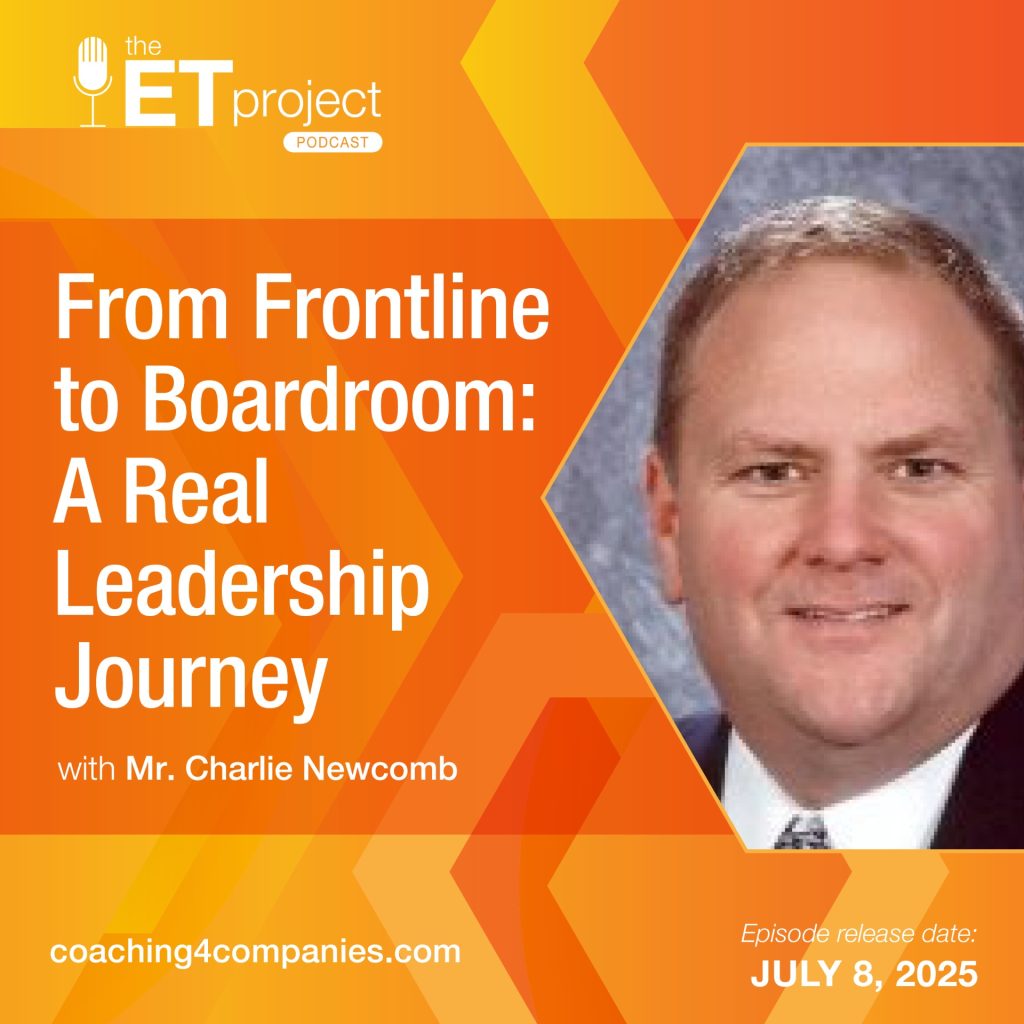
WAYNE BROWN: Hello, I’m your host, Wayne Brown, and welcome to the ET project. We’re delighted to be delivering this podcast for executive talent all over the world whom we’re affectionately referring to as ‘Team ET.’ Today, we’re back in Boston, Massachusetts to chat with our guest leadership guru and recently published best-selling author, Charles Newcomb. Charlie is the Vice President of Global Accounts and has just one client that takes him across the globe, that client, McDonald’s. He has over three decades of leadership experience and specializes in developing talent, P&L management, and creating best-in-class customer experiences that drive sales growth. His approach to leadership emphasizes strong communication, effective conflict resolution, and building exceptional interpersonal relationships. In fact, during our conversation, we dive deep into his number one best-selling book titled ‘Life, Leadership & Success’ as we address the critical skills modern leaders need, including effective communication strategies that build trust and drive accountability, conflict resolution techniques that maintain team harmony, methods for providing constructive feedback that motivate and inspire, change management approaches that empower teams during transitions, as well as the subject of work-life balance solutions for sustainable leadership success. So, team, as you listen to this discussion, you’ll hear us talking about stories and insights from some leadership legends such as Dale Carnegie, Ken Blanchard, Stephen Covey, also personal favorites of mine during my career. So do yourself a favor and stay tuned for this enlightening conversation and open yourself to the insights offered by two true leadership veterans.
INTRO: Welcome to the ET project, a podcast for those executive talents determined to release their true potential and create an impact. Join our veteran coach and mentor, Wayne Brown, as we unpack an exciting future together.
WAYNE BROWN: Hello and welcome team to this week’s episode of the ET project. Today we’re going to dive into our favorite subject on this show, leadership, and we’re going to look at the powerful intersection between private life and professional career with somebody who has lived it at every level. So, please join me as we explore the valuable lessons learned on the frontline from fast food through to corporate and welcome our guest, Charlie Newcomb. Charlie, it’s a delight to have you here with us today.
CHARLIE NEWCOMB: Yes. Thank you, Wayne, for the opportunity. It’s great.
WAYNE BROWN: You’ve recently released a book earlier this year, if I’m correct, called ‘Life, Leadership & Success: Purposeful Life Lessons and Strategies for Managing Teams with Impact’
CHARLIE NEWCOMB: Correct.
WAYNE BROWN: Now we’re going to spend most of our conversation diving into that. We’ll be discussing many of the topics found between the cover of the book. So, before we do that, let’s perhaps jump into a little bit and do a background.
CHARLIE NEWCOMB: My first experience with college, it seemed to be the thing to do back in the late 70s. Okay, you got to go to college, that seemed to be the way of life. And I obliged and thought I would do the right thing. And I decided to take a major in computer science and that was going to be my career, but honestly, I didn’t know a lot about computers. And I realized after one semester that I was kind of spending my money on something I wasn’t sure was going to be a good benefit. So, I decided not to return for the second semester, I returned home and I figured I had to pay my bills somehow and I took a part-time job at McDonald’s while I figured it out. And I eventually did decide to go to school, back to school locally in Portland, Maine, and I was going to be a police officer. And so, I took a part-time job at McDonald’s to start paying the bills. And I tell you, I realized real quick within the first few days that I really liked working at McDonald’s. I liked working around people. And I always believe, I wrote about it in my book that everything happens for a reason. And you see that in a lot of places, a lot of people say it, but I kind of lived it. And I took some of those things as omens to start my career, instead of going into law enforcement I went into the management program at McDonald’s and I loved the customer interaction, I loved working with the team. There are so many great skills that I learned at my job at McDonald’s. And lo and behold, I never expected it to last 33 years.
[00:05:00]
CHARLIE NEWCOMB: I was blessed with some great training, I worked with some great people, I always tried to have somebody in the McDonald’s system, in any job actually, somebody as a mentor that would help bring me along and help me learn the ropes. And here I was as an 18-year-old, not exactly sure what I wanted to do in life. But I realized within that first year of working at McDonald’s that I had a real opportunity to grow my career in McDonald’s and work my way up. So, you know, they paid with a lot of great training. They invested in me, and 33 years later, you know, I’m still learning even in my jobs now. Three jobs since McDonald’s, I’m still learning. And that’s what it’s always about is continuous improvement, always learning, trying to make yourself better. You know, what are you doing today to make tomorrow better? That’s usually my mantra that I live by.
WAYNE BROWN: I know you talk a lot about the difference between managers and leaders, and I’m wondering, were there any early experiences during that period that sort of helped you shape your understanding of that difference?
CHARLIE NEWCOMB: I knew in my time, I felt that I was a natural leader, and I always aspired to do better, to improve upon myself. And a lot of times we think a good crew person or a good associate at a CVS, for example, might make a good manager because they do a good job stocking the shelves. Or in the McDonald’s world, you know, if you were a cashier and waiting on customers, just because you did a good job and were friendly to the customers, people thought you could automatically be a manager. And you find out quickly that people don’t have those leadership traits that you would like them to have. I’ll tell you a little trick that I used one time, I put up a notice in the back room to say to anybody, if you are interested in being a shift manager, please sign up below and, you know, see what happens. And what you find is people signing up that you automatically would think that you dismiss. Oh, Sean, he doesn’t do a very good job as a crew person now, I don’t think he’s going to make a good manager, but just by putting that list up, you get a list of people that are willing to take an initiative to try to do better. So, of those people that signed up, I remember, you know, what can we do to work with a Sean to make him do a better job? And then you find out they actually have some pretty good leadership skills. Maybe they’re a little bit quiet, maybe shy, but they really care about doing a good job. And they help train others sometimes. I mean, there are so many good traits that people have that you never would expect. So, I just remember just by putting a simple signup sheet on the back, by the time clock, you really identified people that maybe had an interest in growing a career. Who knows?
WAYNE BROWN: That’s quite a powerful method of identifying potential leaders of the future. It sounds so simple, but really powerful.
CHARLIE NEWCOMB: It’s not just about food service. You know, we have many transferable skills in our jobs that I remember a couple of people that… you know, I remember one former HR person told me, here I was, I think 45 years old wanting to change careers at McDonald’s. And he said to me that you have so many transferable skills that you may not realize it. And the best time of your career to change jobs is between 40 and 55 because you have the experience and you already know what you’re capable of doing. You have those leadership traits already built in you and companies love the experience and it worked out.
WAYNE BROWN: And to that point, I mean, you’re essentially now working in an industry, which is, if I recall our earlier conversation, it’s a supplier to McDonald’s, what are you doing at the moment?
CHARLIE NEWCOMB: I currently work for Manitowoc Ice. Manitowoc is one of the two globally-approved ice machines for McDonald’s. So, I sell ice machines for McDonald’s and I have one account, McDonald’s only, and I travel the world. So, you know, I’ve been to about 20 different countries in the last three years, it has been a unique experience.
[00:10:00]
WAYNE BROWN: Let’s transfer a little bit into the book. After 33 years of leadership, maybe more now, what was the inspiration? Why write the book?
CHARLIE NEWCOMB: It was something I always wanted to do. I’ve been blessed with some great training, McDonald’s has invested a lot of money. They paid for me to take a One Minute Manager presentation. You know, Ken Blanchard wrote the One Minute Manager. They paid for me to take a seminar from Stephen Covey and a lot of those discussion points for both Stephen Covey’s presentation and Ken Blanchard really struck a chord. And I still live those learnings to today. A good example of that is, you know, Ken Blanchard talked about, you know, he’s famous for the One Minute Manager and always coaching, giving feedback, you know, the One Minute Praise. I kind of came up with a phrase of my own, I call it ‘praise in public, criticize in private.’ It’s kind of one of those things that I live by. People don’t want to hear you criticizing about someone else because then they think, what do you do when they’re not looking? But anyway, Ken Blanchard was really good about giving constant coaching. And at the same time, he talked about goal setting, make sure that they’re realistic. They talk about the smart goals, specific, measurable, attainable, realistic timeframe. And I’m kind of rambling on a little bit, but I’m pretty passionate about this. And a lot of times what you see managers do is they’ll give you their goals. Let’s say they’ll give you your new goals on January 1st, then all of a sudden, your six-month performance review comes up and come the end of June and you haven’t been given any updates on where you are in your goals. And all of a sudden, your boss comes up to you and says, hey, Charlie, I’ve talking to you about, you know, you need to improve profitability or your labor costs on your shifts. And, you know, you kind of get zapped for that because you didn’t meet your goal. If you’re not kind of given this score along the way, how do you know how you’re doing? I remember working with new shift managers and experienced shift managers, I would give them feedback every day that they would run their shifts. So, come the time I did their performance reviews, there was no surprises. My first review that I had at my current job with Manitowoc Ice back, three years ago at this point, but my boss said to me, there’s nothing on your performance review that you will not have heard from me already. And it brought up this whole 20-minute conversation about the One Minute Manager and Ken Blanchard. He was very well familiar with that. And we had a great discussion about it and he’s right, everything we talked about on the performance review, he had already told me about. So, in theory, your performance review should only take you a few minutes. If you’ve already talked about and given updates throughout that six-month period, there should be no surprises. And there are some bosses out there that are afraid to give honest feedback about somebody that might be struggling in a certain area, instead of asking questions about why they may be struggling, they just assume that they are just not doing a good job. You know, people don’t wake up in the morning to fail, they want to do a good job. So, again, constant coaching, constant feedback is such an important discussion point with Ken Blanchard. See, I can talk on and on here, Wayne. Stephen Covey was the ‘Seven Habits of Highly Effective People.’ I mean, I live so many of those principles that he talks about, I’m the first one to ask a question. And sometimes when I ask a question, I’ll say, “I’m asking this question, seeking understanding,” because sometimes you’ve got a new procedure coming up or a new product coming out and I’m trying to ask questions to understand what’s expected. The other thing he talks about is begin with the end in mind, what does a new product look like? What should we expect for sales results? What are some of the barriers that you run into to achieve good results?
WAYNE BROWN: You also talk about Dale Carnegie. So, what was the influence he had on your career?
[00:15:00]
CHARLIE NEWCOMB: Well, I’ll tell you, it sounds silly and I talk about this in my book that remembering names and I’m sure everyone can relate to a time. Let’s say you and I were talking and an old friend of mine came up, we’ll call him Doug, comes up to me and starts talking. Well, here you are, I’m carrying on a conversation with Doug, what I really should be doing is introducing you to Doug, “here’s my colleague, Wayne,” so that you can join in on the conversation and you can feel comfortable with it. And at the same time, another thing that happens is, you talk to different people throughout your career and then it might be two years later, you run into them again. And what Dale Carnegie taught me was it’s okay to say, “hey, I don’t quite remember your name, my name is Charlie.” Don’t assume they remember your name either. And they can talk at ease about that. “Hey, my name is Josh.” And then you kind of reconnect and say how the family and whatever that may be. But I’ll tell you, that was the first class they talked about in Dale Carnegie that really stood out to me. And the other one that stood out to me, I think it was the fourth week of Dale Carnegie, when they tell you to bring in a newspaper and what they want you to do is stand up in front of a group and slam the newspaper down and say, “I hate my job,” or “I am so pissed off at certain people.” And the purpose of that exercise was really to get you to, or how I interpreted it is, how to say what you want without having to slam something down on the table. Because we’ve all had bosses that all of a sudden, they walk into a room, they slam down a book and instantly their audience or their employees just stop talking and they’re like on guard. And again, what it taught me is you can still say you’re upset. And that led me to some great conflict management training. I joke about the time my manager came up to me and said, “Charlie, you have bad breath.” You know, my first reaction was, “thank you so much for telling me.” And what amazed me was how easy he had a job of managing that conflict. Now, it’s a small thing. You know, we’ve all had somebody that has body odor and we’re afraid to say something to them, we think they’re going to be embarrassed. We don’t want to make them feel embarrassed, but they got to know that it’s not right. You know, another good one is like somebody wearing too much perfume. You know, if you’re in a room full of people, sometimes people walk in and they just overpower the room with perfume. It’s a little thing, but I guess the subject is really about conflict and that also goes to home life, that goes to anything, any part of your life is… you know, your kids do something wrong, address it, tell them it’s not acceptable, so they’ll learn, and that’s how we learn is just by addressing conflict, being honest with people, it only hurts for a couple of minutes.
WAYNE BROWN: One of the key skills that you really highlight is effective communication. And I think you’ve already demonstrated a lot of that in this conversation already, that where does communication or miscommunication show up as leadership or as part of your leadership? What are some of the traps that you’ve seen with leaders in their communication style?
CHARLIE NEWCOMB: Yeah, I mean, I’ve seen it, both opposite spectrums, so, you’ve got the folks that are really good about communicating, you know, communicating expectations. And I always try to think about if I’m in their position, what do I want my people to know? And I have to write those things down because a lot of time that we assume, that’s the other part of ineffective communication, we assume that they know what they’re doing. And we also want to encourage questions. A lot of times in an environment, a group setting, there are people afraid to ask questions and sometimes you kind of got to fish that out and sometimes if an effective communicator doesn’t communicate it, they just remain silent, you know, and that was a great skill and facilitation training that I went through is, you know, ask a question and then just be silent. When you first do that, it is so awkward. You just want to say something, but if you can just resist the urge to say something, eventually somebody is going to say something to break that ice.
[00:20:00]
CHARLIE NEWCOMB: And so, communication is good, but there are so many different facets with it, you know, you got to be a good listener. And a lot of times, Steven Covey talks about this, a lot of times people listen to respond and you see it happen so much, if I’m talking about something, about a plan of action and somebody is watching me and listening to me and all of a sudden, they turn around and say, “well, I think we should do this.” Well, they didn’t even acknowledge what I had said, they just kind of were listening to what I had to say to spew out their own ideas, what they think we should do. So, communication takes so many different avenues. And sometimes, there are quiet communicators. I always started expecting people to talk above everyone else as a communicator and I quickly learned that someone can be an effective communicator, you just may not hear them doing that all the time, they could be quietly training somebody, they’re just not talking loud in a store or in the environment that they’re at. So, like I said, communication takes so many different forms of little winding, routes, turns in the road.
WAYNE BROWN: Yeah, for sure. And as you point out, it’s such a broad topic and there are so many individual components to it. One of the things I’ve noticed myself in my own career, Charlie, is communication, authenticity, all of these are factors that help build that trust. I’m wondering your experience in how the leaders go about building trust, it’s such an essential communication, authenticity, all of these things we’ve spoken about, is there any methodology that you try and incorporate as a leader to establish trust?
CHARLIE NEWCOMB: I’ll tell you, trust is so tricky. I have always, and I write about this in my book, that trust is… when we first talk or anybody I first meet, they have my ultimate trust, I trust what they say, hopefully they trust what I say. But then if you find out that what they tell you is different than they tell somebody else, then they shoot… you know, trust can be shot down in a moment’s notice. And to build that back up takes so much time to learn to trust them again. And, you know, keeping your promises. If you promise to try to help somebody get a pay raise, or if you try to trust them to maybe get an extra vacation day and you don’t do anything about it, if you make a commitment to promise that you’ll do something and you don’t come through on that promise, how are they going to believe you the next time you say something? And I wrote an example in my book that talks about trust being shot down immediately, I was with one of the superiors traveling different restaurants in my McDonald’s days, and all of a sudden, he went to listen to his voicemail on speaker, so that’s a mistake right there, a leader should not be letting me listen to his voicemails. But the next thing is there was a voicemail from my direct boss saying, “Charlie needs to do a better job with the organization and I’m kind of disappointed at this,” and my trust with my boss just went down to as low as it could be because he never had told that to me. If I had heard that from him before, it wouldn’t have been a big deal and I’d say to the person I’m with, “hey, Bob, he’s absolutely right, this is what we’ve talked about, this is what I’m working on and this is how I’m trying to correct that situation with this organization.” But instead, my trust for him was shot down and what else is he saying about me to other people? And I’ll tell you, I learned so much from that one example that I never say anything to a boss unless my person that reports to me has heard it from me already. And, you know, that should be a cardinal rule, but… so, that’s a great example that I talk about in, you know, the trust in my book; it’s so easy to shoot it down in no time, it just takes so long to build it back up.
[00:25:00]
WAYNE BROWN: Closely aligned with conflict is the feedback. So, constructive feedback is something that we’ve probably all engaged in at times, particularly as leaders, our audience, predominantly leaders, how do you approach giving somebody that constructive feedback? You’ve already touched on, you know, you do it regularly, but is there a way that you found works better than other ways when you have to give, maybe not positive feedback, but areas where somebody is challenged, they need support, they need to change something?
CHARLIE NEWCOMB: Yeah. I would tell you the first thing that people do, it’s so natural, what a boss will say to you, you’ll go sit down and talk and they may say something like, “Charlie, you did a really good job handling this customer today, but you really got to do a better job doing X, Y, and Z.” And then that X, Y, and Z becomes a 10-minute conversation. So, they feel that they need to sugarcoat, butter you up by giving you a quick 15-second, 10-second compliment and then you say, “but…” and that’s the other word I mentioned in my book is you don’t need the word, ‘but,’ and you don’t even need to sugarcoat with a compliment. Let’s talk about how I think you could do a better job during a situation and kind of do a role play. Again, about also being honest, specific examples, don’t say, “I don’t like your attitude.” Attitude to you and attitude to Henry down the street are two different meanings, two didn’t mean two different things. So, what is it specifically that you felt was my attitude? Was it how I spoke to customers? Was it how I talked to a fellow employee? You know, what specifically did you say that you thought I have a bad attitude? And so, the feedback can’t be diluted. You have a terrible personality, well, what specifically on my personality don’t you like? So, that’s what I say about feedback is one, you don’t have to always… people always feel they have to give you this compliment. And then what you get, you get this reputation and you’re sitting there. Okay, here he is. I’m listening to the compliment, but you really don’t… that isn’t what you want to talk about, you want to talk about the opportunities, just let’s get it over with. So, I don’t even hear what you say for the positives.
WAYNE BROWN: For sure.
CHARLIE NEWCOMB: And sometimes just leave it alone as a positive. “Hey, great job today. I liked how you handled the customer. I liked how you handled…” You know, handling that customer complaint and leave it at that.
WAYNE BROWN: And back to the Blanchard methodology, the One Minute Manager, you can address these issues so quickly on the spot, while it’s still relevant to the situation, you can do it in a way that nobody is really hurt by it. They learn and they grow from it. Right?
CHARLIE NEWCOMB: Yeah, I think Ken Blanchard calls that the ‘One Minute Praise.’ So, if you have an associate who wants to work on customer interaction or handling a complaint and all of a sudden, they get a complaint, compliment them right then and there. “Hey, you handled that perfectly.” So that person, that associate feels good about himself that, you know, one, he listened to you, so you feel good about the fact he listened to you. And two, he feels good about it and he continues to set that example and repeat the good things.
WAYNE BROWN: So, we’ve touched on a number of topics already, right? So, we’re going quickly through it and you cover these in more detail in the book, of course. Another area is around change. It’s one of the biggest challenges that we see in our business world today and likely to remain one of the biggest challenges going forward, given everything that’s happening.
CHARLIE NEWCOMB: Yes.
WAYNE BROWN: What’s your message around managing the change process, working with the team, how do you deal with it?
CHARLIE NEWCOMB: You know, my motto is, I’m just trying to think of a quick saying that came to the top of my mind at one point in time, but there are certain things that are certain in life and I can’t remember all of them, but one is change, especially in the work environment, procedures are constantly changing, systems and routines are constantly changing.
[00:30:00]
CHARLIE NEWCOMB: And you think about our daily life, as you go through life, you change how you handle modern technology. And I’ll give you a good example, years ago, 15 years ago, I worked out of a manual calendar. I carried a 12-month calendar of the year and I would open up to certain days and say, “okay, we can do this on this day, we can go visit a restaurant or we can talk about performance reviews on this day.”
WAYNE BROWN: Right
CHARLIE NEWCOMB: And when they came out with an electronic calendar, I resisted that. But at the same time, now I should say, now I can’t imagine going back to that old calendar because I finally evolved. And so, my message is always, you’ve got to recognize that change is always going to be a constant in your life and you’ve got to adapt to change. And, you know, look at the electronics in a car, you know, or smart TV at your home, so much more streaming. You know, there are so many people that have cable TV that don’t want to change to go to streaming service, but they can save a boatload of money by doing that. You know, so it’s in our life, social media’s change, it affects our moods and companies are always changing, ownership takes over a certain company, they have a change in procedures. And I tell people, absorb that, think about it, don’t make irrational decisions, recognize that you’re going through some change, recognize that a week from now, you’re going to feel better about that. And for me, what I say is once I get a good night’s sleep, I can digest some of this change overnight on my own, and then I’m ready to conquer it the next day. So, like I said, change is a constant and we have to change, we always have to change our way in order to really survive, that sounds so crazy, but I really survived a job change, I went through my first, leaving McDonald’s after 33 years, that was a big change, and I remember walking out on my last day of work out of the office and you’re questioning yourself, “am I doing the right thing?” And you know deep inside your heart that at that time I was doing the right thing. So, you know, instincts can take over and help you manage change, if you know in your heart that it’s the right thing to do, and people’s struggle with change and sometimes resistant to change and they don’t survive, it’s hard.
WAYNE BROWN: Being a Stephen Covey fan, I’m sure, this quote, and it’s probably the one you were thinking of, the only constant is change.
CHARLIE NEWCOMB: Yes, thank you. That’s right. Yeah.
WAYNE BROWN: The whole premise of change often perplexes me. I mean, as you’ve mentioned, we experience change almost every day of our life. It seems to be more challenging for people in the workplace than it is in their personal life, mainly because they have more control, I guess they feel at least they have more control from a personal perspective in their own life than they do within the workforce. How do you nurture a team when you’re introducing some change initiatives? Like, how do you bring them along on the journey so that they’re not those who are fearful, they’re not the ones who are resisting? Do you have any experience yourself that comes to mind?
CHARLIE NEWCOMB: Yeah. I would tell you, the first thing that I always do is, again, I go back to Stephen Covey, he talks about beginning with the end in mind and creating a vision as to what that change is going to look like. Also acknowledging to the group that this is a paradigm shift that, you know, I need your support, I need you to manage this change. And immediately they’re thinking, “okay, I’m with you. I’m going to help you.” You know, because you need them on your side and you also acknowledge that it’s going to be difficult. And you also make sure you know that they’re not going to do it the next day, it’s a gradual change. And a lot of times where I think managers fail is they want you to go from A to Z overnight and you need to go through the rest of the alphabet first, it’s baby steps. And recognizing and acknowledging when somebody is trying to make that change, it’s hard to do. It’s hard to sometimes manage that, but where managers fail is not understanding the feelings that their subordinates are going through.
[00:35:00]
CHARLIE NEWCOMB: So, they need to acknowledge that change, that they’re having a tough time with it and try to help them through that. And continually talk about it and eventually it becomes a habit. Stephen Covey talks about it takes 21 days to change a habit, it’s so true, I go back to my electronic calendar, it took me probably about a month to get used to it, but it becomes a way of life. Once you accept it, it’s much easier. And then you always see people realize, “Hey, you were right, to go through that, we’re better for this. We’re better as a result.” And sometimes you see it like setting a goal. You know, a lot of times you have a good year and then you set a goal for next year and you think, “Oh my God, I just did a 15% increase, you want me to do another 10% sales increase? That’s impossible.” You know, and so their immediate reaction is, “fight, fight, fight, let’s resist that, let’s resist that. I can’t do that. I can’t do that.” But again, you create that vision of what that’s going to look like. How are you going to feel if you can achieve another 10% sales increase on top of what you just did, you know? And yeah, so change is always happening, always changing.
WAYNE BROWN: Is there one lesson or a concept from the book that you wish every leader could hear or learn and adopt?
CHARLIE NEWCOMB: You know, there’s a couple of things that come to mind, the biggest thing I always talk about is constantly coaching, constantly giving feedback and be honest about that feedback. And the other part of that I always… I’ll tell you, I love quotes in my book and the best quote that I love, I’ve experienced it many times is, you know, I was recently faced with it in my job where my, where both of my immediate bosses left their job and went on to new careers, different jobs. And first reaction was, “oh, that’s hard, how can I continue on with that?” And the quote that we talk about is from Julia Roberts, and she says, “when people walk away from you, let them go, your destiny is never tied to anyone who leaves you, and it doesn’t mean they are bad people, it just means their part in your story is over.” You know, when I took my job, my current job at Manitowoc Ice, I love the job, I love the product, I love the people that I work with and my bosses were bonus. And all of a sudden within a month of each other, they both left. And I realized that I took this job for the company and the brand and what it represented and that their leaving wasn’t going to control my destiny. So, I took a lot of solace in that and it made their departure a lot easier. And I try to tell that to other people, because there are a lot of other people in that same position as me, that it’s okay. You know, it’s a change and I’m going to be better as a result, and I’m going to work harder as a result. And I wasn’t successful because of them, I was successful because of who I am.
WAYNE BROWN: One thing that stands out to me, Charlie, having, come to this point in the communication or the conversation is that you appear to be a very genuine, authentic individual, and I’m sure this comes to your leadership. It definitely aligns with what I read in your book, so, I’d really encourage our listeners to go out there and get a copy of the book. Where can people go to get a copy?
CHARLIE NEWCOMB: Sure. The easiest way is amazon.com. It’s now a Amazon Bestseller, which is great news. I also understand it has been released to other outlets, Barnes and Noble, Walmart, et cetera, but it’s ‘Life, Leadership & Success.’ And excuse all my little tabs that I got different… I marked a lot of my quotes to refer to, but I’m really proud of the results so far. Sales have been very strong. And I always feel like I have to constantly teach and constantly set the example and I use that with my family and my girls, that they’re watching, as parents, your children watch how you react.
[00:40:00]
CHARLIE NEWCOMB: And there are so many life lessons that I talk about in my book as well, that shaped who I am as a parent too.
WAYNE BROWN: Where can people connect with you if they want to discuss different stories, different things, or what has it been like to be a parent?
CHARLIE NEWCOMB: Sure. I was just going to add that, you can connect with me on LinkedIn @Charlie Newcomb, and then my email is charlienewcomb@comcast.net. I’d be glad to talk to anybody. I’m looking to make public speaking a part of my routine as well. So, I’m looking for a group of, Home Depot managers potentially or anybody that manages people. And it’s not just about… the corporate world is about life too, life experiences.
WAYNE BROWN: Well, definitely great connecting Charlie, I really enjoyed our conversation. Thanks for being on the ET project.
CHARLIE NEWCOMB: Yes, I appreciate you having me.
OUTRO: Thank you for joining us on the ET project, a show for executive talent development, until next time, check out our site for free videos, eBooks, webinars, and blogs at ‘coaching4companies.com.’
[END OF TRANSCRIPT]