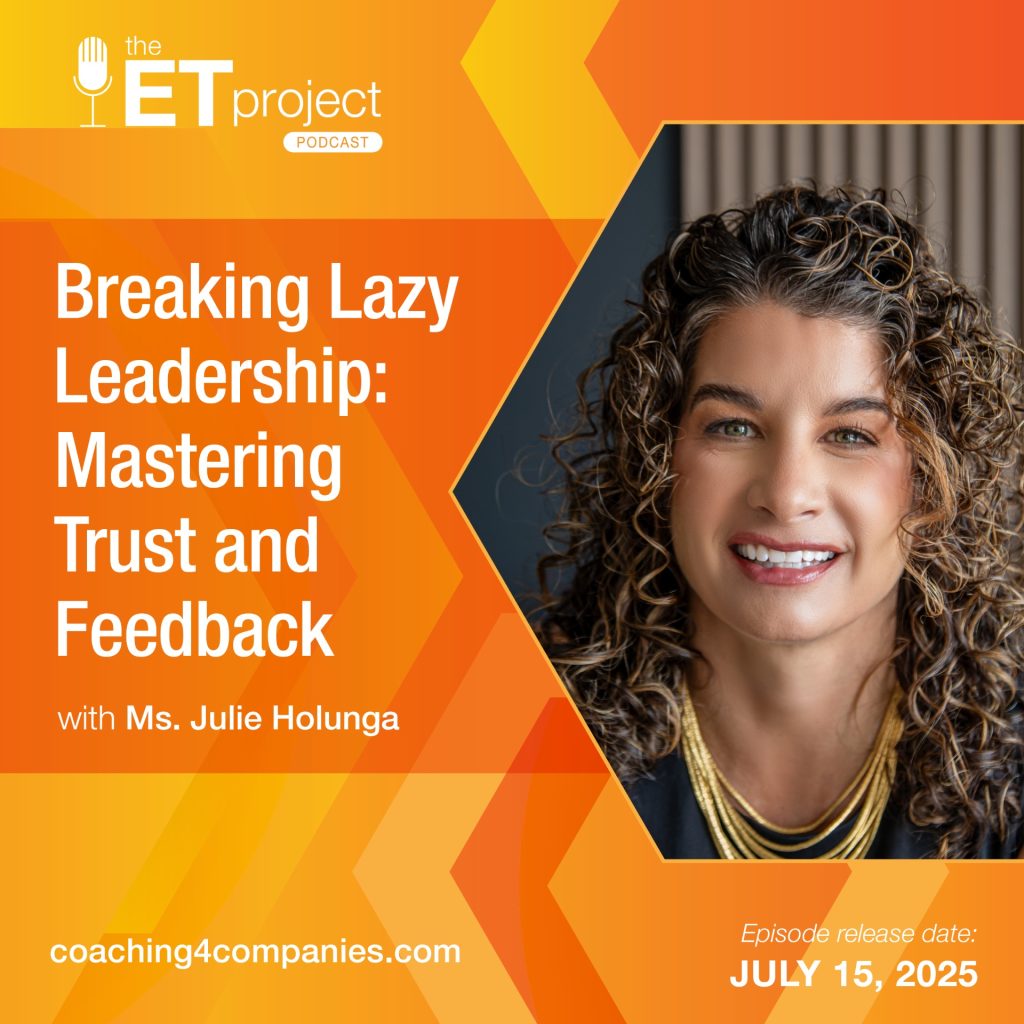
WAYNE BROWN: Hello, I’m your host Wayne Brown and welcome to the ET project. We’re delighted to be delivering this podcast for executive talent all over the world whom we’re affectionately referring to as ‘Team ET.’ Today we’re in Denver, Colorado and chatting with Julie Holunga, founder of Chinook Executive Solutions. Julie is a leadership trainer and executive coach, developing professionals to amplify their influence and impact. She works with attorneys, CPAs and business leaders with an expertise in the careers of female professionals. You’ll hear Julie and I discussing how she assists her clients excel in their careers with her proven communication strategies, how to hone their leadership skills, build increased visibility and heightened confidence. Julie works with highly driven teams to instill ‘The Trusted Voice Paradigm’ and develop collaborative patterns that deliver value. Through these programs, leaders learn to get out of their own way, develop trusting relationships with key stakeholders and have a positive impact on the organization’s bottom line. Prior to her starting her own consulting practice, Julie served as a project manager for Alumni Career Services at Harvard Business School where she focused on advancing careers for female alumni. She worked with Fortune 500 companies to retain and advance women into positions of leadership. Another subject you’ll hear us dive into is Emergenetics. Julie is one of 30 global master trainers for this assessment platform and coaches leaders and teams and global organizations to align their communications for positive impact. Julie gave her first TEDx talk in 2020 titled ‘Don’t Let Your Words Sabotage Your Career.’ She’s a contributing author to the leadership book for women called ‘On The Rise’ and also spent seven years living and attending school in France, India and Hong Kong. So, as you might imagine, we also touch on the influence this experience has had on her career. It’s a delightful and extremely impactful conversation ahead, which I know you’re going to enjoy.
INTRO: Welcome to the ET project, a podcast for those executive talents determined to release their true potential and create an impact. Join our veteran coach and mentor, Wayne Brown, as we unpack an exciting future together.
WAYNE BROWN: Hello team. I’m sure you’re all aware that we’re in a time where a single misstep in communication can damage not only relationships, but it also has the ability to disrupt even the most stable environment. We’re building trust through clear, concise communication has never been more essential. On today’s episode, we’re going to explore how leaders can foster this trust through clarity, courage, and conviction in communication. And joining us is Julie Holunga, a leadership expert and founder of Chinook Executive Solutions, I hope I got that right, Julie.
JULIE HOLUNGA: Yes
WAYNE BROWN: We’ll be discussing how professionals can develop their trusted voice as well as navigate conflict and even build cultures of alignment and accountability. So, Julie, welcome to the ET project, I’m really excited to dive into how better communication builds stronger trust. And I know you talk a lot about this, so I’m looking forward to our conversation.
JULIE HOLUNGA: Thank you, Wayne. I’m excited to be here.
WAYNE BROWN: To start with a little bit of a back journey and your backstory. One thing that jumped out to me, because I traveled a lot during my career, but I noticed that you’ve studied abroad, France, India, Hong Kong, all places that I’ve been to as well. So, what was the experience to you?
JULIE HOLUNGA: Well, I was quite young, so it wasn’t by choice. But as we talk as a family, we talk about what an unbelievable experience it was and sometimes unaware in the moment how great it was. But in looking back, then you say, “oh, wow, that really…” and it did, it really shaped me, who I am, my curiosity in people and different cultures, whether we’re talking about nationalities, different countries, but also cultures within teams and organizations. And it is amazing, the memories I have from those seven years of living overseas are clear as day. And yeah, and really, I love talking about it, but was given very poor advice from a school counselor that when we were returning to the United States, to our home country, that no one was interested and don’t talk about it. And that stuck with me for probably 30, 35 years until I realized, oh, this is something people are interested in and it’s unique and it’s different.
[00:05:00]
WAYNE BROWN: Sure
JULIE HOLUNGA: And how can I share these stories that are both funny, but so different than growing up that most of my friends and family had the opportunity to experience.
WAYNE BROWN: Interesting advice. We have a large audience in India, so I’m guessing they’re probably wondering where in India you were at the time.
JULIE HOLUNGA: Yeah, so we lived in New Delhi on Panchsheel Marg, right near the American Embassy and the International School. And we were actually there when Indira Gandhi was assassinated. So that was a fascinating, scary time. And I remember my mom growing up always saying that she remembered very clearly where she was when JFK, John Kennedy, was assassinated. And I now remember very clearly where I was at school, how I learned that this has happened, what happened at the school. We were all brought into the gym that didn’t have windows and we saw the Marines as we were entering into the gym, but then we were told that the Marines were also on top of the building, that they didn’t know, they were nervous, I guess, what else was going to happen and all the things that then did happen following that. At the time, my parents were in Nepal. My dad had a business trip and my mom went with him and they couldn’t get back to New Delhi. At the time, pre-cellphones, as a parent now, I imagine that a very stressful time for them, we were all safe and fine, but a very uneasy time for the people and the country as a whole, it was unbelievable, to say the least.
WAYNE BROWN: How much do you think that experience or those different memories had any influence on your leadership and your career?
JULIE HOLUNGA: Yeah, 100%. I mean, I really think about the curiosity I have in people and to understand what got them where they are today. I mean, mostly it’s professional because that’s my role and that’s what I do. I really like to understand how people made a decision, whether there was a fork in the road and how they decided or how they got on their career path and the choices that they made and what they said yes to and what they said no to. I also find that I am far more open-minded because of those experiences, where I was the odd man out, especially in India and Hong Kong, that I stood out in so many ways, I didn’t speak the language, my skin was a different color, I dressed differently. Because of that, it doesn’t make me less off or less able to contribute in some way. So being able to have that perspective and understand where people are coming from really helps. I had a client for years and they had operations all over the world, including France, India, and China. You know, just the ability to say, I get it, I understand, I know, you don’t need to explain all those things to me, I understand culturally what that looks like. So, it really has shaped me. And as I said earlier, at the time, I didn’t understand how it was so different and unique in a really good way, I just saw that I wasn’t getting certain foods, like I really wanted Lucky Charms, well, you couldn’t get Lucky Charms anywhere that we lived for seven years. But now being able to reflect back and see things a little differently, I think makes my journey through life just that more interesting and to have that curiosity, and certainly now I’m in a place in life where I can travel quite a bit. I have not been back to India; I would love to go. And at the same time, I remember a certain way and I don’t know if I want to see it. I mean, obviously, it has grown since I was there in the 80s. But that’s always something that I really enjoy revisiting. And I think a lot about bringing my family and being able to show them, this is where I went to school, this is where we lived, this is the playground I went to, these are the shops that we got our meals, this was my favorite restaurant. That’s very exciting for me to have that opportunity and hopefully that will come about one of these days soon.
[00:10:00]
WAYNE BROWN: I read somewhere that you said you’re on a mission and you want to rid the world of lazy leadership. So, what does that mean? Lazy leadership.
JULIE HOLUNGA: Well, lazy leaders… so, I think we’ve all had moments where we have practiced lazy leadership and typically, where I see it happen is when people are stressed, when they are overworked or overwhelmed in some way, when there’s a lot of pressure on them and they tend to be reactive. And when I’m in a room full of people, I always ask them certain questions. And there’s always a couple of people who don’t raise their hands when I say like, have you ever been stressed? Have you ever behaved reactively? And I always say, thank you for your honesty and everyone else. It’s okay, I know you’re lying, but it’s okay, we’ll let it pass for now. Because we’ve all been in these situations, right? Whether it’s at work, whether it’s with family. When our kids were teenagers, I had examples coming out of my ears of all the times that I was reactive because my family knew which buttons to push that would set me off. I like to say it wasn’t intentional, but. So, when I think about lazy leadership, for instance, it’s not giving someone feedback that they need to hear because it’s uncomfortable for you, right? I don’t want to tell Wayne that he’s underperforming or that email he sent was not accurate or that he isn’t meeting expectations because it’s uncomfortable for me; that’s lazy leadership. And when I look at the flip side, which is deliberate leadership, is taking the time and the effort and slowing down for even a second to say, Wayne needs to hear this feedback and it’s going to help him grow. And it’s going to make my life easier, by the way. If people can think that way, then they are able to be proactive instead of reactive. And it really does help. I have people telling me all the time, oh, I thought this was going to be so much harder than it actually was.
WAYNE BROWN: On the topic of feedback, probably you and I grew up in a period where we were told to sugarcoat it on both sides.
JULIE HOLUNGA: Exactly.
WAYNE BROWN: Lead with something positive, finish with something positive, and give the constructive feedback in the middle. How do you address that in today’s world? Do you advise differently to that?
JULIE HOLUNGA: Yes, of course, don’t do it. I actually have a great example of all the different kinds of cookies that are bad examples of giving feedback. Because what happens is that if I tell you, you did such a good job dealing with that difficult client, I really appreciate how you did that. But you undermined the firm, or you undermined me. But you know what? You’re great. As the recipient, I don’t know what to do with that. I don’t know, wait, am I good? Am I bad? Am I…? Right? And there is no clarity on what needs to happen instead. So, what do I need to change? And that’s what happens in that compliment sandwich, feedback sandwich, that people don’t know what to do with it. I even hear from people, I say, well, what kind of feedback have you gotten? Oh, I keep being told I’m doing a great job, keep doing what I’m doing. And then that person isn’t being promoted, or they’re not getting placed on the exciting projects, or they’re not getting placed in the complex engagements. What’s going on? What’s the disconnect? And often it’s because if I tell you you’re doing a great job, keep doing what you’re doing, you’re going to keep doing what you’re doing A, B and C. But what I think you’re doing great at is X, Y and Z. And if I’m not clear giving you that feedback, you don’t know what to continue doing well and that’s where that miscommunication, that communication gap happens because we make an assumption when… our brain wants to fill in the blanks, right? So, when I hear a good job, I think, oh, I did a good job. Everything I did was great, I’m going to keep doing it. But in fact, maybe I didn’t consider something that someone else thought was good.
WAYNE BROWN: There’s also a regularity aspect there in how frequent you give that feedback. It’s not just about the twice a year performance review…
JULIE HOLUNGA: Exactly.
WAYNE BROWN: On a regular basis I’m guessing.
[00:15:00]
JULIE HOLUNGA: Exactly. And I find… but that’s also a balance too. I had a client years ago and the team, they went from one extreme of not giving feedback to the other extreme of giving a lot of feedback. And it got to the point that people stopped listening because it felt disingenuous. Like, oh, I just have to give feedback after every single meeting, after every single email, after every single, and they stopped listening to it. So, they stopped hearing that constructive input that would allow them to do better. So, it’s finding this middle ground. I work with a lot of professional services firms. So, sort of a blanket rule to go by is at the end of any engagement or the end of any case or project to sit down the whole team and talk about what could have gone better, what did we do really well, and what’s something we could do even better. When there’s this natural inflection point of the end or the conclusion of something, evaluate it. We do that for a lot of things, but not enough. Because what I always tell people is in a performance review, you should leave thinking to yourself, oh yeah, I knew all of that. If there’s something new that comes in a performance review, that’s not the best scenario.
WAYNE BROWN: As you mentioned, part of the reason for the reluctance to have these, let’s say constructive conversations at best, is that conflict aspect. And I know you talk a lot about the positive aspects of having the right type of conflict, can you speak a little bit to that as well if you don’t mind?
JULIE HOLUNGA: Yeah. So, I look at conflict as… there’s two types, I mean, there’s way more than that. But if we simplify it down to two types, we either have destructive conflict, which it may be avoidance, it may be a delayed response. You know, three months ago, Wayne, you said this, and I’m still carrying it with me, right? This destructive conflict that can become alienating or polarizing in the sense that you lose clients, you lose employees, you lose relationships of some kind. On the other hand, we have constructive conflict, and that’s the kind of conflict where perhaps you and I are brainstorming a solution to a problem, and we disagree or we’re coming at it from different perspectives. But we’re invested in solving this problem. And even if I don’t like you very much, I trust that you have a good perspective on things, and I’m going to listen to what you have to say. And I’m going to take the personal aspect out and really focus on, okay, we both want to solve this problem, so I’m not going to avoid this, I’m not going to hold back, but I’m going to push maybe, and I’m going to ask a lot of questions. So, I always try to simplify things without being simplistic so that people actually take action on it. So, what I always say to people, when you find yourself in that moment, oh, I think there’s a misunderstanding going on, or I think we have a difference of opinion. Okay, I’m in a moment of conflict, and it can escalate or it can de-escalate, my choice. So, I’m going to take the destructive path, it will escalate or I’m going to take the constructive path, and it will de-escalate.
WAYNE BROWN: And I guess that’s the whole premise of psychological safety, having that environment as well, right? Is you build that environment where people have that confidence to be able to have those disagreements and grow as a result, right?
JULIE HOLUNGA: Exactly.
WAYNE BROWN: So, you have the same beneficial outcome and people are prepared to speak up and have a voice. You have a, I don’t know if you call it a model or a method called ‘The Trusted Voice Paradigm,’ and it has got four levels, and I’ve been reading through it a lot, and I’m quite fascinated by it. So, I wonder if you could, we’ll start with the high level, and then we might go a little bit deeper into each of the four levels, but could you introduce the paradigm overall, if you don’t mind, please?
JULIE HOLUNGA: Sure. So, the trusted voice paradigm is essentially looking at trust in all aspects of starting with the people, your talent, then we look at leaders, and then we look at teams, and then we look at the organization or the firm as a whole. And this is a dynamic, you know, I look at it as a wheel, right? It’s constantly shifting, and you’re constantly having to think about how do I build trust in my people? How do I build trust in the leaders? How do I build trust in my teams, and how do I build trust in the organization as a whole?
[00:20:00]
JULIE HOLUNGA: And when we look at it holistically like this, then people are better able to understand this is not just a one and done. Okay, I’ve built trust with my customers, so they’re always going to buy from me, right? And that’s the trust in the organization. No, because you make one mistake, like airlines is a great example of this; I trust you, XYZ airline, until you screw me over, excuse me. Like, my flight is delayed, and you don’t pay for my hotel, and you don’t book me, and you’re nasty, whatever, then you lose trust in the organization and the company as a whole. The other three are more internal, right? So, trust in the talent, that’s I hire you, and I trust that you can do what the job requires. And then leaders is I as an employee, I trust my leadership, and people trust me as a leader. And then we think about teams, it’s oftentimes people come to me and say, it’s within the team, but trust is also across teams. And that’s the piece that I often see is gets let go or isn’t focused on. And I see it a lot, especially with engineers or product developers. And then you have the engineering department, you have the product department, you have the sales team, you have a business development people that are also working in, and if they don’t have that trust, one is promising something, like the sales team is promising something to a client that the engineering and product team can’t deliver on, and that breaks trust. And if we think about this as this constantly evolving wheel with trust being that middle spoke, and we constantly feed it. So, I think of it as a plant. You water your plant, you feed it, and it flowers. Well, then you don’t stop watering it just because it flowered. So, it’s that idea. And I help people think through that when trust is broken, it may be from one pillar. I have four pillars that I look at with trust. So it may be that when you missed a deadline, let’s say, and because of that, I don’t trust you anymore. And when we sit down and I explain this and talk this through with people and we start peeling back that onion, and I kind of guide them in a certain way around the conversation, oftentimes people realize, well, you know what? I don’t trust Wayne because of dependability, right? He’s not delivering on time. But I know that he generally cares about this project. And I know that he typically does what he says he’s going to do when he says he’s going to do it. So, what’s going on that this one… what happened here? So, the pillars are humanity that they generally care about this project. It’s authenticity, I do as I say, and I say as I do, right? So, I’m not talking out both sides of my mouth telling you one thing and telling someone else another thing. The dependability is I’ll do what I say I’m going to do when I’m going to do it. And then the fourth piece that often people forget about is this aptitude. Do I have the skills, the resources, the knowledge to complete what I’ve committed to? And oftentimes there may be one or two of those pillars where trust has been broken. And when we can flip the switch in our minds and say, but I actually trust Wayne because I know he cares about this and I know he has the skills and the resources to do this. All of a sudden, it’s a very different conversation that again deescalates that conflict. So, you can approach the conversation and if I’m saying like, Wayne, I’m surprised that this was late. This is not like you. I know that you care about this project. I know you have the knowledge and expertise and experience to complete this. What’s going on? Why did you miss the deadline? And I want to trust you. I want us to have a trusting relationship. But when you miss a deadline, it makes me trust you less. And all of a sudden then to your point about the psychological safety, people feel comfortable to say like this literally just happened and it’s not funny, but this came out with a client. There’s all this conflict and it’s escalating and one wanted to leave.
[00:25:00]
JULIE HOLUNGA: And what came out when we were able to really peel back the onion was that the individual has a neighbor who had been diagnosed with cancer and the individual was taking her to her radiation treatments or chemo, one of the two, every morning. And he was feeling sad, he was feeling distracted, he was not producing the same way because of that, he didn’t want to share because he didn’t want pity, he didn’t want anyone to feel bad for him or sorry for him. And he also said like, I was doing this because I care about my neighbor and I wanted to help her out. And I didn’t want anyone to think differently of me. And when he said that to me, I said, but people are going to think differently of you because this is a wonderful thing that you’re doing. But he didn’t, for whatever reason, he didn’t think that way. And once that was shared, it was amazing how many people said, okay, I got your back. I’m going to do this piece, if you could do this, I’m going to do this over here and I can help you… like he actually had someone junior on his team say to him, I’m going to make sure that I know all the pieces of the project to make sure that we meet this deadline. And he shared with me privately, I had no idea that people would do that, which kind of blew me away. Right? So, there was so much trust in him that he didn’t feel for whatever reason, he doesn’t know why, we’re still working through that part, but it was amazing how many people stepped up and said, I’m willing to help, I trust you. This was odd behavior, I mean, it wasn’t just one project, it was over time.
WAYNE BROWN: Yeah. So as a coach I’m coming along, and I want to start to leverage this great model, how would I work with a client from a beginning point of view, if you could just take me through the process to give me a little bit of clarity on how I might bring it to the table?
JULIE HOLUNGA: Right. So, I typically, starting with a client, I will walk them through some questions that are really trying to, on the one hand, uncover what’s going on, but also make people feel safe to share whatever it is that is going on, that there’s no judgment, there’s no wrong answer, but also help them think why is there a trust here, but not here. And so, we walk through, and it starts with, tell me about your team, that’s always… and usually I get some pretty superficial answers like, “oh, you know, we’re like family.” I get that all the time. And that to me is a good thing. And it’s like family. So, there’s some ugliness, there’s some sweeping under the rug. So that’s always, to me, a little bit of a red flag. And I say like a tiny red flag because that’s room to start questioning. Okay, tell me, like, what is it? Why is it like a family? Oh, you know, we really trust each other and we want us all to succeed and I’ve got her back and she has got mine. Oh, great. So, what happens when you disagree? And then all of a sudden, we start going down this path of being able to see where trust exists and where it doesn’t and my goal is always like, if it exists over here, like there’s a lot of trust in your talent. As individuals, there’s a lot of trust. But as a team, I don’t know if they really have my back, you know, and they want to do like, I hear this all the time, like the sales team just wants to make their numbers, I don’t trust that they really have my insights in mind. Or people say, oh, well, you can’t say anything in front of HR because they’re just going to report us.
WAYNE BROWN: It’s going to get recorded and reported, yes.
JULIE HOLUNGA: Right, exactly. And so, being able to understand where it exists so that we can replicate and we can say, okay, what’s going on that it’s working here and how do we transfer that? And what do you need, leader, to have trust in HR, to have trust in the sales team or in engineering or whatever, you know, the group is. What is missing for you? And we’re able to uncover both the opportunities and the strengths like where it’s a really strong rooted trust. We still got to water it, we still got to fuel it. But how do we take what’s working well and transfer that over? So, I firmly believe in the positive psychology aspects, right?
[00:30:00]
JULIE HOLUNGA: Like, not looking at what’s not working, not looking at weaknesses, but instead looking at strengths to then be able to transfer over into places or situations or circumstances that aren’t working as well, because I find that then the change sticks.
WAYNE BROWN: Right. It sounds like there’s a lot of traits or a lot of elements heavily focused around the ability to communicate effectively.
JULIE HOLUNGA: Yeah.
WAYNE BROWN: And of course, communication is such a broad topic. I know you have a training or a learning in Emergenetics.
JULIE HOLUNGA: Yes.
WAYNE BROWN: Probably a term that not many people have heard of, certainly myself, and I’m coming up to 50 years in the world of business and I’ve never heard of this methodology before. So, I’m really fascinated by this as well, but it’s neuroscience-based, I believe and it’s a profile system.
JULIE HOLUNGA: Yes, yes. It’s really a communications assessment to understand for professionals, for people on how they prefer to communicate. And one of the reasons that I really delved deeply into this tool and became a master trainer with them is because, one, it doesn’t stereotype, there’s no bad profile, there’s no ideal profile. And it separates how we behave with how we think, because a lot of tools… there are a lot of amazing assessments out there. A lot of them combine the two. And what I mean by that is, oh, you are right-brained, so therefore you must be an extrovert; not always the case. You’re left-brained, therefore you must be an introvert; not always the case. And so, helping people, the assessment, it’s 100 questions, it goes by pretty quickly. To take the assessment, it takes about 20 minutes and people come away with understanding this is who I am, which is great. But the tool is so powerful because within a team, it helps people understand, oh, this is why Wayne asks all the why questions. He has an analytical brain, he’s trying to understand the ROI, he wants to know the research, it better be, you know, from a solid organization who… he doesn’t want to hear, “research says…” He wants to know the American Heart Association research shows X, Y, and Z. So, understanding what someone else needs completely changes how we communicate. So, I call this ‘The Titanium Rule,’ which is built on the golden rule, which you all know. And then there’s the platinum rule, which is kind of bringing it to the next level, thinking about what other people need. And when I talk about ‘The Titanium Rule,’ I define it as speak to others the way they want and need to be spoken to. So not thinking about what I need to say, but what do you and my audience need to hear and how? And understand, for instance, we have internal processors and we have external processors. I’m an external processor, I speak in order to think. So, I’m going to say something out loud, talk it through. My husband, on the other hand, is an internal processor. We always laugh about this, when we were dating, I would call him at work and I would say, “do you want to hang out tonight? Do you want to grab dinner?” “Sure.” And he would say, “well, where do you want to go?” Or, “what kind of food do you want to get?” And I would say, “well, I had pizza for lunch, so I don’t want pizza, but I have heard there’s this great Thai restaurant and I think we should try it, but I’ve heard it’s really busy, so we should go early.” And I would give him this long, drawn out five-minute answer. And he was very patient, is very patient with me. If roles were reversed and he said, “hey…” if I said to him, “let’s go out, what do you feel like?” It would be crickets. Because in his mind, he’s saying, “well, I had pizza for lunch, but I’ve heard about this great Thai restaurant.” And so, I could joke around with him that once I really understood this tool and understood who I was, who he is, it saved our marriage. Because now I understand when he’s silent, he’s thinking the same thing that I’m thinking, I say it out loud, he says it out loud to himself. And he has got a great poker face, so I’m not going to see or hear it. The other example I give of him is our kids played hockey and when they were little, our son was in a game and it was, I think it was a state championship or I don’t know, league championship game.
[00:35:00]
JULIE HOLUNGA: And it went into overtime and another overtime, and then it went into a shootout and they won. And afterwards, and it was very exciting. I mean, 12-year-old kids, in the moment it was very exciting. And afterwards I said to my husband who was coaching, I said, “what did you think? That was pretty fun.” And he says, “that was the most exciting game I’ve ever been to.” And if I didn’t know him, I would, “what are you talking about!?” But that was demonstrating his excitement. I may have exaggerated a tiny bit there, but not much. But I’m not going to hear this, “woo,” and I’m not going to see it on his face. But I know now, we’ve been together over 30 years, I know now what his excitement sounds like, looks like. And in the workplace, we can misdiagnose someone’s behavior. And then again, we have those communication gaps because I think, you know, you’re nodding your head at me, you’re smiling in my head I’m like, “oh, Wayne likes what I’m saying, I’m going to keep going.” But if you were an internal processor, you may be nodding and smiling internally and I might just see this great poker face.
WAYNE BROWN: Exactly, exactly. But that comes all the way back to lazy leadership, right?
JULIE HOLUNGA: Right.
WAYNE BROWN: So, all of this that you’re talking about is very logical from the perspective, and you nailed me, by the way, analytical very much. It requires the leader to take the time and to make the effort to understand their people, and to understand the teams and their colleagues, et cetera, to get to this point, I can imagine and that is really where you step in when you say, “okay, well, let me help you do that.”
JULIE HOLUNGA: Yeah. Exactly, exactly. And it makes life easier for everyone, right? When they understand each other on a different level.
WAYNE BROWN: Provided they’re all prepared to be open and transparent.
JULIE HOLUNGA: Exactly.
WAYNE BROWN: They can trust the whole room. So, there is the whole thing in a nutshell. A really fascinating approach and I may have to steal some of that, Julie, if I’m permitted.
JULIE HOLUNGA: Yes, yes.
WAYNE BROWN: I do enjoy looking at these different attributes, the thinking and the behavioral attributes. And I can see how you can tie that then back to ‘The Trusted Voice Paradigm.’
JULIE HOLUNGA: Exactly.
WAYNE BROWN: You’re doing a lot of different things at the moment and I was enjoying your TED Talk that you did, your TEDx talk. You did that, what, five years back now?
JULIE HOLUNGA: Yep, yep, exactly.
WAYNE BROWN: How much of that was premised on what we’ve spoke about?
JULIE HOLUNGA: All of it. All of it. Yeah. And really having this desire to impact as many people as possible and that’s a great avenue and personally speaking, it was a huge challenge that I wanted to tackle. And I think a lot of us remember the first TED Talk we ever watched or listened to and so just having the ability to stand on that red circle was just unbelievable. And I highly recommend it to anyone listening. If you have a good idea to share, get it out there, because people need to hear things and understand. You have a message that needs to be heard, and you can have an impact on people.
WAYNE BROWN: I mean, to that point, most of our audience are leaders, how do they go about putting their name down to become a speaker for TED?
JULIE HOLUNGA: Yeah, so every organization is slightly different, but there’s always an application process. I applied four times before I got it, so I was rejected three times. I have a friend who was rejected five times before she got it, and I have a friend who got it the first time around. But know that there’s a wide range, and it really depends on the theme that they’re going for that year. What I found to be really successful in terms of having my application accepted was, and I’ve mentioned this already, it was simplifying the idea that I wanted, what is the message that I wanted to share? So, you don’t create the talk before you’re accepted, but you have to be really clear, what is the change I want to see? What’s the message I want to deliver?
[00:40:00]
JULIE HOLUNGA: And if you can be really clear on that, it’s easier for those who are reviewing the applications, and they get so many of them, to see it. And I think about… because now I want to do another one, but I’m not quite there in terms of what is the message, what’s the next message I want to share? I have a lot of ideas, but haven’t fleshed it out yet. And so really talking to others, like, what are you hearing? Listening to what people are talking about. And if you have a particular take on things that has been helpful for you or for others, then maybe other people need to hear that as well.
WAYNE BROWN: What are you working on? What are you looking towards in the near future? Anything coming up?
JULIE HOLUNGA: Yeah, so I have been thinking about how to take ‘The Trusted Voice Paradigm’ and get it out there into the world and really thinking about this idea, which by the way, came about during COVID when we were all at home and all my travel had been canceled. And I went through and looked at 10 years of notes from clients and what were the common themes that kept coming up and what I kept seeing when relationships worked, when relationships were challenged was either there was trust or there wasn’t. And so, I’m thinking about how do I get that tangible into organizations and with leaders and within teams to help them. Yes, I can teach them how to build trust, but really taking a step back and thinking, how do I infuse it into everything that I do? And the biggest thing is to find time to do that, but we’ll get there. But really thinking about… because I see that especially now in our world that trust is lacking in so many places, and how do we focus on it and think about that and not make it a nice-to-do or a nice-to-have, but a necessity and how to influence people in that capacity.
WAYNE BROWN: Well, we’re finished. Where can people connect with you?
JULIE HOLUNGA: So, they can go to my website, which is julieholunga.com. I also suggest connecting with me on LinkedIn. I have a monthly newsletter, so not too much, it’s a quick read, but I have a lot of… people tell me that they get a lot of value out of the pieces that I write and the tips that I offer. So, always happy. And I always say to people, if there’s some situation that you’re dealing with conflict or you’re having miscommunication or you have a lack of trust somewhere then reach out and let me know what’s going on, and I’m happy to support you however I can.
WAYNE BROWN: Very nice. You also have an assessment on your website, I believe.
JULIE HOLUNGA: Yes, yes. And that’s a quick one; it takes less than seven minutes to go through. And again, it’s the start of the conversation, where is trust really strong and where is it lacking and where’s the opportunity to build.
WAYNE BROWN: Well, Julie, thank you very much for coming on the ET project, it has been a great conversation.
JULIE HOLUNGA: Thank you, Wayne. It has been a lot of fun.
OUTRO: Thank you for joining us on the ET project, a show for executive talent development, until next time, check out our site for free videos, eBooks, webinars, and blogs at ‘coaching4companies.com.’
[END OF TRANSCRIPT]