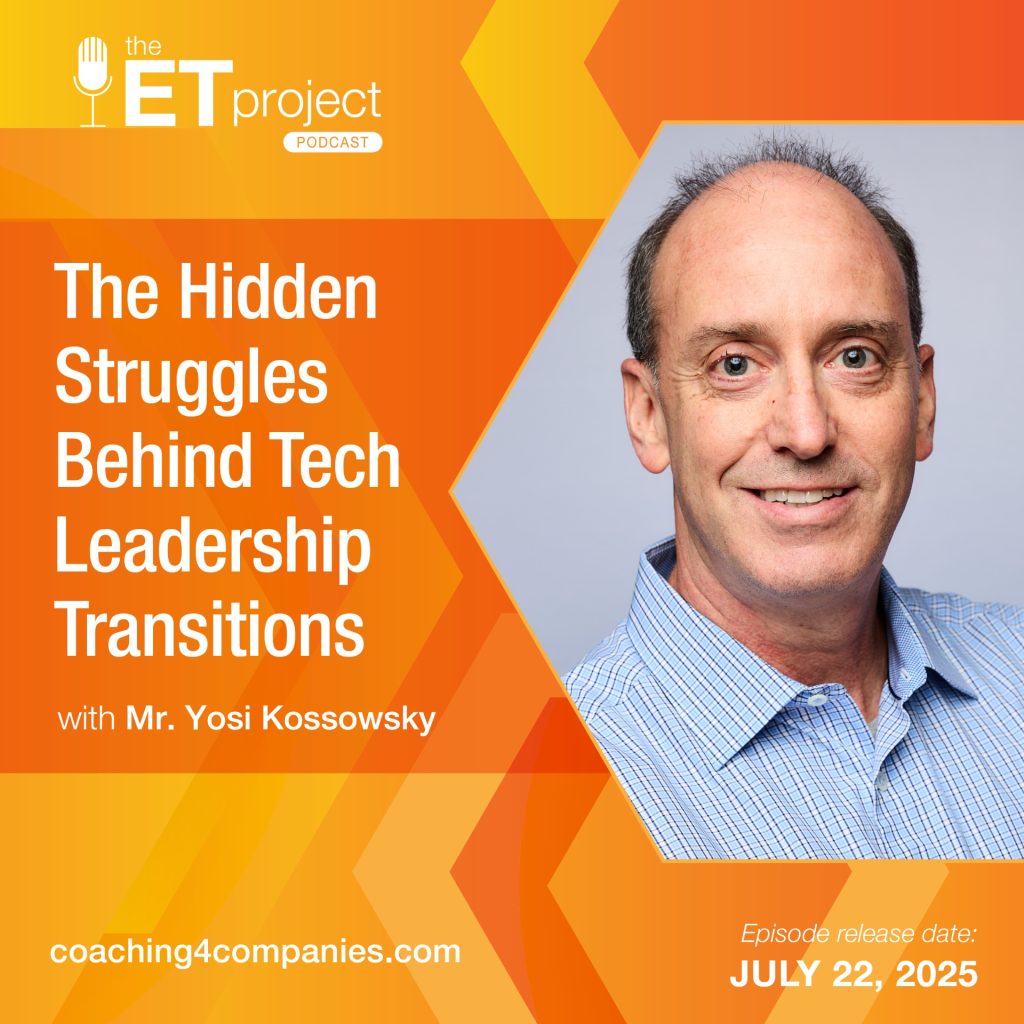
WAYNE BROWN: Hello, I’m your host, Wayne Brown, and welcome to the ET project. We’re delighted to be delivering this podcast for executive talent all over the world, whom we’re affectionately referring to as ‘Team ET.’ Today, we’re in the Big Apple. Yes, New York, New York, and we’re connecting with executive coach, Yosi Kossowsky. Yosi is a seasoned business leader with a wealth of experience in the corporate world. With over 30 years in the industry and 15 years as an executive team facilitator and coach, Yosi brings a unique blend of practical business acumen and coaching expertise to his clients. As a business leader, Yosi has held leadership roles in startups and Fortune 100 companies across a variety of industries including engineering, technical services, sales, HR, and operations. He uses this valuable experience and inside perspective to support individuals, leaders, teams, and organizations through change. Yosi’s approach to performance improvement coaching is holistic, backed by neuroscience and tailored to the specific needs of each client. He has a reputation for quickly building trust, asking deeper questions that uncover underlying issues and encouraging clients to tap into their strengths in new and effective ways. Yosi’s expertise extends beyond coaching through his executive roles in areas including CTO, team and technical leadership, senior director of talent management, leadership development, organizational development and effectiveness, change management, workplace planning, operations, quality assurance, leadership transitions, and HR. He has a track record of helping clients across Fortune 500 companies gain new perspective, navigate challenges, and simplify complexities. Team, this is a truly insightful and highly applicable conversation that has tips and actionable suggestions for all leaders regardless of age and experience.
INTRO: Welcome to the ET project, a podcast for those executive talents determined to release their true potential and create an impact. Join our veteran coach and mentor, Wayne Brown, as we unpack an exciting future together.
WAYNE BROWN: Hello team, and welcome to the show. Today, we’re diving into the shift from being a high-performing technical expert to one who starts to lead high-performing teams. It’s possibly the number one issue that we encounter with our clients each year. And with our complexity in the business landscape today, there’s many questions that come out. How do you continue to master the human side of leadership? How do you build and maintain trust? How do you inspire accountability as well as lead confidently without losing your edge as a leader? These are all crucial questions for every company as well as every leader. And so, joining us here to help us explore these questions and to share his own powerful insights for many decades in the leadership space and also in coaching technical leaders himself is executive coach, a former CTO as well as director of talent, Yosi Kossowsky. Yosi, welcome to the ET Project, great to have you on board.
YOSI KOSSOWSKY: Thank you, really glad to be here, Wayne.
WAYNE BROWN: Perhaps to get us underway, if we could just look at your own journey and what inspired your shift from being a corporate leader, a CTO, director of talent, to actually starting to coach and develop other leaders. What was the prompt that led you in that journey?
YOSI KOSSOWSKY: Yeah, thanks, Wayne. So really the order was a little bit more backwards than that. I was in an engineering role, starting to have an opportunity to take more of a leadership role. What I started to discover was that the skills that we’re talking about, building trust, leading others, getting people to follow, clarity and understanding whether it was transmitting a message or even receiving a message wasn’t clear cut, it wasn’t was something that like putting a computer or building a system or writing code, those things I would read a book, take a training course, and then I could go and do it. And having read about these skills, I’m thinking, okay, so active listening, you sit there and you listen. I didn’t understand that not all listening is the same, that was the real challenge. And so that led me to, A, recognize that these were called soft skills, but I think of now as the hard skills, weren’t going to be easily doable just by thinking about them or reading about them.
[00:05:00]
YOSI KOSSOWSKY: And that led me to study emotional wellness therapy, which then led me to study neuroscience therapy. And I was doing that while in my engineering role, and that was the underpinnings that helped me understand emotions, feeling them, experiencing them. What is the process of where our emotions, our actions, our reactions are coming from? What is the role where our thoughts and the belief systems that we have and the value systems we have play a role in how we see, understand, make sense of the world, navigate experiences. In the neuroscience piece, really understanding what is the different parts of the brain that play a role in our emotions, in our thinking, how do those two parts of our brain play together, what is the role of the different chemicals that, you know, we hear about dopamine or serotonin or cortisol, et cetera. And what are those roles that those play on our behaviors as well? And as I was really learning this, it kind of became clear why this is so hard to translate from a book into practical, usable knowledge. And so, I got my first coaching certification in 2012, not to be a coach, not to think that that was going to be a job, but rather to help me bring these skills into the workplace in a more effective way as a leader, life presented a lot of opportunities and I moved from there into a larger scale change management role within the company that I was in, Cisco, and it was global and it gave me this opportunity to travel as well and do global projects and learn about culture and the impact and the influence of different cultures as well as gender and generation on all of these things that we’re talking about. How do we communicate? How do we listen? How do we understand? How do we get along? How do we get into sync? How do we get out of sync? And it was only after I left Cisco that I was at this point of reflection and saying, “well, where do these skills serve me in the workplace?” Like, what’s the job I get next? And again, I hadn’t really considered being a coach. So that’s when I went and got a job as a talent management lead in HR. That wasn’t really the fit that I was hoping it was going to be and then I got offered a chief technology officer role and that was very cool and amazing, but also not the fit that I was looking for. And once I had, I guess, kind of had those additional experiences, I said, “okay, so, what is it that I really want to do here?” As I reflected back on the times where I felt I was in my groove, I was making a difference and I was feeling like other people were getting value, it was in the coaching type of work that I did internally at Cisco. And so that’s what led me to say, okay, I’m going to put up my hat and virtual banner and go full time into this amazing work.
WAYNE BROWN: And here we are today. You mentioned two areas, emotional wellness, as well as neuroscience and the wellness behind that. I mean, neuroscience has really started coming to its own in the last two, two and a half decades. How much has it evolved since you started to have an interest within the neuroscience and how does that then translate into helping coach others?
YOSI KOSSOWSKY: From my perspective, neuroscience has evolved in the language becoming more common and more understandable and therefore translatable into practical usage and utilization. When I was first studying it, they didn’t call it neuroscience therapy. The way that it was presented was understanding the physical interactions with our emotional spaces, I just translate it to what is now, what I look back and see how it’s being done as neuroscience therapy, neuroscience therapy. But at that time, it wasn’t called that. In my engineering brain, I actually had translated the difference between the two as the software and the hardware. So, the emotional work was the software and the physiological biological work was the hardware on which it’s running on. Bringing it into coaching as an engineer by trade and by thinking, understanding the systems to me is the key to solutioning. If I can understand how the systems work, that’s how you troubleshoot where the problems are and then you go after and you address the problems.
[00:10:00]
YOSI KOSSOWSKY: And so, when I am working with people and whether it is to be a better presenter or a communicator or have more executive presence or to work through anxiety in getting up and speaking in front of a board or how to make difficult decisions quicker, how to bring or build trust within a team or an organization, especially when the way that you think and the way that you talk is not necessarily the way that the whole organization thinks and talks. What I really do is in understanding what are the systems and also understanding that there’s always going to be nuances in the systems and there’s definitely a huge set of nuance in the software, in the emotional space of how… but the way in which in general our filters play a role on our behaviors is pretty consistent, what I have found, what’s different is what are your filters and what are my filters? So, when I help people reflect and learn about, A, what is in their systems, identify what is the, let’s say the software version and the aspects of their filters, their beliefs, their rules, their limiting beliefs, their ideas, their ideals, how does that interact with other people’s and systems, all of a sudden, they now have a whole toolset to bring to whatever their challenge is in the moment that they’re trying to strengthen or overcome, get a better understanding of themselves in that moment, get a better understanding of the audiences or audience and tap into that knowledge to bring about a more effective result.
WAYNE BROWN: So, you’ve worked with a lot of technical professionals, they’ve been promoted into leadership roles, whatever their role might be. We both know that everyone faces challenges when they make these transitions. What’s some of the most common challenges that you’ve seen with these people making transitions?
YOSI KOSSOWSKY: The first one, Wayne, thank you for the question. The first challenge that I see people often face is the mindset of I know how to get my work done. I’ve become good at getting my individual contributor tasks, responsibilities done. What I don’t know is how to broaden that responsibility into understanding how to help other people get their tasks done, that the knowledge of doing something, especially in the technical realm, doesn’t automatically translate into getting others to do that. So that’s the first one, the second one, which is luckily not all the time, is that often technical leaders, and I can’t really just say it’s only technical leaders, but you asked the question about technical leaders, don’t always really want or enjoy the responsibility of the people management piece. What they really wanted was more influence, more exposure to things that are happening at higher levels in the organization. It happens to be that many companies don’t have a individual contributor executive track where you can grow and just maintain being only responsible for yourself. And so, if taking on the role brings people with it and you don’t love that, but you’re not going to say no, then all of a sudden you kind of get saddled with this whole set of responsibility. And very often the mindset that will come along is, well, okay, these are all adults and therefore they’ll do what they should do. They’ll just do their work. And it really won’t require that much effort or time from me. And then lo and behold, they find themselves in a whiplash event because people aren’t doing what they’re told. People aren’t doing what they should be doing. And then they’re like, okay, and it almost turns into this like command-and-control mode; do what I tell you to do. And then they sit there and they see the frustration because they’re like, they should have done this, they should have done that, they should know this, they should know that.
[00:15:00]
YOSI KOSSOWSKY: And you can shut up, you know, the wazoo and find that still nothing is getting done. And that all of a sudden, you’re really in a frustrated space. Your leadership is looking at you and saying, “where’s the magic that you were bringing in as an individual contributor, why don’t you bring in that now?” And so, those are the two big ones that come to mind as we’re talking.
WAYNE BROWN: What happens if nothing changes, like, how do they move forward or do they not move forward? Do they just disconnect, look for a new job or what’s the next step for them when they’re in that position?
YOSI KOSSOWSKY: So, I’ve seen a full gamut, honestly, of it. I’ve seen some of these people where they continue on even for a few years and by their sheer will alone, they get their teams to do stuff, but the teams are toxic. And the turnover starts to go on the rise and eventually people don’t really want to work for them. And then that’s when they hit some sort of stumbling block. Other people do get frustrated and leave and then try and find another role. I’ve seen a number of those types of leaders just go back into individual contributor roles in other companies so that they didn’t have to do that. A whole bunch get training of some sort and start to make even incremental movement. And what happens, and this is the most common one that I find, a mix of good and not good, which is they start to make incremental improvements from the employee perspective and from HR’s perspective. And therefore, they get to continue to go. But really the day-to-day experience of the teams doesn’t really improve in any significant way. And so, it just becomes what is really common in our industries is really toxic technical teams that are never producing at the level that they could or never being as effective as they could. Whatever the employee survey of flavor that the company uses always has mediocre results. And again, then the next year there’s a couple more trainings for these leaders, and then there’s a couple more trainings for these leaders and maybe they even get a coach here and there. And, you know, Wayne, you and I know this, we’ve talked about it, not all coaches are the same, they don’t all have the same background experience to, you know. It’s like any professional, some people are better at some things and some people are better at others. And just because you’ve got the title of a coach it doesn’t mean that you’re good at those, at helping leaders find their solutions to those challenges. So, the one I see the most is this like constant friction, toxic-ish and the leader is frustrated and always worried about their job, the teams are frustrated. The ones where, you know, they either quickly get removed from their role or it goes to a relatively quicker end within a year or two, or they just leave are the saving graces. And then of course, there’s the leaders who we, you and I work with that figure this out and they want to figure this out. Who, A, want to figure it out and therefore put in the effort to do it. And they become these really transformational leaders.
WAYNE BROWN: When you’re working with people and you’re coaching your clients, how do you start off introducing leadership, the whole premise of leadership? How do you introduce that topic? Or do you? Would be a better question.
YOSI KOSSOWSKY: Yeah. So, I normally ask, within the first one or two meetings, I do a developmental history review with the leaders, what has been their life experiences that have brought them to today? How have they navigated early life, university or educational life, and then their job growth.
[00:20:00]
YOSI KOSSOWSKY: And at the end of it, it asks, how do you define leadership? What makes a leader and all of that. And so, it comes out really very early, often in my coaching practice that that is thought about and shared. And I generally ask them before I do any definition. I don’t know if I have a good definition of leadership, I think that it is a multi-pronged thing and I think it depends again on the person, the environment that they’re in. In repeated from many other sources, inspiring others to do work in inspiring or building, follow-ship, whatever that looks like for each person and where the feeling, which is really a hard thing to measure, where the feeling on the team is one of, I want to be here, I want to come in and work with this group of people and with this person on a regular basis. And again, that doesn’t always come out from the same types of behaviors of the people. Because you and I were not the same and most two people aren’t the same and the way you lead and the way I lead, I probably imagine Ashley has crossover and then there’s the unique Wayne that comes out every day and part of what people want to follow is the unique Wayne piece that you can’t bottle and sell.
WAYNE BROWN: Are there any key components that every leader needs to have or to be able to develop and does anything come to mind?
YOSI KOSSOWSKY: Yeah, for me, the most important key component, I’m going to say the word and I’ll give an attempt to explain it, I’ll call it curiosity. And in my definition, curiosity means the mindset of what if I don’t know shit? And so, what if I don’t know how to do this job? What if I don’t know what the other person is thinking? What if I don’t know their reasoning? What if I don’t know why they’re not getting stuff done? What if I don’t know? Because there is no space of learning if I know or I think I know.
WAYNE BROWN: So, it’s the ability to be somewhat vulnerable, I guess, to remain curious and put yourself in a position where you have to be honest and transparent and in certain circumstances and say, “hey, I don’t know everything, let’s work on this together.” How does that potentially impact team performance?
YOSI KOSSOWSKY: So, what ends up happening is the next step of ‘I don’t know mindset’ is ‘how do I find out mindset’ and, ‘how do I find out mindset’ is very much what I think you just alluded to, which is let’s have a conversation, let’s talk about this together. That inherently automatically starts to reshape the team dynamics when the leader is sitting down, not to school you, not to tell you, not even to mentor you, but to learn about you and learn with you and even from you. You can just imagine what that will be like when people feel like, oh, there’s real value, human value being put here on the table and the teams really respond overall very well. It’s not a straight path, it’s not a simple path, we have our years of our habits and our behaviors and some of our really ingrained things. And so, I’ve never yet encountered somebody who was able to like hit a light switch and say, okay, I’m going to be in the, ‘I don’t know mindset,’ and just do that. And then all of a sudden, a crisis arises, push comes to shove and some of the old initial traits come back out and other things. So, it’s a process and this human side processing that we’ve already been talking about earlier on about understanding ourselves a little bit, understanding our, what did you call it? Our maps? How did you call it?
WAYNE BROWN: Our map of reality.
YOSI KOSSOWSKY: Our map of reality, right?
WAYNE BROWN: Yeah.
YOSI KOSSOWSKY: Those pieces are so interconnected all the time and it can’t just be that, oh, here’s my map of reality and I can hang that on the wall now and refer to that, right? No. You got to keep on coming back.
[00:25:00]
WAYNE BROWN: I can imagine like there’s multiple elements as you mentioned, trust, we’ve probably heard the term psychological safety and having that environments and having the ability to have that communication. How do you try and bring those sorts of factors into this conversation about creating that, ‘I don’t know,’ space because without those factors, I imagine this, ‘I don’t know,’ space or being curious, is that much harder as well?
YOSI KOSSOWSKY: Yes. So, it kind of depends on where, at what scene of the play am I walking in to, am I walking in the opening scenes where relationships are still being built or am I walking into a completely toxic environment that needs to be healed? So that depends. I rely a lot on Patrick Lencioni’s work in The Five Dysfunctions. And my current hypothesis is especially in public companies, companies that are traded on a stock exchange, that the idea of building psychological safety in the teams is a myth. Because as long as I could be fired, in general, how safe can I be? Meaning you can have real psychological safety in a family because you never get fired. But if I’m in an organization and at the end of the day my employment hinges on somebody else’s decisions, whether those are financial decisions, anything but my performance, then how safe am I really?
WAYNE BROWN: Yeah.
YOSI KOSSOWSKY: So, I first honestly work to dissuade the idea that we’re ever trying to achieve any dictionary definition of psychological safety. And the second is going to Patrick Lencioni’s work is rather let’s focus on transactional trust. You and I, we’re in two different countries, but one of the things that we know, we share together is red lights mean stop and green lights mean go. I trust that I to be driving in Australia, you to be driving in the U.S. even though it’s opposite sides of the street, red and green mean the same thing. So that level of transactional trust is easier to achieve, it is easier to operate on and lowers the expectation that it should be more than that, that could lead to great levels of disappointment, not because anybody actually had an infraction, but because that’s not the depth of the relationship.
WAYNE BROWN: Are there any simple insights that come out of the neuroscience theory that leaders can take as examples today and say, “okay, I’m going to try and apply something here from this conversation to help make me a better leader.” Is there anything that you would suggest that people can do?
YOSI KOSSOWSKY: The very first one is one that we’ve talked about a bit earlier in the show, which is adopting an ‘what if I don’t know mindset.’ So, whether it is, I am observing somebody on the street, in the mall or at work doing something, what I have is observable reality. I observe what they’re doing. I could say, “I see you do this,” but stop there and don’t go to, and this is why I think you do it, or this is why you do it. Stop before we make up a story of motivation, intention, reasoning. If we could stop, if we could really start to build a curiosity mindset, a ‘what I don’t know mindset,’ then we will inherently have less conflict and less frustration because what we will have is more dialogue.
WAYNE BROWN: Can we define that to mean we need to develop more of a growth mindset or is that too generalized?
YOSI KOSSOWSKY: I think that I feel that a growth mindset is inherent in some of this work, because a fixed mindset in one format is pass and fail, success and failure mindset. And anytime we want to look at our actions or our results in terms of success and failure, there is such a weight of failure that it carries with us.
[00:30:00]
YOSI KOSSOWSKY: Rather than the experimental mindset that comes with growth mindset, which is, what did I learn here? How do I take that and move forward? And so, yes, I would say a growth mindset. However, the growth mindset doesn’t really talk about the curiosity aspect of how do I become aware that I make a tremendous amount of assumptions every moment of every day and those assumptions are essentially fiction that my head is writing that I don’t really, really know. And we fill the maybe I don’t know spaces with little tidbits to prove to ourselves that my assumption, my assertions are correct without making the effort of checking. And so, I am all with you on the growth mindset as a critical success factor for any person or team. And the difference of, if I want to really learn about other people, really understand what is going on in my team and my environment, the only way I know how to do that is if you leave space for the unexpected, for hearing, truly hearing what is for another person. And it’s not a matter of agreeing with them, it’s not a matter of, you know, we’ve got to be best friends, it’s just understanding the other human in the same way that you are looking to understand yourself and wanting to be understood by others.
WAYNE BROWN: Right. You talk about leadership isn’t about changing who you are, but it’s about using your strengths in new ways, is that somehow accurate?
YOSI KOSSOWSKY: That is accurate. Yeah. I’m a big believer in what some people have started calling ‘spiky leadership,’ that if we really understand how to tap into what we’re really good at, and we recognize how to bring that skill, that strength into what we’re doing, which brings up a whole bunch of things we’ve talked about. Are you in the right role or et cetera? Then that becomes your superpower. And if every leader had the same superpower, we would only have a very lopsided result. It’s the fact that many leaders have learned this idea that I’m not going to try to be this well-rounded perfect thing in everything, because I’m not sure that as humans we know how to do that. But I can spend my time trying to really well round myself out. And it’s a beautiful growth to do that and I’m all for that. The science seems to say that the effort I’m going to put on becoming so well-rounded is going to take away from my ability to spend time leading others and bringing that time to the organization. Certainly, I don’t want to be mean, cruel, toxic, or all of those, I think that we have to understand, as you’re saying authenticity doesn’t mean I could drive through every red light because for me that’s authentic. We live in a society and in society… I’ve been trying to find a more universal translation of this idea, but, do no intentional harm or intentionally try to lift everybody up around you, something. That if we can operate on that idea or some version of that idea, then recognizing what you do really well, maybe better than most, brings the gift of the real Wayne into the world. If Wayne and Yosi want to be exactly the same people, cool. I think maybe I’m not sure the world can handle two of us the same, but then where’s your special spices and gift to the world going to come from?
WAYNE BROWN: We often hear people talking about strengthening your strengths, if you come across people and you’re talking about working on their strengths, is there any particular means to help them achieve that? Like, how do you guide people to say, “okay, let’s identify your strengths,” that part, not so difficult, but how do you then reframe or enhance somebody’s strength?
[00:35:00]
YOSI KOSSOWSKY: So, I made up a term, it’s already existing, I just use it in my own definition of what I call ‘real-time leadership.’ And it is understanding what is happening today in your environment or this week or this month. Like, I was coaching a leader last night and he was about to have to go deliver some really tough news to an executive and ask for more budget. He was just, A, I think a little nervous and, B, such a detail-oriented person that he was like a kind of lay out the whole sausage-making to this person about why and how we got here. So, I said to him, when you go to the mechanic and your car is making a noise, what do you want to know from the mechanic? Like, can you fix it? Okay. Do you care how he’s going to fix it? Sometimes a little bit, but no, not really. I’m like, okay, so what is the style that feels best to you to talk like the mechanic to the non-initiated who just wants to know that you can fix the car. And then we role-played and I had him talk through the way he likes to talk, his style of it and gave him reflections about where he went back into the sausage-making, the details, helping him reflect whether or not that was helpful to get the result that he wanted. And so, for me, there is this dynamic that his strength is in the details, he could tell you every nuance of this project of why it works, how it works and all of that. So how does he bring the poignant parts of saying to the guy, like the mechanic, I know how to fix your problem. I know how to do this. This is my strength-spot. I can give you all the details. What is it that you really want to know today? You want to know how I’m going to fix the car? Let’s sit down and I’ll have that conversation with you. If you want to know if I can fix it, then we’ll have that conversation. And so that’s in my sense of how I work with leaders when they understand where they’re really strong or helping them reflect to get to that recognition, then understanding how do they apply it in different scenarios. Because it will be different, whether they’re talking to their team and wanting to get their team aligned versus going to an executive and wanting just to get by it.
WAYNE BROWN: Anything you’re working on in particular at the moment, so you’re working on any programs or what does the near future look like?
YOSI KOSSOWSKY: Yeah, so the near future is focused on building more personal accountability. So many people come to me and talk about the challenges of the world that we’re in today and what the governments are doing in this and that. And that this feeling of powerlessness and even though it’s not said in this way of being a victim, as I imagine you know, we haven’t talked about this topic, that if you are in a victim mindset, you’re stuck. And so how to help people re-recognize where they do have their power, their choice. In America, they use the word ‘agency’ a lot, I don’t know if it translates to Australia, because no one can really take away my free choice unless I give it up. And so, the current project, and I’m not sure where to go with it yet, someone said to me yesterday, after talking it through with them, I got to write a book, I’ve never written a book, I don’t really know how to write a book. So, I don’t know where it’s going to go yet, this has really been very top of mind. And so that’s what I’m working on.
WAYNE BROWN: Where can people connect with you?
YOSI KOSSOWSKY: Yeah, thank you. So, the best place really is LinkedIn. I have the domain name of my name ready for a website; I even have a person who is building it, I just haven’t spent the time. So, LinkedIn is right now the best place and if you can put that link in the show notes, there’s, I put a button on my LinkedIn page that you can book a free 30 minutes just to talk and have a chat. So that’s really open to anybody. So yeah, that’s the place right now.
[00:40:00]
WAYNE BROWN: Very nice. Well, a great conversation. We literally scratched the surface, we haven’t gone deep, we’ve touched on just a few areas that are relevant to leaders, but I think it has been a very powerful conversation nonetheless. So, thank you for being on the ET project, Yosi.
YOSI KOSSOWSKY: Thank you, Wayne, for having me. I really appreciate it. And I wish you a wonderful and blessed day.
OUTRO: Thank you for joining us on the ET project, a show for executive talent development, until next time, check out our site for free videos, eBooks, webinars, and blogs at ‘coaching4companies.com.’
[END OF TRANSCRIPT]