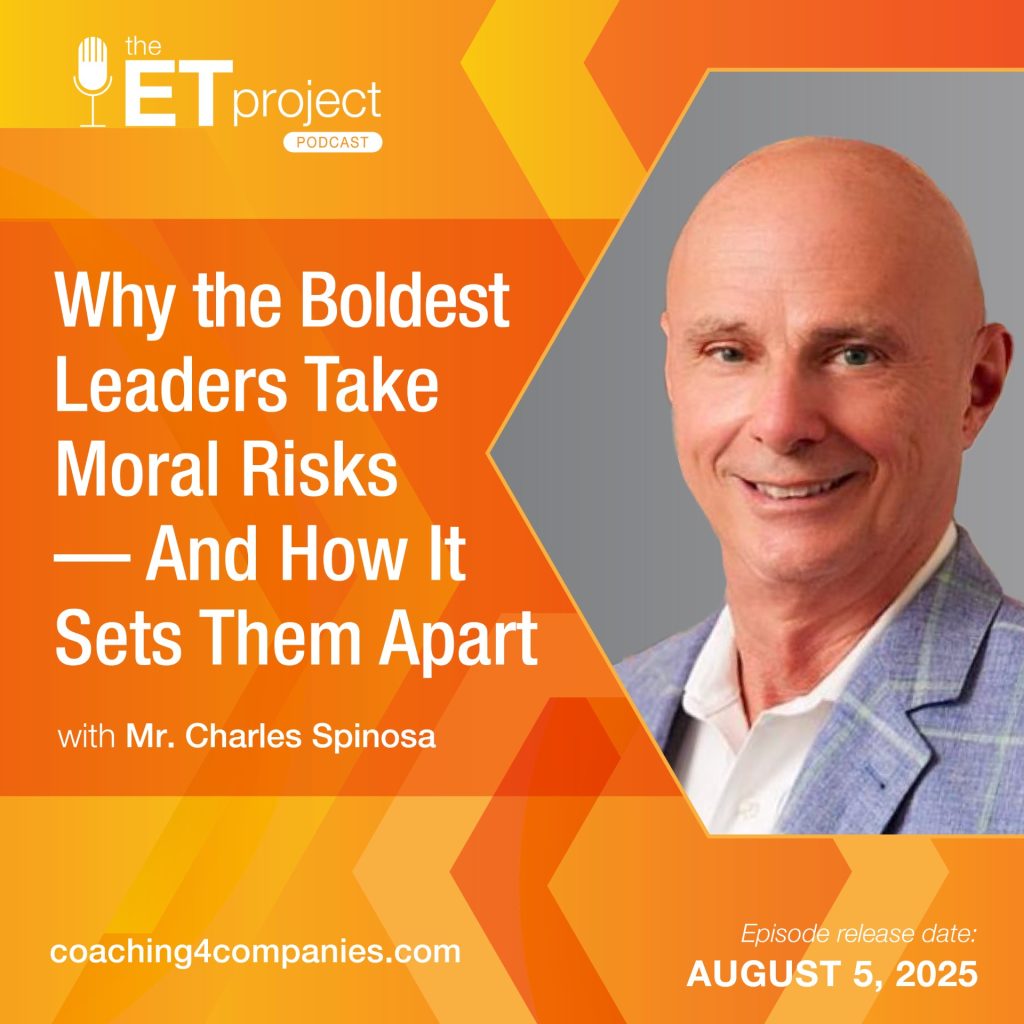
WAYNE BROWN: Hello, I’m your host, Wayne Brown, and welcome to the ET project. We’re delighted to be delivering this podcast for executive talent all over the world, whom we’re affectionately referring to as ‘Team ET.’ Today, we’ve traveled to New York, New York, and catching up with management consultant Charles Spinosa. Charles is a group director in VISION Consulting and leads work on strategic innovation, programs to correct cross boundary coordination problems, and leadership coaching. He has developed and deployed value conflict resolution methodology for innovation, enriched and deployed commitment management methodology, and new methodology for leading knowledge workers. Before management consulting, Charles taught English literature, as well as philosophy, publishing widely in both fields, and he has earned his PhD from Berkeley. During the last several decades, Charles has co-authored numerous books, written countless academic papers, and much of our conversation explores the more recently release titled, ‘Leadership as Masterpiece Creation: What Business Leaders Can Learn from the Humanities about Moral Risk-Taking.’ By leveraging history and his interest in philosophy, Charles and his colleagues have produced an intriguing and thought-provoking account of leadership, often expressing what may be seen as a controversial stand. It certainly makes for an interesting conversation with many stories reflecting on the ways of the past and current global recognized leadership figures. As you know, I get to review many books and enjoy reading nothing more than those that challenge my thinking, my biases and my beliefs. And this book certainly fulfills that desire. Team, if you’ve ever considered how effective you are as a leader and wondered what you might be able to do differently, then I would highly recommend reading this book and listening to the following conversation.
INTRO: Welcome to the ET project, a podcast for those executive talents determined to release their true potential and create an impact. Join our veteran coach and mentor, Wayne Brown, as we unpack an exciting future together.
WAYNE BROWN: Hello, team. In this episode, we explore leadership as a masterpiece creation, organizations that are willing to instill bold new moral norm, to challenge the status quo and inspire others. And joining us to discuss these ideas, professor, philosopher, management consultant, Charles Spinosa. Charles, welcome to the ET Project. I’m looking forward to our conversation.
CHARLES SPINOSA: Thank you, Wayne. That’s a lovely introduction, that’s exactly what the book that I just wrote is about, having that moral imagination and acting boldly on it.
WAYNE BROWN: Maybe you could just give us a very brief overview of what brought you to where we are.
CHARLES SPINOSA: Okay, I’ll try to do it really briefly. I started out not as a management consultant, but as actually a professor of English literature. I taught Shakespeare for some years at Miami University in Ohio. And then I started publishing in philosophy and I ended my academic career as a philosopher. In both those worlds, both those disciplines, I was always interested in how human beings transform themselves, how we in a certain sense become who we are. We’re not really ourselves and how we’re constantly becoming. I talked about how Shakespeare did that when I was teaching Shakespeare. I spoke about how Heidegger, Kierkegaard and Nietzsche got us doing that when I did philosophy. I wrote my first book in 1997 with a philosopher and with a management consultant on what innovation in business looked like from a philosopher’s perspective and that led me into management consulting. I started management consulting interested in how people innovate and interested in helping leaders find their defining passion. And my original view was if you found your defining passion, but the big consulting triumph was with Fernando. We were consulting with Lorenzo Zambrano, the CEO of Cemex, which at that time was a very small cement company, it has become the third or second largest in the world. His defining passion was to bring to Mexico first world transparency in debt and raising debt and so forth. And it was amazing because he had that passion, he could have more sophisticated strategies and he could take harder hits than other people. I won’t go through the story, but when you have a defining passion, you get challenged in that defining passion. He was challenged in a very hard way and was able to see his way through it. In any case, that’s how it started out and I started working that way and helping people innovate. But as I work more and more with leaders, I discovered about 10 years ago that leaders really have a sense.
[00:05:00]
CHARLES SPINOSA: This is going to seem like an obvious discovery, a moral sense of what the right way to treat customers is, what the right way to treat employees is, what the right way to treat owners is, and the right way to treat managers. And when I say right way, I mean, they meant morally right. It took me a while to put that together, but I saw that when they did that, when they could take the risks to do those things, it always requires risks, we can come back to that, they created masterpieces. And so, I wanted to help them do that. They do it mostly behind their back. Why? Well, they’re taught in business school and they’re taught by consultants like me, follow this framework. Well, consultants have four box frameworks, they have all sorts of frameworks. Follow this. One recipe after another recipe after another recipe. We give leaders recipes. And if you’re a leader, what’s your life like? Well, you end up fighting a lot of fires, you end up having to make a lot of snap decisions. It’s tough. So, if you’ve got recipes there, and if the recipes work, and they give you operational excellence, of course, you’ll follow them. And I learned to begin asking leaders, what always goes wrong in your organization? And when I found out they had an answer, that’s when I said, I’ve got to write this book, I’ve got to write ‘Leadership as Masterpiece Creation: What Business Leaders Can Learn from the Humanities about Moral Risk-Taking.’
WAYNE BROWN: I do have to ask, if you could define masterpiece organization, what is it that we’re referring to when you talk about a masterpiece, and then we have this, probably this mental image of some sort of Rembrandts or a painting, looking like a masterpiece, what does it mean when you talk about masterpiece organization?
CHARLES SPINOSA: By the way, I love that, you can think of an artistic masterpiece and the cover of my book as an artistic masterpiece. But for me, a masterpiece organization is an organization that’s morally distinctive. It doesn’t have to be an organization that we love, but it’s one that’s morally distinctive. Let me give three examples so you can get a sense of that. The one that I talked about in the book is Anita Roddick’s, ‘The Body Shop.’ She was dealing with the beauty business back in the 90s. And how did you sell cosmetics and skincare to women? Well, you made them feel anxious about their looks, the more anxiety they had, the more they had to buy stuff. She thought that was just terribly wrong. She created an organization defined by values of compassion, most importantly, having fun, having fun in the store, trying stuff on. She was the first one to do that sampling and taking care, finding a way to take care of yourself, not anxiously try to make yourself look good, but actually take care of yourself as a whole. That was a moral break from the industry as it was, and that made it distinctive. Now when you do that, it also turns out to be aesthetically distinctive. And she worked on the aesthetics that would go along with that. Another morally distinctive company, a lot of people don’t like it, is Bezos’ Amazon. Whether you embrace Amazon or not, I think you can’t help but see it as distinctive. He wanted to save retail on the internet. I think most people don’t remember that in the 90s the internet was actually wild. It was full of all sorts of job boards, Craigslist, all sorts of lists. And you could buy options on things, you could buy all sorts of things. You didn’t know what you were buying was for real, whether it was fraudulent and so forth, it was sort of a Wild West. And he wanted to tame it and he thought that to tame it, and I think we have to grant him, he might have been right about this, he had to create a company where people worked relentlessly, where he was constantly raising the bar on expectations of employees, where he was frugal and where he was fanatical about customers. He created that organization and he was actually quite ruthless. His first logistics genius, who was a genius, who saved Amazon, in fact, Bezos was the one who called him a genius, he wanted to work 30 hours a week and play Frisbee the rest of his time and hang out with his wife, that was not relentless, Bezos nearly fired him. His name was, I can’t remember his first name, his name was something Lovejoy. The same thing happened with his founding employee, the guy that created the Amazon site. When it was time to create the second site, Bezos, who had promised him a job for life, saw that he probably was not up to Bezos’ standards.
[00:10:00]
CHARLES SPINOSA: And so, he forcibly retired him, his name was Shel Kaphan. It’s that kind of ruthlessness. Now, Amazon is enormously successful and it’s enormously successful in those terms that Bezos set out. And we end up excusing him, or at least giving him a pass for those actions, that’s what I mean by taking a moral risk and having moral luck. And he created that kind of distinctive organization. Relentlessness is its key. Look at Google, that’s a completely different kind of organization. Google started out as a kind of follow your dreams as much as Google can. You follow your talents. You get a certain amount of time each week. Now they keep on reigning in and going back to it to explore whatever you love doing, whatever your talent says you should do. Google is famous for its psychological safety. Imagine the difference between Amazon and Google and what a good life at Amazon is like and what a good life at Google is like and contrast that with Anita Roddick’s body shop. For me, those are three very distinctive good lives that you can have. They’re not suited for everybody, not everybody can work at Amazon, not everybody can work at Google, not everybody could work at the body shop, but they’re morally distinctive. And when you have an organization that has got sharply etched moral distinctiveness like that, I call that a masterpiece. Let me add one thing. It has to be admirable, of course, across a wide number of people. Somebody could say, that some organized crime unit or a cartel has a sharply etched order of its own and they might even call it a moral order simply because it’s so orderly, my pluralism does not extend that far, it has to be admirable to wide groups of people. So that’s the other thing I’d add, too.
WAYNE BROWN: The word admirable comes up a lot throughout your book and I think it’s an important attachment to the whole philosophy across the book, because as we were discussing before we came on here, it could be seen as a very controversial book and you make alignments with a lot of very notable characters over history in your writing. But one area, even in the title of the book, that really stands out is the humanities aspect. So, you draw on the humanities a lot, philosophy, literature, history, the arts, and how that shapes leadership thinking. Why do you believe so much in the humanities being an essential tool for business leaders?
CHARLES SPINOSA: I don’t know if I can give you a short answer for this. I mean, the easiest answer is that’s where I come from, that’s where I saw business, that’s where I see the struggles that people have. There are tons of consultants and other people, other advisors who can give people in business recipes for operational excellence. But that’s not where I find the hearts of most leaders lying. And when I say most, I mean, in my consulting career, I mean, 90%. 90% of the leaders I’ve dealt with want to do something more than have operational excellence, they want to test their view of what the right way to deal with people is, and that’s what their business is. If we look at small businesses, businesses that line the street, businesses up and down Madison Avenue in my neighborhood, you look at each one, there’s a vision there of how to treat customers, how to treat employees, and it’s different. And you go to the owner and you say, “well, why in your hardware store are you playing classical jazz music?” He doesn’t say, “I got a consultant who said that I could earn additional profits if I distinguished myself from the hardware store down the street that plays pop music.” You don’t get that answer. And I don’t think everybody is surprised that you don’t get that answer. You get this is the right way to treat customers in a hardware store. They’re here to create beautiful things in their homes, pop music doesn’t do it. So, the first thing is the way I deal with people, but the more honest… I mean, that’s true, everything I said is true. But what happened is when I started out, I started working in the humanities, I started helping leaders find their defining passions because I believe that’s what you do in the humanities. You try to understand the defining passion of the person that you’re reading. You try to understand if you’re reading a novel or a piece of literature, the defining passion, both of the author and of the individual characters in the book, and you develop a moral imagination that way.
[00:15:00]
CHARLES SPINOSA: And so that’s where I started. The next thing I came to is if you read literature, it’s all a moral conflict from Homer straight through to James Joyce to Virginia Woolf, it’s dealing with moral conflict. And if you look at what businesses are trying to do, they’re trying to sell into, I believe, moral conflicts. They’re trying to give you not just goods, but good lives. And so, the products they give… and when they talk about a user test, they don’t just mean, can you flick the switch and does it work all the time? They have a picture of how, for instance, a light switch functions in your life. You’re at home, you’re in the dark, you need to turn on your light easily, does it do that for you? Does it make that part of life easy for you? And is it better to have Alexa that you shout at and have her turn on the light? Is that the advance or not? People are thinking about what makes a life good for people in business. And so, it’s this constellation of things that lead me to the humanities. Now you could very well say, “Charles, it’s because you started from the humanities that you ended up there,” I confess it may be, I don’t have enough introspection to know if I had started in business, whether I would have come to the humanities, but I do believe the people I run into and the questions that they’re really trying to solve are questions that people in humanities have been thinking about.
WAYNE BROWN: Early in the book, you make a distinction between moral norms and various other kinds of norms. So, almost in a hierarchical sense, you talk about moral norms and legal, conventional, prudential, can you walk us through the differences and how they show up differently?
CHARLES SPINOSA: Wayne, first of all, I have to thank you for asking that. I have had more people say to me, “Charles, how is it this early in the book, you had the gall to make me think about different kinds of norms? It’s philosophy, I didn’t come to your book for philosophy.” I want to say that the whole book is not that way, but it’s really important. So moral norms are norms where we are clear that it’s a right or wrong that we don’t want to violate. And some of our laws actually embody moral norms; do not steal, do not commit murder, those are moral. Some, drive on the left side of the road and some countries drive on the right side of the road. In other countries, we see those as conventions for organizing ourselves. It’s wrong to break the conventions because it leads you to violate other norms, you’re putting other people in danger needlessly, right? That’s a moral, but conventions are conventions. And the third kind of norm that we have are prudential norms, and those are the norms that most people in business try to adhere to and try to define what their business is; it’s prudent not to charge too much to your customers. It’s prudent to give customers, even if you might not see them again, a good experience in your business. It’s prudent not to wear your employees out so that when they’re dealing with customers, they can bring the customers a good experience and so forth, those are the kinds of things that are prudent. Now you can elevate those into moral norms and you elevate them into a moral norm and say we care so much about customers, it’s absolutely essential that my employees are able to speak to the customers with a smile on their face the whole time, no matter how crabby the customer is. When you do that and it becomes the basis of your business, then it becomes moral. Why? Because it’s the right way to treat customers and in this organization, it is just wrong. It’s terribly wrong if you don’t and you have to be fired. It’s no longer a matter of prudence. It’s no longer in this instance or in that instance. It’s in every instance that you’re in this organization, this is how they treat people.
WAYNE BROWN: Right.
CHARLES SPINOSA: I can go on; I don’t want to be accused of forcing people to…
WAYNE BROWN: Maybe. But think it’s important to get that distinction up front to understand.
[00:20:00]
WAYNE BROWN: But you even then define it further when you talk about moral norms and you’re talking about three different types and organizing. So maybe you could just enlighten about that as well within the organizational context.
CHARLES SPINOSA: Yeah, I do that, but by the way, that’s something that comes from Heidegger, that distinction, that any organization has essentially three kinds of norms and there are the norms… and it’s so useful for understanding the history of organization and other organizations, I can’t help myself. First of all, there are the norms that are most taken for granted, these are the ones that we don’t really want to fight over, we want to take them for granted. In the United States, you should take the United States as a country, we have taken for granted the norm of neighborliness. And I think if you get to live in the United States for a while, I think you also have in other countries, I don’t want to be exclusive about this, you’ll find yourself treating your neighbors with a kindness that’s different from the way you treat people in the street, familiarity and kindness. And that governs in… when I talk about Churchill, I talk about Britain in 1940 and they had something similar, they had kind of buoyancy and Churchill loved to mention that buoyant English behavior, we’re buoyant with each other. And you can sort of see the traces of that in Britain today, I believe. And I believe it also is in other Commonwealth countries. You would know better than me, Wayne, but I think there is a kind of buoyancy. Then there are the norms that we do want to get absolutely clear about and we fight over. And in the United States, those are the libertarian norms, those are the norms of right, those are the norms of equality, those are the norms of freedom. What am I free to do? Those are the things protecting our Bill of Rights. Can I say anything? How much can I say? What can’t I say? Is there anything I can’t say? What do you have to do if you’re going to arrest me? What rights do you read to me? All of that we like to get very, very clear about. Those are the clarifying norms. What does it mean to be a woman? What does it mean to be a man? And so forth. Those are the clarifying norms today and we work to get those as clear as we can. And then there are the norms of… and companies have these as well. And then there are the norms; what happens when an unspoken norm, a norm you don’t want to speak of like neighborliness, comes in conflict with a clarifying norm? And those then are the organizing norms that resolve that conflict. And in the United States, classically, we resolve conflicts even around the family dinner table, roughly like a law court. We deliberate precedent counts. What did we do before? What did we do last time? And we try to reach a reasonable judgment. We do a kind of judicial deliberation. And it makes sense for a country like the United States where our clarifying norms are so legalistic that we end up doing that, that we end up deliberating in a judicial way as our organizing norm. And so that’s how I try to understand the normative orders of the various companies I deal with. And so, when I spoke earlier about Anita Roddick’s body shop, her grounding norm was taking care of your body. And she looked like she liked to go to traditional cultures and find out how people in traditional cultures took care of their body and bring those in. But again, that was an unspoken basis of having fun and experimenting with various goods. And the interesting thing was she actually was having fun, that was the clarifying norm, and experimenting was one way in which she was able to bring those two together when they came into conflict. In her organization itself, she said when things come into conflict, growth is the answer. What will enable us to grow? That’s how we’re going to resolve a conflict between taking care of yourself and having fun. And growth wasn’t essentially important to her because she thought only if she grew could she take on the beauty business so she remained a small store in Brighton, it would be okay, hippies could go there and nobody would care, so.
[00:25:00]
WAYNE BROWN: Right. Our listeners are probably wondering why we’re talking so much about moral norms; I can assure you moral will become clear as we continue through the discussion, we get into moral mistaking and anomalies and dealing with all sorts of things. Maybe a final clarification is, what’s the difference between a moral norm in a corporate sense to purpose, values, codes of conduct? How do they align or do they?
CHARLES SPINOSA: They do align. I mean, codes of conduct and purpose tend to be your clarifying norms. That is if you’re honest, by the way, if you’re really honest about what your purpose is, if you’re really honest about what your code of conduct is, then that will be the clarifying norm. Those are the things that you’ve got your people in your HR working out and when they find a confusion or a contradiction, you’ll get a new memo sent out to you. You seldom in businesses, unless you’ve sort of been corrupted by Charles Spinosa or people like him, get your grounding norms inside there. I’m working with one business right now where they’ve listed five norms. One of the key norms is every case that we work on, it’s actually a sales organization, so they have cases with customers, has one leader in charge of the whole case, that’s a clarifying norm. They call that leader, the quarterback. Now they have a grounding norm, which is we always endeavor to speak with simplicity. Now I got that inside their code of conduct, I don’t think most places would have that inside their code of conduct. Now, one more thing, I want to say that the masterpiece organizations, when they create these norms, they’re generally focused on achieving a purpose that people think is sort of odd. Anita Roddick’s purpose was to change the beauty business so that women wouldn’t feel anxiety over their looks. Well, that’s sort of weird. How can you sell them… Why would women be doing this if they didn’t? Well, Anita Roddick’s answer is because they’re having fun and taking care of themselves. But until you get Anita Roddick establishing the body shop, that doesn’t make sense. And that’s what I’d like… That’s the thing that’s key to my masterpiece businesses, the purpose that you are working for it doesn’t make sense to people until you establish your business and show that it counts. And the same is true for Bezos, really? Was retail under threat? Walmart was not going to go away; Walmart was going to be there. So, there’s this little online world where retail fails. Well, we can see the online world has become pretty big. And with Amazon, it is like traditional retail with owners taking care of customers and so forth. So, you wouldn’t have seen it as a real-life purpose until it actually happens. And then, wow, it is, the person was onto something. Does that answer the question you asked me?
WAYNE BROWN: Yeah, sure, sure. It also drags in another word, which I mentioned in the opening, which is vision. So, it would then stand to reason that these leaders must have that foresight or they must have that vision that they’re passionate about, as you mentioned, that really drives their conviction as they’re working towards this new moral norm. It’s sort of all stacks up, right? In fact, you even talk about, I don’t know, what do you call it, five steps or five stages, but you give a sequence of how leaders create new moral norms, you talk about the living in the organization’s moral law, you talk about encountering…
CHARLES SPINOSA: The anomaly.
WAYNE BROWN: Yeah. And conceiving it in a way that enables action, right?
CHARLES SPINOSA: Yeah. Let me just say something about that, because I think it’s important. I mean, people, whenever we’re talking about norms and so forth, the answer to that is a masterpiece business changes the norms. It’s an organization that creates its own distinctive norms, and when you do that, you’ve got something that people admire. People say, “wow.”
[00:30:00]
CHARLES SPINOSA: People in business, consultants like me, we’re constantly telling people, what’s your vision, what’s your vision, what’s your vision? It doesn’t start there. Here’s something that I learned the hard way after 25 years. You can go to owners, leaders of business, serious leaders of business, and say, “what always goes wrong in your business?’ And you can get an answer. We always mistreat loyal customers, we take advantage of them so we can offer goods to new customers to get the new customers around, that’s a common one. Anita Roddick’s, we create anxiety in our customers. We only do what is safe, which is a big one for me, but the clients I deal with, we don’t do innovation. We only create video games that really appeal to the nasty sides of adolescent men. Even when we start out trying to do the reverse, we hit a problem and it’s so easy to go to the nasty side of men, we go there. What do you do wrong? I find that leaders can answer that. I was amazed that leaders can answer that, by the way. I thought that would be the hard question. I thought I’d be writing a book that said, “you have to figure out the answer to that question.” No, I was wrong. The next question actually is the hard question. The next question is the basis of the vision question. “What would you love to do instead?” I run into the… people have a lot of difficulty. Why? Well, leaders have gotten to their position because they’re brilliant at managing around the difficulties of the business, of making it so nobody even sees the difficulty that they’re managing around. They’re brilliant at it, that’s how they got the position. So, when you say, what would you love to do instead? That throws them back, that throws them further, but it is the question that they’ve really wanted to answer. It’s the question that they’re really glad somebody is asking them, at least in the quiet if they’re not having to do it before their team and other people in the company. But as soon as they come up with an answer, what would you like to do instead? Well, then you have something that qualifies as a vision. It’s the thing that’s going to drive the company. And Bezos came up with, although he didn’t tell anybody, I want to have an everything-store, that was Bezos’ vision. Roddick’s vision was, I want to have a store that teaches people how to take care of their bodies, that was her vision. The fun part, the compassion part, that was what went along. And then to get that vision, to enact that vision, you have to take moral risks. And my book sort of points out that you have to take moral risks. But then it’s sensible to try to take the moral risks in order where you’re increasing in the risking it each time. Not all leaders have done them in order. Leaders tend to be passionate people, they’ve got their defining purpose, they’ve got what they would like to do. But in the book, we advise take your moral risks.
WAYNE BROWN: You also argue that traditional leadership models tend to focus too much in certain areas and not enough on the moral risk-taking. So, empathy, as one example, or I know you mentioned Google and psychological safety, or Amy Edmondson’s term of what Google identified, but I mean, this is where the book could tend to become a little bit controversial, right? So, in many instances, many of the examples, you’re talking about cultivating that courage to take the risk, but not always in a way that would be deemed by everyone to be morally correct.
CHARLES SPINOSA: Exactly.
WAYNE BROWN: There’s a little bit of a dichotomy there, right? That on the one side, we get to that outcome, but to get there and be that mole breaker, sometimes they have to do the controversial steps, which don’t always see the light of day at the end.
CHARLES SPINOSA: That’s true. I think in fact, they always have to. I’m not sure that you might be able to come up with a case where somebody was able to do these risky things in a way that offended nobody. I haven’t found it and I think it could take a lifetime to find it. And if you did, I don’t know that it would be worth anything because I think it’s so rare that it would have to remain a rarity. Because what you’re doing, when you create a new moral order, you’re essentially telling some people that they’re wrong.
[00:35:00]
CHARLES SPINOSA: And that is always a risky thing to do. Not only are they wrong, but they’re wrong about something that they have done for years and years and years, and maybe the industry has done for years and years and years and has lots of justification for. The case that actually drove me to write the book was, I have to keep it mostly anonymous, but I was working for a leader in a gas distribution, that market. Gas distribution is a risky business, gas can explode, gas can catch on fire. And when it does and if you’re feeding the fire, it can do lots of destructive stuff and be very, very harmful. And so, it is an industry full of protocols for safety. And you know, it’s an industry where people say safety first, safety first. And you can say there’s a good reason for that. It’s also an industry where you might want a little bit of innovation because of the climate and because of other things. In any case, this leader, he was somebody that, how shall I put it? Anchored after innovation, he constrained himself most of the time and went along. But he had the greatest misfortune befall that you can have as a leader of a gas distribution system. In one of his cities, there was a fire being fed by his gas, it was in a multi-story building, the shutoff valve was under meters and meters of cement, there was no way to get to it. The maps of the pipes were ancient and were inaccurate and the protocol basically is you go back and back and back and shutoff and shutoff and shutoff and shutoff until you can shut off the gas. He saw that that was a mess because they were trying to rediscover where the pipes were and so forth. He convened his team and said, “can we do something here that’s innovative?” And they said, I actually think he might have come up with the innovation. And they said… and I’m not, apologies to engineers among your listeners, I’m going to say it as best I understand it, essentially find the pipe that we think is pouring the gas and blow up a balloon in it to block the gas. He said, “okay, let’s do it.” His team said, “we’re not going to back you on this. This is against the protocols. If something goes wrong, we are all going to go to prison. And even if it goes right, we’re going to be called before judicial hearings, probably for years and years and years.” He did it. He took the authority, he took the risk, it was a moral risk, he did it and it stopped the fire. He believes he saved lives. There’s some controversy whether he could have done it the same way by following all the protocols or not, but he believes he saved lives by doing that. And I started working with him very, very shortly after he did that. And he was, he spent half his week in judicial hearings and it was going to go on for years. And he said, “Charles, did I do the right thing?” I said, “well, why did you do it?” He said, “well, number one, I thought it was the best thing to do for the people who were in danger. Number two, I think we need to bring innovation to this business. I think it’s the only way we can make it a business that people can appreciate.” Another word for admire. And I said, “I think you have to stick by that and you have to stand for it.” He did. And he is one of two companies now that has robots going through the pipes seeking leaks, it has cars above ground, going around sniffing for leaks and he is driving innovation in gas distribution. That to me, that’s leadership, that is admirable, that’s the story that I encountered before writing the book.
[00:40:00]
CHARLES SPINOSA: Now what does he have to do? He’s also tough. People come in and tell him, “Safety, safety, safety, safety.” He has to say, “no, safety, safety, safety, innovation.” And that means not all people can work for him. He has got to fire some people. And he has got to be ruthless to invent this company in gas distribution that values both safety and innovation. And you do take a risk and had his risk not worked out, he might well be in prison.
WAYNE BROWN: Yeah, it’s very much the contrarian view that comes to the fore in that moment of decision making that underlying all of those acts are a set of skills that you speak mostly about throughout the book. And we won’t have the time to go through all of them unfortunately, but I wonder if you could just, you know, talk generally about the different skills that you highlighted in the book.
CHARLES SPINOSA: Yeah. Okay. I’ll go through them quickly and then you can ask me the ones that are interesting. The simplest one is managing moods. You never get into a conversation like the one that the person that I just described got into unless you can manage the mood of your senior team. Part of the way you manage your mood is essentially acting as though you’re in the mood you want them to be in, even if you don’t feel it. And let’s face it, when people are losing their lives, it’s very hard to be in a serene or inventive mood, which is what he had to get his team into. A second one, and I know Wayne, you like this, is listening for difference, that is really understanding the opposite side. People tend to cover that up with empathy. Empathy is different from listening for difference. When we say we’re empathetic, we’re usually listening to the other person and sympathy to the way they’ve been mistreated. Listening for difference is listening to get the whole, how they mistreat other people, how they have been mistreated, what it’s like to be in their shoes in all respects, not in the respect where they suffer. I say to people, if you don’t know the reason why somebody would hate you, you haven’t listened for difference, that’s the most extreme version of it. Building trust by listening for difference, but also by expressing your virtues.
WAYNE BROWN: Is there something like one thing perhaps you hope they just take away from the book, something they can apply immediately?
CHARLES SPINOSA: Yes. Actually, I’ve learned this. I didn’t say this, and one of my co-authors thinks that I’ve turned into a terrible hypocrite. But a number of leaders have said to me, “Charles, what I really love about this book is you have given me permission to spend my life making this business into one where I believe I’m doing the right thing for people and not just going for operational effectiveness. And what I think is the right thing is not choosing a purpose off the shelf and saying this is a standard purpose, but really treating customers the way I think that’s right. You have given me permission to do that. Thank you.” “What about the chapter on truth,” I say? “What about the chapter on moral risks? Hasn’t that changed your life?” “Those are good, Charles. But it’s the permission that makes it different.” Now I have reconciled myself to the view that if it does that for leaders, if it enables them to go off and try to create their masterpieces, even if they’re not following some of the conceptual practices I lay out or some of the simple pragmatic skills I lay out, I consider that a success. I believe we are experiencing the rise of businesses where people in businesses understand truth itself quite differently. I’m calling them plural truth businesses. Leaders in those businesses are developing new ways to manage that actually defy some of what I say in the book and are creating distinctive businesses. That sounds very abstract, let me give you something, just for listeners to keep in mind, think of a single genius business, think of Bob Dylan.
[00:45:00]
CHARLES SPINOSA: I’m sorry for the baby boom reference, I apologize, I’m a baby boomer. But I think most people know Bob Dylan even if they’re not baby boomers. There’s a genius and his songs come together in the lyrics, paint, a really brilliant thing and I love Bob Dylan. Now, and this is more of a baby boomer reference, think Lennon and McCartney, those are two guys with two very different views of what truth is, what good music is. John Lennon is more of a philosopher, Paul McCartney, let’s say it, likes to write love songs. And if you were around in the 60s, one of the conversations you had was, “I bet John wrote that line, I think that line was written by Paul,” because you could feel the tension in the music, you can feel the tension right there. And it’s one of the things that made it really jump and pop. And so, there are businesses that are being formed today where the leaders really have quite different views. And the leader of that business is allowing them to have their different views, not trying to bring them together, not trying to have them decide what’s fundamentally going on in our business, but… and this is the anomaly today, trying to get them to work diplomatically with each other, hold onto their differences and work diplomatically with each other so we can delight in one being in the lead with the other creating dissonance that we love. And so how does that play out in business? I’m working with a sales organization right now. One leader in that business believes that the way you sell is you show that the product is what they’re going to need in the future by laying out a model of the world and the future so they can see exactly the place it’s going to fill in that future where they need it. Another one, and that’s a correspondence theory of truth if you’re a philosopher. Another one says, no, you can’t do that, you have to get the client to have hands-on experience with using this product. And once you use the product, you can see you can use it here, you can use it here, you can use it for this, it becomes familiar to you and it’s out of that that you buy the product because you have a sense of how you’re going to be able to use it on and on. The other one thinks that that’s all nonsense. One guy is in the clouds, the other guy is on the ground, he says, what you have to do is you have to show how this product brings unity to the family. And if you show them how the product brings unity to the family, that’s what they’re going to buy. The product comes second, that would be a coherency of truth. And the interesting thing is from each of those perspectives, you can argue endlessly. You’re never going to convince the other, but bringing them together in particular sales gives the client something far, far better, a far better experience, far more understanding of his or her life and the product. And I think the anomaly then is that there’s these kind of post-truth or plural truth businesses, how can we make them work and how can we believe that they’re a good thing? And that’s what people are working on right now. And you can probably hear that to me, some of the stuff that Trump does, he’s a kind of coherent, he tells a story, other people are fact of the matter, how can we bring them together and create something where the dissonances add to the beauty of the other view?
WAYNE BROWN: Charles, a fascinating conversation, incredible book, ‘Leadership as Masterpiece Creation: What Business Leaders Can Learn from the Humanities about Moral Risk-Taking,’ where can people access the book?
CHARLES SPINOSA: I think Amazon is the easiest place to access the book. It’s in Barnes and Noble, I send people to Amazon, I think it’s in. The audio book should be coming out, for those who like those, in a couple of weeks.
WAYNE BROWN: Nice. Probably by the time this episode releases, it could be available, so.
CHARLES SPINOSA: Yeah.
WAYNE BROWN: What about connecting with you or following you?
CHARLES SPINOSA: Yeah. My LinkedIn account is the easiest way to find me. It’s LinkedIn, Charles, I think hyphen Spinosa is the easiest way. And I think you should be able to find it very easily Googling me with that.
[00:50:00]
CHARLES SPINOSA: And in that account, I also give my email account. So, if you want to email me, you can use the LinkedIn account to email me. And if you are reading the book and have questions about it, I try to respond to everybody who has got a question.
WAYNE BROWN: Gosh, you might want to be careful you open that door to me.
CHARLES SPINOSA: Wayne, I hope your listeners know how remarkable you are as an interviewer. I have never had somebody so far ask me such detailed, penetrating questions, I really, really appreciate it. The homework you do in order to be able to do this podcast.
WAYNE BROWN: Charles, thank you so much and I look forward to staying in contact.
CHARLES SPINOSA: Wayne. Thank you.
OUTRO: Thank you for joining us on the ET project, a show for executive talent development, until next time, check out our site for free videos, eBooks, webinars, and blogs at ‘coaching4companies.com.’
[END OF TRANSCRIPT]