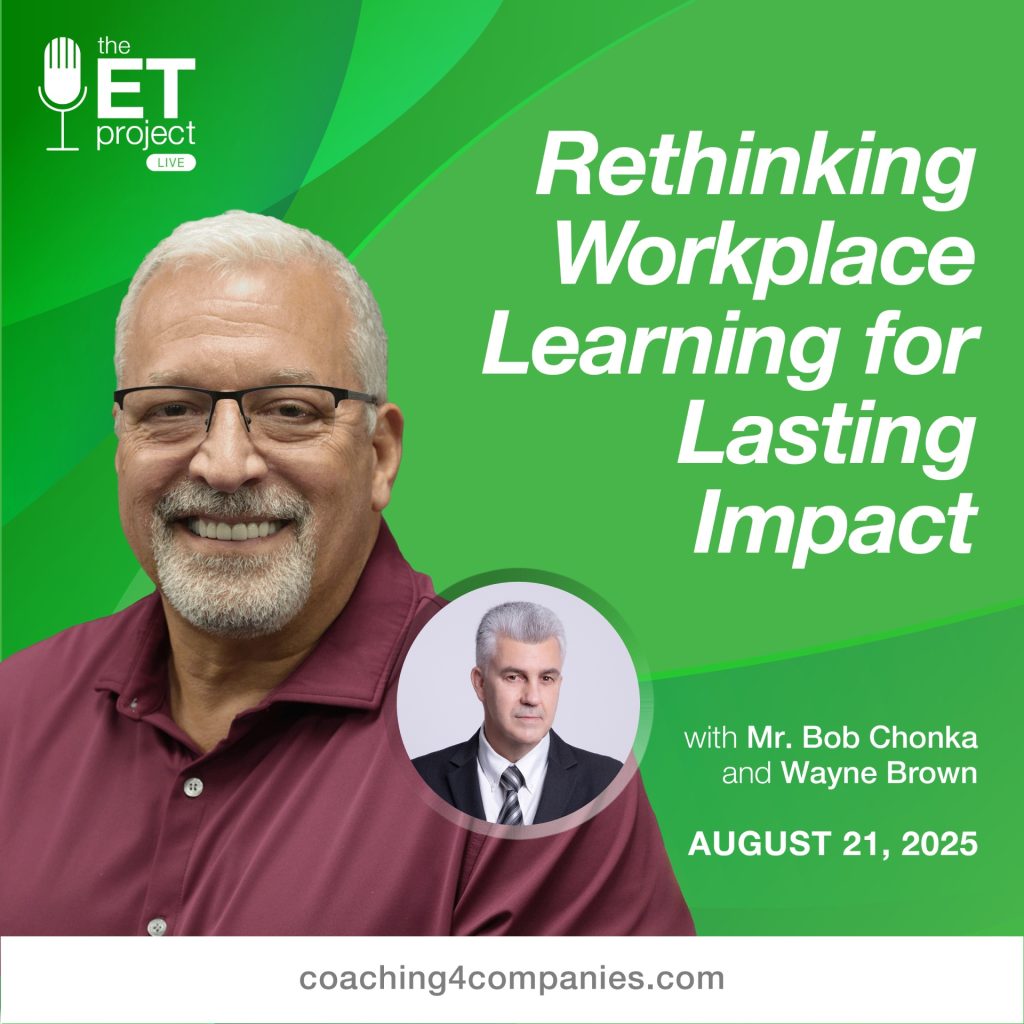
WAYNE BROWN: Hello, I’m your host Wayne Brown and welcome to the ET project. We’re delighted to be delivering this live episode for executive talent all over the world, whom we’re affectionately referring to as ‘Team ET.’ Today we’re in Des Moines, Iowa, speaking with Bob Chonka, co-leader of Sollah Interactive, an award-winning learning solutions company that has transformed workplace culture for over six million employees worldwide. Bob has over 25 years in the training industry since beginning his career in the 1990s at American Media Incorporated, the number one training film organization at the time. Bob oversees business strategy and spearheads creative development and is hands-on when developing Sollah’s Hollywood caliber video productions, leveraging advanced learning psychology, transcending conventional training models to create lasting behavioral change. This innovative methodology has proven particularly powerful in addressing contemporary workplace challenges from navigating generational dynamics to fostering authentic inclusivity. Bob’s philosophy centers on relationship building and respect, helping organizations prioritize employee success to create enduring partnerships that drive long-term value. He strives to create content that strikes a unique chord by engaging both heart and mind, seamlessly translating learning into actionable workplace behaviors. Bob complements his corporate acumen with competitive tennis and fishing expeditions, embodying the art of life and work synergies. Team, as many of you will be aware, adult education is an area where I continue to spend much of my time, be it as part of my lifelong learning journey or in the development of executives like you from around the world. This is one that you don’t want to miss.
INTRO: Welcome to the ET project, a podcast for those executive talents determined to release their true potential and create an impact. Join our veteran coach and mentor, Wayne Brown, as we unpack an exciting future together.
WAYNE BROWN: Hello team. Today I’m extremely excited. Why? Because I get to chat about an area that I’m super passionate about and that’s adult education. Let’s just spend a moment and think about your most recent training experience. I’m sure you all know the kind, right? It’s mandatory, probably forgettable, it checks the box off the list or ticks the box, but it doesn’t change anything. What would it be like though if learning at work actually stuck? What if it felt less like a chore and more like a real conversation, something that you could see yourself and feel something about and actually use what you learned the next day? Well, today we’re going to dive into what makes training truly work. Not just informing people, but connecting with them. And in my opinion, at least, the best learning isn’t about data, it’s about the emotion, the relevance, the real-life moment, and when it’s done right, it can even combat fear. It can help you build confidence and future-proof your career, which is part of what we’re all striving to do in today’s crazy world. So, we’re going to be talking about how to design, develop and deliver training that’s truly impactful. And I’m joined by Bob Chonka, co-founder of the Sollah Interactive Group, and a driving force behind some of the most human-centered learning solutions in the industry today. And I’ve had the pleasure of looking at some of the training, it is really well-class. Bob, welcome to the ET project, great to have you here.
BOB CHONKA: Yes. Yeah, it’s great to be here, Wayne. I’ve been looking forward to this conversation with you.
WAYNE BROWN: Yeah. When we first met, Bob, you mentioned the three R’s.
BOB CHONKA: Yes.
WAYNE BROWN: I don’t know if you remember, but realistic, relevant, and relatable. What’s it all about? What’s the meaning behind that? And why is it so important?
BOB CHONKA: Yeah. You know, Wayne, when you spoke a little bit earlier about the type of training that is typically experienced. So, we won’t dwell on that, what we’ll talk about is can training actually make a difference? Can it help people change their behavior? And the answer is yes. And what I’ve learned over the years, Wayne, is that if you’re going to provide information, you have to do it in such a way that they’re emotionally engaged. You think about it, anytime you’ve watched a really good movie, you’re engaged, what’s going to happen to the heroes? The hero is going to be able to win the prize at the end, or are they going to get stopped? Because you’re emotionally engaged and all that information will now come in.
[00:05:00]
BOB CHONKA: And it’s just the way we’re designed, subconsciously, when we put down the wall, because we’re emotionally engaged, we’re not restricting it, we’re not putting walls up, we’re letting that information in, and that’s true communication. So, my business partner and I, that’s the formula that we’ve come up with is E plus I equals C. Emotion plus information truly means communication because people have to receive the message. Now, how do you engage somebody, especially in adult learning in today’s world, everything’s moving so fast, everybody has so much on their plate, it’s unbelievable how stressed-out people are. So, you have to make something that they can relate to. They have to be able to say, oh, this is realistic I could see that happening, in fact, it happened last week. And then it has to be relevant. What’s in it for me? And when you can hit those three Rs, now you have an adult learner that’s engaged and wants to receive that information. And the great thing is they can apply it immediately. And as leaders, what I’ve seen over the years is when things start really speeding up, there’s a lot of information that we’re receiving, AI has really made a strong impact in the industry, all across the industries. And when you look at the economies that’s wherever you’re residing, there are so many fluctuations, there’s more stress that gets put upon their shoulders. And so, the best thing they can do is slow down, receive that type of training so that they can make behavior changes immediately for the better. Because I guarantee you, and I’ve done this before, if I’ve met with some leaders, I’ll say, “what’s the most important thing you need to do today?” Nine times out of 10, they will say, “well, we’ve got to go through our budgets, we’ve got to go through our planning, our scheduling, our strategies. What’s our marketing doing?” All of that. And you know what the answer should be? “I need to help other people.” And when they focus on their resources, which is their greatest resource, which is people, and they see how their position can impact those inside of the organization in a positive way, they are going to get great results. Because you’re going to have people in the organization that want to do a good job. They feel included, they feel valued, and it’s amazing, Wayne, how easy it is for leaders to lose sight of that, because when they’re focused on all of those other very important items, but they begin to neglect the people. And then they find themselves reactionated, putting out fires; why aren’t we growing? We only grew by 2%, we had a goal of 7%, we know where the answer is, it’s your people that are going to do it.
WAYNE BROWN: And there’s always a fine line, is my experience, if you have quality training, then it’s a much easier sell because you need the people attending the training to also be those promoting the training, so to speak. So, if the training is not the right quality and it’s giving the wrong message, then that’s also going to get back to the C-level, back to the mid-level leaders, and they’re going to say, “well, why should we bother with that?” So, there’s that mix. I think the emotion versus the information to equal communication is a really nice balancing act, not always easy to achieve by the way.
BOB CHONKA: Yeah. As you do anything, as you learn, you grow. So, I’ve been doing this for quite a long time and I have seen directly the impact that it has on people. And here’s another interesting thing, Wayne, that is interesting because of our culture around the world, it’s moving fast, right? All the information, and as I said, AI is really impacting. And how does learning happen? So, you got the three Rs down, but if you’re going to say, “hey, let’s sit down for the next five hours,” well, that’s not going to happen.
[00:10:00]
BOB CHONKA: So micro learning is very, very strategic in helping employees at all levels, whether you’re a C-level or whether you’re at the very bottom of the chain. Micro learning, because what it does, it allows that person, the adult learner, knowing that it’s going to be short, they’re willing to keep their mind focused on that item versus if they know it’s going to be two hours, they’re, “well, I’ll give it 10 minutes and then I got to do this and I got to do that.” So, when they know it’s short, you can get their attention and then when you apply the three Rs in there, they grab that information, you’ve communicated with them, and now they can immediately apply that training. That when you think about the empowerment, and that’s why I sit there and I think if I could get at C-level executives, I would always tell them, help other people, help your people, give them that micro learning, empower them so they can make really good decisions. So, they move away from reactionary to responding, they move away from unethical decisions because they’re feeling the constraints or the pressures to making ethical decisions, they move away from just getting the job done to how can I make it better? They move away from being, “I’m just a cog in the wheel here and gears and nobody cares about me,” to feeling, I’m a part of something and I can actually make a difference here, that is a lot, just because they launched micro learning.
WAYNE BROWN: Right. I guess for many people, we use language that is coming to us, Bob, but I guess we should describe what is micro learning in essence?
BOB CHONKA: Yeah. So micro learning is basically just you’re taking the information and you’re giving it to them in chunks, bite-size. I shared this analogy one time and no one ever heard this before and I was kind of baffled, but I said, “how do you eat an elephant? One bite at a time.” Yeah. And I had to explain it. But that’s basically micro learning, because if you’re going to take a deeper subject, like when it comes to compliance here in the US with harassment and discrimination, there are so many laws, there are so many variances and what most managers don’t realize is they’re an agent of that organization. So, they are liable as well. So, if an organization gets sued for discrimination and it’s found out that they were a part of that activity and not even so much being a part of it or did nothing, they also can be sued and held accountable for that. Yeah, so micro learning is, can help keep an organization and managers out of court, which is in today’s world, you know, everybody just wants to sue everybody. So, I think, and kind of go back full circle, Wayne, with C-level executives, I can feel their pain because of the pressures of trying to move an organization, but losing sight of their most greatest resource, that’s so critical. And I’ll give an example, I was asked to present to a board of directors at an insurance organization, the HR person invited me because she could not get the buy-in, she was struggling. And so, I was asked to present and I presented some situations and I said, “let’s watch this little short video.” And we begin to see three coworkers working and it just ends up really bad. And in the scene, the coworker storms off and the other guy is like, “well, fine.” And you know that they had been working together for a long time and the third employee, the female in the scene, she’s just all squirmish and going, “Ooh, my goodness, what just happened?” So, then I asked the C-level, the board of directors, and I said, “can you see that happening here?” And they all agreed. “Yeah, well, I’m sure it happened.” And then I started asking questions, now, if you do absolutely nothing, what’s going to happen to those three, how is that working relationship? Is it going to grow or is it going to start getting weaker and they’ll start separating?
[00:15:00]
BOB CHONKA: Then what’s going to happen when that employee talks to somebody about that situation? Because that’s just human nature, we want to share, “Oh my goodness, Rich and John, they blew up out of each other.” “Oh, what happened!?” Well, now that starts bleeding into your organization, you’re not helping people, you’re hurting them. How are you hurting them? You’re not providing them tools, how to deal with conflict in a positive way. And so, I said, “what if there was a tool that could help them?” And they all realized, yes, that would be helpful. And then I showed them the conclusion of how this one employee used the tool, a model, a communication model to help them work and navigate through that sticky situation. And it came out positive. And another, just one quick comment too, a beautiful thing about conflict, you know, people either want to… they’ll fight or they’ll go flight or they’ll freeze. But when you work through conflict in a positive way, working relationships actually get stronger and better. So, it should be seen as a positive thing so that the conflict turns into more of collaboration.
WAYNE BROWN: One of the things that I know about micro learning is that I often hear criticism saying because it’s so short, the risk is it’s superficial. We don’t cover enough content within the context of the situation, like you just explained. How do you overcome that? How do you deal with that to make sure that the message is still delivered, the solution, in this case, the tools are still provided? How do you ensure that happens within that bite-sized learning?
BOB CHONKA: Yeah, that’s a great question, Wayne. It really comes down to the expertise of instructional design, knowing how adult learners learn. And I’ve had conversations with organizations, because we’ll set them up with multiple micro learning courses. So, if you have a really nice thick steak, well, if you slice just the very top and you have a 16th of an inch and you put that on a person’s plate, they kind of look at that and go, “well, that’s not going to fill me up.” But if you take the steak and you cut it in slices this way, so you’re going down, but you’re going down more modular, that’s how you can be truly effective with micro learning and really understanding. So, if the topic is being an empathetic leader, well, there are so many nuances to doing that. How are you in your positive reinforcement? Are you kind of the helicopter manager that comes over and goes, “hey, Sarah, come on, I thought you were going to get that report done today.” Or are you going to be that positive manager that says, “you know what, Sarah? I’m just so grateful that you’re a part of this team and the reports you put together are so accurate and wonderful, you fill in the details just wonderfully, where are you at with that report that we need to get out today?” That’s a huge difference. So that’s one part of an empathetic leader. Then you move on to how are you an active listener? So, you just start going down the categories of what really is an empathetic leader. And it’s interesting that topic because most organizations don’t have empathetic leaders; it has been seen as kind of a weak, it’s been seen as a touchy feely. And it can’t be so opposite of that, it’s such a great way to lead people, is being an empathetic leader, because you’re going to be positive, you’re going to have true active listening. And here’s a piece that I think has been missed for many years, and I go back to when I go back to when I was dating my wife at the time, before we got married, I was asking curious questions; what’s your favorite color? What ice cream flavor do you like? What kind of music do you listen to? Developing the relationship so that we can get to know each other. You to take that into the workplace, we should be asking those curious questions so that you can develop a strong working relationship.
[00:20:00]
BOB CHONKA: And I don’t care who it is, but when somebody asks a question about you, you feel good and you want to share and you start trusting that person, and that’s a major thing that can be developed by being an empathetic leader.
WAYNE BROWN: It’s truly an interesting point Bob, we did some research at one stage several years back and we asked the question to those in the training, how many of their bosses, how many of their leaders spoke with them about why they were coming to the training in the first place and then how many would follow up after the training to find out what they learned, how they could apply it. And we ended up with statistics around 55-60% and the relevance to that survey was the internalization of the message of the learning was so much better received because the people in the training felt appreciated, they felt they understood the reason why they were there and what was expected of them and they could take away the right message and put it in place and it all comes back to that empathy and compassion and building that strong team. So, there’s so much value that comes out of it. My own feeling is empathy gets a bad rep because it’s one of those buzzwords, right?
BOB CHONKA: Yes
WAYNE BROWN: And you know, Brene Brown talks so nicely about it, you hear a lot of people talking about it, but managers today are in this crazy space trying to do everything to stay afloat and quite often empathy is one of those things that gets thrown out like the baby and the bathwater type thing, but it is truly, truly important.
BOB CHONKA: Yeah.
WAYNE BROWN: I mentioned to you just before we hit record that I downloaded one of your guidebooks, your ebooks, and it talks about some of the most common mistakes that organizations make, particularly on training, right? When they’re trying to customize the training for their culture, you list seven different mistakes and I’m not going to go through them all now and I’m not going to put you on the spot and ask you to repeat them, but is there anything in that that really stands out to you that our listeners who are predominantly leaders, right? So, we’re talking to the end source, the sponsor of the training, is there a message there in that list of seven that really resonates and you think is important for them to know?
BOB CHONKA: Yeah, I would say, you know, I guess I would start at the top, you know, the C-level management. If you just go into the hallways of any organization and talk and you ask these employees, “are those folks up in the executive offices, are they in touch with reality? Do they really know what we go through?” And most of them say, “they don’t have a clue,” because they’re so out of reach, they’re so far up, they’re unapproachable. So, when you flip it and you have the C-level encouraging, endorsing training, that will radically change how the employees look at the training, because they’re going to see it as, “hey, they actually want to help us. They’re providing more tools for us. They want to make our jobs more easier and we can be more efficient. We can be more creative and innovative. They’re giving us that empowerment, that freedom to actually try to do a good job.” So that’s probably the biggest mistake is they don’t endorse it, they don’t promote it, they don’t communicate it, and a lot of the problems is they see it that way themselves. Well, let’s just roll out the sexual harassment trainning, get it done, get it over with. And when they don’t understand that even a topic like sexual harassment here in the States, how you approach it can actually make a positive difference versus it being, “hey, don’t say this, don’t do these things, that’s wrong.” When you can actually show how it can impact other people because of someone harassing, targeting somebody or many people, how it’s disruptive, how it’s contagious, the negativity, and how it will actually make their lives worse. So instead of that, you are now more proactive, you’re more aware, recognition, you know how to respond if you see it, you know what to do.
[00:25:00]
BOB CHONKA: And when a C-level executives share that, that changes the whole perspective of why they’re going through that type of training, I can’t say enough about endorsing C-level. And sometimes I wonder if there’s lack of humility for some of these leaders, I don’t need this training, but let’s give it to our employees, they need this training. And like I said with the example, I gave some questions to the board of directors, they saw the errors of their way because they had been so engulfed in all of their responsibilities and not paying attention to the people. And I will just keep preaching this till the day I die, it’s about help others, when you do that, it changes everything in your decision-making, it will change in how you think in strategic terms, what needle you’re trying to move, are you trying to move creativity, innovation, are you trying to help improve processes within the organization? Are you trying to capture more market space? Are you trying to give yourself a competitive advantage? All those needles that you want to move has to happen through your people, help them.
WAYNE BROWN: And to that end, one of the three Rs, the relevance of the training. So, you need to make sure that the training people are going through is relevant to the needs of the business in that moment. One of the biggest push-backs that I used to hear was, we don’t have the time for our people to stop doing the business, to go away and do the learning, and Stephen Covey’s expression, ‘you need to stop and take time to sharpen the saw’ or the axe, to be able to improve the productivity of chopping down the trees, right? It’s the same premise for me. If you don’t give the people the opportunity to pause, to breathe, to learn, then the growth of the company is not guaranteed because you’re shutting down innovation, you’re shutting down creativity, you’re shutting down productivity. All of these elements come out of that opportunity. So, I think we’re on the same page by the way.
BOB CHONKA: Yeah, Stephen before he passed away, I was very fortunate, I got to meet with him and chatted with him for about a half hour, he was a fascinating man. And one of the things that I had learned was the slow down, because he would ask me all sorts of questions when I was much younger, and I was much more energetic, and I wanted to go, go and I wanted to take my business, and I wanted to grow it into a multimillion-dollar business, and I was so focused on that. And he asked me those questions and he said, “what’s the most important thing you need to do today?” And as I said earlier, my brain went to all of the tasks that I need to get done and he just said… and if you remember one of his, I can’t quote it exactly, but if you put the corporate ladder on the wall and you’re trying to climb it, but what if you’re on the wrong wall, right? So, you climb it up and you’re like, “oh, there’s nothing here.” And that’s what he was really trying to drive for me to really understand, slow down, where are you going to put that ladder? And what’s that goal? What are you trying to achieve?
WAYNE BROWN: Exactly. That goes back to my research and my point earlier about, the leader actually having a conversation with the participants of the training to help them understand why they’re going through the training, what is expected of them as a result, right? So, there are so many factors that play into this whole scenario. And I think for leaders, we see the broader benefit, but it’s natural for leaders not to be focused on learning like we are as learning professionals. And therefore, it’s our job to help the leader understand those benefits to your point, right?
BOB CHONKA: Yep. There’s a key word… Oh, I’m sorry.
WAYNE BROWN: No, please, go on.
BOB CHONKA: Okay. We’ve been throwing that word relevant around, here’s a really interesting perspective I think when I see happening in our world today, is that there’s a fear of being obsolete, this FOBO, and the lack of being relevant because if I’m being obsolete, I’m no longer relevant to my position, to the organization.
[00:30:00]
BOB CHONKA: Now imagine the C-level, the communication comes down and says, we want to provide this training to keep you relevant, to keep your skills, master these skills and to upskill, give you some new ones, we want to keep you relevant. Think about the impact that would have on an employee, a manager, I mean, frontline manager, middle manager, upper management, that message comes to them, that’s going to lock them in, they’re going to want… this is an organization I believe in, this is an organization I want to stay, this is an organization where I can learn and grow. And here in the States, our resources are minimal. So, the way you’re going to get new employees is basically get them from other organizations, the unemployment pool is pretty much empty and you don’t want the other organization getting your employees, so the whole retain, attract, really keeping those employees and that will actually attract more.
WAYNE BROWN: I love the collaborative approach as well. Even asking your employees, what are the skills that you’re lacking at the moment to do this job and to excel in this job and get there by and to start with. And then they’re going to be really aligned with it. One of the things we spoke about, Bob, is micro learning and there is so many different forms of learning that are applicable that you can use in micro learning. And in your case, and in your business’s case, you use a lot of cinematic Hollywood caliber productions, if you like, what’s the purpose behind that?
BOB CHONKA: Yeah, that’s another great question. This is really an interesting concept, years ago, when I got into this industry, when you go to a theater, the screen, much wider, not as tall as compared to the television, now television has gotten much closer to theater screens. Now, the concept was when you go to the movie theaters, you’re there to be entertained, those walls are down and you’re… I want to enjoy this. So, it’s the same concept, people look at Netflix, Prime, Hulu, Disney, look at the quality of programs they get to watch. So, when they watch it, it’s for entertainment, the walls, their guards are down. So now here they are in the workforce and they see something similar, same quality, same approaches, subconsciously, “oh, hey, what’s this? I’m interested.” The walls go down, they’re not as guarded and they’re open. And in micro learning, one of the tricky things to do, because you have a short amount of time to keep their attention, you tell them what you’re going to tell them, tell them and then tell them what you told them. When that happens, so right there, right up front, when you tell them, this is what we’re going to be talking about, you get their buy in. Oh, okay, yeah, this is relevant. Yeah, I do want to know, what truly is an empathetic leader. And then you start telling them and then you give them quickly to be able to process and digest what they heard by telling them what you told them, that helps the adult learner then to be able to walk away with that information and then begin applying it. And that is one of the, I think, the lost art of a lot of training, because we’re all after behavioral change. But if you don’t give the adult learner, you don’t set them up for success, how can you expect behavior change? I think back when I was… I raised two boys, when I first got out there, out in the yard, I wanted to teach them how to throw a baseball, what did I do? Did I tell them everything about how to throw a baseball? No, I started in micro learning, here’s how you hold it, I started there. So, it’s the same concept. If you can give them in micro learning, you’re going to get them to be a famous baseball player.
[00:35:00]
WAYNE BROWN: Yeah, it is truly a great approach. The art of storytelling, of course, is foundational in the form of communication. One of the things for adult learners that is often overlooked by, I won’t say the learning fraternity, but by many leaders, is that we have that experience. You know, we often talk about the 70-20-10 from a learning perspective, and the 70% is that experience space that you have in your daily tasks, your activities. How do you factor that in? The fact that adults are coming to sit in a training class or do a micro learning, they already come with their own experience, therefore, they’re going to have their own biases, their skepticism, all the things that go with that. How do you respect that, that they had that experience, to open them up to learning?
BOB CHONKA: Yeah, that’s another great question, Wayne. One of the things that I’ve learned right away is when you talk at people, you’re going to lose them. Because they’re coming already with their preconceived ideas, they have their biases, they have their prejudices, they have their stereotypes, everything, all of their experiences, how they were raised by their parents, what cultures they were part of, what religions, faith-based, whatever it might be, all that’s coming. And you start talking at them, “hey, this is the way to…” blah, blah, blah, done. But when you talk to them, I understand your world as a manager and all of these responsibilities, here are some ideas to consider that may help. And then when you begin to show them, and you see it played out, that’s when they go, “ah, aha.” Or you get another response of, I knew that, I’ve known this, and now I need to get back into practicing this. So, it really is… you have to be very careful on how you present and communicate because of… I mean, we’re all so unique. I mean, one of the things is right now in our culture, we have four generations, and the majority of the generation are the two youngest generations. Well, they do not operate like the other two generations, there are some major differences of what they value and how they communicate and what they expect at work. And one of the biggest ones, and this is why C-level really needs to understand this, that our current, the majority of how organizations are set up, is the CEO and vice presidents and so on, that’s a military structure; generals, colonels, majors, captains, et cetera. Well, the two new youngest generations in the workforce, they do not like the military structure, they want an even flat. Now, does that mean they’re right? Not necessarily, but there’s some understandings that executives higher up, even upper-level management, even mid-level managers need to understand that you can’t operate this way, but you can all depending on how you relate to them, how you talk with them, how you give them tasks, how you give them direction, it’s… Wayne, we could probably have a 24-hour, if we could stay up 24 hours and go through all the nuances of what upper management needs to know, what mid-level, and you know, everything I’m sharing, I truly hope that anybody listening to this and watching this will begin to say, “you know what? I can do this. I can put this into practice. I can slow down. I could be curious and learn about people that report to me. And above all, every day when I wake up, my first thought should be shut off all the tasks, I’m going to help somebody today. I’m going to help somebody,” that will radically change their life and those around them.
WAYNE BROWN: 100%, Bob, I totally agree. There’s another element that I wanted to throw in there as well, because I think this is also important and often overlooked. I don’t know if you’ve heard of the forgetting curve, Hermann Ebbinghaus, and the whole concept of we learn something and it’s very easy to forget it.
[00:40:00]
WAYNE BROWN: Now, micro learning helps overcome that challenge because you’re giving it to them in bite sizes, therefore, you’re not saturating their short-term memory with too much information, but it’s still a relevance in that spaced repetition. So, repeating the learning over a period, maybe an hour, maybe a day, maybe a week, whatever, is going to help deepen the retention on that learning point. How do we address that as learning professionals? How do we ensure that adult learners have that ability to be able to hear this message more than once?
BOB CHONKA: Yeah, again, this ties back to the C-level, the buy-in, because everything you said is spot on. The adult learner, I mean, anybody, you just ask yourself, if I see it one time, am I going to master that now 365 days of the year? The odds are no, I need to see it again and I need time to practice it.
WAYNE BROWN: Right.
BOB CHONKA: So, in fact, I’ve had conversations with large organizations, we’re talking, over 100,000 employees, and they talk about how they want to change the needle. We want to go from this type of culture to this, and what do you have? And I first immediately, I say, “first of all, one and done training doesn’t exist, it doesn’t work, it’s not effective. We want to be a partner with you because we want to be able to work alongside of you and help you in blocking out the moments of repetition, when they occur, how they occur, how often they occur.” Those are so vital because if you’re truly wanting to help that person, that employee, that goes all across your organization, you have to introduce them to the topic, you have to give them time, some skill, they can begin applying. And we know the greatest learning… we have the maximum amount of learning through mistakes. And when you give them permission that they can make those mistakes, and they’re going to continue to get more training, you’ve set them up for success. And you will get buy-in from those employees. So, repetition, Wayne, without repetition, you’ve just wasted your time, your resources, it doesn’t make any sense, but with repetition, absolutely.
WAYNE BROWN: I fully agree, Bob. And you highlighted a point there that I will reinforce, quite often, I experienced people would come to a specific training, only to go back to their workforce, or back to their workplace, where the process or the system was a different system to what they have just been trained on. And therefore, it was just a total waste of time, we might have given them a nice solution, but they couldn’t apply it. They had no way of repeating it, putting it into practice. So, it was just a time out, basically. So, there is so much for the leaders who are listening to really understand that… my own advice, and I’m sure, Bob, you’re on the same page, is you need to be communicating at the first instance with your learning managers, even with those people providing the training, to absolutely understand what’s in the training, what’s the value of that particular training, and is it right, that’s the first point, once you’ve got to that point where you’re ready to provide your training, you need to make sure it’s the right training.
BOB CHONKA: Yeah, absolutely.
WAYNE BROWN: The final element, if you like, or the final phase, again, I see overlooked so much, is the measurement of the impact or the ability to really look at how do we evaluate the training that has been delivered and the impact that it has had on our business. And there’s many models out there. I mean, Kirkpatrick, probably one of the most popular, most famous, not always easy to implement from a learning perspective, but for the company, maybe. Any suggestions on how companies can really start to measure the impact or the progress that they’ve made?
[00:45:00]
BOB CHONKA: Yeah, that’s the million-dollar question that all organizations want to know, is what’s my ROI on my training? And there is no magic formula that’s going to capture it. But what organizations can do is be very strategic in terms of how are they going to capture those behavior changes? That’s where the frontline managers, supervisors are vital because they’re working with those people shoulder to the shoulder; they see the changes, they see the nuances, they see these coworkers working together. There’s surveys and the surveys… and this is also another little slippery slope, I’ve seen organizations put out surveys, but it’s already preconceived, they want to hear what they want to hear, instead of asking very open, honest questions; what part of the training did you enjoy? What part are you using? Have you been able to practice it? Are you seeing changes in yourself? Are you seeing changes in others? Give us a scale of… let’s do a one to five, one star, five star. Do you feel that you’ve been able to be more creative? Do you feel like your ideas are now more? Are you able to share those ideas because of the training? All of those things, they can basically take the pulse and temperature of the organization and you do it before, you do the training, and then you do it after. And we have recently, there was an organization that asked about how can we do this? And we shared those concepts during the medical field. So, there are some other things they can do to acquire information, how effective was this training? Are we changing the environment, the culture, our patient care, our customer care, which that’s what gets lost a lot of times too is how are you caring for one another in the organization? How respectful are you being? If organizations can get a little bit more open, honest, and ask true questions and give them permission, the employees, to actually express these things, you’re going to find out how well the training is, whether it was effective, somewhat effective, or it was a waste of time. Obviously, I invest my heart and soul into making training that will impact people, that will make a difference. And the effectiveness, the ROI really depends on how well they did in their repetition, how well did they do in their reinforcement? One of the great things they can do is huddle discussions. There are so many pockets when you’re in team meetings, when you’re put on a team, you have those moments where they can talk about that. And only within three to five minutes, it’s amazing the healthy conversations that can take place and will impact the organization in an extremely positive way, especially when you give the younger generation a voice, because it’s nothing new under the sun, older people think, well, I’ve got all the years of experience and you don’t know anything. And the young people are going, there are so many new ways we can do things, you’re stuck in your old ways. Well, what happens when the two merge? Well, now you’ve got years of experience and you now couple it with fresh new ideas, that can be tremendous. There could be a lot of cost savings that take place because there’s new processes that are put in place that will save lots of time and money. When I look at the ROI, it’s how well did they execute? How well did they communicate? How well did they plan to help their employees be more successful?
WAYNE BROWN: And you’ve mentioned two words that are really at the core of all learning managers’ dialogue and psyche, which is behavior change. I know from a leader’s perspective, that often sounds strange, what do you mean, Bob? We’re trying to change somebody’s behavior through training? Well, at the core, that’s exactly right. Do you want to talk… what do you mean? How is it we’re changing behavior? Well, I mean, I thought we were here to give me new knowledge, give me skills. What is it you mean?
BOB CHONKA: When you think about it, I always love this, okay, let’s just take this character, Jonathan.
[00:50:00]
BOB CHONKA: Jonathan shows up to work and Jonathan is on his phone a lot. He’s checking his email and someone comes up to him, “yeah, yeah, yeah, yeah, yeah, I’ll get that to you later today, no worries, chill, it’s all good.” Right? And back on his phone. Like, that, blah, blah, blah. Okay, paying Jonathan X number of dollars to do what? He’s kind of just getting through the day, just kind of doing his thing. So how is he talking to his coworkers? How is he seeing himself in the organization? So, now, Jonathan starts getting the skills and he’s starting to see and he relates and he sees how relevant and it’s realistic when he receives that training. Now all of a sudden, Jonathan sits there like this, and he goes, “oh, you know what? This can wait. You know I’m thinking about these reports, they’re coming from different places.” Now the employee, the other coworker comes up and says, “hey, how about we do it on this one project,” instead of saying, “hey, it’s all good, chill out.” Now all of a sudden Jonathan is being respectful, “Sarah, you know what? I’m glad you asked, because I’ve actually been struggling a little bit trying to get this report finished. Do you have any insight on what I might be able to do differently?” Now all of a sudden Sarah is getting impacted by Jonathan’s behavior change. And now Jonathan goes to a meeting a little bit later in the afternoon and he says, you know, I’ve been thinking about, we’re getting reports from this division, this division, this business unit, et cetera, could we set up a platform where all of those reports can go and we, one person or maybe two, we’ll figure that out, can administer all of those reports and summarize it for us? Let’s use AI to help us with that. Look at the behavior change that has happened to Jonathan. Now the next day he wakes up, now Jonathan is actually going, “I’m going to work today.” He’s excited to go to work, he’s glad to be there, he’s happy, he’s now enjoying the coworkers and they’re enjoying his new ideas, he’s hearing new ideas. Do you want behavior change or not, Mr. C level? I would.
WAYNE BROWN: Thank you for elaborating on that because I think that’s something that leaders probably don’t look at training as providing, but it is at the core of good training. We’re really tight on time, Bob, but I can’t not ask this next question because I think it’s important, if we look at the transition that’s happening in training, we’ve come from that traditional classroom-style move to more virtual-built, et cetera, micro learnings. The platforms we use, LMS now moving to LXP or more frequently corporations can create their own playlists, where do you see the future? What do you see happening?
BOB CHONKA: Well, micro learning is, is definitely going to continue to grow. In fact, I don’t want to sit here and promote me and myself, but what we’ve done is we’ve created a family of products, the ‘why it matters series.’ And that answers the question right away, why does sexual harassment prevention matter? And the learners then are going, “yeah, why does it matter?” And then when they begin to understand it and you engage them. So, the micro learning is going to continue to grow and how you develop those micro learnings is going to be very critical to helping an organization be successful, is they have to embrace it and release it to their organization. And again, it’s being very strategic, how and when and how often do you provide the micro learning? So micro learning, I think is also going to impact one-on-one meetings. So, when managers are talking to the employee one-on-one, having those micro learnings before they have those conversations with that employee, whether it’s someone with a difficult attitude or someone that’s not performing up to the level, or there’s some sort of behavior changes that need to take place, you know, they’re absent too often, they’re late, whatever the cases may be.
[00:55:00]
BOB CHONKA: So that micro learning needs to be available down into the grassroots level, as well as looking at the organization as a whole to upskill, that to me is… that is where micro learning can really do is upskill. So, you can reinforce what skills they have, but then you can raise their skill level, raise their skill level, keep raising it. And results is, they’re going to feel like you’re actually investing in me, so, I feel a part of this, and you’re going to get a greater return from that person. You’re going to increase their sense of being relevant in today’s world, it’s rapidly changing. So, the benefits just go on and on and on. It’s like it makes absolutely no sense to not use micro learning. So, we’re excited about it, that’s what we’ve been investing predominantly all of our resources to develop more and more, the micro learning.
WAYNE BROWN: Where can people go and see what you’re doing, experience some of the learning themselves to get a feel for what we’re talking about? Where’s the best place?
BOB CHONKA: Yeah, and just go to sollah.com. Once you get there, then you’ll see that there’s a link that you can go to our library that contains everything that we have produced, from e-learning courses to videos to workshops, all the support materials. We do a lot of the heavy work for people because we want the organization to be able to take that training and be able to release it right away.
WAYNE BROWN: I think I read somewhere you have something like nine and a half thousand asset items within your library of training.
BOB CHONKA: Yes. And that’s an interesting thing that we’ve done, which makes us very unique, is when we produce these, I’ll just call them short films with multiple situations, we take that full length video and we cut it up into those separate little vignettes, that allows an organization to say, “you know what? We’re struggling with this.” Now they can take that one vignette, use it as a micro-learning, get it out to their employees and make an impact immediately.
WAYNE BROWN: Yeah, for sure. And if they want to connect with you directly, Bob, how do they?
BOB CHONKA: Yeah, they can just send an email to me. My email address is bchonka@sollah.com. I’d be happy to engage in a conversation with them.
WAYNE BROWN: Excellent. Well, we’ll definitely leave a link to all of that. Bob, a great conversation, we’ve literally just scratched the surface, we’ve gone very broad, we’ve touched on a lot of topics, but we’ve only gone surface level. There’s so much more to discuss, so I’d really encourage everyone to check out Bob’s library of learning opportunities, it’s quite phenomenal. Thanks for being on the ET project, Bob.
BOB CHONKA: Thanks for having me, Wayne, it has been a real pleasure getting to know you.
OUTRO: Thank you for joining us on the ET project, a show for executive talent development, until next time, check out our site for free videos, eBooks, webinars, and blogs at ‘coaching4companies.com.’
[END OF TRANSCRIPT]