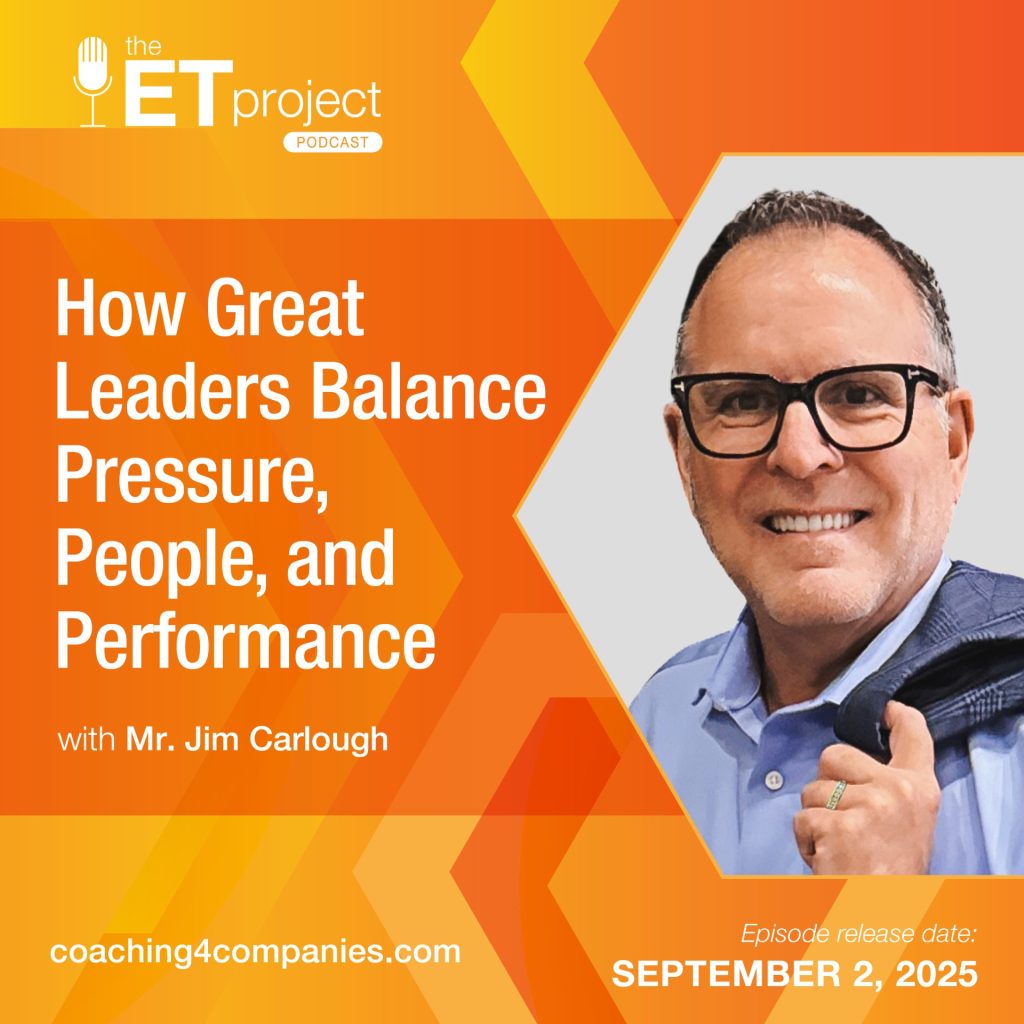
WAYNE BROWN: Hello, I’m your host, Wayne Brown, and welcome to the ET project. We’re delighted to be delivering this podcast for executive talent all over the world, whom we’re affectionately referring to as ‘Team ET.’ Today, we’re in Dallas, Texas, chatting with Jim Carlough. And with over three decades of leadership experience, Jim has become a recognized figure in the world of business strategy, leadership development, and organizational transformation. As an author, professional speaker, and leadership mentor, he draws from a vast career, helping healthcare organizations achieve measurable growth, revitalize underperformance, and create cultures grounded in excellence and resilience. Jim’s career trajectory showcases a consistent thread of performance-driven outcomes rooted in people-focused strategies. His ability to navigate complex business challenges while building high-performing teams has earned him a reputation as a transformative leader. Having worked across varying corporate landscapes, he has developed a comprehensive approach to leadership that integrates structure, empathy, and accountability. A central element of Jim’s professional identity is his philosophy that leaders aren’t born, they’re developed. This idea forms the backbone of his book, ‘THE SIX PILLARS OF EFFECTIVE LEADERSHIP: A ROADMAP TO SUCCESS.’ In it, he outlines a systemized method that helps individuals identify, cultivate, and sharpen their leadership capabilities. The six pillars he presents focus on actionable traits, as well as behaviors that can be nurtured through experience, feedback, mentorship, and commitment to personal growth; and you’ll hear us speak at length about this. His strategic insights are not confined to theory alone, having been instrumental in turning around struggling business units and scaling operations, Jim offers grounded perspectives shaped by challenges that he has overcome and lessons learned along the way; this unique vantage point allows him to advise leaders with a deep understanding of what drives people and performance. So, team, this conversation is grounded and practical, making it suitable for all levels of leadership, I know you will all enjoy.
INTRO: Welcome to the ET project, a podcast for those executive talents determined to release their true potential and create an impact. Join our veteran coach and mentor, Wayne Brown, as we unpack an exciting future together.
WAYNE BROWN: Hello team, welcome to another episode. Today we’re going to be exploring what it really takes to lead in sales, not just when the numbers are up, but when the pressure is on, when the team is stretched, and the path forward isn’t always as clear as you might hope. Sales leadership, for me at least, has never been just about the quotas and the pipelines, at its best, it’s about people; how you show up as a leader, how you support your team, and how you stay grounded when everything feels like it’s just moving too fast. To help us unpack this and dive deeper into it, we’re joined today by Jim Carlough, a seasoned sales leadership executive, as well as the author of ‘THE SIX PILLARS OF EFFECTIVE LEADERSHIP.’ We’re going to explore how Jim’s six pillars don’t just sound good in theory, but actually play out in the real, messy, demanding life of a sales leader. So, Jim, thanks for joining us and welcome to the ET project.
JIM CARLOUGH: Well, thank you for having me, Wayne. I’m really, really excited to be here today and talk about things that I love; sales, leadership, and how to impact others.
WAYNE BROWN: You have a really interesting long journey, several decades now, primarily in the health industry, health insurance through to healthcare and tech. You’re currently the Chief Sales Officer at mPulse, I believe, and all the while you’ve been mentoring your team, mentoring other leaders, writing about leadership, what inspired you to crystallize your experience into the book?
JIM CARLOUGH: Yeah, so I was sitting around two years ago and I started to think, age is catching up with me and what am I going to do when I retire? I was in a conversation with my wife and I said to her, I said, “I like to fish, but I can’t go fishing every day, that’s not mentally challenging.” So, I thought if I’m going to give back and find something that I love and am passionate about that I could have fun with, what would it be? And I said, “you know what? I’ve been doing this mentoring thing for free for years, why couldn’t I do something that could help people and potentially get paid for it and have fun at the same time?”
[00:05:00]
JIM CARLOUGH: And so, as I started to explore and do this and started speaking about it and speaking about leadership, it occurred to me I’d add a little bit more credibility if I had a book to go along with it. So, I sat down and started to write out a list of all of the characteristics that I think make a great leader. I had a list of like 15 to 18 items and I said, “oh boy, I can’t do that, I can’t write a book about 15 to 18 things and expect people to implement it.” So, I started whittling it down until I ended up with six that I felt were core things that have endured the essence of time in my own career and are still applicable today even if I started learning that pillar in 1983. That’s really the emphasis behind it and it’s interesting because it’s creating quite a following. And I’ve had people from actually your part of the world, Japan, over in that neck of the woods, buy a copy of my book. It has sold well in India and other places and as well here in America. And so, I’m pleasantly surprised because I’ve crossed over that 1000 or 2000 kind of benchmark for book sales; I expected only to maybe sell 50 or 100. And ironically, I haven’t done any advertising, what I have done is I have been on fellow podcasts similar to yours that focus on leadership and different things in that nature. But what really has struck me funny or odd is its appeal has gone outside of corporate America. I’ve had teachers, I’ve been on a podcast for teachers, a podcast for principals of schools. I was even on a women’s stay-at-home moms podcast and was invited on it, and at first, I said to the interviewer, the podcaster, “I don’t know that this is going to resonate with your moms.” And she said, “you know what? The two things I hear from my moms all the time is, how do I show compassion and empathy to my kids?” And she said, so it definitely resonates with that audience. So anyway, it has been a fun ride and I can’t wait till retirement when I can do this full time.
WAYNE BROWN: You often say in the book and other areas that I’ve read, that leaders aren’t born, they’re developed. So, within the context of the high stakes world of sales, quotas, commissions, competitions dominate typically, right? How do you reconcile the developmental mindset with the pressure to perform? Typically, we have to hit the ground running, we have to make sales immediately, how do you bring all that together as a leader who is still developing? There’s an expectation, you come to the batting pitch or whatever acronym or metaphor you want to use, but there’s an expectation you come ready to play. But in this case, we’re saying leaders really need to develop over a period, how do you reconcile that?
JIM CARLOUGH: Yeah, so what I see here in America, and I’m sure it’s the same way in other parts of the world, we take an individual contributor, let’s say a salesperson who has knocked it out of the ballpark year over year, and we go to them and say, “Wayne, we’re going to make you a manager.” And the world changes now, Wayne, because you don’t get the commission level you were getting before, but you’re going to have a bigger responsibility and get something from everybody. And they’ll shake your hand, give you a pay raise, and they wish you good luck. But nobody gives you a roadmap for the things you’re going to run into. You know your product, you know financials, you know how to measure sales, you know what forecasting is, but do you know how to manage people? And what are the things that you’re going to have to do to be able to juggle the balance between financial results and human behavior and life lessons and all of those things? And I think it’s important to ground yourself as a leader and understand where your strengths and weaknesses are. You don’t think of these things, business school doesn’t teach you compassion, right? You got to learn that by being in the day to day and being down in the trenches with your field organization or your sales organization to understand what they’re going through.
WAYNE BROWN: Right.
[00:10:00]
JIM CARLOUGH: And so, I wanted to make sure that in all of the organizations that I’ve led, that people understand some things that are really important for them to be able to look out for. And it’s not just managing by the numbers and sales, it’s managing by the numbers and setting the expectation, but setting kind of the framework for which to work in. And I’ll give you an example, my number one pillar that I say is non-negotiable is integrity. I learned integrity… that pillar there is a point in time in my life where I remember it because it hit me like a baseball bat upside the head, but I had just won a political election in the city I grew up in. I was 22 years old and I ran for city council and I won. A couple of weeks later, I mean, we’re talking November of 1983, that’s a long time ago, and the city administrator asked to see me, so I went in to meet with him. He congratulated me and he told me he was happy that I won because I was a smart young guy and he wanted to give me some advice or actually he asked me if I would do him a favor. And I said, “sure, what is it?” And he said, “every night when you lay down to go to sleep and you put your head on the pillow, I want you to ask yourself one question. And that question is, did I do anything today for my own personal benefit that was at the expense of another individual, group of individuals or organization?” And he said, “if you say yes to that question, you need to do two things right away. Figure out how to unwind it if you can, or two, or and also two, never do it again.” I have not only led my life by that, I ask myself that question every night before I go to bed to this day. And I teach that to the salespeople that I work with because nothing starts until you establish credibility and trust. And whether you’re a CEO or a salesperson, you have to establish that level of trust before anyone is going to buy something from you. And if you walk in and just start promoting the goods and services that you have or whatever you’re selling without first listening, without first establishing a rapport and getting to know the person you’re dealing with and working with, you’re not going to be successful at anything. And that’s the very first thing I teach them. So, integrity is not just dealing with the customer too, I want integrity with what they put into salesforce, I want integrity in the pipeline that they’re forecasting, right? It transcends everything that that salesperson deals with. And they’ll be a lot more successful if they can establish that level of trust.
WAYNE BROWN: It sounds like there’s an underlying current there that we as leaders first need to be self-aware. And I guess that’s one of the things that really helps separate a manager from a leader is when they’re fully conversant with who they are, they’re able to make that transition easier and lead people versus the leaders who call themselves leaders who haven’t really established that awareness. What’s your thoughts around self-awareness and the importance of that?
JIM CARLOUGH: I think it’s critical. In fact, what I tell people that I mentor is you have to be able to read your employees better than they can read themselves. Even though my degree is in psychology and it’s only a bachelor’s degree, which doesn’t get you much in terms of financial rewards, but you have to be able to detect when one of your employees is having an off-day, not necessarily a bad day, but an off-day. Maybe their child is ill, maybe a relative is ill, there’s something going on that’s causing that. And it may be just that they’re not walking around with their chin up and smiling like they did yesterday. And they’re just walking the same pace, but their head is just tilted down. To be able to spot things like that and to be able to say, “hey, Bill, can we talk about it? Something is off with you today,” and encourage them to talk because the longer they keep it inside, the worse it’s going to be for them to deal with it. And that awareness, you have to be aware of your own emotions to be able to detect it in somebody else.
[00:15:00]
WAYNE BROWN: Right. Let’s walk through the six pillars. We’ll get the overview of the six pillars first, and then we’ll dig into each one. You’ve already mentioned integrity, what are the other five?
JIM CARLOUGH: So, after integrity comes empathy, compassion, focus, stability, and the one that raises everybody’s eyebrows when I tell it, humor. But let me start with humor because I’m sure people who are listening are going to say, this guy is a crackpot, but I’m not suggesting that the leader has to be a stand-up comedian at the water cooler, that is not it at all. But I use humor in specific situations; I use it to kick off a meeting, I use it to redirect at a meeting, I use it to reduce stress and anxiety or at a time of conflict between employees. And you have to be careful with humor today because society is hypersensitive. So typically, my humor is self-deprecating humor about something stupid I did, which there has been plenty of stupid things that I’ve done. But the reality is people then realize that I’m human like they are. When they see that their leader has a human side to them, they become more trustworthy of the leader and more supportive because the leader is just one of us.
WAYNE BROWN: Particularly in a high-stress environment. So, we’ve got integrity, humor, what are the others?
JIM CARLOUGH: Compassion. Let me give you an example because this happened a while ago, but I had an individual on one of my sales teams. And as you and I have talked before, I’m very focused on KPIs and pipeline management and really measure and manage by that, especially the sales organization. And he was going through a rough time, he was going through a divorce, it was amicable, but he was caught by surprise by it. They had a child, they were working through the details, and his results plummeted, his activity plummeted. And I knew even before it got to that point that there was something going on. And we got ready to do annual reviews. So, this is a year or more ago, and I knew he was stressing over that. And so, I put some time on the calendar and I called him and I said, “I’m throwing 30 minutes on the calendar, it is nothing bad, but I want to have a conversation with you, but I don’t have time today.” So, we got on the phone and I said to the individual, I said, “look, you’re going to get an annual review and I know you think you’re going to get fired, you’re not going to get fired, you’re going to have a decent review because of what you’re capable of. But what’s going to happen is you have a year to figure this all out. You’ve proven yourself over the last seven and a half years that I’m going to give you the time for you not to have to worry about these metrics and just focus on you, your daughter, and how you move forward.” You could see the life coming back into his face, he was totally not expecting that and totally expecting the total opposite because I’m a hard driver, I’m quick to make a decision, but he had proven himself year over year, we owed that to him. And so, to me, that’s compassion, being able to understand and being able to help him through that situation, I couldn’t change it, but I could remove the stress.
WAYNE BROWN: I can imagine another one is empathy, and I’m just sort of thinking about what is the difference then between empathy and compassion, they’re very closely aligned, it would seem.
JIM CARLOUGH: They are closely aligned. I, like everyone else, get them confused. In that situation, I probably could have even used that example for empathy, but I just remember how his response was about being he never expected that level of compassion from me. But to me, compassion is being able to help somebody through something and help them solve, is compassion.
[00:20:00]
JIM CARLOUGH: Empathy is helping people through something, but you can’t solve it for them. And so, in empathy, I’ll give you an example from when I had a department reporting to me that was a group of software engineers and account management people and the like. And actually, there were salespeople in that team as well. And they were focused on a healthcare claim system. And this was back in the early 2000s timeframe, but this particular claim platform was green screen technology. Now, you and I go way back, we remember green screen technology, some of your listeners may be too young for that, but that was before the mouse was developed, and everything was by tabbing over and hitting the return button. We had decided that we were going to sunset the platform, and I had the luxury of telling 25 people they were going to lose their job, and I didn’t know what to do. I really, really struggled because I couldn’t solve the problem for them, which was it’s old technology, we’re just not going to keep it running, but we have customers we have to support. So, my challenge was how do I get them not to run out the door, but to stick around long enough to help convert the clients? And again, I couldn’t solve it for them, but I tried to figure out what would I want to know or how would I want my boss to approach me in a similar situation? So, I came up with three things. The first is I tried to convince them that I had their back, and I think they believed that, and I told them that each person would be given as much notice as possible, and knowing that the new Windows-based products would take 8 to 12 months to implement, most people, unless customers quit that we didn’t expect to quit, would have a minimum of 8 months’ notice before their job would be eliminated, so that was number one. Number two, I said to them, if you want to learn the new products that we’re developing and learn how to code in those languages and how to support them and how to be an account manager for them and all of those other things, I will provide the training for you during the workday, so that was the second commitment. The third commitment, if they wanted to stay with the company but not in a similar capacity, I would help them find a job within the company. And one more step further, I said, “if you don’t want to stay with the company, I’ll help you find a job on the outside that’s similar to what you’re doing today with the same amount of financial reward that you have today.” Over a three-year period, nobody left before it was their time to leave, so, I accomplished my goal. But then a funny thing happened about two years after I made those promises, I got a phone call from Human Resources, and they asked me if they could come and see me because they had just gotten the results from the annual employees’ survey. And I said, “uh-oh.” And I said, “what group?” And they said, “your group out in California.” And I said, “come on down.” And two HR people came into my office, they sat down, they closed the door, and I said, “okay, how bad is it?” And they said, “well, that’s the problem. We don’t understand, but that team of people are the happiest people in this entire 20,000-person company.” And they said, “you’re getting rid of them, how can they be happy?” And I sat there, and I said, “I don’t know.” But then as we talked through what I was doing for them or what I promised each and every one of them, they said to me, “you took all the stress away from them, you gave them a pathway to not have to worry about being unemployed.” You, in essence, not only had their back, you were willing to work with them to ensure that they landed on their feet.
WAYNE BROWN: There’s a couple of things I take away from that story. One is that the communication as a leader is something that’s essential, even though it’s not part of your six pillars. But I think it’s a foundational element, if I read your book correctly. So, communication is something very big. But you also made a big commitment, and I’m thinking about a number of leaders, myself included, would I be invested that heavily? When you think about leaders, is that an expectation that you have that all leaders would be that heavily invested in their team?
[00:25:00]
JIM CARLOUGH: I worked for Mr. Ross Perot for a long time, he always said, “our number one asset is our people.” And we had a responsibility that if we had an employee, or if the employee of ours had a spouse or a child with a serious or life-threatening illness or injury, to report it to his office, and he would work with you to ensure that they got the best medical care anywhere in the United States, even if he had to pay out of his own pocket. I had a young man on my team when I worked for him who was 28 years old and had to have a valve replaced in his heart. He lived on the West Coast. Of course, I’m not on the West Coast, so I said to him, Mr. Perot would like you to come to Dallas to have the surgery because we’ve got the big university hospital here, they’re big on heart surgeries. He actually said, “I would rather stay here where I live, that would be fine, but I’m comfortable with the doctors that I’ve been seeing and I’m confident that they can handle it.” And we said, “that’s fine.” So, I reported that back to Mr. Perot’s office, and Mr. Perot said, “how are you going to take care of the family?” I said, “I’m going to feed them.” He said, “good idea.” So, I called the hospital he’s going to be admitted in, and I asked for the dietary department, and I asked them how do I arrange to pay for three meals a day to be delivered to the ICU unit while one of my employees is there recovering from heart surgery. They said, “well, we don’t do that.” I said, “well, we need to do that.” And I said, “the option is I send a caterer in three times a day, your choice.” So, they referred me to the CEO. So, I talked to the CEO of this hospital, I told him who I was, who I worked for, what I was trying to do, and he said, “we don’t have a way to do that.” I said, “it’s not complicated, have them go down to the cafeteria, give their name, somebody writes down what they ate, and you keep a running tab, and you send me a bill at the end, I’m going to pay for it, I’m not asking you to feed them for free.” This kid is estimated to be in the hospital two to three weeks, at least seven to 14 days potentially in ICU, and then another week to recuperate on a regular floor. So, he calls me back a couple of days later, and he figured out, the CEO said, “I found a way to do it.” He said, “a lot of people aren’t happy, but I don’t want you bringing caterers into the hospital,” because he knew I was serious, I had a job to do, I had to take care of this employee’s family. So, the kid has a surgery, very successful, the family gained 10 pounds each, because they got fed three times a day, they got fed really, really well. And he goes home, and he comes back to work. And about three months later, I realized I never got a bill. So, I called the CEO, and I got him on the phone, and I told him who I was. He said, “I remember you.” He said, “how can I help you?” He said, “do you have somebody else coming into my hospital?” And I said, “no.” I said, “I’m calling because I owe you money, I need that bill.” He said, “Mr. Carlough, there’s not going to be a bill, you taught me a very valuable lesson about what leadership is and about taking care of your employees, I owe you a huge thank you, you’re not getting a bill.” He said, “but the fact that there are people out there doing that, what you did for that family.” And I said, “sir, it’s not me, it’s the company policy; it’s Mr. Perot. He values his employees, and he will back them and take care of them and their families.” And you know what? I saw him do this countless times to people he didn’t even know, he’s just an amazing man.
WAYNE BROWN: Great examples. We have two pillars remaining now.
JIM CARLOUGH: Stability and focus. So, focus is having… they’re similar and different, kind of like compassion and empathy. But focus is zeroing in on exactly what your purpose is and what you’re doing and not wavering. And so, there’s a couple of examples in the book, the one I’ll talk about is Jeff Bezos and Amazon. When Amazon first started in the mid-90s, it was an online book retailer only and he had some very unprofitable years, even as he started to develop the expansion to products and goods, and then eventually even to groceries.
[00:30:00]
JIM CARLOUGH: He never wavered from that. And he didn’t decide to build rocket ships. I mean, now he has gotten into some side things, but he’s not running the company day to day, but it was focus. And one of the examples that I use in the book was, there was a period of time when Amazon was still not as nationally-known or with local delivery like they have today, and he had a terrible credibility issue in customer service. The customer service department wasn’t delivering on what he felt was the commitment that he personally made to the public. Instead of charging the leader of the customer service department to fix it, he took a desk and put it in the center of the customer service department, and for weeks or months, he reported to that desk every day to see exactly what was going on. And he took a focused interest in fixing it, and he did. And he realized that if he hadn’t had that focus, he wouldn’t be where he is today.
WAYNE BROWN: I know we spoke about, the first time we came together we spoke about the pipelines and managing the whole system and the processes. One of the most common arguments that I heard over my career was, do you want me to be out making the sales or do you want me to be sitting here in the office, filling out the CRM, following the processes that you have in place? How do you respond to that?
JIM CARLOUGH: That’s where balance comes in, that’s where you have to balance the activities that you’re doing and the outcomes that you’re looking for. And not everybody… sales isn’t a nine to five job. And the first thing is you’ve got to… people have to understand, our job, if it takes us 10 hours or it takes us 12 hours, that’s what we’re going to put into it. If you want a nine to five job, well, quite honestly, I don’t know many nine to five jobs exist anymore. I think all of us like you and I who are type A, put in more than 40 hours a week. But it’s hard for these new Gen Z-ers, I think are going to have a hard time with the work philosophy of what we’re used to and the time and energy and the passion that we’ve put into our careers to get to where we are. But if they don’t get that, we’re going to have a problem. But I think that’s where what you do and what I do, we can help these people along because I take it seriously that my job is to bring up the next set of leaders in the world, or in the country or the whatever. I believe very strongly that’s our responsibility. They’ve got to be able to balance their home life, but also balance the needs of what they signed up for.
WAYNE BROWN: The one item that we haven’t gone deeper into is stability. So as a sales leader, stability is maybe the most challenging.
JIM CARLOUGH: Yeah, it is the most challenging. The example I use in the book is Warren Buffett. Warren Buffett has been doing the same thing since he was 12 years old, he has been buying depreciated valued companies and fixing them or improving them and flipping them. And he has done it the same way for 50 years or however many years it has been, it has been more than that, actually. But that’s the same thing that I do, I’m using the same stable proven system. Now, the nuts and bolts of it may change if the industry changes or whatever. But conceptually, the same framework is still being used and no different than the six pillars, which the subtitle of the book is ‘A ROADMAP TO SUCCESS,’ it’s that framework that if you can do that and implement that, you’ll be much more successful, you’ll build more loyal teams, people that will follow you, and people who are locked into your vision and your passion. And they actually have more fun because they’re really believing in it. Now, granted, we’re in sales, we all compete against each other, and I’m extremely competitive, and I egg people on with that competition, I use that to my advantage. But at the same time, we’re all building this together.
WAYNE BROWN: What’s the general vibe you hear from the teams that work with you and maybe even the clients around technology in relation to sales?
[00:35:00]
WAYNE BROWN: Sitting here in China, as an example, my wife, who is younger than me, buys, I would say, 99% of her commodities through her phone. So, she never steps foot into a store or very seldom steps foot into a store these days. Is there a fear from that perspective that AI eventually is going to shift the whole sales approach and people no longer have such a relevant role?
JIM CARLOUGH: Again, I’m not an expert, but I could see where a grocery store, as an example can… because obviously everybody has these loyalty numbers with every store, even the grocery stores. So, they know what I buy. And even if I have it delivered to my house by that grocery store, they still know that I buy it. They could determine if I buy milk every three days, every two weeks, or once a month, or if I don’t buy it. So, they could certainly develop AI to be able to email me to say, “Jim, you haven’t bought potato chips in three weeks, and you usually eat a bag a day, get with the program, you need to start ordering up.” I can see that happening. In my sales team, we record our sales calls and our meetings, and we use AI to transcribe those, but we have the AI model also able to write the follow-up notes to the customer and it even is sophisticated enough to detect buying words and buyers’ intent by the words the customers or prospects are using during those conversations. And so, we are using AI in regard of that, we’re not taking it at 100% credibility because it’s still learning, it’s still new for us.
WAYNE BROWN: Yeah.
JIM CARLOUGH: But it has been fairly accurate. It has been extremely accurate with transcribing, extremely accurate with pulling out the highlights of the meeting and next steps of the meeting, and also, to some extent, who the supporters are by the words that they’re using. But if somebody is sitting at the meeting and not saying a word, it can’t make an interpretation. But that’s where you and I can be watching the nonverbal conversations that AI doesn’t see and be able to say, “hey, this person over in that corner wasn’t a believer.”
WAYNE BROWN: One of the things we didn’t touch on, Jim, was the remote team. Leading a team in the office is very different to leading a team, in some ways, different to leading a remote team, any tips on how you deal with that?
JIM CARLOUGH: Yes. I have multiple touch points, and we as an organization have multiple touch points with employees. We have an every-week, 30-minute, all-hands video call. Our company is about 500 employees, 519 to be exact. We are all remote, we don’t have a single office. So, we have a weekly Zoom call for the entire company, which about 85% of the people typically join. You’ve got people who are out sick or PTO or time off or whatever, but a high percentage rate. I have a team call once a week. I also have individual calls with each person at least once a week, if not more frequently. And every sales pursuit, we also have calls depending on the size of the deal. And all of those calls, our company policy is if you’re having a bad hair day or don’t feel well, you don’t need to be on camera, otherwise, you need to be on camera. And so, we really initially forced ourselves to ensure that human connection because not having an office makes it more difficult. Now, what we also do is whenever one of us executives or leadership people travels to a city or a state where we have employees for some business meeting or conference, we’ll set a happy hour up for our employees and dinner and we take them out. And we feed them very, very well. But it’s a way for us to let them know that even though they may not report to me, that they’re important to us. And so, we do that as well. And so, every month somebody is taking a different group out or somewhere. Like I was in L.A. last month and I took the L.A. employees out to dinner.
[00:40:00]
JIM CARLOUGH: But we don’t pay rent for offices. So, we have a lot of money that we can use on that purpose. And so, all of those things together wrap around a way to harness that, as best you can, that in-office feeling because you’ll still be able to get face-to-face time.
WAYNE BROWN: Right. For the listeners, where can they find your book?
JIM CARLOUGH: They can find my book on Amazon. They can find it at Barnes & Noble if they have an outlet there. I can ship it to them as well so they can contact me via my website, which is simply www.jimcarlough.com. And I’m sure there are some other outlets that have it as well.
WAYNE BROWN: Right. Jim, thank you very much, I really enjoyed it.
JIM CARLOUGH: Wayne, thank you for having me, sir. This has been a blast.
OUTRO: Thank you for joining us on the ET project, a show for executive talent development, until next time, check out our site for free videos, eBooks, webinars, and blogs at ‘coaching4companies.com.’
[END OF TRANSCRIPT]