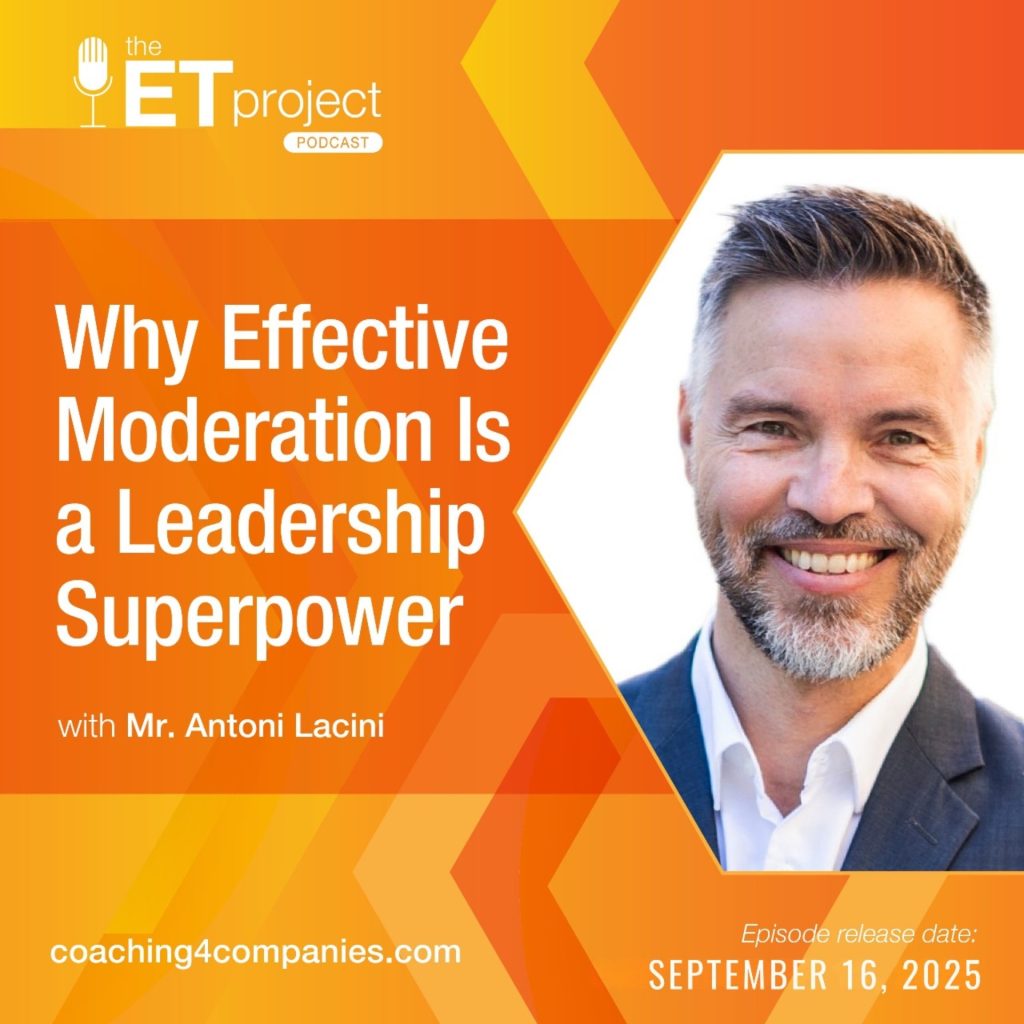
WAYNE BROWN: Hello, I’m your host, Wayne Brown, and welcome to the ET project. We’re delighted to be delivering this podcast for executive talent all over the world, whom we are affectionately referring to as ‘Team ET.’ Today, we’re in Stockholm, Sweden, and chatting with acclaimed international keynote speaker and expert in workplace communication, Antoni Lacinai. Antoni was named Finland’s 2022 International Speaker of the Year, and in 2019, he placed third in the Swedish Championship of Storytelling. He also ranks among Sweden’s most popular speakers, and his TEDx Talk has received over 300,000 views, proving his broad appeal. Besides speaking, Antoni is an illustrator, songwriter, and business strategist. His focus areas include conscious leadership, customer focus, and employee engagement. He blends creativity with practical insights, and as keynote speaker, author, and executive coach, Antoni tackles workplace communication head on. He equips leaders and teams with a powerful communication blueprint; this framework is rooted in psychology and deep research. Antoni believes strong relationships improve collaboration. He also sees better communication as a way to tackle global issues like climate crisis. In his view, better workplaces help secure a brighter future for the younger generations. His talks are known for their positivity and clarity, and he delivers actionable insights that improve leadership, service, and teamwork. Antoni’s goal is to make workplaces more motivating and results-driven. He has authored or co-authored 13 books on communication and regularly contributes to leadership publications. He’s also a familiar voice on national TV and in the media. During our conversation, we honed in on the January 2025 released book, that’s titled, ‘Moderate Great: How to successfully prepare and moderate conferences, seminars and panel discussions.’ Team, as you’ll hear during this conversation, Antoni has a very clear vision on what it takes to moderate well, and we explore multiple elements on that topic. As Antoni shares, a speaker runs a hundred meters, but a moderator runs a marathon. Today’s discussion is one for all leaders who want to improve their prowess, whether as an event facilitator, MC, or moderator.
INTRO: Welcome to the ET project, a podcast for those executive talents determined to release their true potential and create an impact. Join our veteran coach and mentor, Wayne Brown, as we unpack an exciting future together.
WAYNE BROWN: Hello, team, welcome back to another week. How often are you called upon to, I’m going to use the word facilitator, I know our guest will have a slightly different definition. Maybe moderate or even be an MC, whether you’re at a workshop or a meeting, an event, great moderation isn’t just about keeping time or introducing the speaker, it’s about creating a connection. Now, this is me talking about this, our guest may have a slightly different approach, of course, or a different definition, but it’s truly about guiding the energy within the audience, the team within the speaking group, and turning the event into something that’s unforgettable, an experience that they remember and take away with them. Whether that’s a conference panel discussion, a team offsite perhaps, the difference between a forgettable meeting and a transformative one comes down to the person holding the mic, to a large extent. We can debate that, of course. So how do the best moderators command a room while staying in service of not only the content but the audience as well? And what can we learn from this craft that enables us to communicate with more impact in different areas of our life? So, we’re very blessed today to have our guest with us, Antoni Lacinai, international speaker, a storytelling champion, author of a book that we’re going to dive into called ‘Moderate Great.’ Antoni, such a pleasure to have you here with us, welcome to The ET project.
ANTONI LACINAI: Thank you so much, I’m looking forward to it.
WAYNE BROWN: I had the opportunity to read this book, ‘Moderate Great,’ it’s truly one of the books that is genuinely packed with insight from the get-go to the end, you do a very nice job dissecting the process of moderation. As you mentioned, you have a slightly different definition, let’s say, of those words I use facilitation, moderation, being an MC, what’s your take on the difference?
[00:05:00]
ANTONI LACINAI: They’re all in the same family, so that’s the same for me. I use the word ‘facilitator’ more about the person leading a workshop, just to have the different meetings there. You have meeting leaders all over the place, you have meeting leaders for the status meeting, the project meeting, the updates, all of those things are there, right? Facilitation for me is when you facilitate the process in the meeting, like the workshop type of thing. A moderator for me is more the person who leads the conference, the seminar, the panel discussion. And perhaps then the MC, if you want to dissect it a bit more, is the one leading the gala, the master of ceremonies. They all lead meetings, for sure. Different kinds of meetings, perhaps. That’s my take on it, and I’ve led them all, I’ve done it all. And then, again, you have the normal every-day work meeting as well, where you need to have somebody leading that meeting. And they have so many similarities, but also some differences, of course.
WAYNE BROWN: There are, I agree with you fully. The book itself really, for me at least, reframes moderation. It sort of puts it as a high-stakes art form, and not just keeping things on track, as you’ve already highlighted, but shaping the whole experience. One of the metaphors that jumped out to me in reading it was, you talk about a speaker runs a hundred meters, a moderator runs a marathon, it’s such a powerful way to set the stage. It sort of makes me wonder, what does the marathon mindset look like in practice? How do you bring that to the table?
ANTONI LACINAI: Well, you know, again, since I do both, I spend at least half my time just being a keynote speaker myself. So, it’s when I’m the rock star, if you will. It’s the one, I have my 30 minutes, I have my 45 minutes, whatever it is. And it’s like, I need to just boost the energy in the room, I need to share the insights and all that. And I am, in that case, the star, if you will. But when I’m the moderator, I take a step back from that, and I try to just lift the person who is speaking, giving them all the opportunities to share their messages, come across as a good person and so on. So, I have a different approach to it. But I was thinking about looking at track and fields and so on, if you see the people running 10,000 meters, that’s not a marathon, but let’s use that because I did a calculation of how fast do they run 100 meters. And it turned out they run 100 meters in about 14 seconds for each 100 meters, like in 10,000 meters. Can you imagine? I could probably run that for like one, perhaps 100 meters if I’m really lucky today, but they do it over and over again. And basically, what they do, they conserve the energy so they don’t spend everything at once. And that’s the same for me with a moderator, you just make sure that you can endure, that you can last the whole distance, because you’re going to be up there over and over again on stage. And between the sessions, between your sessions, meaning when the speaker is up there, you still have to be on your toes. Because they will say things that you need to jot down, make sure that you can lift when you come back up so you can clarify something, you can strengthen something, you can deepen the conversation about something. You are on your toes all the time, but you cannot pretend to be the speaker, you’re not the speaker. Let them shine, and make sure that you can run the whole marathon, if you will.
WAYNE BROWN: One thing that comes to mind as you say that is the ability of the moderator then is one who really needs to be agile and adaptable and able to ad lib in certain circumstances, because they’re not going to be the expert as the speaker is, but they need to be there to support the swim.
ANTONI LACINAI: Oh yeah, oh yeah, ad lib for sure. And you know when you can really do that? When you can really improvise? That’s when you have done a lot of preparations, then you are ready to improvise. I see, unfortunately, too many people just saying, I will ad lib, that’s good. And it’s not, because they haven’t done any homework whatsoever, meaning that everything is improvisation and then it just doesn’t fly as well. If you don’t do your homework, if you don’t do your research, if you haven’t talked to the speaker, for instance, in that case, then I’m sorry, it might work, but you are definitely in a situation where you have to take a chance all the time.
WAYNE BROWN: I enjoy your writing style as well, just to digress a little bit, but within that book you have, I think there’s about 10 main chapters or thereabouts, and just based on what you mentioned there, it’s a great segue into the book, because one of the first things you talk about is understanding the purpose behind the meeting, the event, whatever it is that you’re there to moderate. Could you expand on that a little bit for us?
[00:10:00]
ANTONI LACINAI: Well, there are two questions that really need to be defined before you even start, and that is the goal and the purpose, and they are a bit different from each other. And it’s the same with every work meeting. I’ve been doing some digging about this as well, because I wrote three books only about how to handle work meetings, normal every-day meetings. And in Sweden, where I live, and we are a good country when it comes to meetings, we know how to run meetings, still 54% of all meetings lack a clear goal and purpose. How can you perform if you don’t know why you’re there or what you’re supposed to achieve? And when it comes to a moderator then, if you understand the purpose, if you’ve asked the organizer, for instance, or someone who is in charge of that, “why are we here? Why have you gathered these people? Why have you invited them? What is the real purpose, the meaning of it?” If you can understand that, it’s much easier for you to contribute. But I’ll tell you, too many people don’t know the purpose. They say, “we always did it,” or “yeah, I think it’s a good idea that we just gather.” And I said, “that’s fine, it’s all good, the tradition is nice, and gathering people is nice, but what else? What is it that you want to achieve in the long run?” And hopefully they can answer it. I sometimes press them a bit on that one. But also, then the goal, what is the goal for this particular meeting? What do you want to achieve with that? And I asked the speakers the same question when I have that role, what do you want to achieve with your presentation that will add to the whole purpose and the whole goal of the whole event? And that is also good for me to know, because then I can make sure that that main message comes across. If they forget it, I will help them. If they say it, I might strengthen it, and so on. So, it’s really important for them to also contribute. Everyone should contribute to the same goal for the event or the day, and then for the purpose of what it’s supposed to mean.
WAYNE BROWN: How much overlap do you see between the role of a speaker versus the role of a moderator?
ANTONI LACINAI: There are a couple of different ways to start off a seminar. One is that I or the moderator starts. And then you’re there to build a good connection and to create a good atmosphere in the room so that the feeling is good. Because when people feel good, they open up, they open up to new ideas and so on. It doesn’t mean that the topic has to be all happy, it could be a serious topic, it could be problematic things that you have to discuss. But still, you have to create that feeling of trust and some sort of warmth, I would say. If you can do that well, then the audience have opened up, as I said, and then every speaker has a better chance to get their messages across. There is absolutely distinct differences. I mean, both are on stage. If this is a conference, both are on stage, for sure, both are delivering something. But the main content does not come from the moderator, it comes from the speaker. The challenge I see sometimes is if you have an expert also taking on the role as a moderator, because then they want to be the one shining, they want to be talking about what they can offer, what they believe. And then there’s a big risk that they only ask some closed question, “this is how it is, isn’t it so?” And it’s like, no, that’s not the way to go, let them talk. So basically, if you want to have a Q&A session with them, the shorter the question, the longer the answer. And the longer the question, the shorter the answer, meaning that if you spend all the time telling people how it is, and then you just have to say, “right?” And then they might say, “yes,” “no,” or “maybe.” And that’s not a very good conversation. So, your role as a moderator is to be an excellent conversationalist as well.
WAYNE BROWN: How do you go about then establishing that connection, that trust with your audience to bring them along with you as the moderator to enable them to speak?
ANTONI LACINAI: Well, I do a couple of things. First of all, I normally look pretty happy to be there. So, I’m there for them, we can talk nonverbal communication here, it’s about open body language, it’s about smiling, it’s about looking at them. All of those things that makes them feel, okay, this person likes to be with us. So, that’s a good start, for instance. And then making sure that you take away all the anxiety from the audience that this doesn’t lead anywhere, that the moderator doesn’t know what he or she is doing. So, I give them a clear path of what’s going to happen, for instance. So that they feel, okay, this person is on top of this, I can lean back and I can be part of this or I can lean forward and be part of it. But it’s still… I don’t have to feel any nervousness that this will go sideways. So, it’s both about the structure, feeling of logic and structure, but also the connection by talking to the audience, letting them perhaps be involved in one way or another.
[00:15:00]
ANTONI LACINAI: I always ask the speakers as well, is there anything you want to do to involve them, the audience? Do it. I do it when I’m a keynote speaker myself, but I also do it when I’m the moderator, making sure that they feel that they are more or less co-creating this event. It’s for all of us, it’s not only for them to sit there passively and for the speakers to do all the talking, for instance. It’s simple things like hand up, or if we have two minutes, let’s do a beehive, something like that. It could also be, if there are digital tools, it might be that they want to send in a question, for instance. There are different options of involving people, or at least make them feel involved, whether they say something or not, it’s another story. But they should feel that they are invited, included. It’s really good.
WAYNE BROWN: Do you have a favorite opening?
ANTONI LACINAI: You know, one of them is that I stand there on a stage together with the CEO, for instance, if there is a CEO involved. So, we do it together because already then it feels like this is a joint thing. We do it in combination with each other; it’s like a team play. And the moderator is one player on the field. Perhaps the moderator is the goalkeeper who just throws the ball to whoever is on the field and so on, that might be the metaphor we can use. But as a moderator, you’re part of the game, of the team, so to say. And it’s really nice to do that, start with the, well, let’s say the CEO, for instance, in that case, and end with the CEO. So, you go full circle. You start off with the CEO asking them about the goal and the purpose, and then at the end you say, how did we do? Did we manage to fulfill that purpose or that goal? So, then they can say it as well. I think that’s a really good way to start. Otherwise, I don’t mind at all being the person who starts immediately by myself welcoming them with broad gestures and making sure that they immediately feel that this is the place I want to be in. And then, you know, simple things like house rules and so on, but then just quickly go into the topic.
WAYNE BROWN: You mentioned earlier about the preparation, and you already spoke about a couple of things, purpose, goals, what else is involved for you as a moderator in preparing to make this a success?
ANTONI LACINAI: I always do some searches on each speaker, for instance. But I start off with the organizer. Whoever it is that organizes this, I want to know from them first, I want to know what they want out of it so that I can contribute to that, that’s the first thing. Then I’d like to talk to each of the speakers somehow. Some of them are really busy, but then let’s have at least an email conversation. Let’s do something where I ask them again, what is your topic? What is the main takeaways for the audience? What might they wonder when you’re done? And that last question is about, what questions could I ask you if we have time for questions at the end? Sometimes I read books that they’ve written before. Sometimes I do at least Google-search and other things so I can find out what’s working with them. So, there’s all sorts of things you can do, and it takes time, but it’s worth it. I also do some research on the topic as such, even though I’m not the expert of it. For instance, pretty soon I will moderate a day in the financial business, I’m not really a financial expert, but of course I will find out, you know, what is it that we want to talk about in this one? What is the terminology that I should know that I can use and what are the possible challenges in that industry that we will face? If I can find those questions out, if I can do research on that one, it’s easy for me also to ask that follow up question. I can say, but, you know, there is a study about, da da da da and then I can, you know, how does that relate to what you’re talking about? And then it’s easier for all of us to feel that this is really about that topic. That’s something I sometimes see, for instance, celebrities, media personalities forget. Not if they’re journalists, then they will, but otherwise they don’t really think about topic at all, they just want to be funny or something. And then they introduce the next speaker, a stand-up comedian, something; it doesn’t work. Having said that, I must say once, this is a disclaimer, there’s no person on earth in my business at least that works as hard as stand-up comedians when it comes to their material, they are the best, I admire them greatly. But I’m talking more about this lighthearted, yeah, let me be on a stage and be funny for two minutes between each session, that might work in, again, the gala dinner, the award ceremony, and so on.
[00:20:00]
ANTONI LACINAI: But if it’s in a professional serious topic, then I would like everyone to spend a little time at least understanding what that topic is about. Because then you can again, add more value, contribute better, as I said before. So, I don’t want to rain on anyone’s parade, I don’t want to do that. I just want to say it’s really good to have read something about the topic we’re talking about.
WAYNE BROWN: And you highlight that in your book where you talk about making sure that you weave the thread between the speakers, not only the speaker, but also being able to make the connection across the whole entire event. So maybe the topics are different, but you somehow find the means for making it flow. Is that…
ANTONI LACINAI: Yeah, I mean, sometimes it’s not possible, but if it is possible, then it’s good to kind of find a way to bridge between one to the next. Sometimes it can’t be done, it’s more like, okay, over to something else and then you move on. But if you can do it, it’s good. And in my case, I mean, I’ve been also working as a manager for event project leaders back in the days when I was in a normal job, if you will, it was a long time ago now. So, I’ve been asked also, perhaps because of that, perhaps because that I also coach other speakers to be better or business people to be better presenters and so on. To also, you know, they want my input on how do we make this flow? What is the dramaturgical curve that we can use in order to create attention in the beginning, making sure that we end it with a bang and perhaps find ways in the middle to get the real meat out of it and so on. So, I do have some ideas about that and experience about that as well. So sometimes I just help them with that. But it’s not really the role of a moderator, I would say, but it’s just that if you have that competence, why not share it if you can help them.
WAYNE BROWN: You also mentioned about the importance of, I use the word primacy and recency, so the beginning and the end, how essential are those two periods in your mind?
ANTONI LACINAI: People tend to remember what you do and say in the beginning and what you do and say at the end. So, if you want them to remember anything after the session, meaning if you want them to act on something, then you must have them remember. People cannot act on what they don’t remember. So, if you put some extra emphasis on the beginning and the end of your speech, for instance, then you increase the chances that people remember it and thereby being able to act on it. In a day where you have many sessions, you also have many beginnings and endings, and I think you should treat it like that. So, each speaker, for instance, have a chance to give their own beginning and ending. And then you have the whole event having a beginning and an ending. So, it is multiple layers going on here. But yes, it’s a key factor if you stumble in the beginning and start to be very nervous, for instance, fidgeting and stuff like that, that’s what people remember, they forget what you say because they’re so worried that you won’t take this all the way home. So, you want to create a situation where they can feel good in the beginning, open up, as I said before, and then they can listen to the message and then at the end, you tie it back. Do it for each of the speakers in a conference. People have such a short attention span, you know. It’s ridiculous. I read recently about one, I think it was a study saying that in 2004, we had an attention span of 150 seconds, in 2014, 10 years later, we were down by half to 75 seconds. And now, more than 10 years later, we’re down to 47 seconds. So, we really need to introduce new things, be dynamic on a stage or in a conference room, whatever. We need to be dynamic in our communication, we need to find ways to enlighten people, inspire people, perhaps one or two surprises coming in, jaw-dropping facts if you have any, change gear, all of those things have to be done. And going back to the moderator role, sometimes you have speakers who are really bad, then you need to lift the energy back up again and give them a couple of laser-sharp questions so that they really can get their message across and then move on to another one. Sometimes they are enormously energetic on a stage, perhaps then you need to be the one structuring it again so that they can, you know, not be all over the place. So, you have that role all the time.
[00:25:00]
WAYNE BROWN: As the moderator, how can you inspire action to take away out of the event? I mean, it sounds like a particularly challenging task for a moderator.
ANTONI LACINAI: Well, you can do everything. I mean, you can tee up, but you cannot do it for them, it’s really not your responsibility. What you can do is to make sure that you do everything you can to make the possibilities happen, at least. For instance, finding out if there’s time at the end, I want to, again, have a beehive or something, saying, what did you take out of this session, this day, for instance? What is the most important thing that you will do when you come back to work, if we have that as a context? That I can do. For each speaker, I can also ask some generic questions like, if you want to summarize this in three main takeaways, what is it? If you want to give people homework, like one thing that they should do after this, what is it? So, I can help them by doing that, but I can’t do the work for them, they have to still do it themselves. And sometimes it’s really easy to take on too much responsibility of this, it’s not your job, you’ve done your job, you just have to do it so good that at least there’s a chance for them to do something afterwards. And if this is like an internal event, let’s say this one company having their own kickoff, well, it’s up to them then, it’s up to the leaders in that organization to go forward, build momentum, use the day as a kickoff for something else coming up. If they don’t, then it’s really up to them. If it’s an open conference, then of course it’s much harder because you have perhaps 20, 30, 200 different organizations in that event. And then of course you can’t do it, but you can still do what you can. Again, back to that, what is it that you can do when you go back home? That’s a question you can always ask to make them understand that there is something to be done with this. Otherwise, it was just a waste of time or a nice-to-have and not-need-to-have.
WAYNE BROWN: Sure. Do you find the opportunity to guide your client? You and I sound like we both are on the same page in the need for action after an event for it to stick. Do you find there’s an opportunity when you’re talking with your client to say, you know, the success of this isn’t just going to be this event, it’s going to be what happens long beyond the event, what are you going to do? Do you have that opportunity?
ANTONI LACINAI: Oh, yeah. I have pre-meetings with the clients and it’s one of those questions I would like to ask them every time and I often do. But it depends on my role of how much responsibility I have to actually do something or my mandate. Often when I am the moderator, they just want me to moderate the day, that’s it. When I am a speaker, a coach, for instance, then it’s a different story, then I will probably help them before and after and so on. So, yeah, I mean, I raised the question and as I say to them, it’s really about… the event is much, much bigger than just the day or the half day or the two days, it’s how you build up to the event, it’s how you use all the things that comes out of the event in the future as well. So, you have this almost like an arc where the peak is the day, the conference, but it goes on for a while longer, at least if you do it good. Otherwise, again, it’s a nice rollercoaster for a day, but then what? And if it’s a strategically important day, which it probably should be, especially when it’s an internal event, handle it with respect, you’re just taking people out of their normal work for a day or so, it’s a lot of money invested in that one. So, let’s not use it as a one-off, but rather as a really important piece of the bigger puzzle.
WAYNE BROWN: If you were to summarize the role of a moderator, is it possible to say, okay, here’s five things that a moderator must do or should do as a guideline?
ANTONI LACINAI: I wonder if I didn’t write like the lazy version of that one. I think I have that like the three or something things, a couple of things that you should do in the very beginning. Here’s one, okay, three tips for the lazy ones. Number one, find out what the organizer wants, good one. The next one, talk with all the speakers in advance, how they want to be introduced, what questions they want you to ask, and also what the topics are for each one of them. And then get the audience to feel secure and let them know where you’re headed, that’s the first thing. If you read a little bit longer, that’s the nine-step process, and that’s actually the process I then go through the whole book then.
[00:30:00]
ANTONI LACINAI: But yeah, create a good feeling, do your preparations, and then make sure that you understand that you are not the star, they are the stars, the ones who will then be the one delivering the messages. Help them deliver that message because then it makes sense to the audience and then everyone is happy.
WAYNE BROWN: It was a great opening to the book, actually. You have the three for the lazy people, and then you have the nine if you want to go deeper. You mentioned earlier, you said, I think, 14 different books you’ve been involved in, written or co-written?
ANTONI LACINAI: Co-written as well, yes.
WAYNE BROWN: Yeah. I know a lot of what you’re noted for, your brand, if you like, is communication. How does that fit within the leader’s perspective? We all know communication is important, but what are some of the key essentials to being a leader and being a good communicator?
ANTONI LACINAI: Can you be a good leader if you’re not a good communicator?
WAYNE BROWN: Mm-hmm
ANTONI LACINAI: Let me just put that question out there. Is it possible for you to be a good leader, not a manager, but a leader if you’re not a good communicator? I found it really hard. So, you do need communication skills, that’s when you build relationships, that’s when we connect with people, that’s when you clarify things, that’s when you bring the empathy into it as well. I talk about the three communication superpowers more or less all the time when I speak about communication; and those are empathy so that people feel that you are interested in them, understanding them, try to understand them, listen to, understand not to respond, for instance. It’s clarity so that they understand you, so, that your messages comes across, also memorable. And then finally it’s energy so that you deliver it with a passion showing that you believe in what you’re saying. Because if you don’t seem to believe in it, why should anyone else? Of course, this goes across any type of communication between colleagues as well, it doesn’t have to be a leader, but yes, I do speak to leaders mostly, it’s mostly about managers or executives that I help to be good. Because I know if they are good, then the rest of the organization have a good chance to also perform well and be engaged. Because communication is the key that unlocks engagement and engagement is the key that unlocks performance. So, it’s really hard for you to make people perform sustainably in the long-run unless they are engaged. Yes, you can make them perform by threatening them and making them feel afraid, it works for a while. But if you want people to perform because they want to, not just because they have to, which is much more sustainable, people will be less burnt-out and so on. Then make sure that you’re a good communicator, inspire that engagement so that people will perform well, that’s the chain, that’s what I talk about all the time. And it’s applicable in a moderator role, it’s applicable in a sales role, and it’s applicable in any type of collaboration role. And of course, it’s applicable for leaders.
WAYNE BROWN: I don’t know how much you get exposure to the different generations that are now in the workforce, whether it’s as an entrepreneur or in a corporate role. But how much do you believe the younger generation, so the Gen Z, even the younger version of that, the Alpha, how important do you feel that communication is for them? Is there a difference with the older generation and the younger generation?
ANTONI LACINAI: It seems that the older generation will always say that the younger generation is bad, that they are lazy or unfocused and all sorts of things. And I’m not sure that this is true, I just think that they’re young. There is a difference, however, and that is technology, technology is the difference. And I did a TEDx about this, a TEDx talk a few years ago where I celebrated analog communication in this ever more digital world. And there is a risk that if you only communicate in a digital space, it might be, I mean, that you don’t practice well enough when you meet people in the analog space, meaning that there are, of course… I’m not saying this on a person-to-person level, individual level, it’s not like that, but there is a risk that if you haven’t practiced well enough to just cooperate and collaborate and hang out with people in the analog world, then you might risk being worse at it. I mean, just like if you don’t practice your football skills, if you’re a football player, then you won’t be as good in football. So, it’s the same here, there’s a risk.
[00:35:00]
ANTONI LACINAI: But I would say that people grow up, and no, I think it’s more of a situation where when you’re young, you’re young, and then you get older, you’re older, it’s like that. So, perhaps I’m stepping on some toes here when you have those generational experts saying Gen X, Gen Z, and so on, I don’t think it’s… for me… okay, I’m going to be very provocative, it’s almost like astrology, how can you cluster everyone in a certain age-group around the world saying that they are all like this? They are not. I have two sons, one is, I guess, millennial, and the other one must be, well, it’s on the borderline to Gen Z, I guess, they are very different. And it’s not about the fact that they were born in certain years, it’s just that they’re different. So, I wouldn’t put too much emphasis on it. Having said that, I still hear a lot of people saying, “oh, the young kids coming in, they don’t really understand taking responsibility,” and things like that. And it might be true, I don’t know if it’s because they are a Gen Z or because they are just young, I can’t say.
WAYNE BROWN: Any parting suggestions for our audience when it comes to moderation, but also within being a more professional, better equipped leader?
ANTONI LACINAI: Care is my mantra word this year, last year, and next year, I guess, as well. I’m writing a book with a friend of mine in Switzerland right now called ‘CARE.’ It’s about how to lead with care. If you care for your people, if you care for the vision, the mission, care for the planet, if you care and it will shine through, then it’s so much easier for people to just like you and make sure that they want to work with you or be led by you. If you don’t care, it will also shine through and then people will not be as inclined to give you anything extra, they will just do the bare minimum. So, care is my word. By the way, it stands for, we also have an abbreviation of that one, so it’s about; connect, amplify, reflect, energize. But that’s a whole new book and we can talk about it at another occasion, if you will.
WAYNE BROWN: It sounds like we’re having a point with coming up. When is the release? Do you have a date yet?
ANTONI LACINAI: We’re writing it right now, so hopefully it will be done by next year. It takes time. We both are very busy, so we’re trying to find a time slot to dig into it. We’re very enthusiastic about it. We like it. This is the book out of all the 14, 15 books I’ve been writing now, this might be the one. So yeah, but it takes time, we don’t want to rush this. There’s another thing I would like to do as well, and that is that if you listen to this, if you found this relevant and valuable, then connect with me on LinkedIn and tell me about this, that you’ve been listening to this podcast and I will make sure that you get a hidden link to my web page where you can download a number of books for free. So, that’s my gift to you who listen to this as well.
WAYNE BROWN: We’re so grateful for that, thank you. What is your LinkedIn address?
ANTONI LACINAI: Oh, you have to just spell my name correctly, if you can do that, then you will find me, I’m the only one in the world with that name. So, it’s Antoni Lacinai, and you’ll get the spelling, I guess, in the material here.
WAYNE BROWN: Well, Antoni, thank you so much for being on the show, I really enjoyed the conversation.
ANTONI LACINAI: Thank you so much, Wayne.
OUTRO: Thank you for joining us on the ET project, a show for executive talent development, until next time, check out our site for free videos, eBooks, webinars, and blogs at ‘coaching4companies.com.’
[END OF TRANSCRIPT]