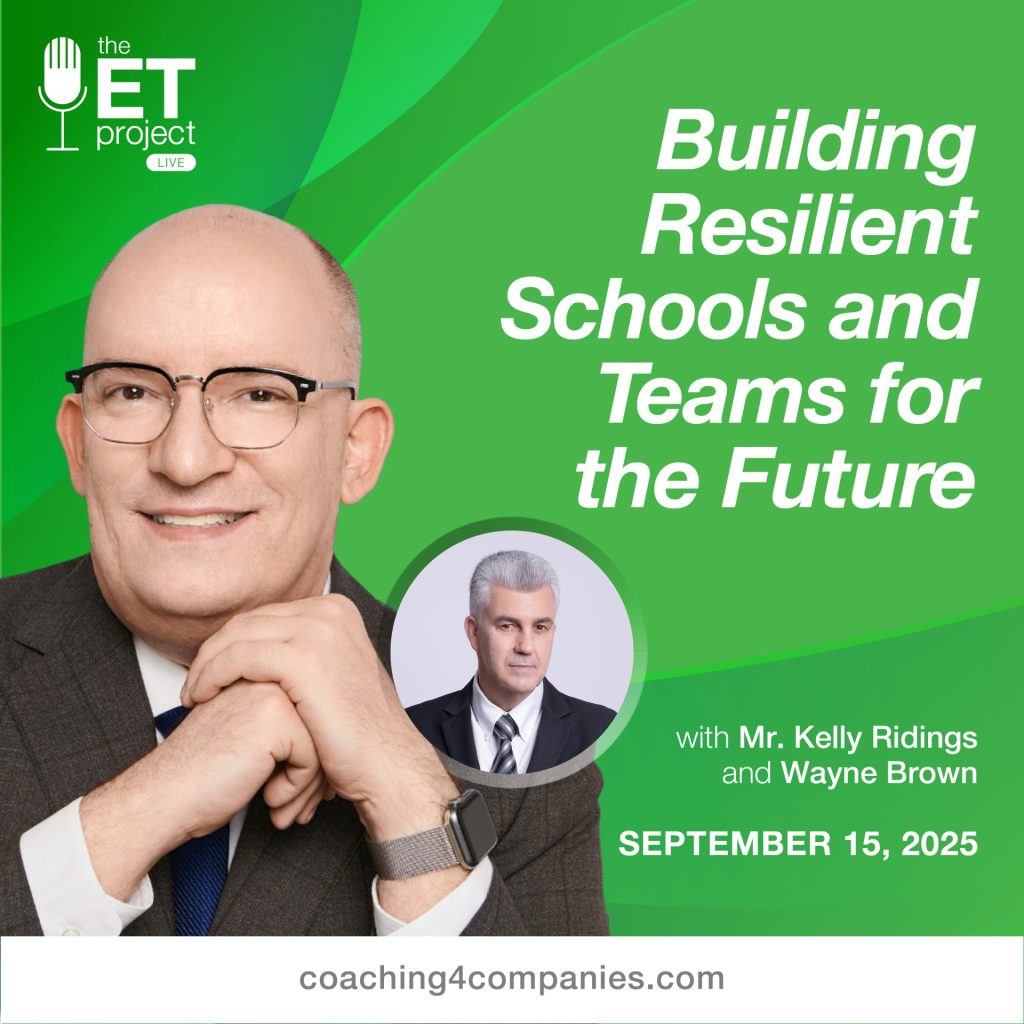
WAYNE BROWN: Hello, I’m your host, Wayne Brown, and welcome to the ET project. We’re delighted to be delivering this podcast for executive talent all over the world, whom we are affectionately referring to as ‘Team ET.’ Today, we’re in Dalian, which is a city located on the east coast of China and not so far away from my own home base for the past 20 years here in Shanghai. We’re excited to be here and chatting with Kelley Ridings, founder and chief innovation officer of EduNetPro Consulting. With over 30 years of experience in the education field, Kelley is a veteran international educator and global citizen hailing from New Mexico, USA, and now a permanent resident of the People’s Republic of China. Kelley has worked with students and professionals from preschool through college levels in a career that has taken him to South Korea, Mexico, the United States, and most recently here in Shanghai. His two decades of school leadership experience as superintendent, principal, and director allowed him to hire hundreds of educators across his career. Kelley’s teaching experience is in History and English, working with both high school and college students. In 2024, he retired from his work in schools and now devotes his time to consultancy, writing, and travel. Kelley has published two books as part of the School Jobs Mastery Series; the first is ‘Teach or Lead Abroad’ and the second, which he released at the beginning of 2025, is titled ‘The GIFT Hiring Method.’ Our discussion today centers on that second book as we unpack what it takes to truly establish a faculty of gifted staff. So, team, this conversation stretches way beyond the school campus and into the reaches of all aspects of good leadership. I look forward to having all of you tune in and listen to these intriguing rules of engagement.
INTRO: Welcome to the ET project, a podcast for those executive talents determined to release their true potential and create an impact. Join our veteran coach and mentor, Wayne Brown, as we unpack an exciting future together.
WAYNE BROWN: Hello, team. Today, we’re going to be speaking about something that I’m pretty sure many of us grapple with, particularly as parents, as well as the influence that it’s likely to have over us as leaders over our team; and that’s the topic on school. What’s the most important ingredient for a school, not just to survive, but to truly thrive in this new era? The answer, according to our guest at least, might surprise you, it’s not a piece of software, it’s not a new policy; it’s a radical rethink of how schools find and hire their people. To help us unpack this powerful idea and to show us a better way, we’re thrilled to be joined by a true expert, veteran international educator and author, Kelley Ridings. Kelley, welcome to the ET project.
KELLEY RIDINGS: Thank you, Wayne. It’s great to be here and I appreciate the chance to talk with you and your audience.
WAYNE BROWN: So, we’re coming up to five, six years since the beginning of the pandemic, what was the global impact? We all saw it as parents, or those of us that are parents, we saw the impact of the virtual learning with the teacher on the other end of the screen. How did the schools cope with it in the first instance?
KELLEY RIDINGS: Well, that was quite a moment in history for everybody around the world, for sure. But it really was a challenge for those of us in schools because here in China, we were just beginning the Chinese New Year holiday, which is the major holiday in this country, which is about a month-long. And so, people had just gotten out for the break and had spread out around the world, not just the staff, of course, but obviously families and students had traveled as well. And so, people were spread out everywhere. And then here in China, when this problem became worse, the government had said, “we’re not going to have school, it’s going to be online.” And so here we were, spread out around the globe and we had to pivot to having online school, which was going to be a challenge, of course, to be able to figure out how that worked because we weren’t an online school. And some people had their devices with them, their computers, their laptops, they were able to do this, some people weren’t, didn’t have them, rather, and so it was a bit of a challenge for that.
[00:05:00]
KELLEY RIDINGS: As the problem worsened, as the numbers spread and so on, we knew that there was going to be some issues and trying to then figure out how to deal with the people all across the world that were facing these issues, people within our school. We had told the staff that they needed to start returning to the country, and at some point most people had, but by March 18th, the government had closed the borders to foreigners and so, most of our staff had returned, but some had not, and families. And so, then we had to deal with, okay, now what do we do in trying, even though we were online at that point, we knew at some point we would return to being an on-campus school. And so how do we deal with that? And we had already hired people for the new year, and then we thought, oh, if the borders are closed, how are we going to get these people in? Are we going to be able to? And so, we had to deal with a lot of different situations, and we had a general plan, but then you had to have a plan A. I mean, literally, we had a plan A, a plan B, a plan B1, a plan C, plan D, plan D1. We had a lot of different individual items that we had to deal with for every person, because obviously, we’re dealing with people, we’re not just dealing with an event or a thing. And then we had a lot of students and families as well that were abroad, and how do we handle that? And even when the lockdown situation that we had in the country had abated and we went back to in-person school, we still had to deal with, okay, we’ve got a lot of families that are abroad, we had some staff abroad, and then we had some people that were coming to campus. Some students weren’t comfortable, some families weren’t comfortable sending their kids to campus, even though they were here in Shanghai and in China. And so, that was a real challenge, and we were able to move through it, we had to be incredibly flexible in order to do that, Wayne. I’m sure you understand, you went through the lockdown that first time, the first year, and it was really one of the most challenging times in terms of leadership that I’ve ever experienced, not one of, it was the most for sure. And I, other leaders in the school, we had to teach classes in order for people that weren’t able to come back and it was just all kinds of things. So, we had to deal with technology, with personnel, with enrollment numbers, and dealing with families and providing support. We had a lot of staff who were not able to come back and they were planning to move to another place anyway. And so, then we had to basically move all of those staff and pack up everything. So, we had to create a team in order to help to move them out of their apartments and move all of their personal belongings, but still do it in a way that’s sensitive to their personal needs and not invading their privacy. And it just all kinds of things that we would never have thought of in normal situations and normal life. And plus, you’re dealing just with people when they’re scared and they didn’t know what was going on, it was at a very basic, the Maslow’s hierarchy and the basic needs of survival and food and safety and health, and people react very differently in those situations. So, the whole gamut of issues that we had to deal with, it was incredibly difficult. But we came together as a staff, I can’t even imagine having gone through that and how the staff just responded so well to trying to help and trying to just make do with what we had to do. So, that was really encouraging to see and the situations worked out for the most part. Some people weren’t able to come back into the country, but by November, those who wanted to come back did, that first year, so that kind of gives a year in a nutshell for that, I guess. What a year!
WAYNE BROWN: What I was really intrigued by was how quickly the whole schooling system was able to pivot to a fairly virtual environment.
[00:10:00]
WAYNE BROWN: How many years prior to the pandemic had this transition been happening? Because it couldn’t have just happened on a dime, right? It must have been happening over the years before.
KELLEY RIDINGS: Well, yeah, just to speak to your points, I mean, for the first part about the families and the situations for them, these are people that mostly were working themselves and they had their own jobs and their own careers that they were trying to do, and they had to go online as well. And then when they had young kids, the kids, obviously when they’re very young, their attention span, just in terms of their developmental abilities, kids can’t just focus for hours on end on a computer and they need stimulation from play and the people around them and interacting with others, and it was really challenging. And so, for families who weren’t used to that and parents who weren’t used to it and grandparents who weren’t used to sitting there with their kids and trying to keep them focused, it was really, really tough. And so that first year was very hard for the families. And so, most did fine and they just went with it, but there were some times where it was just really just too much and the pressures that they were facing, plus they had their own economic situations, their businesses that weren’t doing as well in some cases. And so, it was just hard for them and it was not easy for older kids either because they faced, isolation, social isolation, they weren’t used to working online, they had to deal with all of the things that were happening at home and didn’t really have outlets to be able to do things. And so, it was very tough for them. And nobody expected this to happen and we had to always come up with all kinds of different situations. So, when you ask the question about how long did we have… were we preparing for being online? Well, I mean, I think there were probably components that we had that were online. Like, we had, parents could look online and could find their kids grades and things like that, and we already had a system in place for that. We had some communication channels, we were using an online program, it was called ‘Learning Management System,’ so we already had something like that in place so that individual families and kids also could see what was the assignments that they had and so on. But we had to come up with how do you teach online? And that was a challenge at first, it’s different, it’s not the same thing as trying to teach face-to-face in a classroom, a regular bricks and mortar classroom, it’s just not the same. And so having to come up with how to do that took time. And so, I can’t say, I wish I could say that the first year was super-successful with that because it wasn’t as much so as we would like, but we got through it. And that was the important thing and people made it through and did what they needed to do. But then what we did the second, after the first school year had ended, we then talked about, “okay, what can we do differently?” So, then the next year, we had an online training that we use for every staff member in the school, all teachers and all administrators and we did a course that was offered through Coursera, through the University of New South Wales. And so, we did a 19-hour course on how to teach online. And that was just fantastic because we learned so much about how to do that. And so, then when we had our second set of lockdown, in the school year 21/22, I think that was right, then we were prepared and we were able to do that pretty well. And we had a lot more… well, and parents and everybody had understood the situation a lot more, they were more used to it. And students and everything, we were able to prepare and be pretty successful with that, thanks in part to planning and preparation. We knew some things were going to be happening, so we already had a system in place to support people personally, professionally, helping them to have the systems in place so they could be successful.
[00:15:00]
WAYNE BROWN: Do you see teachers and their role in the future becoming more important or do you see that starting to subside as technology comes into the environment?
KELLEY RIDINGS: Well, this is certainly one of the interesting debate questions that’s in the world of education today, I’m very much on the side that a teacher cannot be replaced. And so, the teacher is not just about knowledge, that’s just one component of what a teacher is doing. But a teacher is providing nurturing to students, is helping kids to grow up, not just to be academically smart, but also to be personally responsible, to be good people, to care about one another. And there’s an affective part to what teachers do and what educators do, that there’s not going to be any online system or AI system or robot that is going to be able to replace that. And so, that part is irreplaceable. And so yes, can students look online and can find information and can use AI and so on? Absolutely. But there’s an in-person component and a caring component that would absolutely not be there at all through technology, it’s impossible to have. And so, teachers can be facilitators, school leaders can facilitate using technology. We’ve learned so much about how to use technology, like for example, right now, today, what are we doing? We’re sitting here having a conversation on Zoom, we’re not in the same cities, we’re in the same country, but we’re not in the same cities and we’re able to have this conversation, and we’ve talked before, you and I have talked before online, we’ve had this opportunity to do this that we would not have had five-plus years ago before this happened, even though Zoom was around, we didn’t necessarily know that technology super well. And now nobody even thinks anything of it. And in fact, Zoom is actually a verb. “Hey, let’s have a Zoom.” And so, it’s a very different world, and I think it has opened up a lot of possibilities. And that’s what happens with change, and that’s what the change process is about, we don’t go back to doing things exactly the way they were, and it’s not going to completely change everything that we did. It has modified certain things, and we’ve come up with new ways of doing it and we have now lots of different new things that we didn’t have five/six years ago. And so that’s where technology is going to have changed education, I think, is just the way that we deliver, the way that we can learn is different, but replacing the needs, the affective needs, and even also, Wayne, not every student does terrifically, not every teacher does terrifically, teaching online; some can do it, some cannot. And I don’t mean it’s that they don’t want to, it’s just that’s not how they’re hard-wired. We generally want to work in a world where we can interact with other people, and some people handle it better to be working online than others, and some thrive with it, and some don’t. And that’s just the way the world works. So, I really don’t see technology replacing teachers or schools, it would be very difficult to do, I think.
WAYNE BROWN: Right. Well, that’s a perfect segue, actually, into your book. So, you’ve written a book called ‘The GIFT Hiring Method.’ GIFT, is an acronym, we’ll get into that shortly, but what was the impetus for writing the book in the first place? Was it sparked by the pandemic and AI or was it just a culmination of what you’ve experienced over your career?
KELLEY RIDINGS: Well, I think it was more of a culmination of what I’ve experienced throughout my career and obviously the pandemic was part of that. But I think that it came, it started actually, the process was around 2014/15 school year was when I began contemplating the ideas of hiring in a very different way.
[00:20:00]
KELLEY RIDINGS: And I wrote a book in ‘21 called ‘Teach or Lead Abroad,’ which is about how to find dream jobs in international schools. So that was from the teacher, the candidate perspective; teachers and leaders who wanted to find work in international schools. But I also knew that at some point I wanted to write a book about how to create a system within a school for leaders who wanted to find quality candidates to hire in schools in general, not just international schools. And so that first book, the ‘Teach or Lead Abroad,’ I actually finished that during the pandemic, I was writing that at that time. And then the second book, ‘The GIFT Hiring Method,’ is the companion book to it. So, it’s a series. And so, this is kind of the companion, but from the point of view of the leaders within the school. And so, the processes that I have worked with over the years have been through a lot of study, through practice, through evolving our systems so that we could hire people that were going to be quality candidates, quality teachers to upgrade the school and to uplift the school, people that were going to match with what the school’s ideals are and also to be able to find candidates that can support that and they want to do it because it’s just naturally who they are. And so, we had to find the attitudes, the right attitudes for people. And so, developing that took several years in order for that to happen. And lo and behold, there comes the book, ‘The GIFT Hiring Method,’ as a result.
WAYNE BROWN: And as I mentioned, GIFT is an acronym or a statement, if you like, what does it stand for?
KELLEY RIDINGS: Yeah. So, the GIFT method is about gathering information and facts thoughtfully. And so, the whole process of GIFT, is about finding candidates who have the right fit and the right attitude for the school. And so, as a school leadership, we have to create a system that supports finding the facts and the information that we need in order to support our students, our school, our community. And every school is different, we all have different needs, no two schools are exactly alike, none. And so, they’re all set up for different reasons, they all have different needs, they have different motivations, they’ve got goals and strategies that are quite unique. And so, every school has to figure out what their school work culture is and what they are about. And then they design a process, design questions for the interview that are going to help to find those candidates that meet the school’s particular work culture. And so that’s the crux of this, the most important part of this process is finding that. And then you have to train leaders as well to be able to identify and to see what are the flags, what are the things that we need to be looking for, the positive things as well as the things that are not as desirable for our schools. And so that is something that we have to really work on because we have certain psychological kind of needs that we need to meet both as school leaders who are trying to hire and also as candidates who want to find a job, everybody has certain needs that they want to meet. But those things don’t always necessarily match between the two sides and we’ve got to find a good match. And that’s what this process, the GIFT method is about.
WAYNE BROWN: One of the statements you made that stood out to me the most was, “hiring is the most important work that a school leader does.” When I first read it, I thought, gosh, that’s a bold statement. I mean, there are so many elements that are important in the world of leading, particularly within schools, test scores, making sure the tech integration is there, safety of students, safety of staff. But hiring? So, what is it that makes it your top priority?
[00:25:00]
KELLEY RIDINGS: Well, and this applies not just to schools but to any organization, if we don’t have the right staff, and what I say by the right staff, I just mean people that are the right fit for our school culture, our work culture. If we don’t have the right people to support that culture, how is the school going to operate and is it going to really be able to meet its needs? And if we can’t meet our needs, we can’t meet student needs, we can’t meet family needs, we can’t meet the needs of other staff members either, then it’s going to be very hard to operate efficiently and effectively. And this is true of every organization, every workplace in the world, it is the same way. And so, the most important work that we do is to set the foundation. It’s sort of like building a house, Wayne. When we’re building a house, we’ve got to have a proper foundation in place, the structure of the house has to be solid. How we decorate the house once the walls are up and the drywall is finished and everything, but how we decorate and how we make the space of living a comfortable space and workable for what we need, that’s up to individual tastes and how we can do things. So, teachers have plenty of agency to be able to do that within their classrooms and so on, but the foundation remains the same. And so that foundation is what any leader is doing in their organization when they’re hiring, it is that they are finding the right people to support the organization. And so, if we don’t have… and even just one person, if they’re intent upon doing it, they can easily completely disrupt the organization, sometimes to the point of near-destruction. And so, it’s incredibly important work that we’re doing and it cannot be underestimated how important it is. So, is it a bold statement? Absolutely. And it’s bold because it’s completely 100% true.
WAYNE BROWN: Well, I’m curious and I also, the level of leadership program, we talk about exactly what you said, attitude being more important than skills and knowledge. It’s also hard to quantify, particularly with a candidate, easier to see with people you’re working with longer term, but how do you go about identifying attitude during the hiring process? Is there a particular method?
KELLEY RIDINGS: Well, this is where this method evolved from, it is because when we have general conversations with people, we might hear some of their ideas and their views about things, but people can say one thing and their actions can be something else. And we may not necessarily know how they act. And we don’t know how… you know, they may genuinely feel something and they may have some ideas that they genuinely believe in, but that doesn’t mean that we act in the same way in how we carry out our work and how we interact with others. And so, we have to try to figure out what that is in the interview process, and that’s the key that’s missing in most interviewing procedures that we do as leaders, both within schools and in other organizations as well, I’m completely convinced of that. Instead, what we tend to focus on is skills when we’re interviewing, and that’s not going to get us to the attitude. So, instead we’ve got to focus on the attitude that people have and trying to discover what that is genuinely. So, we have to very carefully identify what is the desired work culture within our organization. Generally, you’re going to have four to six main ideas that are the most important. And then you’re going to design questions around those important attitudes, the desired work culture attitudes that we want to make sure that we’re hitting upon that everybody fully supports and believes in the organization. And so, we’ve got to designed questions in an open-ended kind of a way that doesn’t telecast to the candidate what we’re actually looking for. So, we’ve got to design that open-ended question, kind of present a scenario to them and let them then answer from real examples of what they have done in the past.
[00:30:00]
KELLEY RIDINGS: It actually works really well. So, for example, you know, a question that we can use is say, for example, “can you tell us about a time when you were doing something within your school, when you were working with other colleagues outside your regular job description?” Well, that’s just telling a scenario. So, people may or may not necessarily know what the purpose behind the question is, but then they’re going to tell us something. So, people are going to answer that question, and then this is what they will honestly do because I’ve sat through hundreds of interviews. So, I know how it will work. You know, they’ll go…
WAYNE BROWN: The psychology behind a hint
KELLEY RIDINGS: Yeah, let me think about, you know, and some of them will really struggle to come up with even one thing that they have done outside the regular classroom. Some of them might be, well, I tutored a student or helped them after school, but that’s just their job, that’s not outside of the classroom. And so, you know, some of them will have come up with nothing or very little where they’ll say, yeah, well, back in 2002, I did dah, dah, dah, dah, dah. Well, that’s not very current. But others will say, oh yeah, you know, we had this school sports day and we were doing this and I had this part of the job and I was organizing students to do such and such, or we had a school play and I was creating sets for kids. And that was a lot of fun, you know, and it wasn’t anything I knew how to do, and I was just asked to do it, but I did it and it really turned out to be a lot of fun. And, you know, so that’s what we’re looking for is, and people will tell us about their experience and they will volunteer it. We don’t have to say very much beyond asking the question. And that will tell us everything we really need to know, is does this match with what the school culture, the reason we would ask that question is we want to find team players, people who willingly do things outside of the regular job description, they’re not going to complain about it, they’re going to just do them because they know it’s for the good of kids and it’s for the good of the school and they’re happy to do that. And they just naturally want to do it. So that’s what the attitude is about.
WAYNE BROWN: There’s another rule that stood out to me, Kelley, rule number four, where you say, it’s better to keep a position unfilled than to hire the wrong person. Now, I understand the premise of that. However, thinking about it from a practical point of view, if I’m the principal of the school and it’s August and we’re about to start school in September and I’ve got vacancies in my teaching staff, I am sure that the temptation is to find somebody just to fill the gap. How do you avoid those circumstances?
KELLEY RIDINGS: Well, that temptation to fill a position is very strong, that’s one of the psychological needs that a recruiting leader has to have. They want to fill a position and they want to do it quickly and they want to do it right away and as efficiently as possible. But sometimes we just don’t have the right candidates and we’re just not able to find them. And even if we find the right candidate, it doesn’t mean the candidate wants that position with our school, they have to also want to be in the school. And so, the reason that we want to really emphasize finding the right people and leaving a position unfilled if we can’t, is that if we’ve got the wrong person, it’s going to destroy the school’s morale, the team morale, and so on, that is most likely going to happen. Even if it doesn’t destroy it, it’s going to make life very difficult for the other team members, it’s going to make life difficult for the leaders within the school because they’re going to have a very high-needs candidate or a person who comes in who is… it’s an employee, is going to have a lot of needs and they’re just not going to be able to make it. And then when they’re unhappy, they’re going to destroy morale of those around them because they’re going to be complaining all the time and it’s going to be very, very difficult. Sometimes you can find okay candidates who might have the right attitude, maybe they’re weaker in skills and if we can build those skills up, then okay, then we’ve got to spend, we can hire them and we can build them up. Sometimes we can find candidates who might have maybe some of the attitude things we’re a little bit unsure about, but then we’ve got to examine it more closely, is it something we can live with or is it something we’d rather not live with?
[00:35:00]
KELLEY RIDINGS: And so, we’ve got to look carefully at that and figure it out. And there are sometimes when we just can’t fill a position. So, then we’ve got to come up with other ways to do it. So just like what I said a little while ago, when we talked about the pandemic issues, one of the things that you can do is, okay, can an administrator go into the classroom and teach? That’s what I had to do when we were in that pandemic and some of the teachers couldn’t come back. They were doing the lesson-plan and all that from home, from abroad, and we had ways that they could deliver some of the lesson online, but in terms of having an in-person instruction and a teacher there in the classroom, well, sometimes we had to do that. So, every leader had to go in and teach classes. That is an alternative, could somebody teach an extra class during the day? So, if we have a department of teachers, could somebody do some extra thing? Could we have a substitute teacher who comes in, who does some work for a while until we can come up with something else? There are lots of alternatives and Wayne, I’ve never had a situation that has been just impossible to find. There’s always an alternative available; it’s a matter of if we want to use them or not, and if we can do that, then let’s do it. And that’s at some point where you have to just make the decision as a leader and you have to say, “okay, well, can I live with this?” Maybe sometimes parents may not love that, the staff member who has to teach an extra class may not love it, but you don’t just do it for free, you pay the people, you try to treat them well, you try to give them the support that they need so they can do that extra work. And generally, it’s going to be just fine. And then we find then somebody within months or the next semester or whatever the situation is, to be able to do that, to make it happen and make it work. And it always will.
WAYNE BROWN: Yeah. Rule number seven, you talk about train, train, train. For me being in this world as well, one of the things that I’ve experienced over my corporate career, this is an area where many companies fail and I know you’re addressing it to the hiring committees and the schools, but this also applies in the corporate world. HR tend to be the experts in the corporate world in hiring people, but more often than not, the final decision comes down to the leader of that group, division, organization. They’re often not trained about what they should be looking for and then the decision is incorrect. In many cases, the blame game starts, et cetera, et cetera. Hiring the right people is a skill, and as you say, you need to be trained in what to look for and educated in that process. How much time and effort is required for that training?
KELLEY RIDINGS: Well, you know, when somebody is first going to university and studying about how to be a leader, I would say that probably most schools, most universities don’t train people on how to hire, they don’t at all. They might do say like, okay, students, you know, college students, you’re going to do a mock interview together. And one of you is going to interview and the other one is going to be the candidate, and that’s about it, and it might be just a very brief thing. Maybe they’ll learn a little bit about processes possibly through the HR point of view from human resources point of view, but that’s about all there’s going to be. It’s very limited, it’s nothing about the psychology, there’s nothing about actual strategies, I would be virtually certain that nearly no leader is trained that way. But, as I mentioned, and that was certainly true of me and it’s, I’m not saying anything against my university or anything like that, it’s just, that’s the fact of the way it was. So, I never got training in any school that I worked in as a leader about how to train, no, no system, no district that I worked with, no schools train me on how to do it, I had to learn the processes through my own research. And what I had to figure out, you know, sometimes it’s just through practice through trial and error and also learning by reading other books and learning about how to do this, lots of conversations with people that I worked with on how to make this process work and through trial and error; eventually this is where this method and system came from.
[00:40:00]
KELLEY RIDINGS: The training part, whenever we have leaders, we have to train them each year about how to carry out this process. You know, so every school, like I mentioned, has its own unique culture and its own unique way of doing things. So, not every place is going to be the same. So, all new hiring leaders need to be trained in the process when they first come into the school, if they’re going to be part of the hiring team. And then if there are changes in the process, the way that we’re doing things, some of the rules, the regulations, and so on that govern hiring, then all of the team leaders need to know about that when they happen. And then we’ve got to set the system and implement it once people are trained and you do that just gradually. So, we never just release a new hiring leader into the hiring mix without pairing them up with a veteran hiring leader, going through the interview process together, talking about it afterwards, about what does this mean? Even if somebody is a veteran administrator who has done lots of hiring on their own, they still have to learn what the system is within the new school that they’re a part of. And they’re not just released on their own to do it, and then once they’ve learned what the system is, then they can begin doing it on their own. And I absolutely guarantee that everybody who does this process, they’re always kind of wowed about the results because they just go, “Oh my gosh, I never thought about that. I never realized that this is what could happen,” you know, about looking for the attitude and what to watch for, for the flags and how to chase those down and to be able to kind of suppress this need to get the job filled without, you’re really finding the right person to do it. And so, it’s a team process for sure, in doing this and getting hiring right, but boy, it makes all the difference in the end result for what it will do for the school, because ultimately a whole team of people who come in as the new employees, they’re going to support the school system so much more. They have the right attitude and everybody around them, other team members, students, and families, they’re going to notice that difference, they’re going to see it. And within a matter of the first hiring cycle after that, those people are brought in, it’s going to transform the school a little bit, but every hiring cycle afterwards that uses this system, it will completely transform the school, guaranteed.
WAYNE BROWN: Right. So, the book details a full hiring workflow, if you like, as you mentioned, the whole process might take 12 months to implement. If we have any school leaders listening at the moment and they want to get started tomorrow, what is one change that they could make? What would you recommend is the first step that they should take?
KELLEY RIDINGS: Well, I think the very first thing is to really take a look at what your school culture is right now and what is the desired school culture that you want to work toward. And it takes some frank conversation and reflection to be able to do that, but it’s not impossible to do. And once you, as a school and school leadership, have been able to identify where you want that desired work culture to work toward, to look like, then you can begin designing the process to, as I outlined before, through the interviewing questions and all of that, you can begin designing that. But the first thing is really just assessing where are you right now and where do you want to be?
WAYNE BROWN: You mentioned towards the end that one of the unexpected outcomes of the whole process was that you’re raising the bar with the new hires and the consequence was some of the high-performing veterans in the school now seem less so. And I guess that creates a dynamic or potentially some sort of pushback or resentment. How do you deal with that?
KELLEY RIDINGS: Yeah, that is definitely something that will come about. And so, people early on, they might be high flyers within the organization and they’re doing seemingly very well, but then the new work culture doesn’t, it’s not necessarily totally against what they’re believing in, but they just may not quite fit in with that.
[00:45:00]
KELLEY RIDINGS: And they’ve got to retool a little bit and that’s not always comfortable, none of us really like change, that’s not something that we enjoy, just like when we had our lead-on conversation about the pandemic, I mean, nobody is gonna say, “I enjoyed that process,” absolutely not. I mean, health issues and all of that aside, I mean, the whole change and all the massive changes that we were required to undergo both as staff and students and families, it is just unimaginable that we could go through all that, but we do and we adapt. And I think that’s what happens within organizations too, the people in the work culture have to adapt and if there’s problems, then as leaders, we’ve got to identify them. We’ve got to help staff to be able to evolve their way of thinking, and most are going to, most are going to see the need already. They’re going to understand that, okay, I’m a little out of step with this, I’ve got to change. So, it’s the three Rs; it’s either rethink the way they do things, relocate some other place, you know, either another position that fits them better within the organization, or maybe it means relocate to another school if they just aren’t going to fit in or retire all the way. So, those are the three Rs and so that’s what it is. And for the most part, people are going to rethink and they’re going to readjust, they’re going to make the changes that they need to do, and then they’ll be just fine. They’re going to find these people coming in, the new colleagues that they’re working with, or have a different mindset and they’re going to go, “mh, I don’t know, I can learn from that.” And most people are very growth mindset oriented and they’re going to just adapt just fine. They’re going to be a few who won’t, and if that’s the case, then okay, they either need to get on board or move on and we don’t want people to move on, we’d like them to readjust, but that doesn’t always happen.
WAYNE BROWN: Yeah. You mentioned at the beginning that there’s a book prior to ‘The GIFT Hiring Method,’ that’s called ‘Teach or Lead Abroad,’ I think, I can imagine there’s a number of aspiring leaders, in this case, educators, school teachers who have a dream, a secret dream of working internationally, working in schools abroad, is there one piece of advice from that first book that you can give to people that might be thinking that?
KELLEY RIDINGS: Well, I think that the thing to look for particularly is, if you want to, it’s more than just traveling and more than just vacationing. So, there’s a difference between that and actually living abroad. So, if it’s something that you really are wanting to do to live abroad and to work abroad, and if you have a family to raise them and kids in that experience, or having a husband or a wife or a partner that you’re traveling with and having that experience of really immersing yourselves into that culture, then it’s worth exploring and going into, but you have to make sure that you and all of the people that are in your family unit, that you’re all part of that and you’re all on board. And when you’re able to do that, there’s a world of opportunity that’s out there; there are 14,000-plus international schools in the world. So, there’s lots and lots and lots of opportunity for people to find jobs in great schools all around the globe, in any country, pretty much that they want to. And so, it’s just a matter of being able to find them and it just takes time, just like any job search, it takes time to do, and it’s a carefully-prepared process to make it happen. But once it happens, it can be incredibly rewarding once we find the right roles, right schools and the right roles.
WAYNE BROWN: And of course, in your case now, you’ve stepped away from the school leadership area and you’ve moved into running your own company, consulting, what are you doing in that field? And how are you staying involved with the schooling system?
KELLEY RIDINGS: Yeah. So, after 32 years of working in education in schools, I retired at the end of June of ‘24. And so, I’m now… but I wanted to still remain working, I’m not ready for the rocking chair yet. So, I wanted to continue working in education. So, now I just do it in this different way. So, what I’m doing is I focus a lot on my writing of the books. So, for example, I wrote ‘The GIFT Hiring Method’ after I retired, I finished writing that I’d started before, but I finished it and did all the work that I needed to do to get it published.
[00:50:00]
KELLEY RIDINGS: I’m writing another book now; this one is getting ready for a kind of a mentorship series of sorts that’s dealing with different topics. So, this first book is looking at dealing with the growth mindset and professional development and how we can grow in our careers through different ways to help to support our career enhancement and enjoyment of what we’re doing. And then also, part of my business, which is called EduNetPro Consulting is just about helping people around the globe who are interested in accessing this kind of career in international schools and how to help them to grow and either finding jobs. I’m not a recruiter, so I don’t do recruitment for schools and I’m not recruiting specific candidates, but trying to help them to prepare themselves so that they can be better able to enter the job market and be successful at what they’re doing and then also just helping them in terms of mentorship for their career growth. And so, I find that there’s people all around the globe who are very interested in growing their careers, who want to be able to either get into the world of international schools, or once they’re in it, they want to go even more, but they’re not quite sure how to do it because they just don’t have somebody who can help to kind of guide them with some ideas and help them to think about things in a different way. So, I provide some… both online classes that I provide for people, but I also just do individual one-on-one kind of mentorship as well and working with them. So altogether, still I’m part of the education world, but I’m just doing it in this different way through my business EduNetPro.
WAYNE BROWN: How can people continue the conversation or get some support from you?
KELLEY RIDINGS: So, I’m very active on LinkedIn, so that’s one way to be able to connect to me there. I’m very active in posting regularly and sharing ideas about what I do. Also, people can get in touch with me through my website and they can learn about the services that I provide that is edunetpro.com. And my books are there as well as courses that I offer and the other services that I provide. I also work with schools too in helping them to be able to design systems for hiring that are going to be robust and helping to find quality candidates for their schools. And then I also work with other things like, for example, accreditation. I work with WASC as a volunteer for committees that are going into schools and do accrediting. So, I do a lot of work with that as well. So, I’m pretty active with… I’m retired, but I still have plenty to do.
WAYNE BROWN: Kelley, a great conversation, I really enjoyed the book. Thank you so much for being on the ET project.
KELLEY RIDINGS: Well, thank you so much, Wayne, I appreciate it. And thanks for the good words about the book.
OUTRO: Thank you for joining us on the ET project, a show for executive talent development, until next time, check out our site for free videos, eBooks, webinars, and blogs at ‘coaching4companies.com.’
[END OF TRANSCRIPT]