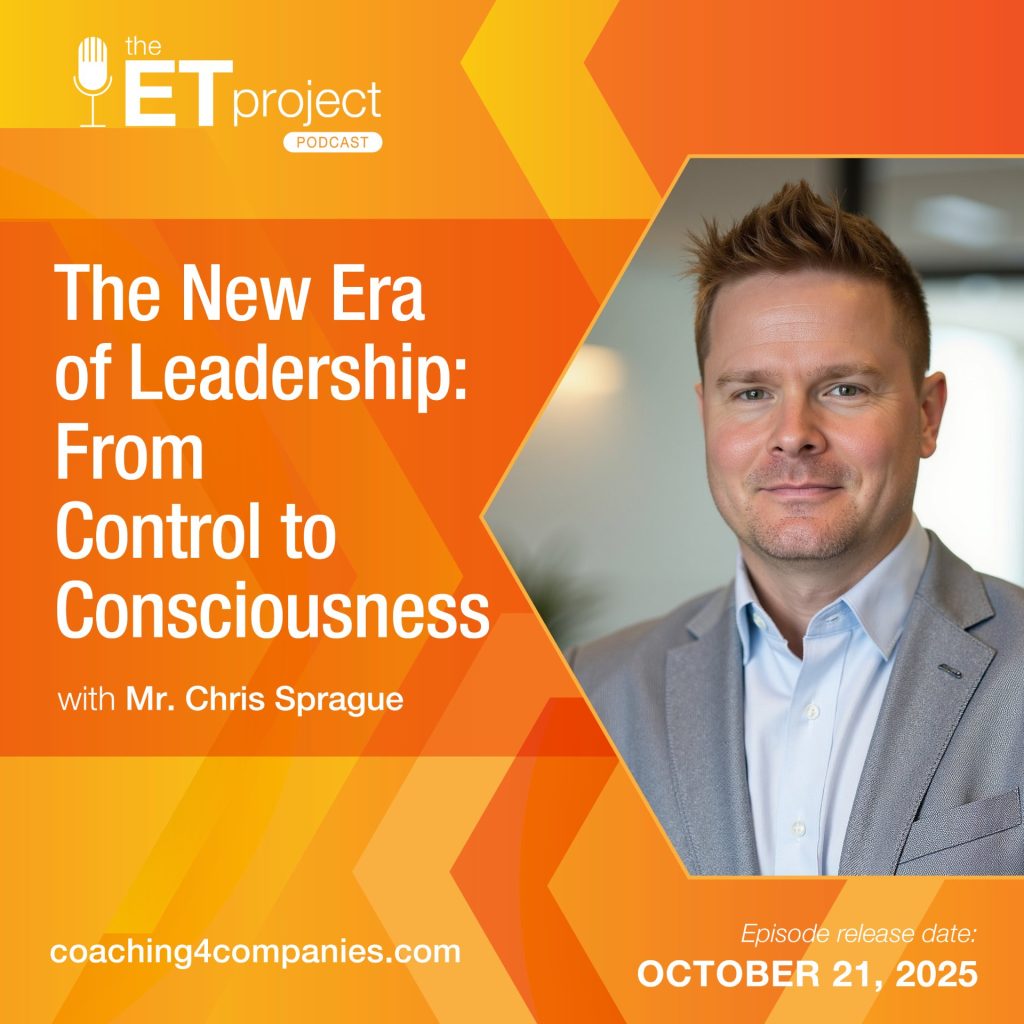
WAYNE BROWN: Hello, I’m your host, Wayne Brown, and welcome to the ET project. We’re delighted to be delivering this podcast for executive talent all over the world, whom we’re affectionately referring to as ‘Team ET.’ Today, we’re off to Lake Zurich, Illinois, to chat with our guest, Dr. Chris Sprague, CEO and co-founder of the Enluma Leadership Group and author of ‘Lead Without Limits: How Inspirational Leaders Make the Improbable Possible.’ Chris’s journey to founding Enluma took a unique path. For over 20 years, he led large-scale transformations with Fortune 100 companies and along the way observed a powerful pattern; the most successful teams weren’t just productive, they were inspired. People worked hard because they wanted to, achieving remarkable results in a healthy and sustainable way. These insights became the foundation for Enluma, which Chris launched to help grow and elevate inspirational leaders across organizations around the world. During this week’s conversation, Chris and I dive into his book to reveal what drives inspirational leadership and how it empowers individuals, teams and organizations to achieve more than they thought possible. Along the way, we unravel how to inspire greatness with the key leadership elements that he outlines in his book. We also talk about how to foster holistic leadership regardless of your role, how to learn the must-have glue that holds teams together and how to tailor your leadership growth with a personalized plan. Team, this is another great discussion and one that you truly won’t want to miss.
INTRO: Welcome to the ET project, a podcast for those executive talents determined to release their true potential and create an impact. Join our veteran coach and mentor, Wayne Brown, as we unpack an exciting future together.
WAYNE BROWN: Hello team, welcome to this week’s episode. I have to start with some sad news for all of you, that’s you, our audience of leaders I’m talking about, despite a constant focus on leadership development, there’s a staggering 75% of employees who do not find you inspiring. Sorry to tell you that. So, what’s missing? We spend billions on training, yet organizations everywhere are still grappling with turnover, disengagement, stagnant cultures even; it suggests that we might be focusing on the wrong skills entirely. This crisis of inspiration is the core of our conversation today as we’re joined by Chris Sprague, who left his Fortune 100 career to solve a critical problem, why are inspiring leaders so rare? In his new book, ‘Lead Without Limits,’ he reveals how to bridge that gap and unlock unprecedented team potential. So, I’m looking forward to this conversation. Chris, welcome to the ET project.
CHRIS SPRAGUE: Wayne, thank you so much for having me. I know podcasts like writing a book are a labor of love, so thank you for inviting me in, I appreciate being part of this.
WAYNE BROWN: You have a very fascinating bio; you have a PhD in toxicology. So, I want to start with, what the heck is toxicology? It does not sound…
CHRIS SPRAGUE: It is the science of what happens when things go wrong. I was a biology major with a chem minor for undergraduate, and what appealed to me with toxicology was it’s really trying to understand what happens when you overwhelm systems, that’s when you get cancer, that’s when you get a variety of diseases or other genetic abnormalities. A funny story is my father actually also has a background in toxicology. So, when I figured out that I wanted to go into toxicology, there was part of me that just said, “no, I’m doing what my dad did.” But no, in all honesty, it’s about the science of when things go wrong. And I’ll tell you, I needed to go to graduate school because it helped me to think more clearly, think more critically, it helped me with my own personal drive, taking ownership of things, and my communication both oral and written. And you don’t know it at the time, but after the experience, I’m very grateful for my time at Wisconsin and Madison to go through that and to grow as a person.
WAYNE BROWN: When you finished your studies, what did you do? You went into the corporate world or what was it?
[00:05:00]
CHRIS SPRAGUE: I did. I actually went into, for a couple of years, it was a joint venture with ExxonMobil and Shell Oil located out in New Jersey. It was a lot of regulatory submissions. So, a lot of times you don’t think that like engine oil additives, there’s a lot of safety data around those, but there actually is a fair amount, that was all through the US EPA and some of the European regulatory bodies. And so then from there, I went and joined Abbott, a company in the Chicago area, Abbott then AbbVie for the bulk of my career. And I had the opportunity… I was very fortunate because very early on, I was put in positions where we were leading some rather large transformations. And when you’re leading transformations, you start to see what goes well and what doesn’t go well. And you talk about strong leadership or the impact of poor leadership, it is, I would say, amplified when you’re trying to lead a large-scale change. I remember one opportunity for a global project and just working with people around the world and different cultures and being sensitive to that. But the key, I think one of the first things I realized quickly was listening is a very underrated yet powerful tool. And if you’re forcing your agenda on people, that usually does not go well, but that’s okay. And then I had the opportunity to lead an enterprise resource planning system go-live, SAP, when AbbVie split from Abbott, and that was an incredible opportunity because I worked with people literally from all over the world and talk about leading without authority. The team I had the opportunity to lead we were small, it was four people, but there were hundreds of people we had to interface with. When push came to shove, we were the ones that were responsible for all the planning and the execution of these go-lives that really handled billions of dollars in inventory and even more in sales. And if you treat people with respect and treat them as equals, even if they’re ‘levels below you’ people really will rise to that challenge. And I learned that as, you know, talking to shop floor analysts, getting their feedback, talking to supervisors in manufacturing areas or financial supervisors. When you do that and you get their input, it is so powerful because it just gives you such a more robust picture. Those people will then go to bat for you. And it’s funny, I saw that time and time again, because after that role, I had the opportunity to call center transformation. And I know we talk about this in the book a little bit, but it was a hornet’s nest. And look, I was not an expert in call centers, nor did I play one on TV. I did not really understand how they worked, but the people who took the calls every day did, the people, the supervisors did. And that was a great example of if you listen and use that powerful tool to your advantage. So, in this instance, for specifics, we did… so, it’s a team of about 150 people, I had the opportunity to lead the entire team and I did one-on-ones with everybody, actually multiple rounds and just said, “Hey, what do we do well? What don’t we do well? And if you had my job, what’s one thing you’d do right now?” What we also did was we did roundtables and our managers did one-on-ones as well and we collected a master list of all the things we could do. And I’ll tell you, Wayne, what was interesting is the majority of stuff was small, but we did it. And one of my favorite examples is there’s a lady, Kathleen, on the team, but she goes by Kathy and I’m having a one-on-one with her and I say, “Kathy, what’s one thing I could do right now?” And she said, “could you change my name tag at my desk? It says, Kathleen, I’d prefer it to say Kathy.” And we walked over to our admin, we got it taken care of that day, for two, I’d say at least two weeks, she was so excited that I actually did it, that I actually listened. And every time our… she thanked me probably 20 times and I said, “Kathy, it’s…” but it was the gesture because I listened and I took action.
WAYNE BROWN: Yeah. We use an expression, ‘curious listening’ and that sounds exactly what you were doing
[00:10:00]
CHRIS SPRAGUE: Yeah.
WAYNE BROWN: You mentioned a second vital ingredient, in my mind at least, is that listening is the first half of the equation
CHRIS SPRAGUE: Yeah, correct
WAYNE BROWN: If you don’t do anything with the information or with sharing, then that trust that you start to build is quickly evaporated as well.
CHRIS SPRAGUE: Yeah
WAYNE BROWN: So, I think by virtue of the fact that you took action and you took it quickly, you really cemented that following, that belief, that trust. So, a great example.
CHRIS SPRAGUE: Yeah.
WAYNE BROWN: I’m curious to understand, what was the pivotal moment for you then to move out of the corporate world? Was there something that triggered the decision?
CHRIS SPRAGUE: I think the turning point was the call center rule because I saw what was possible. I had been largely exposed to old school type leadership, the command and control, slam your fist on the table, do what I say. And what I found was an approach where you’re actually working to elevate others, where you work to have good communication, you’re listening to others, can actually be much more effective than the old school approach. So, for example, in the two years that I had the opportunity to lead the turn on the call center, our engagement scores went up by almost 20 points, we cut $5 million out of the budget, but honestly, what I was most proud of is we helped almost 40 people grow and improve and do things they didn’t think was possible. And that was my first taste because… and then the next role I had was the head of global quality control and in that instance, it was aligning multiple manufacturing sites and getting them on the same page and building a future and defining the culture. But it was more because of the call center things started to shift and I started to realize and I thought, if I could help leaders, if I could help organizations achieve these types of results, and I think I realized, and I know it now that I can help companies more being external than I can as compared to be an employee. Because an employee you’ve got training, you’ve got meetings, you’ve got all these other requirements, now I can help companies just focus and focus intently on those improvements, the strategy, the turnaround and help them to be better, and I find that incredibly rewarding. So, I would say it was that the spark was lit, but then I remember I was sitting in a meeting in 2023 and all of a sudden something came to me and they said, “what about inspirational leadership? Leadership that really elevates others.” And I thought, that’s where I want to go, that’s what I want to do. And ’23 was really the turning point to say, okay, I started working on the research for the book and then after that I knew that’s the path I wanted to go.
WAYNE BROWN: Okay. We’re going to dive into a question that I have around the term ‘inspirational’ in a moment. But before that I would like to understand a little bit more about your business, your organization, Enluma. The name itself is quite interesting, but what is it you’re doing and where’s your reach?
CHRIS SPRAGUE: Yeah, absolutely. No, thanks Wayne. So, Enluma is actually a combination of enlighten and illuminate. So, our goal is we want to enlighten our clients around inspirational leadership, but we want everything applied, so we want to illuminate a path for everyone to grow. And so, what we’re doing is, and we’ll talk a little bit more about the book, but outlined in the book, we’ve identified and built ways to measure your leadership potential to inspire your peers, to inspire and elevate direct reports, to elevate an organization where you have multiple levels of people reporting to you. And what we’re doing is we’re leveraging that for analytics. So, we do do workshops where we work with teams to how can they improve collaboration or work with people leaders, how can you elevate your ability to inspire your direct reports? And then we also work with senior leadership teams.
[00:15:00]
CHRIS SPRAGUE: It’s interesting because the senior leadership team, you might jump to, oh, you got to focus on strategy, you got to focus in on the culture, that implies that the senior leadership team works well together. So, a lot of times what I’m seeing is we have to work with those senior leadership teams to really encourage them, enable them to work well together, to challenge each other in a healthy way, to understand what each other is doing. Because then when you build a multi-year plan, it’s going to be more robust because it’s not, “hey, Wayne is the head of commercial, Wayne knows what he’s doing, I’m not going to say anything to Wayne.” It’s now, you and I have seen each other’s financials, we’ve seen each other’s thought processes or challenges. Then I can say, “hey, Wayne, I understand that you’re targeting this growth in three years, but do you think that’s enough?” That’s what you need. And so many leadership teams, it’s like the leadership team are like ships passing in the night, they’re working on their own little fiefdoms, but they’re not working really well together. So that’s where I’m seeing, we can really help companies with that senior leadership team, how do you get them to work really well together? And then ultimately build out that future strategy, define your culture, and then we can help them to make that sustainable and help them build momentum to get there. And then the other piece that we’re working on is we’re taking our analytics and we’re actually combining, we’ve partnered with an AI company out of Arizona and what we’re doing is you can take the analytics, the assessments, and you get peer feedback, direct report feedback, or organizational feedback, get the results. And then you actually can see your data and you click on your lowest results and it will say, “Wayne, would you like to create a development action for this?” You click yes, and then you’ve got access to an AI coach. And what the AI coach will do is in a discussional format, will say, Wayne, I see that you want to work on maybe making your staff meetings more robust, or maybe it’s a peer collaboration piece and you want to work on how do you have more collective impact with your peers? And so, then it’ll help you to do that. And then we also have courses that will help you to learn some of the theory and the application around leadership, and so, you can take those. And then we’re also working to marry that with live-coaching as well. So, you could have both an AI coach and a live coach, so you could actually have both. And then how do we get them to work really well together? We’re excited, we’re actually finishing the build now, we’re going to start testing with a small group in October. But yeah, I think what we’re trying to do is everything we do, it needs to be applied and people need to know exactly where they have opportunities to improve. Because if they read the book, if they go through a workshop, if they use our IT tool and they’re not sure, then we’re wasting their time. It’s a lot like you just said, Wayne, with if you listen to people and don’t take action, leadership development has to have clear action plans for every single person. Because if it doesn’t, it might be a great experience, but ultimately, it’s not a good use of your time.
WAYNE BROWN: The book, ‘Lead Without Limits,’ it is, what? Three months now, I think, since the release.
CHRIS SPRAGUE: Yeah.
WAYNE BROWN: But it comes at a time when, probably since the pandemic, we seem to have established these phrases, great presentation, quiet quitting, all of these nice expressions that keep you amused.
CHRIS SPRAGUE: Yeah.
WAYNE BROWN: But it’s really centered around this widespread burnout and this whole transition that we’re experiencing. Why the book at this moment? Is there a critical point that led you to writing the book?
CHRIS SPRAGUE: I think I realized, if you look online, if you scroll through social media, and granted, that may not be the best example, but if you do watch the news in almost any country, there seems to be an overwhelming absence of great leadership. And it almost, it seems in the political area, in the corporate world, it’s interesting that a lot of companies will complain about millennials and Gen Zs not being loyalist to companies.
[00:20:00]
CHRIS SPRAGUE: But millennials and Gen Zs are one of the first few generations that they’ve always seen layoffs and then the stock market go up. So, if they’re seeing that on a regular basis, why on earth would they be loyal to corporations if they’re seeing what corporations are? So, I think that the turning point was the lack of leadership in the world, but also the lack of, I would say, I got frustrated because I felt like there weren’t a lot of books out there that give you a clear path on how you can be better. And I just got, look, I’m a self-professed leadership nerd, I love reading leadership books, but I got to a point where kind of at the same time of all of this, I got tired of reading about Fortune 500 CEOs. Or you finish a book and you think, oh, all those are great stories, it was very interesting, but I don’t know how I can apply it. Or on the other end, you might read a 300-page book about coaching and feedback and think there’s so much in there, I’m not really sure what I need to do. So, the goal was a balance, a balance to provide something that’s very actionable and applied, but also to address the challenge that we have right now that we truly do have a leadership crisis and that there’s a huge gap out there. And I know you shared the statistic at the start, but McKinsey in ‘23 did the survey where they surveyed almost 400 companies and they surveyed the employees at these companies and said, “are your C-suite executives inspiring and fit for purpose?” And only 25% said that their C-suite executives were inspiring and fit for purpose, which means, like you said, 75% is uninspired and that’s a problem. And not only a problem, I think it’s a huge missed opportunity.
WAYNE BROWN: Yeah, for sure
CHRIS SPRAGUE: Because if you have leadership that is truly inspiring by providing a clear direction, by living the culture, it is just such a game-changer for a company or an organization. And it doesn’t matter if it’s five people or 50,000 people.
WAYNE BROWN: Do you have a core theme for the book? Like, if you were to give us your elevator pitch of the book, what’s the message running through it?
CHRIS SPRAGUE: Yeah, I think the simple theme is inspirational leadership is about helping others become more and achieve more. And in the book, we want to be very clear on what that means, but also how you can get there, how anyone can do it. And in the book, you can start right now with becoming an inspirational leader.
WAYNE BROWN: I mentioned a little bit earlier, Chris, when we talk about the word ‘inspirational,’ there are so many parallel words that get thrown around. For me, it’s always important to establish a distinction between what I’m referring to when I say a word. So, there’s words like ‘transformational,’ there’s words like ‘servant leadership,’ you talk about ‘inspirational leadership,’ is there a definition that you have around inspirational and how does that differ to the others?
CHRIS SPRAGUE: Yeah. Wayne, it’s a funny question because when we were writing the book, we searched high and low and we kept coming back to this old quote by John Quincy Adams, and we’ve tweaked it a little bit for our definition, but if your actions inspire others to dream more, learn more, do more, and become more, you’re an inspirational leader. And it really resonated because it’s about action, it’s about positive intent, helping others to become more. Also, what’s not there is a position of authority. It suggests that anybody can be an inspirational leader if you’re helping others to dream more and learn more and do more and become more. So that’s where we landed and that’s where we leaned in really heavily with that and how we define inspirational leadership. And we wanted to take those and then how can we apply that so anyone can see what it is but then learn how to become one.
WAYNE BROWN: Yeah, you’ve mentioned already a few areas like command-and-control form of leadership, do you have a list in your mind or in the book that talk about some of the missteps of old school leaders and old school leadership?
[00:25:00]
CHRIS SPRAGUE: Yeah, you know what’s interesting is we have known for decades that this old school tough leadership actually inhibits productivity. People are more likely to get sick, they’re more likely to make mistakes. Psychologically, if you have a leader who is chewing you out and pushing you really hard, most people are going to immediately trigger that fight-or-flight response, which means they’re most likely, because it’s their boss, going to want to get out of the situation. As a result, what happens is people will do just enough, they’ll do just enough to make that boss happy, they’ll do just enough so that boss goes away. And for whatever reason, we need to move away from this because it’s almost like, and I haven’t put my finger on this, it’s almost like we see that great business and being truly successful in business is like going to war and being in the military and you’re going to chew people out and you’re going to tell them what to do. But what’s funny is the military is not even like that anymore. In the great book, ‘Turn the Ship Around,’ which I highly recommend, the author talks about how he was preparing to take over the number one submarine, and Wayne, I don’t know if you’ve read the book, he’s preparing to take over the most advanced submarine in the US Navy. And at the last minute, they said, “oh, by the way, David, no, no, you’re not getting that one. You’re getting the lowest performing oldest submarine in the Navy.” But what he did was he realized that he didn’t know anything about this new boat, he knew about the modern one, so he had to rely on his people. So, he empowered them to come up with ideas, he empowered them to drive. He was, in a lot of cases, a sounding board. But it really illustrates that we need to let go of this old school command and control because even the military it’s not effective. But for whatever reason, it is the default in business, and it’s actually embracing mediocrity.
WAYNE BROWN: We see it on TV, right?
CHRIS SPRAGUE: All the time.
WAYNE BROWN: We see the military films where the tough sergeants are there screaming at their people. And it becomes probably that subconscious default setting that we see and we think, well, that must be the model, that must be the way that we have to act to get people to follow what we want them to do. And as you say, certainly in the 21st century, this doesn’t work anymore.
CHRIS SPRAGUE: No.
WAYNE BROWN: This doesn’t work anymore. And one of the problems that we find with our clients, particularly the older leaders, is to make that transition from being a 20th century to a 21st century leader.
CHRIS SPRAGUE: Yeah, and it’s not impossible. If you can help them to change their approach and if they see great results, even better results with their new approach versus their old approach, then the proof is in the pudding, but, yeah. The other thing I think is interesting is Gen Z I don’t think is going to tolerate the old school leadership, they’re just going to leave. And some of the research I’ve seen that suggests that Gen Z, of the survey participants, they’re actually saying they don’t want to be people leaders because of unnecessary stress, lack of work life balance, they’d rather be subject matter experts, which is fascinating because I’m Gen X and I know our generation a lot of ways was, okay, I wanted to be a people leader, I wanted to move up the ladder. But now we’re starting to see a different approach where there’s more about meaning, more about purpose, why am I doing this? Are you supporting my growth and development? And so, leaders are going to need to adapt. Otherwise, they’re going to miss out on great talent.
WAYNE BROWN: Was there anything really surprising through the research or that came out of doing the research that you think is a good lesson?
CHRIS SPRAGUE: Yeah. When we were starting the research, one of the pieces was, as we define inspirational leadership, we thought, okay, if someone is helping you to dream more, learn more, do more, and become more, you’re learning.
[00:30:00]
CHRIS SPRAGUE: And we know people are likely to be happier and more engaged that they’re learning. And if you’re doing more than you’re achieving more, right? So, we thought, how often are people involved in groups that achieve incredible results and people happily worked hard? So, we thought, maybe it’s 50%, it was 90% of participants. And this was over 400 people that we surveyed and interviewed, had experienced at least once in their career, and I was floored. And what’s interesting is we continue to survey people post-publishing the book, and that 90% seems to be consistent in multiple groups that we’ve talked to. The other part was interesting, we thought, okay, what’s driving these groups? And we thought it’s got to be communication and it’s got to be achieving results because you have to talk to each other and achieve results. And I would say that for both of those, we were slightly right. Where we were really surprised was people came back and they said, “I was focused on seeing the team be successful, it wasn’t about me, it was about the team.” So, this notion of collective success, and Wayne you brought this up a little bit, a we before me and having that focus of what can the team do? What can the organization do? That was a surprise and it was very common. The other that was a surprise for us was people would say, “we trusted each other, but then could also push and challenge each other. I wanted to push and challenge my peer so that they could do more, they could be better.” That one, I think I did not see coming at all because you think, okay, I get the team piece, they’re working together, they’re communicating, they’re working, but it was the utilization of healthy friction where you’re helping to improve each other, but it’s based on trust. The other piece was, we call it, ‘with the glue,’ is there’s this consistent piece of having fun, of enjoying yourself. And I think about the leadership challenge, the book where the authors surveyed over 5,000 people and there was two consistent pieces with every time in those 5,000 stories when someone was at their leadership best. And Wayne, you probably already know this, the first one was they worked hard, well, that doesn’t surprise anybody, right? The second one in every single story was that people enjoyed themselves, they were energized by what they were doing. And that makes a ton of sense because, have you ever had a job that you didn’t like? Sunday afternoons are terrible because you don’t want to go to work on Monday, you don’t want to do it. And if you’re a bad leader and you’re causing that impact on hundreds of people, shame on you. But going back to your question, I think the surprises were the view of the collective success, but then also challenging each other to be better.
WAYNE BROWN: I was wondering while you were talking there, from a leader’s perspective, it’s actually easier to work with a team because it doesn’t take as much effort. You may not get it right, but I’m wondering, is there a need to not only focus on the collective, but to focus on the individual as a leader?
CHRIS SPRAGUE: Yeah, there absolutely is. And here’s why, is if say you have five direct reports and you work with those five direct reports and say, you know what? If the five of you work really well together, this is what can be achieved. At the individual level though, you have to define who’s accountable for what. Because otherwise, if it’s a collective output, you may have one or two individuals, if they’re not clear on their expectations, if they’re not clear on what they should be doing, they may be perceived as riding on the coattails of others. So, there absolutely has to be a balance, you need to have that individual accountability, individual clarity of what people are doing so they can contribute to the collective success. But there absolutely has to be a balance.
WAYNE BROWN: One of the things I heard you mentioned earlier was that when you sit with people, you ask them, what can you do to help them? How big is question or are questions as part of leadership in today’s world?
[00:35:00]
WAYNE BROWN: I think the first time we spoke, we spoke about Dr Marilee Adams’ book, ‘Change Your Questions, Change Your Life.’
CHRIS SPRAGUE: Yeah, absolutely.
WAYNE BROWN: That was a pivotal moment in my leadership career, reading that book. But how big a question in your mind?
CHRIS SPRAGUE: If you’re coming from a place of curiosity, as a leader, it’s more powerful to have curious questions than it is to have the answer. I can give you an example, I had a data analyst that I worked with who reported in to me and he would always come to me with a problem expecting me to give him the answer. It was kind of lazy on his path, but that’s what he was used to. And finally, I said, “dude, I’m not going to give you the answer. Here’s what I need you to do, when you have an issue, I’d like to understand what your thoughts are. What do you think the possibilities are? And then where do you think we should go?” And at first, he struggled a little bit with that. But then after a while, I noticed he knew I was expecting it. And as a leader, if you start to tap into that… And a great example, that’s the book, ‘Multipliers’ where Liz, she does a great job of calling out that, but if you’re approaching things with curiosity and you’re asking questions, what it does is a few things, one is it gives people ownership, because Wayne, if you’re coming to me as the big boss and you’re saying, “Hey, Chris, what do you think?” You’ve now put an invisible pressure on me that I want to deliver because I don’t want to let you down because you just treated me like an equal. So that also from a more subtler piece encourages the organization to search for the best solution as opposed to, what do you think is going to make the leader happy? Because I’m sure we’ve all seen those organizations where the senior leader is not approaching it with curiosity, they’re just looking for people to validate the theory that they already have. And so, they’re not approaching it with what could be possible. How could we do this differently? And so, with those curiosity-based questions, they really can be an incredibly powerful tool in a toolkit for a leader to really unlock the potential of an organization. I’ll tell you, I’ve had multiple opportunities in my career where we would have a challenge and we’d get a small group together and I’d describe the challenge and just say, “Hey, could you come up with a plan in two weeks? I don’t have a plan. If you would come up with a plan, that would be great.” And I will tell you 19 times out of 20, they came up with a better plan than I could have ever thought of. And it’s a way that as leaders, if we ask those questions also of, should I be doing this or should a team be working on this? Because the mediocre leaders think they have to be involved in everything. The great leaders say, “no, this is actually an opportunity for someone to do a better job than me.” And that is a strong dose of humility. But if you have that humility and lean in with those curiosity-based questions, it is such a powerful combination.
WAYNE BROWN: The book itself, Chris, is really a practical guide I found, for me it is. And I think it’s… you know, one of the challenges that we all have when we’re trying to support leaders, every leader is at a different stage in their journey.
CHRIS SPRAGUE: Yeah.
WAYNE BROWN: And so, what I liked about the book is the guy offers emerging leaders as well as C-suite leaders, opportunities to learn and grow and find ways to be more inspirational. And I think the book is really a great tool to have sitting beside you as you go through. Are there some actionable things that our audience can take away? If they haven’t read the book, obviously the first thing is to go out and buy the book. But apart from that, are there some actionable steps that ladies can put into practice tomorrow?
CHRIS SPRAGUE: We can take this from a few different lenses, how about we do two or three? One is, and this is a hard pill to swallow, is if you have, from an individual contributor perspective, working with peers, think about that one peer that is hard to work with because we all have them, right?
WAYNE BROWN: Yeah
[00:40:00]
CHRIS SPRAGUE: Think about that one peer and ask yourself one question, “am I contributing to the problem?” Because it’s easy to say, “Hey, Wayne is a jerk,” but it’s another thing to say, “am I actually contributing to the difficulty that I have with Wayne?” The other thing you can do is, we found in the book that people were constantly communicating, it costs nothing, very easy, anyone can do this, whether you lead an organization or working with peers, think about information you have that someone may not have and share it with them proactively without them asking. Just to say, hey, Wayne, I was in this project meeting last week. I bet Wayne could benefit from this. “Hey, Wayne, you may have heard this. Hey, I just wanted to share this.” You didn’t ask for it, but what happens a lot of times is people say, “Oh, Chris is sharing things with me thinking I may need them. I should also think about what Chris may need,” and so, it can encourage… and it’s a very small act, but yet it can have such a big outcome of just sharing information without people asking. I would tell you that one of the last ones is do you have something you’re working towards? I think as a leader, it’s so critical to be working towards something aspirational, something better. Are you fixing a problem? And if you can’t answer that question yes immediately, then you need to sit down and think, okay, what should we be fixing? What should we be addressing? Even if it’s small, start small, and then you work your way up to bigger things because people to be motivated, you need to be working towards something that’s going to improve your future. And if you’re not actively working towards that today, it’s going to feel like every day it’s just rinse and repeat. Okay, today’s Monday, I come in tomorrow, it’s going to be Tuesday, well, for you, it’s already Tuesday, but you know what I mean, if you don’t have that item. So, I’d say sharing information, thinking about the collective, thinking about what’s out there and what could be better, those are small things you can do right now that you don’t have… They don’t cost anything, but they can help you to progress your journey. And Wayne, like you said, in the book we’ve got even more suggestions of things you can do to elevate your leadership and help you to be an inspirational leader. So, even more is in the book.
WAYNE BROWN: Where do you go from here? What’s next? What’s next on the mission?
CHRIS SPRAGUE: Yeah, I’m working on a book. I’ve started working on a second book, I had a health challenge this year, which helped me to understand that our time is finite, but that is actually, for me, has been incredibly liberating because if you know you have limited time, then it forces you to think about what your priorities are, what is meaningful to you, who is meaningful to you, and what’s the impact that you want to have. And in researching for the second book, I found that in almost every religion they talk about the philosophy of impermanence and how things are constantly changing, even your perceptions, your thoughts over the years they will change. But it’s actually, if you understand that you can really connect with and handle the world in a better place. So more to come on that one. Yeah, that one is very interesting. I find it very interesting, it’s a little bit different than typically, you know, obviously ‘Lead Without Limits’ implies limitless potential, but taking a little bit different approach actually to be more motivating to understand that our time is finite.
WAYNE BROWN: Where can people go and buy it? It’s on Amazon, I know, anywhere else.
CHRIS SPRAGUE: It is. Most retailers, it’s going to be there, most online. On Amazon, it’s both in the paperback and Kindle versions. They can also go to our website enlumagroup.com and they can be connected with ordering it there as well.
WAYNE BROWN: And where are people able to connect with you if they want to find out more about what you’re doing and maybe do some work with you?
CHRIS SPRAGUE: Yeah, absolutely. So, LinkedIn under my name, so Chris Sprague or the Enluma Leadership Group. And also, I’m on Substack as well, I tend to put out articles there and then also I have a YouTube channel.
WAYNE BROWN: We’ll definitely link to all of those. Chris, great connecting, I look forward to… We’ll probably have to come back together for the second book release, I look forward to that.
[00:45:00]
WAYNE BROWN: But thanks for being on the ET project, it has been a great conversation.
CHRIS SPRAGUE: Yeah, Wayne, thank you so much for having me. I really appreciate it.
OUTRO: Thank you for joining us on the ET project, a show for executive talent development, until next time, check out our site for free videos, eBooks, webinars, and blogs at ‘coaching4companies.com.’
[END OF TRANSCRIPT]