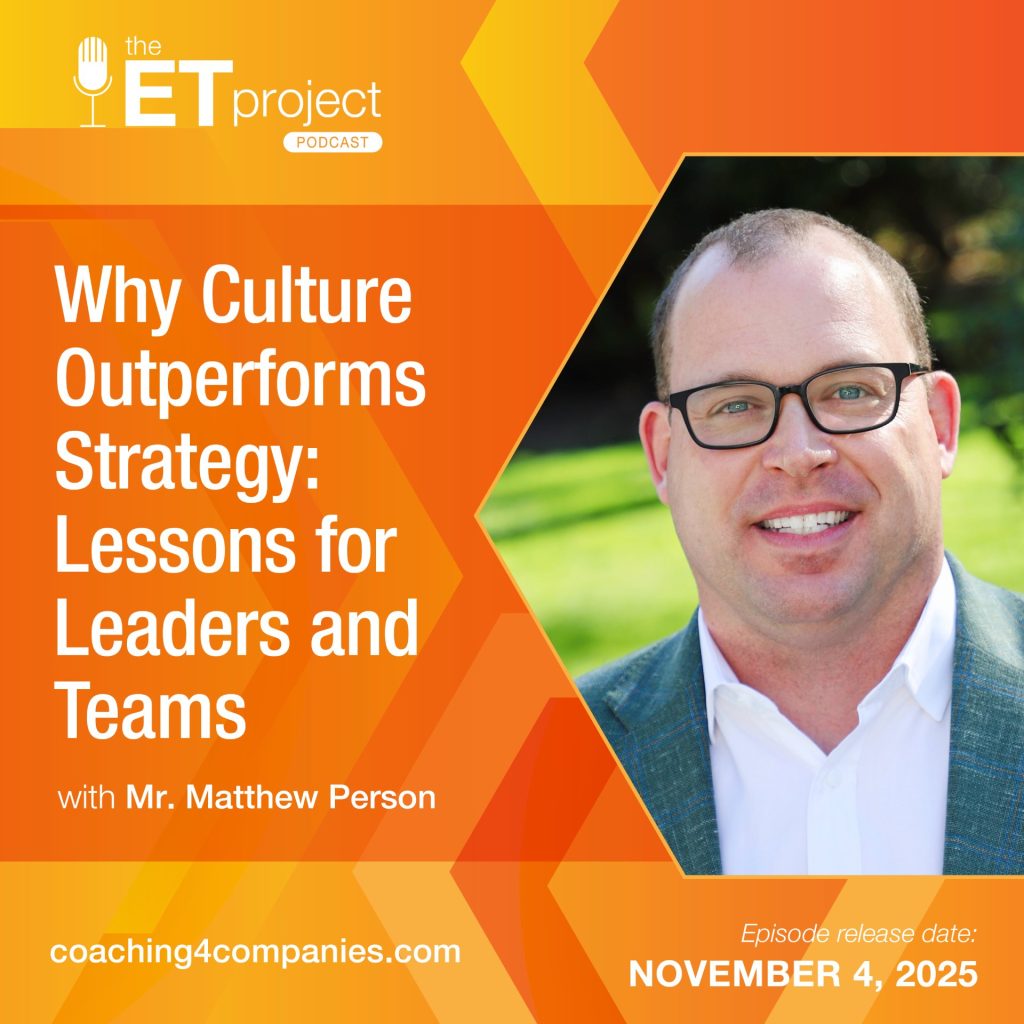
WAYNE BROWN: Hello, I’m your host, Wayne Brown, and welcome to the ET project. We’re delighted to be delivering this podcast for executive talent all over the world, whom we’re affectionately referring to as ‘Team ET.’ Today’s guest resides in Greater Boston, Massachusetts, and is the founder of the boutique consulting firm Town Square Advisors, his name, Matthew Person. Matt has more than 25 years of experience helping companies design and capture enterprise value. He has created the proprietary Square Management System to facilitate improved performance through optimal organizational design methods framed around a concept called ‘Constrained Independence.’ Team, you’ll hear us discussing this methodology with many other aspects around how we can all leverage this tool to understand our own leadership as well as company performance status and identify gaps. In addition to Town Square Advisors, Matt has led global inorganic growth strategy plus M&As from multiple private equity-backed portfolio companies. Prior, Matt established global corporate development departments for Green Street Advisors, an international data group owned by Blackstone. During his tenure, Matt led six transformative M&A transactions and was recognized as a Finalist of the prestigious Thought Leader of the Year awarded by Alliance of M&A Advisors. Team, if you’ve ever wondered what professional acquisition leaders look for and the tools that they use to guide their decisions, then this is the episode for you. Tune in and be ready to take plenty of notes.
INTRO: Welcome to the ET project, a podcast for those executive talents determined to release their true potential and create an impact. Join our veteran coach and mentor, Wayne Brown, as we unpack an exciting future together.
WAYNE BROWN: Hello team, great to have you joining us again for this week’s conversation. I want to start with a question, how many of you have been involved in a business acquisition? I’m wondering if it would surprise you to hear that nearly 70% of merges fail to create their intended value that was originally expected. And often it’s not because of the strategy or the finance, it’s a silent killer, cultural misalignment. And what if the secret to high performance isn’t more control, but a smarter kind of freedom? So here to help us explore how to build a culture that drives growth, instead of draining it, we’re joined by Matthew Person, founder of Town Square Advisors and creator of the Square Management System, and you’re going to hear us talk more about that shortly, but Matthew, welcome to the ET project.
MATTHEW PERSON: Thanks for having me, I’m really excited to chat with you today.
WAYNE BROWN: Yeah, I’m looking forward to this conversation, I mean, mergers and acquisitions, always an interesting topic. So, maybe before we jump in, from what I understood when we were doing our preparation, you’ve got a fascinating blend of both high stakes M&A, private equity, and almost a decade or a decade in the professional sports management arena. What was the through line, if at all, that connects what seems to be two different worlds?
MATTHEW PERSON: It’s a great question, as disparate as it may seem, all my different stops across my career are all linked in one way, and that is very simply understanding how to create value, it’s just done different ways. I did start my career in professional sports on the business side in executive management. I basically flipped and enhanced underperforming franchises all over the United States, and really found and learned a lot of lessons around how to do organic growth, especially for a product that no one needs. I ended up just burning out a little bit from the demands of that work schedule, I decided to make myself, life a little easier, I became an investment banker, which of course is a joke, because that’s a high-stakes, high-pressure, high-speed environment. But I did become a sell-side investment banker and spent many years doing that with the lower middle market and understood how to shift from organic growth and organic value creation into the attributes that an acquirer would value and where value creation is in a transaction. And then I shifted to the buy-side and sat in strategy and buy-side M&A, acquiring businesses for private equity-backed portfolio companies, where you’ve got to understand the rules of the game from an organic and inorganic perspective to really see where value sits. So, I have all three pegs of the stool, so to speak, and I’m also, as you know, launched a company, Town Square Advisors, so four pegs in many ways.
[00:05:00]
MATTHEW PERSON: And that really helps me frame and understand where value creation sits, what good looks like and everything in between.
WAYNE BROWN: When you first started out, was it with one particular sport that you were involved in or was it cross-sport in general?
MATTHEW PERSON: I was in professional baseball.
WAYNE BROWN: Professional baseball. So, in a big league or like?
MATTHEW PERSON: The minors, single A through triple A all over the country, small towns to big towns and really found it entertaining to see the variances from what geography brings to how you think through strategic growth to size of community. There’s a lot of different dynamics there. And then, of course, every company has its different attributes as well. And so, you can kind of start to see, I used to call it the matrix, you can kind of see the tea leaves a little bit and read through where we had problems organizationally. And it brought a lot of the learnings from my multiple stops into the M&A side of things.
WAYNE BROWN: So, as you said, you were involved with a lot of private equity firms. From where I read Vista, Blackstone, TA Associates, what was the biggest lesson for you that came out of working on mergers from that buy-side perspective? Was there a key lesson that came out of that?
MATTHEW PERSON: Well, I think there’s a couple. One is organic growth is welcome, is healthy, it proves the intrinsic value of a business. But companies that do programmatic M&A that acquire and roll ups, they tend to grow materially faster, they maintain their competitive position. And so, businesses that acquire and successfully integrate, I know that you start at the top where value may not be created in all transactions, and there’s definitely reasons for that. But M&A works and there’s a reason it’s done, and there’s a reason that private equity leverages that tool to create value. And so, for companies that are TBD on whether they should acquire things, all the statistics will show that growing a business via acquisition and complementing that with organic growth is your fastest way to create value for your business.
WAYNE BROWN: That could be a fascinating discussion in itself for another day.
MATTHEW PERSON: For sure.
WAYNE BROWN: But was there a moment or a pivotal point during that where you decided, okay, I’m ready now to step out on my own and give this a shot?
MATTHEW PERSON: Well, what I saw was I think a lot of people are attracted to the big leagues, so to speak, the big time, they want to be part of the biggest companies. But to a degree, M&A they’re somewhat easy, it’s rote, everyone knows what they’re doing, the numbers all work, everyone has audited financials. Where are most of the difficulties in managing a process? Where is there most difficulties in professionalizing a business? It’s the lower middle market. And I knew that world very well for my time in professional sports, those are smaller businesses. And I saw a need to fill the gap in businesses that are 10 to 100 in revenue that could benefit from something that was more actionable, it wasn’t just your big four consulting, “hey, here’s a 100-page PowerPoint deck, go do something with it.” I always hated that. And I also found myself along the way seeing this, because I talk to so many companies, I’ve seen good, I’ve seen bad, I’ve seen ugly. Where I felt like I could probably help bridge the gap and say, hey, if you just do these things, you’re able to affect a higher degree of scale, you’re able to enhance your profile. We could probably just, with a couple tweaks, do better for companies and we don’t need an MBA and you don’t need a big four consultant to tell you how to do it. It should be actually actionable and digestible and that’s the effort here behind the Square Management System, it is designed for smaller businesses. There’s nothing wrong with the middle market, that’s where all of the majority of people work, actually. But it’s also a place where you want someone to read this and digest it and go, “I’m going to go action that today.” And that’s the point, it’s not meant to be a sit on your desk, it’s meant to be read, digested, actioned.
WAYNE BROWN: So, tell us a little bit about Town Square Advisors, I mean, the name in itself strikes up some interest, what was the premise behind the name, if there was one, and what do you focus on?
MATTHEW PERSON: Well, the name is intentional. And it’s part of where the Square Management System attributes come from. The first side of the square is identity. And a lot of companies can go awry with their brands and their mission not aligning. And so, Town Square Advisors should, as you rightly acknowledge, should pretty much tell you where we’re focused, which is on the business that’s in the Town Square, it sits in the lower middle market. So, the name itself would lend it to the type of business that I want to work with. And so that’s the derivation and the focus for the business.
[00:10:00]
WAYNE BROWN: I read somewhere that says the business is described as independent but also industry-agnostic, can you elaborate a little bit on that?
MATTHEW PERSON: Independent in the sense that I’m not trying to bring a lot of consulting companies, a lot of boutique advisors will sit there and try to promote something that has a tag-along, there are other services that are intrinsically related to it. So independent in the sense that I’m just here to provide value to companies. And then industry-agnostic, because honestly, a lot of people pitch specialization these days. I don’t really know if anyone is a true specialist, if that really adds value from a consulting perspective in the sense that being a generalist actually allows you to see through all the muck and kind of go, “hey, this might not be a right, this might be here, you can come at it from a different lens.” Industry specialization has been growing, when I was a banker, you were a specialist in a certain industry, you knew that sector. And that’s helpful, but the number of times that I was in pitch meetings, saying I’m an industry specialist, and I’ve read all these books on X, Y, and Z on the market, and the number of the likely buyer for your businesses in this top 10, do you know how many times the number of the buyer was in the top 10? Zero. It was usually someone actually in the bottom 100 who ended up being the reason that the acquisition occurred. So, I’ve always kind of looked at it saying, if you generally know how to run the 80% of a business, which is what most businesses are very linked, they’re 80% the same, they all have P&Ls and balance sheets and staff and operational metrics, you can do a lot for a business, the 20% when it comes to advisory, it can be learned relatively quickly.
WAYNE BROWN: Okay, well, let’s dive into this core methodology, the square management system, if you don’t mind. It has this compelling concept, if you like, on constrained independence.
MATTHEW PERSON: That’s right.
WAYNE BROWN: So, I would love to understand a little bit more about that.
MATTHEW PERSON: Yeah, so part of what I saw over all the years was the good and the bad and the ugly around how companies worked. And I’ve been in great cultures and I’ve been in bad cultures. At the same time, I’ll argue there’s no such thing as a good culture and bad culture. My association to that culture is what creates the perception of good or bad. But ironically, the places that I thought were bad cultures had people who had been there for 20 years, that company had won a ton of awards, it just had a different way of doing than I perceived to be good, and as a result, we had a mismatch. So, what is actually constrained independence? If you step back, you know, Wayne, start a new job and there’s no constraint, you could just action your own ideas, you could do whatever you wanted to, right? Well, that doesn’t work, because companies have service standards, they have quality standards, they have compliance metrics and regulations. So, there is a constraint on your freedom to act and action your own ideas. And so Constrained Independence is the known and communicated degree to which an employee can action their own ideas. And that matters because that independence, that degree is something that can be intentionally designed, it’s not this amorphous way of doing that just you kind of figure out, it can be known, it can be intentionally constructed. And what I’ve realized over the years is that culture itself is actually just an output, it is the output of your ways of doing, it’s an output of your systems, your processes, your procedures. So, what is the square? The square is the degree of which you’re constrained. You can action or not your own independence. And there are people who really like a very wide or what I would call light degree of constraint, they want to action their own ideas, they want to ideate, they want to make the decisions themselves. There’s other people who really want to have a high degree of constraint, there’s also industries with a high degree of compliance. If you go into a hospital, there’s not a lot of independence there, someone is going to die if you don’t follow the rules, right? So, there’s places in which you have this high degree of constraint or people want that, they need that in their role because they don’t want to make decisions, and that’s okay too. So, then I sat back and I said, “well, how does this work?” There’s not one person, you can’t have one person align and fit in that box of independence because companies have a thousand, ten thousand, a hundred thousand people. So, the goal is to, within the degree of variance, get everyone inside this box, this way of doing. And if everyone kind of is in that box, what do you get? You get happier employees and higher-performing and higher-trusting employees. How does that happen? That box if it’s done correctly, is a known degree of constraint. If you’re inside that box, you know what decisions you can make and what decisions are outside the box where you can’t outside the square. That means you don’t have to go, “Wayne, can I do this? Can I do this? Can I do this?” You just know, and you can act faster. If you are able to make decisions on your own, then you feel like you’re a part of the output, you’re actually influencing the direction of the company. You can innovate without fear of doing something that maybe you shouldn’t be doing because you kind of know, right?
[00:15:00]
MATTHEW PERSON: If you know all your other employees are inside the square, you create trust. Hey, I kind of know where we’re supposed to be. We all are on the same, we’re paddling in the same direction. That trust, that independence, that innovation, that creativity that fosters, creates an environment of trust, it also creates an environment of loyalty. So, you get a faster-moving employee, you get a more innovative employee, you get a decisive employee, and all those things lead to trust and loyalty. And we all know that hiring a new employee is worse than training and upskilling an installed employee. So, this square creates the fashion by which you can just move faster as a company. There are four sides, each side has its own elements, but in effect, when you design that, you create that environment for culture, the output that employees love to be in.
WAYNE BROWN: Do you want to identify the four sides?
MATTHEW PERSON: Sure. Yeah, I’d love to, I just didn’t want to keep on rambling a little bit, but yeah, there’s four sides. So, what are the four sides? Well, the fifth eye is the output, that’s constrained independence. The four eyes that create that degree of independence, there’s 10 elements on each side, 40 elements in total. The first eye is identity, and that’s obviously the starting point for everything, that is your organizational definition. That’s your mission, your values, your brand personality. So, you ask me about Town Square and where it comes from, that is as simple as logo to mission association. Sometimes people get this way wrong or they shift it and it goes sideways, look at Cracker Barrel, obviously got into a hot water over their logo change. But the key question here is, do our… that was an interesting story, do our people know, do our staff, do our clients know what we stand for and why? The other second one is instruction, that is how you operate. This is the clarity and consistency of expectation, onboarding, knowledge transfer, training protocols. The key question here is are our rules, our expectations, our performance clear? Are they scalable? It’s not always the case in every company. The third eye is inner communication, this is what most people think culture is, this is how people interact and how information flows, it’s organizational hierarchy, it’s meeting cadence, it’s your ping pong table and your happy hours on Thursday, it’s your tone, your use of communication tools. The key question here is information flowing in a way that drives trust and clarity? And the last one put it all together is information feedback, and that is how performance is measured and evaluated, it is feedback loops, performance reviews, operating metrics, recognition programs. Are we learning? The key question here, are we learning and adapting fast enough to stay competitive? So those four sides, identity, instruction, inner communication and information feedback all have 10 elements. They all combine, they have varying degrees, if you if you go on my website, townsquare-advisors.com, you will take a free quiz, you can kind of learn about each one or go into the 40 points and actually pick high, medium and low levels of independence and you can actually see how those operational elements will influence the business. Once an executive team or a founder uses those things to construct the business, it’s a diagnostic tool. So how does this apply in M&A? You should, as a company, as the home company, you should score yourself, you should know who you are as a business. And then you should score your target company and see where the variances are. And the varying degrees between the target company and the home company will tell you where you have culture mismatch. I’ve been in rooms as an investment banker where the acquiring company, the home company, was very much a work in the office environment with mandatory reporting and suits and ties. And they were looking at it in business, and they really liked what it would do for them from a strategy perspective. But in the meeting, they quickly found out that everyone was remote, that no one really reported, there was a whole different way of communicating, inner communication, that angle was way off. And they backed out of the deal, they said, “no, we don’t really want to buy this company.” And you could sit there and say, “that’s a bad idea,” and I actually would applaud it and say, “no, they knew what their culture was, and they knew it wasn’t going to work.” Regardless of how good the product was, the people wouldn’t have stayed, it wouldn’t have worked. So that is a big part of this, it’s a diagnostic, it’s an effort to understand where you have culture mismatch through operating systems and processes.
WAYNE BROWN: Thank you for answering the question in my mind. So, I’m just going to ask you, how does it play out in practice? But no, now I understand. And I can imagine, you just talked about identifying gaps. One of the areas that I’ve seen many times are the processes, the systems, the platforms that both sides use are often very different and it creates a huge rift between who is going to win. Are we going to be this platform over our platform that we spent the last 20 years perfecting? We’re going to throw it out, we’re going to bring in Salesforce, as an example, over our local legacy platform, do you address that type of thing?
[00:20:00]
MATTHEW PERSON: Well, so that platform is a way of doing it, right? And that’s part of the inner communication process. And so how you operate the business, the ways of going to work, all that gets wrapped into the 10 elements that are in inner communication. And traditionally the home company, the acquiring company should win because it’s their systems that are the default. And what I’ve seen in integration is you need to do that shift sooner than later, if you leave people on their old systems, then they still think they’re part of the old company. So, you got to make that culture shift relatively quick, you can’t disrupt operations, no one wants to mess up sales and synergies. But there should be a path as part of your integration work to shifting everyone over. You don’t need two of this and three of that, you should be able to sync everyone up onto their own systems. In the right cadence and the right communication, again, there’s a reason that there’s four sides here, you can’t change an organizational process without having the instruction and then training everyone around it. If you start changing too many things, that changes the brand identity, then you screwed that side up, they’re all linked for a reason. So, when you look at Cracker Barrel and they took out the logo, they didn’t really communicate it in a way that made sense. They hadn’t also really understood their identity, they didn’t realize how strong that logo brand image was. And so, people did really… the key question, do our people and our clients know what we stand for and why? It was obvious that the management team didn’t know the strength there. So, you’ve got to link all these things together, if you make one change, you have to think about the implications on the other sides.
WAYNE BROWN: How much would the model play out outside of the corporate world? So, would it be applicable in profit versus nonprofit? Or would it be useful even in, say a government body?
MATTHEW PERSON: I think so. I think it’s any operating system, any operating system where you have a business. Any time you have four walls that people have to walk into, it’s applicable. The key thing, though, is that this is a symbiotic relationship between the employee and the company, right? And so, the big factor here is that this is just as applicable to the individual, you should know who you are, too many employees chameleon themselves for the sake of a job. Now, I’m not going to sit there and judge someone who needs a salary and has to do that, and we’ve all been there, where you are you just like, “I got to take a job, I got to do it, it is what it is.” But if you have the luxury of choice, I think people need to know who they are and they should ask, “hey, how do you guys go to work? How do you communicate?” X, Y, and Z. There is a diagnostic on the website, townsquare-advisors.com, for individuals. And everyone who I’ve had take the quiz, the free one or the one that has all 40 points, comes back to me and says, I kind of knew maybe a little bit about me, but I never really thought about it that way. And maybe I’ve just been in more environments or have seen more environments by virtue of my background where I kind of know me very well, like, I am not going to do well in an open environment, I like a closed door in an office, I like regular reporting, I like dressing up when I go to work, I don’t do well in bean bags, t-shirts, and laptops. And that sounds simplistic, but it’s also best me. And so individual employees need to understand who they are and align themselves accordingly as well. Employment is a two-way street, and I think individuals owe it on themselves as much as companies do to make sure they got it right.
WAYNE BROWN: And I had a guest on recently who said one of the ways that companies can do it, is they can make their values very clear at the outset from the very beginning so that the individual can see whether they’re a fit or they’re not a fit, and they can make that choice, yeah?
MATTHEW PERSON: That’s right, they should. And I think the key cog in this whole entire wheel is the HR department, they got to do better, because the cliche is no hiring manager has ever said that their culture is terrible. Have you ever been interviewed where everyone was like, “this culture is terrible, I don’t know if you’re going to survive here, but good luck to you.” Never. Good luck. Correspondingly, one of my favorite phrases I’ve coined is that no employee starts their first day disgruntled, it just doesn’t happen. No one is walking in and they are going, “God damn it,” it’s just not the way it works. And so, you know, ironically, both sides think everything is great on day one. Research will tell you almost 50% of new hires leave their job, either they quit or they were fired in the first 18 months, 50%. So, obviously it’s not working. So, what causes that problem? What has happened in culture and corporate organizational design is we’ve gone so broad with culture, we’ve tried to get to this organizational we, instead of looking at who they want to be. And they’ve also common-sized culture.
[00:25:00]
MATTHEW PERSON: We’ve said, “Hey, you’re a best place to work. And we’re going to copy what you do.” Because if it’s… you know, it just like the “you can’t go wrong buying Salesforce” because it’s so big, if it doesn’t work, it’s like, “well, it’s Salesforce, I don’t know, it must not have been Salesforce.” So that’s why some of the junior tech doesn’t work as well or get as much sales. Because if that goes wrong, they’ll say, “well, you should have just got Salesforce, Matt.” So, we’re in a copy culture, we’re in a copy on everything. And you see it in a lot of business books, hey, I’ve interviewed 500 executives, I’ve done analysis on a thousand companies and here are the aggregated common things that you need to know that makes X, Y, and Z the best. And I honestly, I don’t even read business books anymore because it doesn’t mean that it’s applicable for me, right? And so, a lot of what I write about in the forthcoming book, ‘The Culture of Alignment,’ which you can reserve an advanced copy of if you’d like on my website, talks about how we got this, why that has gone sideways, what’s wrong. Because if you try to be everything to everyone, just as much in sales, if you sell everything to everyone, you sell nothing. And in culture, if you try to be everything to everyone, you’re going to fail, you’re going to upset somebody. And we’ve got to get away from that, we’ve got to start to look at the company that we want to intentionally design and then have the constitution to adhere to it. And that’s the point of this book, it’s not even really a book, I call it a pocket guide for a reason. If you truly believe philosophically, this is the right way to operate and you can go right through and you can start scaling a bit. You can immediately take a diagnostic, go in the back of the book, start answering the questions, and you can start actioning immediately. And that’s what I think is the missing from all these books, from all these guides is the how. And this book gives you the how and the understanding of, okay, I like this, I’m going to go do that, here’s a vision of what this looks like, this element implemented at a high, moderate or low level of constraint, and you can go dig in and start doing it today.
WAYNE BROWN: The book you just mentioned, ‘The Culture of Alignment,’ do you want to dive into that a little bit? Like, is it… how far away from release?
MATTHEW PERSON: I’m working with publishers right now and I’m humbled that I have a couple of them willing to work with me. Publishing is an interesting world, not one that I knew much about until I started this, I’m not a natural writer, I also didn’t intend to write a book. It’s something that has taken me eight years to bring to life, but I’m really proud of the fact that I’ve been able to get it to a satisfactory place where a publisher will work with me. So, some point in 2026 is when it’s coming out. So, if you want to go on the website and reserve a copy when it does come out, you could do that. But more importantly, you can go on townsquare-advisors, take the free quiz or you can dive into the full 40-point methodology and really start actioning it almost immediately. So, I’m here to really promote that thought leadership and the understanding. But the book is coming. The book really does break down really quickly. Like, how do we get alignment wrong? How do we get culture wrong? It’s that copy. Why is alignment the right way to think about it? And then how do you affect alignment in a way that we probably haven’t thought about before? Because a lot of people will tell you culture is amorphous, it’s just the way of doing it. And again, I argue, no, this is a known and intentionally-constructed output that you have the ability to affect as a leader of a business.
WAYNE BROWN: It sounds like an interesting book, we’ll probably have to come back together again when it’s released.
MATTHEW PERSON: I hope so.
WAYNE BROWN: But is there a key lesson that people take away from the book?
MATTHEW PERSON: I think the key lesson is intentionality. Because what I see a lot of in businesses is default, this is just the way things are. And when you take that approach, where you copy, you’re effectively letting someone else control the culture of the business, you’re letting fiefdoms happen all the time. If you don’t fill the void, you don’t intentionally design your business, you don’t follow the methodology, you are effectively letting your employees then default to what the outcome should be, and that’s where chaos ensues. You’re going to get variances in performance, you’re going to get ambiguity across the business, and that causes chaos and confusion. A common example of that is you have a policy around behavior, and there’s always a sales guy that is just breaking all the rules, except he or she is probably the highest performer. And everyone goes, well, you know, that’s just Lisa, you know, but she’s, you know, we just got to learn to work with her. And it’s like, no, you’re now telling everybody, you know, that in reality, the rules aren’t really the rules, right? Because you didn’t have the constitution to adhere to it. And you do more damage allowing that person to stick around than you do letting the person go. So, the big rules, intentionality, and then having the constitution to adhere to what you want it to do and what your culture to be. And then the last one is the toughest one, which is part of, you know, having a Lisa or, you know, someone in sales or any other division that’s just not quite on par with the culture is realizing that it’s not your culture, that box, that square that you’ve created, it’s not for everybody. And that’s okay. And employees have to be okay with it too. Neither party is wrong, it just means you just didn’t fit that one arena, and that’s okay.
[00:30:00]
WAYNE BROWN: So just to summarize on the Square Management System, as an individual, I can use it, it’s useful as a company, I can use it, it’s useful, if I’m looking to merge with another company, I can use it, it’s useful.
MATTHEW PERSON: Yes. That’s true.
WAYNE BROWN: It’s a very versatile tool that seems applicable in many different situations. So, I did look at it on online, I haven’t had the opportunity to go and put into it into practice yet that I will be. So, based on that, thank you. Where do you see the future heading with, not only with your own company, but with technology the way it is now, with the impact that it’s having on companies, how is that playing out with mergers and acquisitions at the moment?
MATTHEW PERSON: I think what I hope is that people take this as a framework and leverage it and action it. And I do see, because culture is so important, I do see people spending more time getting that right and assessing whether or not this is really going to work regardless of the value of the IP that’s being acquired. Because we’re probably at a point where, you know, with the advancement of technology, it’s going to be more, the people that are there, are going to be more important because they’re the ones who have to affect the outcome and technology always has an adverse impact on employees in some fashion. But the people who remain are the ones who are critical and people are your culture. And so, you really got to make sure you have the right people in the box to ensure that you get the most out of whatever you’ve acquired or whatever you’re running if it’s a business. Either way, culture is the key cog beyond creation of shareholder value. The people who create the shareholder value are your staff, so, you got to get those people right. Because it doesn’t matter how great your IP is, it doesn’t matter how great your product is, if you don’t have the right people in the room, it’s never going to get anywhere.
WAYNE BROWN: And underlining all of that is this whole principle of Constrained Independence, I guess, using the Square Management System.
MATTHEW PERSON: That’s right.
WAYNE BROWN: You wrote somewhere I read saying that there is no perfect culture, there is no one culture that fits everything, it’s actually somehow ensuring that it’s the right fit with the culture.
MATTHEW PERSON: That’s right.
WAYNE BROWN: You’ve done a very good job of explaining that, is that the concept?
MATTHEW PERSON: Yeah. I think in closing, you know, that’s key, there is no right or wrong culture, the whole goal is what is right for your company. And then you as an individual, what’s right for you? And having that alignment, it’s not binary, nothing can be binary, nothing is perfect. But knowing the box that you want to give people to play within is just, that’s the key. And I think we’ve missed that, we’ve tried to make it so… that box so big that it just, we’ve lost sight of what real culture is. So, I think there’s a lot to be learned from making sure that you really know the box that you want to play in and how to create it, and this system does that.
WAYNE BROWN: Aside from the book, what’s lies in the short-term horizon for you, for the organization, the company, are you looking to scale or is there something on there?
MATTHEW PERSON: No. Right now, it’s the thought leadership in the book, and then just getting that out there and promoting the work that I’m doing there is really the goal.
WAYNE BROWN: Well, is there any… we’re going to wrap up shortly, but is there any tips for leaders, managers, entrepreneurs listening who might be inspired to learn more about how to apply? I know you’ve mentioned that you have the tool on the website. Obviously, for the listeners, that would be a great starting point, is there anything they can do outside of that and before the book gets released to take some action immediately?
MATTHEW PERSON: Yeah, you can go on the website townsquare-advisors.com and do the full 40-point methodology. So, you can start to understand it almost immediately and start to walk through the elements and pick them and understand it’s not as in-depth as the book will provide, but it is a start. And then I think going on the website too, you can learn more about how the methodology impacts sales, impacts marketing, impacts organizational design, and you can start looking at it. I think people should just start to think like, do I have this all right? Do I have a full box? You know, do I actually have a square in place? Are all my systems lined up? Do I have all four sides? I think that’s probably the takeaway. Start to really think, do you really have what you think you have in line? Is my culture really the right way of doing things? Do I need to make changes? I think you can start to affect those simple things relatively quickly.
WAYNE BROWN: Matthew, a fascinating conversation. It’s an area that probably the majority of our listeners don’t get involved with, I would imagine. But as you explain it, I mean, it’s applicable to me as it is to an individual to ensure they’re in the right organization. It’s useful for the organization and it’s useful for the M&A side of the business.
[00:35:00]
WAYNE BROWN: So, I think now there’s this huge opportunity for all listeners to go on the website and play around with the system and get a feeling for it. Where’s the best place that they can connect with you? Is it through the website? Through LinkedIn? What’s your best?
MATTHEW PERSON: Through the website, townsquare-advisors.com. Wayne, I appreciate you having me. I hope all your listeners took something away from the conversation. Go on the website to learn more. I’m looking forward to seeing how people feel about the concept and applying it.
WAYNE BROWN: Well, we’ll definitely come back together for the book, I look forward to that. Matthew, thanks for being on the ET project, it has been a great conversation.
MATTHEW PERSON: Thank you so much.
OUTRO: Thank you for joining us on the ET project, a show for executive talent development, until next time, check out our site for free videos, eBooks, webinars, and blogs at ‘coaching4companies.com.’