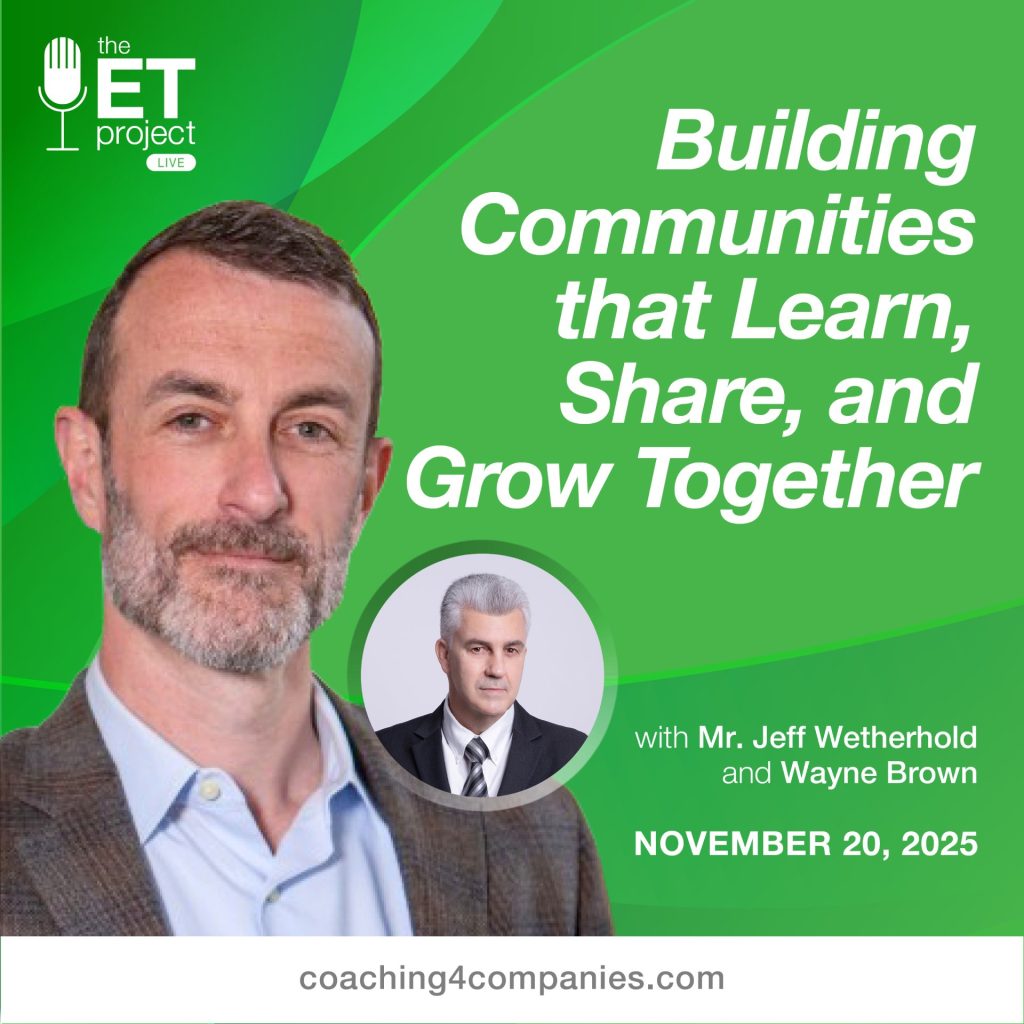
WAYNE BROWN: Hello, I’m your host Wayne Brown and welcome to the ET project. We’re delighted to be delivering this live episode for executive talent all over the world whom we’re affectionately referring to as ‘Team ET.’ Today, we’re in the city of Scarborough in the northwestern state of Maine, USA, to chat with Jeff Wetherhold, a trainer and coach with 15+ years of experience supporting hundreds of teams in making and sustaining change with improved outcomes. Jeff is a member of the Motivational Interviewing Network of Trainers who has trained and practised in quality improvement, motivational interviewing, facilitation, mediation, negotiation and evaluation. He is also a faculty member of the Institute for Healthcare Improvement where he has supported healthcare organizations in adopting evidence-based safety practices. Throughout his career, the most common obstacle to change that Jeff has observed is poor quality conversations. Motivational interviewing is the most effective discipline that he has found for improving those conversations both with patients and within teams. Jeff founded MI for Health to provide accessible and skills-focused training and coaching to mission-driven organizations. He has used motivational interviewing to lead change initiatives with a broad array of clients including healthcare organizations, non-profit, civic organizations and educational initiatives. Jeff has served as a trusted advisor to organizations including the State of Illinois, the Institute for Healthcare Improvement, the University of Nebraska Medical Centre, MIT and the Institute for Healthcare Delivery Design. As a former behavioral science researcher, he draws from disciplines like motivational interviewing, deep canvassing and reflective listening to help clients move beyond top-down messaging and co-create change for those who may be skeptical of it. Team, Jeff also holds a master’s degree in education from Harvard University and you’ll find our conversation digs deep into the challenges that many leaders face and must overcome if they are to embrace and master the application of change. Tune in as this conversation is likely to alter the way that you approach this important leadership function.
INTRO: Welcome to the ET project, a podcast for those executive talents determined to release their true potential and create an impact. Join our veteran coach and mentor, Wayne Brown, as we unpack an exciting future together.
WAYNE BROWN: Hello team, welcome back for another week’s conversation. If you’ve ever worked in an organization of any size, I’m going to guess that you’ve experienced this. There’s a new initiative that gets announced, great fanfare, kick-off meetings, slide decks, ambitious goals, but six months later it’s quietly abandoned. Whether it’s the software that’s not being used, a new process gets ignored, everybody slips back into their old ways, probably a little bit more frazzled and burnt out for their efforts. So, the question is, why does this happen so often? Why do well-intentioned, strategically-sound change initiatives fail at such an alarming rate? Conventional wisdom tells us it’s a lack of budget, a flawed technology, perhaps poor planning, but what if the real problem is much more fundamental? What if the single greatest point of failure isn’t the what or the when of change, but the how of the conversation about it? And this is the exact challenge that our guest has dedicated his career to solving and is here to explain how we can stop just announcing change and start actually making it happen. So please welcome the founder of MI for Health, Mr. Jeff Wetherhold. Jeff, welcome to the ET project, great to have you with us.
JEFFREY WETHERHOLD: Wayne, it’s a pleasure to be here. Thank you for having me.
WAYNE BROWN: Where are you sitting at the moment?
JEFFREY WETHERHOLD: I am in Maine in the United States.
WAYNE BROWN: How is everything in the States? I know it’s an interesting period at the moment.
JEFFREY WETHERHOLD: Well, for somebody like me who spends a lot of time thinking about how to get people with different perspectives to work better with one another and to have better conversations with one another, it’s a challenging time, but it’s also a time at which those skills are badly needed.
WAYNE BROWN: I see.
JEFFREY WETHERHOLD: So, I try to take the solace that I can from the fact that this is something that, not just at an organizational level, but as a culture we struggle with and that we could all stand to continue to get better at.
[00:05:00]
WAYNE BROWN: I think it’s a worldwide phenomenon, I wouldn’t isolate it just to the USA, of course. It’s an area where… let’s jump into the work that you’re doing, I mean, from what I’ve read and learned, your work is very much grounded in the belief that better outcomes start with better conversations, can you unpack that for us a little bit? Why is the conversation itself so often the missing piece in creating change?
JEFFREY WETHERHOLD: That’s a great question. So, my job is to help organizations change together, that’s the work that I’ve dedicated my life to. And the vast majority of organizational change efforts fail. When they fail, those failures are incredibly expensive and avoiding them requires conversational or relational skills that most leaders and teams have never been taught. So that’s why I focus on that piece. We often approach organizational change as if it is strictly a technical pursuit. If we have the right plan, the right framework, the right information or measurement strategy that everything is going to fall in line. And we have been badly misled, if that is what we believe. So, we know that 88% of organizational change efforts fail to produce any lasting results. So, when somebody tells you there’s going to be big changes around here and you laugh or just sort of shrug them off or ignore them, you’re not pessimistic, you’re not resistant, you’re rational, these things fail 88% of the time. And when we ask people who’ve been part of organizational change, what was missing? What were the obstacles that you ran into? What do you need? They tell us they don’t talk about frameworks and models, they don’t talk about measurement, they don’t talk about roles even. They talk about things like a lack of awareness for the reason that change happened in the first place. They talk about fear, lack of support and trust in leadership, lack of inclusion, buy-in, and inability to manage the people side of change, these are not technical needs, these are relational and conversational needs. And they point to me very clearly to a conclusion that we teach people how to think about change and plan for change, but we never teach them how to speak to it. And we see really poor results and really expensive failures as a result of that omission.
WAYNE BROWN: You touched on a number of points there. I mean, the buy-in aspect, what does a core quality conversation look like? When we sit down, we all talk about we need to communicate better, we need to have those conversations at the beginning of a change initiative, what is it that leaders in particular are missing in this whole push?
JEFFREY WETHERHOLD: I think it starts with our fundamental attitude toward how people feel about change. We often think about change as something that people have already made up their minds about. There’s this well-known phenomenon in behavioral psychology called the ‘binary bias,’ where we as human beings are predisposed to take rich and diverse sets of information and reduce them to two options. You’re for it or against it, you’re with me or you’re not. Nobody who I’ve ever spoken with has needed to reach very far to find examples of this in their day-to-day life, we do that with change. I mean, we approach it as if people have made up their minds about it and what we know from the skill sets that can help us approach these conversations differently is that in reality, we’re all ambivalent about change. We have reasons we’re willing to consider it and we have reasons that we’re not willing to consider it. And those reasons coexist, they never completely go away, which is one of the reasons that reinforcement for organizational change is so important. So that, if we follow through on that lens of ambivalence, puts us in a place where we no longer feel like we have to convince people to think of change our way. So let all their reasons to be skeptical of it, to embrace all of our reasons to do it. If you’re waiting for that moment where somebody tells you, “I’ve been thinking about this all wrong, you’re right,” it’s not happening, in 20 years, I haven’t seen one, perhaps I’ll be proven wrong in time. But we don’t need those moments because our job in helping people accept change is to accept they have motivation to change. We can learn about this and that we don’t need to reinvent their attitudes toward change wholesale, all we need to do is turn up the volume on some of their reasons to consider change or turn down the volume on some of their reasons not to.
[00:10:00]
JEFFREY WETHERHOLD: And there are a lot of ways that we can do that. So, when we take that lens on these conversations, it takes us from a place where our path forward is very narrow and nearly impossible, in my opinion, to a place where there are many paths forward, where there are many ways to engage with someone about change. And if some of those are harder than others, we can pivot and we can move on to other angles, that involves learning how to listen for those attitudes, to hear that motivation, and how to value that intrinsic motivation as highly as we should.
WAYNE BROWN: Listening and asking the right questions, it starts with the fundamentals, is what you’re saying. We have to get better at doing the basic things that we should be doing as leaders all the time, and that’s where we kick off from. I like that. MI, by the way, I just need to ask you this question, MI for Help, MI stands for ‘Motivational Interviewing,’ is that correct?
JEFFREY WETHERHOLD: That’s correct.
WAYNE BROWN: And it comes from more of a clinical counseling context?
JEFFREY WETHERHOLD: It does.
WAYNE BROWN: Right. So, what was the initial spark to you? I mean, you work more with teams and with organizations rather than individual potion, what was the initial spark that led you in that direction?
JEFFREY WETHERHOLD: Yeah, the initial spark for me was starting to work on my own and getting questions from clients that I didn’t feel like I had good enough answers to. They would ask me questions like, you know, we did everything that we agreed we’d do, we followed through on the plan, we have our value propositions, we have our plan for how we’re going to engage people and they didn’t do it, what do we say? How do I talk to them? Please don’t make me have the same conversation that I’ve had with this person five times, a sixth time. There has to be a better way. And they were right, and in all honesty, at that point in my career, I didn’t have good enough answers to feel like I could be as helpful as I wanted to be to them. So, I went out looking for communication approaches that could be helpful. And while there are several that I draw on, Motivational Interviewing, or MI, is the foundational one to my work. So, MI was developed about 45 years ago at this point to help clinicians in mental health and recovery settings have better conversations with their clients and with their patients. But a curious thing has happened in the decades since, it has spread to many other disciplines as diverse as athletics coaching, dentistry, organizational change, pastoral care, and the evidence for this approach’s effectiveness has become overwhelming. We have more than 2,300 randomized control trials, 200 meta-analyses verifying the effectiveness of Motivational Interviewing in helping people move toward change in an amazing variety of fields. But we still think of this in some ways as something that clinicians do with patients or clients in certain settings. Even though the evidence has made it very clear, this is something that can and should be used much more broadly to help organizations have better conversations, not just with their clients but with one another, about how we work through change together. So, it is something that has become foundational to my approach and that when I bring in other approaches I layer those on, and it’s not because this is just an approach I prefer or something that I’ve been trained to do for a long time, this is where the evidence took me.
WAYNE BROWN: Right. You touched on an interesting point there because I was also wondering, I know you’re a member of the Motivational Interviewing Network of Trainers, as well as a cross-eyed certified change practitioner, when I put those two together, they sound like different languages, but the way you explain it, there really is a way for that.
JEFFREY WETHERHOLD: Yeah.
WAYNE BROWN: Is there a distinct means of how those two approaches fit together?
JEFFREY WETHERHOLD: I think that we’re getting better at that by the year, and that we need to continue to get better at that by the year. Historically, these aren’t disciplines that have been integrated with one another. So, you mentioned the Motivational Interviewing Network of Trainers, I was at the annual conference for that group two weeks ago at this point, and I was just about the only organizational change person there.
[00:15:00]
JEFFREY WETHERHOLD: I’m looking around, I’m surrounded by psychiatrists and therapists, social workers and leaders from lots of other sectors, but not a lot of people from organizational change. I was fortunate enough to be able to teach a session there with some colleagues who are also interested in this, we had a packed room. So, there is an appetite for how we use these approaches in organizational change, people see the need for this, they feel it. If you’ve ever been part of an organizational change as a staff member that has gone wrong, it’s very easy to empathize with the position that we put people in. There’s not as much crosstalk between change management, as we’ve traditionally thought of it, and these disciplines as there should be, we need a lot more of it. I think the evidence makes it very clear, this is what people ask for when we ask them what’s missing. This is what people need, and not only is it something we don’t train those people in, most people don’t even know that these skills exist.
WAYNE BROWN: If I look at Prosci, my background with change, I know that the ADKAR model, you know, ADKAR under Prosci starts with awareness and desire, how would you then bring motivational interviewing specifically to help leaders cultivate that genuine desire and motivation in their teams rather than just achieve compliance? So how do you start the conversation?
JEFFREY WETHERHOLD: Yeah, that distinction that you just made between compliance and commitment, I think is a very important one. We want to help leaders understand that there is a difference between these and that it’s not just a nice-to-have. I think often it’s easy to think, oh, conversational work, intrinsic motivation, this is the right thing to do. We should do this, if we had the time, we would do this. It is the right thing to do, it’s also the affordable and the wise thing to do. We know that intrinsic motivation more reliably leads to habits, it more reliably leads to behavior change. We know obviously that people generate their own intrinsic motivation. And we also know that intrinsic motivation is much more durable than extrinsic motivation. If you’ve ever been in a position where you’ve had to extrinsically motivate someone, the rewards diminish over time, we can see this in work, in our personal lives, in parenting, all over the place. So, when we try to motivate, when we try to replace intrinsic motivation with extrinsic, what we’re doing is replacing a renewable resource that’s durable and that leads to habits with a resource we have to generate that’s fragile and that doesn’t. And that is something that leads to immense amounts of waste and immense amounts of waste that we can begin to quantify. So, for let’s say a 200-person mid-sized organization that’s undergoing a one-year project, an organizational redesign, they can expect to lose a minimum of 1.5 million dollars to an organizational change effort. That’s factoring in turnover, productivity loss, time spent on organizational change, it doesn’t begin to touch on things like opportunity costs for other activities that they could be involved in or customer satisfaction, which I’m sure are impacted but are much more challenging to measure and tie directly back. But that’s an immense loss for an organization of that size. I think it’s very important for us to move past the impulse to look at this as a nice-to-have or the right thing to do if we have the time and to realize that the reason that organizational change is so hard is that we are wasting immense amounts of time doing this in a particularly arduous way. The ADKAR framework that you mentioned is a really powerful tool which I use all of the time to help people move past this notion that there’s a singular reason that people don’t adopt change or that if we just train them it’ll solve our problems because of course training is a solution to one level of the ADKAR model, it’s knowledge. And we can distinguish even within those levels where training isn’t helpful. What’s missing from that and what I think is really important to fold in is the conversational skill, not just diagnosing what the obstacles might be to accepting change, how do I speak to them?
[00:20:00]
JEFFREY WETHERHOLD: How do I listen differently and speak differently down to the level of an utterance? I talked to so many leaders who understand this, who’ve done the research and understand on a theoretical level how they’re supposed to engage differently, no one has ever taught them what the tools are to have a different conversation. They’ve never been given that very granular and actionable guidance, here’s how you can listen and speak differently to have a very different conversation. I think it’s a core need for organizations that are doing this. So, the ADKAR model is a great start but there is a very clear need for much more granular and actionable guidance, how do we speak to one another differently? What are we supposed to say? How can we change the ways in which we interact? And these have a really powerful impact on the conversations that we have with one another when we’re able to put those in place.
WAYNE BROWN: Jeff, I’m wondering, I mean, by default, change tends to filter from top down, right? So, it tends to be the organization identifies a need for some shift in the direction. Using the MI-informed approach, does that give any opportunity for a leader’s role to incorporate more of the body of the organization? Like can the lead for change stem from the employee or does it still have to be a top-down initiative?
JEFFREY WETHERHOLD: It can’t all come from the top down, it just can’t. The leaders who I work with, particularly in large organizations, they’re dying. I mean, they’re spending so much of their time on this and it can’t all be them. So of course, it starts at the top and it starts with executive leaders’ vision for the organization and their goals for those organizations. But the skills for how we engage with teams, it can’t only be executive leadership. And often that next level down or the one under that, the directors or middle management in an organization, they’re the ones who are going to be having a lot of these conversations. So, it’s important not just to have executive leadership learn these skills and approaches, but to have those filter down, to offer training and resources to the directors, middle managers, whatever that is in your organization, who are those nodes and connectors who are going to be the ones having direct conversations. In my experience, when we offer them those opportunities, they latch onto them very quickly. They’re looking for something, anything to help them have these conversations better. So, it does come from the top down, but it can’t just be executive leadership, there aren’t enough hours in a day and there’s already so much pressure on leaders in these roles. I hope one of the benefits to leaders is to look at this and see a way out of that, to see a way, to move past a place where they’re carrying all of the weight of change and where they can begin to distribute that more intentionally across their teams.
WAYNE BROWN: One of the things we talk a lot about when we talk with our clients about change is avoiding that disconnection as it cascades throughout the organization and being able to sustain the alignment. And I guess the conversation is, is that conduit, is the bridge in the majority of cases, would that be true?
JEFFREY WETHERHOLD: Yes, it absolutely is. Organizational change, even in large and complex organizations, it’s the product of individual decisions to change, it’s kind of that simple. Individual decisions to change are the product of conversations that we have with one another. So, of course, there’s a role for structure and systems to support all of that, I don’t want to diminish that at all, but we have to make space for the skills that are going to help us have different conversations that can help people move toward genuine committed decisions to change behavior on their own terms that can help an organization move in that direction. If we’re not working with that intrinsic motivation, we’re working against it. And this is too hard already to afford to waste time working against the motivation that exists in your team.
[00:25:00]
WAYNE BROWN: I can imagine there’s leaders in our audience who are listening to the conversation thinking, Jeff, it all sounds great, but I just don’t have time for long therapeutic conversations. Is there a simple MI-informed technique that they can use with their next team meeting, let’s say, to discuss a potential change initiative?
JEFFREY WETHERHOLD: I can introduce two for people to start with, and these don’t have to be long conversations. MI, when it was initially developed, was as a brief intervention, it still works really well as a brief intervention. Some of the feedback on early demonstrations of MI’s effectiveness was, can’t you make it longer? It’s tough to compare it to longer conversations, can we make these conversations longer? Which is a funny thing to look back on now. But two skills that you could use right away is to start to listen for that ambivalence. We think of this in MI as change and sustain talk. The reason someone has to change or the reason someone has to not change. Start to listen for those as people speak and you’ll notice you hear both in every conversation you have. Often, you’ll hear both in the same sentence, right? I should make this a priority, but there’s too much on my plate. Start to learn to hear those and hang on to them, those are the raw materials that are going to enable you to have a different kind of conversation. And then the next thing I tell people to do in these conversations is to ask fewer questions, which sometimes gets received as heresy. We’re taught to live and die by our questions, I was trained as an evaluator, so I understand, I used to believe this too. We ask fewer questions and reflect more. We learn how to reflect back what people say, and we can do that in a wide variety of ways. A couple of important things happen when we reflect. First of all, there’s a lot of power in asking a question, the person who is asking the question always has the power. When we reflect, we return that power to them, but that also puts them in a place where they have to consider their opinions more than they may have. We have this saying in MI that I’m really fond of, that, “we learn what we think as we hear ourselves speak.” We haven’t made up our minds about everything already, often, particularly in this moment culturally, we’re encouraged to form very strong opinions very quickly and hang on to them for dear life. When we put someone in a position where they have to spend time with those opinions, often we realize they haven’t had it. And I see those moments as opportunities, nobody has given them the opportunity to really think about, how do I actually feel about this? What does it mean? And as they start to work through that, and they start to share more, they’ll start to share things they didn’t intend to share. They’ll start to work through things that maybe are new to them, but they’ll also start to arrive at their own reasons to perhaps open their mind, and those are going to be far more durable. So, two things you can start right away, listening for ambivalence, language toward change and language away from change. And reflecting more, asking less to get people talking, to give them time to sit with their attitudes and work through those and understand how they genuinely feel about this and what they are and aren’t open to.
WAYNE BROWN: The last point is framed, in another way I’ve heard you say, service what’s unsaid. So, through the reflection, people have the opportunity to express some of the things that they’re not going to say top of mind, right?
JEFFREY WETHERHOLD: Yes.
WAYNE BROWN: That in itself may sound or feel a little bit risky for many inexperienced leaders, they might think it’s like opening Pandora’s box if I allow this to plug forward. How can leaders create that psychological safe space to actually enable that space for the people they’re working with and to have that reflection opportunity?
JEFFREY WETHERHOLD: Yeah. I think one of the things that’s important for leaders to do as they’re preparing for these conversations is to think about agency or autonomy. Now, I’m a big believer that there is agency in every change that we ask a staff member to make. It may be vast or it may be very small, but there is agency. And we know from decades of psychological research going all the way back to self-determination theory that autonomy or agency is a core need for anyone to make change in their lives. We need to feel like we have some role in that change, that we have some freedom about how it happens.
[00:30:00]
JEFFREY WETHERHOLD: Now often, leaders hear that and they think, well, what if I don’t have the autonomy they want? And that’s a real concern, I want to validate that. The reaction to that is then I just won’t offer them any, I just won’t go there. And what I try to impart to them is what you’ve just done is taken every conversation that you’re going to have and made it the hardest version of itself. Because yes, there will be conversations where you don’t have what they want and you’re not able to get where you want to be, they happen, they’re hard, we can help you manage those. It is nowhere near every conversation. Often people are very responsive to the agency that you have to give. They just want to know, is there a place for me in this somewhere? Is there some way for me to exercise that self-determination and freedom to move? Many people will respond to it and offering them that is a really meaningful and authentic gesture to engaging them in change. That doesn’t mean that you offer them everything, there isn’t an organizational setting where someone has total agency over how they’re going to navigate change, but to think about where those boundaries are, where do they have agency and where don’t they? That helps us have two different parts of a conversation; one where we’re communicating very clearly where there’s not agency and another where we’re engaging and evoking their reasons in places where there is agency. That’s much more likely to get them to a place where they’re able to accept change. I think it’s really important for us to think about that because often what happens if we don’t, we either over-offer or under-offer agency and that’s dangerous. We offer decisions that aren’t real and then we have to take it back when they make the choice that we didn’t think they’d make, or we don’t offer them any decisions and we alienate them. Those are difficult and avoidable situations that are also not good uses of your time and resources, you’d be much better off considering where are the boundaries here and adjusting your communication to what you have to give and see how they receive that.
WAYNE BROWN: I read in your bio, I think, you talk about losing their humanity as a team, is that tied to what we’re talking about now? What does it look like for a team to lose its humanity during this change process?
JEFFREY WETHERHOLD: I think that need for autonomy or agency is a core part of that humanity, that we all want some voice or decision in what’s going on. It doesn’t mean we all get to pick and choose or get our first choice, but that we’re regarded with enough respect to be worthy of that. That we’re given the time to work through our feelings on the change, that we’re given the space to process that and learn more about how we feel. I do think those are basic aspects of treating people with humanity, regarding them as whole people in an organization, and if it sounds time-consuming, I assure you, revisiting unsuccessful conversations over and over and over again is much more time-consuming. The reason that you don’t have time for this is that you’re losing mountains of time having the wrong conversations.
WAYNE BROWN: You’ve worked with some impressive organizations, MIT, state governments, is there a common, maybe surprising source of resistance that leaders often overlook?
JEFFREY WETHERHOLD: First of all, I try to encourage people not to use the word ‘resistance,’ and I do that because… We as change management practitioners are guilty of doing this, we use that word all the time, resistance attributes intention to someone’s decision around change, and that’s not always the case, it also flattens their attitude toward all changes, their attitude toward one change. There are a lot of ways in which someone can be skeptical or disengaged from change, and it’s not an act of active resistance. If they’ve never been trained in how to do something, if no one has told them why a change is important, if their boss has told them that the change management consultant will go away in three months, so they’re not going to have to worry about this, just hunker down and wait for it to blow over, which, yes, has happened to me multiple times, they’re not resistant, that’s not about their decision.
[00:35:00]
JEFFREY WETHERHOLD: And so, I want us to be careful about putting that language on people because I think it limits their possibilities for accepting change in very powerful ways and makes this harder. We know that the number one reason for both employees and supervisors for not being able to follow through on change is not understanding why we’re doing it, and as simple as it sounds, I would be derelict in my professional responsibility if I didn’t say that’s the thing that people overlook most often. They assume that because they’ve communicated it in one way, that it has been heard, that people have understood it. Every bit of evidence that I know of tells us this is where change goes wrong most often. It’s the first A, in ADKAR, people aren’t aware of why it’s happening. So, getting people to a place where they give that the time and energy that it deserves, where they’re willing to communicate with different audiences in different ways or risk communicating more than once. I often encounter leaders who think, well, we’ve already told them once, if we tell them again, we’re just going to annoy them, we’re not using their time well. There’s an old aphorism that by the time you get tired of telling them, they’re starting to listen. We often need to hear things multiple times in multiple ways to understand them.
WAYNE BROWN: Yeah.
JEFFREY WETHERHOLD: So, that fundamental obstacle, I think, is the one that continues to surprise me, we have all of this evidence to tell us this is where it goes wrong most often, and it sounds like it should be such a simple and straightforward thing, and yet it’s not. It’s something that we really struggle with and that really benefits from some time and effort and intention.
WAYNE BROWN: The word or the term ‘deep canvassing,’ I haven’t heard this term before, what’s the connection here? Deep canvassing, the name first of all and how is that formed?
JEFFREY WETHERHOLD: Yeah. So deep canvassing is an approach to political canvassing that was developed about 15 years ago, it draws on a lot of the elements of MI. So, a lot of the tools and skills that are used widely in MI are also used in deep canvassing. MI as an approach is used historically for conversations where someone has agency and where they’re working with you to set a goal, you’re trying to understand what’s important to them. That’s one kind of conversation that we have as leaders. Another kind of conversation is where we have a perspective that we need to advocate for, maybe it’s important to us, maybe it’s an organizational priority and it’s not our choice, we have to advocate for it, it’s our role. But they still have agency, they can do whatever they want, including slamming the door on your face, metaphorically. Now for political canvassers, that’s something that happens literally every day and approaches to political canvassing can be really valuable tools to fold in with motivational interviewing to help people have better conversations where they have a clear perspective that they need to advocate for, and yet they don’t have control, there are no consequences for whether or not someone accepts it. We can think about this in some staff conversations with clients, with potential clients, sometimes talk about this as influencing conversations and we fold in some of the elements of deep canvassing. Two of the most important ones are bringing in personal narrative, which is never something that you’d learn in MI and shifting from facts to the process for arriving at those facts, those things are really important to opening someone’s mind to a perspective that you’re advocating for. So, deep canvassing is an approach that I fold in and help people use for those conversations. Using that or some of the other leadership frameworks that I work with clients on, it involves that diagnostic step, and that’s something that I have to train leaders and managers on how to do. What kind of conversation is this? I tend to talk about those through one of three lenses; it’s guiding, it’s influencing, or it’s leading. For guiding, we can use MI as it has historically been used. For influencing, deep canvassing can be folded in to help us. If it’s leading, then we can bring in some other frameworks because we’re going to need to toe a line between that clear communication and engagement around agency that we talked about earlier.
[00:40:00]
WAYNE BROWN: I was just visualizing as you were speaking there, in our current environment, even the future, where we have many more remote teams, we have AI rapid change happening through technology, are these tools sustainable in that future environment?
JEFFREY WETHERHOLD: I certainly hope so. My experience, when people ask me about AI’s impact on these conversations, there’s two things that I call out; one is, anecdotally, from my experience, I feel like this is making people worse at communication, I feel like we’re more reluctant to have these conversations, I talk to a lot of people who are hoping for one reason or another that AI will eliminate the need to connect with others, however irrational or undesirable that may sound, and that it’s just going to solve that for them. In my experience, it’s making us worse at it. I also know from a change management perspective that we tend to suspend disbelief when it comes to AI, it’s such a transformative change that we think, well, maybe it won’t be subject to the laws that all other changes are subject to. I’m old enough to remember that we had a similar kind of magical thinking when the internet first entered our work world, where we thought, well, this is so important, this is so revolutionary, this isn’t going to follow the path that other changes, it won’t even be necessary, we’re just going to glide right past that. Not the case, and I don’t think it’s the case here either. We are still going to have to help people adopt things that they have mixed feelings about adopting. We’re still going to have to engage with one another. And to the extent that AI may give people a reason to give that short shrift or to think that they don’t have to do this anymore, I think it’s actually making the need for this conversational work more acute, I think it’s making the need stronger. Now, I do think there’s a lot of potential for AI tools to help us scale these kinds of approaches, to help us facilitate learning for these kinds of conversational approaches, but they’re not going to give us the solutions, they’re not going to hand us those solutions. And developing versus scaling a solution, well, those are two very different things as you well know.
WAYNE BROWN: Yeah. Where can listeners connect with you if they want to learn more about what you’re doing?
JEFFREY WETHERHOLD: Sure. So, you can find me at jeffwetherhold.com or you can learn more about MI for Health’s work at miforhealth.com or you can find me on LinkedIn @Jeff Wetherhold. And I welcome conversations and follow up, if you’re listening to this, if you’re curious, if your interest has been piqued, I find that I learn as much from conversations with listeners, interviews like these, as they learn from me, perhaps more. So please reach out, I would love to engage, I’d love to talk through this more and continue to make this work stronger.
WAYNE BROWN: Well, it has been an absolute pleasure. So nice to connect with you and all the best for the future.
JEFFREY WETHERHOLD: Thank you so much, Wayne.
OUTRO: Thank you for joining us on the ET project, a show for executive talent development, until next time, check out our site for free videos, eBooks, webinars, and blogs at ‘coaching4companies.com.’
[END OF TRANSCRIPT]