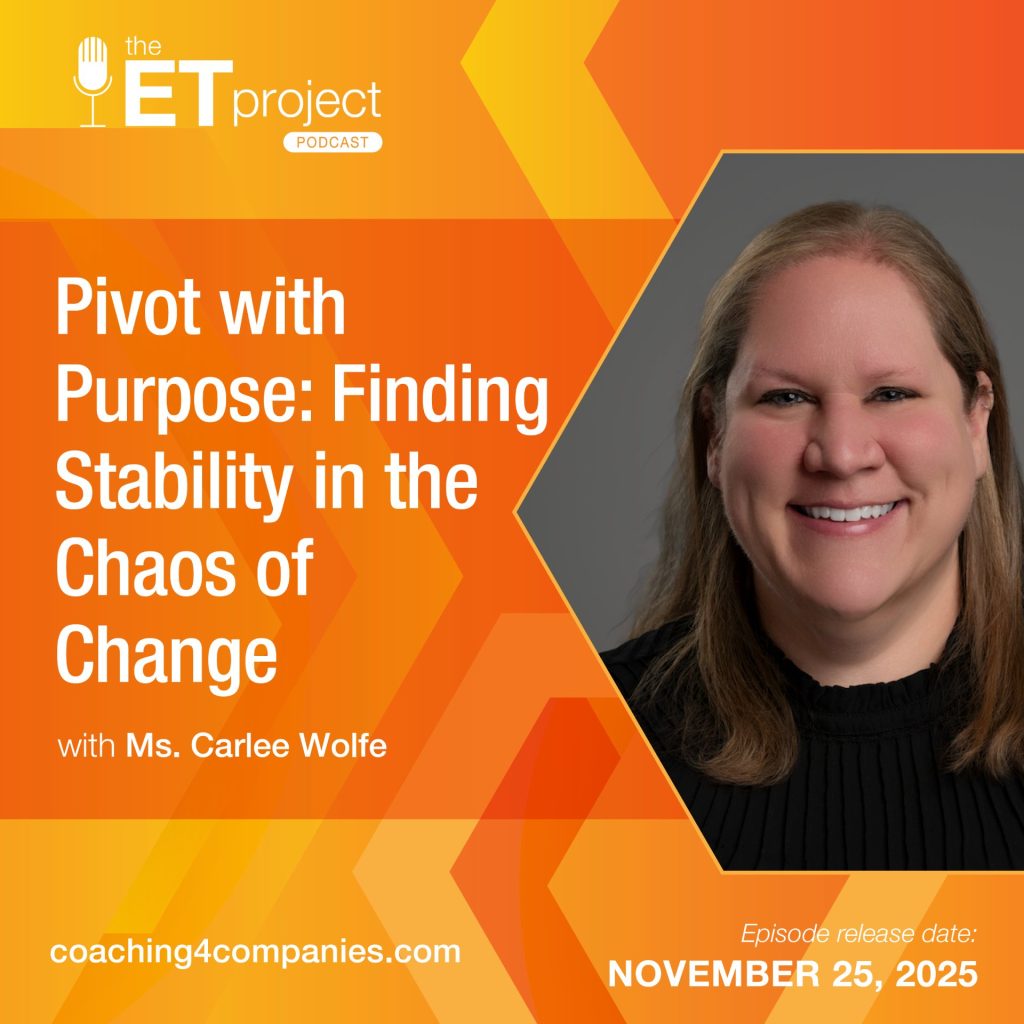
WAYNE BROWN: Hello, I’m your host, Wayne Brown, and welcome to the ET project. We’re delighted to be delivering this podcast for executive talent all over the world, whom we’re affectionately referring to as ‘Team ET.’ Today, we’re traveling to Baltimore and chatting with Carlee Wolfe, a multi-certified HR, Talent Management & Organization Development Executive. Carlee designs and implements strategies that close talent gaps, solve organizational issues, and enable leaders to deliver on their boldest ambitions for growth and transformation. While her job titles and industries have evolved, one theme has remained constant, she takes on newly created roles for mission-driven organizations, including Hyatt, Under Armour, and the U.S. Olympic and Paralympic Committees, where she builds clarity out of complexity and helps leadership teams thrive through change. This is a fascinating conversation in many ways, where we draw parallels between professionals in sport and the corporate world. We leverage multiple scenarios which apply to our approach in sport and ask, how might these be applied with my team in the office or the field? Team, as you know, I love a passionate guest who is proven in their field and delivering that experience and expertise to their clients, and that’s exactly what I found with Carlee. Tune in, and you’ll understand what I’m meaning.
INTRO: Welcome to the ET project, a podcast for those executive talents determined to release their true potential and create an impact. Join our veteran coach and mentor, Wayne Brown, as we unpack an exciting future together.
WAYNE BROWN: Hello team, welcome back to this week’s conversation. If you’ve ever had that sinking feeling that your job may not exist in the next two or three years, I’m sure there’s many of us out there that have had that, perhaps you’ve even found yourself looking for a new direction after a layoff, you know exactly how that forced career pivot feels like, one of the most stressful experiences a professional can face. Where do you begin? How do you compete? And how do you manage the fear and the uncertainty that comes with all that change? Our guest today has built a career on answering those exact questions, both in the corporate world, as well as on the playing field. So, in short, we’re going to be exploring the parallels, if you like, as well as the differences between the ways of professionals, both in sports and career, as people attempt to handle change, adversity, and everything that goes with this. So please welcome Carlee Wolfe. Carlee is a multi-certified HR and talent executive who helps organizations and individuals thrive through this transformation. So, Carlee, thrilled to have you on the ET project.
CARLEE WOLFE: I am so thrilled to be here. I was very excited for this conversation so thank you so much for having me.
WAYNE BROWN: Let’s jump in the deep end and look at your own parallels, both in sport and career, if you don’t mind.
CARLEE WOLFE: Sure. I mean, for me, I think the big parallels are kind of like the continued pursuit and learning and exploration and betterment. And I think that shows up as having curiosity, wanting to be connected with others, connected with mission and purpose. And so, when I think about it in sports, maybe it’s the pursuit of winning that match, or maybe it’s learning a skill. At work, it’s about doing well in a meeting, also learning a skill. In life, it’s making choices that we feel are fulfilling for us and also learning through that. And so just to kind of get us started on a few parallels, like for me, those are a few things that immediately come up, perhaps because those are things that I value. But there’s, as you said, there’s a ton of parallels.
WAYNE BROWN: Okay, excellent. And your workplace in the corporate world, are you still involved in the sports arena at all? I know you’re on Olympic and Paralympic committees at some stage, are you still involved?
CARLEE WOLFE: Yes. So, I work at Hyatt Hotels organization where I do leadership development and organizational effectiveness and am still in sports. So, there’s kind of two ways that I do that; one is that I work on the Paralympic side of sport or the adaptive side of sport, and specifically in volleyball, so sitting volleyball. And I always love to give a pause in this moment to say if people have not witnessed or been a part of sitting volleyball to pull up YouTube and check it out, it’s an amazing sport. I’m biased, I’m going to say to look up the Paris Paralympic Games, the gold medal women’s sitting team where U.S. won gold, so I will say to check that one out.
[00:05:00]
CARLEE WOLFE: But I support the pipeline program, so basically that’s where athletes come in either to be exposed to the sport, maybe they’re transitioning from another sport, or they’re getting in because they’ve played volleyball and they’re good enough where they’re kind of at this level where the national team is taking interest, we want to be able to build your skill to maybe then compete at that level. So, I’ll call that on my elite side of involvement with sport, but also live in Baltimore, Maryland in the United States, and I also work in my community in adaptive sport and work with youth. So, it can be any sport, it can be wheelchair basketball, pickleball, bocce ball, whatever, I show up in Gwen and Jerry, tell me what to do, I’m there to help. So that’s how I still am in sport today.
WAYNE BROWN: A career pivot can often be quite traumatic, but if we actually look at the word pivot, I find that’s quite an interesting definition, because in sport it often means that we’re changing direction, but we’re sort of keeping a central point, or we’re keeping one foot firmly planted on the ground, if you like. Is there a parallel in the corporate world, or when we talk about career pivots, that you can make with sport and how sport deals with the pivot?
CARLEE WOLFE: I love that analogy, and I’m going to steal it, which is the pivot, which is rooted in having some anchoring point, and you immediately put me into the sports gym of maybe leaning on my right side and literally sort of pivoting around my right foot as an example, but do I think that there’s, one, a connection with that, for sure. I think the concept of a pivot, what anchors you, if you will, that metaphorical right foot, are perhaps things that you value, experiences that you’ve had, passions that you have, it’s the foundation of what we’re entering maybe that next step with, which is then the literal pivot of where is the movement happening. And that’s where I think the exploration, the curiosity to wonder and to think about what’s next is amazing. And so, where is that? I think that that’s where, one, the metaphorical gym, but also the work part is, yes, there are things to anchor, but your anchoring shouldn’t prevent you from moving and getting to the next place. And the other maybe draw I’ll have in there is you can have a small pivot, which is, I’ll use basketball, maybe it’s just like a little pivot to kind of brush someone off, or it’s a big pivot to make a move or to take a shot. And what are those moves and shots that you want to make in your career or how you think about delivering work differently? And that’s how I kind of, I guess maybe as a way to think about it or where there’s some similarities
WAYNE BROWN: Yeah, I like that you mentioned values, and I think that that’s always very much at the heart of everybody. And if they understand their values, the pivot somehow materializes and becomes an easier transition. I don’t know if that’s your right definition or the right way to explain it, but you mentioned earlier that you’re not only involved in the top echelon of sport with the Olympics, Paralympics, the adaptive games, also at the local level, and the reason I say that is because you must be dealing with a lot of athletes, professionals who come into the sport after facing catastrophic events, for whatever word, they come into the adaptive sports probably later in life because of something has happened. Have you seen, maybe is a better way of saying it, a mental shift that has to take place for them to be able to make that pivot from life as it was, their normal life, to that catastrophic event? What’s the mental shift, if any, that you see that helps to redefine who they are and the path they’re going? The new path.
CARLEE WOLFE: Yeah. I love this question for two reasons; one, I think it gives an opportunity to talk about the sport and the diversity of athletes that are there and that, to your point, sometimes there are these events that occur and you’re forced into a pivot. And then perhaps there’s also just, you were born with something and you’re pivoting from another space in time, maybe it’s another sport, maybe it’s an elevation of where you are, these pivots show up in a lot of ways, but I think what’s profound, no matter what, is that shift in elite athletics is a huge amount of commitment, it’s a huge amount of drive, it’s a huge amount of wonderment.
[00:10:00]
WAYNE BROWN: Yeah
CARLEE WOLFE: And when I say wonderment, I mean you’re moving into a career, elite sports is, you’re highly concentrated, you’re in pursuit of a long-term goal that you’re actually actively working on every single day. And so, when you’re making that shift, I think it can be very… that in itself is a pivot, life as you know it is changing. Maybe you’re a student and you think about how to balance this training. Maybe you have a full-time job and you pivot to a part-time job because you want to be training. You have lots of friends and family at home and you need to move away to be dedicated to your training. And then the question that you asked me, which is also maybe one day I was going about my life and I had an accident and now I need to like reorient to my daily routines and how I move about in the world. And so, I think there’s a lot to be learned in this space, which is whether it’s, I’ll call it like a pivot that has been put upon you or a pivot that you’re moving on, how do you embrace that and how do you bring yourself into fully that next chapter? And so, I think what’s great with athletes is that sort of pursuit of excellence, it like really becomes about the goal; I want to be the best that I can in the sport, I want to win at Worlds, I want to win at the Paralympics. And that becomes the new purpose that then anchors maybe our anchor point or pivot to be able to make those changes. But I think what’s amazing about a lot of athletes’ stories in the space is the incredible amount of sacrifice that comes with the pursuit of those dreams. Like things that I couldn’t imagine. I think about, let’s just pull out two different sports like gymnastics, that’s something you start playing, you’re doing when you’re little, and you might actually retire when you’re in your twenties, right? But your whole beginning of being is dedicated to that. And so, imagine also pivoting out of, so there’s pivoting in and there’s pivoting out and both of those things I think come with an extreme amount of bravery, curiosity, drive to make those things happen.
WAYNE BROWN: And that’s the actual point because you know, the majority of athletes, their professional sports career is over mid-life and they have to adjust and pursue what most of us call ‘normal life.’ Back to the grind and back to the daily chore of doing things that are less exciting. So, I think there’s a lot of parallels there and pivoting, just listening to you talking about it, pivoting is something we do throughout our life, right? I mean, it is a sense of change. So, we’re all making some form of pivot.
CARLEE WOLFE: Yeah. And I was inspired about something you said earlier, you started the interview with this, which is kind of like the fear that can come with the pivot. And I think that that’s because sometimes we put part of our identity in what we’re doing and I think this is of a strong parallel at work, we have a part of our identity wrapped up in that. How do I want to show up? What am I doing? Everyone sits on a different degree of how much identity that takes in, but there is a part there, you commit a lot of time to work and so you take on that. And as an athlete and a lead athlete, you take on the identity of athlete. And so, in both cases, you’re committed to something, committed to a craft, committed to your contributions, to the people that you work with or perform with. And so, when that change comes up, whether it’s sport or at work, that could be a little scary because a part of you is shifting and your orientation in the world that shifts and so to regain that, we’ll call that like sort of solid ground again, it takes some time, but the in-between, it’s another phrase I love, like the in-between time can definitely be uncomfortable.
WAYNE BROWN: Right. I was thinking earlier about adaptive sports and you know, talent, if you look at your role in HR, you’re often, I’m sure looking for talent and looking how you bring that talent into the corporate world, but in adaptive sports, talent identification, it comes through a different space, I guess. It’s not that traditional background that we’re used to, it’s more about somebody’s potential and their adaptability into this new world, right? So, it’s into the pivot. If we try and make a parallel now back to the corporate, how can hiring managers, or even those seeking the job, think about that and apply that principle in their own case to finding talent or to becoming that talent, stepping outside that non-traditional sense, like how can people take that on board?
[00:15:00]
CARLEE WOLFE: I think this is such a good question because at this current moment there’s a lot happening in the world of work, AI is changing as we know it, how we get work done and what workplaces and workforce will look like. And so, I appreciate the question because I think one, there’s probably a lot of people wondering this, right? Like, how do I think about it? And two, there’s a core sense of, I’ll use the term like skills, because I think this sits with athletics and I think this sits at work that we can stem from in order to move forward. And so, on the sports side, you mentioned like adaptive sports, like the recruiting part of it. Yes, you’re recruiting from other sports, you’re recruiting, maybe you’re at a volleyball match, an indoor match, and you see an athlete playing with their sibling and you’re kind of recruiting from there or local rec programs, right? It’s not this huge, we’ll call it funnel that you might have in the indoor women’s game as an example. Same thing with like, let’s use a different sport, a lot of track athletes get identified and I’ll use the term pivot. Hopefully we won’t overuse it today, but like pivot over to bobsled because they have the system, the physicality to be able to move into that sport. And so, I guess on the work front of it, I go to what are those core skills that you’re really good at that can propel you moving forward, and so, if I go down this path of AI, where we’re either augmenting work or shifting work, the question might be, well, where does that leave me? And I think it’s twofold; one, how are you AI-curious and starting to learn AI skills and language and ways of thinking so that you can move into the pivot? But two, what are the things that you’re passionate about, that you’re good at, that you’ve done before, that can be that anchor for you that makes the pivot happen? And so, things like, if I think about, you know, I work, as you said in HR, I’m right now thinking about actually, for example, like recruiting talent, how do we do this differently? And so, I’m using my new skillset, my AI curiosity to think about, well, can we recruit people differently? How do we source differently? Are there AI tool sets to help us with that? But I’m staying anchor in my skillsets of understanding, okay, once we find someone, how do we interview against that? Are they going to be the fit in the organization? When I think about the role that I have opened to help us deliver, fill in the blank project, can this person both deliver about against it, but also continue to grow? I’m being very broad, but I’m trying to hopefully make an example of the things that we know can bring to the table, help us propel into also what’s new and to be flexible and to be fluid.
WAYNE BROWN: On the back of that, I read in preparation for our conversation, I was reading, I think it’s on LinkedIn, you make a statement, “15% of jobs on LinkedIn don’t even exist,” that was quite alarming to me, can you explain that a little?
CARLEE WOLFE: First of all, I’m so glad you opened this up to me because the number is wrong, it’s actually higher than it’s like 40% or more.
WAYNE BROWN: Ooh, okay.
CARLEE WOLFE: You thought 15% was bad. So yes, in that I actually, I had a… so thank you for giving me an opportunity to correct that. But essentially, so they’re called ‘ghost jobs.’ And so, it exists for a number of reasons, either companies have posted jobs that they’ve forgotten about. Maybe they’re posting jobs that they’re sourcing future needs for. The algorithms have posted something, the Apple employer’s website, maybe there’s a glitch in the background, there’s a number of reasons that feed this issue and I think it’s something very important for people to be aware of. One, for those of us that can help solve for it, how do we solve for this? We need to make progress because it’s really taxing and frustrating for people. And then also for those looking for jobs, like maybe this gives a little bit of a sigh of relief, which is, okay, one, now I know what pool I’m getting into, but two, it’s not me, like I talked to so many friends out there who are looking for jobs and they’re thinking, how am I not getting picked up at all? Well, when almost half of them aren’t even real jobs, like that’s tough.
WAYNE BROWN: Right. The parallel I was making when I read it is like I’m training for a race that gets canceled, right?
CARLEE WOLFE: Yeah.
WAYNE BROWN: I mean, how should a job seeker scout out and find the real gain then? Like where are the genuine opportunities? How do we find those?
CARLEE WOLFE: For sure. For sure. Whether it’s a ghost race because we went to go sign up for it and it doesn’t exist or we show up at the starting line that’s actually not there. I think, it’s in the career sense, how do we leverage our networks?
[00:20:00]
CARLEE WOLFE: I think this is one of those old-age networking, there’s a lot of power in networking. And by the way, I think networking is important for a number of reasons; one, we’re talking about one, which is it helps connect you to real jobs and real people, but two, I think just like you and I are doing today, there’s always something to learn, to share, to connect on. We’re in a space where that’s really important. The world of work is changing a lot, so the more we can learn together, I think is huge. So, networking could be one. Two, there are some validation mechanisms. So, for example, on LinkedIn, there’s like some verified job options. I think also doing research when you go to other sites, like in Indeed, for example, like when was the job posted, something that’s like extremely outdated, I would put a question mark next to that, would be a few things. And I think certainly visiting not just the career site, but is this available in other places? Sometimes if it’s just posted in one spot, that might mean it’s a false one. Now you and I are both smiling because I’m also thinking, gosh, this is still a lot of work for people. But you asked, you know, what’s the filtering, but to bring it back to the parallel, is it better to do a little check and not show up at the race when no one is there or to, you know, drive down to the full restart and have spent all that time on it. So, it’s a balance, it’s a balance for sure.
WAYNE BROWN: For sure. I mean, and the message to all job seekers, I would say, if you’re not doing a little bit of homework before you’re applying for the job, you’re really just mass-mailing for job opportunities, right? So, whatever you end up with is probably not going to be aligned with what you really want to do anyway. So, you need to do homework on the companies, on the job, et cetera, as Carlee said, you do a little bit of background work before you make the application.
CARLEE WOLFE: Yeah. I was thinking about, you know, we’re talking about sports and parallels and I think, you know, if I want to change sports, I should probably like at least watch a video clip and see what it’s all about before I start to go to train. And I’m with you, but also, I say that jokingly, but really, I agree with you, it comes down to intention. There’s power in intention, both in the upfront in what we’re trying to accomplish for ourselves, like we want to work in good places with jobs that we’re interested in, but also give us the best opportunity to show our best, and I think that that’s key.
WAYNE BROWN: One of the parallels I love between sport and working in a corporate or an entrepreneurial world is the fact that you’re in teams and when we look team sports, like volleyball, whether it’s volleyball or whether it’s rugby league or whatever team sport, quite often as the individual within the team, we have to be able to shift position, things happen and we have to change our cap, so to speak. As a professional, quite often people get hung up on that need in a corporate world environment within a team when they’re asked to reposition themselves or to refine their thinking, their tasks, how do you deal with that when it comes to supporting people when they talk with you about this challenge they’re facing?
CARLEE WOLFE: I think one of the biggest, I think conversations around this is having a clear sense of purpose and outcomes really come from that purpose, without clarity of where the team is going and whether they’re going together and what it looks like to achieve that together, I think it’s really hard to ask people to make changes, they’re reorienting their identity and their skills to accommodate when they don’t understand what that looks like. And so… this is a sport metaphor, one of my favorite examples, the Chicago Bulls in the ‘90s were very, very good. I’m originally from the Chicago area, I grew up during this time when they were amazing. And if you know anything about the Bulls at that time, outside of winning a bunch of championships, they had a head coach, Phil Jackson, that ran a non-traditional system and it was called ‘Triangle.’ And not that we have to like over-index on the methodology of this, but the point was, how are you passing often and moving the ball and it’s set up in a triangle and it’s very different, but it’s not about any individual player, but about the team and the outcome, shared outcome is let’s get points on the board so that we can win games so that we can win a championship and it was that sense of clarity that got them to that effective system to move the players like a Michael Jordan and a Scottie Pippen who in and of themselves are some of the best in the game to operate under team outcome versus an individual outcome. And if you just sat down and you said, “we’re going to do triangle and Michael Jordan, you got to give up a few shots” they’re going to be like, “well, why? Because Michael Jordan is going to make all the shots, this does nothing for us.”
[00:25:00]
WAYNE BROWN: Yeah.
CARLEE WOLFE: So, I think the same exists at work, if you think of your world as your Scottie Pippens and your Michael Jordans, what’s the shared outcome to take that best talent to deliver against what we’re trying to do together. And it sounds simple, but I think it is so often lost, where we’re moving quickly, maybe the purpose or outcome shifts, we don’t go back to kind of re-create or correct that, we don’t bring the team in to help co-create, there’s all these things that happen, but ultimately, starting with purpose and outcomes against purpose is…
WAYNE BROWN: I love that. In our business environment today with AI, it’s creating so much constant flux and the need for adaptability, that if we aren’t in that mindset or that ability to reframe how we see our game, we’re going to get left out. And quite often that’s when we do get asked to pack our box type thing. So, I think it’s extremely important that we look at it on the broader context than just as the individual, we have to see it as a game, as a team sport whether it’s in business or on the field, and be able to make that pivot. Another thing, another parallel, if you like, and I’ve got lots of these, so I apologize, but if you talk about sport, I know in my rugby league days, one of the things that I became or I came to enjoy the most was the studying of the game film, whether it’s your own game film, whether it’s your competitor’s game film, and we’re looking for areas of improvement, if we bring that into the corporate world, is there an equivalent that we can talk about from understanding, studying our performance, looking at how we can make improvement?
CARLEE WOLFE: Oh, for sure. And I think performance inside, outside, all of the above is all insight that we can gather to better ourselves. So, one is inside, certainly looking at team, back to clarity of purpose and outcomes, what are we trying to achieve and what are the things that are going to get us there? I think the next question is how do we measure it? So, if it’s not baskets, is it revenue, is it customer satisfaction? Is it new innovations? Like what are the things that we’re looking at and how are we tracking that? But back to the external part of it, or not back to, but to add the external part of it, I think it could literally be competitors. I think about, like I used to work at Under Armour and we talked… well, we didn’t actually talk about Nike, we said the other guys, but you had to look in the market to understand what’s happening, because you have to kind of play… you have to know what’s happening in the space. I think there’s also good competitive view, which is what can I also learn from other people, we’re in that right now. AI, I think people, everybody in every role in the industry should be looking at not just their competitors, but what’s just happening in general, right? It helps us stay informed, help us navigate to help make intentional decisions and back to your point, actually perform really well and continue to be the innovator in our own work. So yes, competitive market analysis we’ll call it maybe our stat sheet or a scouting report, what are those? That these are maybe sports term, but what is your variation of that as you think internally.
WAYNE BROWN: It’s a lot of fun, actually, I’m having fun making these parallels, so.
CARLEE WOLFE: I have all day, for sure.
WAYNE BROWN: I have another one Carlee, so, training. So, every sports person trains and they practice, they try and improve, they have a regiment or a regime of what they do. It’s never an absolutely black and white, there’s always some transition or shift that happens within the training that I’m doing, whether it’s because we’ve identified something that our competition might be doing, whether it’s because in this case, technology or even just our own circumstances, maybe we’re feeling exhausted or overstretched and we need to take more rest or whatever. How do you advise somebody in the corporate world for their own continued improvement and longevity, what does their training regime look like or needs to look like?
[00:30:00]
CARLEE WOLFE: Yeah. I’m going to use an old term that I was fortunate to come across, it was coined by a gentleman named Jim Lehrer, who was a tennis coach and a performance coach and he wrote a book and started a program and one of the phrases that they used in that program was the ‘corporate athlete.’ And so, you asked like, what can be people be doing at work? And maybe one of the ideas is to take… literally, what we’re talking about these like metaphors and parallels and say, how can I be my own corporate athlete? What are the things that I’m doing to take care of myself? Whether it’s learning new skillsets, whether it’s actually taking time during the day to stand up, to breathe, to eat. Do I have time outside of work to eat appropriately, to sleep, to rest, get to the gym? How am I showing up with others both in my life and at work? I think these are all really big questions that maybe as we look at the human experience, not just the, am I outputting a product at work? Because that’s what my job literally is, but how am I thinking about my total performance and levers that I can be pulling to bringing the best of myself to work and into life? So, I offer up that term because I think it’s a fun one in the conversation we’re having, I also think it invites a broader perspective other than just performance or the output that we do but the whole part of ourselves that is the human experience.
WAYNE BROWN: Right. I’m going to steal that by the way, so thank you.
CARLEE WOLFE: No, I’m still on it too, but that’s why I gave the name. So, yeah, I think it’s… keep it, for sure.
WAYNE BROWN: Well, if we expand that premise and you talk about holistic coaching, from a corporate world, the leader, the manager, the boss, how do they take on that role of a holistic coach? What does it mean, first of all, but how can we adopt the whole premise of looking at the individual more holistically and helping them to become everything that they could be type of thing?
CARLEE WOLFE: I think the coach is a very powerful and impactful position to be in because it’s an opportunity to really impact someone’s life in a positive way. One thing that we don’t really do for ourselves is to have our own mirrors around us or perspective, we are operating in the world in which we live in. And so, where the coach comes in is that the coach has perspective, a literal outside view of yourself. And where I think maybe it’s privilege and honor to be a coach, which is to be a part of someone’s life to have that experience and perspective and to offer up whether it’s those insights, questions, reflective moments, for someone to really have a moment of learning, to be able to better themselves, what an amazing gift that we can offer. And I want to share something because I’ve personally been wrestling with this, we’ve been talking about it at work, I think a lot of people have also been thinking about this in themselves, which is, you have something like AI, which in one way you could say could supplement coaching, right? I can work with an AI coach.
WAYNE BROWN: Yeah
CARLEE WOLFE: I think one thing that AI can’t do that the human offers up is the perspective in which I’m referencing right now, right? Like I can, if I’m with you at work, I can experience you, I can see you, how you connect with others, how you think about things, where you struggle, it’s an observation, that connection, and so that to me is where the coaching comes in. And I think it’s the same thing in sport, to be on the sidelines, to be able to see a team moving, to be able to see an individual perform, to have the insight to offer up perspective to make somebody better I think is immensely powerful. And so, whereas coaching, I think I’d offer up maybe that perspective and the honor of having that perspective for somebody else to grow and what you can do to support whoever it is, whether it’s on the gym or in the office to be able to be successful.
WAYNE BROWN: I think it’s very powerful. There’s also another aspect here and not everything goes according to plan, right?
CARLEE WOLFE: Never.
WAYNE BROWN: So, we all face setback, we all face loss, failure, whether it’s in sport, whether it’s in your career, how can leaders in business create that environment where the pivot, coming back to our core word, is taken on board as a positive rather than that negative for a failed outcome. Is the leader able to make that transition for the team or does the team have to find it within themselves or is it a hybrid of some form?
[00:35:00]
CARLEE WOLFE: Yeah, I think it’s all of the above. I think the foundation is the culture of the team, how is that group building a learning culture? How are they celebrating the wins, the learning moments, the trips, if you will, how are you having that open conversation of experimentation and the power of experimentation? So, we start with culture. And then I do think it is both the team and the leader because I think everybody plays a role. I think the manager, the leader has a very interesting role to play, which is that you can easily squash or shift the culture by, one, are you following through with the commitments? Are you doing what everyone on the team said that they would do? Are you holding people accountable and rewarding for the things that we’ve said are important? Are you yourself walking the talk? So, the leader can both facilitate and amplify, but they can also very easily quiet and snuff out energy around learning in these moments to be able to make a pivot. And then it’s also on the power of the team, which is I don’t always have to have a leader or manager telling us what to do or how to do it. But that through our culture of being empowered and to move forward as a group, that I’m also actively participating in that. So, I think these are a few layers, it’s not maybe a linear answer, but a complex answer. And so, it’s a mix of culture, team, leader, and the intersection of when those things come together, because I also think in a non-perfect world, which includes the question you’re asking, some days we’re our best selves and some days we’re not. And so, one of these things might be out of flux, team, leader, culture, but how are you paying attention to that so that you can be intentional about still moving as a unit to succeed? And I think that’s the same with sport. And I think that those are… one thing that we do on sport that maybe we could bring into the work is things like huddles and high fives and laughing over something silly that happens, being able to use that little break in between. One thing I love about volleyball, if people watch the sport is, at least… well, in both men’s and women’s game, after a point, both teams often come together at the middle of the court, obviously on opposing sides, but it’s usually about like, “Hey, get the next point” or “nice job,” there’s a moment in between, point one or lost about what’s next. How can we incorporate some of that at work to continue to facilitate and build that culture so that team comes together to deliver as one, one great innovative, executing team.
WAYNE BROWN: So many rabbit holes from your answer there, but surely, you’re not suggesting we have fun at work, come on.
CARLEE WOLFE: I know, why wouldn’t we do that? Why wouldn’t we laugh or smile or high-five? I mean, what are we talking about here? What a wild time!?
WAYNE BROWN: Come on, come on, we’re going to be wearing shoulder pads to work next time.
CARLEE WOLFE: Well, maybe we should like, “Hey, we’re going into a tough project. Everyone put their helmets on, let’s just make this happen.”
WAYNE BROWN: I have a vision of the leader standing at the door as the team is entering with mouth guards. But what I know you talk a lot about is community programs and this term of equity engines, how does the career opportunity fit into that? Like what is an equity engine that you’re talking about in the first instance, and then how do we bring that into the corporate space?
CARLEE WOLFE: Love it. I’m so fortunate to live in a city that is really about community, it’s about connection. There’s a term here of Baltimore, ‘Taking Care of Baltimore’ and I think that that’s about understanding both what makes the city great and where does it struggle and how do we lean into both? And so, when I talk about equity engine, it’s really about the celebration of all the differences, of all the greatness, of all the opportunities, maybe I’ll use a work term there and having progress together. And it’s not about this one neighborhood is better than the other or this job or this sport or fill in the blank, it’s a collective sense of us and when you talk about us or we, I should say, there’s a connectivity to that, it’s a lifting up of others and so that’s why I talk about community because I think community is about connection, about seeing, about supporting and with that we’re creating equity versus inequity, right?
[00:40:00]
CARLEE WOLFE: Us versus them or better than or can do, can’t do. And so, I think that spirit of community and connection, the Baltimore serving Baltimore, how is our workplace serving workplace? How are we in it together and lifting one another up? I see someone that’s like struggling with a new skill, how can I help them out? I see someone else who is just having a tough day, how do I maybe take some of the workload off? Back to our joke, someone did a great job, I give them a high five because we want to celebrate good things. Company taking care of company, build a sense of ownership, belonging, collective action, which I think really delivers, in that case it’s about results, I think community is about… results in sense of purpose, connection, relationships, and it all flows. I think there’s a lot to learn from our communities and the power of community that could be brought into work more for sure.
WAYNE BROWN: I was thinking often the infrastructure for supporting people with disabilities is not right within communities.
CARLEE WOLFE: Oh, yeah
WAYNE BROWN: Inside a corporate environment I see many challenges as well for people that have disabilities, is there something that the company heads, but you as the leader can also be doing that makes those situations less challenging for people with disability?
CARLEE WOLFE: Yeah, I love that. And also thank you for bringing that up, it goes back to the community equity engine, I think this also sits there. Like I think about access to sport, the small things that our communities are doing, like think about a playground, are people entering the playground through a step or through a ramp? What slide do you have? Are the community programs offering adaptive sports that everybody can play? Adaptive sports isn’t exclusive to only athletes with disabilities, right? These are things that… or perhaps like stereotypes that we’ve built up on our own experiences or just haven’t experienced, to speak differently. So, I draw that to what you’re asking about with the work, which is building that culture around one, understanding that everyone brings their self, which includes their orientation in the world, the needs that they might have, the specialties that they’re bringing. And so, how do you celebrate that on a regular basis? And I think it goes back to, and perhaps does it bow on the team aspect, right? How is player A or colleague A, their skillsets being appreciated in the project that we’re delivering. And so, when it comes to, we’re talking specifically about disability at work, I think it’s also the question of like, what can get in the way? So, whether it’s a disability or I’ve had a tough day, the range of that are all human experiences, but how are we recognizing, creating the space for that, recognizing it and doing something about it to help one another out? Or if we’re in positions where we can make system change, whether it’s policies, whether it’s programming, fill in the blank, we all have a role to play in that.
WAYNE BROWN: And whether it’s mental or physical, we hear a lot more today about mental health issues, which is a great thing.
CARLEE WOLFE: Yes
WAYNE BROWN: But I’m also cautious that it runs parallel, not substitutes awareness about physical challenges that people face as well. I think we still have so much more that we can do and grow into our awareness and our understanding around this as a whole, whether that’s community, whether that’s corporate, whether that’s even sports. And so, there’s still a lot more we can do. Where can people find out more about your involvement if you want them to? And what’s something that our audience, the listener, the leader, whether they’re in community, whether it’s corporate, whether it’s in sport, what’s something that they can do today after listening to our conversation that’s going to make a difference to the people they lead, but also in their life, and I know that’s a very broad question.
CARLEE WOLFE: No, good. I think so. First of all, I am very happy to connect with people and continue the conversation. The best place to find me is on LinkedIn, I have one, you can follow me, I’m regularly posting, but two, if you’re open to connecting, have conversation, I am open to those, so that’s always a place to visit.
[00:45:00]
CARLEE WOLFE: Maybe something to leave with is I’ll use the term curiosity, I think we’ve maybe sprinkled that throughout today, but I’m going to triple underscore that because I think it really wraps around everything we’ve talked about. How are you staying curious in your pivot? How are you staying curious about other people to build inclusive culture? How are you curious about what’s possible in your career and where you’re headed? How are you curious about your neighbor and building relationship, which extends into community? And maybe also curious about what you’re fearful about and curious about what is possible in your life and at work. The more we can stay open and curious, I think the possibilities continue to evolve, the more we can learn and the more that we can improve. And I welcome the opportunity to leave people with that word because I hope it inspires because it’s something that’s simple that we can start our days with or end our days with, but the power of curiosity I think really keeps us moving forward.
WAYNE BROWN: All the best for you and thank you for being on the ET project.
CARLEE WOLFE: Thank you so much for having me. I really, really appreciate it and I enjoyed and will continue to follow this conversation and I appreciate being a part of it.
OUTRO: Thank you for joining us on the ET project, a show for executive talent development, until next time, check out our site for free videos, eBooks, webinars, and blogs at ‘coaching4companies.com.’
[END OF TRANSCRIPT]