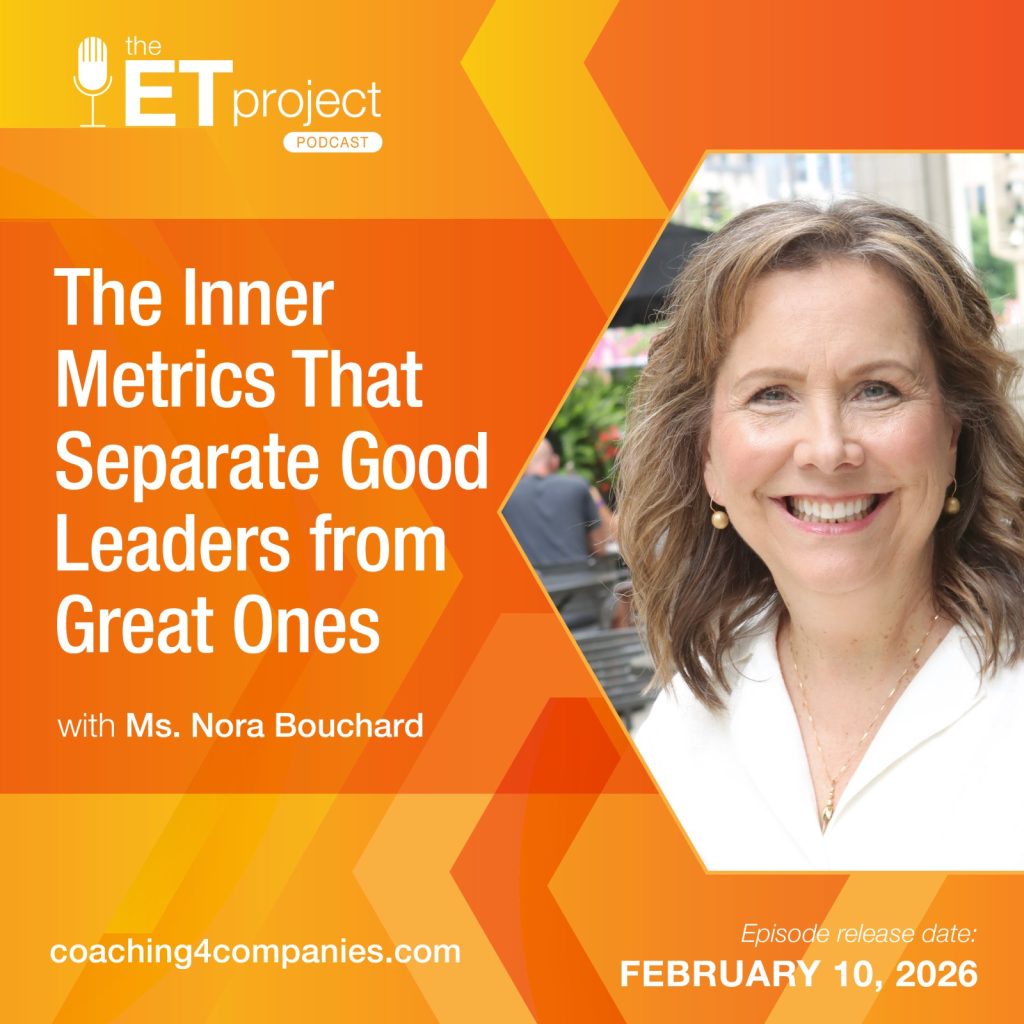
WAYNE BROWN: Hello, I’m your host, Wayne Brown, and welcome to the ET project. We’re delighted to be delivering this podcast for executive talent all over the world, whom we’re affectionately referring to as ‘Team ET.’ Today, we’re flying into Rockford, Michigan in the USA and reviewing a new book from our guest, Nora Bouchard. As a master level coach, Nora is highly skilled in creating opportunities for C-suite and other senior executives to discover personal solutions to their leadership challenges. Nora enables emerging leaders to be more effective as they transition from doing to leading. She begins by creating trust with each leader through an easy-going, comfortable dialogue, ensuring coaching goals are in alignment with the organization’s direction. She works with the leaders to create new mindsets and behavior change necessary to achieve those goals. To ensure sustainable long-term progress for the individual and the organization, Nora capitalizes on the leader’s innate strengths, personal values, and personal commitment to success. M. Nora Bouchard, as you will often read about, is an accomplished executive coach with more than 25 years’ experience. For over 15 years, she has coached both technology executives determined to enhance their existing capabilities as well as eager to learn from emerging leaders. Nora inspires clients to shift their perspectives to see options for action that have been hiding in plain sight. Rather than targeting what’s wrong, Nora capitalizes on the strengths and innate motivations of the executive. Adept at meeting and training facilitation, Nora holds an MA in instructional design. Having designed, developed, and delivered training with a global consulting firm, Nora creates powerful, interactive, and customized learning opportunities. Today, we speak specifically to Nora’s latest book, which is due for release in the coming month; it’s titled ‘Hidden Metrics: The Coach’s Secret to Success That Really Matters.’ And you’ll hear us unpack a number of the key 15 leadership shifts discussed at length in this book and find out some of the ways that you can start to immediately make a stronger impact yourself as a leader. Team, this is another great conversation that will help us all sharpen our abilities with practical tips and actions. So, let’s dive in.
INTRO: Welcome to the ET project, a podcast for those executive talents determined to release their true potential and create an impact. Join our veteran coach and mentor, Wayne Brown, as we unpack an exciting future together.
WAYNE BROWN: Hello, team. Welcome back to this week’s conversation. Today, this topic is fairly much one that I’m confident most of you will have personal experience with, given that our audience is predominantly leaders. And it’s about being promoted into leadership and feeling like you’re wearing a costume or a mask and trying to meet everyone’s expectations except your own. It sounds familiar, right? If so, stay tuned. Much of leadership is measured by what’s visible, right? Results, outputs, approval levels, but what about the inner metrics, that quiet gauge of authenticity, alignments, emotions that determine whether you’re leading with clarity or heading down the path of burnout? So today we’re going to explore how leaders can stay grounded and effective by defining what my guest calls hidden metrics. So, joining me is master executive coach and author of a soon-to-be-released book, ‘Hidden Metrics,’ Nora Bouchard. Nora, welcome to the ET project. It’s great to have the opportunity to connect.
NORA BOUCHARD: Hey, thank you, Wayne. I’m so happy to be here. I think it’s going to be a great conversation.
WAYNE BROWN: I’m looking forward to it. I’ve had the pleasure of pre-reading some of the book, and it really is so on point, I have to say. But we’ll get into that, we’ll get into that as we go. But you’ve been coaching leaders for more than 25 years.
NORA BOUCHARD: Yes.
WAYNE BROWN: I’m curious, what first drew you to this work of helping people transition from doing to actually leading?
NORA BOUCHARD: I’m actually a big believer that coaching should be showing up at all levels of the organization, and unfortunately, it’s usually kept to the C-suite or senior leaders. And I did have an opportunity, gosh, maybe about 15 years ago now, to work with a group of new emerging leaders and to help them establish their leadership philosophy, their habits, their visions for themselves early on in their careers.
[00:05:00]
NORA BOUCHARD: And those people have gone on to do amazing things. And so, I just loved how they wanted to soak up everything. I loved how they were willing to let go of the old behaviors or habits that they had, the old way of doing things; they were so open to trying the new stuff. And so sometimes it’s hard, there’s a challenge at times in working with senior leaders because they have done it their way often for decades.
WAYNE BROWN: Yeah.
NORA BOUCHARD: And getting them to take even a little step to letting go of that is always hard.
WAYNE BROWN: It is.
NORA BOUCHARD: So, for me, it was just, wow, this is wild, I love the energy, I love how people react to it.
WAYNE BROWN: Yeah. Is there a philosophy that has come out of this that you see of what really makes an effective and fulfilled leader?
NORA BOUCHARD: Yeah, there is definitely. I think that the people who early on recognized that things have changed and that they haven’t just changed because they’ve gotten a new title, although that’s a big part of it, but that how they relate to themselves, their relationship to others, their relationship to work, all of that has shifted. And so… oh, I’m sorry, I think I froze there for a second. I’m back, okay, good. So, the philosophy comes from working with people to help them understand that change is actually a good thing, it’s a natural thing, and if you hang on too tight to what was, you’re not going to find that success. And that’s when people start feeling it, even small steps forward, the energy starts ramping up, and they feel more confident. You could just let them go, they go of,f and they need to do.
WAYNE BROWN: I don’t want to delay our conversation too much. I want to get into the book because there’s so much in the small amount of the book that I did read that I would like to unpack, but I’m not going to destroy the book for everyone else because you’ve got to get out there and buy it. But we are going to touch on several of the key items or the key topics that are covered. Again, the book is called ‘Hidden Metrics: The Coach’s Secret to Success That Really Matters.’ So, a natural question was, was there a pivotal moment or something happening within a client environment that really made you say, hey, I need to write this book?
NORA BOUCHARD: Well, yes, there were two instances. One actually had to do with me and my experience early on in my career, and the other came along just about maybe a year and a half ago with an actual client of mine. But the first experience was when I was working for a Big Six accounting firm at the time, global in nature. I was just out of grad school, I thought it was hot stuff, I had a team of people working for me, I thought I was great. And yes, I admit to my age, I wore shoulder pads and had the big hair and the whole thing, it was a period of time for me where my confidence really was not warranted. I was actually a toxic leader. I was too demanding, I expected the highest of standards at all times, I was rude, I yelled, I insulted, I was like your worst nightmare of a leader, and I lucked out because I had the best boss ever. And somebody finally complained about me, finally complained about me, and so I got called into his office, and I sat down waiting to be lectured. And all this man did, and he really wasn’t even paying attention that much to me, he was fiddling with something on his desk, and he just kind of asked, “What are you afraid of, Nora?” And in that moment, I actually stopped myself. I didn’t let that uber-confident persona come out and say, “I’m not afraid of anything.”
[00:10:00]
NORA BOUCHARD: I actually stopped myself, and I thought, and I realized that my fear was driving my behavior and that there really was no reason for me to do this, to behave this way, because there was no reason for me to be afraid. And so, I actually began working on my first hidden metric at that time. I didn’t tell anyone I was working to be a better leader. I didn’t tell him, I didn’t tell my team, I just kept it to myself, and I started thinking about what was important to me as a leader. What did I want to be known for? How did I want my team to view me and our work together? And so that was my first hidden goal. And I was actually flying off to Australia, your home stomping grounds, very shortly after that meeting with my boss. So, I had plenty of time on the flight to just sit down and really think. And over the years, I have learned to manage my fear, to notice it, and to deal with it. And so now, when I tell this story, a lot of people are, “That’s not you, that never really happened.” And then I started working with a client, like I said, about a year and a half ago, and I started realizing it wasn’t that she was toxic; she had other goals that she wanted to achieve, but she didn’t tell other people that she was working on these things. And it occurred to me that when I look back at all the clients that I’ve worked with over the years, there are more important goals that we work on than the ones that have been given to us by our bosses, by our superiors, by our companies, and hers was very different from mine. But again, she was not all that interested in sharing that information. So, we spent time really breaking it down. What does this look like? How do we move forward with it? What are the values that you want to see that you want to make sure you bring into your environment? And what are the strengths that we can tap into? So that’s where it kind of came about. Long story, but it was eye-opening for me way back, Wayne. It still applies.
WAYNE BROWN: Yeah. I wonder how the person who said something to your boss felt validated, perhaps, about taking that step, and what that learning was for their career. So, I can only imagine it was very powerful to see that they used courage, they took a step forward, they did something they believed in, and the outcome was so powerful. So, kudos to them.
NORA BOUCHARD: Yes. I’m actually very grateful to that person.
WAYNE BROWN: Exactly. And then the second thing I remember when we first spoke, you mentioned, you quoted, I think it was something like, “use work to identify your life’s goals.”
NORA BOUCHARD: I consider work really life school. We spend a lot of time going through school and then college and maybe advanced degrees, we do all of that, but really, work is where we work on ourselves. And almost every day there’s an opportunity for you to learn something about yourself, and that certainly was the situation for me, and it has been for all of my clients as well. So, I consider that life school.
WAYNE BROWN: Yeah, I love that, I’m stealing it by the way, so thank you.
NORA BOUCHARD: It’s fine with me, I stole it from somebody myself, so.
WAYNE BROWN: Let’s start with the end in mind. When is the book released?
NORA BOUCHARD: So, we’re looking at mid-February. We’re doing pre-sales through my landing page right now, and that is www.hidden-metrics.com. Hidden-metrics.com.
WAYNE BROWN: I signed up for it today.
NORA BOUCHARD: You signed up already?
WAYNE BROWN: So, you have your first sale, maybe. What’s something, you know, when the readers get to the last page, what do you hope that, at least one feeling or action that they take away from reading the book?
[00:15:00]
NORA BOUCHARD: Oh, a deep satisfaction that they know what their path is, or at least the beginning of a path for themselves. Hopefully, they’ve felt a sense of growth themselves and feel that satisfaction that, hey, yeah, I’m doing the right things, I’m in the right place, I’m asking the right questions, I’m taking on the right challenges and feeling that sense of satisfaction that comes from it.
WAYNE BROWN: I would like to have our core discussion or theme around how ‘Hidden Metrics’ help leaders stay authentic and aligned. And I know in your own words, to some extent, you talk about this alignment. Why is alignment between a leader’s internal compass and their external role so critical? And why do you think it’s so often missing?
NORA BOUCHARD: I’ll tell you, I think the reason why it’s most often missing first, and that is that when we’re moved into this new role, there’s a lot of unknowns. And so, we latch onto people who seem to know, and we follow their path or their example. And 99 times out of 100, that’s not going to work for a person, because every person has to find their own path, everybody does. And that’s part of what I enjoy doing, is helping, whether it’s somebody reading the book or one of my clients, to actually envisioning what their leadership is supposed to be about, what their legacy is going to be, what’s the meaning behind your role. And making sure that that is clear makes it easier for your team to understand you, for you to interact authentically with your new peer group, for you to be real and genuine with your boss, for you to be fearless in working with senior leadership; that all comes from understanding what your core sense of meaning is all about.
WAYNE BROWN: Is that how you define a hidden metric? Or do you have a succinct definition, may not be the right word, but do you have a succinct meaning to that term, hidden metric?
NORA BOUCHARD: Yeah, you know, and I think we talked about the idea of purpose. Purpose is a word that’s used a lot, but to me, that’s almost too heavy. It’s too limiting almost, because people, I think, are afraid of that word. I think what is meaningful is easier for us to figure out what would give us a sense of loss if we didn’t have it in our lives. What would make us feel satisfied when we’re retired and sitting in our luxurious condo on the beach somewhere, thinking about our careers, what would bring that real satisfaction, that belief that you did something good for this world or for the people that you worked with? It’s not going to be whatever it was you achieved last quarter; that is not going to be what you remember.
WAYNE BROWN: Is there a common symptom that you see in leaders who typically are measuring that external KPI? Let’s say, like you mentioned, versus their hidden metrics? If I’m a leader with a team, how can I gauge that they’re really all about the superficial external versus understanding myself? What would I see?
NORA BOUCHARD: Well, somebody who is more focused on the external, those metrics that are more traditional, and you alluded to them in your opening remarks, these are the things that are easy to measure. This is the performance, the KPIs, the satisfaction readings, those kinds of things. And as a leader, those externally focused leaders are going to be focused on making sure they hit those things. And so, typically, there’s a nugget of fear driving them to that, whereas if you’re working from an internal hidden metric that is grounded in what’s meaningful for you, it’s not about fear, it’s about this, you’re compelled to do this because it’s what brings meaning to you in life school. And it’s inspiring and it’s driving and it’s what makes you feel good at the end of every day.
[00:20:00]
WAYNE BROWN: Right. Reading your LinkedIn posts, I saw last year sometime that you were at a workshop or a conference, and Martin Seligman, who happens to be one of my adopted mentors, was speaking. And to your point, those people quite often, the external metrics people, quite often tend to be the narcissistic, even the psychotic, sometimes leaders that we end up with, you mentioned yourself. I also went through that phase early in my career, I was a very toxic leader because of that focus on the external.
NORA BOUCHARD: Right. And I think that’s very true, and I think sometimes people just don’t know better, they don’t give themselves permission to go ahead and create what they want as part of this new role. And they think their entire reason for taking on this role is to achieve all these other goals, and that is not the point; that is not what is going to keep you or even elevate you to a level of success, you’re still just going to be doing somebody else’s water-carrying.
WAYNE BROWN: That’s such an important message, and I’m hoping all the leaders that are listening that are yelling, “No! We have to hit our targets,” yes, we have to hit our targets, but we have to do it in a way where we as individuals can survive. The burnout, the isolation, the anxiety that comes along with just being that external KPI achiever is so evident all around the world. At the moment, we have epidemic, pandemic levels of mental illness in leaders, and I venture to say a lot of it is because of that factor. I’m not a medical person, so don’t follow me to that, but just at a very high level, I’m sure there’s a contributing factor there.
NORA BOUCHARD: Yes, I agree.
WAYNE BROWN: In the book, chapter two, which is the chapter that I’ve read, thank you. But in the book you introduce 15 shifts that leaders must make to start to really embody, I guess, or understand these hidden metrics. And we start to see patterns, we start to see what’s the most universal struggles we’re having, so to speak. When you got promoted, was there something that jumped out at you that you were blindsided by that you didn’t realize?
NORA BOUCHARD: Yeah. Actually, that’s a really good question. Yes, I was very excited about being promoted. The ENTJ, for those of you who follow Myers-Briggs, that’s kind of like the field marshal, so I can get real bossy at times. And depending on the work environment, that might actually be something that is really valued. And recognizing that that is only appropriate in certain situations, for me, that was a huge shift, a huge shift. The first shift that I had to make was to move away from my old vision of myself to a new one. And that, I think, is the most common that people have to deal with when they’re promoted, regardless of the level. Even if they’re going from director to VP, or VP to president, or president to the C-suite, everyone has to shift how they see themselves and their relationship to themselves and their leadership.
[00:25:00]
WAYNE BROWN: Right. I’ve chosen three of the 15 shifts. The way it’s laid out is so beautiful and I really struggled to pick just three, and I 100% agree with all 15. But the first one I’ve chosen is motivation, so shifting from being a motivator to somebody who inspires. Why is that distinction so important and powerful for a new leader?
NORA BOUCHARD: Well, the way I define the difference between motivation and inspiration is that motivation is external, it’s like we’re pushing someone to do something, inspiration is… just even the root of the word is about breathing in, it’s about something that’s internal that is driving you forward. So, when you move into a leadership position and you’re accustomed, especially if you’ve been a leader of people or a leader of projects instead of people, I hope I’m not stealing your thunder on one of these, but especially when you’re moving from leading projects to leading people, that shift is really important, that it’s not about telling people what to do anymore, it is truly about figuring out what inspires that person, what gets them up in the morning, what brings them to work, what keeps them there, what makes a great day for them, when are they most satisfied. And when you understand that about your people, it’s easy-peasy to inspire them.
WAYNE BROWN: How do we go about finding that out? Do you use certain tools in your coaching, or how do we identify what inspires rather than how to motivate?
NORA BOUCHARD: There are two activities that I rely on pretty heavily; one is called a peak experience. And the peak experience is simply asking you to tell me a story about a peak time in your life when things were going so great, and you felt like you were successful. What is going on? And as I listen to you tell me that story and embellishing it with the emotions of that time and the actions of that time and the people you were working with, as I’m listening, I’m listening for clues. Oh, he likes working alone. Oh, he likes working with a team. Oh, he likes communicating like this. I pick up on those things as a leader. The other is I love the Strengths Profile, which is… are you familiar with Cappfinity? It’s a European tool.
WAYNE BROWN: Yes.
NORA BOUCHARD: Or it’s out of the UK. I love it. There are lots of really good strength tools out there. I particularly love this one, and just a heads up, they’re going to be changing their name soon. So, I’m not going to steal their thunder on that, but if you look up strengthsprofile.com, it will take you there. And their definition of strength is something that really resonates for me; it’s something you do well that energizes you. And so, if you’re doing things that energize you, you’re going to want to come back and do more of it over and over and over again, and it’s just going to be the energy, the fuel for your future.
WAYNE BROWN: Yeah, that’s beautiful. Actually, I, as a coach myself, I use your example where we ask people to think back over their careers in particular and identify three occasions and then describe those three occasions. And we’re looking for the strengths, right? And so, we’re looking for that profile that starts to emerge and help them to be able to see that and build on it from there. I very much like that one, so I’m ticking one box for myself, well done, Wayne.
NORA BOUCHARD: Well done! Well done! Good on you.
WAYNE BROWN: Very good. Is there another tool as well?
NORA BOUCHARD: Well, in the US, the one that is the most popular is the CliftonStrengths, which has had a number of name changes, too, but CliftonStrengths is good as well. I’m a big fan of the Strengths Profile. I love the four-quadrant model that they have, and I think the way they roll it out makes it easier for you to understand how to use these strengths. Oh, and the other thing that they do is they actually use the word weakness. And so, I do believe we all have weaknesses, I don’t shy away from that word, we should know what they ar,e and we should know how to deal with them, and that’s one of the things that the Strengths Profile helps you with.
WAYNE BROWN: It’s the age-old debate, right? Whether we should focus only on our strengths and build on them or whether we should work on the weaknesses. Do you sit on the bench…
[00:30:00]
NORA BOUCHARD: Yes, don’t work on the weaknesses, know what they are so that you’re not building them into your job, but know what they are, but do not spend any time on them, a complete and total utter waste of time. The most you will be able to do is maybe improve your performance in those areas by a small percentage. You might be able to tap into some other strengths that might help you do better there, but it’s better to find someone else to help you with them, to delegate those kinds of things, to get them off your plate so that you can do what you’re really good at, what you’re put on this earth to do.
WAYNE BROWN: How does clarifying what inspires you and your team become a foundational metric for leadership?
NORA BOUCHARD: The way I work this, the way the magic combination or the equation that I like to use is we begin with this vision of what it is you want your leadership to be, what you want from your team, and you spend time really thinking about what that is and declaring it, making it a powerful declaration. And then we take a look at the values, the things that really are sometimes aspirational. For me, I wanted to be a better leader. I had aspirational values that I was going to be implementing, but there are other kinds of values, things that act as guideposts. In the book, I write about Senator John McCain here in the US, who had been a prisoner of war during the Vietnam era for years. He was tortured and beaten, and he was encouraged. He was given the first chance to go home and he said, no, he wasn’t going to do it. He was given a second chance to go home and he said he wasn’t going to do it because he knew other men had been there longer than him. He had some really strong values that kept him on his straight and narrow, on his vision, towards his vision for what he was as a leader. And then we have this whole idea of strengths, I see it, it’s like the vision is your destination and the values are the signposts and the fuel for your vehicle is your strengths because that’s what keeps you energized going forward.
WAYNE BROWN: Right, a great mindset. All right, the second shift and this one is very topical right at the moment with many of our points and it’s shifting from clarity to being comfortable with ambiguity, so clarity to ambiguity. For many of our clients, the mere mention of ambiguity induces some sort of anxiety. So, how can leaders embrace this? Very interesting, I’ve just spoken with another podcast guest on this topic as well, so it’s very present in our world at the moment. How can we embrace it and make it a non-negotiable?
NORA BOUCHARD: Yeah, life is way too complex and if you think it is black and white, you will struggle as a leader because it is not. Human beings alone are complex and then you put human beings in a work environment, it’s a wonder we get anything done, actually, given how complex things are. When I’m working with my clients on this, oftentimes they’re struggling to make a decision and it’s usually because they don’t have all the information yet, but they want to make that decision, they want to move forward, they feel compelled like they have to do it for whatever reason, but oftentimes it’s because they don’t have a clear picture of the whole. And so, ambiguity requires patience, we have to slow ourselves down and we have to believe and understand and it’s easier to do when you have experience that the answers will come, they do come, but we have to give ourselves time to make that happen.
[00:35:00]
WAYNE BROWN: Yeah, the third shift and we’ve sort of talked around this third one, but it’s shifting from pleasing to positive results. So, from being a pleaser, a leader who just wants to please everybody to actually looking at how do we generate these positive results, can you talk to that?
NORA BOUCHARD: Yeah, and we have been kind of talking around that, this idea that I want to please my boss, I want to achieve the goals that he has set for me or that she has set for me and I want… that’s how I’m going to get recognition. But that’s not, I mean, on one level, yes, that is what your superiors are looking for. And on another level, they’re really looking for you to bring all of yourself, your wisdom, your experience, your insights, your creativity to work, to the situation, to the challenges and to use it in such a way where you’re anticipating, you’re being innovative, you’re being supportive and brilliant, all of those things come when we’re being ourselves and not just worried about pleasing everybody else.
WAYNE BROWN: You spoke earlier yourself about moving, first of all, being aware and then being able to move progressively, I guess, as a leader. I’m guessing many points along that journey where you said, “oh, this is too hard” and “I want to go back to my comfort level.” Or was it so clear that you said, “I have to do this, whatever the cost?”
NORA BOUCHARD: For me, it was so crystal clear, I did want this, and I still admired my boss. He’s passed now, but he still inspires me all the time. He was a gentle giant of a man, laughing and embracing every day, and I wanted to be more like him. So, for me, it was much easier; for others, it’s a bit more difficult. I’m thinking about all the stories. I think I have at least 20 clients mentioned in the book, but I think about one client who was… he was really smart, he was really good, he had an incredibly smart team, but he was two hands-on, and it was hard for him to let go of that. But his team was desperate; they wanted him to stop interfering, they wanted him to stop coming to the team meetings, they wanted their chance to make decisions. So, for him, it took a while, but he got there. And we got there through a lot of humor and lightness and celebrating the small successes. I mean, I really, as a coach, I’m a believer in making things light because work is tough enough as it is, life is tough enough as it is, we have to find a way to make things light in order for us to really achieve what we want.
WAYNE BROWN: What’s one simple hidden metric that you would encourage our listeners to define for themselves, let’s say, before next week?
NORA BOUCHARD: I would encourage them to take a look at how they interact with others, determine whether or not that’s what they really want, and that is really how they want to be interacting with others. And then start identifying the values and the strengths that are going to help you change that. And then just pay attention every week or every day; how did I do today? How was that interaction? Did I get a sense that that interaction was successful or could that have been better? And what do I want to do differently next time?
WAYNE BROWN: By the way, what is your LinkedIn? Where we connect on LinkedIn.
NORA BOUCHARD: Oh, on LinkedIn, go to LinkedIn, it’s @ M. Nora Bouchard, I believe that’s what it is. Gosh, I haven’t… the best way to get a hold of me is nora@mnorabouchard.com.
WAYNE BROWN: Nora, thank you so much for a great conversation. I look forward to staying in contact.
NORA BOUCHARD: Thanks, Wayne. My best to you.
OUTRO: Thank you for joining us on the ET project, a show for executive talent development. Until next time, check out our site for free videos, eBooks, webinars, and blogs at ‘coaching4companies.com.’
[END OF TRANSCRIPT]