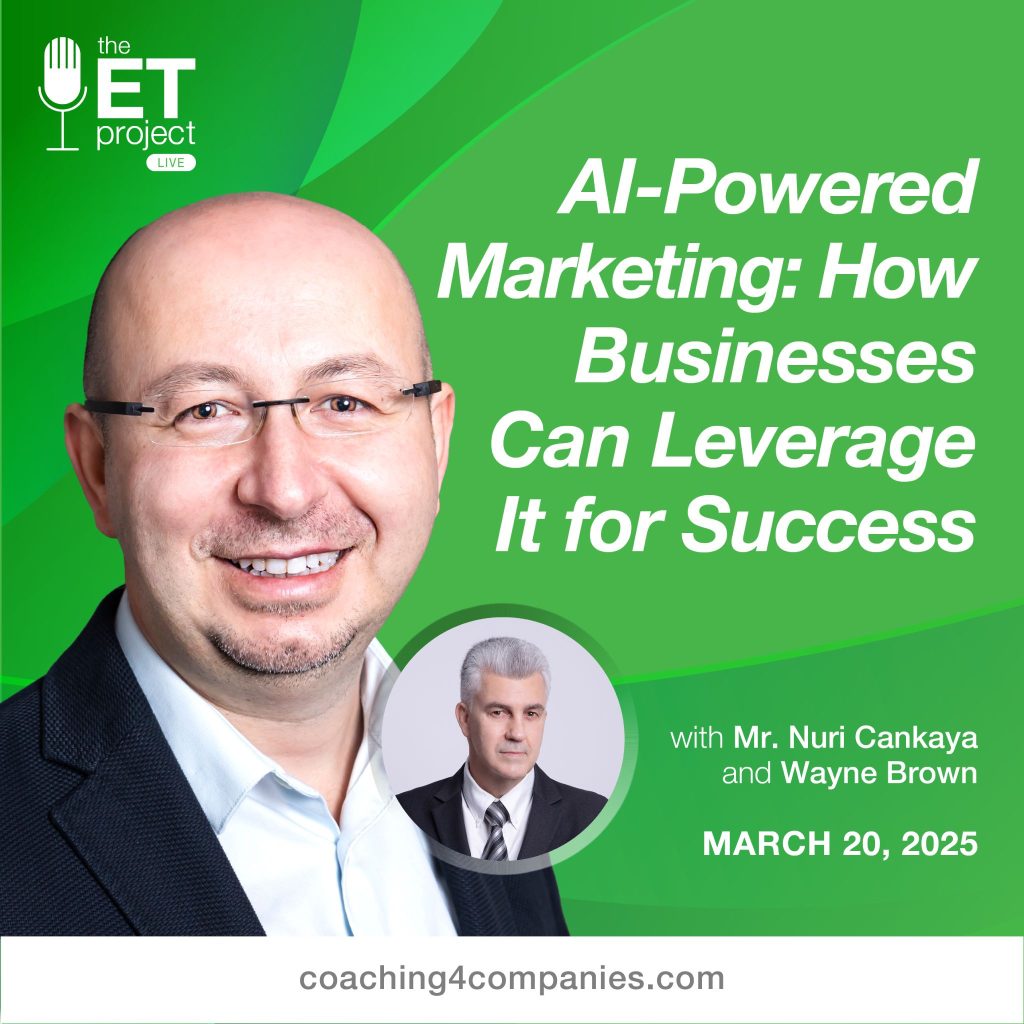
WAYNE BROWN: Hello, I’m your host, Wayne Brown, and welcome to the ET project. We’re delighted to be delivering this live broadcast to executive talent all over the world whom we’re affectionately referring to as ‘Team ET.’ Today, we’re in Kirkland, Washington in the US and chatting with Mr. Nuri Cankaya, VP of AI Marketing at Intel. With such a rich background spanning two and a half decades in marketing and innovation, Nuri is dedicated to helping customers overcome their business challenges and surpass their goals through the transformative power of AI. As a futurist at heart, he derives great joy from delivering presentations on the subject of AI in the future at numerous customer and community events. He has authored books on technology and the future of the internet, covering topics such as AI, Web 3.0, Internet of Things, and Blockchain. Prior to joining Intel, Nuri spent 17 years leading product marketing around the data center, AI and Cloud with Microsoft Azure. Nuri’s latest book, which he has just released this month, is titled ‘AI in Marketing,’ in which he outlines his three-step, ‘AIM Framework’ for marketing leaders. And you’ll hear us discussing the application of this framework throughout the conversation. Team, if you know me at all, you know that I love great discussions around strategy and the future, so I’m excited to bring you this conversation where we get to explore the current world and beyond related to marketing. It’s a wonderful discussion that’s filled with key takeaways for all leaders trying to learn how to cope with the AI landscape. Please prepare yourself for the following insights shared by someone who is really at the center of all this action, Mr. Nuri Cankaya.
INTRO: Welcome to the ET Project, a podcast for those executive talents determined to release their true potential and create an impact. Join our veteran coach and mentor, Wayne Brown, as we unpack an exciting future together.
WAYNE BROWN: Hello, team. Welcome to this month’s ‘ET project Live.’ Today, we’re going to be speaking about the future of marketing and exploring how cutting-edge technologies are reshaping businesses and the way that we connect with our customers. And of course, naturally, this is going to be, we’re going to be speaking about the impact of artificial intelligence. In marketing in particular, it has been such a game changer for all leaders across all industries, right? So, whether it’s personalization or customer insights, whether it’s automation, even ethical considerations, AI is truly redefining what it means to build impactful data-driven strategies. And of course, I’m no guru in this area. So here to help us uncover the present as well as the future of marketing is our guest, Mr. Nuri Cankaya, who is really a trailblazer in leveraging AI to drive innovation and growth. So, I’m looking forward to learning from Nuri more about how businesses can strategically embrace AI and deal with challenges that they’re likely to face, as well as probably some of the opportunities that lie ahead. So, Nuri, welcome to the ET project.
NURI CANKAYA: Yeah, thanks a lot for having me, Wayne.
WAYNE BROWN: I think we’re going to have an interesting conversation. You’ve just released a book called ‘AI in Marketing,’ we’re going to come back to that in a moment.
NURI CANKAYA: Perfect.
WAYNE BROWN: But as we do with all of our clients and our guests, let’s start with a little bit of your background. So, you’re located in Kirkland in Washington, which is for our global audience, is in the northwest corner of the US.
NURI CANKAYA: Absolutely. I’m a big fan of the Pacific Northwest. I mean, our state is the Evergreen State, so it’s beautiful because we got a lot of rain. I think many people know Seattle area is raining nine months of the year. But as a result of that, we have the Evergreen State, so it’s amazing here. And maybe the reason I’m here is I worked at Microsoft for 17 years, and Microsoft is headquartered in Seattle, Washington, so, that’s the reason. I’m now with Intel, I’m still based here as a remote worker.
WAYNE BROWN: Yeah, I had the pleasure of visiting the Microsoft offices or campus in Redmond and it’s a spectacular place. I never got across to Intel.
NURI CANKAYA: Yeah. Intel’s office is just next to Microsoft’s new campus. But again, Intel’s headquarters is distributed, so the majority of my team is in Portland, Oregon. Also, our headquarter is in Santa Clara, California. But I have team members in Austin as well as Phoenix, Arizona. So, it’s mainly on the west coast, but distributed where our production facilities and manufacturing abilities are in the company right now.
WAYNE BROWN: So, you’ve been in this industry for quite some time, I believe, a couple of decades or more.
NURI CANKAYA: Yeah, it’s more than 25 years, so. I spent like 17 years at Microsoft. I’m with Intel for the last two years. But before joining Microsoft, I had my own startup, so. And again, I have that mindset of how can we deliver some of the exciting stuff first in the market. So, year 2000, I actually had a startup back in Turkey, which is acquired by a company. And after that exit, I started another company, which is also acquired. So, after that, I joined Microsoft. But by heart, yeah, I have seen multiple stages and, you know, living in this industry. Internet was a big moment for us, I was there again. The iPhone moment, the mobile era was a big moment. Similarly, I think the cloud was a big moment. I spent almost 10 years with Microsoft Azure, and now AI is the next big wave and I’m super happy where I am and like living, breathing AI every single day.
WAYNE BROWN: So, you truly have had this front row seat to see this whole journey unfold. I’m wondering, does that help prepare you for where we are today? Or is AI really creating this greenfield for everybody? And we’re all diving in and slipping in together sort of thing, yeah.
NURI CANKAYA: I believe AI is just democratizing all the potential like roadblocks for everyone and really making it easier to have intelligence on your access for everyone. And this wasn’t the case. Like I remember in order to be a good programmer, you had to spend a lot of time, learn how the algorithms work. Like, you had to learn the syntax of Python or whatever languages that you will use. But now, if you have the idea, you don’t have to spend… You still need the engineering mindset, don’t get me wrong, but you don’t have to write the code itself. You can get the best code interpreter to help you in seconds. Similarly, I think this, I call it the ‘Distributed Intelligence,’ is going to help everyone. If you’re in a drug discovery, for example, in order to get and brainstorm with experts on this area, if you’re in biology, maybe you’re not an extreme intelligence on the physics and math, but now with the mixture of experts and all these models are helping you to be wiser and wiser, and then you can develop some new solutions faster. That’s how I think we are discussing today, like, “can AI cure cancer?” Absolutely. I mean, if you have the right idea, you have the expertise and intelligence in the system. So, I think back to your question, AI is really breaking all the barriers that we had to access information. Now it’s making it to everyone. So, you have to be asking the right questions. So, I think that’s a different mentality. You have to know stuff before, now you have to know how to extract the information from these intelligent machines.
WAYNE BROWN: From a leader’s perspective, around the application of AI as… technology, I guess, in general, right? It’s not only AI, whether it’s the discussion around the biases that may be built into the system, whether it’s ethics, whether it’s data privacy, and of course, customer personalization, we’re going to jump into the book in a moment, but I’m just wondering as a starting point, are there any considerations that leaders, and I’m talking leaders across the board now, I’m not talking specifically in marketing, but are there any considerations that leaders should keep in mind when they’re looking at AI integration within their company?
NURI CANKAYA: Absolutely. I will start with the first part of your question. Things are going so fast. Every day I open my phone to check the news. It is fascinating to see this is the five things that launched just today. If you take a vacation for a week, when you come back, something happened.
[00:10:00]
NURI CANKAYA: And specifically, I will call the December 2024. It was really crazy. OpenAI announced a lot of new stuff day after day. Again, they call it ‘the 12 days of the holiday season.’ Similarly, Anthropic, which is again famous with the Claude engine, they introduced. China came up with DeepSeek, and then like… and everybody was like, “okay, there’s an open-source model that can compete with this.” And instantly, just before the Lunar New Year, they hit with the DeepSeek R1, which is the reasoning model, which is an open source, that really shake the industry a lot. I remember that day, there was a couple of… almost a trillion dollars wiped off from the stock market with one announcement. So, things are shaky, but back to your question. And I was in a Gartner conference yesterday in Dallas. Maybe the listeners are aware of the famous hype cycle. So, Gartner has this like, everything goes as a hype, and it reaches to a peak, and after the peak, it goes slightly and fast down, but there’s a plateau of productivity on the right side of the chart. So, I think with AI, we are either just on the peak or we are approaching the peak. We are so close, but there will be a buzz in the system, at least in the next 18 months, like, “oh, AI was a big balloon, it bursted” and everything, but technically, it’s becoming mainstream, so.
WAYNE BROWN: Of course.
NURI CANKAYA: And I think the Gartner analysts explained it really well. Like, it’s not going to be all the way down, but we are seeing for the first time after the hype, it’s almost like plateauing faster. Many organizations are making those decisions as we speak. AI is showing the ROI instantly. Like during the dot-com era, you have to wait for Amazon to sell everything other than the books, and it took two years. Like the same for Spotify, in order to break the European Union laws and sound rights, it took four years to Spotify to mainstream things, but in AI, I think we are going so fast. There is a challenge to it because, as you said, I think the leaders need to make the right decisions, and it’s not that easy. You can just try to maximize your profit as a company, and you deploy an AI solution. In the long run, maybe it’s not the responsible AI that has been deployed. So, I’m definitely with you on this one. I believe we shouldn’t shortcut the AI adoption journey. Enterprises especially need to think multiple times on integrating some third-party tools to their environment because the company’s most valuable asset is the intellectual property within the company. All the data, like these GPTs, let’s say ChatGPT, is trained on available internet data. All available data is only 3% of the data, 97% of the data still sits behind the firewalls. All these companies have the intelligence because that’s the asset that the companies have, so. And when you introduce these AI solutions into your factory, into your maybe business, if you don’t set the right set of governance rules, responsible AI practices, it will really melt your profitability faster than you expected. So, in order to get that benefit from AI, you have to be thinking about secure AI practices, confidential AI practices, but most importantly, as you said, responsible AI is going to be a top-key consideration for the leaders to understand and act early on.
WAYNE BROWN: That’s an interesting point, only 3% of the knowledge basically out there rests within the AI learning capability.
NURI CANKAYA: Exactly.
WAYNE BROWN: And I think that in itself is a wake-up call for most leaders probably listening to this. What has happened in my circle at least is people have suddenly dropped their own thinking process and they’ve suddenly started relying entirely on AI. And as you say, this could be a real nemesis for any business.
NURI CANKAYA: Absolutely. Absolutely. And I have some real examples. I’m not trying to scare people about using AI, but this is a real case, by the way, if someone searched for it. A famous Nasdaq-listed company, a developer in that company just copy-pasted the source code to ChatGPT and said, “Hey, can you optimize this code?” And then, of course, when you share information, like if it’s not gated, you’re just becoming the next part of the training data.
[00:15:00]
NURI CANKAYA: Other developers went and said, “Can you write me a code like this company?” Because now the copy-pasted code is there and it really provides you the reverse-engineered version of the code. And this creates a lot of security risks for the company because the developer went and really disconnected everything and then put the data on internet. That’s risking the company’s most valuable asset, which is the information. So that’s where I believe that confidential AI is a huge topic. Now, imagine the governments are putting their spending data forecast and all this information on the large language models. And we have to be making sure that the implementation is right so we are not disclosing private information or sensitive information that will be consumed by some communities which will use this against the same community. The boundaries, again, the opportunities are endless, but we have to be super cautious about what we do in the short term.
WAYNE BROWN: We can open up a whole can of worms and spend the rest of our time essentially talking about this because the possibilities of doing the wrong thing are endless, just like they are during making good use of it. Let’s jump on to the book.
NURI CANKAYA: Yeah.
WAYNE BROWN: It’s brand new.
NURI CANKAYA: Actually, it is like 10 minutes ago before the podcast interview, so I got it from Amazon delivered, so. It is great, so, again, holding your own book. But yeah, it has been in my mind for a while because on LinkedIn I’m sharing regularly, but even back at Microsoft, I’m working on AI in marketing, and it is my really personal passion to share more about this with everyone because I see marketing is completely changing. It’s not about AI is the future concept. It is happening right now, and I want everyone to get the benefit out of it. But again, I want it to be a structured approach because I see lots of videos like, ‘Use ChatGPT to Generate 100 Posts.’ Why are we generating AI posts where AI will like it and AI will reshare it? We are creating like the nonsense content. How do we make it meaningful and really helping the information to grow? And for especially marketers, I said like, “there should be a framework.” On the book, I call it the ‘AIM Framework.’ So, Assess, Implement, and Measure. So those are, in my mind, those are the three simple steps that any marketing leader should take into consideration before deploying AI at scale.
WAYNE BROWN: Well, let’s start with that and then walk us through those three elements; assess, implement, and measure. We don’t have to go too deep we want people to get it.
NURI CANKAYA: No, no. Absolutely, absolutely. But I want to start with the ‘Assess’ one because, in my opinion, that’s the most important one, and people are really, most of the time, they just want to go and implement. So again, I have a project manager background as well as some of the business consultancy. This is the most important step by like, what are you trying to achieve with AI? The assessment phase. And what are the processes that you can almost outsource or Copilot with? And this is an area that… like I did it with my team at Intel. I said, “can you give me like the 10 tasks that you repeat every day?” And some of the employees are like, “why are you asking me this? Don’t you trust me?” I said, “no, no, it’s not about the trust. I want to help you to find more time and automate some of the things through the AI agents.” And they said, “what’s an agent?” And then we went deeper into AI agents are like automated processes that will take the best parts of your daily jobs and help you to find the right next step before you even think about it. And then when we make that due diligence, I think we found that a lot of things can be easily automated. So that part is, in my mind, super critical, especially like Agentic AI is the topic of 2025. So, we will see the majority of the companies will automate some of the repetitive tasks and spend more time on creativity, getting some of the messaging right. And for marketing, I try to be really simple. I mean, what we do is like we do outbound campaigns, we do social campaigns, we do like brand management, we do a lot of the product marketing, like document creation for partners, creating content for the website, and like working across the spectrum of our marketing operations journey with the respective regions.
[00:20:00]
NURI CANKAYA: So, there’s a lot of translation going into this. And almost 90% of the job, when we did the right assessment, I clearly see you can use AI tools and expertise. So that’s the first step, make the assessment, don’t jump into like one specific journey and… like there might be multiple things.
WAYNE BROWN: When you’re using AI at that stage, so we’re doing an assessment, we’re looking at how we’re going to use the tools, et cetera. When you’re planning a campaign from a marketing perspective, are you also using this as a predictive tool?
NURI CANKAYA: Absolutely.
WAYNE BROWN: Like planning these needs and using the analytics to…
NURI CANKAYA: Yep. Absolutely. And I will give maybe a real example. So, for example, recently I did like a big campaign, a couple of million dollars, and normally marketers do like a lot of the A/B testing, like we do with some audiences, but with AI, it’s endless. Like I can generate, let’s say 10 different visuals for my campaign, and I will ask the system like, “go and try this.” Which one has the best click-to ratios for my web page? Or if it’s a social ad, like what’s the engagement that I’m trying to derive. And I can fine tune it, and like the AI is today actually helping me, like the color coding is critical, the words on this one, because it has the knowledge of multiple intelligences, and I think we will come to that, but like in the next 18 months, most likely, we will reach to a level of AI, which is called AGI, artificial general intelligence, where AI knowledge surpasses humans’ cognitive ability in all aspects, from like math to physics to science to creativity. So, while we have it, like we should ask the right questions, but I also try to connect it with the measures. Like I go from the outcomes, like, “hey, I want to help my customers to know about this product is going to help them to save money. Is this campaign going to achieve this or not?” So, like you can build all these test systems with the outcomes in your mind, so that’s also the assessment stage, because like there are multiple tools to make it happen, but if you have the structure in your mind, what are you trying to achieve? AI is really helping that, and this is… we are talking about vast amount of data, like, I mean, maybe like a trillion parameter on a single campaign, a human cannot process that much information, but AI can, and it will give you like, “go with the campaign A versus B.” Like, I mean, that’s the simple answer, but it will affect my revenue generation, it will help the marketing automation in a better way, and the most important is the speed, because if I can do it faster than my competition, that’s the beauty, because then I will grab more market share in the market.
WAYNE BROWN: It’s a fascinating world, an area that I have not had much exposure to, so just listening to the capability of it, obviously I’m sure there’s a lot of listeners like me there that are thinking, “gosh, if we can go down this path, how much further advanced would we actually be with our business and more successful?”
NURI CANKAYA: Exactly
WAYNE BROWN: So, I think that in itself is extremely exciting.
NURI CANKAYA: And also, it’s not just for the big companies, I want to emphasize that, it’s like big or small, AI is everywhere. Like, we want to make sure everyone understands that, like, I mean, you almost have a marketing guru in your fingertips. You can just ask the right… If you know how to ask the right questions and if you have the data to feed the system, I mean, you will get a lot of great creative visuals like both on the text, on the image, on the video now. I mean, the video creation is just fascinating. And as a marketing leader in this industry, to record a video commercial, you had to have, like, a couple of million dollars of budget, you have to brief the agency. You just now prompt it and you can generate almost customized video messages for your audience. Like, this is a mass creativity at scale. So, we haven’t seen it before, and I call it the hyper-customization. Like, what is, like, Wayne Brown likes on social media, I can show you an ad just tailored for you. Like, I mean, this never happened before. And I think we are just in that hyper-personalization stage of the marketing.
[00:25:00]
WAYNE BROWN: Incredible. Let’s keep going with the ‘AIM framework,’ that’s ‘Assess,’ let’s go to ‘Implement.’
NURI CANKAYA: Implement, I think implement is the fun part because now it’s all about upskilling your team and implementing the tools. Like, in the book, like, I recommended like roughly 15 tools. It’s going to be, again, maybe obvious, but, like, I personally use, like, a lot of the basic tools are provided, like, Microsoft Copilot. I mean, I was there when it was built, so I was there when OpenAI services are integrated. But getting the first thing, like, productivity, like, implementing those things in the marketing process is so critical. And, again, you don’t have to find that, like, small vendors, like, go with, like, the big ones that will help you. Again, I mentioned ChatGPT multiple times, the OpenAI solutions. But also, like, from an enterprise point of view, implementation in the book I cover, like, where do you deploy these solutions? Because, like, AI on-premise is a big thing, but it comes with, like, some of the implementation challenges. Like, imagine if you’re a 10,000-plus employee company, you really don’t want to risk your data governance, put it on a cloud and, like, give it to a third-party company. You want to make it behind the firewall. And I will give a name, like Aramco, for example, the oil and gas company. Like, you cannot risk because, like, all the world is watching you. You have to be secure, and I totally understand that you have to create that private AI for your company. And many of the, like, companies is in this case, but also the federal governments and many other government entities, they have to deploy these AI solutions, especially on the marketing side, on, like, the local. So that’s why on the implementation phase, I try to give it, like, what’s the benefits of putting it on a cloud? What’s the benefits of getting on a data center? Or what’s the benefit of putting it on a hybrid? Because you can just play with the data. And it’s a fun part, but, like, if you read it through, the most important thing is the data. Like, if you don’t have the data to feed the AI, like, what comes in, what goes out? Like, if the data is not structured and quality, it’s not going to help you. I mean, if you don’t feed these engines well, it doesn’t really drive a lot of great results. So, it starts with really structuring your data, like, especially for marketing. Like, do you have a sales data backwards with customers? Do you have all the social media tracking? Do you have analytics on, like, which customers bought what product after that? And then AI can bring the intelligence on, “hey, looking at your data, which is really in-depth, I can predict this is the next product this customer will buy, so I will help you with that.” But if you don’t have it, it will just create random things, like, which will not be really critical. So, going back to your question, ‘Implement’ is a good step to learn, and really, how do you drive the tools, not like many, but like a couple of them, structured in the organization.
WAYNE BROWN: It’s interesting listening to what you just said, and it’s like the human brain in that regard, that we don’t like gaps in our thinking, and our brain will fill the gap whether we know it or not.
NURI CANKAYA: Absolutely
WAYNE BROWN: And it sounds like AI does a similar thing, right? So, if you ask it a question and it doesn’t have the answer, it will create the answer for you, whether that’s right or wrong.
NURI CANKAYA: Yeah, yeah. And we call it the hallucination issue. Like, I mean, AIs today, unfortunately, they hallucinate because a couple of things, but it’s the lack of the data and lack of maybe strong governance on this one. One of the key things that has been introduced by DeepSeek, and OpenAI also introduced, is the reasoning. Like, now, I think the big thing in 2025 is the AI is now trying to think like humans on, like, “okay, you asked me this question, but like what’s the underlying thing?” And then on models like DeepSeek or GPT-01 or Perplexity, you clearly see the thought process on, like, it asks the question to itself to fine-tune the answer, that’s brilliant and I think we will see more of it in the marketing space as well.
WAYNE BROWN: Yeah, very interesting. I don’t know if you’ve heard of… and I’m not sure what the correct pronunciation is, but Qwen
NURI CANKAYA: Yeah, yeah, the Alibaba’s engine.
[00:30:00]
WAYNE BROWN: Gosh, I forgot his name, from Microsoft, right? Their co-founder.
NURI CANKAYA: Exactly. And I think there’s one thing, which is the naming is interesting, like 4.5, calling it o mini. Again, Claude has different versions like Sonnet. I don’t think the industry nailed it yet, but, I mean, I go to Hugging Face, which is the, let’s say, the model ranking, and every day that ranks are, like, going up and down, like, many of the, like, customers are using different models, but there’s a tendency to go more open because everybody wants to know, like, how this data is trained on, what’s the results that I’m getting, and can I keep it confidential. I think that’s why the DeepSeek was a big moment in the industry, but at the same time, like, kudos to Meta team and the Llama because Llama is the most downloaded large language model which provides this as an open source, which is great for the industry, and I will not be shocked if OpenAI finally goes open because it’s not open. Same with, maybe, Perplexity and same with, potentially, like, the Anthropic team because they are now the big frontier models. They are dominating all the solutions with Amazon, Google’s Gemini, and I think Meta is doing an interesting move with the Llama and providing this through the PyTorch Foundation. So, this is an area that I’m watching, and I think, as you said, every day we are learning new tools. They will keep coming, but I think there will be also a settling time. We will see, like, some are monetizing well, and then they will be the market leaders, but it’s the time for the listeners. If you are thinking of a startup, this is the time. You can just get a high valuation, and if you have a product which solves the problem of the users, boom. I mean, your valuation will skyrocket, for sure.
WAYNE BROWN: Well, let’s jump into ‘Measure,’ which is the third pillar, if you like.
NURI CANKAYA: Yeah. And this is, in my mind, like, I put it at the end, but this is also the critical part because all leaders make some investments on, like, any project, but specifically on AI, this is, like, first a little bit time-consuming because getting there, upskilling your team is not easy, but also AI is costly. Every time, I mean, we are hearing this, but there is more electricity to power the systems. Every time you do, like, I mean, there is more, like, energy required to cool the systems. And this is, like, becoming a big bill. So, you have to show ROI. And especially on marketing, the return on marketing investment is a critical metric. That’s why in that section of the book, I put some measures, like, and this is from my expertise, like, almost last the 10 years on AI and specifically marketing, I said, “define the objectives and key results.” And this term is coming from Michael Doerr, he’s one of the key concept drivers of OKRs. They tried it in Google when it was there. He has a book, like, ‘Measure What Matters.’ It’s all about, like… I mean, it started with Google, but it expanded to the industry. And I’m saying, like, objectives and key results should be a part of the AI implementation project after that as a measure, because if you know what to measure, you will show the ROI to the leaders. And, like, if you’re a marketing manager, you can go to your, like, board and say, “I invested, I’m just making like $100,000, and I made like $2 million. If you want to invest more, I will bring more revenue,” because marketing most of the time is seen as a money-burning machine. You just, like, throw the money, you don’t know if it really drives revenue. But with AI, you can clearly show that every dollar you spend is turning to a return on investment for the company to grow the revenue and really increase the profit. So that’s the section on the book. Again, like, I mean, that’s why I call it the AIM, and I asked the designer to put three arrows, like, I mean, they’re hitting always on the middle, but, like, if you follow the right steps on, like, if you assess it right, if you implement it right, and if you also measure it right, it’s a circle. Like, I mean, you have to be implementing the next AI project in a short time with even more funding, but you have to show that you have done a great job with the first project.
[00:35:00]
WAYNE BROWN: It’s good that you highlight that.
I was curious, not reading the book myself yet,
but I definitely will be, but do you provide
some key indicators or metrics in the book,
and it sounds like you do.
NURI CANKAYA: Yeah, exactly. I have, like, 12, and I go in-depth, like, again, with the experience, I said, like, “these are the 12 metrics I used successfully,” and again, like, I also, like, attend many conferences, I check with, like, the colleagues and analysts from Gartner, Forrester, so I know what’s the market intent on the analytics as well, on marketing, so, yeah, like, I mean, they’re on the book, in-depth explanation how to measure it, but what is the right measure? So, especially thinking of OKRs, if the listeners are new to the topic, OKRs are set as, like, at 80% success rate, so you try to shoot for the stars, it’s 100%, if everything turns to a green result, then you’re not stretching yourself, like, I mean, that’s why we try to go, like, above, and you can go down under 60% achievement, we call it embracing the red, like, this was red, but, like, what did we learn? So, we set really high targets, but I think that OKR process, the objective and key result setting process, is super critical for any AI implementation, so you can clearly show the return on marketing investment to all stakeholders.
WAYNE BROWN: You mentioned AGI, artificial general intelligence, a moment ago, as a starting question, I guess, what’s the difference, if you could explain simply enough, what’s the difference between Generative AI and AGI?
NURI CANKAYA: Yeah, in this Generative AI phase, like, we are in this, like, narrow AI, so where, like, the systems are trained on specific inputs, let’s say all the information on internet, all the written books, like, scanned and put it on a digital system, and then it’s, like, training our neural system, so, like, we are technically mimicking how the brain works, that’s why I call it, like, very close to neuroscience, now we are just rewiring some of the knowledge gathering process. But doing this, we didn’t have some capabilities in all the aspects, so, like, some of the information is not there, and then the hardware is not there. Again, like, imagine the depth of the knowledge in our brain, like, with the synapses and everything, you go depth in your memory, similarly today, like, on the existing AI models, you can go now and build that deep learning algorithms, which means that we need to feed more data in it, which makes it, like, in a nutshell, today we are living in this Generative AI, which is really narrow, it responds to you with a text, maybe an image, but it doesn’t really understand the concept itself, so it’s not self-conscious. The AGI stages, it approaches and surpasses human knowledge in all the aspects, and then AI becomes aware of, “okay, I am an AI.” So, like, I mean, that’s a different stage, so going to an AGI and passing that is critical for human beings because for the first time in the history we know, we are creating something more intelligent than us, and it’s going to happen in the next 18 months or so, like, I mean, we can predict it because of the pace of the hardware deployments, the training, and, like, we learned that there’s a famous Google article on 2016 on, like, the Transformers, like, all this goes back to that Transformers, and that’s the GPT, it stands for generative pre-trained transformers. So, like, this is how the brain works. AGI will change a lot of things because, like, imagine one system that knows everything better than humans, so in an ideal world this should be a guide-on-the-side for, like, any decision-making, but as we all know, history repeats itself, the governments who will reach the AGI will have a massive advantage, like, you can develop good things and also bad things, so I think the governance of that AGI is super critical. I mean, for the listeners, that’s why we are having this AI race because every nation wants to be the first one to reaching the AGI stage and containing it first.
[00:40:00]
NURI CANKAYA: But in the long run I’m just looking at from like an end-user perspective, it will impact all of our lives. I mean, there will be value, like, we have seen this with the internet, like, the access to information became so easy, with the mobility we have access to information everywhere, with cloud we have generated, like, gigantic data sensors, that really fuels the growth of AI today, and in the future AI will be everywhere, like, I mean, in your thoughts, like, I call it, we will merge with AI, like, before you really execute anything, you can just, like, double check, triple check, you can create that reinforcement learning into your life, and the values will be amazing. So, again, I think curing cancer is just, like, a very simple one, but you can ask today, like, how can I extend the life, how can I create a more valuable time, and all these things will drive deep questions, because it’s alignment, like, your, like, good might be somebody else’s nightmare, so, like, how do we align this AGI systems on the basic thinking, but again, I’m just being an optimist, like, 10%, this might go wrong, and that’s a very bad 10%, but 90%, I think the human will, like, find the right cause of using AGI, we will be there, it’s all about getting the benefit out of it and using this as a guide on the side and then merging with it to really become, like, even more knowledgeable versus really, like, repeating some of the things. So, I think for all the listeners, I recommend everyone to spend some time on upskilling their-selves on AI, this is going so fast, like, I mean, I find myself, like, “what did I miss today on AI?” Versus, like, every almost a year is almost a decade-long loss from an upskilling perspective, so if there will be people, like, accelerating with AI, and this comes to me as a question, like, “am I going to lose my job to an AI?” No, like, I mean, you might lose it to someone who is using AI better than you, like, because that’s the differentiator in the short term, at least in the next five years.
WAYNE BROWN: So, I’ve been a follower of Ray Kurzweil and reading all of his books and predictions, you know, 18 months, so I’ve heard other people, Musk, as one example, talking about that short timeframe, are you suggesting 18 months and we reach singularity?
NURI CANKAYA: Not the singularity, but, like, and maybe just define, so after AGI, we have another step called the ASI now, because we want to differentiate, that’s the artificial superintelligence, that’s where the singularity happens, and again, for the listeners, singularity is the stage, AI knows it’s AI, and again, like, it can mimic that the AI doesn’t know it, but again, that’s the really important stage, like, now, with all the tests, like, we have biomedical, nuclear, I mean, we implemented those tests, like, when you have an EVAI system, you ask basic questions like, “if you have the magic button, do you start a nuclear war, yes or no?” And of course, like, the idea is testing the AI’s response, like, can this go loose and then be a risk for the humanity? This AGI test will really be important before the ASI, I don’t know if we will ever reach ASI, or is it, but again, I’m sure if we take the right steps, singularity is nearer, so Ray Kurzweil’s book is all the same, but again, we might be there soon, but again, I cannot put a date like I can put it on AGI.
WAYNE BROWN: That’s fascinating. I mean, I’m also curious then about the progress that the whole technology space is making towards the customer’s interfacing or interaction and helping the customer feel the authenticity within the interaction. How do you see that from a marketing perspective? I guess this is extremely important.
NURI CANKAYA: I mean, as you said, I think the customers are also first expecting more, but at the same time, their needs are not changing.
[00:45:00]
NURI CANKAYA: If you are ordering a book like me, you want it as soon as possible, a good high-quality service, and when you want to reach out to the right people, they should be there to support you. And let’s say if you have a ticket and if you have a problem with traveling, going to a website today and calling the agency, it’s not a good experience. So, with AI, I think we can automate the majority of the things. Again, I’m going back to the AI agents, but agents will replace some of the repetitive human work and it will create a lot of customer experiences because what we want to achieve is really meeting the customer needs in today’s intelligent world. Today, we are just putting some telephone routing systems. I mean, still the old way. But the world has been changing and shifting so fast. How do we get those helping you? And from that lens, I think every company needs to look at their product portfolio. If you are an Airbnb, what do I provide to my users who are booking accommodations through different hosts? What’s the Generative AI solution that I can bring today? And what’s the predictive thing? You just like landed to a new city and you want to book maybe something, this becomes a really smooth integration with the existing experiences, I think we are lacking this. We call it the life hacks because there’s no smooth integration today. But with AI, I think these are all going to be possible. But it goes back to, again, the experiences. Like, what are we providing the customers as an experience? And from the marketing side, how can we make sure this is well known from the customer perspective? I think this is a good assessment stage going back to the work. You have to assess this regularly. What can I do better with the help of AI? And how do I differentiate myself from the competition because this will be a crowded space. There will be startups coming just a couple of days and then they will challenge you. And this is what we have seen in the market. Like, Uber came and then there’s no taxis around. I was in the airport yesterday, there’s still a line of taxis, but the majority of the line is the Ubers and Lyfts off the road, so. And these are small disruptors that is a good showcase, there will be more disruptions in the economics that we see today.
WAYNE BROWN: Certainly, a lot of our clients struggle with this whole concept. So much disruption is creating this almost fear of taking the step, jumping in, because of that degree of change, and they’re fearful, they jump in today and tomorrow what they’ve decided is out of date. How do you overcome that? As somebody who is working in the industry and seeing this on a daily basis, how would you suggest to a leader listening that they overcome that?
NURI CANKAYA: I think the big next step is really jumping in the water. I mean, AI is happening. You will make mistakes. Do your assessment, but don’t wait too much, you will lose the time. First, as I said, try upskilling yourself. It starts with asking GPT solutions the right questions. How do you maybe become really a prompt expert? And this is really a deep thinking. When I try to solve an issue, I use the dictation feature, I talk almost 20 minutes. It’s like a long text, but the output that I’m getting is precise because I’m giving more data to it, which means I recommend all the leaders to experience AI firsthand. Start with the basics. Increase your productivity with meeting notes. Get some AI assistants to do some of the summarization for you after meetings. Get some of the transcribing and maybe, again, the basics of voice and maybe image generation. After that, try to implement some of the maybe not super confidential parts of the implementation, especially for marketers. Social media is an easy one because it’s already public, so you can just analyze all the information that you posted, try AI tools to train itself, and almost generate a system that really engages with the customers with their own needs.
[00:50:00]
NURI CANKAYA: So, I think, back to your question, it’s more about understanding the need, but don’t wait. Just go and execute, upskill yourself, but also test and fail. Not every project will be successful, but you will learn from the mistakes, the next project will be even better.
WAYNE BROWN: Nuri, such a fascinating field. What has got you the most excited about the future, particularly in marketing? Let’s stick in your general, but what has got you the most excited?
NURI CANKAYA: Again, I’m using AI in my daily life. I have a full self-driving car. Every day I see like… and if you look at it, the shortcut is robotics. I really want AI in my house with humanoid robots and really helping my life quality going higher, which I can spend more time with my kids. I can spend more time with maybe the nature because there are some repetitive things, driving was one of them for me. And again, don’t get me wrong, I love driving, but in the last years, I haven’t driven so much. I just enter the location, I press the button on my truck, and then it goes. Of course, I follow the road, but I listen to podcasts. I’m giving my full attention, but also, I’m not driving the thing. And it gives me freedom. If this is happening today, and this is a well-defined space with the roads in the US, well, everybody applies the traffic rules. There are some, of course, learnings, but apply this thing to robotics. Imagine all these AI features are coming to your life daily and making a big change. Again, hospitals during the COVID, we have seen the shortage of human in the facilities created a lot of issues. Imagine we can have a higher quality healthcare service, higher quality retail services, and this is going to be a part of our lives. Again, I’m looking at the opportunities where AI merges with robotics in the next five years, where we will have true companions helping us across the tasks, and then hopefully we are connecting with our family, friends, and the nature more and more, rather than repeating ourselves on daily routine tasks. There’s good and there’s bad. You can just create a scenario of the Terminator, that robot just can’t kill you exactly. That’s why I’m starting with the AI safety first. If you build it, and again, my previous book was about blockchain and AI. I believe that we have to log every single decision-making AI makes into a blockchain, because blockchain is an immutable ledger where we can trace it back. It’s like the accounting ledger. You never delete something from a ledger. You just add money, move money, but again, it’s plus and minuses. Same with the AI decision. If AI tomorrow decides to kill a human, we have to treat it like, what went wrong? How can we find the root cause and fix it on the training data or whatever is the fine-tuning stage? But again, I’m not a pessimist, so I’m an optimist. We will solve these problems, I guess, and AI will be awesome in our lives.
WAYNE BROWN: Right. Right. It’s certainly a subject that’s going to evolve at increasing speed. I feel it is at the moment anyway. And I’m confident that the majority of our listeners are probably out there running as fast as they can to learn and understand what is an ever-changing landscape for them at the moment. And it sounds like your book really brings an abundance of insights and fresh perspectives. So, for all the listeners and all the leaders out there, probably it’d be a great idea to grab a copy quickly?
NURI CANKAYA: Yeah, it’s available on Amazon, and globally it’s available. I’m working with the Amazon team on the translation. It became the bestseller in a couple of things, which is a good thing. It’s in the category, but as you said, I think it’s a good reference for everyone looking for a guide on the AI journey. If you go to Amazon and search for ‘AI in Marketing’ or my name ‘Nuri,’ it will pop up.
[00:55:00]
NURI CANKAYA: Yeah, it will be great. We have a Kindle version, a paperback version, and a hardcover version. So, depending on if you’re a digital reader or a physical reader, we have options, and it’s globally available.
WAYNE BROWN: Are you open to people connecting?
NURI CANKAYA: Absolutely. I’m very active on LinkedIn, so you can find me on LinkedIn. I do share almost four times a week, so I publish infographics. I started the short videos as well, because we are in the consumption culture, so I want to share information as much as… fast as we can. I also have a bi-weekly newsletter, so if you don’t want to miss anything, just subscribe to the ‘Beyond the AI horizon.’ I try to recap what happened in the last two weeks in the AI, so at least you are on top of what’s going on in the world.
WAYNE BROWN: Oh, beautiful, I’m subscribing. This is one of the biggest challenges for people not in the industry, I feel, is staying up to speed with the changes.
NURI CANKAYA: Absolutely.
WAYNE BROWN: Not looking at how to play with them, but just even knowing about them is one of the biggest challenges, and if your newsletter was reaching that…
NURI CANKAYA: Absolutely, that’s the aim. So, like, a recap of the last two weeks, and it’s bite-sized, so you can just download it into your brain three minutes, and you are up to date on what’s going on in the AI today.
WAYNE BROWN: Well, Nuri, a great conversation, as expected, and I’m sure the listeners got a huge amount out of this. Again, the book is called ‘AI in Marketing,’ and you’ll find it on Amazon, so please do yourself a favor, get out there, get a copy, and deepen your understanding. But Nuri, a great conversation. Thank you for being on the ET project.
NURI CANKAYA: Thanks a lot, Wayne, for having me.
OUTRO: Thank you for joining us on the ET project, a show for executive talent development. Until next time, check out our site for free videos, eBooks, webinars, and blogs at ‘coaching4companies.com.’
[END OF TRANSCRIPT]