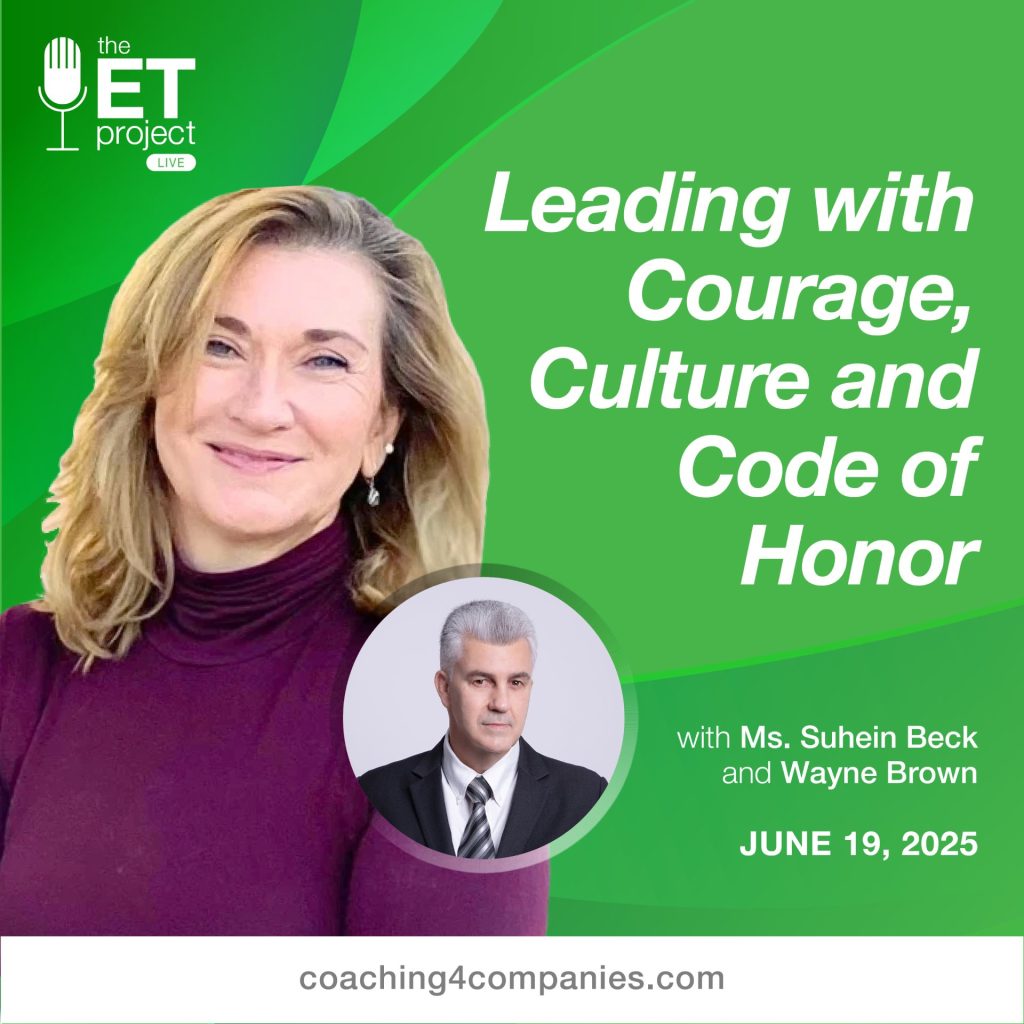
WAYNE BROWN: Hello, I’m your host, Wayne Brown, and welcome to the ET project. We’re delighted to be delivering this live episode for executive talent all over the world whom we’re affectionately referring to as ‘Team ET.’ Today, we’re heading to Laguna Hills in California to chat with the founder of ELAJ, Suhein Beck. Suhein is affectionately known as the culture cultivator. She’s a dynamic speaker, author, and entrepreneur, a proud Circassian with roots tracing back to the legendary Amazon women. Heck, we may have even traced her lineage back to Leonardo da Vinci. Currently, Suhein has launched an international speaking tour and campaign that draws on her rich heritage to challenge mainstream narratives and ignite transformative leadership to develop their own higher standards and adopt a personal code of honor. Along Suhein’s journey, she has pushed through intensive therapy and adulthood to reconcile the traumas of not just being caught in the wildfire of gangs and mafia as she was, but the generational traumas of genocide and being exiled from her own homeland into becoming an American entrepreneur that had to make tough choices between making money and her own personal code of honor that has stayed with her after all these years. This is a one-of-a-kind interview where one of our strongest guests reveals the truth about how to exercise the muscle of courage like a true Amazon warrior princess. I know you are going to love this conversation.
INTRO: Welcome to the ET project, a podcast for those executive talents determined to release their true potential and create an impact. Join our veteran coach and mentor, Wayne Brown, as we unpack an exciting future together.
WAYNE BROWN: Hello, team. You know, we often think about resilience as something about enduring hardship, which it actually is. But what if we also looked at it as a reinvention opportunity? So, in today’s conversation, we explore the extraordinary journey of somebody who turned around displacement, danger, even doubt, and looked at it through the eyes of purpose. So, from exile to entrepreneurship, I’m going to build this up now, Suhein, from exile to entrepreneurship, from trauma to teaching, this is the story of courage, cultural identity, as well as the power of listening, not just to your own dreams, but to the people around you. So, I’m very excited to welcome today’s guest, Suhein Beck, to our show and to learn so much more. Suhein, welcome to the ET Project.
SUHEIN BECK: Thank you, Coach Wayne.
WAYNE BROWN: Very good. It has been a long time coming, this conversation, and I apologize for the false starts on multiple occasions.
SUHEIN BECK: Nope, not your fault.
WAYNE BROWN: You have a long line of Circassian ancestors, and I know you’re extremely passionate about this. So, I thought we might start at that point. Is it possible to tell us about your people’s history and what it means to be Circassian today?
SUHEIN BECK: So, for your audience, I can almost 99.9% bet that hardly anyone from the audience has heard because in my 50-something years in the United States, I’ve come across less than five people that have ever known what Circassians were. So, when someone asks me, who are you, where do you come from, it’s a loaded question. So, the interesting thing is that we are one of the oldest civilizations. We go back 7,000 years, indigenous, attached to our land continuously. So, while other cultures were migrant cultures or they were nomadic, we were very specific to our land, and our land is beautiful, and that’s why. And so, what’s strange is that for generations, we have been locked out of our land, and yet there is this strange poetic yearning that all of us have, and it’s a really strange phenomenon, and I’ll explain it. So, the Caucasus is actually in the Caucasus Mountains between the Black Sea and the Caspian Sea. So, think of where Russia is, we are in the southern border of Russia between the Black Sea and the Caspian Sea north of Turkey. Now, if you look just a little bit to the left, there’s Greece. So, you cross from Greece northeast, and that’s where it begins.
[00:05:00]
SUHEIN BECK: So that shoreline that hits from Greece upwards and eastbound all the way through to the Caspian Sea is called the Caucasus. You know, we’ve always said the mountains are our only friends, because the only thing that we had to defend ourselves with were our mountains, Mount Kazbegi, Mount Elbrus, that whole ridge, which, by the way, the largest, tallest mountain in all of Europe is Mount Elbrus. Why doesn’t anyone know that? Again, it adds to the mystique, right?
WAYNE BROWN: Guilty as charged, I have to say. I had no idea until you and I connected.
SUHEIN BECK: May I erase your guilt? Because you’re not guilty. Okay, because our history was erased. And that’s why I’m so grateful that you, Wayne, have invited me to this opportunity to help, you know, let the world know that we exist and we existed. And, you know, as much as it would have been convenient for us to not exist, we do. And we have. So, since the Greek times, even before, I’ll give you like the highlights of our history. The Greeks would go up on the shores of the Black Sea to the shorelines of what’s now Abkhazia, Sochi. You know, if you remember Sochi, if that rings a bell, Sochi Winter Olympics. Well, that basically is the grounds of where the biggest modern genocide happened in European soil in modern times. It was the first and largest genocide before the others that happened. So, ours was the first. And so, when the Greeks would come up that way, the Spartan heroes and whatnot, what they found mesmerized them, and that is what Greek mythology started with. The historians started at that point. And so, they started creating this mythology around what they found. What they found were men and women warriors. And at different stages of our life cycles, of course, there’s a larger population of men and a lesser population of men, depending upon the wars and defending our lands and whatnot. And so, at times there may have been a decrease of men. And so, the women rose to the occasion and were definitely there to defend our land. Something I tell people all the time, and that is that the power of war is not hatred, the power of war is love. So, what’s strange about that is if you have more love for your people, for your land, that is what wins the wars more than hatred. So, in our case, we were able to win all the wars. So, with the Greeks, they were struggling with us because they saw that we would go berserk. And that word actually comes from Circassian. And we were able to have this rage kind of tribal thing. So, when they would see these women on horses, which is actually the credit to our strain, we were an equestrian nation, we were one of the first to tame horses. We were the first to wear pants. And so that concept, and it was because we were on horses all the time. So, from three years old, you put a girl on a horse, you put a boy on a horse, that is the equalizer of physical strength. But when the Greeks saw that back then, they were so discombobulated by what they were seeing as women on horses, because that was not a thing, and fighting and being really good at archery and whatnot, because if you train a girl and you train a boy archery from a young age, there’s equal power and strength. So that was the so-called message that they were receiving, is that the strength and whatever. In their minds, they magnified what they were seeing in order to dilute the defeat. So, when the Spartans were… initially, and I know you’re Greek, so forgive me, when the Spartans would come, they were too ashamed to say, “I got beat up by a woman.” So, what they did was they magnified our physicality in their mythology to justify the initial losses.
[00:10:00]
SUHEIN BECK: And that is where that concept of Wonder Woman came from. Remember her golden belt?
WAYNE BROWN: Yes
SUHEIN BECK: And remember how it was part of the thing about stripping her of her superpower was that golden belt?
WAYNE BROWN: Correct
SUHEIN BECK: Well, that golden belt to us has our identity written in it. So just in case we did die in battle, we can be identified by our belt and who our seven generations of ancestry were, because we are required to know our generational ancestry seven layers back. So, in our belt, we have that. Now think about that, symbolically, isn’t that beautiful?
WAYNE BROWN: Mm-hmm, it’s incredible
SUHEIN BECK: Stripping her of her belt, stripped her of her identity, and that was her superpower, that’s one of the highlights in history that I think is really romantic, you know.
WAYNE BROWN: Very well said. Yeah. Sorry. What was the population of the whole country?
SUHEIN BECK: Varying stages, anywhere between a million to two million. Okay? And so, you know, we all had land, we all had mountains, you know, we were mountaineers.
WAYNE BROWN: Right
SUHEIN BECK: And the soil, again, this is another aspect of it. You know, people would ask them, “why was everyone at war with you?” Well, it’s a strategic location, you know, so it’s how the Russian Empire would have loved to conquer the Ottoman Empire. You know, all the way down through Turkey. And then Turkey is as strategic as you can get, you know. Our soil was very rich, agriculturally as well with minerals. So, the Bronze Age actually began there. And that allowed us to have some of the best weaponry ever. So, hundreds of years later, thousands of years later, basically, the Russian Empire came to be. And they realized that this land was so rich. The Caspian Sea, until today, has one of the best oil reserves. Condoleezza Rice, George Bush, you know, they went back there after Alfred Nobel had exhausted the first hundred years-worth of supply, secondarily that was replenished, and then Condoleezza Rice and George Bush started making visits to the Caucasus, which had never been done before. And that was as a result of the discovery of the Caspian Sea being rich with oil, again. Another unknown fact is Marco Polo, the great discoverer, had gone through the Caspian Sea, the Caucasus, and discovered that there was this gunk residual when they were mining for that oil or lamps and whatnot. And he had noted in his journals that people would take that gunk, that residual gunk, and slap it on their burns and their wounds or their horses’ hooves, and they would heal magically. And that was the rich mineral component of what is now petrolatum, which is used in Vaseline. So, the history, again, was taken away from us. Even though Marco Polo wrote this in the 1400s, petrolatum was discovered in the United States, in Pennsylvania, trademarked in the United States. But it was used, and there’s proof that it was used for medicinal purposes back then. And you know, later, my grandfather used the petrolatum as the base for his skincare medicinal formula, which I launched, and, you know, I launched it about 14 years ago, and it went global. Anyway, so going back, so Russia then decided that it wanted that land. Also, there’s a lot of mineral hot springs that are very healing. So that’s how rich the land is, like it is truly healing. And Tolstoy went down there, and he was embattled and then went to go healing, and he went to the healing waters of the Caucasus. So, the Caucasus is now kind of this resort place where the Russians go in order for them to heal, because everything about it is healing. So that is the justification why everyone wanted a piece of the Caucasus. The other aspect of it is, is that historically anthropologists were fascinated with the people of the Caucasus because we had such a resiliency, we had such a strength that was unencumbered by anyone else.
[00:15:00]
SUHEIN BECK: Like no one could understand what this strength and passion and joie de vivre was. And it is, you know, something that we as a culture have maintained until now. Up until only the last 50 years, previous to that, we were one of the largest populations of centenarians. People that lived to be over 100 years old, but with quality of life, good eyesight, physicality, you know, total mental capacities, sexual energy, like all of that was there. You know, like my great-grandfather fathered, wins at 70, and then another son, 77-ish, and whatever and he had a great, young, hot wife that was devastated when he died when he was over 100 years old. And I ask people like, what kind of a person was that, that at over 100 years old, his wife, who was like 40 years younger than him, she was devastated and went into severe depression when he died. What kind of a person had what kind of capacity in life to have died and to have left such a huge void that, you know, still the family talks about him. So anyway, so just to give you that in a nutshell. Okay, here’s another highlight, the Russian empire started a war with us in 1763, that brutal war, genocide after genocide, ended in 1864, that is 101 years of war with the Russian empire. Put that into perspective with Ukraine today. We were a completely self-contained nation where everything we needed was self-contained and we contained within ourselves. And so agriculturally, food, weaponry, you know, clothing, materials, all of that, we did not receive any help from the outside, Britain offered, but never came through. Again, put that into perspective. What kind of people is it that can fight the Russian empire for 101 years completely independently of any help from the outside? We became known as a warrior nation. So, from the Amazons, way before the great times and going back all the way to the Sarmatians, going all like 7,000 years, we were professional warriors. On the negative side, we did not build anything of significance architecturally. We did not develop like this extraordinary cuisine, you know, because it was always all hands-on deck, that’s what we were known for. Anthropologically speaking, there was an anthropologist who was German and very racist, Blumenbach was his name and he basically was studying skulls. And out of all the skulls of humanity, he decided Circassian skulls were the most beautiful skulls. And this is a very repulsive thing. Like, here we are in 2025, we can say like, “this is a very repulsive concept,” you know, that they were the most beautiful. So, he basically created this publication of the Circassians and that’s what we were called at the time. So, we are Circassians, also known as Adiga, but at the time, because it was the Caucasus Mountains, he called us the Caucasians. From that word and his glorification of, look at my skull, isn’t that like one hell of a sexy skull? I’m sorry. It’s a joke. It’s a joke, really. That concept of our skulls being the most beautiful was disseminated all through Europe into the United States that glorified the Caucasian race as being the superior race. That’s where the word Caucasian comes from, it was from a completely repulsive, disgusting point of racism because he had fallen in love with a Caucasian woman, actually she was Georgian, so she was south of the Caucasus and he studied skulls and said they have the most symmetry. And that was where it all started.
[00:20:00]
SUHEIN BECK: So here in the United States, they took that and ran with it. The Ringling brothers and Barnum & Bailey Circus took, kidnapped Circassian women, put them in cages and showcased them and revived his bankrupt circus show because of the Circassian that was enclosed in a cage to showcase her. So that initiated the slave trade. So, they would capture Circassian women who had the great skulls. So, they had what was considered the colors of the Europeans and the exotic features of the Asians. And so, our physical bone structure has the combination of both. And remember, Genghis Khan in the East was always trying to penetrate generation after generation. And so, we warded them off, I think the first two or three invasions and the third they did penetrate, there was a lot of rapes and whatever. And so, there was the Asian influence that came in, but otherwise we had always stayed in our land.
WAYNE BROWN: Right
SUHEIN BECK: So, one of the kidnapped princesses of the Circassians of the Caucasus was a woman who ended up in the Istanbul slave trade, was picked up by an Italian notary, that notary thought she was exquisite, took her to Italy. She gave birth to Leonardo da Vinci. So now, and this is just, Wayne, this just was confirmed by the Italian archives two years ago.
WAYNE BROWN: Wow
SUHEIN BECK: So, I joke about this and I say, “not only do I have a sexy skull, but I’m cousins with Leonardo da Vinci.” But you have to understand something, I’ve been invisible my entire life. No one knew who I was. At best, growing up in the seventies, I would open up the Encyclopedia Britannica and like search for any clue that we existed. If we were lucky, there would be one sentence under Circassian. And this was a noble, proud culture of warriors, you know, brave warriors and beautiful women. That’s it. That’s all we got.
WAYNE BROWN: Wow
SUHEIN BECK: In all of history that we have existed continuously in the land, defending ourselves 101 years against Russia, against the Greeks, against the mythology. The Greeks took us and magnified it into their mythology to make some kind of a sexy fantasy kind of a thing going. And then Hollywood exploited it to the point of Wonder Woman and the Amazons. But what about who these people are and where are they now? That’s what you’re doing, Wayne, thank you.
WAYNE BROWN: I feel like I’m in history class, it’s a fascinating discussion, I have to say. I’m learning so much, which is fantastic. If I then look at the cultural aspect and the values that clearly have transcended. I read somewhere where you mentioned one of the processes or one of the things that you’re very humbled by is that you bring the enemy into your home as honored guests. And I think you alluded to that a moment ago, but how, I mean, love, yes, but how do you have that presence to be able to turn hatred on its head and bring somebody that you’re an enemy of into your home as a guest?
SUHEIN BECK: So, this was a frequent occurrence. So, during the time that Russia was trying to conquer us, they were trying to build forts throughout the Caucasus. And, you know, there was disease and because they were not natives, of course, they would fall prey to, you know, anything and they would become sick and, you know?
WAYNE BROWN: Right
SUHEIN BECK: So, they would end up knocking on our doors, you know, begging for help of some sort. And they knew, they knew, it’s the same concept that in some forms of Christianity and Orthodox churches that you knock on the church door and you ask for refuge.
[00:25:00]
WAYNE BROWN: Right
SUHEIN BECK: The church, no matter what your denomination, whatever you are, whoever you are, whatever crime you’ve committed, that door will open for you and they are required to protect you. Isn’t that right? Same concept. So, you know, it is that concept of, you know, taking care of the needy in a humanitarian approach. So, we are blinded by the fact of who they are, they are human in need. And I, in a position of power and honor and nobility, the nobility is not something that we associate with blue bloods. You know, yes, we had noble tribes, but the nobility was not based on bloodlines. The nobility was based on execution of character. So, who of the tribes proved themselves to be worthy became of the noble class. It really was an action-based culture that rose to the occasion. So, whomever of the families, whoever of the tribes exhibited truly the characters that we have, which I have trademarked basically at this point, the H4O, which is honor, honesty, humility, and humanity, those H4s go into the organization and the organization is your village. It is your work culture. It is, you know, whatever. So that’s what I’ve coined as the H4O instead of the H2O. And you need those to survive as a community, organization, community, same, same.
WAYNE BROWN: You’ve had a life and multiple milestones along the path that have somehow led or shaped you to be where you are now, during your corporate world or during your corporate life and working in real estate and working with all of these other groups, did you have as strong a sense of purpose around where you are now at that time?
SUHEIN BECK: Yes. In fact, I always felt like I was not living my true life. Actually, like pure existence, like I wasn’t true to what I needed to be. I’ve always known I should be a writer. I’ve always known I should be a speaker, but my circumstances forced me to be the breadwinner. You know, I had to support the family. I had to go out there. So, you know, I opted for safety. I opted for stability and structure and all of that. And even while I was in those roles, everyone always told me, like my best friend Ingrid in Seattle, we saw a training seminar one day. It was Toni Blake. She was just this cute bubbly speaker and trainer in property management. And we walked out and Ingrid says, “that should have been you.” That was 25 years ago, 30 years ago. It took this long for me to be authentic to myself.
WAYNE BROWN: Right
SUHEIN BECK: I didn’t have the courage to really follow that because this means the world to me. This is what I know. And of course, that’s why I was afraid of it.
WAYNE BROWN: And so, do you still have your business ELAJ and are you still using the products and it works, et cetera?
SUHEIN BECK: Yes. Yeah. So ELAJ, is that petrolatum-based formula that my grandfather took from the Caucasus and developed in the Middle East for wound care for soldiers in the Ottoman army. I launched it, I don’t know, 14 years ago and it became an FDA-registered over the counter medication and then it went global. I licensed it and made almost no money, that was an interesting thing, you know, and then I had to take it out of that contract because the licensee was not honorable. They were trying to steal the formulation and hock it off into the multi-level marketing, you know, sector. And I, by very, very lucky chance, caught them in a breach of confidentiality agreement. And because of that, I was able to get my company back without going to court, without doing anything. They knew. They were caught red handed and it was like, nope, and I will not deal with people like that.
[00:30:00]
SUHEIN BECK: So, I got my company back. Then I had to wait for, we had hundreds and thousands of jars in every store nationwide, like every Bed Bath & Beyond, every Walmart, like here in the States, it was major. And then it was going, you know, international, you know, we were filming in Spanish for our Spanish commercial audiences in Latin America as well, and in French for the Canadian audiences, that was very tough. And then I had to rebrand it all over again, same name, but basically that I, the owner, took the company back, brought it back on board. Hard times, let me tell you. I mean, I ended up in the hospital quite a few times and yeah, and I ended up leaving the United States, moving to Turkey, taking two years off during the time of COVID. And during that time just rested my soul and replenished the well. So, this is me back from that two, three-year, you know, romantic trip around Turkey that was exhilarating and life-renewing, but now I’m back.
WAYNE BROWN: There was a point in your career, I think it was around 2006, somewhere around there, where you were off to Lebanon, you had the title of…
SUHEIN BECK: Wayne, you are going to go there? We were having such a good conversation until you…
WAYNE BROWN: I find it was a really fascinating period in your journey. And if you’re open to it, we can talk about it. If not, we don’t have to, but being given the title of the Oprah of the Middle East, I think, you know, is something in itself, but it was a period of high expectation. And unfortunately, due to a series of events didn’t eventuate.
SUHEIN BECK: You’ve got a good memory. For a short period of time, I think for about like three, four years, I did some creative writing and I wrote a screenplay and I sent it to the one actress that looked identical to me in the Middle East. She’s Syrian. Her name is Rahda. And she was in Egypt, she was like the Meryl Streep of the Arab world and we looked identical to each other. So, I wrote the screenplay for her and I sent it to her. She responded immediately and said, “when can you come to Egypt as my guest?” So, she has a house on the Nile. I stayed there for about, I don’t know, two weeks. And we met up with the top producers in all of the Middle East and the concept got picked up. And then I met with the producers again and again. One of them came to the John Paul Getty Museum in Los Angeles. And then one more time in Syria, we met with some other actors and then they looked at me and they basically said, “look, we’ve been really studying the screenplay. It’s phenomenal, the premise is amazing.” And it basically is just East and West through the eyes of two women that have lived one in the East, one in the West, but they’re both Middle Eastern. It’s a comparison and contrast of their lives. Okay? They met up with me privately and they basically said the concept is phenomenal and we can’t understand how you grew up in the United States and yet you’re so intuitive with the Arab world, despite all the, you know, idiosyncrasies of the Arab world. You know, it is what it is. And then they said, “can you switch over and speak in Arabic for the rest of the day?” And I’m like, “yeah, sure.” [Foreign Language, Arabic] Okay? By the end of the day, they basically were calling producers back in Beirut in Lebanon and they’re like, “we found our Oprah of the Middle East.” Unbeknownst to me and I’m listening to them and they’re like, “all right, we’re bringing her over for a screen test and we’re going to start.” I instantly got my own Talk Show, my studio Talk Show. I got another show called ‘Bootcamp of Young Women with Suhein,’ which I know sounds militant to any American audience or Western audience. They’re like, “whoa, bootcamp of young women in Arabic in the Middle East!?” It’s exactly the opposite. You know, coming from an Amazon warrior. Yeah, you would think that, right? It’s exactly the opposite. It’s about breastfeeding. It’s about honoring the feminine, the sacred feminine. Using the femme fatale for all the good reasons.
[00:35:00]
SUHEIN BECK: And they wanted to do a third show, the cooking show, which I denied. I was like, “no, I’m not doing a cooking show,” even though I love cooking and I am a good cook, but like, no, I’m not doing that. And I don’t want to, you know, dilute my philosophical messages with like, “you need to turn the garlic this way and extract the juices with salt to dehydrate, to really activate the polynoids.” No. It was every sense of credibility, redemption. I am talented. I am. Someone sees me and remember I’ve been invisible. I’m a Circassian, no one knows who I am, blah, blah, blah, blah, blah. Now all of a sudden, I get to speak and they want to hear me. And so, they trademarked Suhein, you know, they bought Suhein.com. This was 2005.
WAYNE BROWN: Right
SUHEIN BECK: They were investing millions into this. And I was flying back and forth, first class, me and my two daughters and yada yada. I was working on the 30-day pilot series of the bootcamp of young women. So, we take six girls from the Middle East, all different cross section, you know, Muslim, Christian, you know, the whole gamut. Okay? I take them up into the mountains of Lebanon and it’s kind of like ‘Survivor,’ but at the same time, like mentor young women, you know, and it’s all philosophical, you know, like one particular day I take them to go milk cows, and these are elite girls having to milk cows. And then I teach them how to make yogurt with that milk. Yogurt is very important because it has probiotics. Because pro bio means for life in Latin and yogurt is the food that archeologists have found Amazon women had in their graves with them when they died, with their weapons, with their horses. So, yogurt was that sacred. So, I was teaching these concepts, philosophical, biological concepts to these young girls of how sacred and powerful we were through our milk. It was a phenomenal production. We had seven cameramen. So, each girl had her own cameramen. I had my own cameramen. Sound engineers, yada yada, right? It was a phenomenal production. On the fourth day of filming, the bombs began to drop. July 13th, 2006, Israel started bombing Hariri Airport in Beirut. And within half an hour, I had to pack up 30 days-worth of wardrobe. The six girls, not tell them why we are suddenly packing them up and taking them back into downtown Beirut, back to their families without telling them that we are now being invaded. It was the most devastating thing in my entire existence. And I’ve been through other things, that was the worst. And the worst of the worst of it was not that I was afraid of war, I couldn’t care less about the bombs. Like, I forced my chauffeur to stop and get a shawarma sandwich, like a street taco, basically while the street we’re on is getting bombed. And I’m like, “no, I need a shawarma before I leave Lebanon.” Because the Armenians in Lebanon really know a different flavor of spicing and they use paprika and smoked red cayenne, and I want that. So, I wasn’t afraid of the war. There was one moment where we were driving down the mountain and we were listening to Fayrouz, Fayrouz is the voice of the Arab world, classic Arabic singer. And it’s one song she sings [Foreign Language, Arabic] like, I love you, dear Lebanon. In your wars, in your fires, in your minds that explode, and I lost it. And I can see all of the military ships lining on the horizon as we’re driving down the mountain. And I started crying. And the chauffeur was like, “madame, please, s’il vous plait,” you know, because I speak French, you know, don’t cry, don’t cry. And I was devastated because here, this is Fayrouz who stopped singing for 15 years because of the previous war in Lebanon.
[00:40:00]
SUHEIN BECK: She went silent until Lebanon stopped war. And then we’re still driving down. And then all of a sudden, I’m looking at the shoreline, like I can see the shoreline and I’m seeing like people on the shore, the coastline and they’re zigzagging. And I’m like, “what is that?” They were jet skiing. And that’s when I started laughing. I was crying and then I was laughing because I learned that’s life. However, what happened to me on a creative level, what happened to Fayrouz, ironically, I’m so connected by spirit to Fayrouz that she went silent for 15 years, I, my ink, dried up for 17 years, I did not write anything creative after July 13th, 2006, up until three years ago. So almost 17 years, I went silent. If you and I had this conversation three years ago, I would not be able to talk about it. I would have had an anxiety attack and I would have maybe had to go to ER because my throat would swell up and I wouldn’t be able to breathe. And I actually have video footage of this happening to me from a therapist. So, three years ago, I wasn’t able to, but my therapist taught me, speak it in small amounts. Like, throw out one thing here and don’t finish the sentence. Say it here a little bit. Like, little by little, train the muscles to allow your voice to come back. And it took three years of that intensive level of therapy in order for me to bring that back and to yearn for my creativity back, 17 years. So, this is it. This is what you’re seeing, after 17 years of devastation. And the shame of it is that I didn’t feel I was allowed to mourn what I lost. I lost my TV shows. I lost the books. I lost everything. My dreams, that lottery ticket that I won, the Oprah of the Middle East. I felt like I was shut and punished because I’m not allowed to be creative because I am the sole provider. I am, you know, da da da da da, get back, Suhein, work, make money, make a living. You’re not allowed to be creative. So, I was punished. And how dare I cry? How dare I, “I lost my Talk Show, I was flying first class back and forth and they were doing this for me and I was getting a studio built in my name and…” people lost their lives, people lost their homes. So that’s why I was silenced, I didn’t feel I was allowed to mourn what I lost because it was minuscule compared to what they had lost. How bougie of me to be like, “ugh, look at me, I lost a TV show,” you know? So, I just went into complete silence. And that year of my life, I don’t remember it after that, like 2006, I don’t know how my daughters got to school, how they came back, how they were fed. I don’t know. And I was a single mom. So, I don’t know any of that. I do remember waking up, going to the kitchen, thinking, “Eggs? Cornflakes?” And I couldn’t make that decision and I’d go back to bed.
WAYNE BROWN: Wow
SUHEIN BECK: And that was the first time ever I started to understand what depression was because it’s paralyzing to that level of debilitation. Because I am not, like, I’m a very high-functioning person. I’ve dealt with depression, but I’m a high-functioning optimist.
WAYNE BROWN: Mm-hmm
SUHEIN BECK: But never did I get so broken as I was after that. So that was a blip on my radar.
WAYNE BROWN: Suhein, where’s the best place for people to connect with you and follow the work that you’re doing?
SUHEIN BECK: Suhein.com.
WAYNE BROWN: Suhein.com?
SUHEIN BECK: Yeah.
WAYNE BROWN: Okay.
SUHEIN BECK: Yeah. So, on Suhein.com, you’ll be able to find my company ELAJ for the skincare product. You can book me as a speaker. You can purchase the books and you could just peruse as much as you want because I’m publishing so many articles, both about the Circassian history, the culture, as well as comparison contrasts, every culture, Vietnamese, you know, Hong Kong, interesting right now.
[00:45:00]
SUHEIN BECK: All the different cultures, you know, I’m constantly in this quest of, you know, comparison and contrast of cultures and leadership as well.
WAYNE BROWN: Well, thank you so much for being on the show. Really a pleasure.
SUHEIN BECK: Thank you so much.
OUTRO: Thank you for joining us on the ET project, a show for executive talent development, until next time, check out our site for free videos, eBooks, webinars, and blogs at ‘coaching4companies.com.’
[END OF TRANSCRIPT]