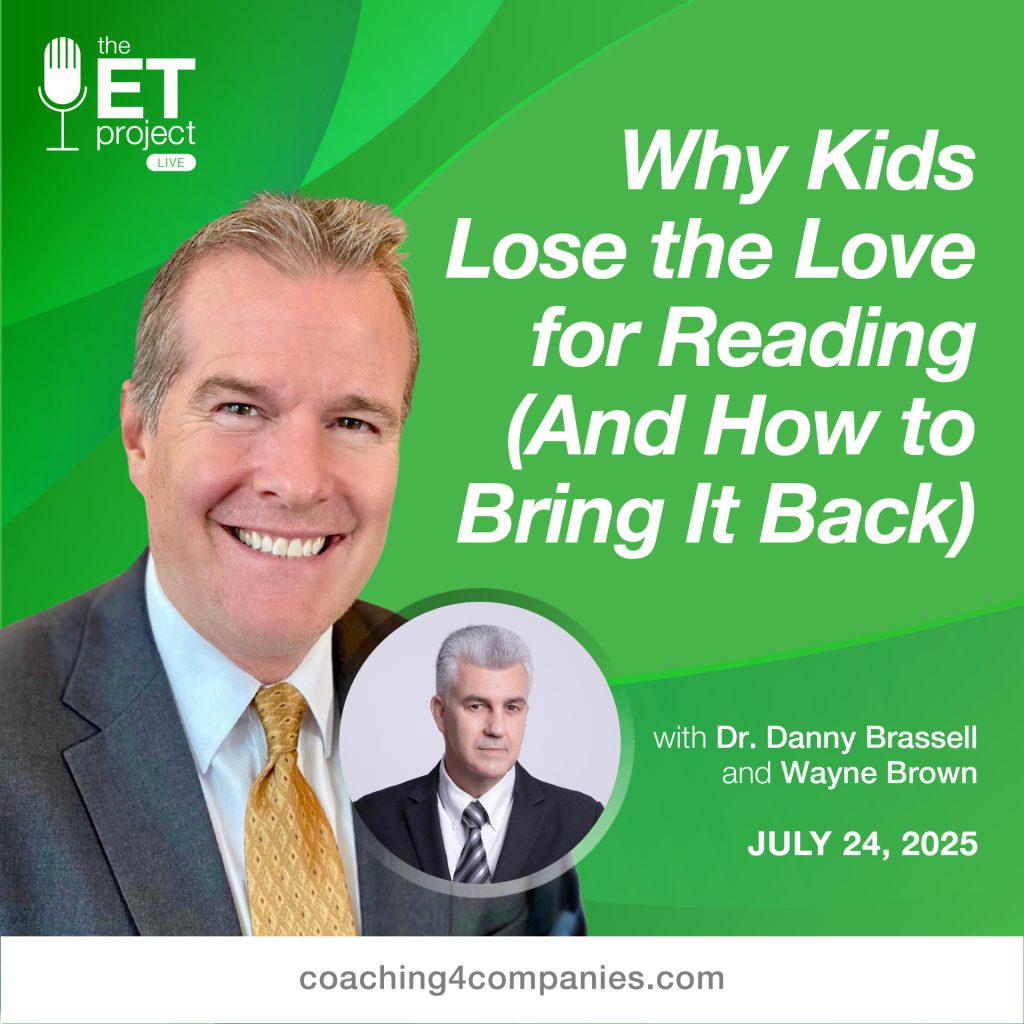
WAYNE BROWN: Hello, I’m your host Wayne Brown and welcome to the ET project. We’re delighted to be delivering this live episode for executive talent all over the world whom we’re affectionately referring to as ‘Team ET.’ Today, we’re heading once again to Denver, Colorado and connecting with an educator, speaker and author Dr. Danny Brassell. Danny has devoted his life to improving literacy aptitudes and attitudes of thousands. When Danny discovered that many of the reading teachers, the parents, community volunteers and other students that he trained found little time to read for their own personal enjoyment he began giving them recommendations of short literary works that anyone could read while waiting in a grocery line or sitting at a boring staff meeting. The son of a librarian and a reluctant reader most of his childhood Dr. Brassell became an avid reader when he finished his doctorate in education and discovered he could finally select books that he wanted to read. His goal is to stimulate people’s interest in reading so they make it a lifelong passion. In 2003 Danny founded The Lazy Readers’ Book Club, Google’s number one ranked site for cool short book recommendations boasting well over 10,000 subscribers. He has hosted his own radio program and appeared in various television and film projects and for five seasons he hosted the TV show, People Make a Difference, which could be viewed in over four million homes throughout Southern California. His 2012 TEDx talk, ‘The Reading Makeover’ has been singled out as one of the funniest and most inspirational educational speeches ever. A recognized authority on leadership development motivation and communication skills Danny has been honored consistently for his strategic intellect and practical solutions. Audiences rave about Danny’s ability to deliver meaningful and memorable messages that are applicable for individuals within all levels of organizations. A gregarious sought-after author speaker and business consultant Danny is characterized by friends, colleagues and clients as one of the most insightful powerful and compassionate individuals in business today. Thousands from small business owners to corporate executives have enjoyed his energetic interactive and informative presentations. Team, this is a conversation that delivers on the hype, so, get ready get comfortable and tuned in so you don’t miss a minute as I know you’re going to love it.
INTRO: Welcome to the ET project, a podcast for those executive talents determined to release their true potential and create an impact. Join our veteran coach and mentor, Wayne Brown, as we unpack an exciting future together.
WAYNE BROWN: Hello, team we’re blessed today to have Dr. Danny Brassell. Danny is a storytelling expert, a TEDx speaker as well as a literacy advocate and works with entrepreneurs to help them attract new clients through authentic stories but also to help kids discover the joy of reading. Welcome to the ET project Danny.
DANNY BRASSELL: Thanks so much for having me Wayne and more importantly thanks for spreading some joy in the world, we need a lot more of you, I appreciate you.
WAYNE BROWN: Why don’t we start and go back a little ways look at a bit of your back story without too much detail, but, what led you to start this journey?
DANNY BRASSELL: Oh, goodness, if I was going to write an autobiography, Wayne, it would probably be called ‘Pivots’ because I feel like I’ve already lived nine lives. 30 years ago, I was a journalist, I got to cover President Bush senior for the 1992 presidential election here in America. I loved my job; I got to meet every major editor of every major daily and one offered me the job as a CityBeat reporter for $16,500 a year. Meanwhile, a friend told me that they were hiring teachers in South Central Los Angeles in the inner city for $25,000 a year. So, I became a teacher for the noblest of reasons, Wayne, for the high pay, and I actually fell in love with teaching and I’ve taught all age levels from preschoolers all the way up to rocket scientists, I can make that claim because I used to teach English as a second language to engineering students at the University of Southern California. And in 2005 my wife and I attended a real estate seminar which turned out to be a scam and we lost everything and I could give you the whole story but I’m a positive person, I learned a lot from that experience. First of all, I learned that my wife is my soulmate, she stuck with me and she is just an incredible human being. Second of all, I learned money is not everything because you can lose money just like that. Third, I try not to judge other people because if I was somebody who saw what I did, I would have said, “well, you deserved that,” but now I realize if you don’t know everything about a person, you really don’t know anything about a person. Fourth, I became a Christian which I’m always embarrassed to confess but the more I read the Bible, I’m not the first screw-up to find Jesus.
[00:05:00]
DANNY BRASSELL: And then fifth, I didn’t want to file for bankruptcy and my accountant said, “well, you have to earn this much more money this year,” so, I started speaking on the side and I hit his number right on the number. Well, the next year, Wayne, he gave me a much higher number and I hit that number right on the number. So, in year three I thought, well, maybe I should set a higher number and basically during one of the worst economic downfalls of society I was able to build a highly lucrative speaking business which attracted the attention of some pretty famous people and companies who started asking me to coach them and I resisted, you need to know this about me, Wayne, one of the reasons I left teaching is I have a very high standard for my students, I will not let you fail, I will hold you accountable and be on your back until you succeed. Well, now that I work with entrepreneurs and executives and business owners, I find that they’re highly motivated, they do the work, it’s probably the most gratifying thing I’ve ever done, so, I absolutely love it. So, that’s a very long answer to your short question, but I’ve been all over the place.
WAYNE BROWN: You have so many great sights that I’ve been to in preparation for our conversation, you started as a reluctant reader, can you share a little bit about that and how that transitioned for you.
DANNY BRASSELL: Yeah, I mean, it’s ironic, I’m considered America’s leading reading ambassador because I grew up hating reading, my father was a librarian, I always hated the public library, it always smelt funny to me, the furniture was uncomfortable, there was always an elderly woman telling me to be quiet. There was always a freaky homeless guy that I thought he was a vampire, hanging out by the shelves; I always hated the library. And it wasn’t until I started teaching in the inner city where I saw a lot of my kids didn’t have a lot of the advantages I had growing up and I basically said, “shame on me,” I mean, I was blessed, Wayne. Both of my parents were in the home, we were poor but we always had food on the table and my parents always read to us kids and we had plenty of access to reading materials and so it really became a passion of mine. Especially, a lot of my kids never went anywhere and I said, “you don’t need to go anywhere to have a passport, your library card can show you the entire world.” I’ve always thought it’s funny that Jules Verne rode around the world in 80 days and he never once left France his entire life, I’m like, “oh, that’s a pretty cool story.” And now I’m passionate and I’ve got one of the top reading clubs online and I just like to work with people that say… you know people say, “I have no time to read,” I’m like, “who has time to read when you watch the game on TV, have a couple of beers, go out shopping,” I mean, life is all about priorities. And so, I find, Wayne, schools do an adequate job of teaching kids how to read but the question I always ask people is, what good is it teaching a kid how to read if they never want to read? I teach kids why to read because I’ve never had to tell a kid, “go turn on the TV,” I’ve never had to tell a kid, “go play a video game,” and I never want to tell a kid, “go read.” I want them to choose to do it because they love it and there are simple strategies I share with parents on how to get their kids to love reading.
WAYNE BROWN: I heard you talking, it may even have been the TED Talk you were talking about, illiterate versus alliterate, and I guess the not wanting to read is the alliterate side of things, right?
DANNY BRASSELL: Yeah. I mean, there’s a lot more illiteracy than… I mean, even the illiteracy thing I think is overblown, Wayne, I mean, I was working with a kid and he was a fourth grader and his teachers were like, “he won’t read,” I was with him for an hour, he must have sent 20 text messages, he emailed some friends, he was surfing the internet, he’s highly literate. You know, he’s not reading Jane Austen but he is reading and that’s the big thing. It’s not rocket science, find out what the kid is into, I mean, you were talking about your passion for rugby earlier, if you were one of my students, I’d say, “hey, here’s a book on rugby, check it out.” I mean, research is very clear on this, it doesn’t matter what you read, what matters is how much you read. It doesn’t matter if you’re reading James Joyce or James & The Giant Peach, people who read more, read better. When I was in high school I had a teacher who made us read ‘The Scarlet Letter’ by Nathaniel Hawthorne and no offense to people that love ‘The Scarlet Letter’ the book is basically about Hester Prynne commits adultery and so she’s forced to wear an A on her chest, and I raised my hand in class and I asked my teacher if I could wear a B on my chest because I was so bored reading that book. I just think back to that time, I’m like, if she was a better teacher, she would have said, “well, what do you want to read Danny?” and I would have said, you know, a football book or some kind of sports book, that’s what I like to read usually. Now, I read all kinds of biographies, but this is why you got to expose kids to this type… I mean, the way I got most of my kids excited about reading is I introduced them to poetry because poems aren’t very intimidating, they can be short.
[00:10:00]
DANNY BRASSELL: Even when I was a kindergarten teacher, on Thursdays I… no matter what grade I’ve ever taught, I mandate my kids have to memorize at least 20 poems and it’s a great way to differentiate instruction. So, on Thursdays, my kindergartners would become poets. So, I got Jose one of my non-readers, he’d say, “hi, I’m the sitter by Shel Silverstein, Mrs. McTwitter, the babysitter, I think she’s a little bit crazy, she thinks a babysitter is supposed to sit upon the baby,” and then I got Laura one of my top students and she’s like, “hi, I’m Mark Anthony from Julius Caesar by William Shakespeare, Friends, Romans, countrymen, lend me your ears; I come to bury Caesar, not to praise him. The evil that men do lives after them; The good is oft interred with their bones; So, let it be with Caesar. He was my friend loyal and just to me but Brutus is an honorable man.” A six-year-old girl memorized 50 lines from Julius Caesar, I got that idea from watching the movie ‘Kindergarten Cop’ with Arnold Schwarzenegger, in that movie he got the kids to memorize the Gettysburg Address, I’m like, “huh, I wonder if that’s possible.” I think we underestimate kids all the time if you get I’m interested in something, you know, this is why I love… everybody else is fearing AI right now, I’m like, ah, AI is just a game changer for kids. I see kids that you would never see wanting to do work and now they’re just sitting there playing around with AI seeing what they can get away with, which I think is clever, I think that’s… I mean, adults were like, “oh, they can’t get away with that,” I’m like, “well, we get away with it.” The kids are figuring out their little shortcuts. And I love AI because answers are no longer as important as questions and I’ve always taught this to kids, I’m like, “life is all about asking the right questions, never give up, it’s about figuring out what’s the best question.” That’s what AI is… I’m sorry, I’m going off on a rampage but I get excited because I just… I love figuring out what’s the right book for the right book and sometimes it’s not a book, sometimes it’s a magazine or a newspaper, whatever, what’s the right thing for each person to read.
WAYNE BROWN: Your approach I’m going to imagine works as well with neurodivergent students, learners, as well as… you know, more traditional, more normal learning styles, would that be the case?
DANNY BRASSELL: Yeah. Absolutely. I mean, we just have to expand the definition of reading, I’ve worked with kids on the spectrum that there’s no way you’re going to get them to read a novel but if you give them a technical journal on how to put together a computer they’ll sit there and analyze it for a hundred hours. I used to work with autistic kids, one of them was nonverbal and his parents were in tears one day because I didn’t show up to class and for the first time in his life he said a word, he said book. I mean, I guess we were getting through. It’s kind of like reading to… everybody has to also understand reading disabilities, every reading disability is curable and by far and away the most undiagnosed reading disability out there is dyslexia. I mean, I’ve seen statistics that can show up to 60% can be dyslexia, I mean, there’s a lot of people with dyslexia. And one of the strategies I share with parents is just… and I mean, and you’re in good company, George Washington was dyslexic, Tom Cruz is dyslexic, Sir Richard Branson is dyslexic, there’s a lot of people that are dyslexic. And dyslexics tend to process information better with their ears and now research shows us it’s just as powerful to be read aloud to as it is to read on your own. So, I always tell people that are dyslexic, I’m like, “we’ll start listening to audiobooks,” that’s a good…. Actually, I love listening to audiobooks, it’s a great way to spend time in the car. I had read the book ‘Greenlights’ by Matthew McConaughey but then I listened him narrate it, and it’s so much better when he narrates it. Actually, you’d like it because he talks about when he was an exchange student in Australia, it’s pretty funny. It’s great stuff, I listen to audiobooks all the time, so, that’s an easy strategy there to help.
WAYNE BROWN: I was going to ask that question, do you have a preference? Like, I know you talk a lot about curling up with a good book, is there any loss in the audio approach?
DANNY BRASSELL: Actually, one of my mentors… unfortunately he has passed away, his name was Jim Trelease, he wrote probably one of the most important books anybody can read called, ‘The read-aloud handbook’ where the first half of the book gives you all the research on why reading aloud is the single best way to improve a kid’s reading skills and then the second half of book goes grade level by grade level recommendations of some of the best books to read aloud to kids. Here in America, I’m one of these nerds, I actually read government reports on reading. So, I’ve read the reports from the last hundred years; ‘A Nation at Risk,’ ‘Why Johnny can’t Read,’ ‘Becoming a Nation of Readers,’ ‘The National Reading Panel.’
[00:15:00]
DANNY BRASSELL: And it’s interesting because these reports are always 2,000 pages long, Wayne. And it’s usually on page 100 where there’s a paragraph that says, “the research seems to suggest the single best way to improve reading is to be read aloud to,” and then it never mentions it again because that sounds way too easy. Jim used to say if reading-aloud cost $129, every parent in America would rush out and buy it and if we found out kids didn’t like it they would mandate it in the school system tomorrow, it’s so simple and yet it’s so powerful. I mean, when I was a middle school teacher, I was the only teacher in the school that none of my students were ever tardy to class and the reason is because I always read aloud to them, I’d read a lot of Paul Harvey stories. Paul Harvey when I was a kid growing up, he’d be on the radio every day at 12:15 and he’d say, “I’m Paul Harvey, with the rest of the story…” and for five minutes he’d tell you a story about a person or a company you’re trying to guess the whole time but the problem with Harvey is a lot of his story stories are about like Fred Astaire and Sears Roebuck. Well, kids today don’t know anything about that, and so, I wrote a book called, ‘Leadership Begins with Motivation,’ which was basically my homage to Paul Harvey and it has more contemporary stories of people like Jeff Bezos and Elon Musk, people like that. But after I wrote the book, Wayne, I read it and I’m like, “huh!” Completely unintentionally so many of my stories were of white male Americans and so the last book I wrote is called ‘Misfits and Crackpots’ and most of these stories are of women, minorities and international people and that’s how you get kids excited about reading, is getting them… you know, again I always find out what they’re passionate about. Really, it has always been easy for me to write books because I try and figure out what the kids are interested in and I’m like, “oh, if there’s nothing for you to read I better write that so you have something to read,” and that’s what I like, when it’s writing stories that inspire them.
WAYNE BROWN: You mentioned reading out loud now. You talk about you reading to somebody as reading out loud and or the individual reading out loud which is the difference or is there a difference?
DANNY BRASSELL: Yeah. So, the research shows kids they’re read aloud to, you don’t have to… I mean, I stuttered as a child, I hated popcorn reading, there was nothing that made me angrier and more scared in class than the teacher calling on me to read aloud in front of my classmates, it was very embarrassing and I honestly think it probably stinted my reading for years. So, no, just the teacher can read to the kids, the kids will sit there and… I mean, when I was a teacher we called it ‘Fluffy Fridays’ I’d have the kids, they’d bring pillows from their house and I just let them lay down and that was the reward for fulfilling all of our goals for the week, is they’d lie down and I would read to them and that’s another little simple little strategy I’m using there is you got to make reading the reward. I mean, Pizza Hut has the BOOK IT program which is wonderful but if I ever meet the CEO of Pizza Hut I’m going to make a suggestion, the way that program works right now is kids read books and they get rewarded with pizza. If I ran the program, it would be exactly the opposite, every time a kid came into my Pizza Hut and got some pizza I reward them with a book, you’re sending a very different message to the kid that reading is the reward, my kids when they get good grades the reward is we go to the bookstore and they get to buy a book, you’re sending a totally different message, oh, reading is fun, I’m not one of these people that gives the kids prizes for reading, I give them books. I mean, if I’m going to give them prizes, it’s going to be books or bookmarks or you know, things like that.
WAYNE BROWN: I was visualizing a stack of kids around a car, “oh, I’m not here a present, give me a book.”
DANNY BRASSELL: That’s right.
WAYNE BROWN: On the subject, you showed us a couple of books there, what’s the count now? How many books have you released?
DANNY BRASSELL: I’ve published 19 so far, but I’m in the process of finishing three because I’m a… I think you and your listeners can tell I have… I call it ADWT, I have attention deficit… what’s that? I have lots of different interests. So, yeah, right now I have three completely different books I’m writing that’ll be published here, hopefully pretty soon, I’ve been delayed a little bit on that.
WAYNE BROWN: And all about learning how to read or different topics?
DANNY BRASSELL: Not at all, I have one about… one is coming out, it is going to be about the process I take entrepreneurs through on how to create a well-crafted speech.
[00:20:00]
DANNY BRASSELL: One of them, you and I were talking off-air; I wrote a book for my wife about our trip around the world and she was not thrilled that I had made her a character in one of my books and so I have to rewrite the book under a pen name and change her name in it. And then the other one is a book, it’s for prisoners to show them hope in prison because I get a lot of letters from prisoners asking me for books, it’s actually one of the coolest things, it’s kind of funny that it takes incarceration to get a lot of people interested in in their education, I’m like, “wow, this is…” I mean, I guess, the funny line is, well, they’re a captive audience, obviously. But, yeah, it’s a book of hope for prisoners to show them that, you know what, don’t let the worst moment of your life define you, your story is still being written.
WAYNE BROWN: You’re also an avid reader, I read some crazy number, was it ten books a week? Ten books a day? What was it?
DANNY BRASSELL: Oh, yeah, well, I used to always tell this to my little ones, I’m like, you know, because one of my favorite historical figures is Theodore Roosevelt, actually I have a book right here, it’s a great book by Edmund Morris, it’s part of a trilogy called ‘The Rise of Theodore Roosevelt,’ it takes you to the moment he became president, the second book in the trilogy is called, ‘Theodore Rex’ which takes you through his presidency and then the last book is called ‘Colonel Roosevelt’ which shows you what he did after he was president. But by the time he was 30 years old, Theodore Roosevelt had read over 20,000 books and so my little ones will be like, “wow.” So, I tell the kids, “we got to read a lot of books,” and so I’m like, “I read ten books today.” You know, a lot of them are scratch on stiff and pop up but I do read ten books a day. Because of the… I have a book club called ‘The Lazy Readers Book Club’ at lazyreaders.com. So, those are all book recommendations of books under 250 pages and so I have probably about 5,000 books sent a year to me from authors all over the place and I like to profile first time authors and people that write positive things. Especially, for young adults it’s horrible when I walk through the bookstore and I go to the young adult teen section and the books are all about date rape, suicide, dystopian society, I’m like, no wonder teenagers are screwed up, they got nothing but negative stuff to read, I think they need more uplifting things, show them some positive examples.
WAYNE BROWN: So, you have Lazy Readers, there’s… I saw a number of programs that you offer as well to help all ages I guess right from very young through to adult readers.
DANNY BRASSELL: Yeah
WAYNE BROWN: What are the best sites that we can sort of publicize here that people can go to?
DANNY BRASSELL: Oh, you’re having me break my rule, because I always say, “you should only have one clear call to action,” but lazyreaders.com, that’s where if you subscribe, it’s a free subscription, once a month for the rest of your life I’ll give you ten book recommendations, three or four adult level, three or four young adult level and three or four children’s level books all under 250 pages so you have something you can read when you’re stuck in the doctor’s office or at a boring meeting. Again, I’m just trying to encourage people to read based on their interest. I point this out to parents, the little boy who only reads ‘Captain Underpants’ is going to become a better reader than the little boy who refuses to read anything, ‘Captain Underpants’ is the gateway drug to Shakespeare but you got to get the kid hooked first and so once… human beings we only do things we’re comfortable at and the psychology is fairly interesting on that, if you don’t trust me, drive a different way home tonight, it’ll drive you crazy, we’re creatures of habit and routine and so it’s really important to establish those basic routine. I mean, one of the first strategies I share with parents is turn on the closed captioning on the television set and people say, “well, what if the shows in English and the subtitles are in English, what good does that do?” I’m like, “well, that’s a fair point, but let me make a point, have you ever watched a show with captioning and not looked at the subtitles?” It’s actually very difficult to do, your brain is drawn towards the text and there’s actual research that supports what I’m saying, if you look at reading scores around the world, the more kids watch TV, the lower their reading scores are in every single country on the planet except for one, the country where kids watch the most TV also has the highest reading scores in the world, it’s Finland. And people are always, “how can that be?” I’m like, “well, because Finland makes really bad TV shows.”
[00:25:00]
DANNY BRASSELL: And so, what they have to do is they have to import all these old American sitcoms like ‘Happy Days’ and ‘Welcome Back, Kotter,’ and they translate them into Finnish and the kids are reading all the time, it’s an easy strategy. I mean, for me I have three kids, they’re older now, but ever since they were little, I established the habit, because I think television is here to stay and so I always let the kids watch TV but the price of admission was before they could turn on the TV, they had to bring me something to read. So, when they were little, they’d bring me picture books we’d read the picture book together then they could go watch TV, now they’re older so they usually bring me their iPads and we’ll read some news article or something that they find interesting. But, I mean, this is 20 years, I mean, my oldest is 21 and she still just has the habit of, she knows that before she can turn on the TV, she has to bring me something to read, so, we do that. And then just another one easy strategy for parents is I have book dates with my kids and my wife. So, my oldest daughter she’s into Game of Thrones and so we’re reading the George R.R. Martin ‘Fire and Ice’ book and there’s language and situations I’m not thrilled about but she’s into it, so, I’m like, “ugh, I can’t break my rule, I got to do that.” My son for some reason loves war books and things like that, so, we had seen the movie ‘Master and Commander’ which is an awesome movie and so, we’re reading the book version and I never knew how stupid I was, Wayne, until I started reading that book, because I have to get out a dictionary about four times a page, it’s written in like Middle English. And then, for some reason my youngest daughter likes literature and we’re reading, ‘The Great Gatsby’ which I hate that book, I hate it. I absolutely… and it’s, you know, I guess reading it aloud to her… I guess, the good thing is I now understand, oh, F. Scott Fitzgerald, he’s a really good writer, I just hate the story, I hate the story, I hate the characters, but I can’t show that to her because she likes it and then my wife she likes… we’re reading this really neat little series of books called the ‘Unselected Journals of Emma M. Lion’ by Beth Brower and I can’t believe that Reese Witherspoon hasn’t bought the movie rights, it’s such a nice series, it’s about a young woman in Elizabethan England and her three best friends are like an American photographer, a British Duke, and a minister and it’s funny and it’s nice and there’s no f-bombs and nobody is getting raped, I’m like, wow, I haven’t read a book like this in a long time, it’s nice. So, those are just three real quick strategies that any parent can use to really encourage their kids to read at home
WAYNE BROWN: Lazyreaders.com, I subscribed two days ago I think it was.
DANNY BRASSELL: Great.
WAYNE BROWN: My daughter and I and looked through your July list and we’ve already picked one of one of the books, I’m trying to remember what it was about but there’s a children’s book on there. So, we’ve already got that one earmarked from Amazon and we’ll…
DANNY BRASSELL: Awesome. Adults should know that the best books are usually the… I mean, I wrote a book called… well, here, I’ll give you one more website for your… I’m already breaking the rule; I’m supposed to only give one clear call to action but another, a free website everybody can go to is freegiftfromdanny.com. So, when you go to freegiftfromdanny.com I’m going to send you a free copy of my book, ‘Read, Lead & Succeed’ which is a book I wrote for an elementary school principal who was trying to keep his faculty and staff positively engaged so I said, “okay, I’ll write you a book.” So, every week I give you a concept, an inspirational quote, an inspirational story, a book recommendation on a book you should read but you’re probably too lazy because you’re an adult, so, I also give you a children’s picture book recommendation, it demonstrates the same concept nothing pleases me more than watching CEOs start meetings with Dr. Seuss books, that’s because of some of the best lessons are in the kids’ books. And then I also give you a free five-day training on how to get your kids pumped up about reading. I’m totally breaking my rule on one clear call to action but that’s at freegiftfromdanny.com. I guess, the teaching point for your audience Wayne is you have entrepreneurs listening in and I think you’ve seen in my background I’ve got lots of different pots on the stove. So, I have my reading businesses there, I have my speaking businesses, I mean, you know, basically on the four aspects of communication speaking, listening, reading and writing. I have different arms of my companies working for those different things.
[00:30:00]
WAYNE BROWN: For sure, we’ll make a list of all of those. It’s a nice segue though. So, let’s now transition a little bit into business and communication through the storyline and I know you talk a lot about storytelling, why is it that storytelling is such a critical element for anyone that’s in a leadership role, but throughout our life, why do we need to learn to story-tell?
DANNY BRASSELL: Yeah, so, of all people is Joseph Stalin who said, “a million people dead, is a statistic. One person dead is a tragedy,” translation, facts tell but stories sell, facts inform stories can transform. I was sharing with you earlier, one of my clients just did a TEDx talk and she wanted me to analyze it, so, I analyzed it right before I came on your podcast and I mean, I’m like, “can you go ten seconds without giving me a number?” I mean, I was doing more math than I have ever had to, it was crazy, like give me stories. I was on a Christian podcast the other day and I pointed this out is when I read the Bible I always laugh because Jesus is just frustrated all the time with his disciples, he’s like, “all right dense people, let me tell you a story, okay, so, there’s this prodigal son… oh, you still don’t get? Okay. Let me tell you a story about the Good Samaritan.” And he’s all… I don’t think you have to be Christian, I bet you most people on the planet are familiar with the prodigal son story or the Good Samaritan, any of these Bible stories but I’ll also make this claim, I bet you nine out of ten Christians cannot tell you the Ten Commandments and the reason is because it’s presented as a list, it’s not presented as a story. I mean, I never had a person tell me, Wayne, six months after a presentation, “oh, Danny you know what I loved the most about your talk was that one PowerPoint slide with the 18 bullet points that I couldn’t read because the font was so small,” I’ve never had anybody say that but people remember stories and that’s why use stories is… and you look at the most powerful… Steve Jobs used to say that, he said, “the most powerful person in the world is the storyteller,” whoever tells… I mean, politicians, it’s always the person that has a better story wins the… what’s the story that they’re going tell. You watch the best comedians, they are great storytellers. But really, especially with entrepreneurs it’s your business. I think, speaking is the fastest way to grow your business and it’s all about the story that you choose to tell.
WAYNE BROWN: Yeah. What always amuses me is I’ve never met anyone who challenged what you just said, I think we all understand that, what I struggle with is why therefore are we so bad in many cases at telling stories? Why can’t everyone grasp this concept?
DANNY BRASSELL: I don’t know if everybody is bad at it, Wayne. I was just in Ireland and I’m like, “oh, these are my people, man.” I had to add an extra half hour to every interaction because I knew they were going to talk to me and I was like, wow, this is the kind of… when I was growing up, this was my dinner table, was everybody swapping their different stories. And that’s an interesting point because there’s actually research that shows that the more talking taking place in homes, the better you are in school usually and it doesn’t actually matter what language, it’s just that the kids are hearing lots of it. And so, there’s a lot of practice involved. And that’s what I tell my clients, most of my clients I’ve worked with. So, I have a company called ‘The Well-Crafted Story Workshop’ with my partners coach Jimmy Hays Nelson and Dave Ward; I call us the professor, the performer and the producer because my background is academia, coach Jimmy was an actor on Broadway and Dave was a lawyer and an AI expert from Silicon Valley and I just always loved the way we’re analyzing people’s stories and listening to what can we do better for people. We work with so many technical people that… you know, Jimmy loves to name-drop all the famous people we’ve talked to and I believe in discretion, I don’t talk about any of the companies I work with by their real names or the people. But most of the people we work with are absolutely terrified of speaking, where they have no interest in speaking and that’s why they don’t know how to tell stories but this is a skill, Wayne, it can be taught. I guarantee you the first time you did your podcast you sucked and the second time you sucked, but you didn’t suck as bad as the first time and now it’s a fine oiled machine, you got your process no problem because you got in the reps, my youngest daughter right now is learning how to drive and I just love watching her because when she gets in the car she’s adjusting mirrors and she puts her hands at the ten o’clock on the two o’clock position, I guarantee you in a year she’ll be driving with one hand putting on lipstick eating a Big Mac listening to the stereo because it’ll be automatic.
WAYNE BROWN: Yeah.
[00:35:00]
DANNY BRASSELL: It’s the same thing with storytelling, is we just need practice, and this is why I always tell people, I mean, there’s really only two ways to get better at speaking, first of all, you got to watch lots of speakers. I mean, I watch ten speakers a day, I watch politicians, I watch comedians, I watch televangelists, I watch them in front of big groups, in front of small groups, in front of men, in front of women. I’ll give your audience a ninja strategy, I watch a lot of televised award shows because when the person wins the Academy Award, they only have 45 seconds to connect with their audience, I want to see how they use their time. Now, most people waste their time, they get out there, like, “I want to thank God, I want to thank the Academy…” stupid, nobody is paying attention. But every now and then, a person does an incredible job. So, a few years ago, there was a guy by the name of Joe Walker who won the Academy Award for best film editing, now, Wayne, this is Hollywood, the important people are in the front of the room, the actors and you can tell none of them are paying… this is film editing, they’re not even paying attention, and Joe Walker stands up there, he’s British, he speaks very slowly and deliberately, he says, “a lot of people don’t know this, but when phrased properly, the term Academy Award nominee can be used as an insult,” well, now the camera scans the crowd, you see people kind of leaning in like, “what’s he talking about?” he says, “for example, yesterday I got in an argument with my 17 year old daughter and she said, well Academy Award nominee Joe Walker,” all of a sudden, you see everybody laughing hysterically. He gets off stage, Denzel Washington wants to meet him, Sandra Bullock wants to meet him, Brad Pitt wants to meet him, Time magazine said it was one of the highlights of the Academy Awards. Well done Joe Walker, 45 seconds, he did it, he connected. So, the first way you get better at speaking is watching lots of great speakers, the second way, you get better at speaking… I’ve had lots of great coaches and mentors in my life, one of my coaches was a guy by the name of Jim Rohn and Jim used to say, “you can’t pay other people to do your push-ups,” translation, you got to do the work. I mean, I express this to my clients all the time, we got to get you speaking, it goes to point, Wayne, when you say a lot of people are bad storytellers it’s because they’re not practicing telling stories, you need to really… it’s fascinating to me, I think everybody would benefit from an improvisation class in school, something where they just have to make up story. I did a tour once of the Mark Twain’s home in Hartford Connecticut and my favorite part of the tour was the docent, our tour guide, he showed us the fireplace and there was ten objects on top of the fireplace and he shared with us that every night Mark Twain’s daughters would put the objects in a different order and they’d sit by the fireplace while their father told them a story with the objects in that order, I don’t know, that’s why Mark Twain is America’s greatest storyteller, he told stories every day. So, it’s just like anything else; it’s practice, you need the reps.
WAYNE BROWN: What’s a myth that comes to mind about public speaking? Any myths to dispel?
DANNY BRASSELL: Yeah, I’ll tell you, the biggest mistake I see most people make is most people brag during their presentations and I’m a big fan of Brene Brown, she’s a wonderful speaker, she talks about vulnerability and that’s what I insist to people, is stop sharing your successes, start sharing your failures because not everybody in your audience has succeeded but they’ve all failed, and the more you share your own failures, the more your audience is going to see themselves in you and that’s the whole purpose. You have to understand your purpose of a presentation is to connect with your audience. I mean, I work with clients, a lot of them will brag to me, “hey, I got a standing ovation,” like, that’s great or they’ll say, “oh, people think I’m a great speaker,” I’m like, “that’s great.” The only way I measure your effectiveness is how many people in your audience decide to take the next step with you. I mean, now, that can be an unpaid next step, like subscribe to my podcast or book a free phone call or it can be a paid offer like buy my product or invest in my coaching. But I’m looking at presentations that don’t just move hearts, we also want to move the needle, we need to make you effective. And so, that’s what coach Jimmy and I are always looking at in your presentation, is okay, we need to switch this and put this here, we’ll have more effectiveness. I mean, and that’s why I think entrepreneurs need to learn how to communicate better, you look at a guy… I always point to Steve Jobs because I think his commencement speech at Stanford is one of the most incredible presentations I’ve seen in my lifetime. Also, when he introduced the iPhone the way he set up that speech is so well done. There’s nothing that gets me more excited than watching people that give an effective presentation and everybody has that ability and I’ve seen it.
[00:40:00]
DANNY BRASSELL: Even the TEDx talk I just watched this woman deliver I can hardly wait to help her with her next TEDx talk because it won’t be anything like the one I just saw, I’m like, no, no, no, no, you just gave so many numbers, you can connect with stories, stop speeding through it, the stories and the description really… you know, it’s horrible, Wayne, as I grow older it turns out all of my idols are scumbags, but when I was a kid I idolized Bill Cosby, just the funniest comedian ever and that guy could tell a story for 90 minutes about nothing and you’re hanging on every word because he takes his time, he describes what he sees, what he smells, what he tastes, just an incredible storyteller and I watch people all the time… I mean, I was working with a client the other day and one of the speeches I was showing her was from a bridesmaids’ wedding toast and she’s like, “how did you find this?” I’m like, “oh, you have no idea, I watch everything.” I mean, people think that a presentation is just in front of a large group of people. I’m like, oh, no, no, no. I watch board presentations, I watch people that are pitching their ideas to get funding for… you know, I was just working with a firm in Silicon Valley and watching their pitches and like, okay, you know, Shark Tank, Shark Tank is all around the world, watching people, what is it that captivates people to want to invest in your idea? Those are good things to watch. Again, I can’t over-emphasize this, you should watch people… another thing, a myth, when you’re… I’m going long on your question, so another myth, this is why I watch comedians, one of my favorite things that comedians do is they take their perceived weakness and they turn it into their strength. So, Kevin Hart is just a short black guy. So, what does he do? He tells lots of jokes about being a short black guy. Jim Gaffigan is a big fat white guy. So, what does he do? He tells lots of jokes about being a big fat white guy. I’m like, “wow, that’s really smart.” You know, take what if I had…. in our last presidential election, I do help politicians, I did not help either president Biden or President Trump but if I was advising President Biden, I would have said make fun about your age, “I can’t remember anything,” because if he makes fun of his age, it’s no longer an issue because he’s making fun of it. President Trump, make fun of your humility, “nobody is more humble than me.” You know, if you make fun of it, now, it becomes something that everybody enjoys about you, which is a very different strategy that… so, I always like watching comedians because they’re best at doing that.
WAYNE BROWN: The public speaking gives you the visibility, the credibility, but what do you do with that when you step off the stage? How do you turn that into result?
DANNY BRASSELL: Yeah, so, the presentation that I help people and Jimmy and I help people, we call it a well-crafted story, politicians will call it a stump speech, superhero movies they call it an origin story, you can call it peanut butter and jelly, it doesn’t matter what you call it. But this is a talk that you’re going to deliver again and again to introduce yourself to new audiences and we want to make sure it’s flexible enough that you can deliver it as a 45-minute keynote or as a 30-second elevator pitch. But it’s the same reason I do podcasts, it actually kind of drives Jimmy crazy that I do so many podcasts. And I say podcasts are a win, win, win, win, win, I love podcasts because I get to practice. I mean, you’re asking me questions today that people haven’t asked me before, I’m like, “oh, now I know how to answer this question,” or “oh, maybe I could have done a better job on that question.” And then secondly, you never know who is listening. He gets annoyed, he’s like, “you’re going on a podcast, they only have one subscriber,” I’m like, “yeah, but if the subscriber is Oprah Winfrey, that’s a pretty good subscriber.” You never know who is… I’m completely serious about that, when I first started speaking, Wayne, I had two speaking bureaus that were paying me $700 a day. Meanwhile, my public library they asked me if I would do a free talk at the library. Like, we’ll have 500 people, I’m like, “okay, I’ll do that.” Four people showed up; two of them were my real friends, the other two was a Hispanic couple that didn’t speak a word of English and so I believe in giving a hundred and ten percent so I translated as much into Spanish as I could, we all had a fun time. A week later, it turns out the Hispanic woman was taking English classes at the adult literacy center, she recommended me to give a 45-minute talk for $4,000 which was six times my daily fee at the time, I realized, whoa, you have no idea. To get back to your question about how do you adopt this, I mean, I use it with my own kids, I use the strategies, the structure with my… I mean, there’s things that Jimmy and I are teaching people about pacing your audience.
[00:45:00]
DANNY BRASSELL: One of the techniques is called ‘Picture a Day’ where you get the kids thinking of it, I do this with my own kid, picture a day when your room is cleaner than every other room in the house, picture a day when mom and I are saying to you, “ah, we’re so proud to have a child like you,” picture a day when your parents are never on your back, that day is just a clean bedroom away. But I’m practicing, I practice on my own kids all the time, but there’s little strategies there, one of the things, a former teacher so all of my processes either rhyme or they are alliterative. So, Jimmy and I we teach people what we call ‘The Five C’s Process’ so before you put together your speech, first of all, you need clarity and then once we put together your speech you need to be able to connect with your audience, teach meaningful content that serves them, have one clear call to action and finally have an emotional close that gets people rushing to want to continue to work with you. And a woman I was working with a couple of weeks ago, she’s a nutritionist and so her whole presentation is she had digestive issues and so she teaches people with digestive issues how to live a healthier lifestyle in 90 days and she didn’t know how to close her presentation and so one of the techniques Jimmy and I teach is to have a different story that has nothing to do with anything you’ve taught but is a metaphor for what you want the audience to do. So, I asked her, “what do you want the audience to do?” and she said, “well, I want them to understand that they can’t do this on their own.” I said, “oh, you need to hire an expert story.” and she’s like, “what is that?” I’m like, “okay, I’ll give a demonstration.” So, this is how I would end a presentation, I’ll leave you with this; many years ago, my wife and I had theater tickets, we were dressed to the nines set to go and as we were driving to the theater we got a flat tire, my wife said, “well, I’ll call the tow truck company, AAA.” I said, “you don’t have to call them, I’m a man, I can fix a flat tire.” So, I opened up the trunk and I got out the spare tire and then I got the pumper thing and I got the big jack thing to take out the nuts on the tire, 27 minutes later I have grease all over me, I have not fixed the flat tire, my wife is shaking her head, like, I could have done so much better than this guy. Well, unbeknownst to me she had called the towing company when I had started, this tow truck shows up and this 17-year-old punk kid hops out and he fixes my flat tire in three minutes flat. I think there’s times in life when all of us think we can do it ourselves but if you want to save time, you want to save money and you want to save a whole lot of headache and embarrassment you hire an expert. And so, what I’ve shown her is here’s a story that has nothing to do with nutrition but what it’s telling the audience is it’s alluding… I mean, mine is pretty smart, it’s sophisticated, oh, I could do it but if I want to avoid all these other problems, I should probably hire her. And so, that’s the that’s the impact of storytelling and again, I go biblical, I mean, that’s what Jesus whenever he was trying to make a point he would tell a story. Because he’s like, “hey, dense people, you don’t understand it, otherwise, so, here’s a story.” And I’m like, there’s a… it’s fantastic… and that’s why I think people are silly to overlook children’s stories, you have no idea those little children’s stories you heard as a child how much they stick to you, Hansel and Gretel, don’t talk to strangers. I mean, I’m thinking about all of the little nursery rhymes and things that I learned, I’m like, “wow, it’s kind of fascinating, there’s a lot of wisdom in those things.”
WAYNE BROWN: One last piece of advice for people who are terrified about public speaking, any sort of immediate tips they can put into practice?
DANNY BRASSELL: Yeah, so as a specific strategy, first of all, you’re in good company. I mean, Barbra Streisand vomits before she ever goes on stage, Bill Russell, the famous basketball player used to vomit before every game, president Reagan vomited before every speech he ever gave. So, you’re in good company, a lot of people they get nervous or fearful. A couple of things that I usually stress with people is look for the one person in your audience that’s smiling and just focus on that person. Really though the best way to get over your stage-fright is with practice, it’s kind of like when I was in college I hadn’t really studied for my final exam and as I walked in the classroom I told the professor, I’m like, “I hope I do well,” and he looked at me, he shook his head, he’s like, “the time to make the bet is before the wheel starts to spin, Danny.” He’s right, I would have felt a lot more confident had I studied for it, it’s the same thing with speaking. But again, it is a skill, I’ve worked with some people with severe stage-fright who had no willingness to go on stage and they’re… I’m not going to say that they love going on stages but they’re much more comfortable going on stages now and they understand the effectiveness of it as a client acquisition tool.
[00:50:00]
DANNY BRASSELL: And that’s what we’re trying to do, it is how to grow your business. I mean, and… you know, it was either William Shakespeare or Keanu Reeves who once said, “all the world is a stage,” and this podcast is a stage, talking on the phone with your grandma is a stage. I mean, you alluded to it earlier, Wayne, a lot of people stink at storytelling because they’re not practicing, you got to practice telling stories. And you’re also right, it’s something that people don’t debate because it’s in our DNA, even the cavemen were wriggling each other at the fire, the people that died were the people that didn’t listen to the storytelling about, oh, when IGU was telling me the story about why you shouldn’t go to the poisonous bush and eat the purple berries, if you didn’t listen to that story, you’re in bad shape, that’s the importance of storytelling.
WAYNE BROWN: Where can people connect with you? What’s the best place?
DANNY BRASSELL: Well, again, I’ve already given you a whole bunch of websites, I’ll give you one more as a thank you to you Wayne and your audience for having to listen to me; if you go to freestoryguide.com, guide like a tour guide, freestoryguide.com, I’ll give everybody their own well-crafted story blueprint, what this is is the actual process that coach Jimmy and I take our clients through on how to create your well-crafted story, what this does for you is it takes the guesswork out of, where do I put this and why do I put this here? And what this means for you is the peace of mind that I have a client-acquisition tool that I can repeat again and again by drawing new audiences to my business. So, you can get that at freestoryguide.com.
WAYNE BROWN: Danny, thank you so much for being on the ET project, it has really been a delight.
DANNY BRASSELL: Absolutely
OUTRO: Thank you for joining us on the ET project, a show for executive talent development, until next time, check out our site for free videos, eBooks, webinars, and blogs at ‘coaching4companies.com.’
[END OF TRANSCRIPT]