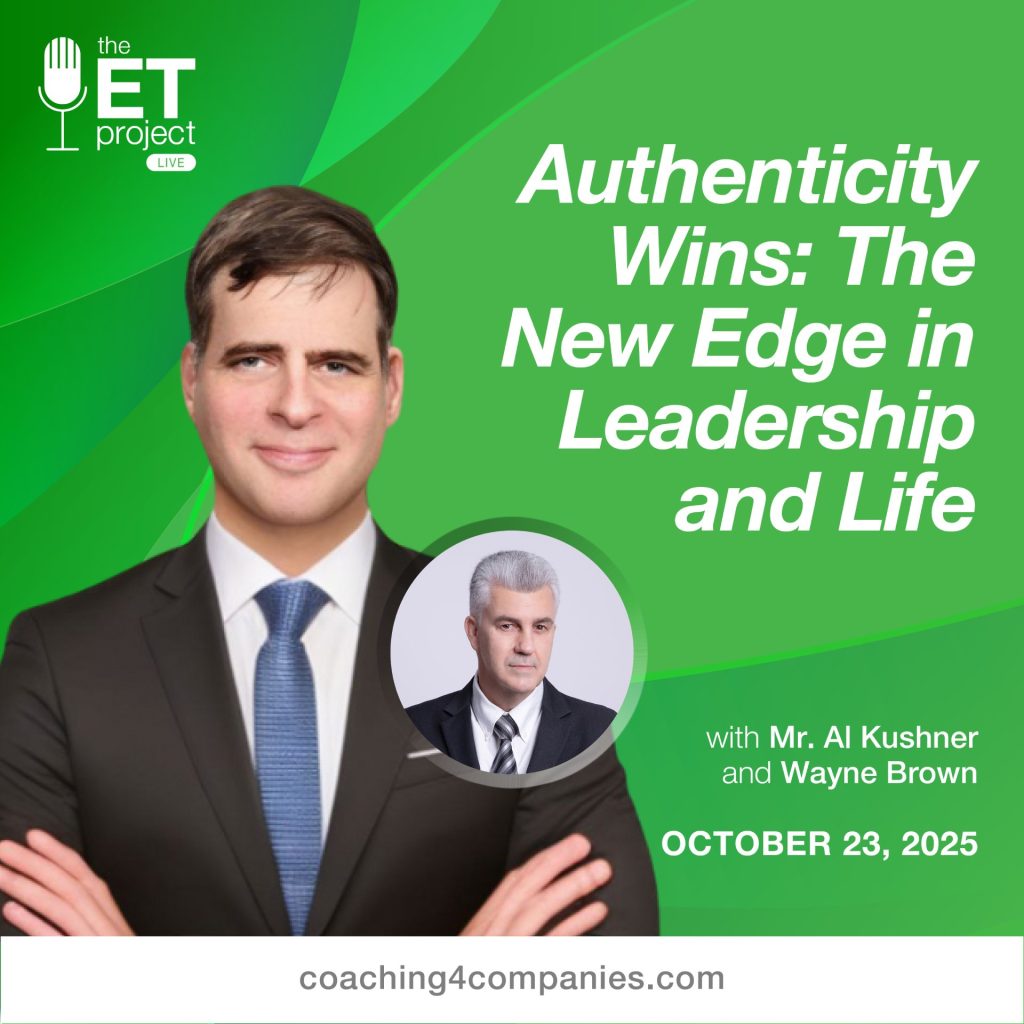
WAYNE BROWN: Hello, I’m your host Wayne Brown and welcome to the ET Project. We’re delighted to be delivering this live episode for executive talent all over the world whom we are affectionately referring to as ‘Team ET,’ and today we’re in Florida conversing with Al Kushner, a recognized thought leader, award-winning author and a true innovator in the realm of AI-driven personal branding. Al is best known for his book, ‘The A.I. LinkedIn Advantage,’ which has quickly become a go-to resource for professionals looking to navigate the complexities of today’s digital-first environment. Al empowers entrepreneurs, executives and changemakers to craft compelling personal brands, forge authentic connections and achieve remarkable career transformations. What sets Al apart is his unique ability to distil complex AI and LinkedIn strategies into clear, actionable steps. His training and workshops have proved indispensable for countless individuals and organizations. Al’s approach is rooted in the belief that AI isn’t just a futuristic concept, it’s a tool that can be used today to enhance your LinkedIn presence and amplify your impact. He emphasizes that the importance of understanding the fundamentals of AI and how strategically to apply them to your LinkedIn activities. He focuses on simplification, offering practical solutions that anyone can implement regardless of their technical expertise. Al’s insights have helped start-up founders triple their LinkedIn following and attract significant investor interest within months. He has also helped other clients secure multiple keynote speaking opportunities, effectively doubling their visibility and influence. This real-world impact showcases Al’s exceptional ability to turn theoretical knowledge into tangible results. In essence, Al Kushner is a catalyst for professional growth in the digital age. His expertise lies in equipping individuals with the tools that they need to stand out, grow faster and lead with confidence. And team, as you will hear in this conversation, Al shares plenty of practical tips and even offers tools that can take you far beyond our conversation today. This discussion, therefore, is a must-listen for every digital-age leader.
INTRO: Welcome to the ET project, a podcast for those executive talents determined to release their true potential and create an impact. Join our veteran coach and mentor, Wayne Brown, as we unpack an exciting future together.
WAYNE BROWN: Hello team, welcome to this October 2025 episode of the ET project Live. As leaders, I’m guessing most of us know, LinkedIn matters. But let’s be honest, for many, we’re probably barely scratching the surface when it comes to leveraging its capability. Perhaps we post occasionally, I know I tend to scroll mindlessly at times and then wonder why nothing is changing. However, some professionals are quietly building their influence, they’re landing opportunities and expanding their networks in ways that, well, that feel almost unfair. What if the difference isn’t just the hustle though, but a smarter way of using the tools already built into the system and at our fingertips? And that’s exactly what our guest has cracked. Al Kushner isn’t just talking about AI, he’s showing leaders how to use strategically the tool to help them stand out, to connect with impact and grow their influence without burning out. As the author of ‘The A.I. LinkedIn Advantage,’ he’s helping executives, founders and rising stars like many of you turn LinkedIn into a real engine of opportunity. So, with that, Al, welcome to the show. I know I’m looking forward to this conversation for a number of personal reasons. So, let’s get into it, shall we?
AL KUSHNER: Absolutely. Thank you, Wayne.
WAYNE BROWN: You help professionals. I read somewhere you’ve helped some triple their LinkedIn following, you help them secure business leads and job opportunities, speaking roles even, when you start working with your clients, is there a mindset shift? Is there one thing in the form of a mindset shift that happens that makes the biggest difference?
[00:05:00]
AL KUSHNER: Well, I think that most people, Wayne, they are shocked by the results that I get for them, they still can’t imagine how amazing the results are because the fact is that they’ve been trying every which way that they can to try to connect with people, do outreach, and they realize the simplest things is all about optimizing their profile. And once I did that, they were really impressed by how many people were willing to connect with them as a result of, you know, a simple action; simple for me, that is, but.
WAYNE BROWN: So, the profile is truly that important?
AL KUSHNER: Yeah, it makes a difference. If your profile is not optimized, you will find that people will simply ignore you or won’t even consider you, connecting, because it is about privilege to connect with someone.
WAYNE BROWN: And of course you talk about that element in your book. So, let’s jump into the book. I mean, it’s about an AI LinkedIn revolution, if you like, for leaders and if they’re just starting, what does that actually mean? Like an AI revolution? How do you put that?
AL KUSHNER: Well, the fact is, is that AI is a tool that will help you to optimize your profile and it’ll help create content for you or at least give you ideas for content and could help you become noticed on the platform where before you would be ignored. So why not take advantage of a tool that can help you elevate your presence?
WAYNE BROWN: And I’m guessing therefore that AI is part of the method or the tool that you use on that profile improvement.
AL KUSHNER: Yeah, it certainly is because it’ll help you look for keywords, it’ll help you with your summary page, create more robust information. And I would say overall, it’s going to make a difference in terms of you being considered as a thought leader, if you do it the right way.
WAYNE BROWN: Right. The profile actually builds as part of your personal brand, I guess. And AI as a tool helps you create that brand or make it more consistent or credible, what’s the link with the personal brand?
AL KUSHNER: I would say, it would optimize, for example, your headline, looking for words, because LinkedIn is also a search engine too, so people seem to forget that. And a lot of people who are looking for people, maybe experts in their field, they will search on LinkedIn by certain keywords and that’s exactly what will come up. In addition, you can use information like creating content and articles that will really resonate with your target audience, for example, newsletters are great to have, and I send out at least five newsletters a week to different targets that subscribe to it. I have scripts that I create with AI to help ideas for videos, you know, which is really what’s taking off on LinkedIn, getting more eyeballs on their, videos is what the algorithm loves, so people need to know that this is definitely a way to get more noticed by using that particular modality.
WAYNE BROWN: So, you mentioned a few words there that for some of us older generation of leaders, it sounds more like a tech tool. Like you need to be somewhat of a tech expert. You talked about keywords and algorithms and using some of the tools, do you need to be a tech expert in this case?
AL KUSHNER: No, I mean, it’s always good to get information and there are a lot of ways to do that, whether it’s through books, like I write, there are podcasts you can listen to, it’s really not a big learning curve, it’s just a matter of seeing the value behind it, and if you could see the value of using it, and if you never used, let’s say, I don’t know, ChatGPT, which I think so many have used at least once, that’s just the starting-point, the tip of the iceberg, a lot of AI technology tools that are available that could help you enhance your content that you’re creating on the platform or ideas that you never would think about in using, it’s just an incredible tool that a lot of people don’t really take advantage of because maybe they’re afraid or don’t understand, but start little by little, that’s what I did, yeah.
WAYNE BROWN: And you mentioned content and different topics. So, how can AI help leaders identify the most impactful content topics so that they’re not just posting but they’re actually starting to create influence?
AL KUSHNER: Well, a lot of times when I use LinkedIn and I would follow an influencer and usually I’ll get notified as soon as they release a post and I’ll reply back to that influencer as soon as the post is there and that influencer could have hundreds, if not thousands of followers.
[00:10:00]
AL KUSHNER: And I respond back in a way that, not like, “Hey, thanks for sharing,” but a little bit more intuitive by using AI to get the information of that particular post and do it in a way that I can reply in a favorable light and maybe even ask a question or two at the end. And that usually once I post on there gets a lot of results and eyeballs. And all of a sudden, I’m getting the influencer’s influence as a result, because people are checking out my profile because I responded in a way that actually enhanced that influencer’s post. And a lot of times the influencer will reply back to me by answering the question that I asked, just think about it, before I wasn’t noticed, now, I’m getting noticed by a major influencer, think about the reach you get using AI technology.
WAYNE BROWN: I’ve had some experience with that, so I do understand the power that that brings. You also mentioned that LinkedIn rewards eyeballs or people reading the post. How can AI help leaders stay active and visible without becoming, I don’t know, for me, sometimes it feels like a full-time job. So how can we avoid that trap and use AI to help us?
AL KUSHNER: Well, use it to create content for your newsletter. I mean, a newsletter is a great starting-point and you can do it once a week, which is fine, and have people who will follow you, subscribe to your newsletter. And what’s unique about the newsletter is that once you post it, they’ll get notified, not only on just LinkedIn, but also in your InMail box. And all of a sudden, it’s bypassing spam filters because LinkedIn has such a high authority that spam filters just let you go right in, which is great, and you can’t get that reach from a company newsletter, I could tell you that right off the bat. So, as long as you’re providing value to people and people are subscribing to it, you’ll be able to be top of mind when they think of you for your particular service.
WAYNE BROWN: Right. And I guess we should step back here a little bit. I made a bold statement in the beginning saying most of us understand the power of LinkedIn, what is the reach of LinkedIn? Why would a leader want to be on LinkedIn in the first place?
AL KUSHNER: The fact is, is that if they’re not doing it, their competition is, so that’s the fact. And you don’t want to get left behind.
WAYNE BROWN: Right. Are there a list of common mistakes that you see when you’re working with people, particularly with the AI side, when they’re creating their content? Is there a set of traps we should try and avoid?
AL KUSHNER: Yeah, I mean, a lot of times people are just taking the AI, what’s generated word for word and doesn’t sound authentic and you really need to just use it as a tool, but you need to put your own input in there to give it that authenticity, which you’re not going to get with AI.
WAYNE BROWN: How does AI turn a single insight, like a meeting or an article into a week’s worth of meaningful posts? Like it just takes the idea and then depending on your prompt, it will create the right post for you?
AL KUSHNER: Well, you can use it to create ideas of topics that are pain points for your particular target audience, it can come up with hundreds at once, so that’s not a problem, you’ll never run out of ideas, and just share one of those ideas in your post. And people will receive it, those who are following it and sometimes they’ll comment on it and at least you know that it’s getting some traction, that’ll keep you top of mind at least once a week.
WAYNE BROWN: Right. As a general guide, Al, from your perspective, how much time should we be spending on LinkedIn to achieve that level?
AL KUSHNER: Well, I think it’s a matter of what you’re looking to accomplish. I know my situation is different from others and I’m usually on it pretty much weekdays, primarily between Tuesdays and Thursdays, when LinkedIn is the most busiest at those days, I find to get the best traction at that time, because it’s really, you know, the weekends are kind of dead and Monday and Fridays, people are kind of winding down. So that’s the kind of time you want to dedicate, at least three days a week, during that time and respond to anyone who has responded to your post, that’s always common courtesy.
WAYNE BROWN: And there are so many different articles I’ve found talking about the frequency of posting, the length of the post, the methodology of the post, any tips along those lines?
AL KUSHNER: Yeah. If you want to get noticed, you got to look at videos, that’s really is going to make a difference, because the algorithm loves videos on LinkedIn and a sweet spot is anywhere from 30 seconds to 90 seconds, that’s all it takes. And I post in groups, I’m part of at least two dozen groups that I post, usually a couple of times during the week and it gets noticed.
[00:15:00]
WAYNE BROWN: There are so many tips that you just mentioned ad hoc there that they sound so easy but maybe not so much the case. How do we make the first step? Like, if we’re brand new to the platform, what’s the process for us to get established?
AL KUSHNER: One is optimize your profile, if you don’t know how to do it, you can go to my website, I have a checklist, a profile optimization checklist, it’s free and doesn’t require your email to get it, it’s at linkvantage.com/audit. And you can go ahead and get my checklist and it’ll give you at least a good foundation to get started with that. Once you get that, I’d focus in on a headshot, most recent one would be ideal, a professional headshot, invest in that. I would look at your background image as well, a lot of people don’t usually do anything with it, but you can do Canva and be able to come up with a pretty nice-looking background image and then work on a headline, to get someone’s attention because that’s the next thing they’re going to look at and have it optimized with certain keywords towards your target audience, that would be a good starting point, I would say.
WAYNE BROWN: Right. How often each week should we be posting? You mentioned Tuesday through Thursday, is three times a week sufficient?
AL KUSHNER: Well, I think it’s a matter of what you want to achieve, because everyone is different. Some people have their own companies and you can have a company page, for example, on LinkedIn, besides your personal page, you may want to post different information on your company page versus your personal one, so that’s an idea and what LinkedIn loves is at least three times a week is that’s what they’re looking for. So, whether it’s an article that you’re posting or a video, as long as you’re active, the algorithm will look at you more favorably.
WAYNE BROWN: And LinkedIn used to be, I’m curious, is it still primarily a business platform, so the people on the platform are essentially people like you and I, leaders, business owners, people engaged in business, is that still the bones of the platform?
AL KUSHNER: I would say the majority is employees, I would imagine, because they are looking for work. So, they are very active on the platform and always looking for job opportunities and such. And they always need to get everything in order, they need to have an updated profile and they change jobs, they need to update their, you know, at least quarterly, their LinkedIn profile for any changes. And so, these are things that they’re probably most active, I would think on LinkedIn.
WAYNE BROWN: I know, in my case, I find a lot of people using it as a business tool and let’s say they’re keen and a little bit too eager for me for my own style. So, they connect with me and before I know it, they’ve jumped straight into their pitch and they’re trying to generate business. Do you have any advice along those lines when it comes to building a community and building that engagement? How do you suggest to your clients that they approach that?
AL KUSHNER: Well, we use the term called ‘pitch slap.’ And the fact is that you, as soon as you do that, as soon as for me, it’s just… I do two things; I usually unfriend them or not deal with them or I give them my own pitch slap, you know, right back at them, my services and such, and then give them a little taste of their own medicine. The fact is that, they want to approach people, you just want to simply, “thanks for connecting,” make it simple. Like you met someone recently at a networking event and just, you know, “thanks for connecting.” And if you have mutual friends, say, “Hey, you know this person? I know this person.” And, “let’s keep in touch.” That’s it. Sometimes I add a little value, I would offer my checklist that is free to them and I don’t require their email address and if they find real value, that’s great. Give them something of value, they appreciate that more. It’s all about just giving more than you receive, that’s how you become successful on LinkedIn. If you do that method, you’ll find it to be very effective.
WAYNE BROWN: Is there a correct protocol? I mean, people are on there to grow their business. So, when you do make a connection, is there a length of time you should adhere to before moving in that direction? Is there any guidance in that area?
[00:20:00]
AL KUSHNER: Absolutely. So, this individual, for example, you’re connecting with, you follow them and then what you’ll do is on their profile, you want to get notified when they post. And there’s a little switch, I think it’s a bell, that you click on and you’ll give a frequency, and if you want to get notified immediately, which is a good thing, then as soon as they post, you reply and respond to the post in a favorable light, not just, “thanks for sharing,” but give it a little more insight, that’s how you’re going to get their attention. Because the fact is every time people post, most of them, nobody really listens at all. So, if they get somebody listening, all of a sudden, you get a little presence on there. And I’ve used it many times, in fact, a lot of it resulted in business because I was being kind to them and I was being sincere. But a lot of times it’s challenging because most of the time when people post it’s self-serving, narcissistic, so you’re really kind of like challenged. And sometimes I use AI technology to help reply to that post in a way that it’s favorable to them and that’s something that usually is appreciated by them because a lot of times they don’t know certain etiquette and how and why to post.
WAYNE BROWN: So far talking through this, AI seems to be the key tool, are there other tools built within the platform that we should be aware of, that we should be using?
AL KUSHNER: Well, inside the platform, LinkedIn has a premium version, I believe, it’s a premium and they have Sales Navigator that you pay extra for. And that gives you certain advantages over the free service. One in particular is who has let’s say, looked at your profile, you’ll be notified exactly who are the individuals that looked at your profile and that’s an opportunity to make a connection with that person, if they checked out your profile, which is great. In addition, you also have features on your profile whereby you have a featured section where anything you want to put on there, it’ll go to the top of the LinkedIn page on your profile. And that could be a very advantageous, particularly if you have recommendations on your profile, even instead of them scrolling all the way down to find your recommendation, it could be upfront in the center, which is great. And that builds credible authority. I mean, third party endorsements recommendations, that’s the golden goose right there, you got to get those and you’ll find that it’ll make a difference.
WAYNE BROWN: Mm-hmm. I read somewhere about digital note-take and you say it’s foundational for AI success, why is it so important?
AL KUSHNER: Digital note-taking, I would say, it really gives you a way to get the information out of the conversation more accurately, you know, what you remember. You know, nobody really remembers, but this will be like, like having a stenographer right there taking notes. Like if you’re in court, what he said, she said, and you have it, and then you can use that in a way to get back to the individual about a strategy that you’ve talked about that maybe you don’t remember because nobody remembers a lot of things, we talk in this conversation, the only time we remember it is when I watch the podcast and I’ll find the transcript. So, it has a use for it and AI has been used in that situation effectively.
WAYNE BROWN: I know my own practice with the note-taking and the transcript needs to be improved, so, I definitely will be working on that. What else can we do with LinkedIn?
AL KUSHNER: What else you can do with LinkedIn? Well, let’s see, for outreach, you can create, I would say, become a thought leader, which is great. I mean, you can have content like articles, case studies, for example, videos, these are all things that can be part of your profile and that can make a difference of you getting noticed over the competition. So, the more rich that you put information in there, the better it is, better than a business card. When you think about it, you have accomplishments you can put in there. If you’ve done volunteer work, you can indicate in your profile. If you’re part of groups, which is great, that’s also going to help you with your outreach, because a lot of people may be part of those groups and accept you because you’re part of the group. So just think about it. And of course, obviously the best thing is the recommendations, which people seem to ignore that. Guess what? That’s gold right there. Recommendations are crucial for your success.
WAYNE BROWN: If I’m a leader listening to the conversation at the moment, can I track my performance? Is there anything I can do that’s going to give me some insights about whether what I’m doing is working or it’s not working, how do I know?
AL KUSHNER: Well, with the premium version Sales Navigator, I believe, there’s a score called the SSI score that you can use and it shows you a certain number, they have numbers between one and a hundred, and I think if you have at least 60 or greater, you’re considered somewhat active on the platform.
[00:25:00]
AL KUSHNER: And the higher the number, the more effective that your reach is working. So, you can reference that usually in the premium versions of LinkedIn.
WAYNE BROWN: Okay. Are there any analytic elements that you can look at like number of views, number of people that have followed me or unfollowed perhaps?
AL KUSHNER: I don’t get fully unfollows, but yes, you do get the views, they usually send you at the end of the week, how many views received, you know, interest, which one was taking off. And I use that in my way of understanding which works better and I find, for example, videos are working more effectively than the text that I write, but I find also that if I’m commenting on influencers, sometimes that could also go viral as well, if the influencer’s post is viral and I’m part of that, I get also that love from that influencer.
WAYNE BROWN: You mentioned earlier about groups and that you post in groups. Is there any special approach to identifying the right groups? And then once you’ve identified them, do you need to be accepted by the group or? Like, what are the logistics behind that?
WAYNE BROWN: Yeah, you need to be accepted by the group first of all, and that will take some time, especially if you’re certainly getting started new on that day, they may not know you because it has a moderator in there and such. But I think once you get into a group, you want to provide value when you’re posting and you’ll find some groups are more active than others, everything is different. I have about over 30 groups I’m part of and I would say that when I post into these groups, I usually post the ones that have well-received my videos, and some are more active than others. You can be part of a large group with over a million followers, but you may not get any views at all or in a smaller group that’s very niche and get hundreds of people commenting on a video. So, everything is all different. So, it’s all a trial and error, I would say, when it comes to groups.
WAYNE BROWN: I know one of the things that I’ve been focused on, I don’t know if it’s right, so, I’ll throw the question across to you, but when I post, there’s an area at the bottom of the post where it shows number of likes, number of comments and number of reposts. So, my focus has always been on the repost, can I get this reposted by an influencer? Is that the right focus? Should I be looking more at the likes? Should I be looking at the amount of interaction engagement through the comments or are all of these things critical?
AL KUSHNER: I guess it’s a combination of such, certainly if you post with an influencer and you’re getting a lot of likes that could be your advantage because it could help raise your profile, algorithm loves that. If you’re posting videos and groups and sometimes that could be very effective in terms of the interaction, so it’s a combination of things, I think the key is to post at least three times a week, of the days itself and just provide value, whoever you’re connecting with, that’s really what it’s all about.
WAYNE BROWN: Does AI have a tool that allows me to create my posts and then schedule one for release or do I need to have a separate external tool for that?
AL KUSHNER: Well, LinkedIn has a schedule built in for a newsletter, for example. As well as for a post. So, it’s part of the LinkedIn platform and you would use a separate tool, let’s say ChatGPT to create ideas for content and then you can schedule that in advance, weeks in advance, months in advance, it just depends on what you want to schedule it for. So, a lot of times I’ll write my articles on the weekend and have it posted on later in the week and it works out well that way, it just depends on the time you have towards that.
WAYNE BROWN: For me, it tends to be a real time saver, I can maintain my train of thought across multiple articles and then by being able to schedule them, it sounds more cohesive, at least in my mind, I’m not sure if that’s correct, but it tends to be the way I see it. Within the platform we’ve spoken about groups, I’m wondering if I’m a leader, is there a way I can stay ahead or even current with industry trends and even position myself as that forward-thinking voice in that group?
AL KUSHNER: Forward thinking, in a group? I would say it’s very challenging to do that. The thing you can do of course is like what I do is create videos and provide value to whoever I’m connecting with. Remember when you’re a part of a group, you are not in control of the post and they can decide whether or not to permit it or not.
[00:30:00]
AL KUSHNER: And if they see it self-serving, you won’t get that post seen by the people you’re connecting with or you want to connect with. So, unless you start your own group and that could take some time before you get any traction or followers. So, I’d say be respectful in the groups themselves. And if you’re going to post, post short videos that are educational and going to provide value to the members, and then you’ll be considered a thought leader, I would say, if they allow you to do that, then that’s a good thing.
WAYNE BROWN: It sounds like there’s no silver bullet, no easy path to becoming recognized in LinkedIn, to really standing out, it is a series of practical steps that you need to have in place, would that be an accurate statement?
AL KUSHNER: If you want to become a thought leader on LinkedIn, write a book. I mean, that’s going to get you noticed, whether it’s on LinkedIn or off LinkedIn. Once you do that, then create content, maybe it’s from the book or some other wings, if you provide value to people, you’ll get noticed and it’s going to take time, but the end result is that you’re going to get quality connections who you want to connect with, you’re going to get people reaching out to you because of an article that they read or a pain point that you helped them solve. Well, that’s going to be something that’s going to do it, but it takes time, but if you do it the right way, you will basically become dominant in your field and your competition won’t be able to catch up with you because you’ll be so more far advanced because they’re taking the lazy way of doing it and think there’s a silver bullet out there and it’s not. But do those combinations, as I listed in my book, and you’ll find, you’ll be able to dominate your competition and won’t even think about anything else other than being a leader.
WAYNE BROWN: Yeah. Good advice. I mean, that also lends itself to the question about ethical considerations that we need to keep in mind when we’re using AI on LinkedIn. Are there any guidelines that you offer around the ethical aspects for leaders to consider?
AL KUSHNER: Well, yeah, certainly don’t take the raw information from, I don’t know, let’s say ChatGPT and just post it, because that’s going to come across as being inauthentic. So again, just use it as a tool to come up with ideas, concepts, and you’ll find that over time, you’ll learn that you will get better at it and also take advantage of various types of AI tools, not just ChatGPT, but there’s other tools out there using that combination of that, work each other off each other, you’ll find to be more polished and more authentic and more impactful and that’s what I find to be effective for me.
WAYNE BROWN: I have a personal question now, because one of the challenges that I’ve found is as I’ve grown my following, I tend to lose track of the people that I originally engaged with because it’s a continual momentum building machine. And I’ve often paused and thought, “gosh, who was that person I was connected with six months ago?” Are there any methods or tools that you can advise or that I should be looking at to be able to, I don’t know, sort of cluster those people? Is there any methods I can adopt?
AL KUSHNER: Well, with Sales Navigator, which is a premium version of LinkedIn, you can actually do searches on there. So, let’s say you want to find people who are accountants, it can actually find all your first-degree connections who are accountants, who are active on LinkedIn, and you can reach out to them if they have a birthday coming up or anniversary or a job promotion, compliment them on that, that gives them recognition, that’s some things I’ve used that worked quite well.
WAYNE BROWN: Another area as you grow your business now is it can attain, within your own setting I’m talking about, also use your profile or do we need then to go into that company page and talk to you about and start to build a company profile and get the engagement through the company or how can we use LinkedIn when we start to have multiple people in our team?
AL KUSHNER: LinkedIn allows you to have people to use your company page but not for your personal profile. So right off the bat, you can have a team of people working on your company page and those individuals could write articles, content, do outreach on behalf of the company, and that certainly is a way to grow a presence on the platform.
WAYNE BROWN: And in terms of frequency of posting for the company, is it as critical to be regular or can it be more irregular, let’s say, for lack of a better word
[00:35:00]
AL KUSHNER: I would say at least once a week, it would be kind of a minimum for a company page, but LinkedIn, I think once you reach a certain amount of subscribers, a company page, once you reach a threshold of 150 or greater, then the LinkedIn algorithm encourages you to post at least three times a week, because they will give you a much bigger outreach, up until that point, they won’t. So, again, once you reach the threshold of 150 or greater with subscribers, then it becomes an advantage to post at least a minimum of three times a week, and it could be anything again, company-related that will help you to get even more subscribers, and that’s really a great thing that the algorithm does for you.
WAYNE BROWN: Okay. And so, you’ve just touched on a very important point there, which is, the platform itself will actually help you develop and help you become more visible once you reach that.
AL KUSHNER: Absolutely.
WAYNE BROWN: Are there any specific things that you can do as an individual or as a company, apart from the following, is there anything you can do to encourage LinkedIn to help you with that?
AL KUSHNER: Well, there’s a paid version for the pages, I believe, that’s available for $99 a month where they give you much more enhanced features on the company page that allows you to reach out to more people to become followers of your particular page, so that is available for those who want to bypass and not have to wait till they reach 150, they could do it automatically and that’s something you can look into as a paid version of LinkedIn.
WAYNE BROWN: We’ve talked about the book indirectly, but let’s speak directly to the book, I mean, what was the purpose behind writing the book and why now?
AL KUSHNER: Well, as I mentioned before that if I didn’t do it, the competition would. So, I decided to jump the gun and take advantage of it, and then I did it. And still to this day, it’s the only book out there that combines both LinkedIn and AI together. I think a lot of people will find a good value in reading it because it really helps you to streamline the platform, it helps you to save time, become a thought leader in your industry because this is exactly what AI is capable of doing and to take advantage of it, the time is now, not wait.
WAYNE BROWN: It’s definitely filled with huge number of insights, eye-opening in many cases and I would highly recommend everyone grab a copy. While we’re on the book, where can they get it? Where is the best place to access the book?
AL KUSHNER: Yeah, well, it’s available through retailers, Amazon, Barnes and Noble, Google. You can also find it on Spotify, Audible or audiobook versions available. You can go my website, and have a free checklist, they can check out linkvantage.com/audit. You can get a free profile optimization checklist and the best part; you don’t need your email to get the checklist. So, I won’t spam you, don’t worry about it. You get it free and take advantage of it because it’s definitely a good starting point to help you optimize your profile.
WAYNE BROWN: Very much so. I’ve grabbed my free version. So, thank you for that. I want to pivot a little bit here and talk about the value that business owners and leaders can actually derive through LinkedIn and through its correct application. I read where you’ve worked with startup founders and helped them attract investors, is that done along the lines of what we’ve already spoken about or is there a specific strategy that we should be thinking about that would enable us to do that?
AL KUSHNER: Well, again, I work with a lot of startups and kind of customize their profile in a way that’s attractive to investors to also showcase their particular expertise. So, everybody is different, so it’s not one-size-fit-all, but yeah, you can actually do that and make a company page that’s robust and makes it more impactful, whoever has been looking you and deciding whether or not they want to invest with you, it should come across as being someone that’s trustworthy and that’s really what I help a lot of startups do.
WAYNE BROWN: You mentioned a while ago in terms of updating our profile but is there anything specific like on the features that we should be showing or highlighting, you mentioned also about the testimonials, the references, what are the key points there? I read somewhere about the ‘about section’ was also important.
AL KUSHNER: Everything in my checklist has all those features, so check it out. I mean, we could spend another hour talking about that, which is working well, but, you know, it’s available, you can get started with it and the end-result is that if you do it the way I structured it, you’ll find that the end-result is that your profile will be something that someone would want to connect with, you’ll come across as someone that is, maybe even a thought leader, if you have the content and the way it’s structured.
[00:40:00]
AL KUSHNER: People would want to connect with you and basically become someone that has a presence on the platform instead of just having an account, but having a profile that is recognized as someone that they want to work with, it’s going to make a difference. Because like I said, if you’re not doing it, your competition is, kind of look at that and look at your competition, look at their profile, if it’s better than yours then there’s something wrong, and that’s usually what’s happening and that’s… I work with people all the time and I’m really just blown away how they think they can go and just throw up any kind of page and they think they’re hot shit and they’re not, because I can see right through it, and most people do. So, it’s the harsh reality is that you’ve got to really learn.
WAYNE BROWN: Right. So, the secret then is download that checklist, it is definitely going to give you a lot of great insights on how you can set yourself up for success. One of the challenges that I’ve noticed with all platforms is that the owners of the platform continually update or change their algorithms for success in many cases, how do I as a user stay abreast of that? How do I know that there’s a change that I need to be aware of and I need to do something?
AL KUSHNER: Easy, subscribe to my newsletter, because I’m always updated on what’s going on. So, you want to know what the latest changes are? Well, I’ve got five different newsletters. You can subscribe to it and you get it for free and you’ll know what’s happening because I’m on top of everything that’s going on there. So, if there’s a new change, there’s a new type of problem or your account is restricted, I can solve those problems for you by just subscribing.
WAYNE BROWN: Okay. So, we log onto your LinkedIn profile and we’ll find the details, the method to subscribe to your newsletter. If we project ahead a little bit now, Al, AI is changing the world so rapidly, technology from a broader perspective, but how should we be positioning ourselves on LinkedIn and using AI to stay abreast of these changes? Is there any specific steps we should be putting in the practice into our strategy perhaps?
AL KUSHNER: I would say is you’re building your foundation. So, create content, start now, if you create at least an article a week, you’ll have 52 articles at the end of the year and in three years, five years you’ll have over a hundred articles. The more information you are providing people, you’re providing value, you’ll be more recognized as a thought leader, that’s really what works and that’s what I find to be successful, it’s just being consistent to what you do.
WAYNE BROWN: Right. Are there numbers that we should be targeting in terms of number of followers? So, let’s say I start out on LinkedIn and I have a big vision where I want to become a thought leader in my field, how do I know when I’ve hit that sweet spot where I’m seen as an influencer?
AL KUSHNER: Well, I think probably once you hit your first a thousand followers, you start getting a little more traction at that point, but up until then, you just keep on keeping on, write the articles, eventually you’ll get to that point; slow and steady wins the race, that’s really what it’s all about, there’s no quick fixes on this. But the more you provide value to LinkedIn, the LinkedIn algorithm will help raise your profile.
WAYNE BROWN: Where is the best place for people to connect with you? I’m probably asking the obvious question, given we’re talking about LinkedIn, but is that the best place for people to go and connect with you?
AL KUSHNER: Yeah, there you go. There you go, LinkedIn. It’s like, what’s the color of George Washington’s white horse? Well, it’s white. And that’s where you can find me on LinkedIn or go to check my website, linkvantage.com and check out my book, ‘The A.I. LinkedIn Advantage,’ you can get my information or sign up for my newsletter on LinkedIn and you’ll get it every week and keep you up-to-date on what’s happening on the platform.
WAYNE BROWN: Excellent. I’m always curious with people I talk to, the experts in one particular area, do you also engage on other platforms? Just out of curiosity.
AL KUSHNER: To be honest with you, I don’t really have time, LinkedIn pretty much is all-encompassing. And I think you really can’t be a jack of all trades, so, I just focus in on what works best, and LinkedIn for me, I don’t even look at other platforms. Well, no, I do post on YouTube as well, so that is another platform, because I find people also find information on there because it is owned by Google, of course, the algorithm is working well. So, sometimes you can find that, but that’s pretty much it, I would say, the social media.
[00:45:00]
WAYNE BROWN: You spoke about videos today are quite important on LinkedIn, but I’m guessing you also post videos on YouTube, but how frequently are you posting videos as opposed to written posts?
AL KUSHNER: I would say videos are at least three to one compared to written posts, because the algorithm loves videos, let’s face it. And I find that when I try to post into groups with text, it doesn’t get automatically posted, but when I post a video, it just goes on automatically. So, I got to go with what LinkedIn wants me to do. And that’s really what makes a difference.
WAYNE BROWN: Any secrets on the video production, like, how professional do the videos need to be?
AL KUSHNER: Well, the fact is that there are a lot of AI tools available that can really make it look very polished. I mean, there’s a lot of amazing avatars that you can use, they’re very lifelike and real, that can actually get your message across which really saves you a lot of time and heartache because creating videos is very challenging, to say the least, between editing, lighting and all these other things, but with AI technology, you can make it very easy nowadays, there’s no reason why not to get started with it.
WAYNE BROWN: Now, of course, a very interesting topic, a very interesting conversation, a great book, I highly recommend everyone grab it. Anyone that’s interested in growing their profile on LinkedIn, Al’s book is the Bible to go to. Al, the book’s title?
AL KUSHNER: It’s ‘The A.I. LinkedIn Advantage: Unleash the Power of AI and Dominate the Competition.’
WAYNE BROWN: Well, it has been a pleasure to connect and I look forward to watching your space and also taking your tips and growing my own profile. So, thank you for that.
AL KUSHNER: Thank you, you’re welcome, and have a great one.
OUTRO: Thank you for joining us on the ET project, a show for executive talent development, until next time, check out our site for free videos, eBooks, webinars, and blogs at ‘coaching4companies.com.’
[END OF TRANSCRIPT]