[music]
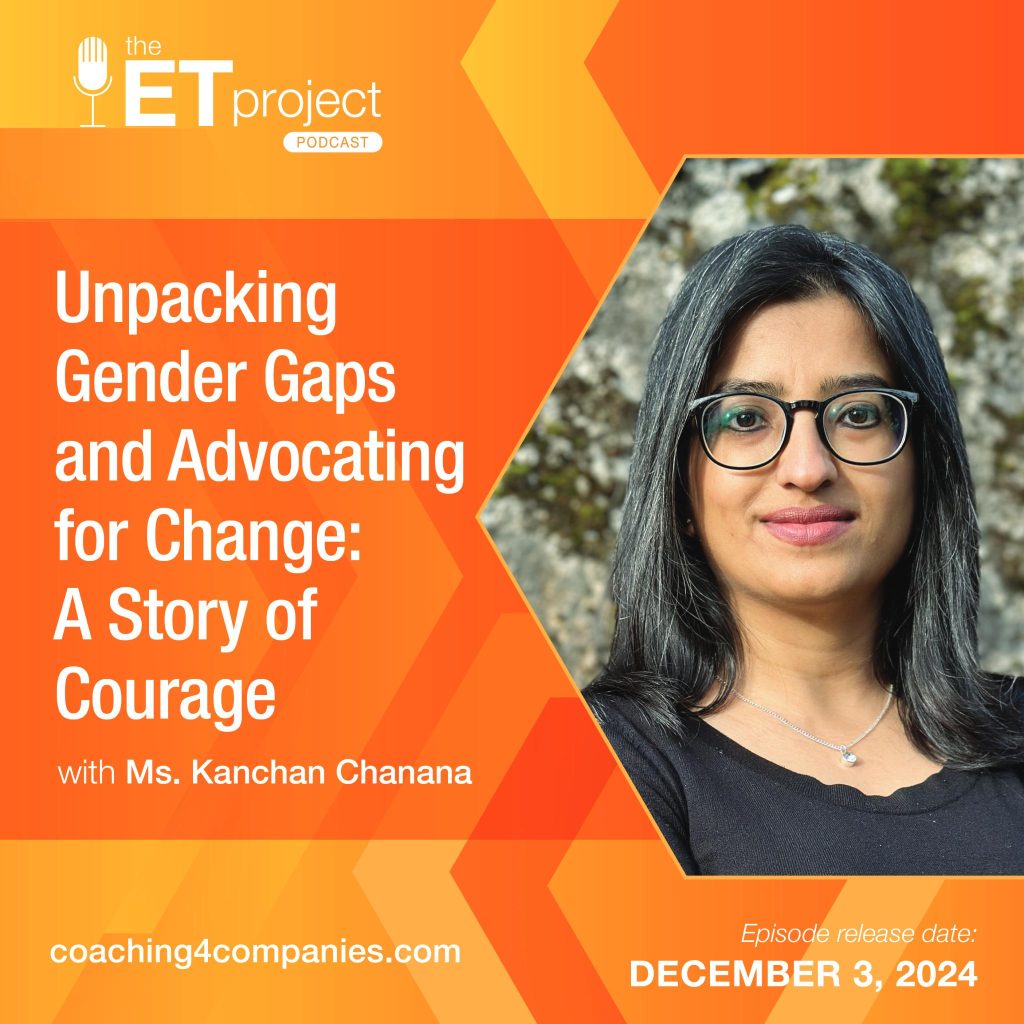
0:00:01.9 Wayne Brown: Hello, I’m your host, Wayne Brown, and welcome to the ET Project. We’re delighted to be delivering this podcast for executive talent all over the world, whom we’re affectionately referring to as Team ET. Today we’re off to somewhere special, to a city called Lausanne, located on the northern shore of Lake Geneva in Switzerland, to chat with our guest, Ms. Kanchan Chanana. Kanchan describes herself as an observer, curious and a striving human who’s actively broken given norms, rules and excuses for the past two decades to unlock the other side of being. She’s a first-generation professional in STEM and management. However, growing up came with considerable challenges from the many norms, beliefs and rules that she felt suffocated by. Mentions of money, for example, was simply out of the question. Her academic journey proved adventurous, starting in an all-girls government school and deciding to pursue mechanical engineering, where she was the only girl in a class of 50. Her professional career started in a male-dominated world of automotive procurement. She became the youngest buyer responsible for managing a spend of more than $100 million, and this role enabled her to oversee successful and complex negotiations with top suppliers and to understand the link between money and authority.
0:01:28.6 WB: Three years later, she went to pursue management studies in India and the United States and then joined a leading consulting firm where she worked in the US, Southeast Asia and India, solving complex business problems for large multinational organizations. This role further expanded her understanding of money, authority and decision-making. Some six years later, she joined the strategy function of a global 500 corporation and found numerous systemic gaps leading to leakages in women’s payslips every month, every year. This inspired her to speak up for equal pay for women at her workplace, which led to serial abuse behaviours, exclusion, non-transparency, baits, bribery, threats and eventually a non-mutual separation. Kanchan’s journey has revealed visible and invisible challenges to achieving equal and fair pay for women. She notes that in Switzerland alone, the women’s pay gap amounts to more than $45 billion annually. Kanchan’s story is to enable, educate and engage women on the taboo topic of unfair pay. Team, I truly hope you’re fully prepared for the conversation ahead and ready to practice some active listening because there’s a powerful message that awaits all of us as listeners.
0:02:55.6 Speaker 2: Welcome to the ET Project, a podcast for those executive talents determined to release their true potential and create an impact. Join our veteran coach and mentor, Wayne Brown, as we unpack an exciting future together.
0:03:09.9 WB: Hello team, today we hope to challenge your consciousness as leaders. This week’s theme is all around learning to thrive despite living in a world where quite often the odds seem stacked against you. And I think it’s a fair statement, maybe a little bit controversial, but I think it’s fair to say that not everything is created equal. And when it comes to humans and society, there’s many of us that have lived a more privileged life than others. And yet we’ve witnessed throughout history, in our modern day as well, where the odds can be reversed and the less fortunate at birth can rise to the challenge and also conquer. So often the societal environment becomes the catalyst for navigating daunting personal and professional hurdles. And so in this episode, I’m extremely happy to have with us Ms. Kanchan Chanana to help us walk through some of the big questions and lay out the essential strategies for building resilience, fostering inclusive relationships in leadership, and aligning personal values in particular, even as I’ve said, when it feels like the odds are stacked against you. So Kanchan, welcome to the ET Project. Wonderful to have you here today.
0:04:35.6 Kanchan Chanana: Thank you for having me, Wayne. I’m so delighted to be here and have this conversation.
0:04:42.1 WB: If you don’t mind, if you could share a little bit about, you know, that journey as you were growing up, in what I believe, if I did my research correctly, you refer to as a non-inclusive society. And I’m wondering how it shaped your perspectives and your ambitions.
0:05:00.8 KC: Sure. So if I can take you right from the day I was born, if I can start my story from there. So I was born in a patriarchal family. Those days our family never wanted a girl child. So me and my mom were expelled from our family house. So my mom took me to my maternal grandparents. And then in four years my mom, I came back to my father and my mom also came back and so we reunited. So I think that was the start of my life and the journey. Then I was four… I was… I started to go to school. I was good at studies. And that was, I think, one of the requests or let’s say demands from my parents that be good at studies. So I think that I was doing. But otherwise, there were a lot of, let’s say, practices or hesitations or norms which a daughter or a girl should follow. So I grew up in Delhi in India. So while it’s a large, big city town, but it has a lot of challenges from a gender perspective. You might know that Delhi is not one of the safest cities for women to be in the world. So we grew up and, of course, our parents had inhibitions because they had daughters and they wanted to protect us. But in that protection, we were also devoid of a lot of opportunities, as simple as, let’s say, going to a school with boys.
0:07:00.9 KC: So I studied in a girl’s school. I went to a government school. So I was essentially, as a girl, I was being formed to be a daughter-in-law, pretty much a good daughter, which forms into a daughter-in-law after a point in time. And when I was 17, I got into engineering college. So it is one of the top in India. And I chose to be a mechanical engineer and there was no girl in my class. So it was a very big shift for me to go from a girl’s school to a boy’s class in engineering. And it was a big shock. But the bigger shock came when, after my first year, my father passed away. And we were still doing very hand to mouth. And I had to make my fees to fund my studies. So that’s when life really hit me hard that what I was prepared for and what now life has become, there is no synergy or there is no commonality and I have to find everything. So right after a week of my father’s death, I started to work to fund my studies. And that was, I think, the first, let’s say, practical challenge for me to face at my individual level. But it was not just it, because even as family, so I have three siblings, so we are three sisters and a brother and my mom. So we were largely having women in the house. And even my mom was not shaped for a life without her husband.
0:08:49.1 KC: So we all were, you know, almost left directionless. And I also found that, you know, relatives do not help so much, as much as they claim to. So definitely there was no help. And I think that as an opportunity now, to be honest, like those days when you are facing something, you find it as a challenge, but in retrospect, I truly think that the event of my father’s death actually shaped me a lot because that transition just showed the real world to me and prepared me for a future, let’s say. So after my engineering, I joined an automotive corporation. There also, it was pretty much male dominated. And the field I wanted to get into was procurement. And there was no history of them hiring female engineers right after the college. And I challenged that to the chief procurement officer and I have been that. So that was my first ever, you know, win in the non-inclusive to inclusive. And to the point that, you know, there was no written or formulated policy, but he said that from next year onwards, we are going to have half female engineers in my team. So I think that was a big shift. And that is the kind of leader I always, you know, aspire to have again. I had some, but I think more the merrier, right? So that’s how my career started.
0:10:50.4 KC: I did stay for three years. I was the youngest buyer handling the largest spend. And it was all, I think, good. But I moved on to do my MBA. And I did it in India and US. Again, from one of the top colleges. So it was nice. And then I moved to consulting after my MBA. So I did consulting for six years. My first three years were in the US. The next three years were in India. And traveled a lot. Worked with many clients and industries and various problems. One thing, I guess, which was slowly firming up was the relationship between power, authority, and money, right? And how… And this is where I started to see that we have a lot of gap to catch up. So while we see these days that there are women at the workforce, but if I break it down into, let’s say, real dollar and positions of power, and even if they have position of power, does their voice have a credit or that significance as equal, as comparable? I noticed a lot of drivers. So that I think somehow always was there. In 2019 I got an offer from a global firm in Switzerland.
0:12:21.0 KC: So they were building their strategy team and I joined them. And that’s where I think my world also opened to a very large organization. It’s a global 500, the office, the headquarters in Lausanne. The office has more than, I think, almost 2000 people with 100 plus nationalities. So it was a really diverse environment. And I stayed there for three and a half years. My first, I think, year and a half were really good. And I was doing quite well from a personal individual perspective. But I also started to observe many examples of this gap of pay, power authority. And I started to question because this time they were not very subtle, but they were really factual. So how the promotion process was done, how the hiring process was done and how, you know, during the process, one part would be slightly adjusted or skipped or changed. And that started to show also because I was maturing as a professional, right, over the time. And I was able to see and pinpoint on some of the observations I had. And that’s when the tough part started. I started to ask questions and I think that was more, I guess, from the cultural perspective that this particular organization was not so very used to it.
0:14:14.4 KC: In return, I was getting threats and all the difficult behaviors and reactions from the senior leaders. So that was, I think, that intrigued me a little more. And I did the whole process. Eventually we came to a point where I had a list of facts and the only argument I got that we do it this way, which was very hard for me to accept as a professional in all sincerity and honesty, I think this is very much against my work integrity. And I started to then step away. And eventually, last year, April, I made a move to not be associated. Yeah, because I, as an individual, I don’t wanna support that kind of leadership or that kind of behavior. It’s even like not inclusive, not inclusive, it’s simply that in a professional setup, if you and I communicate right, we should have an open ground to discuss and debate the topics, which are business topics. So I saw that this particular piece I could not explore, which was a no-go. So, sorry for this long one, but this is my history. And that’s where, that’s how I landed last year. And… Yeah.
0:15:56.4 WB: No, very incredible journey. And thank you for sharing so openly. And there’s a couple of points and we’ll come into the, some more detail around what you’ve shared there. But a couple of things come to mind as I was listening. I’m struck by the power of the mindset as well as probably your self-belief, your determination, and how you’ve dealt with everything in your life. And I’m wondering, if you look at that now, has that really been something that’s evolved with you, that’s helped you look at these societal norms or challenges and, you know, take them to task?
0:16:40.3 KC: Yeah, I would say that, yes, definitely there is a correlation to that. So when I guess, if I see myself, I’ve never taken a standard path, I have mostly taken non-standard path, whether it was my career or my personal life or my philosophy. Right? So I think it gets manifested. But to this particular incident, which we are maybe detailing a little more, I started with because I thought that I can take up this challenge and I had self-belief. But on the journey, I also found myself that it was very, very hard. While I felt this is the right thing, but it was not easy. And that actually, when I went through a difficult curve, I did hit a point where there were only two choices: Either I completely break myself or I evolve and come out, you know, stronger.
0:17:53.3 WB: Yes.
0:17:54.4 KC: So I think I feel that psychologically I’m much stronger and it unlocked a whole space where I had never ventured into. I never imagined that I would be, you know, putting my position in front of the board of such a big company to say that this is my point of view. So I think even positioning that is, while I was in the business, I know that even people five or six ranks above me were not able to put a page to the board. So, I know that I think, so psychologically I think I broke many, many levels within myself. And I think that’s the winning maybe outcome for me.
0:18:39.7 WB: I’m really enjoying listening to this conversation because, you know, there’s so many things that we talk about as educators and, you know, I’m listening to you and I’m seeing and hearing this personal resilience that you’ve had to find. How did that resilience stay maintained? Resilience is such a powerful thing. We all have the ability, but seldom, I would say, many of us face the challenges that you’ve probably encountered. So I’m just curious, how did it all play out for you as you look back at it?
0:19:22.1 KC: Yeah, I think as I look back, so just to give a timestamp to my journey, the starting point was around July 2021 and I left them in April ’23. I would be honest that I started with, let’s say, I always thought that I’m a brave woman and I started with that hypothesis in mind. And, but right in July and onwards till the, even after I left, the situations were absolutely crazy and tough for me. To give you some specifics, right, I got threats, written threats. I got legal threats. I got abusive language. I got racist remarks. I got sexist remarks. I got, people could shout at me. I think it is also, so to the listeners we have, I think I just wanna tell that whenever there’s a difficult situation, one of the things which I think the environment does is that they increase the frequency and intensity of psychological violence. So I think that’s how I call it. And it was just piling up, piling up and there was a point when I broke down. I would be honest here. I broke down and I took time to really stop, let’s say, the further addition of these events and to at least process whatever I had gotten in very, very objective way, because I think one thing which I really like being a business professional is that it’s very fact-based and data-oriented.
0:21:14.1 KC: So I like to keep that even in the personal space. And I could take these inputs, right, but when I distanced myself, then it was very easy for me to take them as data inputs, right, and not really anything personal, right? And when I started to analyze, that’s when also I was trying to read philosophy because philosophy is the topic which essentially questions the reason to exist. And in a way for me, it was a battle where I was trying to find my reason to exist there or somewhere else. So it was, that actually added a lot of force in me. Then soon I was clear that which are the criterias will make it a go and which are the criterias will not make it a go. And I was then very confident. But it did take at least three to four months downtime for me to understand and make sure that I’m very objective and I’m not bringing my emotions or my feelings inside this problem statement. And also what happened, I think, the big shift, Wayne, which happened in this three, four months was I started to see the problem as a macro problem and not as a conscience problem. That is very, very important. So, even when I was standing up in the organization, it was never a conscience problem. The problem I formulated was almost five to six colleagues and not less. So it was never me per se.
0:23:08.5 WB: Yes.
0:23:10.5 KC: Because I observed behaviors with even junior women colleagues and even male peers. Right? So I think then I started to see that, okay, this is a much bigger problem and I am too small in front of the problem. In fact, the organization, even if I take the full size of the organization, they are also too small in front of the bigger problem you and I are talking about. So that started to shift and that started to fill me with force, but there was a downtime and that build up resilience, that depleted a large amount of fear in me because thus far, though my life was tough, but I was always admired by people, but this was the very first time that I started to see hate and resentment for me, so which was, I think, the difficult thing to face. Yeah. So then I think the philosophy and blend of philosophy, objective reasoning, and understanding what are my go, no-go drivers, I think that made it easy. But just to give you a sense of it, the amount of analysis I did was no less than a large consulting project I would run at a client. So, it was for me to analyze a lot of things and just by my own writing a project you have team to deliver. So, it was a big piece of thing or data which needed to be analyzed.
0:24:56.8 WB: You grew up in India. You spent time living in the States, in the US. You’ve now moved to Switzerland. You’ve been exposed to a very large number of different cultures with people that you’ve worked with. I’m wondering how much of this broad awareness of different cultures has played a part in your reaction. Was culture something that stood out for you that you felt, this is just not right, regardless of where it is?
0:25:35.5 KC: Yeah, and also, I think when, as you rightly said, I have moved or worked directly in three, let’s say, at least continents and countries, I think one thing which I found and it hit me very hard is that all of us humans, right, and I’m removing even the gender at this point, all of us are essentially mind or consciousness, right? Because whatever you think, then only you act and that gets manifested. So, essentially you are a bunch of thoughts, emotions, feelings, reactions, right? And same as me. So, at that level, you and I are not different. Maybe our expressions are different. Maybe our forms and intensities are different. Our training may be different. But deep down, if I have a fear and you have a fear, we both have fear and that fear can be insecurity or can be in the form of not achieving or not having what you deserve and things like that, right? But at the fundamental root level, you and I both are, you know, like some amount of fear. That really helped me, at least when I see or talk to a human, I sincerely try and attempt not to put any judgment or any opinion, anything, right? And I have also improved, right? Like, I’m not saying that I was doing this right when I was born. But as I progressed and I saw life and I also saw that at the human level, we all are same, we might have different color, gender, sexual orientation or culture or habits or practices, but I think that’s just the cover, right?
0:27:49.0 KC: Inside at the core, we all are same. So that has helped me understand or empathize a little differently than maybe people around me. And that develops compassion, right? And compassion is the action, right? Because many times we understand the situation cognitively and emotionally, but that is not enough to take an action. You need compassion because compassion drives action, because then you are in the shoes of others in a truest form. So I think it’s Daniel Gohl who divides empathy into three parts, cognitive, emotional and compassionate empathy. And to me, I think if you don’t have compassionate empathy, the first two are just good to know, like they’re just information and it doesn’t move the needle. So I try to make sure that at least I bring things into action and practice.
0:29:00.0 WB: Let’s jump into inequality then, because in your case it wasn’t only female inequality. I guess if we were to generalize, most of the time we think of inequality and we think of females progressing in their career, being promoted, and also pay disparity. Now that you’ve been through this process, and I guess even within your coaching, are there actionable steps that an organization can take to try and address this inequality?
0:29:38.8 KC: Yeah, actually, Wayne, what I think is that, and maybe this is from my experience so it could be limited view, but what I’ve seen is that inequality particularly, and it’s basically human inequality, so it could be men or it could be women, I think it’s just that we put some people in the unfavorable place, but they deserve it, and that’s how they’re unequal. Otherwise, of course, there would be a gradient, if you have a pool of humans, then you definitely have to create it. It’s just that how fair you’re doing it. I think one of the things which I found is that the way we do business with the honesty and sincerity and objectivity, I have not seen the same rigor, that same principles of integrity in the people process. So we essentially just need to see to as business processes, and more and more, because in the AI world, like the world we are getting into, organizations will only have specialized talent because all the other day-to-day commoditized tasks will be done by machines. So, if you have a pool of special talent, then you have to treat it properly, and they are very smart. So I also spoke to some friends in the tech world, and they told me that the talent processes are much more objective.
0:31:15.9 KC: And then I was wondering why there’s such a difference, and I think the difference is because the tech world has, on an average, high-talent individuals, and you cannot play them. So I think we don’t need to think women, men, Asian-American, or whatever, I think we simply need to say that this is how we evaluate business, and this is how we evaluate people. And many times organizations do have processes which look objective, but how they are executed are not objective. If an employee challenges, what is his or her way out? It is to take them to court, and that process is so difficult, and so long, and so time consuming, and money consuming, and even psychologically drains you out. No one goes, and that’s why it goes on. But what drives us to not follow the process is simply that, because of familiarity, I am familiar to you, feel secure when I have you, so I will push you forward, because as a person it’s very convenient for me to have someone who doesn’t challenge me, nods all the time, right?
0:32:45.3 WB: Yes, yes.
0:32:45.7 KC: And that’s how you would see that the large organizations, very few are able to meet, continuously grow their talent. And sometimes, at least the organization I come from, a lot of talent, and it won’t be wrong to say that it’s obsolete, and the reason, because they are just there because they keep on nodding to the yes and silence culture, so everything is okay. And that is the price you pay for self-growth or personal growth. So it’s, to me I think the business mindset and objective execution is the key. If the organizations think that employees can never take us to court and that’s why we should not do this, and we should adopt cheap and shallow ways of doing things, they can do it. And I think it’s definitely leadership’s choice. But as a person, as an individual, let’s say as a leader, who I wanna be, I don’t want to be that kind of, or subscribing to that kind of a process. But the other thing, if I don’t speak about the leadership, but I now speak about the individuals, and that’s where I think fear, I think is one of the key drivers, because firstly, no one starts. So just to tell you that in the organization I was, there were so many reports floating around inequality or whatever, like many, many gaps. But no one was standing, like very few people, hardly anyone stood up, and they knew that if they stand up, they will be terminated.
0:34:47.5 KC: So no one would stand up to the challenge. And all the reportings were anonymous. So people were even afraid to tell their name if they have a point of view to a genuine problem because they know that if they tell their name, and then they will be targeted and thrown out. So it’s a real sacrifice one might have to give or do. But also I think it’s the common intelligence we have, right? So when I started to even stand up, but no one could join me, because firstly it was kept so secretive that something is going on. And second, even everyone was so scared to even speak the truth to power. So I think it’s a collective responsibility. I don’t think it should be solved in court or policies and laws, I don’t think so. In my understanding thus far, and in what I’ve seen in my experience thus far, the biggest wins are the accelerations you get either in business or in team or in culture, when the two sides come together and say, let’s do it, right? So it’s also the bottom which plays a role. If I do not, let’s say you are my leader and I do not ask you, then you will be exercising the power you have on the basis of your own integrity and standards. And that’s how the system evolves. So that’s my point of view.
0:36:35.5 WB: Thank you. As you look back over it right now, what do you think the impact of taking a stand is for you, and how do you see that might play out in the future?
0:36:47.5 KC: So for me personally, I think I am now very, let’s say, more clear about my own self and how do I want to come in the world of work and deliver my service. So I think that has become much clearer to me now. As I go on with life, I think I will have to see different contexts and weigh in and then measure if I want to play a role or I don’t want to play a role. So for me I think it was a big eye-opener to see that how capitalism works within a large company and in a diverse environment and a very complex team structure and how things are made, kept visible and kept invisible, both. So I think to understand that drivers and see those like relate to them in my own life, like we all hear big things that leaders are corrupt and this and that, but now I at least can tie that to my real life experience. And that brings a lot of clarity, right, Wayne? I think that brings a lot of clarity. And now I am, let’s say, meeting people or whatever I venture in, I’m very open and direct about my value system. So that if someone doesn’t need to partner or is shy of that, then I think it’s a clear understanding for both of us.
0:38:43.0 WB: Right. Right.
0:38:43.7 KC: But also it has an impact on the organization, right, which I left, because I hear from some of my ex-colleagues that things are shifting for good. I’m not sure if they are momentary or they are for sustained shift. But I guess when one stands up, there’s… It’s an energy, right? So it just explodes in both directions. And as an individual, I think the responsibility for me was, if I see something, I say the fact about it. And that’s as a duty comes to my mind and I did that. That’s it. Good or bad, I think it can always be better, but I guess that’s the start of responsibility that, in your own honest and sincere understanding, do you call spade a spade?
0:39:58.2 WB: As you’re working with different clients at the moment, if one of your clients comes along and they’re working in a toxic environment, based on everything you’ve been through, like, are you going to be able to remove any bias that you may have developed and sort of be able to guide them from that professional level? Do you think there will be any challenge in that?
0:40:23.7 KC: No, I think even at my current place where I am doing my project, I think we are having very honest discussions. As I said, I think the environments are never toxic, we just make it sometimes, right? So everyone has a context. Everyone has a reason why they behave certain way. And my approach is to first understand the drivers of people around me. And then if I spot something, I guess I’m more, let’s say now, evolved to make a conversation more objectively and put it from a business lens, because I think that’s another thing which shifted in me also, that how do I see social issues more as issues of real core things, right? Business performance capability, which I think are precious assets to any organization. And it’s never people, it’s I think the whole context, right, in which you and I operate. So I think my approach is to fix the context and not the person. Yeah.
0:41:57.0 WB: Very nice. Where can people go and find you? Where’s the best place to connect?
0:42:02.5 KC: I think the best place to connect with me is LinkedIn. So I write and post almost daily. I’ve just started this practice, but I’m quite active there and I would love to connect with people if any part of my story resonates with them or they are navigating a part of it, I would be happy to be partner if I can in any way. Yeah. But also otherwise, I would be very happy to connect.
0:42:35.5 WB: Excellent conversation. Really insightful, very thought-provoking. And I wish you all the very best for things in the future.
0:42:44.0 KC: Thank you, Wayne.
[music]
0:42:47.7 S2: Thank you for joining us on the ET Project, a show for executive talent development. Until next time, check out our site for free videos, ebooks, webinars, and blogs at coaching4companies.com.