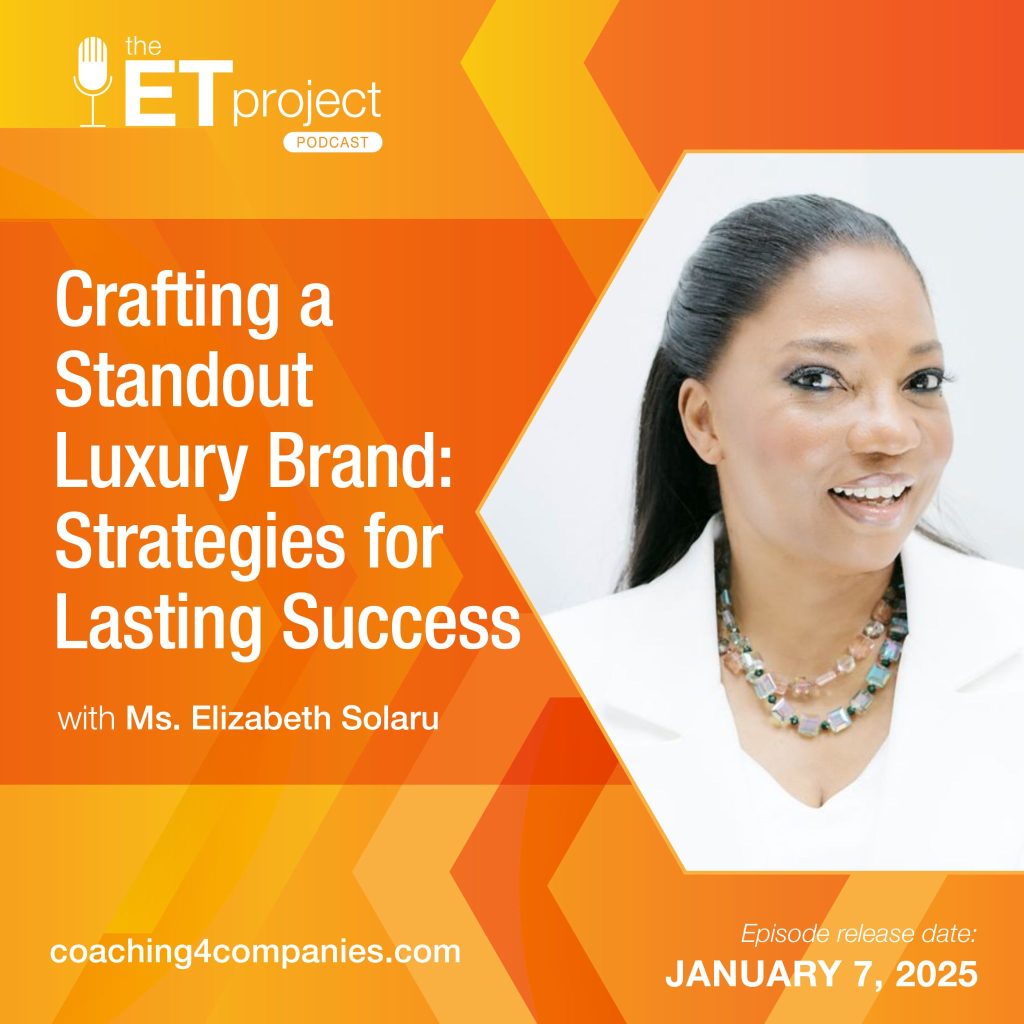
0:00:02.8 Wayne Brown: Hello, I’m your host, Wayne Brown, and welcome to the ET Project. We’re delighted to be delivering this podcast for executive talent all over the world, whom we’re affectionately referring to as team ET. Today we’re heading to London to meet up with multi-award winning luxury business consultant, author and world renowned cake artist, Ms. Elizabeth Solaru. As the CEO and founder of the Diversity in Luxury Awards, she’s a pioneering voice advocating for inclusivity and representation in the luxury sector. An ex microbiologist and headhunter who ran job hunting workshops for C-suite executives. She began her luxury business journey as a celebrated cake artist. Earning international acclaim for her innovative designs and impeccable craftmanship, Elizabeth’s clients include ultra high net worth individuals and royalty. While her creative talent and business acumen led to a successful transition into luxury consulting, where she now advises brands on how to navigate complexities in the luxury market.
0:01:08.5 WB: Her latest book, The LUXPreneur, How to Start and Build a Successful Luxury Brand, has been described as the blueprint for luxury business and a must read for those interested in working in the luxury industry. Elizabeth has been named as one of the world’s masterful 100 in luxury and has been featured on the BBC Channel 4 and Sky tv. She’s spoken in business schools and on some of the most luxury business stages, including JP Morgan, Ernst & Young, and Sotheby’s Institute of Art. Team, I hope you’re fully relaxed and comfortable as we head into this enlightening conversation with Elizabeth Solaru and explore a wealth of practical advice to help you thrive in any luxury market.
0:01:56.4 Speaker 2: Welcome to the ET project, a podcast for those executive talents, determined to release their true potential and create an impact. Join our veteran coach and mentor Wayne Brown as we unpack an exciting future together.
0:02:14.7 WB: Hello team. Welcome to the first episode for 2025. Fantastic that we’ve made it on the other side of the Christmas break. I’m delighted that you decided to tune in, join us for the start. Here to help us today, as you will have heard me introduce already, is probably one of the world’s leaders in building, growing and sustaining luxury brands. Ms. Elizabeth Solaru. Elizabeth, welcome to the ET Project. Wonderful to have you on.
0:02:47.2 Elizabeth Solaru: Thank you so much. I am really, really excited to be here, Wayne, and I can’t wait to dive into our conversation.
0:02:54.7 WB: I normally kick off by asking people to give us a little bit of a background. You have such a interesting backstory, so I wonder if you could give us an overview of how you transitioned from where you started into where you are now.
0:03:11.4 ES: Thank you so much. Potted history. So started my career as a scientist. Yes, I worked in a lab. I was a microbiologist to be precise, and then I went off, did an MBA because I didn’t wanna be a lab rat for the rest of my life. And then I networked myself into becoming a headhunter. And while I was a headhunter, I was recruiting chief executives and very senior level executives. And I did that for several years. And it was while I was doing that that I went back to my first love, my childhood love, which was baking because in my culture, education is everything and I mean everything. And the idea of me even thinking about becoming a baker was not even, was not even remotely possible. But then 2008 I was let go from my job and then we know what happened.
0:04:09.2 ES: The financial markets collapsed. And I was thinking, you know what? Milestone birthday, if I don’t do it now, I’ll never do it. So I decided to set up my own cake company and then I quickly learnt that I had a problem. I had nobody to buy my cakes, so how do I find people to buy my cakes? And I remember I was having a discussion with a taxi, one of my taxi drivers, and he said, they leaflet. And I’m like, can you leaflet the really nice neighborhoods for me? And he said, yes. So I made him amazing beautiful cards, gave him the cards, and he went and he leafleted and I know it was affective because every time he leafleted, which was about every week for about the next six months, I would get a phone call for orders. So I quickly realized that the kind of clients that I wanted would be the high-end clients.
0:05:07.5 ES: And then I did a couple of other things. Another thing I did was I took the yellow pages, because in those days, social media was very much infancy. So I took the yellow pages and I called every planner in the yellow pages. And one afternoon, Wednesday afternoon, I’ll never forget it, I made a call because when I was a headhunter, I was trained on how to make cold calls. So I made the call and the lady at the other end said, do you make cupcakes? And I said, yes, we do. And in fact, I’m going to be in your area in the next three days. So of course I quickly went off, made some cupcakes, delivered them, and I remember literally running out of the office because I didn’t want to hang around and chat. And before I got home, I got a phone call saying, lady Elizabeth would like to see you. And in my head I was like, “Who is Lady Elizabeth?” Anyway, went back, lady Elizabeth happened to be the first proper official event planner, in the UK and she happened to be the late Queen Elizabeth first cousin. And she was party planner to all the royal families in the world, the rich and famous, name it, she was the person. And that’s how I landed one of my very, very important clients. And that was what opened up the world to me.
0:06:36.8 WB: It’s a fantastic story. And there’s so many areas that I really love about it. A, your determination, but having the ability to pick up the phone book and the confidence to make those calls, not everyone would do that. And I guess your background sort of paved the way for that, but also fortune favors the brave in many cases. And I think that’s a great example of it. So that was the beginning, I guess, of Elizabeth’s Cake Emporium. How long did it take to really establish?
0:07:14.4 ES: That’s a fantastic question because I had another milestone, which was 2013. And the reason I remember that year was because I had spent many years trying to fit myself into the middle market. So I know I didn’t want the bottom market, and I know I wanted nice clients and the middle market, I was getting about 90% of all the wedding cakes that I pitched for. So, and I thought it was fantastic. I thought it was great, but the problem was, I was working so hard, I had so many orders, but yes, the turnover was a lot, but I wasn’t making any real money because by the time I paid staff and expenses, et cetera, and I was working all hours. And then I remember 2013, I said, I’m just gonna do it. So I doubled and tripled my prices overnight. And of course I lost a lot of those particular clients, but that was what pushed me into the next level. So 2013, so it took from around 2006, I would say, to 2013 for me to make that next leap into luxury proper.
0:08:28.2 WB: Apart from the pricing and finding the niche that you really wanted to focus on, is there anything stands out as part of your learning there?
0:08:35.9 ES: Oh, I learned plenty. I, oh my God. Okay, so the first thing I learned was that luxury clients are not the same. So the different types of luxury clients, I learned about at least three to four different types that period. And I began to identify the one, the type of client that I was ideally suited to, the ones who naturally would seek me out. The second thing I learned was the power of PR and the power of SEO. And what do I mean in terms of PR? I couldn’t believe that you can, you have the power to tell people what you wanted them to know about you. So if you told everyone, I’m the best at making X, Y, Z, it’s out there. Even if people don’t believe you, it’s out there. It’s in writing and it’s part of historical record forever. So people, if you’re listening, blog, blog, blog, blog, blog, blog, just put yourself out there.
0:09:36.9 ES: Another thing I learned was the power of collaboration. And that’s when I realized that, a lot of people are like you and they’re winging it. Nobody has it all figured out or perfect, but there’s power in numbers. So along your journey, if you meet somebody else who’s on the same trajectory as you or the same journey, you can always ask to, let’s partner, let’s walk together, let’s do certain things together. Let’s throw ideas about, because I began to learn about the power of, especially in the wedding industry, the power of bloggers and the power of certain brands. So certainly if you associate your brand with a certain brand, you are looked upon a lot more favorably. So it’s, so there was a lot of learning, there was a lot of working with people that were suitable, not suitable, learning, moving on, growing, lots of blood, sweat and tears. So that’s what I learned in that time.
0:10:45.6 WB: Before we get too deep into the conversation, and I know you mentioned this in the book that we’re gonna speak about, how do we define that? What is a luxury brand? Is there some specific category or characteristics that bring it into that class?
0:11:00.0 ES: That’s a fantastic question because it depends on, number one, when it comes to luxury, luxury is very personal. So when someone asks me, what is your most luxurious whatever, whatever to me, it’s time and health, they’re my two. It’s not necessarily to do with, ’cause a lot of people confuse luxury with a luxury lifestyle. And to some people a luxury lifestyle is opulence and spending and flying private jets, that is luxury to some people. To some people it could be something completely different. It could be spending time with family. ‘Cause I’ve certainly met, billionaire and other sorts of people who don’t even have 10 minutes to spend with their families. So to them being able to take their family away on holiday, that is luxury. So luxury has nothing to do with money, although money helps, I’m not gonna lie. Money really, really helps.
0:11:56.7 ES: So, luxury number one is personal. And also when it comes to how you, what you identify with and how you identify, with certain types of luxury clients, again that depends on your personal values. So there are certain types of luxury clients, for example, that if their values don’t align with mine, I will prefer not to work with them, if that makes sense. And these are things you learn the more you serve this group of people. So when it comes to you setting up your luxury brand, price is a, it’s an important part of it, but it’s not the only factor because people think that if it’s expensive is luxury, but not everything expensive is luxury but everything luxury by the very nature tends to be expensive. And for some luxury clients, if it’s not expensive, they might not think it’s luxury.
0:13:02.3 ES: So for me things like branding, how are you putting yourself out there? How are you branding yourself? Are you, and I use peanut butter for example. So if you go to the supermarket and you want a jar of peanut butter, you buy, you leave. If your favorite brand is there, fine. If it’s not, you find something else. But if it’s a luxury peanut butter, say if it’s a brand, that peanut butter number one will be in a completely different environment. It’d be the only jar on display, and there’s a story behind it. So the peanuts in the jar are grown on a certain type of soil, are watered by the dew flowing from the mountains X, Y, Z. Are handpicked and shelled on the laps of virgins are blah, blah, blah, blah, blah. So by the time they tell the story around it, and then they also say something like, “We’re only producing 100 of these jars of peanut butter, and you can only get it from X, Y, Z.
0:14:03.2 ES: So they introduce exclusivity, they introduce rarity, they introduce story, they introduce the craftsmanship, everything builds and builds and builds. And that is what makes a luxury brand. And in my book, I talk about the five pillars of a luxury brand, but I use that story to kind of illustrate that. Once you’ve put all that together, then you have the emotional resonance. Because if we think about the big brands that we know, when you think of, for example, Gucci, everybody knows Gucci. But what people don’t realize was that Gucci actually started as a 17-year-old porter at the Savoy in London. All he did was handle luggage. And that’s how he got the idea to create elegant luggage when he went back to his family business when he was 20 something. And then when you think about Louis Vutton, the story around him is that he walked barefoot from his village 300 miles to Paris when he was 13. So again, and again and again, luxury founders themselves were not luxury for the most part, but what they were able to create was luxury because of the emotional resonance and pull that they fed into their brand.
0:15:25.9 WB: Great explanation. The actual precision that you need in the designs, like do you sit with the clients and discuss their vision of what a cake looks like and then you have to somehow come up with that in a design? How does that process work?
0:15:45.9 ES: That’s a fabulous question because it really depends on the clients. So some clients are very hands-on and they have their mood board. Their fact… Because of Pinterest and other visual. Yeah. So, and I even remember a client actually sketched out their cake which is not unusual for certain clients who are very visual. So it really depends. Some clients I’ve never even met. It’s all done through intermediaries or the planner or whatever. Some are very hands on, but the most important thing for me is, try to determine their personality, their likes, dislikes, because the dislikes are just as important as the likes. Also, I need to know what type of wedding it is, what the environment is gonna look like, what their vision for the day is, even in terms of the taste, the smell, because it’s not just visuals, it’s also the taste as well.
0:16:44.4 ES: I even ask things like, what was your favorite childhood flavor? Some are very traditional and they want traditional flavors and some are a lot more adventurous and they want something different. So again, it really depends on the client. But, the one thing I’m happy about, I allow them to be as involved as they wanna be. So if you do me a sketch and you want me to create that exactly, I’m happy to, but there might be a few two weeks, but I’m happy to, and if you wanna be as hands off as possible, again, that’s allowed. The thing though is that when people have a particular vision in their head, you need to better it because if you don’t meet expectations, there’s gonna be a massive disappointment. So there’s something about visual people. And I talk about the different types of luxury clients. In my book, I talk about the ones that are very visual and how to handle them and the psychology as to why they’re like that, as well as who are completely hands off.
0:17:50.4 ES: And all they wanna know is it has to be spectacular. They don’t care about the detail. So for me, in my work, once I’ve done all that, then I need to think about detail. Is like having a sketch. And then you go in as a painter, you start filling in the details. And that’s what I do. So, and then I try to say, “Okay, is there an element of surprise or delight that I can add anything extra, that I can add?” That the client would say, “Wow, this exceeds my expectation.” So that’s how roughly I work.
0:18:24.0 WB: Okay. I think I read somewhere that you provide cakes for a number of the royal families in different countries.
0:18:32.2 ES: Yes.
0:18:32.4 WB: As well as a number of high net worth individuals. So clearly you’re doing something right? What I was curious about when I was hearing for this conversation was, the cake industry when you started building your business, I guess it’s evolved a lot to today where we are, and there’s shows about cake gurus, I guess I’m not sure what the word is, but so the competition I imagine is quite intense right now, not only in the UK, definitely in America, probably around Europe. How is Elizabeth’s Cake Emporium distinguishing itself from that competition? What is it that you are doing that seems to be working?
0:19:14.6 ES: Ooh, that is a loaded question and it’s one of my favorite questions ever. Because you’ve really hit on so many points in one question. So when I started cake making, a lot of the techniques were not easily available on YouTube. So you’re absolutely right. There weren’t as many cake shows. It was a relatively kind of interesting time. I remember when I wanted to learn something, I’d order a book and wait for three weeks for the book to arrive so I can just, and I might not even find the methodology in the book, but now you go on YouTube and there’s everything on YouTube. So it’s been a double-edged sword because there’s been a massive rise in cake.
0:20:01.2 ES: Lots of amazing available techniques have evolved available online, which is great. But on the other hand, because the techniques are everywhere, everyone with an oven can make a cake. So, the barrier to entry is getting lower and lower and lower. And then specialized patisserie is also rising. So a number of people are able to create these amazing, amazing products. So, in terms of distinguishing myself, because I positioned myself as a luxury brand, I know I’m not for everybody. Design has been… Design and color has been one of my… Sorry, two of my ways of distinction myself. For example, I remember years and years and years ago I got told that, I was teaching and I was showing my work and somebody said, “Oh my God, I know all your cakes. They’ve gone viral in China several times now.” I’ve never been to China. But these Chinese students were like, “Oh my God so it’s you.” Nobody you know.
0:21:08.6 ES: Because the thing about your work is that your work can go viral nowadays without anyone knowing it’s actually you. So with design, I try to really, really do things that are different to what other people are doing. I remember one year, ’cause every year there’s something called Pantone Color of the Year, and I happened to have made a cake maybe a couple of years before, and it turned out to be the exact Pantone color, which was purple. They called it some fancy name, I can’t remember now. And that my cake was everywhere. Everybody used it as part of their mood board. So, distinguishing yourself is about creating a body of work that will outlast you, that will outlive you in some ways. And also people might not necessarily know you as a creator, as a craftsman, but it outshines you as a person. Because I also have the problem of people looking at my face and my face not matching my cakes because, I don’t seem the arty type to a number of people, and I wonder why. [laughter] So, you have that as well. But I love that question. Because it’s nice to see the evolution of the cake industry. But on the other hand, it’s been a double-edged sword for a number of people.
0:22:33.1 WB: I can imagine. And is AI or technology having any impact at this stage?
0:22:40.3 ES: Yes. On my page, for example, ’cause I love technology. In fact, today on LinkedIn, I did a post about Willow, ’cause Google has unveiled willow which is a supercomputer of all supercomputers, and it can process information that they never thought would be possible. I did a post about that today because I’ve always been a nerd. And I remember, I did a basic programming course in C in 1998. So I love AI, and I’ve designed cakes in AI that I’ve actually put on my Instagram page.
0:23:22.5 WB: Okay.
0:23:28.9 ES: And a lot of cake makers are up in arms. “Oh my God, this is cheating, blah, blah, blah, blah, blah.” But for me, for some of my clients who are not very visual, I would design the cake in AI, show it to them and say, this is what you’re gonna get. And there’s something about, “Oh my God, this is it’s exactly.” And I’ve had a few clients like that. So for me, AI has been wonderful. For some people, they’re very upset about it because they’re thinking it’s taken over in terms of craftsmanship and artistry.
0:24:05.7 ES: But I think you can use AI art for design because the execution is still with you. Nobody’s going to eat an AI cake. So for me, I think technology can enhance, but we ought to be careful as well, ’cause we can’t just… But I still, I believe that we need to evolve. And I remember people saying the same thing when seat belts first came out, people were very much against it. There’s a lot of things that we have nowadays that it seems normal that people were up against, so who knows?
0:24:32.0 WB: Yeah. And you’ve not only founded the cake business, but you have other luxury brands, businesses. Before we dive into the book, could you just quickly introduce what else you’re doing besides the cake?
0:24:45.0 ES: Yeah. So again, I have the pandemic to thank for this because, obviously during the pandemic, everybody was looking to keep their businesses afloat and alive. And I got invited to a lot of stages to talk about luxury businesses and I joined Clubhouse, and I assumed that there’ll be a luxury business club on Clubhouse. But there wasn’t one. So, I created one and I just found fellow people who like talking about luxury business, not lifestyle, but business itself. And that was how the idea for the luxury business emporium that’s how that came about.
0:25:22.8 ES: So, what I do is, I help brands who want to enter into the luxury market, or brands who want to grow, or brands who are looking to rebrand so that they can attract luxury clients. So, I help those brands and they tend to be small businesses because the bigger brands with the big names, they’ve got the budget, but the small businesses might not have as much budget. But I believe that with a power of creativity and a bit of get up and go, you can compete with a big boys. So, and that was why in a way, that kind of, I did that for a while, but that’s actually what led me in a way to write in my book.
0:26:05.1 WB: Well, that’s a great lead in then. Let’s jump into the book now. It’s called, The LUXPreneur: How to Start and Build a Successful Luxury Brand. What was the motivation? What drove you to write the book?
0:26:19.7 ES: ‘Cause I love books, as from behind me. You can see I love books and I read a lot of business books, et cetera. And a couple of things really. Number one, that there weren’t that many women authors when it comes to business books. At least the ones on the bestselling list. So that was a motivator. But the second motivator was that a lot of the books were written by either professors of luxury who’ve never really run a business or founded a business from scratch as well. Or it was written by people who had worked for these incredible amazing luxury brands. And I felt there had to be something from a founder’s perspective. So if you wanted to set up a luxury brand today, is there anything out there that you can read to help you? So that was why I wrote the book. And the book is in three parts. It’s got five chapters and I’ve made it as a lot of complex ideas. I’ve kind of simplified them because I don’t like highfalutin language or things that sound important when they’re not. I just like very simple ways of looking at establishing luxury brands. So it’s literally a how-to from start to finish.
0:27:41.3 WB: It is, I’ve had the pleasure of reading it and it’s a nice, it’s easy book to read, but so informative. So as you said, it’s a very much a how-to and an alchemy, if you like, of building a luxury brand. What I liked a lot about the book was you allow people to jump around in the book. So if somebody wants to learn something specific and there’s a lot of other information that isn’t so important to them, you’ve given them the means of being able to jump around. So I thought that was very useful. I found it useful anyway. One of the areas, and you’ve touched on already is you talk about the archetypes both from the entrepreneur or the founder’s point of view as well as from the luxury buyer’s point of view. You outline, I think it was nine archetypes in terms of entrepreneurs, founders. Could you maybe just give a high level overview without making it too deep of a discussion, because there’s a lot of information, but could you maybe introduce what you’re talking about there?
0:28:49.7 ES: Yeah, Gosh, thank you. And first of all, I want to say thank you. You’ve definitely read the book. And secondly, the jumping around is so me, because sometimes my trail of thought is not linear. So sometimes, and as a busy person, if I want information, I don’t wanna wade through, I just wanna cut to the chase. So thank you for that. But in terms of the different archetypes of entrepreneurs, because I’m not trying to put anybody in a box. Number one, you may find that you have a few of that and a few of that. That’s okay. So to give an example, I’ll use myself.
0:29:26.8 ES: I’m a visionary as well as an artisan, a craftsman. So which means that as a visionary, I’m always thinking of the future, which is great. I’m looking at the next wave, what’s to come? And another advantage of being a craftsman or an artisan is that when it comes to craftsmanship, I’m very detailed. I will make sure that things align, et cetera, et cetera. But there are disadvantages. As a visionary, I’m not grounded in the present. I am spending far too much time thinking of the future. Instead of thinking, “Hey Elizabeth, how are you gonna pay that light bill? How are you gonna pay your staff?” Et cetera.
0:30:09.4 ES: So there’s that. That’s the cons. When it comes to craftsmanship, it means that somebody had to physically say to me, your budget for this cake is X, Y, Z. You are not allowed to buy the most expensive ingredients in the world and have it flown in at extra cost just because. [laughter] And that’s what I try to do in the book. I talk about the networker, I talk about the salesperson, I talk about the craftsman, the visionary. So like I said, I identified nine different types of people because these are people that I’ve met in my journey. I think I talk about the storyteller as well, and I talk about the pros and cons, and more importantly, the type of people you need around you to make your business a success. Because we’re not taught these things in school. [laughter] I wish we were, I would’ve been further along in my business, but these are things that I learned the hard way.
0:31:10.2 WB: You introduced those types that helps us understand where we’re going with our business and what we need to think about. Then you move into talking about categories, luxury brand categories. So I wonder if you could speak a little bit to that as well, please.
0:31:27.2 ES: Yes, I think identified roughly, and again, this is way oversimplified, because within each category identified five, I think.
0:31:35.6 WB: Yes.
0:31:36.4 ES: And within each five, there are subcategories. Because luxury is extremely nuanced. And I remember when I wrote that chapter, I actually had more pages than the book itself. It was that detailed. Because that was another habit because again, craftsman detailed my editing. The person who did the editing on the book, I tell you, I can’t even thank them enough. So I had to edit down. And the reason it was important for people to know the different types of luxury brands is that many people don’t know this information. Even luxury experts don’t talk about this information enough, because once you know the different types, you can say, actually, I wanna go into that.
0:32:25.1 ES: So to give an example, if you are what I call masstige, masstige is mass, but with a bit of prestige and there’s nothing wrong with that, or you wanna be an ultra, ultra premium, ultra high brand. If you’re going to be an ultra high brand, you need to realize I might not get more than five clients a year, so there’s gonna be a lot of waiting and a lot of frustration while you’re waiting for the right client, but at masstige, “Okay, I’ll probably just get, instead of maybe the normal 50,000 that a mass brand would get, I’d probably get 5,000.” And that’s okay with me. So it’s about knowing how each category works and what I did as well, I gave examples of brands that fall within those categories. So you can say, and it’s for people to go to the website and say, “That’s actually me, I identify with that.”
0:33:24.0 ES: And then you can position yourself accordingly. So, like I said, it’s a how-to and it’s a kind of book I wish I’d written or I’d known about when I started my journey 20 years ago.
0:33:35.3 WB: Yeah, very true. So by being able to identify which category you wanna be in, you then identify the type of client that you’re seeking. The picture becomes so much clearer, then leads you into the five pillars that you mentioned earlier, you introduced this way of storytelling, etcetera, that really pulls then the brand into the whole process is the way I saw it.
0:34:02.0 ES: This is, you know what, next time I’m just going to have you talk about the book because this is amazing. Thank you. I truly, truly, it’s nice when you meet someone that truly gets the book. So thank you for that. And also another thing is, all through what I’m trying to do, is show people how these luxury brands establish emotional resonance, right? So because of brand, they know who they are. They know how they’ve positioned themselves in the market. They know who their client is. And remember, this is information that they’ve spent millions of pounds and a lot of money acquiring over decades and even centuries. And people are getting this information in the book for a few pounds, literally, because that’s what I was trying to show that, setting up a luxury brand is not a matter of, I’ve got a swishy website and I’ve got amazing products, there’s that bit in the middle that makes everything hang together, which you also need… By the time you get to the client journey, ’cause you should imagine how they’re starting their journey. So by the time they get to you, they should be able to emotionally identify. Because when clients who have a lot of money, because money is no longer a barrier to a lot of them, it hinges a lot on emotion. And if they don’t feel that emotion by the time they get to you, and they haven’t got time to waste by the way. So by the time they get to you, no emotional resonance, they’re out.
0:35:45.8 WB: What I really liked about the book is in the final chapter, you then introduce eight archetypes of luxury buyers. Would you like to just mention a couple of those archetypes?
0:36:00.6 ES: Yes. I’ll actually do better. I will do, let’s do three or four. So.
0:36:04.4 WB: Okay.
0:36:05.1 ES: I started with the aspirationals, then I went on to what I call the comfort first or the very security conscious. Then I went on to the only the best. And then I also mentioned, innovator, trendsetter. I also mentioned, I believe the aesthets, the aesthetics are all about. Now I’m gonna use, this well-known meme. Everybody probably knows about the meme, King Charles and Ozzy Osbourne. So according to demographics, King Charles and Ozzy Osbourne, they’re both white males. They were both born in 1948, both been married and divorced twice, and they both live in castles and they’re both rich. So according to demographics, you ought to sell to them the same. But that’s not the case. King Charles is a typical comfort first and Ozzy Osbourne is an innovator trendsetter. We all know what he did to a bat allegedly on stage.
0:37:14.2 ES: So my point about the book was to talk about the different types, what makes them tick, where you can find them, how you can make your approach if you have to. So for example, King Charles being a comfort first, he will be surrounded by gatekeepers left, right, and center. So you will only probably be able to get to them via referral. And you just need to know who those gatekeepers are. I give so many examples of who the gatekeepers are in the book. Somebody like Ozzy Osbourne, you can make your approach. In fact, the more outlandish the approach, the better because he’s like, “Whoa, this is different.” So again, I tried to, this took a lot of research, a lot of research, a lot of journals, I consulted experts, et cetera, et cetera, to make sure I had backing for what I knew to be practically the case, because these are people that I’ve sat across tables from or in the boardroom, et cetera. And I’ve had the privilege of being able to study them from an outsider point of view. So those two examples of King Charles and Ozzy Osbourne, it goes to the heart of what I was talking about in my book.
0:38:36.3 WB: We’re now 20 years on this journey, almost from your side. How are you sustaining this luxury brand? What do you see as the legacy moving forward?
0:38:47.2 ES: Oh, that’s a big one. Gosh. Sustaining is around, because like I said, my natural thing is to be a visionary. So it’s about, “Okay, what comes next? What do I want this to look like in 5 years, in 10 years? Can I even continue this in five, 10 years, or does it need to be in a different form, et cetera, et cetera.” I suppose it’s one of the reasons I wrote the book because the book to me, ’cause I just thought to myself, if I got hit by a bus tomorrow, all my thoughts and ideas need to be in a place and it needs to live beyond me, if that makes sense. So, ’cause I’ve written a cake book before about 10 years ago. And again, I found that that was so important for me to be able to curate some of my best work at that time.
0:39:46.0 ES: So that was important for me as a legacy thing, because people might forget you, your name, et cetera, but there is something about your work that lives on. And thankfully, thank God for the internet, et cetera, et cetera. Thank God that we’re able to even leave images of ourselves and our voice, et cetera, et cetera, because I think in 100 years from now, history is gonna be completely different. We read history as a written document. History might be somebody, a supercomputer looking through TikTok videos and seeing your legacy as a TikTok video. So for me leaving something behind that is bigger than me, that goes beyond me. And also more importantly, that helps other people. And that’s why I’m particularly happy, I did the book because I know for sure that, a lot of business schools have reached out to me because, a lot of business school students, they wanna set up their own businesses now.
0:40:55.8 ES: When I went to business school, we all wanted to work for a big company, the big four, the top five or whatever. But now many young people, they want to set up their own businesses, entrepreneurship is booming. And there are more opportunities to do that now. So that’s for me, if somebody can hold my book in a business school, that is a legacy for me. I’ll be happy with that.
0:41:24.9 WB: I agree with you. And we’ve seen that as well, that so many younger generation are looking to move directly into freelance, set up their own business versus working for the corporate like you and I did during the years early in the piece. You also mentor a lot of people, as I understand. What type of advice are you giving entrepreneurs that are aspiring towards this luxury brand career?
0:41:50.7 ES: Oh, I would say first of all, don’t be intimidated. You don’t have to be a big brand overnight. Start small, small is good because when you’re small, you’re actually a lot more agile and you’re a lot more responsive and your mistakes are not done at a world stage, for example. And if you’re canceled on social media, you can easily reemerge in a couple of months. It would blow over quicker than it would for a big brand. So your small size is actually an advantage if you choose to look at it like that. And the luxury world is not as scary as it looks. Yes, there are rules, there are codes and there is a particular language, but anybody can master those. And the people that serve in the luxury space and like you and I, they’re not… Because people often… They conflate serving luxury with living a luxury lifestyle. They’re completely different things. You’re a service provider, you’re serving at the end of the day. So, and anybody can do that, but it’s just a matter of understanding and knowing your industry.
0:43:16.4 WB: Where is the best place for people to connect with you?
0:43:20.1 ES: LinkedIn. My home now is LinkedIn. It’s been for the last couple of years especially because I was doing more of the consulting because of the pandemic. So LinkedIn is that, it’s find me on LinkedIn, Elizabeth Solaru. And every day I post something that’s happening in the world that can help you in your luxury business. And like I said Google, I’m off now after this, I’m going to investigate Willow ’cause I’m so excited about Willow. I have no idea what it is. I don’t know what it means. I don’t know what qubits it means or anything like that, but this is exactly why I’m so happy that I was… I’m learning about these things during these times because real change is actually happening in front of us. And I’m just glad to be able to be a part of the story.
0:44:13.6 WB: Where can they get the book?
0:44:13.7 ES: Amazon’s the best place. And if they get it, please, please, please read me, leave me a review. The more reviews I get, the better.
0:44:20.3 WB: Thank you so much for being on the show. It’s been a wonderful conversation.
0:44:25.1 ES: Thank you so much for having me, Wayne. It’s been an incredible conversation. Thank you so much.
0:44:33.6 S2: Thank you for joining us on the ET project, a show for executive talent development. Until next time, check out our site for free videos, eBooks, webinars, and blogs @coaching4companies.com.