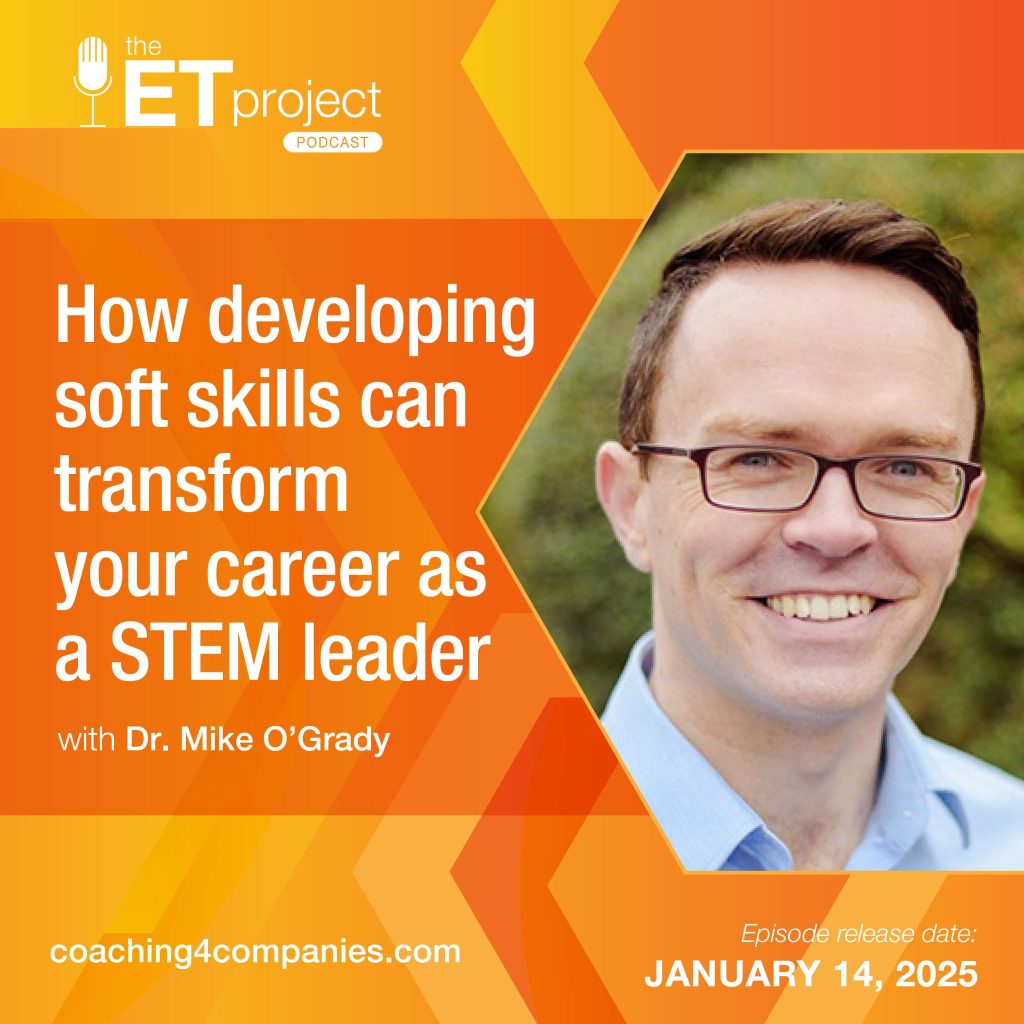
0:00:04.7 Wayne Brown: Hello, I’m your host, Wayne Brown. Welcome to the ET Project. We’re delighted to be delivering this podcast through executive talent all over the world, who we’re affectionately referring to as team ET. Today we’re in Cork, Ireland visiting our guest, Dr. Michael O’Grady. Dr. O’Grady is a STEM leadership and productivity coach, and the founder of Be Wise and Rise, a company dedicated to helping leaders and managers in STEM industries achieve high performance without burning out. With diverse experience spanning semiconductors, medical devices and construction, Mike empower STEM managers to design systems that help them regain control, reduce stress, and focus on what truly matters. He believes true leadership goes beyond managing tasks. It’s about cultivating the mindset and systems that allow both managers and their teams to thrive. During our conversation, we explore many topics related to the broader subject of STEM. Team, if you’ve ever wondered about the role or influence of the STEM industry and the struggles of leaders in this area, then tune in as you’re likely to find many answers. Let’s dive in together.
0:01:20.3 Announcer: Welcome to the ET project, a podcast for those executive talents determined to release their true potential and create an impact. Join our veteran coach and mentor, Wayne Brown, as we unpack an exciting future together.
0:01:34.1 WB: Hello team. Welcome to another episode, another weekly episode, and today we’re going to be discussing or taking a look at least into the world of STEM and STEM leadership. STEM is a really important field, it’s expanded significantly over the last couple of decades, and to the point where it now not only encompasses the four words that STEM stands for Science, Technology, Engineering and Mathematics, but it also includes a number of sub-fields and interdisciplinary studies. This emphasizing the interconnectedness that we have between the sciences and the technologies in our business space today. So I think it’ll be a great conversation. I’m hoping we’ll highlight some of the crucial things around strategic leadership, moving beyond that firefighting, that immediate reaction of firefighting and looking at how we can transition into more of a strategic role. You will have heard me introduce our expert guest, Dr. Mike O’Grady. Mike’s here to help guide us through this journey and through this exciting discussion. So, Mike, welcome to the ET project.
0:02:48.9 Michael O’Grady: Thanks, Wayne. It’s great to be here.
0:02:50.9 WB: Let’s capture a little bit of your background and probably what sort of interested you in the first place to bring you on this path in your career?
0:03:00.9 MO: I don’t think when I started out, I’d have ever envisioned that I’d be where I am at the moment in terms of the decisions and the career path that I’ve taken. But when I think back to when I was in school and even younger, I’ve always had an interest in like building things, computers, trying to understand things from scratch. When things are not working, I was normally the guy at home who would fix the computer or the piece of equipment and get things back up and running. And so that kind of principle or that curiosity to understand how things work and fix things has always been with me from a very young age. And I’ve brought that kind of attitude and that principle with me throughout my career. I was drawn into physics in particular going into third level education, and primarily because I just thought it was a foundational skill to have no matter what industry I was going to go into, it gave me quite a broad amount of knowledge. And from there I kind of expanded into various industries such as semiconductor industry, medical device industry, and construction. So my experience and my knowledge is broad in many different industries, but also quite specialized as well in certain technologies. So I’ve had an exciting career so far, and I’m looking forward to continuing to work with brilliant leaders and professionals in STEM, both in my career and in my coaching practice.
0:04:43.4 WB: I’m sure most people listening will know this term, STEM, Science, Technology, Engineering, Mathematics. Why is it so popular?
0:04:54.3 MO: I think what’s happened is that over the last 100 years or so, industrialization and now the technological revolution, we’re depending more and more on various different technologies in order to, for us to carry out the work that we do and do it efficiently. And so the more that we look into trying solve problems and bring solutions into the world, it requires us to have both the knowledge but also the skills to be able to investigate and understand problems and develop products and solutions that make the world a better place really, and make our lives easier. That’s the idea anyway. But somewhere along the way, things can be challenging and stressful and things like that, but STEM is here to stay and it will continue to grow and evolve depending on the need and what we need in the world.
0:05:58.4 WB: I think in the last decade. It now encompasses economics, it encompasses accounting, and I even saw a new acronym, which is STEAM. So they’ve added an A, which is for the arts. It’s really becoming all encompassing. I’m not sure if that dilutes it or it actually strengthens it, but I think everyone’s jumping on the bandwagon now because they see that it is so powerful.
0:06:26.7 MO: And I think that’s a great sign to see that there is that connectivity between art and science and engineering because there is a creative aspect, obviously in art, but also in the way that engineers and scientists and leaders in STEM have to come up with solutions to different issues and develop products and technologies. So it’s good to see that that gap is being bridged and there’s a way for that to happen. So that’s fantastic.
0:06:55.1 WB: Yeah. From a coaching perspective, there’s the social sciences as well. So it’s not only the hardcore science that we all think about, the physics, the chemistry, the biology, but there’s also the behavioural sciences, psychologies and everything that fall under this umbrella now. And I think it’s truly a fascinating area. It’s very broad, of course. Which made me wonder, when it comes to your approach, do you focus within your coaching and within the areas that you work with your clients? Are you focused on any specific disciplines?
0:07:38.0 MO: It depends on what the client needs in the moment, but primarily I’m looking at helping people improve their workflow in teams and in companies. So I start with the individual and get them to be more productive, more efficient with their time, understand what are the biggest goals that they’re looking to achieve. Both individually in their career, but also their team and in their business. And so when I have an understanding of that first, then it’s easier to then ask the question, “Well, are they getting there well? Are they getting there efficiently? And what could be getting in the way of achieving that?” And so there’s various different aspects I look at. I look at what kind work they’re doing, what’s their process, how much time that they’re spending on certain things, are there interruptions in their day? But then also on an individual level, is their well-being affected? Are they stressed and are they procrastinating? So there’s human behaviour aspect that impacts our ability to get things done. And so we need to look through a holistic lens, and that’s the approach that I take.
0:09:01.8 MO: Is to understand how someone’s individual health and well-being is, is it affecting other parts of their life, their family, their relationships with their wife, their kids. And so I start holistic. I start big picture and then focus in on what is it that they’re looking to achieve. And the most focus is on having a successful career in which they’re achieving their goals, growing as a leader, not at the expense of their health, not at the expense of the relationships with their family, but that they can have both. They can both in balance. And so that’s my vision and that’s what I hope to help other people achieve in their life.
0:09:49.3 WB: So if we think about leadership in the field of STEM, are there any specific characteristics of a leader, skill sets perhaps that are most prevalent that you find that sort of jump out?
0:10:07.0 MO: I think that’s a really important question to ask and have the answer to. And that’s the answer to this question is something I wish I would’ve known early on in my career. And that’s the definition of what a leader is, particularly in the STEM industry. And I believe it’s a little bit different to what other industries are because we rely so much on technology today. We rely on people in teams to have expert knowledge on certain technologies and processes. And so we have leaders who lead the knowledge and the process, the process managers essentially. And we cannot have traditional leaders knowing that level of detail that individual expert knows. The team lead needs to rely on that person to support them with the technical expertise and the information to be able to see things at the big picture, but then bring in the technical information to make the right decisions for the team and the business. And what I didn’t know early on in my career was that it’s so important in STEM to identify as being a leader. Even if you’re not leading people directly through the traditional route, you are in fact leading in a very different way.
0:11:38.7 MO: You’re leading through the process and the knowledge and the technology, and that requires understanding who are the people that need to know about what you do, how it impacts the other people in your team. So it is important to develop the soft skills as well as the technical skills as a leader, no matter what type of leader you are. And so I think that’s what more and more engineers and scientists and professionals in STEM need to understand is having the balance between the technical skills and bringing in the soft skills. It’s the soft skills that’s gonna accelerate who they are and how they lead and how they make an impact in their team, in their business. And that’s something I wish I understood earlier on and valued earlier on. It’s great knowing the technical skills, but it’s even better when you can make an impact with what you do. And most of the time, from what I can see, it’s bringing in those soft skills that’s gonna really make the difference.
0:12:42.9 WB: Now, when you talk about soft skills, you’re talking about things like communication, empathy, perhaps? Like EQ, these sorts of areas? Is that your meaning there?
0:12:56.2 MO: Yeah, it’s about being able to be a clear and confident communicator with different personalities in your team. We all have different perspectives, we all have different knowledge, but it’s about being able to bring to the table what you believe to be true. And to be able to listen to what other people’s perspectives on what they know and what they believe to be true and have the ability to change your mind with new information and not be so identified with your original perspective and opinion. So it does take a bit of humility at times to be able to know that you’re not always gonna be right and other people will be right. And it’s not about you being right, but it’s about discovering what is right, what is true, what is the correct answer, and so having that discussion with other people is a great way to facilitate that discovery of the truth of the right information. And so that is being able to introspect and understand yourself and where you might have blind spots. Other people have their blind spots, but then it’s also as well dealing with disagreement and conflict, which is naturally going to come up ’cause we all have reasons to defend our beliefs or our opinions, and so knowing how to handle our emotions in those situations and being able to be constructive to get to the right end goal is a great skill to be able to do.
0:14:28.9 WB: Yeah. If we role play a little bit, maybe hypothesize a bit for a moment and explore what are some of the ways that leaders can leverage not only the soft skill, but things like resilience, a whole raft of characteristics or competencies that they have as they lead, in particular, as they start to work with their team to try and develop their team and the business.
0:14:58.7 MO: In terms of resilience, I don’t think there’s a clear definition of what that is, but I will bring to the table what I see as being the important factors of resilience. So resilience is the ability to be able to bounce back if you are being knocked down, which does happen at times, it’s your ability to handle stress and pressure. There’s many factors that are important that I believe needs to be taken into account, and one is managing your workload, managing your time effectively, managing the conversations with people effectively, but also being able to have the right tool set to know when your stress levels are increasing, when you need to take a rest, when you need to have a practise maybe in your day to be able to withstand the stresses normally. So you need preventative tools as well as tools that will help you resolve triggers and stresses that naturally will occur in your day to day.
0:16:00.5 WB: So let’s imagine that I’m a leader and I’m coming to you for some guidance, and I’ve recognised that I need to transition from where I am. I’ve seen that I’ve become too reactive. I think you used the firefighting analogy quite a lot, so you could say, I’m living in this firefighting mode and I know I need to transition out of that. I’m not sure to what. I can sense that I’m starting to go down that path of being burnt out through the effort. If I come to you with that scenario, where would you start with me? How would you offer support or guidance about where we go from there?
0:16:45.2 MO: Great question. I would start with asking what they’re doing. Basically do a review on what they’re doing day to day, where they’re spending their time and their energy the most. Where is it in the day that they’re feeling most drained? Is it true doing certain tasks or is it in meetings or is it dealing with certain personalities? It can vary from person to person. So being able to get a good picture on the level of the workload, the energy, how it peaks and drops throughout the day, and what they’re currently doing in order to prevent the stress or resolve the stress. Trying to get a big picture first and then focusing in on where is best to, where’s the root cause and what needs to be resolved first.
0:17:38.3 WB: Starting with that holistic image of where we are. You also touched on earlier about the mind body, and I’m guessing that’s gonna come through this discussion, but there’s a thing you practise, I hadn’t come across it before, it’s called mBraining. I’m wondering if you could just introduce what that is and how you use that when you’re working with your clients.
0:18:06.0 MO: Yeah. MBraining is a powerful tool that can be used to help people make better decisions, think more clearly, and process their emotions more effectively, individually and with other people. It’s a fantastic tool as a leader to become more authentic and more confident in your communication. I remember times in my past where I’ve made mistakes not being able to think things true, and I would regret it then, later on I noticed the mistake that I made, or I said something reactively. There’s things that you can do with the mBraining to help being able to understand where did that come from and change the behaviour or the pattern that’s causing that blind spot or negative thinking or outbursts or negative kind of behaviour.
0:19:04.1 WB: Okay.
0:19:05.0 MO: So it’s about understanding how we think, how we feel, and how we behave in a holistic sense. And mBraining looks at that, both from a human behaviour aspect, but also a neuroscience aspect. There were a lot of studies done on this, and there’s a fantastic book on it as well, if people are interested. I’m sure… I’m just trying to remember. I think it’s called mBraining is the name of the book. Loads of case studies around people having different examples around how people think with their head, their heart, and their gut. So they have three brains.
0:19:45.8 MO: The head, the heart, and the gut, and what they were able to find is that there’s different neural networks that are in the heart and the gut that have memory in it and functions in it. And it’s really, really interesting. So the people that were studying this were able to find that there’s common prime functions that determine what a healthy gut does, what a healthy heart does, what a healthy head does, and what happens when they go out of balance. They were able to map it all out and create a system that helps people become better leaders, better communicators.
0:20:21.9 WB: Right. Sounds interesting. It’s a popular discussion topic at the moment, the three brain theory, right? And there is a lot of growing evidence around the gut. If somebody comes along and they’re stuck in this complexity, how do you work with them? Are there any specific exercises that you use to help people move forward?
0:20:52.3 MO: So one important aspects of the mBraining system and how it operates is the autonomic nervous system. And what is important when we are operating in a balanced fashion is that this automatic nervous system is not in a sympathetic state or a parasympathetic state. So a sympathetic state would be like a kind of fight response, alert, awake, parasympathetic state could be relaxed, maybe even apathetic, disengaged.
0:21:31.1 MO: So there’s different times where we might be in those different modes throughout our day, either naturally or that we’ve been programmed based on a survival mechanism to be in that state when certain things happen in our environment. And so when we want to bring ourselves back into balance, one of the key tools to do that is your breath. And so we use different breathing patterns to be able to bring you out of imbalance and back into balance again. And so it is possibly one of the most powerful but simple tools that we can use throughout a coaching practise or throughout our day when we notice we’re out of balance and we can use that.
0:22:20.5 WB: Yeah, great tip. I’ve had guests on the show talking about that before as well, so thanks for reminding me on that. Earlier when you were talking about the mBraining, you mentioned the role it can play in helping with decision making, and I know you put some work in on helping leaders simplify their decision making. I wonder if you could speak a little bit to that as well, if you don’t mind.
0:22:46.7 MO: Yeah, absolutely. So one of the first things that people need to get clear on is what are the goals for the business? What are the goals for the team and for the individual? Most of us tend to operate with different goals and different priorities, and so it’s really effective to have a conversation with your manager or with your team or with the business owner to get alignment with what’s most important and being able to determine some sort of a framework, ideally a priority setting framework that can happen at a business level, a team level, or an individual level.
0:23:29.3 MO: So that when you are doing your own work throughout day to day, you know what is priority. You can use this framework, which initially is written down, but over time becomes an automatic framework that you can refer to to be able to make decisions on what’s priority, what needs to be done now, what can be done later, what’s important, what’s urgent. The Eisenhower matrix is the common matrix for determining that. But what you want to be able to do is to do that automatically at some point. Initially, when you’re relearning how to make decisions, you kind of have to go slowly step by step. But as you do it over time, it becomes automatic, it becomes muscle memory, and you start making decisions more effectively.
0:24:19.0 MO: So a useful way to approach it is to look at examples of where you notice that you made some poor decisions or things didn’t turn out the way that you would’ve liked. And to reverse engineer that and look at, well, where did that start? And what was the thinking pattern behind that? What information did you have that led you to make that decision? Was it a rational decision? Was it an emotional impulse? What was it exactly? So just trying to understand the pattern of thinking, the pattern of the emotions, the feelings and the pattern of behaviour that led to a decision, that led to some sort of an action that had an outcome that you didn’t want.
0:25:07.9 MO: So that’s where looking at mistakes or failures can be really, really productive. If you’re willing to go there, you’re willing to look at them and go, well, what, where can I learn from this? And what can I change to make myself better? Should this happen again? And by doing that, by looking and reviewing and setting new goals and new patterns of thinking, feeling, and behaving, you evolve your ability to make more effective decisions, which benefits you, the team, and the business. So yeah.
0:25:44.7 WB: Yeah. I was just thinking while you were speaking there, where does innovation and creativity then fit in this mirage of activity? Like becoming better in decision making frees us up to be more innovative and creative? Is that part of the flow or how do you see that?
0:26:06.9 MO: So yeah, great question. It’s important to have the foundations of what keeps a team or a business running, to understand what makes money, what keeps clients, customers happy. They’re the priority, right? Making sure that you have efficient processes in the business and in your team that you can maintain and so that you can reliably achieve the results for the customer or the client. I see that as like being the foundation and the innovation and the creativity comes from the opportunities that are identified when you are willing to look at the issues that happen in day-to-day business.
0:27:00.0 MO: Having some sort of a system that you can capture the mistakes and then review and investigate those mistakes and implement some sort of a corrective measure in the business can make your kind of foundational systems, your maintenance systems work more effectively.
0:27:19.8 MO: But then you can also look at the mistakes and go, well, this is where it gives you ideas of how you can make things even better, not just fix the problem, but how can you achieve a better outcome than what you’ve been doing already? So the better outcomes, the opportunities, the innovation can come from looking at mistakes, but also from different people’s knowledge in the team, in the company. If you can capture that in some sort of a way that you can review it on a regular basis, you can bring that into the business.
0:27:57.3 MO: So what I’m essentially saying is you got to look after the bread and butter, which is like, I see like 80% of the business, let’s say, is maintenance, looking after, making sure things keep running smoothly, but give yourself some wiggle room at a business level, team level, and individual level to work on something that’s going to either improve your processes, the team’s processes, the outcome for the client. It needs to have both.
0:28:24.2 WB: Okay. And, you know, feeding off that, I know you do a lot of work with clients or leaders on developing high performance. Now, whether that’s for the leader themselves or for their teams. So I guess all of those factors are part of that high performance creation. Are there other elements that we need to be aware of for creating that high performance?
0:28:52.1 MO: So I look at high performance needing to happen on an individual level first. So you can’t bring high performance into a team, let’s say, looking at it through a lens of a leader. The leader needs to take responsibility for what they’re doing and optimize that first. That’s how I kind of see it as like optimize your own workspace first and allow it to expand out across the business.
0:29:24.8 MO: So this can happen at like, whether you’re a manager or you’re someone working in a team, you can first of all, get your things in order first and allow it to grow out by driving innovation yourself. So if you have a case study where you’re showing that you’re getting significant improvements, you can bring that case study to be introduced to other elements of the business. You can basically drive innovation that way.
0:29:51.9 MO: There’s also like different aspects of the culture that might need to change in the business, whether you want to enhance the relationships or the ability to be able to be open and honest around the level of communication. And so the level of collaboration within a team environment, that I see kind of happening after you get things organized, things moving in a nice organized fashion, you can bring in more of the culture.
0:30:22.0 WB: I mentioned at the very beginning about this interdisciplinary nature of STEM, meaning there’s this crossover between the sciences and technologies. And how much do you focus on this with your clients, encouraging them to integrate the knowledge and their skills across these different aspects, science, technology, engineering, mathematics? Do you place an emphasis on having this broad application?
0:30:53.7 MO: It depends on what the person’s individual goals are for their own career development and leadership development. And everyone’s different. Some people want to develop their technical skills and possibly even move into a different area to develop a different technical skill set that may even complement what they’re already doing. And some people will recognize that they want to possibly go into a management role and develop the soft skills associated with that.
0:31:27.1 MO: Because often what happens is that engineers will get promoted into management roles without any formal training. And it’s often expected that they will carry out the duties of an engineer, as well as the duties of a manager, and they both can be very different skill sets. And so depending on what their goals are, where they’re right now, might determine the amount that they need to branch into different areas or industries. It may be that they want to stay in the same industry, it may be they may want to even go to a different industry and bring that skill set into it, which could be a unique advantage for that industry. So yeah.
0:32:14.2 WB: How do you advise your clients, leaders in particular, in terms of staying current? Is this something you think they need to do? What’s your approach with the technology?
0:32:28.6 MO: I look at the skills that people need to develop based on the outcome that they’re looking to achieve. And that may be that they’re looking to move into a different industry or maybe that they’re seeking a promotion to a different role and maybe looking at developing management skills. One of the key technologies we are all facing today is the introduction of AI and our dependency on AI. I don’t see any way of us not using AI and it would be foolish not to use it or not to learn it. So looking at technologies that can help us do our job more effectively, like this, is something to consider. So yeah.
0:33:21.4 WB: If you look, I don’t know, maybe a decade is too far out with the rapid change that we’re experiencing, but if you look to the future, are there any skills, the leader, you believe at least, the leader is going to need to maintain or even thrive going forward? I know you’re probably not a futurist, I put you on the spot, but is there anything that comes to mind?
0:33:53.6 MO: I think I go back to my point earlier that the majority of engineers and scientists, and people in IT and roles, the majority would be of the need to develop soft skills. Whether they want to or not is another story. Some people are incredibly dedicated to developing their technical skills, and that’s the path that they’re going to take and continue to take. And we need those people in our teams as well. We need people who are absolute experts at what they do, and we as leaders also need to know how to connect and relate and help bring out that knowledge from them so that we can achieve our best.
0:34:42.1 MO: So anything that’s going to help you communicate more effectively, handle conflict better, develop the relationships with people in your team, anything in that space is going to benefit leaders in STEM massively. And I think that’s always going to be the way, as long as we’re working in teams together, we’re going to be working with people, there’s no way around that. If we’re going to be working with people, we need to be able to have trust, we need to be able to communicate effectively. We need to be able to handle disagreements. And so no matter what technology you bring in, and no matter how good you are technically, if you don’t develop the soft skills, you’re leaving a bit of a gap there in terms of how much of an impact you can make for your team.
0:35:33.6 WB: Right. So with that said, I always like to ask the guest, is there one actionable item you would recommend our listeners to consider doing that’s going to help elevate their leadership and improve their team’s performance?
0:35:54.9 MO: The one thing that I would recommend doing is getting an audit done on the activities that you’re doing on a daily and weekly basis so that you can look at it from a big picture to understand where you’re spending most of your time. Now, it may be that you’re working on something that’s not giving you the impact in terms of achieving the goals that you want. And so by doing this exercise, by doing a time audit, you can look at it and go, do I need to change my priorities? Do I need to focus a little bit more on what’s most important? And it’s often that we’re getting dragged into doing things that need to be done immediately, or we believe it needs to be done immediately. And so being clear on what’s priority, what’s your number one goal, reminding yourself of what that is every single day, and using that as a filter to make decisions on a daily basis, that alone is going to make a huge, huge impact in terms of how much time and energy you have in your day.
0:37:05.2 WB: I like that. We did an exercise a couple of years back now looking at when are we most effective during a day? And the results were quite astounding, I have to say. So we came out of that with each individual knowing, okay, probably the majority were morning people and they were most effective in the morning, but being able to nail exactly what they were most effective at during that point in time was really, really game changing. So to your point, I like that very much. So do a time audit on how you spend your week, your month, et cetera. Very, very nice. So Mike, what is it you’re doing now and looking to do in the future? Anything on the horizon?
0:38:00.4 MO: Well, in the past I’ve been working with leaders in STEM with productivity, sorry, not productivity, with leadership development and career development. But in 2025, I’m putting more focus on offering productivity and time management solutions for leaders in STEM. And so yeah, I’m very excited about that and bringing a holistic product that will help leaders grow in their career and make an impact in what they’re doing on a day-to-day basis while being balanced, while enjoying and loving what they do.
0:38:41.0 WB: Yeah. Where can people go and connect with you and learn more about what you’re offering and what you’re doing?
0:38:49.6 MO: If you’re a leader in STEM, whether you’re a manager or a high achiever and you’re looking to reclaim more time in your day, you want to have more energy, you want to achieve bigger results more effectively and faster, then I’m offering a free time audit. It’s a 30-minute consultation where I will help you identify your biggest time leaks and identify where are the areas that would give you the biggest return in terms of reclaiming your time. And so to do that, all you need to do is just go to my website, it’s bewiseandrise.com and you can book your free consultation.
0:39:36.8 WB: Perfect. Well, we’ll definitely put the link in the show notes. So are you active on any of the social platforms apart from…
0:39:47.4 MO: Yes. You can also connect with me on LinkedIn. That’s the best place to find me. If you have any questions, you can do that or you can email me at mike@bewiseandrise.com.
0:40:00.5 WB: Well, Dr. Mike O’Grady, thank you very much, sir. It’s been a pleasure talking with you. I think it’s a fascinating field looking at STEM by itself, but incorporating leadership under this STEM banners is a fascinating discussion. So thank you very much for being with us and helping all of our listens on the ET Project to understand more. Much appreciated.
0:40:23.9 MO: Thank you. And it was thoroughly enjoyable. I really, really had a great conversation with you. Thank you.
0:40:30.7 Announcer: Thank you for joining us on the ET Project, a show for executive talent development. Until next time, check out our site for free videos, eBooks, webinars and blogs at coachingforcompanies.com.