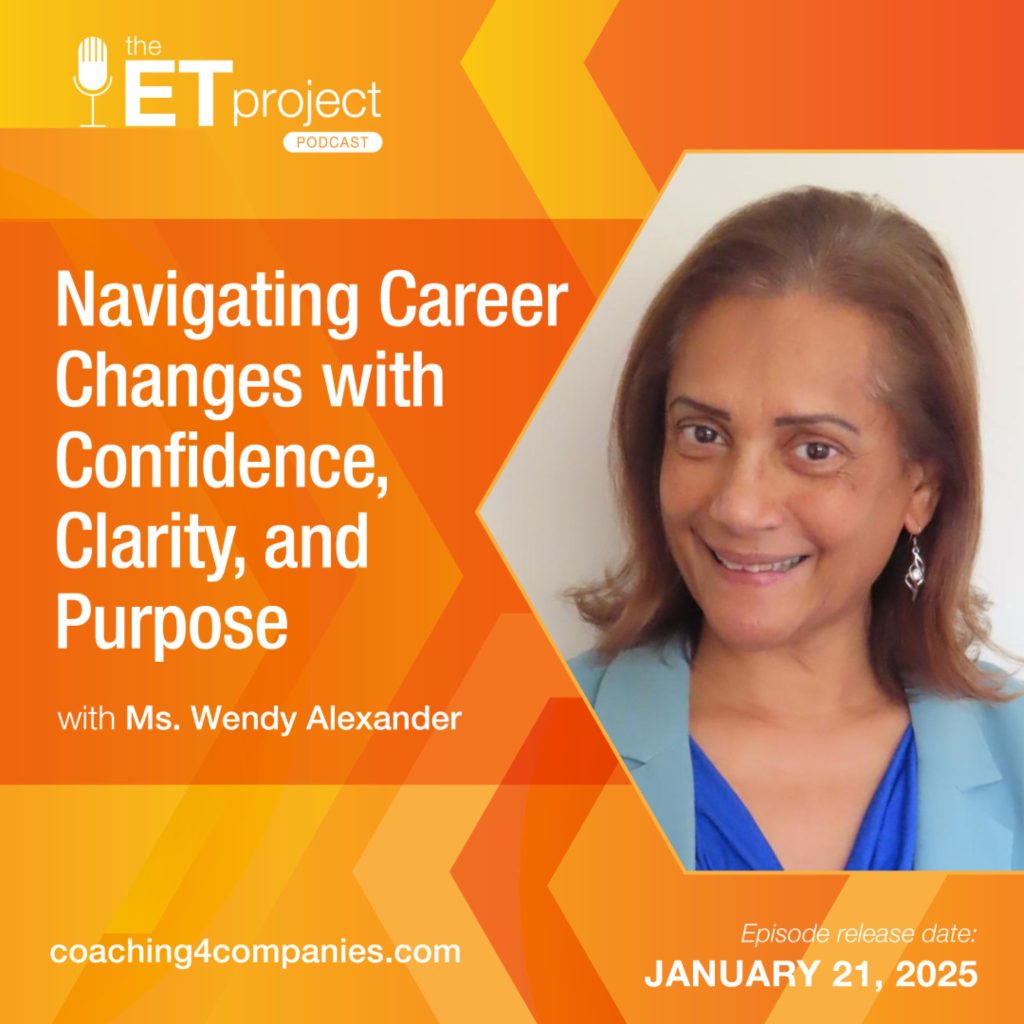
0:00:02.0 Wayne Brown: Hello, I’m your host, Wayne Brown, and welcome to the ET Project. We’re delighted to be delivering this podcast for executive talent all over the world, whom are affectionately referring to as team ET. Today we’re back in Melbourne, Australia, and we’re chatting with Ms. Wendy Alexander. Team it’s early in the new year, and I suspect many of you are working towards that career transition or job change, and therefore, you’re likely to find this conversation particularly valuable. Wendy is an interview and career coach who helps people look so good that hiring managers just can’t ignore them. She was stuck once not knowing how to get out of a financial and emotional mess after a relationship. Breakup left her a broke single mom drowning in debt, but things changed when she changed.
0:00:50.4 WB: She invested in herself and found mentors and the supportive community to turn her mess into success. And there’s been plenty of hiccups along the way from growing up, a woman of color in Apartheid, South Africa, to being held up at gunpoint in her first job in Australia to a horrid time with menopause and more than her fair share of health challenges, but she beat them all. Now she runs her company on her terms and helps professional people fearlessly get the job they want, negotiate the income they want, and ultimately the lifestyle they want. Team It’s a powerful discussion for everyone, and even more so for those wanting to make 2025 a year to look back on fondly as a new milestone of achievement, a turning point perhaps in their professional life. Please sit back and get ready to enjoy this conversation.
0:01:44.2 Speaker 2: Welcome to the ET project, a podcast for those executive talents determined to release their true potential and create an impact. Join our veteran coach and mentor Wayne Brown as we unpack an exciting future together.
0:02:00.3 WB: Hello team. Welcome to today’s episode. You will have heard me introduce our guest career coach and expert, Ms. Wendy Alexander. Wendy, welcome to the ET Project.
0:02:11.4 Wendy Alexander: Hello. It’s wonderful to be here. Thanks for having me. Wayne.
0:02:15.5 WB: When we first met, I know you said you’ve been based in, Melbourne for a reasonable length of time, actually. I’m wondering, do you call it home now because you’re not originally…
0:02:25.6 WA: Oh. Absolutely.
0:02:26.8 WB: Where do you hail from?
0:02:29.8 WA: Okay. So I hail from Cape Town in South Africa, and I left Cape Town a few months shy of my 21st birthday. So I am more Aussie now than I am South African. I’ve been in Australia longer than I’ve lived in Cape Town. So Australia’s home. Absolutely. My parents are here and my siblings are here. That’s right.
0:02:53.9 WB: If you Could walk us through, the experiences and the challenge that have brought you to where you are today in terms of being a career coach. What’s the journey look like?
0:03:04.0 WA: Okay. So the journey into career coaching actually started out of my own challenge over 27, 28 years ago. I was in a relationship, which ended badly and I was pregnant at the time. And so as I came out of that, there was a financial mess because he walked away from all responsibility and the house was sold at a loss. And I was left with the debt, so to speak. I was left with the holding the baby, both the baby growing in the belly and the financial baby. And so once I gave birth to my daughter, I did an evaluation and I was like, “I have to start over. And I don’t know how to do this, but at the time, I was only driven by one thing and it was, I need to make more money.”
0:03:58.9 WA: I have a daughter to support. I have debt to pay off from this house, and I need to make more money. What I’m earning annually is not enough. And so I identified my sum that I needed. I started to play around with my resume, but I didn’t really have the steps on where, how I went forward. And so I actually approached some hiring people in the company I was working for, approached some of the HR people, but I also was looking at going out and contracting because I heard that contractors make more money. And so I ended up talking to recruiters. I just rang them and I started to pick these people’s brains. I had regular coffees with numerous hiring people and numerous recruiters, and I would just say, “How do I get better? How do I position myself to be able to earn more money? Which roles pay better?”
0:04:56.8 WA: All of these kinds of things. So it was an experiment that probably lasted for about six months. And so it was a matter of refining the resume all the time, talking to the recruiters, testing it out in the market, getting some interviews, and one of the ones that was going to pay me the kind of money that I needed, I landed the interview. I did not get the job offer. So I went back to the drawing board, went back to the recruiters and said, “This is the feedback.” And I did manage to get feedback. ’cause sometimes you don’t get feedback from the people. And so I got feedback and they said, “Oh, you just needed to be stronger in these areas in your interview.” So then I practiced with people, and then went back out to market again and I landed another interview.
0:05:44.7 WA: And this time I got the job and the income that I was going to get was double what I needed. And I thought, “Okay, something’s great here.” So I had, I suppose, a framework that worked for me, and went on into this role. And then the people around me, mostly the family, the friends and the colleagues, saw that I jumped quite significantly. And so they came and started asking me for help. And that is in fact how the business was born. I started to help other people do what I did. And at the same time, I kept, I never stopped talking to recruiters and hiring people because I was always trying to refine and learn and get better and also learn how to negotiate when I was in the jobs. Asking for things that I needed, like at the time I needed support as a single mom.
0:06:38.6 WA: So when I would interview with these companies, I would say to them, well, “How do you support single parents?” And I was quite forthright ’cause I said, “I’m interviewing you as much as you interviewing me, and if I can’t get the support as a single parent, then this is not the role for me.” So sometimes you have to be quite upfront. But I found that that actually worked. I found being upfront, asking directly for what I needed actually worked, but there is a caveat with that. And the caveat is that you have to perform, once you get what you want you need to demonstrate to the hiring people that you can perform, that you can deliver. And I knew that right off the bat. In fact, some recruiters gave me that advice and said, “Now you’ve got to deliver, deliver quickly so that they trust you.”
0:07:30.5 WA: Because once they trust you, they then give you all kinds of things. So I was working from home 27 years ago when it wasn’t fashionable because that’s what I negotiated. I asked for that. I negotiated, I was very clear in what I needed as support as a single mom, and those are the frameworks I started to put in place and share with other people, to show them exactly what I’d done. And other people started getting similar success, doubling their income or any of those kind of things and being able to negotiate for the perks and the pay that they wanted. And so the business was accidentally born. The career coaching business was an accidentally born business, but I did it as a side business for 20-something, probably 20 years, alongside the corporate business. So I was a single mom, had the side gig and the corporate job.
0:08:22.4 WA: So busy woman. But it was the way, it was the way I liked it. When midlife came for me, which comes with all those female challenges, the body changes, all of that, I found that I wasn’t as happy in corporate anymore. And so I ended up leaving corporate and took my coaching business full-time. So I’ve been five years full-time in the coaching business. So that was the journey it was dictated by life and some of its changes and some of its challenges that made me go down the paths. I went down.
0:08:58.3 WB: What I picked up a couple of things that you mentioned earlier in that conversation then was you were very intentional about the job you were looking for. So, what we experience a lot at the moment is people apply for 10 jobs, 20 jobs, 30 jobs in the hope that they land something. It sounded like you, you took a different approach. You did your research, you did your preparation, which we’ll talk more about. And you were then very intentional about the jobs that you actually sought out. My own experience is when I see people come requesting a job, it’s so obvious if my business is just one of many that they’re trying to get their foot in the door with.
0:09:49.2 WA: Yeah, absolutely. And look, this is one of the things, one of the foundational pieces that I do with every client who comes to work with me is I take them through a process called Mining Your Story. And I actually still do that on myself. I started that process at framework many years ago, and I have this ritual between Christmas, so Boxing Day to New Year’s Day. I spend those few days going through that process myself. Because what I know is that every year certain goals change or I’ve accomplished certain goals from the year before and I wanna try out something different. So I take myself through this foundational piece. And the mining your story is all about looking at the patterns in your life that inform you about the things that bring you joy, that all that come naturally to you that you could literally do in your sleep because you’re so skilled at it that you don’t necessarily think is a great skill because it’s an automatic skill for you, but that you could, if you package it up, becomes very valuable to someone else.
0:10:58.1 WA: So I do that. I look at all that I’ve overcome, because within what you overcome both personally and professionally is resilience skills are all the other skills that would be valuable to any company. And then I also look forward, I go, “Okay, what is it that I wanna experience next year? I’ve done this, I’ve ticked that box, I’ve had these goals and I’ve ticked it. So what else is there?” Because I think if you don’t evolve and grow, that’s how people become stagnant and stuck and dissatisfied and discontented. And that includes in their career or especially in their career, if you’re not growing, if you haven’t identified what’s your next level or where else do you want to contribute? And sometimes it could be a sideways move rather than an upwards move. And the sideways move is not a bad thing.
0:11:53.2 WA: Some people look at it as a bad thing, but sometimes the sideways move is the necessary move before you move up again. And so I go with through this process, but what I see, Wayne, is that quite a few people are resistant to doing the foundational pieces. And this is where I say to people, “If you don’t build solid foundations beneath whatever goal you are moving towards, it’ll crumble quicker than you can blink or you’ll end up once again settling. You’ll grab a job that you think is the one that you want because you’re like, I need something different. I’m bored, or you need more money and I need to change my circumstances.” And then two years later you are back in the same. I’ve had one or two clients come back because they didn’t follow the advice or they didn’t complete the whole plan with me, settled for a role.
0:12:46.3 WA: And then two years later they back, I get the phone call, I think I made a mistake or whatever, and I can almost foresee it, but people sometimes have to go on a journey. I never discourage people from going on whatever journey they need to go on to learn, but I can often, because I’ve been in the game so long, I can see it before it even happens. And so I say to people, get the foundations right. Identify what you need to identify about yourself, your skills, what you want to do, plan it out, so that you’re not willy-nilly applying for 50 jobs that have no meaning to you. ’cause the thing is, the moment you get to the interview, if you don’t have a genuine enthusiasm for that kind of work, it is going to somehow show. You’re gonna get asked a couple of questions and you’re not gonna be able to bring the energy that you need to bring.
0:13:38.4 WA: And most interviewers or seasoned people, they’ve been doing this for 20, 30, 40 years, you can’t pull the wool over their eyes. And so you have to be fairly clear that that is where you want to be. And sometimes you don’t have all the skills for the role, but you, the person that has to advocate and go, look, I don’t have all of the skills, but these are the transferable skills I have. This is where I’m really strong. And I’ve always been someone that can learn, build the job, advocate for yourself. So I see that often. And I encourage people to not skip the foundation pieces, do the planning, do the research.
0:14:23.5 WB: Great advice. I love this phrase Silver Tsunami. I thought when you first said it, you were just having a dig at my lovely colored hair. But, I’ve really gone in and looked at it and considered it myself. And I really, really like what it all means. And you introduced it when we were first talking as a trend that you’re observing with the older workers, the older workforce becoming more attractive again in the market. And I wonder if you could just build on that, for us, please.
0:15:02.6 WA: Okay. So, first of all, I’ll say that I’m also a silver girl. You can see you have other the sites, but I like a bit of color in the hair. So I’m also, I’ll also fall into the Silver Tsunami crew. What I’m observing is that, EQ skills have become incredibly important in the hiring trends at the moment. And what a lot of employers are recognizing is that those EQ skills are at their best in the older workforce. And that’s not to say we believe that younger people can’t have the EQ skills. The skills that required to lead people, to collaborate with people, to work through very difficult times and most projects hit difficult moments. And what they’re seeing is that, some of the younger generation are coming through and they haven’t yet gone through that real lived experience in the professional world.
0:16:05.7 WA: They haven’t had the super difficult project where you have to work it from all angles, workshop it from every angle, work with vendors and partners and clients to try and make it work. And so this is what I’m seeing is that, suddenly, my partner calls in gray hairs, the gray hairs are on the rise, and companies are looking for people with this experience. So people that have got at least 20, 30 years experience in the workforce, which is our generation, the midlife person and beyond, because they recognize that you don’t get that straight out of university. You don’t get that straight out of a grad or even someone who’s been 10 years in the workforce that comes with experience. And so it’s twofold. One is that they want the experience for the people, the gray hairs to drive the project, but the other is that they want to start developing their people.
0:17:02.8 WA: Which means the gray hairs become the mentors. They become the people that can teach the younger project managers or business analysts or whoever, whatever the title is, how to navigate difficult and challenging times. And this became a lot more prominent after the pandemic because there’s all this emotional resilience that had to be handled. People were in isolation for months on end here in the state of Victoria. We were the longest locked up city Melbourne across the world. So when people started coming back into the workforce or going back into the office, what they were noticing was that there was a lot of ineffective communication. Some people had challenges even socially with their colleagues. And so all of this is needed. And the ones that bring it are the ones that have already lived it, that have lived through these challenging times, overcome, worked through difficult projects, worked with bosses, gone through researches and all organizational restructures, all of these things. And so that’s why the Silver Tsunami, they call it, is on the rise because the gray hairs are now in demand. And so what I wanna do is encourage mid-level people to understand that their value has not diminished.
0:18:26.0 WA: It is in fact on the rise at the moment. This is what I’m seeing. The people I talk to and I speak to both clients who are helped get hired, but also hiring people who are looking for people. This is a trend that’s, that’s on the rise and I think it will continue to be on the rise. And also people are retiring later in life. A lot of people are going, “Well, I’m not ready. I have a lot to still give.” And it might be that they don’t want to work full throttle at 40 hours a week. They may be want to work 25 hours a week or 30 hours a week, but their experience is still valuable. Once you learn to identify those valuable EQ skills, the problem solving, the leadership, the collaboration, the building up of teams, all of these type of things. And you learn to sell that really well. There is plenty of room for you in the workforce, and it will be, so for quite some time.
0:19:29.3 WB: That will be music to the ears of many of our listeners. You actually frame it as a triangle, right?
0:19:37.0 WA: Yeah.
0:19:37.8 WB: So you have EQ, the resilience and the experience at each of the…
0:19:42.8 WA: Correct.
0:19:43.5 WB: Each of the tips. And when you look at that and you think, well, how, how is it that adversity is going to promote my growth as a, as an employee or enable me to work longer? If we look back at pre you coming to Melbourne, you lived in South Africa and you were there during the Apartheid period. That was an extremely tough period I think for…
0:20:12.3 WA: Yes, it was.
0:20:12.8 WB: Anyone in the country. What, what is it that that helped you as an individual develop in terms of resilience, in terms of focus?
0:20:23.1 WA: Well, look, I will say, my parents gave us very strong foundations. So obviously as a child, you don’t know that you live in this segregated country. You don’t know because you’re a kid, you’re playing in your neighborhood, you’re playing with your friends. You don’t know that there’s different neighborhoods for Blacks, Coloreds, Whites. You don’t know that there’s limitations in terms of opportunity. But once I learned about it, I was always a very curious kid, so I was questioning my father, well, how do we go forward? ’cause I’m classified as cape colored, which means, I had the White grandparents and the Black grandparents, so mixed race biracial. And there were limitations there. Only, you could only go to school in certain areas. University was so expensive that you knew your parents were never gonna be able to afford it.
0:21:20.5 WA: So I got into the University of Cape Town on a scholarship. I had to write an essay. Thank God writing was my thing. I loved writing. One of the ways I processed that whole environment was actually through writing. So I began journaling at a very young age because I didn’t understand what was going on. And sometimes the adults didn’t always give me the answers. And maybe it’s because it was too painful for mom and dad to give us certain realities. So I would write out things and I started writing poetry, and I would just journal and notice that I was able to sort of process, ask questions and go and research, look at the library books. Back then, it wasn’t internet, so it was library to find out what was going on in the country. But one of the lessons was my father from very young age had certain demands of us.
0:22:15.5 WA: And one was that you always gave your best. The other was that living in the harsh circumstances that we lived in was no excuse not to succeed. And he drummed that into us from a very young age, that we had to become the captains of our own ships. And it didn’t matter how stormy the waters were around us, you had to move forward. You had to navigate those waters. You had to find a way. And so it was instilled in us from a very young age. And so, even though I’ve been through numerous challenges in South Africa, post South Africa, I lived in the US for a couple of years as well. I always remember that dad was like, you can either be a victim of life or you can be a victor of life. You decide, and for him being a victim wasn’t acceptable.
0:23:10.6 WA: So in the end, it wasn’t even a choice. ’cause dad was just like, “No, I know this is difficult, but there’s a way forward. What is the way forward?” And so that was instilled in us by both my parents, but more so my father. And I think it’s because my father was orphaned at a very young age, at age four, and he was grew up in an orphanage, so he saw some tough times. Not having parents and things like that. So dad didn’t accept that we just became victims of life. And he put those thoughts into our brains from a young age. And in post that time, I’m not saying I haven’t been through hard times and haven’t do, I call it duna diving. I have duna dived where I wanted to hide away from our problems and gone under the duna and cried my eyes out and all of those things. But it never lasted for long, because at the back of the mind was always the, you either victor, victor of your life, or you’re a victim of life, decide. As simple as that. I’ve always only been, there’s the angel and the devil on the shoulders that dictates the way forward.
0:24:22.4 WB: Listening to the journey that you’ve been on and the advice that you got from your father, it’s really framed that resilience that I can sense in you as an individual, when you work with your clients, how do you help them become more resilient? How do you encourage them to be able to shift in this direction?
0:24:44.1 WA: Well, one of the things I always encourage my clients to do is to take it one step at a time. ’cause what I’ve seen in life is that sometimes when we go through huge challenge, we feel like we need to fix everything all at once. And I’ve never actually seen that work. I see that people become extremely overwhelmed. And so then they take no action at all. So for me, my motto and my way of working with people is we take one step at a time. We identify the most important next step. So for example, if you decide I’m bored in my career, or I hate my career, or my boss hates me and I’m never getting promotions, and so on and so on, perhaps the first next step is to identify why you want the career change. ’cause you do need to know what’s motivating you.
0:25:39.4 WA: We need to always identify, I think Simon Sinek calls it identifying your why. Why do you want to have a career change? ’cause if you don’t have a strong enough motivating factor, you’re gonna give up at the first sign of challenge. I’ve seen that over and over. So that’s the first step. The second step is, okay, what do I have to offer the world? I wanna move into, say for example, you’re a doctor and you want to move into health technology. What’s the skills that goes from here to here? Identify that. And the next step would be, okay, how do I frame up these skills so that I can sell myself from here to here? And what help do I need? Because sometimes you can’t do it on your own. I did not go where I am now.
0:26:33.0 WA: I spoke to the recruiters, I spoke to the hiring managers, and I also worked with a couple of coaches. Now, what I did was, at the time when I lost the house and I was pregnant and all of those things, I didn’t have the money. But what I would do with the coaches is I would, the ones that I found and that I really wanted to work with, I said to, I would say to them, What is your fee?” And they’d tell me, and I said, “Look, I can’t afford to do that right now, but how long does this fee hold for? Is it for six months? Is it for 12 months?” And I would actually get them to commit to keeping that fee at that price for me. And then I would go on my saving spree. So I would work out my budget and I’m go, I need to put $50 or $100 away a week so that I can afford that a coach in six months time.
0:27:20.4 WA: And these are all simple steps. So you identify what needs to be done, and then you break it down. And then I would do the commitment to my action steps, whatever the action step is. And for me in the, in the initial stages was I had to save X amount every single week. That was the thing. A ticket. Every week I’ve put the $100 away or whatever, whatever, and then I can go back and afford the coach. So that’s how, sometimes you have to break it down as simple as that. And understand that it’s a one step at a time. It’s a journey. If you try to take on all the actions that you need to do to have change in your life, you will overwhelm yourself. Your brain will switch off and say, Nope, I’m not doing this. This is too much. And then you’re stuck. You remain stuck. So for me, the simplest thing I say to people, and it’s what I do with them when I work with them, is we go one step at a time. What’s the next step? What’s the next best step? And then after that, what’s the next one? And after that, what’s the next one? What I’ve seen happen though, is when people get those little wins, they gain momentum.
0:28:34.6 WA: And when they gain momentum, suddenly they doing three action steps in one week or four action steps in one week. Or sometimes they’re going, oh, I’m doing the career ones, but I also need to manage my health and I need to manage my self-care. And so suddenly they got the self-care and the health and the career and everything starts to gain momentum, because as you get the wins, you gain momentum. And then the actual journey is quicker with that momentum than it would’ve been if they hadn’t started at all. It’s baby steps. Baby steps is, is the answer.
0:29:09.5 WB: There’s a great saying by Tony Robbins that says, we always over anticipate or overstate what we’ll achieve in 12 months and understand what we’ll achieve in 10 years. And I personally believe that is because of what you’ve just explained, is as you start, you have to start small. It takes time to build that momentum. And that’s normally that first year while you’re building and you’re building. But as that momentum builds, then it starts to take off and you underestimate how quickly things will explode after that point. I also think your advice really resonates with a lot of people who are struggling at the moment, with the reskilling, upskilling terminology and whole environment that they find themselves in as a result of technology.
0:30:02.7 WB: And the way it changes. And people feel overwhelmed. At 60 years of age, starting a new career where I’ve got to be more technologically advanced. Gosh, where would I start? How would I start? Need to be able to break it down step by step to build that awareness, build that momentum. So I think that advice is so sound and very, very apt for where we are in society and the world at the moment. So thank you for sharing that. I want to get into the actual interview process a little bit, but before we do that, you’ve got to have the, you’ve got to be able to get to the interview. It starts with the preparation we’ve already mentioned about being intentional, understanding what you wanna do, but then you’ve got to write the resume. Now I know that one of your fortes, what does a compelling resume look like in 2024, 2025?
0:31:06.7 WA: Okay, so a compelling resume is a resume that’s number one. Not too long. So I have seen 10 page resumes, five page resumes, and years where I think a lot of mid-level people make the mistake. They think they have to share every detail of every job they’ve ever held since they left high school. But when you do that, the first thing that’s happening is that you not showing awareness of the busy hiring person. So these people get 100 to 200 applications for one job. So if you are the person that’s gonna send them a 10 page resume or a five page resume, you are already demonstrating that you are not aware of how busy they are. That’s not gonna count in your favor. These days, the first thing that happens with a lot of resumes, they go through the gatekeepers, the ATSs. So you need to write them for that. So one of the clues to writing a good resume that’s going to pass through that first gatekeeper, which is the application tracking system, is to look and start, look at and study the job description.
0:32:15.2 WA: All the important keywords that you need is in that job description. Use it, weave it throughout your resume, but make your resume compelling. Compelling in terms of use active language, language that’s pacey and active. And at the same, the bullet point use bullet points. So it’s easy to read. The information is easy to scan and easy to absorb. As I said, be mindful of who your audience is. Your audience is a busy hiring person, so keep the resume tight. These days, they want to see your last 10 years. So detail around your most recent 10 years. Anything that’s before that you can put as a one-liner summary. So you could say, from 2000 to 2008, I worked at IBM, so you just put IBM and what was the role title. And if you held more than one role title in those eight years and you just put, held these four roles and just put the name, that’s it. That’s enough. Nobody cares about the rest of it. Why? Because it’s over 10 years old. Because technology has emerged significantly since then.
0:33:22.4 WA: Process procedures have changed significantly since then. So people just want to see that you have continuity of employment. That’s why you put your summary roles, but you zone in on your last 10 years and that needs to be about what you achieved. The achievements becomes the most significant things. Now I see the reverse. I see people with long lists of tasks and responsibilities. Boring. Okay. Hiring people hate that. They already know what a project manager does. They know what a change manager does. They know what a CEO does. Go to the achievements. Give a one or two sentence summary of what you did in that role. And then zone in on the achievements. Choose your top six or your top seven. If you’ve been in a role for, say, five years or longer, then six really strong achievements is great on a resume, anything less than five years, three strong achievements.
0:34:17.5 WA: And the way you write the achievement, there’s a framework called the car framework, challenge, action, result. What was the challenge? What were the couple of action steps I took and what was the result? And if you can back up your result with some metrics, some numbers, for example, if you had a challenge of walking into a team that was struggling, you took these three action steps and the result was a 30% increase in productivity of the team. That’s a great, great achievement. And if you learn to write your achievements in this car framework, it’s gonna be sharp, it’s gonna be succinct, and it’s going to be compelling. And that’s the kind of resume that gets someone going, I need to interview this person. I’ve seen the opposite. I see people give this long war and peace story about the tasks that they do and the responsibilities.
0:35:11.7 WA: Nobody cares. They already know what that role does. They wanna see how you’ve achieved in the role. You need to demonstrate how you’ve contributed because that’s the evidence that the interviewer or the hiring person has and says, aha, here’s the evidence that they did this at that company. They can do it here. So always put yourself in the mind of the interviewer and write for that person. Don’t write for yourself. This is not about you sharing your whole long story and, and all about you. It’s always about addressing the selection criteria of that hiring person.
0:35:47.2 WB: What about, how you can leverage the social platforms, in particular LinkedIn, I guess is the number one platform used by recruiters today? What is it on LinkedIn that we really need to focus on?
0:36:02.0 WA: Okay, so LinkedIn is, it’s your brand. This is where you’re gonna brand yourself as a great candidate for whatever role you want to go. So you need to pay attention to a couple of things. One of the things, one of the pieces of advice I give to people is remove that boring LinkedIn banner. There’s a banner at the back that’s got that little blue color and that little two white lines. That doesn’t say anything about you. So don’t let that LinkedIn default banner sell with you. Sell yourself a different way. And sometimes people go, oh, but I don’t what to put up there. Well, nature pictures always work well. People love nature pictures. I’ve had a new, a number of clients who put beautiful pictures of like, if they have a favorite place they like to go to New Zealand, for example, they’ve got beautiful pictures of mountains in New Zealand. Whatever. Have something that represents something about you. Whether it’s something about your work or something about a hobby or something that you’re interested in doing. If you are a traveler, then a great travel banner is fantastic to have. ’cause the moment the person comes to it, people are caught by the banner. If it’s the LinkedIn banner, they tend to not be surprised.
0:37:11.0 WA: There’s nothing inspiring, there’s nothing eye catching about it. So you, everything you do on LinkedIn is about drawing people to you. They need to know what you stand for, what you’re interested in, profile picture front on. Make sure the eyes, like a lot of people have pictures with their animals. This is the one time you don’t have the animals. Nobody should be on that picture. But you and of your face only a smile because, and make sure people can see your eyes, people trust eyes, windows of the soul. So strong. And then headlines. So a lot of people use their title as headline, so they’ll go project manager. What’s inspiring about that? So our copywriter as well, which is why as I’m giving advice from the copywriting perspective. So copywriting is a saying in copywriting. Facts tell, but stories sell. So even in your headline, LinkedIn gives you 220 characters for a reason.
0:38:10.1 WA: They want you to say something about who you are, who you help, and how you help. And so instead of writing project manager as a title, you could write something about experience PM who, what do you do? Who delivers projects on time and within budget and is welcome back on projects. Or you can say who has delivered multimillion dollar projects on time within budget, leveling up high performing teams, something like that. ‘Cause now the person knows how you do it and the scope of the work that you’ve done. If you mentioned that you’ve delivered $200 million projects, that’s huge. And so I say to people, get a little bit more interesting with your titles, with your headline. ’cause that makes people want to read on.
0:39:00.9 WA: And then the other thing is the first three lines of your about section is what is seen before you have to click on that little more before you get to read. Make that count. Use a great quote that potentially this, stands for some of your values. Or introduce yourself as to where did this start? This started for me playing around with a television set. If you’re an engineer, I’m the kid that played around with a television set and was always fiddling around trying to fix things up. And this is what led me on the journey to engineering. That is an interesting little start to your about section. Many people just put a list of all the tasks they do and then they go back to project manager and all the tasks. There’s nothing compelling about that. Tell a story when you’re doing your about section, you get 2,600 characters.
0:39:55.2 WA: They give it to you for a reason. LinkedIn wants you to be compelling. Wants you to tell a story, wants you to brand yourself. And look, if you struggle with those things, not everybody is a wordsmith. Not everybody’s comfort. Some people are numbers people. If you give them maths, if you gave me maths and numbers I’ll cry in a corner, it’s not my forte. But other people are great at that, but they’re not as good. Then that’s when you start getting a writer, a resume writer or a LinkedIn profile writer to help you because it is worth investing some time and money into getting that right because everybody goes there now. In fact some companies go past recruiters and go directly to LinkedIn because they’re cutting out the middleman. They want to find the great candidates directly on LinkedIn. And so many hiring people, bypass even recruiters and go directly to LinkedIn.
0:40:50.3 WA: So you need to stand out there. You need to tell people who you are, who you help, and also share something quirky about yourself. So if you someone who likes flying airplanes, I always say to people at the end of your about section, just use one sentence or two sentences to share something personal about yourself, so people don’t see you as a professional robot. You need to not come across as a professional robot. You need to come across as someone with human interests. If you happen to be one of my clients, he was struggling with confidence and so he took up singing lessons, that is in his LinkedIn profile that he does singing lessons to help him build confidence. And he says every single time he’s had an interview, he gets asked about that. It’s a conversation starter. It’s a way to connect in a different way. All of these things matter.
0:41:48.4 WB: Fantastic. What’s some simple advice you could offer in how to prepare effectively?
0:41:54.5 WA: Okay, so years where I think, look, I think some people can learn how to do their resumes and their LinkedIn themselves, but I think the interviewer, interview is the decider. If you don’t perform in an interview, you don’t get the job offer. And so if you’re going to invest money, here’s the place to invest money with a coach. I also encourage people to practice with a family member with a colleague. But you’re not gonna get the feedback that you need necessarily from a family member or even a colleague. And so if you want to really be strong in your interviews, then it’s probably worth investing with a coach. ’cause that’s where you’re gonna get the real feedback. When I work with my clients, we go through each question. I let them speak the first session. I let them give me the answers and then I start to give them feedback.
0:42:47.6 WA: And it’s like, first of all, you spoke too long interviews, two minutes for each answer is enough. If you’re going beyond two and a half, three minutes, you’re talking too long. And here’s a couple of ways you are stacking the deck against you. ’cause an interviewer will have his 10, 12, 15 questions prepared. There’s a reason they prepare their questions a certain way. They want to first of all see if you’ve got some of the skills for the role. But most important they wanna see if you a culture fit. If you take up so much time answering the first few questions and they don’t get to the latter questions. Now they haven’t decided. They can’t clearly see if you are the right culture fit. So your chances of getting that role is slim, especially now because as I’ve said in the previous answers, EQ skills matter and they’re going to be wanting to ask you for specific and examples around your EQ skills.
0:43:46.7 WA: But if you’ve dominated the interview with five minute answers, they’re not gonna get to those last few questions. And so you need to be the person that has practiced your answers so well. You have your scenarios, and I say to people, prepare six to 10 different scenarios and prepare scenarios that can go across multiple questions. That means you don’t have to remember so many scenarios. You remember your core ones and you adapt them as the questions come at you. You only get better at that with practice. And so I, when I work with people, it’s three sessions before we see if they’re ready. Like one session isn’t gonna do it. ’cause the first session, I’m determining just how good you are at answering your questions. I’m giving you feedback, you spoke too long, hang on a minute. You’ve got these great skills and this great things in your resume, but you haven’t mentioned it at all in your… Because you need to remember the interviewers also looking at your resume while they’re asking you these questions.
0:44:48.8 WA: So everything has to flow, everything has to connect the resume, the LinkedIn, they all have to connect to how you present in the interview. And so it is the spot where you need a lot of practice. I’ve not seen many, even the most confident people have become unraveled in interviews. ’cause all you need is one curve ball question and people panic, the brain freezes and all of that. And so I do multiple various scenarios with people. I ask them the most common interview questions from a behavioral standpoint. But I also get people if they come to me and say, “Wendy, I need help with interview practice.” I get them to send me the job description. And I also prepare job specific questions from that role so that they’re ready. Because I say to them, I can help write your resume into your LinkedIn because I’m a wordsmith.
0:45:47.3 WA: I can do that easily, but I don’t get to walk into the interview with you. You walk in there alone. That means you need to be prepared. Don’t underestimate the preparation that’s required to really stand out in an interview. Obviously research is the other thing. Know the company. Know the company mission. I even encourage my clients to know the company socials ’cause I’m like, “They could have posted.” I always say to my clients before you go into an interview, if you’ve got an interview midday or 10 o’clock that morning, have a quick look at their social, see what they’ve posted. Because maybe they have a project that’s around social enterprise and they very focus on that. Find a way to weave that into the answer. I noticed this morning on your social media that you posted about you doing the social enterprise exercise, do you know how impressive that is to an interview that you’ve actually read that?
0:46:40.0 WB: Absolutely. Do you have any final tips for people looking to transition in their career?
0:46:49.9 WA: Well, the first tip is to do the foundational work. I know that for some people it’s boring and they can’t be bothered and they want to get quickly to the next change in their life. But change without preparation, I’ve rarely seen it work. In fact, I shouldn’t even say rarely. I’ve never seen it work. I’ve seen people come back a couple of years later dissatisfied, more depressed even than they were two years earlier probably because they realized that they haven’t prepared properly. That they didn’t really do what they needed to do to identify where they really wanted to go. And here’s the other piece of advice. You spend a good portion of your day in your working environment, you may as well be happy. There’s gonna be moments where there’s challenges. Nothing in life comes without a challenge. However, you want to be as happy as you can be.
0:47:42.8 WA: So choose wisely and take the time to figure out what it is that you want to do. And then the other tip is self-care. Very important. Many people forget that alongside all change that we wanna make, we also need to be taking care of ourselves, and sometimes a walk in nature, going for some pampering, massage, whatever it is, make sure that you’re taking care of yourself, especially when you’re going through big changes. You need that physical health, you need that mental health, you need that emotional health. All of those are very important because when you finally get to the interview stage, you have to bring the energy. And if you are not taking care of yourself, you aren’t gonna be able, people think they can fake it through an interview, but interviewers are too experienced now. They’ve done this for 20, 30 years, a lot of them. And they know energy, good energy, and they know upbeat energy and confident energy when they see it. And a lot of them, even if you sort of able to fake your way through it in the first part of an interview I’ve seen, that’s when they throw a curve ball question at you just to see how you can pivot, how you think on your feet. All of those things. So self-care is really important.
0:49:04.7 WB: Excellent advice. I know you’ve got a book. What what’s the book title?
0:49:12.5 WA: So the book title is Internal Uprising and that’s mostly written for the midlife woman who is wanting to make change and is going through physical menopausal and all of that midlife change. So it’s about that journey. I went on a very difficult journey. I’m quite authentic in the book about my journey, but also how it led to me then choosing my business full-time and leaving corporate.
0:49:37.4 WB: Sounds like a great story. I’m definitely out there buying it. Where can I get it? Amazon or?
0:49:41.3 WA: Amazon. Yes. I would just do a search in Amazon Internal Uprising and Wendy Alexander. So put those four words in the search and the book will come up straight away.
0:49:51.2 WB: Perfect. People listening. Where can they connect with you if they want to hire you as a coach or find out more about the great, great work you’re doing.
0:50:02.1 WA: So, I’m on LinkedIn. Wendy A. Alexander is the handle I couldn’t get. Wendy Alexander, someone else had it, so I had to put my initial in there. So it’s Wendy A. So there’s two A’s in the middle, Alexander. And then happycareerhub.com is my website and that’s probably the best way to connect with me.
0:50:21.2 WB: Perfect. Well, Wendy, fantastic conversation. Thank you so much for being a guest on the ET project.
0:50:28.3 WA: Thank you.
0:50:30.4 S2: Thank you for joining us on the ET project, a show for executive talent development. Until next time, check out our site for free videos, eBooks, Webinars and blogs at coaching4companies.com.