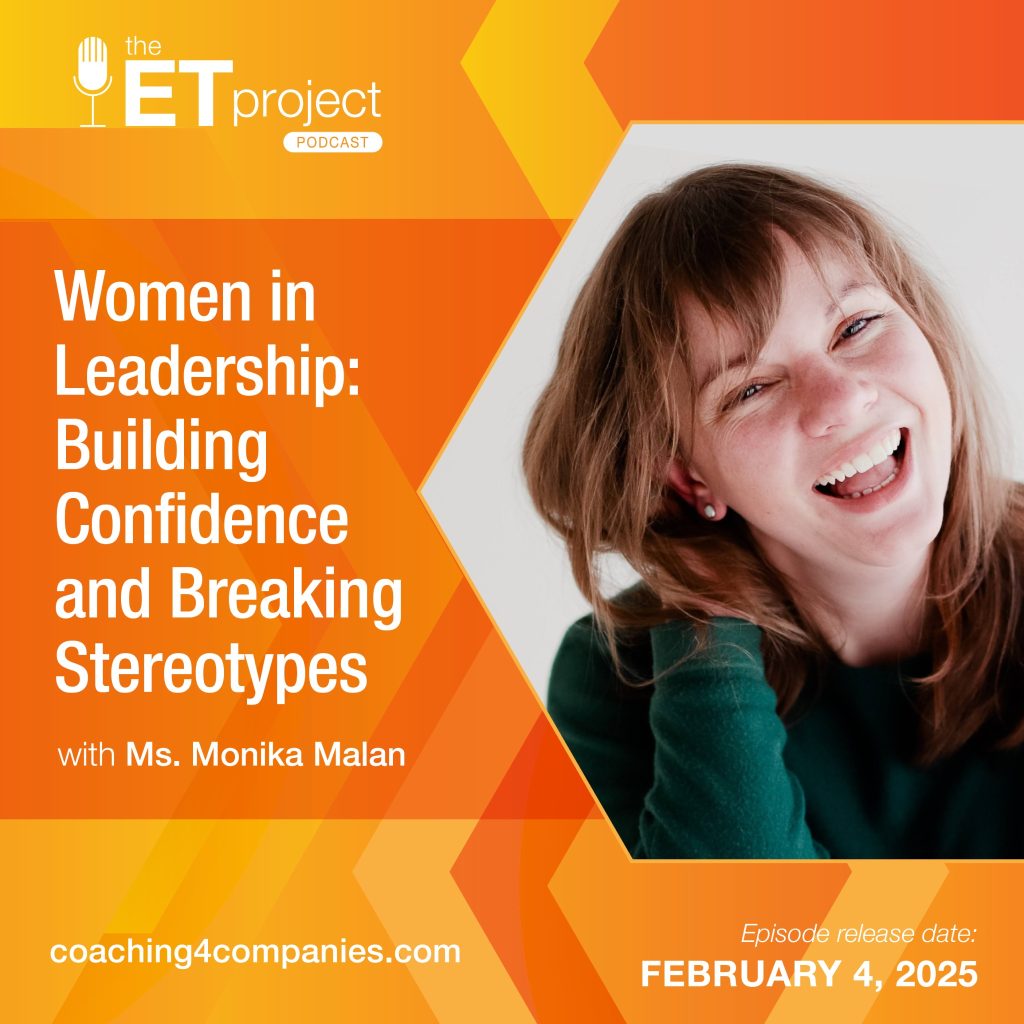
0:00:02.7 Wayne Brown: Hello. I’m your host, Wayne Brown, and welcome to the ET Project. We’re delighted to be delivering this podcast for executive talent all over the world, whom we’re affectionately referring to as team ET. Today we’re in Johannesburg, South Africa, speaking with our guest Ms. Monika Malan. Monika is a passionate leadership coach dedicated to helping emerging female leaders develop authentic confidence and thrive in their careers. With over 18 years of experience in the corporate and IT sectors, Monika has transformed her own journey through resilience, emotional intelligence, and a commitment to personal growth. She believes that women can be powerful leaders while embracing their unique strengths and authenticity. No need to conform to traditional, often male dominated leadership styles. Through her work, Monika empowers women to lead with confidence, navigate challenges with grace, and build a fulfilling life and career on their own interns. She’s excited to bring her insights and offer actionable strategies to help everybody unlock their full potential. Team during our conversation, you’ll hear Monica and I discussing the cultural struggles that young women faces as they enter into leadership, whether that’s due to the country, industry, company, or even role. This is another wonderful conversation for every leader that’s here male or female if you’re wanting to make a difference. So let’s dive in and unpack this subject together.
0:01:30.3 Monika Malan: Welcome to the ET project, a podcast for those executive talents determined to release their true potential and create an impact. Join our veteran coach and mentor Wayne Brown as we unpack an exciting future together.
0:01:45.4 WB: Hello team, welcome back, where we explore inspiring stories and insights from leaders who are making a difference. And in today’s episode, we’re going to delve into the critical aspects of leadership and mentorship with a focus on empowering young female leaders to thrive in their careers. And we’ll be discussing strategies for growth and confidence, effectively managing company culture, as well as leveraging unique strategies and strengths. Additionally, we’re gonna explore the importance of building supportive communities and fostering continuous growth among emerging leaders and of course, as you always hear me say, I’m not the expert in this topic, we’re very fortunate to have a guest with us, Ms. Monika Malan Monika welcome to the show.
0:02:35.8 MM: Ah, thank you so much for having me.
0:02:37.9 WB: It’s my pleasure. Now, from memory, you are sitting at the southern area of the African continent in South Africa, am I correct?
0:02:47.9 MM: That’s right, that’s right, it’s summer by us.
0:02:50.6 WB: Well, as you can see, I’ve got my winter jacket on, so it’s… [laughter] Maybe we can jump into the conversation, if you don’t mind just by sharing a little bit of your background and what sort of got you involved in leadership, project management, finance, IT industry all these great things. How did you get started in this?
0:03:10.5 MM: Sure. I started working straight out of varsity. Lucky enough to get a position at a finance company. At the time, I was convinced I was gonna be an equity analyst.
0:03:27.1 WB: Okay.
0:03:29.2 MM: But I started on the operational side of the business, which is more their like practical implementation side of the business. And before long I found myself in a leadership position, and I quite enjoyed it. So it didn’t take me long to change my mind. I didn’t want the stress of making high stakes decisions around where to invest people’s money. But I really enjoyed taking a leadership role, putting processes, in place and helping people develop. And so I would say pretty much from the age of like 23, 24, I’ve been a leader in some form of another. I’ve led departments. I’ve led multiple teams, single teams. And something that I’ve noticed was that women in particular are very… They have a lot of self-doubt when it comes to their leadership abilities. And it’s something I experienced myself at various times throughout my career, like being bulldoze by men or even by other women sometimes. And just really having to do a lot of deep work to develop my self-confidence and my self-worth, to a point where for the last eight to 10 years I’ve been actively mentoring and coaching other women in the organizations that I was in. And then in the last, I would say year or so, starting my own practice on the side, specifically targeting, female leaders as they enter the leadership journey. Because I feel it’s so important to get the fundamentals right when you start and help build up that confidence before life knocks you down.
0:05:24.1 WB: So you, you talk about some of the challenges for female leaders, young female leaders in particular. What sort of thing did you notice that they were experiencing and how do you guide them? What is it you are guiding them about?
0:05:43.3 MM: For me, it really boils down to self-doubt. As women, typically we are conditioned to be polite to not be “aggressive.” Or if you are talking and someone else starts talking, you just keep quiet and let them do their thing. And so we often get, bulldozed is a term I’ve heard used more than once, by the ladies I coach, they feel bulldozed. They don’t know how to, speak up for themselves or how to take back a conversation once it’s gotten away from them like that. And it further boils down to then, trusting the decisions that they make, not, second guessing every decision they make and whether they are doing the right thing or not. I help them by encouraging a lot of self-reflection and helping them to identify and own their strengths and their values. I help teach practical strategies, and also I do most of this in real time coaching, like one-on-one. I feel it’s quite important for that personal touch. And of course each person’s situation is unique. And that’s what really gets me fired up is helping women, so yeah.
0:07:14.3 WB: Yeah. Very nice. I know we spoke about it when we first connected, in terms of culture. And I’m just wondering what your experience is, in dealing with females and leaders. How cultural centric do you think the challenges? Like, do you think in your experience in South Africa, the women are struggling more than, let’s say a woman in Europe, a woman in Australia, or a woman in America? Have you had much exposure to that?
0:07:47.6 MM: Yeah, that’s a good question. Culturally I think a lot of women feel or experience the same challenges regardless of which country they’re from. I do recognize that maybe not so much country-wise, but culturally in terms of terms, race terms or religion, that could impact it more to a certain extent. I do know that dark-skinned ladies, women of color, they are typically even worse off than what I would be, or what I’ve experienced, and it makes me sad. And obviously that’s part of what, what fuels me is this drive to help women overcome those obstacles. So I do think, in South Africa we are very much aware of different cultures because we are very multiracial country, we’ve got a lot of national languages, lots of different people, working together. And so I think we’ve come a long way in identifying, or at least being aware of these challenges. There’s obviously still some room for improvement in how we address these challenges, but at least we are having the conversation. And so I’m not entirely sure how robust that conversation is in other countries. So yeah, I guess from that perspective, culturally, country-wise, there could be a difference in the challenges that women face.
0:09:40.8 WB: You talk, I know a lot about the corporate environment. If we move now from a, a country culture to a corporate culture and we look at specific industries, I come out of a fairly industrial based industry or industries, and I would say women were underrepresented very much so, you come outta the finance, the IT area. How did you find it within those industries in terms of representation?
0:10:05.3 MM: Yeah, there’s definitely an under representation of females in the IT industry, I do feel it’s getting better. When I look at the newer flood of graduates and stuff entering the market, there are a lot more females than there used to be. So I feel slowly but surely, those gender barriers are breaking down. But definitely, industry as well as company culture plays a large part. I would once again argue that company culture is more important than necessarily, industry. Because from my personal experience, I work at a company whose values or which, whose values company’s, whose values [laughter], resonate very closely to my own personal values. And because of that, even though I’m in the industry, the department, the IT department which typically don’t, have a lot of females, I still feel supported.
0:11:25.4 MM: I still feel empowered. And, because of that alignment of values, I always feel like I am able to speak my mind and I’m taken seriously. Whereas I’ve worked at a different company with different values, not necessarily wrong, I don’t believe values are right or wrong, but a different set of core behaviors that drove that company was not in alignment with who I am. And it was very, very difficult for me to reconcile my leadership style and how I wanted to perceived or taken seriously in that environment, even though at that company, I wasn’t even in the IT department, I was in operations, which is a much better representation of male and female and yet my opinion wasn’t valued at all. And so, yeah, I would say company culture is very, very important in terms of supporting, our female leaders. And that’s also why I put such an emphasis when I work with people one-on-one, one of the first things I do is have them identify their core values because, you need to know what you stand for and what is important to you, and that will help you act in alignment with who you are, which will make you feel and act with more confidence, confidence in the long term.
0:12:56.9 WB: Yeah, for sure. I was just wondering as you were speaking there, if we look at where the values for a company are driven through or from, they tend to be top down, as a generalized statement. If at the top is male dominated, I’m wondering how much there is a male centricity to the values that are being spoken about, and whether that’s creating any disconnect. I hadn’t thought of it from that angle until just now, so I don’t know if that’s relevant or not, that I’m curious on your thoughts.
0:13:33.0 MM: Yeah, I think that very much plays a role. I am a firm believer that, representation on all fronts is important at a senior level, at a c-suite level, not just male and female, but also different cultures, different races, because together you are more than the sum of the pods, you can have a much more robust discussion, you are a lot more aware of implications of decisions and values and stuff like that. So yeah, I definitely think the top leadership, as it pertains to them setting the tone, if you will, the values of the company is very, very important. And so representation is very much needed, yeah.
0:14:17.1 WB: When you’re working with the individual, do you find there’s a general sense of inability to create change as a single person? And I’m wondering how much there needs to be a collective shift from a female perspective to somehow create this dynamic change in culture. If I’m looking at it from a male perspective, and I think to myself, how much influence can I have to shift the culture of an organization versus if a group of us are moving in that same direction?
0:14:51.4 MM: Yeah. The ladies I coach do overwhelmingly feel isolated. And also, at the mercy of mostly like their managers and their colleagues their peers. What is sad to me is that it’s not always that their managers are males, sometimes it’s females. This is a conversation I feel… Like I don’t wanna point fingers at males, because as women we do sometimes bring each other down, which is sad. We need to shift the conversation and support one another, it’s not a competition, we can all rise to the top. We can all be successful, we can all be our best selves. And so, yeah these ladies do often feel, isolated. And so part of what I do with them once again is I bring them back to the core of who they are, what their values are, and I teach them how to expand the circle of influence.
0:15:56.4 MM: I’m sure you’re familiar with Stephen Covey’s circle of influence and concern, because by doing that by knowing who you are and then acting in accordance with that in a proactive way to expand your influence, and your control, you take back control of the situation. And instead of feeling helpless and pointing the finger your fingers at other people, you are in charge of yourself and your situation. And you can make peace with what is not in your control, you can’t control who your manager is, you can’t control the decisions of the C-suite, you can’t control the economy. But you can control your little piece of the world and how you react to the people, around you, that helps you be confident in who you are, which helps you be a confident leader.
0:17:00.4 WB: If we look at it from a EQ perspective, when we talk about self-awareness, and you’re talking a lot about strengths and values, etcetera, being aware of those, then you introduce the tool, which is the regulation side of influence and control. And I think it’s a great dynamic, that you’re introducing for your clients. You mentioned you had the holy grail, so your values are aligned with your company values which is fantastic. And you’re also successful as a female leader. Are you finding individuals who are also able to find this level of success in those people you’re coaching and working with?
0:17:37.7 MM: Yeah, it’s interesting. So obviously different people have have different scenarios. So I have, in the past coached ladies that, are now at my level and I’ve got no, doubt that they’ll surpass me soon, they’re a lot more ambitious in terms of corporate career. At this point in time, I’m focusing on, I found my niche. I’m happy to, to coach ladies, I wanna start my own business, but these ladies I’m coaching, they want corporate careers, they wanna climb the ladder. And so it gives me so much joy to see them succeed. And then on the other hand, I also am coaching, currently coaching this lady who has come to the realization that her values are actually not at all aligned with her company. And even though the company she’s working for is a nonprofit, and she feels deeply aligned with what the company wants to achieve, she doesn’t like the way that they’re going about it. And so she’s actually in the process of making some life changing decisions in terms of is this the role, not necessarily the role is the company for her, she to find something else? Is there a different way that she can, address this need in her to help the community without sacrificing who she is?
0:19:14.0 WB: Right.
0:19:14.0 MM: And so that is, it’s a very interesting journey and I’m so privileged to be a part of it. So, yeah, ladies and from all spectrums and different scenarios, which is really heartwarming to know that we’re all trying our best to add value.
0:19:35.0 WB: I know one of the things that you’re working on, Monika, is trying to build this community and support this community of female leaders. What’s the biggest challenge in building that community for you?
0:19:47.6 MM: Funny enough, the challenge I’m facing is, I don’t think the ladies realize that they need a community. Part of growing up, you’re conditioned to be the nice girl, to people-please, to be less than. But part of it is like, and contradictory to that, you’re supposed to be strong and do everything yourself and not ask for help. Like don’t ever be an imposition to anyone else, heaven forbid. And so I think when you get to the stage in your career and you’ve been promoted as a leader and you’re like, Okay, I’m a leader. I’m supposed to know what to do. I’m supposed to do everything myself. I’m supposed to know what to do. You don’t always realize that what you actually need is some support from other women who have been there, who are there, who are going through the same things you are.
0:20:47.8 MM: I feel that’s something our modern society is really lacking, is this community, especially women, to support each other. So that’s my biggest challenge. So I really want to create awareness around women supporting women, having each other’s backs. The value of getting insight from someone who’s been where you are can skyrocket your career. You don’t have to learn the lessons yourself. You can learn it from someone else and apply it in your own life. And if we try and take on the system in, quote unquote, the system by ourselves, it’s going to be a very lonely, long road to walk. Whereas if we work together, together we can have a massive impact I feel. And there’s also a lot of studies that show apologies if I’m going off on a tangent, but women tend to care for people around them more so than a man would.
0:21:54.2 MM: We’re just more community driven naturally. So I feel if you empower women, if we empower each other, the effect we have is exponential because then we are better able to care for even more people in our lives. And so community is so important. But I need to make people, I need to make the ladies aware that you don’t have to do it alone. You don’t have to. That’s the male way of thinking. And it works well for certain people. But we don’t have to. We don’t have to.
0:22:26.5 WB: There’s so many tangents. We could go down with comments. Vulnerability jumps out to me as one of the key ones. We hear people like Brene Brown talking about we need to be more vulnerable. For me, that is very apt for the male. I don’t feel that the female leaders need to be more vulnerable. I think you’re extremely vulnerable already. And in many cases, that plays against you in the face of the male. And so it’s this whole dynamic that’s shifting. You’re also talking about community. And what we try and do as consultants, we work with small business. The same purpose and outcome is what you’re talking about with the female community. We find with the small business community, you can get so much guidance, support, insight from other small business leaders. You don’t have to know everything. And you shouldn’t be trying to know everything. What about some of the more specific, tangible skills like process improvement or being able to lead in certain areas, set goals, run a team professionally? How much does that play a part in what you talk about with your clients when you’re coaching?
0:23:48.1 MM: Yeah. It’s a very fundamental part. So my framework touches on three main components. The one is EQ, which you’re right, we’ve been predominantly speaking about. Then it’s the leadership skills. That’s the hard skills, how to communicate, how to lead a team effectively, how to lead your team to decide on its goals and its values. And I talk a lot about, you know, sorry, let me just think of it a little bit now.
0:24:22.4 MM: Anyway, there’s a lot of the the hard skills. And then the third component then is career planning and how to be proactive in terms of managing upwards and personal branding laying the foundation for the point in time that you want to take the next step in your career. And really, it’s the intersection of those three that will make you a really great leader. So, yeah, I do focus a lot on the hard skills. It’s very important. So I actually, the program that I offer, I have teachings that cover these hard skills, the foundational stuff that I feel everybody needs to know. But then every person in my program then can set up one-on-one time with me where we can discuss the application of those principles in their situation, because that’s where I feel I add the most value, is uniquely applying those concepts to their situation because that’s where a lot of people falter. I mean, you can find a lot of information online. You can go to ChatGPT these days. But they can always help you apply it to your situation and your personality and what you feel comfortable doing.
0:25:53.7 MM: A lot of ladies at the start of their journey might not feel comfortable being as bold as you might have after you’ve got a couple of wins under your belt.
0:26:07.3 WB: Yeah. There’s the expression that there’s nothing beats experience. Just before we shift off that, you mentioned a program that you have. What do you call the program?
0:26:15.5 MM: It’s called, She Leads Boldly. And it’s my core offering. It’s a three-month program where you’ve got access to these teachings, as I mentioned, of the the hard skills. And then you’ve got access to me, where you can set up one-on-one time with me to discuss the application, as I said. And then you also have access then to a community of other ladies that are part of my program. You can have discussions online. So if you want a more immediate response, because I’m not always available immediately, then you can go to the community and ask your questions there and have feedback from your peers. Yeah. And then you can get then more longer-term access to those teachings after the initial three months.
0:27:08.1 WB: You mentioned earlier on about helping female leaders in particular find their voice. It gave me the concept of communication, which, regardless of who you are as a leader, it’s one of the foundational requirements. How do you help female leaders find their voice or become more effective communicators?
0:27:33.3 MM: To touch back on what you just said, experience plays a big part in that. But you also have to be deliberate. First step is awareness and being aware of how important communication is, and not just verbal communication, but body language as well. And then making the ladies aware of, once again, the the hard skills, which is how to give feedback, constructive feedback, how to listen actively, how to take criticism, how to respond, but then also encouraging them to start applying it. Because it always amazes, well, not amazes me, I mean, that’s what I’m doing what I’m doing, but something I want all leaders to do is meet regularly with the people that report to you. It sounds fairly simple, but yet a lot of people don’t actually do that. And so I encourage them to meet regularly with the people that report to you.
0:28:34.2 MM: And don’t wait to give feedback. I think as females also, we’re very wary of confrontations. So we tend to kick the ball down the road and postpone the problem, whereas you’re not doing anyone any favors by staying away from the difficult conversation. If you need to give someone feedback do it as soon as you can, because it gives them the opportunity to improve before bonus time, before performance appraisals. And it also lessens your frustrations, because now you’re not frustrated by this person not doing their job properly. So you need to have those regular meetings with people that report to you and practice communicating in a way that pulls someone up and doesn’t break them down at the same time. Coming to me or coming to the community and saying, I had the situation and this is how it played out. I feel I could have done better or could I have done something differently? And then having that discussion and learning retroactively is also super important. Once again, that community where you can bounce things off other people and just learn from them.
0:29:52.1 WB: I can imagine the community being super important, particularly for young leaders, young female leaders or young females, even considering moving into leadership. It must be such a weighty decision to say, okay, I’m a female. I’m the child bearer of the two genders. Do I seek a career versus do I want to develop a family while I’m young? How do you guide, and this is more for my knowledge rather than anyone listening, but how do you guide somebody who’s young female and really at that crossroad trying to make this decision? Like it must be so difficult.
0:30:38.9 MM: It is difficult and it’s also a very personal decision. So there’s definitely no cookie cutter approach to how to handle it. I think my best advice in those situations is you don’t know what the future holds. So you may as well do something that progresses you professionally or because if you are in a role that challenges you, you will grow as a person as well. So depending on the age and obviously the circumstances, like I said, you may feel like this is this overwhelming decision that I would just argue that you don’t know what the future holds. You don’t know what’s gonna happen in a year or two. COVID could strike, a pandemic could hit the world. So don’t stress too much about what could happen five, six, seven years down the road.
0:31:40.0 MM: Focus on developing yourself now. Obviously the conversation will change if the person is actively trying to start a family, but it would depend on their personal circumstances. I also know ladies that they thrive on challenges. They’ve got kids and a busy career and they love it. Like they’re not burnt out, which, which is great for them. Me personally, I take a more laid back approach and I do, I don’t, I don’t wanna go, go, go, go 24/7 but we are all different people and yes. So yeah, there’s no cookie cutter approach. Really.
0:32:21.4 WB: Very good. You opened the door and it’s, I ask all of our guests this question, what is the future? So if we look at the future in finance and the IT industries, obviously technology is having a major impact in every industry. Is there something female leaders in this case should be thinking about one, two years down the road that you see on the horizon?
0:32:49.4 MM: Yeah. I think we are gonna be more like having female leaders is gonna be more critical than ever before. We are heading into the age of, well, not heading into, I guess we already are there of AI and don’t forget all the blockchain technology and stuff like that. And it’s changing the landscape of pretty much every industry. But AI cannot replace empathy, cannot replace EQ, cannot replace a person genuinely caring for someone else. And I feel that is a female leader superpower is her ability to have that empathy and that caring, and that genuine drive to do the best for the people that report to her. And so, at the moment, especially with AI, and I don’t know if you’re familiar with Mo Gawdat. I hope I’m pronouncing his surname right, but he talks a lot about AI and he was a leader at Google’s deep mind.
0:34:00.4 WB: Right.
0:34:02.2 MM: But he was saying that AI is not yet at a point where it’s gonna “take over the world” but it’s at a point, if you wanna imagine it as, as like a toddler, it’s at the point where we need to teach it what is right and wrong. What does it mean to be human? A lot of what’s on the internet at the moment is very black and white is very, I don’t know if male dominated, it’s the right word, but it’s very, the nice things, the good news, the happy news, the more feminine aspects of the human nature isn’t always represented on the internet because it’s not news, it’s not entertaining. We are at a crossroads now where we can teach this toddler, this AI toddler, what it means to be human and what it means to care and have empathy and have EQ and female leaders in particular, I think are in a perfect position to do that by speaking up, by being involved in the conversation and definitely being hopefully a part of the implementation [laughter]
0:35:07.5 WB: Right. Yeah.
0:35:08.3 MM: Or future technologies. Yeah.
0:35:08.6 WB: Yeah. I mean, you’re sort of touching on biases. That’s a big topic. I know within the whole IT community and discussion. And I agree with you that the broader cross section we can have in all of the content that’s being produced and all of the programming, et cetera that’s going on, I think the better the future looks for everybody.
0:35:34.1 MM: Exactly.
0:35:34.6 WB: So I think that’s a valuable point if there are young female leaders out there. Any specific tips that you would leave them with as we come towards the end of our conversation? Is there anything that they can do that as a tangible takeaway from this conversation to help them find their voice, to help them progress their career?
0:36:00.4 MM: I would advise them to get to know themselves better. So identify your core values. Three to five at most, and start asking yourself the difficult questions of whether you’re living in alignment with those values or not. I think that’s a very crucial first step. And from there on, when it comes to things like confidence in decision making confidence in when you’re interacting with other people, you make sure that your actions are aligned with your values, that will drive your confidence. And yeah, I think that is probably the most important step that you can take.
0:36:41.1 WB: Very good. Monika, anything apart from your program that you introduced earlier? Anything else you’re working on, any goals for the immediate future?
0:36:53.0 MM: I just want to, like I said spread the news of the importance of community and getting people involved in that and getting the ladies involved in that. And yeah, so to that end, I have a, a resource for your audience. It’s at sheleadsboldly.com/confidence. It’s a document that will help you implement some of the principles we spoke about today. And then based off of that I can get in touch with people one-on-one and we can start building that community and helping each other. So, so that really is my short term goal, if you will, is just get, it’s really like overwhelming community getting started.
0:37:43.6 WB: Very nice. We’ll, definitely link to that in the show notes. So thank you. Thank you for that. Where is the best place for people to connect with you? Whether they pick up this document first or they connect with you on social media or through your website? What’s the best approach?
0:38:01.6 MM: They can download the document for sure, but I particularly hang out on LinkedIn. So it’s just Monika Malan. I can get you that link as well. So I’m, I’m most active on LinkedIn. But they can also contact me through my website or via email.
0:38:19.6 WB: Last question. What’s the legacy that you’re hoping to leave in the realms of leadership, mentorship, coaching? What are you hoping to leave behind as, as a result of everything you’re doing?
0:38:34.6 MM: I want to leave behind female leaders who are in turn making a positive impact on their communities. I want a ripple effect of positivity and female empowerment and female leaders just supporting one another and seeing that ripple prolific, because for every wom one woman I can support, she will in turn, positively influence, I would say, at a minimum four to six other people, probably a lot more. And they in turn will also go and influence, positively influence others. So, that is the legacy I hope to leave behind.
0:39:14.4 WB: Well, I definitely wish you well on that quest, and thank you so much for being an excellent guest on the ET project. Really enjoyed the conversation.
0:39:22.1 MM: Oh, thank you so much for having me. It has been a lot of fun. And keep up the good work. It’s really great that we can have these types of conversations.
[music]
0:39:32.9 Speaker 2: Thank you for joining us on the ET project, a show for executive talent development. Until next time, check out our site for free videos, eBooks, webinars and blogs @coachingforcompanies.com.