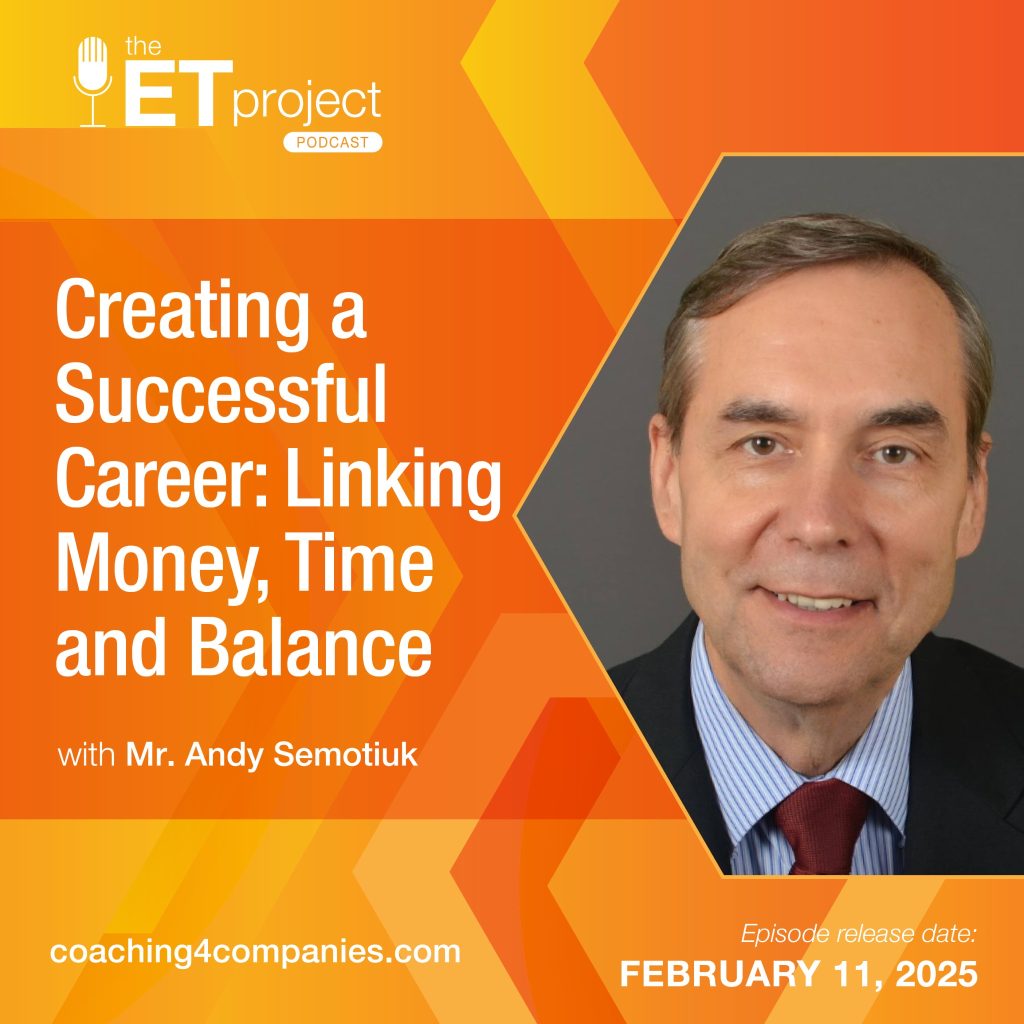
0:00:01.8 Wayne Brown: Hello, I’m your host Wayne Brown and welcome to the ET Project. We’re delighted to be delivering this podcast for executive talent all over the world, whom we’re affectionately referring to as Team ET. And today we’re in Toronto, Canada for the very first time, and we’re speaking with an immigration lawyer. And no, I’m not looking to venture to North America to work or live. However, if I was, then our guest, Mr. Andy Semotiuk would certainly be the person I’d be speaking to right at this moment, given the current events in the US. Andy has an incredible law pedigree. Since 1974, he’s helped over 10,000 clients with various legal problems. He’s an authority on the topic of US and Canadian immigration, writing articles for Forbes, as well as speaking internationally on the subject. As a member of the bars in Ontario and British Columbia in Canada, and New York and California in the United States, Andy is well versed in both US and Canadian immigration laws, and this allows him to fully understand the circumstances and the technicalities involved in dealing with immigration across the US-Canadian border, as well as dealing with immigrants who are coming from abroad.
0:01:15.7 WB: In addition to Andy being a columnist for Forbes, he’s also a former United Nations correspondent. And on top of it all, he’s found time to write several books, with the most recent release in December-January just gone, and this is the subject for our discussion today. The book is titled The Young Professional: A Real-World Survival Guide for the New College Graduate. During our conversation, Andy addresses the book’s central question, how can a young professional starting out today make money, have time for the important things in life, and maintain a balanced lifestyle? Team, you’ll quickly observe from our conversation that Andy has a wealth of experience and is super happy to share his learnings and insights for the benefit of all. It’s a powerful, thought-provoking discussion between a couple of old silver foxes, you might say, with lessons for all young leaders, and well, also the not-so-young. I trust you’ll enjoy.
0:02:18.7 Announcer: Welcome to the ET Project, a podcast for those executive talents determined to release their true potential and create an impact. Join our veteran coach and mentor, Wayne Brown, as we unpack an exciting future together.
0:02:36.9 WB: Hello, Team. Welcome to today’s podcast. We’re going to be embarking on a journey through a highly impressive, multifaceted career that blends journalism, law, and even human rights advocacy, for starters. And we’ll be doing this with our guest, who’s significantly impacted immigration law, in particular, across both Canada and the US. And we’re also going to take the opportunity to navigate, because of that across-the-border situation, we’re going to take the opportunity to navigate through a little bit of an economic and political minefield, I guess. And then finally, we’ll be exploring fresh insights from a newly released book aimed at empowering young professionals in today’s challenging career landscape. So, please get yourself ready for what’s sure to be an engaging conversation filled with many valuable insights. Andy, welcome to the ET Project. Great to have you here with us today.
0:03:31.0 Andy Semotiuk: Oh, I’m so happy to be here as well. I’ve been looking forward to this podcast and sharing some views with you and the listeners.
0:03:42.0 WB: You have a really interesting background and a very interesting scenario happening in your part of the world at the moment. So, we’re going to touch on that shortly, but you’re our first guest on the show. We’ve been two and a half years in the show now, but you’re our first guest from Toronto. So, we will have special welcome. Because of that, we have listeners from across the globe and I’m going to throw the floor over to you as an opportunity to sell Toronto. Where is Toronto for the benefit of those who may not know? And then what’s so special about the place?
0:04:20.3 AS: Well, that’s funny you should say that. Toronto is a great place to live. It’s, for those who are unfamiliar with Canadian sort of geography, if you think of New York and go straight up, just over a little bit to the left on the other side of the Canadian border, Toronto, you’ll find Toronto a top of the Great Lakes that divide Canada and the United States. And the population here is probably over 2 million in the city. Then there’s the outskirts as well. And Toronto is part of Canada. It’s the leading city in Canada. Some of the great features of living in Canada are a democratic system of government, fairly reasonable in terms of what’s going on politically, universal healthcare, pretty great system of education for all kids going through school, multicultural environment. So, there are people here who are living side by side from various parts of the world and somehow we’re getting along more or less. Things are all right. It’s not heavily involved in, with for example, in the United States, one of the things that’s a big deal is guns and how many guns you can have, et cetera. That’s not quite the situation in Canada. We’re conscious of the environment, or trying to be at least anyway. And it’s an open, welcoming society. By and large, people in Toronto are very kind and considerate. So, it’s a good city to live in.
0:06:03.9 WB: Now, I can remember sitting in my geography class many, many decades ago and learning about the capital of Canada. And this was always a trick question in the quiz, right? So, what is the capital of Canada?
0:06:21.0 AS: It’s Ottawa. Ottawa was a compromise. The two principal provinces that formed Canada were Ontario and Quebec. And back then there were upper and lower Canadas, the way they were described. And there’s a little story about that that I can share with you. The prime minister of Canada was a guy named Macdonald. They were trying to come up with a name for Canada. And they were debating in parliament, and they just couldn’t come up with a name. And I don’t know if the listeners or yourself are aware, but Canadians tend to finish their sentences with the word, eh. So, I’m Canadian, eh? Do you like the weather, eh? Where are you going, eh? So, they’re debating, and they couldn’t come up with a name for Canada. So, Sir Johnny Macdonald called all the leaders into a room, and he closed the door, and he said, we’re not leaving this room until we come up with a name. And they debated and debated for a whole day, couldn’t come up with a name. So, finally, he said, okay, here’s what we’re going to do. We’re going to go around the table, and each one of us is going to pick a letter from the alphabet, and we’re going to put those letters of the alphabet together until we get a name. And so, they went around the table, and the first guy said, C, eh? And the second one said, A, eh? And the third one said, D, eh? And so on, and they came up with the name Canada. That’s how we got our name.
0:07:50.6 WB: What year was that? How far back are we going? How many…
0:07:53.8 AS: Oh, 1867.
0:07:56.7 WB: 67. Okay.
0:07:58.1 AS: Yeah.
0:07:58.2 WB: Okay. So, I’m from Australia. We’re actually a little bit older than that. 1770. So, it’s interesting.
0:08:04.6 AS: We have a lot in common with Australians. Like we talked earlier before we came on the air, there is a lot of common between Canada and Australia because of the weather and so on, and the opposite sides of the globe.
0:08:18.8 WB: It’s definitely on my bucket list. So, we may have to organize a trip together. That’d be great. Normally, I kick off by asking the guests to talk a little bit about your background, but you have such an interesting background. I want to make sure I touch on a number of the points. So, if you don’t mind, I’d love to go through a little bit of a bullet list, starting with your time as a United Nations correspondent back in the mid-70s. What was that all about? How did that come about?
0:08:49.0 AS: Okay. Well, I was a UN correspondent working in New York City. I wrote for a group called Southern News Services, which is a Canadian newspaper chain with several newspapers in Canada and for some American papers as well. The way I actually got there was I was a lawyer in Canada, and there was a group that was trying to get accreditation at the UN as an NGO, and they needed a lawyer to do it. For me to be able to do the work, I had to have access to the UN, and so they arranged for me to get a journalist pass to be able to work as a journalist. And so I wrote articles on human rights topics, and they were published in the Southern chain and a few newspapers, both in America and also in Europe. That was kind of the start of my work in New York, both as a lawyer and as a journalist at the same time. That was in the mid-1970s. Well, I had a chance to… It’s funny, Jimmy Carter just passed away. I had a chance to ask him a question in New York. Also, Henry Kissinger, Kurt Waldheim, Idi Amin back in those days, if you know who those people were.
0:10:09.8 WB: Yes. Well, you can tell by my gray hair. I go back that far as well. So yeah, you must be slightly older than me, and I don’t want to put a label on it, but in 1975, I was still in high school.
0:10:28.4 AS: I just finished getting my bar exams done in 1975.
0:10:34.9 WB: Within this role, did you get a lot of exposure to celebrities?
0:10:40.6 AS: Yes, I did. One of the biggest moments in my life was I met Dr. Martin Luther King’s wife, Corella, and Andrew Young, who was then the ambassador to the UN. Andrew Young was one of Dr. King’s close colleagues. So I spoke to them for about a half hour on one occasion. Dear journalists at the UN, every day at noon, 12 o’clock noon, they have a news conference, and whoever’s coming through at the time who’s prominent, many of them choose to come over to talk to the press, and you have a chance to pose questions. Like I mentioned, the few major ones that I had the opportunity to question were Kissinger, Waldheim, and so on. Also Ford. There were a few others. I can’t remember right off the top of my head, but anyway, a few people like that.
0:11:38.8 WB: The connection between journalism and law, did you study journalism? Did you study writing, or where did that concern?
0:11:49.4 AS: I did have a little bit of a connection. That was in Canada previously. I had done some work primarily on the CBC, the Canadian Broadcasting Corporation, from a legal point of view. I had written some materials, some briefs pertaining to their Broadcasting Act and what they should and should not be doing in terms of broadcasting in Canada. That helped to draw me into the journalism. But I can share, it’s a long story, but I’ll give you a short version of it. When I started writing in the early days of my life, still while I was a student, I was pathetic in English. I studied, I took a course called English 101 at the University of British Columbia in Vancouver, Canada. I barely got through that course, just barely. 50% they passed me.
0:12:43.3 AS: So I was pathetic at writing. It took a long time for me to crank up my skills, writing skills to the point where I could write articles from the United Nations. That happened just simply because I was writing all the time. If you want to get good at something, do it all the time. But not only do it, you have to also study how to improve. But if you do, no matter what you do, there’s a philosophy of life that goes along the lines of, if you take anything that you’re really interested in, any field or whatever, and you spend five years of focused effort on it, you can become virtually a world’s expert if you focus it carefully enough and you spend enough time at it. So in a sense, that would be an explanation of how I went from a pathetic writer that my English prof today would turn over in his grave if he knew that I had published five books, and for the last 10 years, I’ve been a computer at Forbes. But that’s the way it goes, I guess.
0:13:53.6 WB: And finally, the connection to civil rights. Was that something that was a passion, or did you fall into that area?
0:14:03.7 AS: Well, I became… For three years, I was a member of the tribunal panel of the Canadian Human Rights Commission. But I kind of got into that from earlier work as a student still. I’m of Ukrainian background, and Ukraine has had this history of trouble with Russia. And you’re probably familiar with the fact there’s a war going on there now. And back in those days, there were dissidents coming out of the Soviet Union. And not only Ukrainians, but Russians and Jews and others were coming out of the Soviet Union. And I was involved in various ways with helping through sort of like Amnesty International type work where we were helping dissidents. I had the honor of helping one Soviet dissident, a guy named Danylo Shumuk, who spent 40 years in Soviet concentration camps as a political prisoner, and he was the world’s longest imprisoned prisoner of conscience. And I spent, well, almost like 15 years, not full time, but on this matter, trying to help him out to get him out. And we actually successfully got him out. I think it was in 1987, if I’m not mistaken. And he came to Canada, and I met him, and I had the opportunity to travel with him to the American Bar Association Convention in San Francisco, where he spoke about his incarceration in the Soviet Union and how he survived for 40 years.
0:15:45.9 WB: He must be one fascinating person to speak with.
0:15:50.1 AS: I asked him two insights into him. One is I asked him Danylo, again, his name is Danylo Shumuk. It’s a strange name. But anyway, I asked him, Danylo, “How did you survive and not break like others over 40 years?” And he said, this was his answer, he said, “There are carnal values, and there are spiritual values. And some people will compromise themselves for carnal values.” And by carnal values, even things like food, clothing, shelter, and your basic values. And he said, “I was just never ready to compromise on that in that way. But others were broken in their pursuit of carnal values.” And the other interesting thing about the guy was I take him out for breakfast. I said, “What would you like? You can have anything you want for breakfast. Danylo, what do you want?” He says, “I want a Coca-Cola.” Okay, Coca-Cola, you know. So poor guy, and his life in jail. So Coca-Cola was his reward, I guess.
0:17:00.9 WB: I don’t know much about the gentleman. Are there books written by him or about him?
0:17:06.0 AS: There is. There’s a biography written about him. It’s online. Danylo Shumuk, he spells his name S-H-U-M-U-K, is the last name. He’s passed away now, he’s dead. But during his life, he was a leading dissident in the Soviet Union. I’ll just tell you one story about him that really registered with me is when we entered the room at the American Bar Association, there was a session going on where former dissidents from the Soviet Union were invited to be present and talk to the American Bar leadership about human rights in the former Soviet Union. And there might have been about two dozen dissidents there. And we entered through a side door, Danylo Shumuk and I followed him into the room. And as I entered the room, I watched in awe as the meeting stopped, and all these dissidents turned and looked at him.
0:18:11.4 AS: And when they looked at him, they all stood up, I guess to honor him. They stopped the meeting, like they knew who he was right off the bat. And then they resumed the session, telling the people listening about their lives in the former Soviet Union. I guess if you’re that strong in character, I don’t know if you ever heard anything by Jim Rohn. In his speeches, he used to say, he used to talk about Christ going around and collecting the apostles. And he used to say, “You, follow me.” He didn’t need to say much more than that. It was his character that was electric enough that he could call people just by saying that, “You drop what you’re doing and follow me.” Well, this guy, I’m not going to say he’s Christ, I can’t say that. But he had a character so strong that it emanated a sense of strength when you met him.
0:19:14.9 WB: It’s quite incredible. I mean, Viktor Frankl, another example, different location, maybe a similar story, not 100% sure.
0:19:26.2 AS: Oh, yeah. I love his book, Man’s Search for Meaning. It meant a lot to me to read that book.
0:19:32.4 WB: Immigration attorney, both in Canada and the US. And it seems like you’ve been practicing law for, gosh, if my math is correct, 50 odd years.
0:19:43.1 AS: Yes. So it’s true, I have. I’ve had quite a career. Strange as it may be, I think if you asked people on our graduation back then, who of all these people in our class, there’s 300 in our class, who would be a lawyer 50 years later? I would be the last guy, my thinking was, I’d be the last guy to report I would still be a lawyer 50 years later. But here I am. And for me, it’s been a rewarding career, up and down. Not everything was perfect. Some hardships and hard times. But overall, it’s been a worthwhile career.
0:20:26.4 WB: And you’re still practicing, if I’m correct?
0:20:29.1 AS: Yes, I am. Yeah. I have the great joy in my life these days is, well, at least part of it is working with these young people who are here in the office and cultivating their life and their career, helping them grow. It’s a wonderful thing to be able to do.
0:20:54.5 WB: I touched on, Andy, during the introduction about the current political environment. I can’t move on to the books yet until we have a very quick banter around the election of the US president and what that means for Canada and business in particular in Canada. There’s a couple of very prominent topics that we see in the press at the moment, 25% tariffs and Canada becoming a state of the US. How is that resonating within the population across the border?
0:21:30.2 AS: I’ll tell you, a big concern, 25% tariff, it’s like a bowling ball coming through. For Canada, if that’s imposed on Canada, economically, it’s going to be a very serious hit for Canada. So a big concern in that area, especially because we’re trying to be united in terms of the response that Canada is going to show to Trump. But we’re not united because a province in Western Canada, which is the energy province, oil and gas province, has said, look, we’re not prepared to threaten cutting energy out from the United States. The supply of energy from that province to the United States is pretty heavy in terms of Western United States. I think they supply something like 40% of the energy for California and the Western states. So there’s this kind of national interest dissonance over what exactly is on the table in terms of a reaction and counter tariffs are planned.
0:22:49.7 AS: There’s no doubt there will be counter tariffs. One of the potential leaders for the Liberal Party, which is the ruling party in Canada, and going through a leadership race right at this time, Christopher Freeland has threatened dollar for dollar tariffs against the US if they impose a tariff on us. So that’s where we are right now. And like 20 years ago, I may have been on the side of, well, let’s talk to the US about some kind of a joint organization or life together. Not now. I’m on the Canadian side, and I do not favor any kind of unity with the United States. Indeed, there’s been some talk about chipping away at California and the Western states to join Canada instead of the other way around. Trump threatened that in a conversation with one of the Canadian premiers, I believe, and the premier shot back saying, well, 51st state won’t forget that. We want California and a few of the states to become the 11th and 12th provinces of Canada or whatever it was.
0:24:08.3 WB: Interesting times ahead, for sure. If nothing else, it’ll make a good conversation in your circle, for sure, within the law arena, as well as the journal, the newspaper. So let’s dive into the books, Andy, because if I’m correct, it seems like in about the last half a dozen years, maybe a decade, you’ve really turned your attention to journalism through Forbes in the column, as well as, I think, five books now?
0:24:45.7 AS: Yeah. Yeah. I’ve cultivated a relationship with young people in particular, trying to help them with their careers. In the course of my work, I’ve helped over 10,000 clients with various legal problems. Most of them were young professionals or people starting out in their lives going to the US or Canada. In doing so, I noticed that there were three principal areas of concern that were troubling these young people. I think they troubled most of us, one or two or all three of them. The three are money, time, and balance, those three questions. So the book, The Young Professional, that I published, it’s called A Real-World Survival Guide for the New College Graduate, discusses those three themes. There’s some stories thrown in there in the book also. I’ll spend a moment or two on the themes.
0:25:51.1 WB: Even though you’re targeting the young professional, I can imagine those three items are relevant to pretty much the world in general.
0:26:00.7 AS: Oh, yeah.
0:26:01.3 WB: Money, time, and balance.
0:26:03.4 AS: Oh, yeah. This book, in particular, is relevant, say, for example, for mothers going back into the workforce or for new people coming into a country and trying to get their feet on the ground in a new job or whatever. That’s particularly relevant territory for them. But even for guys like you and me, older fellows, you think we’re not troubled by money, time, and balance? I mean, that’s the three issues of my life all the time.
0:26:37.8 WB: Absolutely. Then throw people in the mix.
0:26:40.2 AS: Oh, yeah.
0:26:41.9 WB: It’s a continuum. What was the inspiration? I know you’ve sort of touched on it, but I mean, was there a specific tipping point that got you to put pen to paper and produce the book?
0:26:54.2 AS: Well, I was just thinking, here I am working with all these young people, and they’re troubled by these kind of issues. I’m a big Toastmaster guy. I’ve been in Toastmasters for many years, 35 years, actually. If you know Toastmasters, the big thing there is public speaking, but also leadership. I spent time reading about leadership, and that flows right into this area. I decided, well, you can share your ideas, but a good way of leaving something for people is to put them into written words. For the longest time, I’ve been handing out these books to young people coming through the office, just a little bit of help to them on their way out or when they’re going into the world. Sharing a book with someone, giving someone a book is far better than, what, a bottle of wine or a box of candy or whatever. I think a book is a better gift. It’s a more practical and more helpful gift for people. That’s how it started.
0:28:07.4 WB: We certainly share that belief. If we just do a high-level dive into the three themes or the three topics, money, time, and balance, maybe you could just introduce each one.
0:28:22.0 AS: Sure. With regard to money, the way I’m taking it, now if your name is John Paul Getty II or whatever, you don’t have to worry about money or Bill Gates’ son or daughter or whatever. I’m talking about just normal, ordinary people. I’m not talking about people who are going to inherit great wealth or who get a super lotto or whatever it is. I’m talking about normal people. In the case of normal people, when it comes to money, a key thing about money is, what are you spending your time on? What is the focus of your life, and is it on your unique abilities? If it is, then there’s good reason to believe you’ll do well with regard to money. On the issue of time, time is a focus question, but this time it’s a question of priority setting. What priorities do you have in your life, and how are you setting? And there’s this, I’m sure you’re familiar with it, the 80-20 rule as a rule for helping you decide what to do, when, and how, so that I can talk a bit about that. In the area of balance, what I talk about is values, whatever values you have, and how you live your values. Are you equally living all your values, or are you cutting some values short? And there’s a wheel that I use as an example of how you, are you a flat tire or are you a circular wheel and that’s the way I address that topic.
0:30:16.9 WB: Let’s dissect now into each one. Did you come across stories of people who were able to do what you’re suggesting and do it successfully?
0:30:27.0 AS: Yes. I’m going to share one story. I’m not sure if I’ve got it in the book or not, but it’s a story that comes to mind when you ask this question, and that’s, I don’t know if you’ve ever heard of Og Mandino he wrote a book called the Greatest Salesman in the World, and it was a huge hit. And his life story’s a really curious one. When he was growing up, his mother cultivated this idea that, Og, you should be a writer. You’re going to be a great writer. But no, no, no, he wasn’t really that interested in that. He got through high school. He wanted to get out into the world and make a name for himself. And World War II broke out, and he ended up going to Europe, and he was a bomber on an airplane with Jimmy Stewart, the actor. And so he somehow survived World War II and came back at the end of the war. But coming back to the United States in his life, there wasn’t exactly a great need for a former bomber in World War II in terms of work. He couldn’t find work, and his life thrashed.
0:31:39.8 AS: He worked here and there, not doing very well. Got married, had a kid, couldn’t support the family, became an alcoholic, actually, and he hit rock bottom, basically. One day he’s walking down the street as he tells the story, and it’s worthwhile to look up the story just to hear it firsthand instead of through me. But the story goes that he’s walking down the street and it’s cold, and he looks into a window, a store window, and there was a gun for sale there, a pistol, and I think it was $10. And he reached into his pocket and just at that time, he had $10 left. And he thought to himself, why don’t I just go in, buy that gun and put an end to this mystery? Something made him pass by and forget that. And he went to the library and he started reading, and he read a book by W. Clement Stone about success. And I can’t give you the exact name of the book off the top of my head, but I think it was like a positive attitude type book. And it turned his life around. And he started looking at what he could do.
0:32:55.5 AS: And he was reminded of his mother’s words about writing and stuff like that. But he went to Clement Stone and asked if he could join the insurance company that Clement Stone had. And Stone gave him a job, and he became fairly good at insurance. Then Stone said to him, “Let’s do a newsletter. You can write a newsletter for us.” And he started writing a newsletter, and it turned into writing for Success magazine. He became the editor of Success magazine, and then he went on to write these books like, so focusing on some strength that you have. There’s an example of someone who was able to do that.
0:33:42.5 WB: Yeah, it’s a great example. Great story. One of the time you mentioned the 80-20 rule, I’m sure most listeners are familiar with it. Probably tried to practice it. I’m not sure we’ve all been successful in that endeavor, but the concept is probably well known.
0:34:00.7 AS: Yeah, 80-20 rule. So it comes from Pareto, who was an economist in Italy who analyzed the economy in Italy and came to the realization that 20% of the population owned 80% of the wealth. And then if you look at that generally, that rule seems to apply to a lot of things. So, for example, 20% of the people in an organization are leaders, for example, and the 80% are followers or 20% of an organization make 80% of the money of an organization, as an example. But the real big breakthrough for me in this area came from Jim Rohn, which we’ve talked about. In the way he translated that rule into a workable rule for me in my life. And that translation was the way he put it is when you’re looking at something you want to get done, you’re going to find that 80% of what you’re trying to do can be resolved by focusing on four or five things, maybe six things that are key, and the rest is not so significant. So focus on four or five, maybe six things, pay 80% of your time on that and 20% of your time and stuff. Other stuff.
0:35:24.9 AS: And to illustrate this more concretely, suppose, for example, we were talking earlier, I think, before we came on the air, about my background. I’m Ukrainian in background. Suppose you’re President Zelensky and you’re faced with a war with Putin in your country and you’re the president. Suppose you had to run the country. How would you run it using this formula? Well, what you would do is you, I would suppose if I was him, you list all the things that need to be done, health, education, war, missiles, whatever it is, a whole list of things. And then you ask yourself, okay, we don’t have resources to do all of this, but what resources, four or five things can we spend 80% of our time on to get the 80% benefit that we’re trying to get and spend 80% on that and 20% on everything else. And so it might be, for example, ammunition, food, economy, whatever it is, and work with that kind of a formula. And you can get into this. You could pick each item. So for example, in the area of economy, what are the four or five things that are the most important things to do for the economy? And let’s work on those four or five things and spend 80% of our time on those four or five things and 20% on the rest. And then you can go on like this forever. It might drive you crazy. But anyway, that’s the way. That’s time doing the best with the time that you have available.
0:37:06.4 WB: Now, we see examples of that all throughout business, throughout our lives. I mean, you’ve explained it very succinctly. But as a leader, we try and identify the things that are going to have the greatest impact, and we narrow that down and focus on those things and what you’re suggesting, I guess, is for young people, this is also a great piece of advice. Let’s jump into the final one, which is the balance and your lifestyle as a coach. I’m familiar with the life wheel, so I like it very much. So I’ll leave you introduce it and explain it.
0:37:45.0 AS: Okay. All right. So balance is all about values. And values are subjective for the most part. There are some universal values, in my opinion. Like, for example, don’t hurt anyone might be a universal value. Life is a universal value. But generally, most values are subjective values, meaning of value to whom? To you. So take me or you or some person as an example, and you might ask, well, what are your key values? What do you care about in your life? And I don’t know what they may say, but let’s say a person might say, well, I have spiritual values, and I have intellectual values, and I have physical. I want to be healthy. I want to be thinking and emotional value, whatever it is. Or it can be something like I want. I want money. I want a wife. I want kids, a family, whatever it is, whatever the values that you identify. Let’s imagine a bicycle tire. At the hub, there are spokes that reach out to the edges, and each one of those spokes can be represented by a value. So let’s say physical health as a value.
0:39:14.0 AS: And you might number, put numbers on that spoke from 1 to 10, 10 being the outer edge of the spoke, 1 being in the inner edge where the hub is, and same with these other values. And you identify, let’s say, 10 values that are critical in your life with these numbers. And then you ask, okay, how are you doing physically? Like, how healthy are you physically? Between 1 and 10. Okay, maybe you’re a 7. How are you doing intellectually? Are you nourishing your mind? And okay, maybe it’s a five how are you doing spiritually? Are you tuning into the spiritual aspect of your life? It’s a six or whatever. If you’re a balanced human being, when you draw a line around the edges, you should end up with a circle, more or less a circle. If you don’t, you’re a flat tire because you’re not paying attention to certain values that you profess to be your values, but you’re not paying attention to them. You got a problem. You’re not in balance. Now. It’s okay to be out of balance for a while. To give you an illustration, when I wrote my bar exams, I had to be out of balance.
0:40:30.6 AS: I couldn’t do everything. I had to pay attention to study for the bar exams for a few months to get through the bar exam. So I was out of balance for the purpose of attaining a higher goal. But then I had to come back into balance and I couldn’t go like that forever. On the opposite end, if you’re, say, a painter, and let’s say you like Van Gogh, where you love painting so much that you don’t do anything else except paint, well, if you got a brother who will support you so that you don’t go hungry and you got a place to live like he did, well, he could spend all his life painting, but it was a life out of balance. But then on the other hand, he was a genius, so he paid the price because he was a genius. But I don’t know if we’re in a state where we want to pay that kind of a price for our lives. Depends on who you are. But that’s a little comment about palette.
0:41:35.5 WB: And I guess that comes then down to a large extent around self awareness, being cognizant of what your values are and how much attention you actually pay to them and whether you’re living in that balance in harmony with your values. And we talked so much about that, we could talk a long time around this little topic. It’s so important for everybody to really grasp and understand. Unfortunately, time is always against us. Are you a futurist, Andy? I’m wondering how you see the future.
0:42:13.6 AS: Well, I’m an optimist about the future. So, for example, I believe mankind can sort out the problem of climate change. Even though it doesn’t look like we’re doing a good job right now. I do believe that a time will come when we’ll be able to explore other planets and so on. Things of that nature, I believe are possible, but there are things, there are big problems that we have to solve. Nuclear disarmament is an issue that I think needs attention. Wars, genocides taking place in our lifetime. We haven’t learned how to live together just yet the way we should. And there’s a lot to learn yet, starting with ourselves. We have to educate ourselves, have to roll up our sleeves and get to work.
0:43:06.5 WB: And we had this enormous disruptor called technology that’s really factoring into all of this and not making it any easier in that regard.
0:43:19.4 AS: Well, there’s good and bad that this AI seems to be like working with it is incredible. Just unbelievable what you can do with it. Let’s hope that it doesn’t fall into the wrong hands and go in the wrong direction. But so far I found it very, very interesting and helpful.
0:43:40.9 WB: Where it may or may not lead is, I guess, the unknown, right? Yeah, unfortunately, times against us. Andy, it’s been a fascinating conversation. We could of course, go far deeper into the book and I look forward to having the chance to read it. What is the best place to get hold of the book or books? And what about connecting with you? Where can people go and find and follow you?
0:44:08.8 AS: Well, as far as the books are concerned, they’re all on Amazon. If you’re having trouble, you can go to myworkvisa.com and look under my books and you can find whatever books that you need. That’s my personal website. As far as contacting me is concerned, I work at Pace Law Firm in Toronto, P-A-C-E law firm. And you can get a hold of me through Pace Law Firm, the website pacelawfirm.com.
0:44:36.4 WB: Excellent. We’ll make sure we link to all of that and hopefully the listeners are as enthused by the conversation as I am. I’ve really taken a lot out of it. Thank you for that. Thanks for being a guest on the ET Project. Wonderful to connect.
0:44:49.9 AS: I’m very happy to have been on this program. Thank you so much, Wayne.
0:44:56.2 Announcer: Thank you for joining us on the ET Project, a show for executive talent development. Until next time, check out our site for free videos, ebooks, webinars and blogs at coachingforcompanies.com.