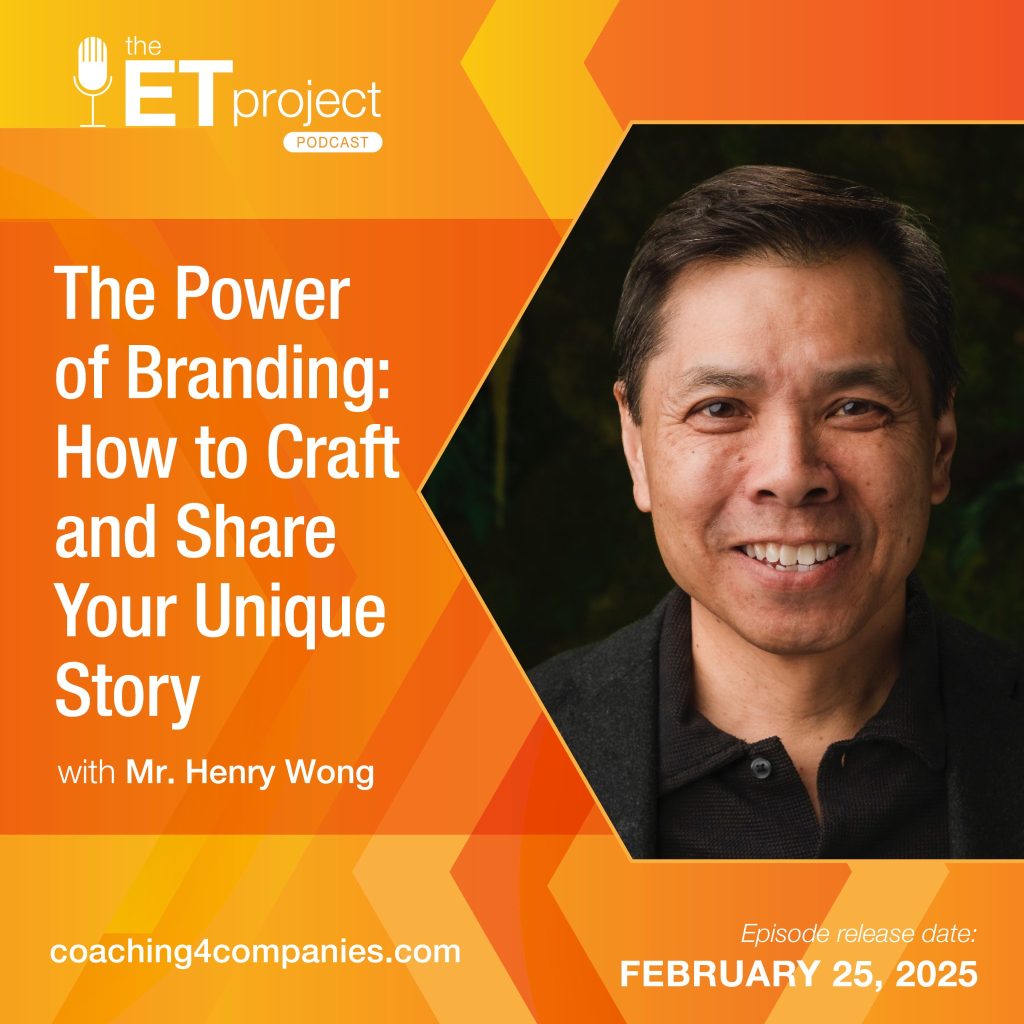
WAYNE BROWN: Hello, I’m your host, Wayne Brown, and welcome to the ET project. We’re delighted to be delivering this podcast for executive talent all over the world whom we’re affectionately referring to as ‘Team ET.’ Today, we’re back in Toronto, Canada, to meet and chat with speaker, brand strategist, marketer, writer, designer, and creative director, Mr. Henry Wong. Henry has guided small startups and SMEs to Fortune 500 companies. He has been a brand guru for politicians, professional athletes, as well as company leaders, and he’s a frequent speaker on branding and creativity. Henry grew up in the back of a Chinese restaurant, but would entertain customers at front of house with stories, little jokes, and big fish tales. These days, he does it on behalf of other brands, large and mid-growth, looking to have a positive impact on the world. His specialties include strategy, branding, ideas, and content, of course. Henry is involved in considerable pro bono work for Médecins Sans Frontières, Oxfam, MAD, Children’s Breakfast Club, Earth Day, Community Unity Alliance, and Centre for Equity Rights. During our conversation, Henry and I unpack his book, ‘Telling Your Story, Building Your Brand,’ a personal and professional playbook, and we really examine what it takes to establish that authentic brand, one that accurately reflects who you are, and one that you want visible to the world. This is such a valuable discussion, so grab your notebook and pen, and get yourself ready to learn and polish your brand through the extensive experience and insights from our guest, Mr. Henry Wong.
INTRO: Welcome to the ET project, a podcast for those executive talents determined to release their true potential and create an impact. Join our veteran coach and mentor, Wayne Brown, as we unpack an exciting future together.
WAYNE BROWN: Hello, and welcome Team ET, to today’s episode, and we’re going to be looking at the importance of developing a personal brand. We’re very fortunate to have Henry on board with us, who is a personal branding and storytelling expert. Henry, welcome to the ET project. We’re going to have a chance to dive into your book, ‘Telling Your Story, Building Your Brand,’ a personal and professional playbook.
HENRY WONG: Wayne, thank you so much for having me on your shows.
WAYNE BROWN: You have a great pedigree in the advertising industry, I wonder if you could sort of introduce a bit of that background from a personal perspective and what the journey was like as you were coming through that.
HENRY WONG: Oh, absolutely. I love the word pedigree, because many times I do feel like a bit of a mutt in this life, having experienced many things through my career. I’ve had the privilege and the good fortune to have had a decent career in the advertising and marketing field. I was once head of creative for the global agency, Saatchi. I’ve run a number of my own agencies, bought and sold. I have invested in companies. I’ve got well involved in many types of enterprises. So, for me, it has been a wonderful journey of just a series of little adventures and lots of fun along the way. And I think if anything, I’ve gained a little bit of knowledge in certainly the branding side and have been able to share it through many of my talks and books. And so just wonderful to hang out and hopefully share some insights with many of your listeners.
WAYNE BROWN: Yeah, for sure. We’ll definitely dive into some of those. What was the moment trigger, perhaps, for stepping aside from that world and going out on your own with your company, do you…
HENRY WONG: Oh, you know, I think one of the things that did happen in my career, I was a partner in an ad agency. Unfortunately, the partner passed away from Alzheimer’s, and it made me take a little bit of stock of life. And I’m sure this happens to many people who begin looking at their life and what they’re contributing back. So, at that point, I decided to do a bit of a reset and I started a new agency and… Under the banner of Vyoo. What I was looking for was, you know, in spite of my boyish looks, I’ve been in the business for close to 30 years. And it was my way of perhaps tapering off and having a little bit of a retirement gig. So, what I wanted to do was begin working with organizations, companies that want to have a positive impact on the world. And my thought at the time was that it would allow me to work a little bit less. But I found the opposite begin happening where I had attracted more people, people who want to work with me, more clients who wanted to, I guess, look for their unique way of finding their position in the marketplace.
[00:05:00]
WAYNE BROWN: The spelling of the company name, V-Y-O-O, but pronounced, I believe, is pronounced as Vue.
HENRY WONG: Correct, yes, that’s right.
WAYNE BROWN: Where does the name comes from? Does it have a special meaning behind the name?
HENRY WONG: Just a little bit more of a phonetic spelling of Vue, but the idea of it being a unique perspective and the way we go about creating both brand and content for people.
WAYNE BROWN: I can imagine being in the advertising marketing space for so long, you probably have a lot of stories. Anything jump to mind straight away?
HENRY WONG: You know, good.” All we did was just simply pack everything up and left. But it was one of those funny instances that can only happen in the advertising world.
WAYNE BROWN: You mentioned the storyboard. We see that in the movieI think there’s always something. I recently shared a story that I hadn’t thought about for quite some time, and it was a situation in which I was presenting some work for a client, and he, being of a certain mindset, had spent the lunch hour feasting on steak and whiskey with his co-workers. So, by the time I was beginning to present after lunch, he was feeling rather dozy or sleepy, and he actually fell asleep right in front of my presentation. And I didn’t know what to do, and I thought I should just begin sort of quietly leaving the room, but the middle manager began signaling me to continue. So here I was presenting to someone, a decision maker who was fast asleep, and I went through the entire series of commercial, what we call storyboards, which were a series of frames to show what the commercial could potentially look like. I finished all of that, he kind of woke up and nodded his head and said, “yes, it sounds s a lot, right? With different pictures and people having their board at the front. Is that literally what it was like when you were delivering a pitch to a potential client?
HENRY WONG: Quite often it is like that. But I learned not too many years after that, that a better way of doing it, and I began adopting my own style, that it’s often difficult to present someone a TV commercial frame by frame like that, because it never really turns out that way, or it never really paints a picture. And this is really the basis of a lot of what I advocate and teach people, which is tell it like a story. So, if you saw a movie last night, you wouldn’t necessarily describe it scene by scene, picture by picture. The way you would describe it is very much like a story, the way you would share it with a neighbor or a friend, as if you were almost there. And that’s the beauty of storytelling, that you can get across these creative concepts in a more connected way to the people you’re sharing it with, and hopefully they buy into it. And that’s really the basis of a lot of what I do these days, is help organizations and people tell their story.
WAYNE BROWN: And you described that beautifully in the book, and we’ll dive into that shortly. One question that came to mind was, as I was reading the book, is there a significant difference between pitching for a viable brand or identifying the story for a viable brand versus your personal brand? Is the approach different, or is it largely the same method?
HENRY WONG: It is very much largely the same, although there are probably more people involved in a global brand making the decision, determining the steps along the way. But I would say if a brand is properly developed, it should follow the same process, which is really understanding, taking stock of what the brand is, what the person is, what the product is, the best attributes, finding that unique position and how you would be superior or better than or different than your competitors in the marketplace, and then finding the best way to express it. And if you follow that sort of route, it really begins to echo a lot of it. I began thinking of this process for personal brands back, I guess that was many years ago, I was approached by a political party at the time, and they had seen one of my campaigns and they asked, could you do something like this for our candidate? And I thought, yeah, the principles are the same. So I began, you know, actually breaking down the methodology and I realized that, yeah, a personal brand should follow the same process and methodology as you would apply to a product or service. And really that’s the whole basis of what I hopefully have developed and begun sharing with people.
[00:10:00]
WAYNE BROWN: That’s a nice segue into the book. So, the book again, ‘Telling Your Story,’ it has a longer title, but essentially ‘Telling Your Story,’ was there a specific inspiration behind writing the book?
HENRY WONG: I’d love to say it was a big light bulb per se, but to tell you the truth, it happened during the days of COVID during lockdown. Many of us were just sequestered inside, we couldn’t get out. And it gave me a little bit of more sort of mind and free time to be able to write. So, I began actually putting my methods down on paper and I realized it wasn’t that difficult. And I was fortunate enough to get an American publisher who got behind it and we put it together and it really formed the basis of, I guess in a way, a bit of a self-help book for people wanting to create their brand. But yeah, the impetus behind it was really a little bit more free time than I had previously.
WAYNE BROWN: I tend to agree. I think the premise in the approach is quite often very similar, right? And the concept of introducing storytelling into the whole process seems to be foundational. When you talk about storytelling, I’m sure many of our listeners have heard people say this before, we need to present in more of a story form. What is the real essence behind that? Why is that so important?
HENRY WONG: I think a lot of it really comes from being able to connect with the people you’re talking to or presenting to or simply meeting. We find that often, you know, a perfect example I think is often, many of us have done networking events and you come across somebody at the drink table and you shake hands again. So, tell me a little bit about yourself. What you often find is people get into this long unfortunate diatribe of their whole background. And it’s a repeat, a little bit of their resume, but you begin to see the eyes glaze over the person you’re talking to. And perhaps they’re not as interested. So, what a story does is find those interesting elements that is really the essence behind what you’re all about, that you can share with someone in that quick 30 seconds. In those 30 seconds, hopefully you can connect with them, you can find out that this is someone that you might want to continue the conversation with. But the idea of being able to boil your story down to a quick 30 seconds is very much like a TV commercial. If you think about it, you have 30 seconds in which you can get across the attributes of the brand or tell the story in a compelling way that I pay attention long enough that I might look you up on the internet, I might connect with you, I might call the 1-800 number, I might go to your website and so on. So very much the same sort of idea, particularly for those who are running businesses, is to really understand what you’re all about, that you can share that with people. And often it’s not so much about the attributes of the business or even yourself, because there are so many other people like that. Each of us have a very unique path and a unique story that has brought us here. And by being able to share that and integrating it with the type of business that you have, or the type of thing that you’re presenting, you’ll find that it just simply connects much better with people.
WAYNE BROWN: You talk about it in the book, you talk about perceived value, and the story tends to help build that perceived value. Is that an accurate approach?
HENRY WONG: Yeah, I think very much. There is perception and there is reality, and so much of how we present ourselves is creating a perception. And it doesn’t need to be a fake presentation or something you manufacture. I believe very much in creating an authentic brand of what you represent. And by doing some of the work and understanding what you’re all about, you can find those elements that begin to shape what your brand is. So, if you think about it, really, what you stand for as a brand can’t be a multitude of things. If you begin… and we’ve been in this situation, and many of our viewers have been in the situation where you’re selling something, it’s very easy to flow into these characteristics of it, the attributes of it, where we know for those who do sales well or present well, you can begin focusing a little bit more on what the benefits are of, then you can connect better with people, weaving that into a story, particularly about yourself in a very refined way can make that connection and it creates that wonderful perception. The idea really is to, once you understand the essence of what your brand is, then the rest of it can build around it, as opposed to should take an element of this and an element of that.
[00:15:00]
HENRY WONG: Or perhaps, I see people wearing suits all the time, so maybe I should be wearing a suit. But really what I’m saying is that that suit is only applicable if it forms what your brand is and what your personality is, you know? You came on to this show wearing this wonderful, interesting UCLA t-shirt, and I think you had another t-shirt the first time we met, and I have a feeling that’s a reflection of who you are as an individual and your brand, which is that… and having spoken to you, Wayne, I know you have a very thoughtful, intelligent way of looking at things, but part of the way you are is a very relaxed individual, so you’re very approachable, that t-shirt creates that perception that you’re very approachable and we could have some very interesting, easy to get along conversations, very different from someone who comes on formally with a suit and tie, and perhaps a different take on the way they go about it, and that’s perfectly fine. The idea, of course, is just to ensure that it reflects what your brand is about and what your personality is.
WAYNE BROWN: First of all, thank you for those. We’ll have to get you back on the show more often, Henry. I like the compliment, sir, thank you. In the book, you really go into that simplicity and being able to refine your story. You talk about the six-word story. I did the exercise, by the way, my six-word story, curiousness advancing businesses and executives.
HENRY WONG: Yeah, very good. That says so much because that key word of ‘curiously’ suggests you listen a lot first before providing advice, but the idea is that you very much all are interested in your client’s business and helping them along. So, for those who are a little bit perhaps lost around the idea of six words, one of the things I talk about is being able to boil your story down to six words. It really comes from the advertising world. If you see an outdoor billboard, there typically can’t be any more than six or seven words on that page or on that board because any more than that, you lose the essence of the message. So, if you can boil your story down to six words, then you’ve created magic and you really have a true understanding of the essence of what your brand can be or what you can offer people. So, by beginning with that, you really point yourself in the right direction of what you’re about because many people, if they’re asked, what is your brand, will begin to wonder, sort of dodge around it, maybe express it in a multitude of words. Bringing it down to six words, you will find really what the essence of what you’re all about, and you begin with that, and then you can build the story out from that, of course.
WAYNE BROWN: Yeah, you read and take it further, Wayne, and you say, what is your one word that really describes, I guess, your character. Mine is contributor, it is the one that I came up with. I’m not necessarily settled on that word, I’m still working through it, but I love the whole concept of being able to simplify it. We’ve all heard the concept of the elevator pitch and you mentioned doing a 30-second commercial, but really being able to bring it down so succinctly to that simplicity, that clarity, I find it so valuable.
HENRY WONG: Yeah. And a lot of that does come from the world of advertising because if I said to you, I asked you, what’s the one word that could describe Volvo, for example, and you would think safety. If I asked you Nike, it would be winning. Apple, perhaps, it would be innovation. So, these major brands have really understood the essence of what they’re all about and we can apply that so much to ourselves because once you have that understanding, it’s easy enough to build everything around it. I think of also the series of messages that we put out and there are different types of ways that you can express your brand. So, those exercises are really meant to lead you to how you can convey it in the marketplace. So, if you think about it, a story should be able to be told, and I’m a firm believer of this, a story should be able to be told in three seconds, 30 seconds, and three minutes, meaning, what is that one word? What is that mnemonic or logo that represents you that could be told in three seconds? How do I do my elevator pitch or how do I introduce myself within that 30-second commercial? Then if someone’s interested, how do I expand that long story into something that is more meaningful? Many people start with the three-minute story and begin losing their audience. So, by going through this progression, you actually begin to understand where you could pull this out to people.
[00:20:00]
HENRY WONG: So, beginning with the 30-second story often is enough to hopefully capture your audience or your prospect or the person you’re hoping to connect with in such a way that it leads to hopefully a longer relationship.
WAYNE BROWN: If I’m starting from scratch today and I want to develop my brand, is that the area that you would start working with your clients, would you get them to come to this realization to be able to describe themselves that way as a starting point? Or are there elements that you do in parallel, like how do you approach this concept?
HENRY WONG: Yeah. So, for example, the one word is almost a bit of a reverse funnel, so just using my hand movements, it’s a little bit like coming down to that one word and then expanding out. And what I mean by that is that you fill the hopper with all sorts of information. Typically, when I work with people, we do interviews with yourself, so we find out a lot about you. You might complete a questionnaire, you might complete a personality test, but that’s, again, only your perspective. I begin interviewing people around you, for example, and this is the same with products and services. You find out you do consumer research. So, I may interview a client of yours, I may interview some close people. This begins to formulate a lot of different perspectives of what you’re all about, because the way you look at yourself may not be the way other people see themselves. So, by folding all this in, we do the work together, and then we begin finding that there is some commonality to it. Once we begin doing this, and we begin papering the wall with all these different sorts of traits and attributes that you have, you begin to boil it down. You can see that there is a certain repetition of a couple of key words, and from that, we look at what is the one word that you want to begin to own that could be your brand. Make a circle around that, and we begin to see, oh, perhaps it is curiosity, perhaps it is something related to that, and from there, we begin to build it outwards. And very much like a product or service, you look for ways in which you could tell that story in the way, you know, instances which prove that you’ve made use of it and been able to exemplify it in some way. That begins to form a lot of the story, and sometimes it goes back as far as, you know, well before you began and embarked in the career. And I think when you were asking me earlier about a little bit my pedigree, so one of the things that I’ve often talked about is growing up in the back of a Chinese restaurant. For me, that formulated a lot of what I begin to understand as wonderful storytelling, because my parents didn’t speak a word of English, or very broken English, but, you know, fortunately I was in school, I had a good command of the English language, and I was pushed to the front of the house, you know, essentially taking cash as an 11-year-old serving customers in that way. But I found that by sharing and telling stories and telling jokes, my tip jar seemed to go a little bit higher than usual. And, you know, I didn’t think much of it until years later when I began to dissect the power of storytelling. And that’s certainly just one instance in which, you know, by connecting with people, by being able to share elements with yourself, I think you can find that pathway to just a wonderful customer relationship.
WAYNE BROWN: Yeah, you touched on something there that’s near and dear to my heart. I do a lot of work with systemic thinking and coaching teams through systemic practice, and your approach of this multiple lens, holistic view, to get a real understanding of the individual, the business, the products, resonates in a similar way, right? So, you’re trying to see the big picture before you start working from the inside out, if I understood that correctly, and I like that approach. I’m curious, how much is community important to you as part of your brand building journey? Is it as critical as we hear? What’s your perspective on that?
HENRY WONG: Yeah, I think so. If you look at the work of many, I guess, popular personalities, there is always the initial crowd that becomes their advocates in the beginning. Those really formulate the early circle of people who become your advocates in many ways, who tout your success, you know, your talent or share that. And you think about it, typically, most of us have that when we begin to follow, you know, create a business or, you know, go on a path of being a personality, for example, you’ll have some initial fans.
[00:25:00]
HENRY WONG: And those are the people that are the ones who begin sharing with other people. So, it’s very important to connect with those and create that initial community in the beginning, so that you begin to amplify the followers. So many of us go and hope that if we jump in, and we go to social media, we’ll get hopefully enough fans that we begin building it. By standing for something by being passionate enough about it, you can get your initial crowd on side, and that becomes your first community, from there it begins to build out. You know, I mean, the classic story of Christianity, Jesus Christ really began with 12 disciples. From there you look at how that has grown. But, you know, beyond that, it was really like any sort of group or even cult, it always begins with those disciples and those initial followers.
WAYNE BROWN: One of the angles you talk about is the difference between mission and purpose, and the importance of purpose. Where does the purpose fit into your brain?
HENRY WONG: I think that really is the essence of a brand. If you have, you know, many people refer to it as your mission statement, I prefer to think of it a little bit more as your purpose. So, mission statement, you may, and many of us may have done this in larger organizations where you try to find the right words to express what you’re all about as a company. So, there may be a multiple of people who contribute to it, and it becomes very watered down. It becomes very compromised because you’re really asking for people to contribute their sets of words. And any of those of us who have done that exercise will find that often a mission statement is words borrowed from multiple people that almost string together to have a statement that you can put on a wall, you know. You begin to lose the essence of why the company exists, because really all that does is answer a lot of that. Or the leader of the company, particularly if you’re starting a business, it’s important to understand the reason why you’re entering into this. That’s the purpose. That’s the motivation behind it. If other people understand that, then they can get behind it. It doesn’t necessarily mean that you need to follow what they want in terms of part of their mission. They really should be following you and what your purpose is and what you’re setting out to do, because those are the ones who will stick with you and be your advocates all along. So, go back, you know, the exercise really is go back to, why am I doing this? Why am I embarking on this journey in this business? So, what is the purpose behind it? If you can begin to understand that, then you begin to formulate what it’s all about. And it’s not looking necessarily for something noble. Some people embark on a business because it’s a money-making opportunity. Others do it because it is an opportunity to change an element in a certain industry or to perhaps change the way things are being done or to offer the world something quite unique. Go back to that, begin to understand it, and then that begins your journey.
WAYNE BROWN: Well, in addition to the purpose, you also talk about identifying your superpowers or, you know, as you identify the book day proposition statements, how do you go about doing that?
HENRY WONG: Yeah, I think that the exercise is really part of your self-assessment at the same time. So, people often will look for, you know, what is the, you know, the one thing that sets you apart from everyone else and being able to understand that begins to formulate that one word at the same time. What is it that you can perhaps do better than everyone else? We often call it a value proposition, but, you know, again, we, you know, if anyone has ever written one of those or attempted to, they can, again, meander and it’d be a number of series of words that may not have as much of a connection to people. And understanding what your superpower is or understanding what you can do better, and that’s where the value is, what can you do better than anyone else? What can I do that is, you know, can eclipse the competition or eclipse my, you know, the people around me? What do I stand out for? What is that element? That can be the superpower? And many of us think about it and we, you know, and we do often have something that we can share with people. And that again, begins from another facet of what you’re all about and being able to put this brand together that becomes you.
WAYNE BROWN: And that you at the end is very important in terms of authenticity, which is a big part of the message that you’re delivering.
[00:30:00]
WAYNE BROWN: The halo effect and a multitude of other biases that we all hold. How does that resonate when you’re trying to create your personal brand?
HENRY WONG: Yeah. And so, I think that word is very key when having a halo effect. What that means is that it is a consistency of your brand that exists in the marketplace. It’s something that people can hold true. So, if you stand for something and, you know, for example, a scandal happens, something comes out. We see in the world of social media, it’s very easy to have the crowd turn on you depending on things, but the element is, are you consistent with that brand? Do you live and breathe it? Is there a element of it that people can see that becomes your halo? So that no matter what happens, you can ride the rough tide of things to come. And that ensures a good, well-articulated brand that is lived consistently can help you through a lot of that. But we see this in elements of, you know, whether it’s a politics or whether in celebrity hood, you know, being consistent with it, being… having that type of brand creates that halo that will hopefully weather the storm and keep your fans close to you.
WAYNE BROWN: Well, you also bring in the element of emotions and you challenge us as readers to think about what emotions am I triggering? What am I satisfying? When you’re working with your clients, how do you address this? Because it is such a broad topic and we have so many variances of emotions. How do you narrow down that focus to identify that?
HENRY WONG: And part of that is the work in the beginning of assessing the brand itself and you know, whether it’s market research with customers or individual research or getting to the essence of what that is all about is really important to being able to understand in how you can continue and move it forward. So, a lot of that, you know, emotion comes from understanding what perhaps the pain points of your customer is, for example. So, if they have relied on you always, if the pain point perhaps in the marketplace is slow delivery, then by offering fast delivery, you’re helping to absolve a type of emotion that is affecting people. So often, particularly for a company, if you’re looking for a way to tap into that emotion, there’s two sides of the coin, what you share with people and what they’re receiving at the same time. So, looking at the market and being able to answer that will hopefully connect you with that customer and what you can deliver. But all of us base our decisions on an emotion. We tend to rationalize it. And we know this from the, you know, years of consumer research is that people will always make a decision based on an emotional trigger. They will justify it based on irrational means. However, it is really the emotional part of that has connected them. So, you can make use of that and find that emotion that you can connect people with, and hopefully be able to present it to them in such a way that they can buy into your brand, buy into what you’re all about.
WAYNE BROWN: I tried doing the exercise and you put in, I think it’s Plutchik’s emotional wheel, and I narrowed it down to a certain area. I want to test that out with you at some stage, but it’s an interesting approach because as much as I was aware that, you know, it’s the emotional triggers that people buy through and from actually trying to put a label on the brands for themselves was a little bit more challenging than I expected.
HENRY WONG: Yeah, but no doubt you found that when you worked with clients, there is a good response from them, and no doubt it has been consistent over time. So, I think if you gave it some thought, certainly you would understand why people come back to you again and again, and why people engage with you. And it may be, you know, a series of emotion, that comfort perhaps, or that excitement. Either way, every brand that is successful looks for a way to trigger that emotion. Just I think doing a little bit of digging and understanding why people are buying from you will again find that emotion that you can hopefully bring out again and again to replicate that success.
[00:35:00]
WAYNE BROWN: The one thing I was wondering is, are there any misconceptions about building a brand or what a brand is that you come across?
HENRY WONG: You know, I think for a lot of people they often talk about, and they set this in front of themselves, I have to work on my brand, but they may not fully understand what that means. What they often are referring to is, I have to get out there, I have to build my followers and that. But I think the misconception is that you can’t be everything to everyone, you can be the right things to the right people, because you have a certain customer base that you want ultimately appeal to. You may not have a contingent or constituents in a political arena that will appeal to everybody, but you need to appeal to the right people who can advance your agenda, for example. So often, people who try to be everything to everyone can really, in the end, unfortunately, can’t be everything to everyone. When we see this even with the popular brands, Nike has done that. Sometimes some of their campaigns can be a bit polarizing, but they’re the right thing to the right people. And many of us are like that. In the US, of course, we have a president that has won the popular vote, but he isn’t everything to everyone, but he’s the right thing for the right people at this time.
WAYNE BROWN: How much would you then overlay that with our digital technological world that we live in now, with so many different platforms through social media? And we can try and put our brand out there on all these different platforms. Is that the wrong approach then? Should we be more focused on identifying where our communities sit?
HENRY WONG: Yeah, very much. I think you’ve tapped into the exact words that I would use. Find out where your customer base is, find out where your community is, and that’s where you should be. In the past, I’ve had clients say to me, “oh, everybody is on TikTok now, shouldn’t we be on TikTok?” And the answer in that case was a simple no, because your audience isn’t there. There may be a lot of people interacting on that platform, but you need to find where you can maximize the return for the money you’re going to spend. And in fact, it may be a better platform on Facebook or perhaps even LinkedIn for that matter. So go where your audience is, see where you can maximize that exposure and focus on that rather than to stretch it out to too many areas. Once you have that core, you can begin experimenting with different other media and seeing the return of that, of course, but understanding where your audience is in the beginning will help you so much in making these decisions because many of us, unlike large brands, don’t have a huge budget to work with because it requires resources of money or people to be able to create all this content on social media.
WAYNE BROWN: And a huge amount of time, I’m talking from firsthand experience.
HENRY WONG: Yes, exactly.
WAYNE BROWN: Content creation, and nurturing the audience, nurturing your community, it takes an enormous amount of effort and time. And I’m a big advocate of sticking with one platform until you have the capacity to expand more so. How important is social media today in establishing your personal brand?
HENRY WONG: You know, if you think… the key word is media. So, what that means is it’s a conduit by which you can get your message out. So, you may have created a brand, you may have developed a wonderful product, a wonderful company, but you do need to find ways in which you can connect with your customer base or your audience so that they can find out more about it. Social media is really just one tool. I’ve been around long enough to remember when all I needed to do was create a TV commercial and perhaps a magazine ad. And that was really an advertising campaign. Now at the same budget, we’re having to work a multitude of everything from SEO, websites, social media, content creation, YouTube, you know, digital ads and so forth. And it becomes very overwhelming. The key, of course, is really to understand where your audience is and where I can engage best with them. Understanding that or seeing where that is or being able to experiment and tap, you know, slowly tap into it, you begin to find where you can achieve some of the early successes and then begin to put more resourcing and more time into it, of course.
WAYNE BROWN: Is there any trend or change shift perhaps that you’re starting to see through the technological advances that may or may not affect branding? Like when we think about the advances we’re seeing everywhere in AI and… does that have any impact on our approach towards branding?
[00:40:00]
HENRY WONG: I think it will, very much so. You know, AI tools, whether you use ChatGPT or DeepSeek, a lot of it is really tools at your disposal. So, what we’ll begin to see is the speed to market. So, I can, you know, go on to chat and perhaps have it create a marketing plan for me or create a brand plan for me. It’s really just the beginning. And I think if… my advice for anyone looking at that, look at it as a tool and not the end solution, it will give you one perspective. But really, it isn’t the full perspective that you really need to do to be able to fully manifest your brand from all facets. But what we’ll find is that as these tools begin to learn, it’ll get to market faster. And you can certainly amplify and get out there faster. And it has created in a very interesting industry that I’ve seen where there are not necessarily marketing guides out there, but there are now AI engineers or agents and proctors who can help you with their knowledge, but they can help you get to market a little bit faster. So, it’ll be interesting to see what will happen. But perhaps we’ll have a conversation in another year and we’ll see how the world has evolved from that time.
WAYNE BROWN: Where’s the best place for people to go, connect, have a conversation with you?
HENRY WONG: Yeah, you can find me easily on LinkedIn through Henry Wong, Vyoo, V-Y-O-O. If you do a quick search, you’ll all come up. And I really enjoy connecting with people and meeting them in all forms. So, if you’re so inclined to do so, I will connect with you.
WAYNE BROWN: Henry, thanks for the conversation. Thanks for being a guest on the ET project. Much appreciated.
HENRY WONG: You know, wonderful hanging out with you, Wayne. And you’re a terrific host in the depth that you go into. So, I’ve really enjoyed my time with you.
OUTRO: Thank you for joining us on the ET project, a show for executive talent development, until next time, check out our site for free videos, eBooks, webinars, and blogs at ‘coaching4companies.com.’
[END OF TRANSCRIPT]