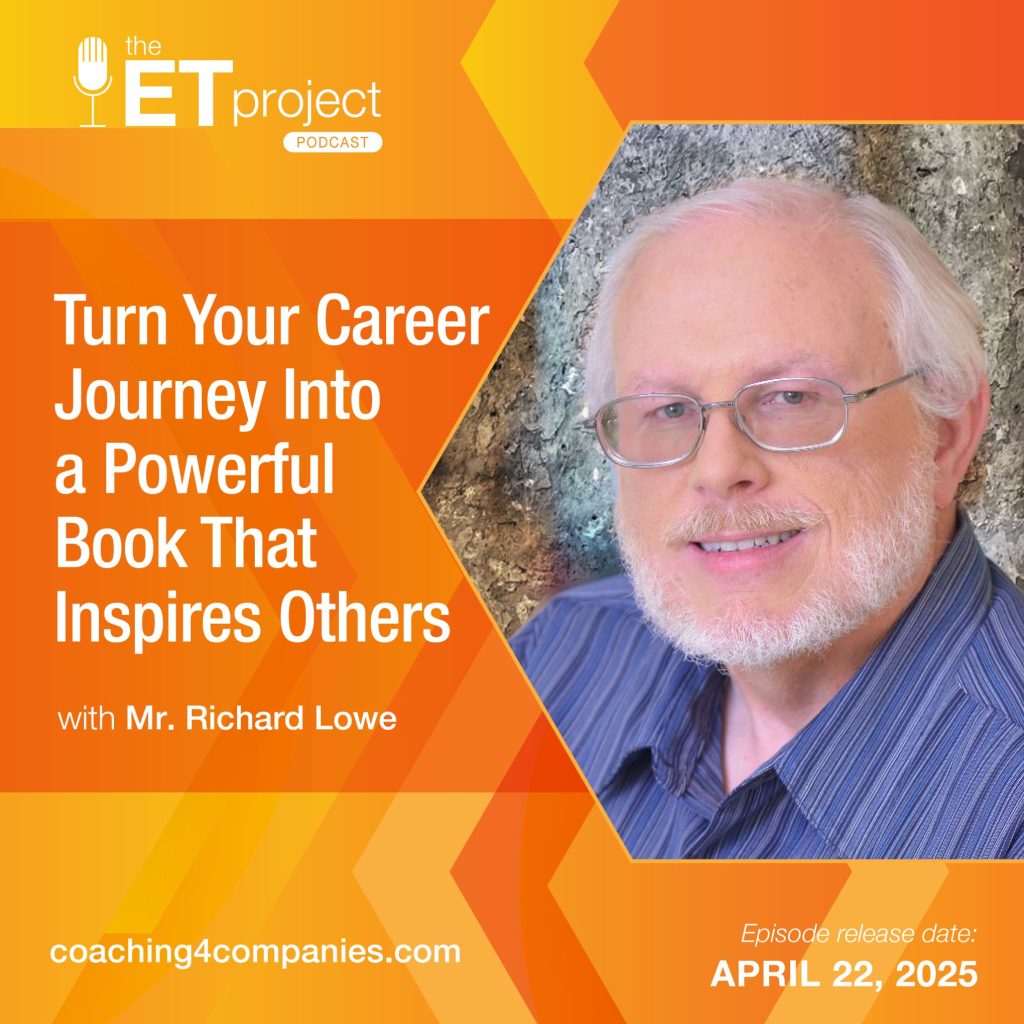
WAYNE BROWN: Hello, I’m your host Wayne Brown and welcome to the ET Project. We’re delighted to be delivering this podcast for executive talent all over the world, whom we’re affectionately referring to as ‘Team ET.’ Today we’re journeying to Clearwater, Florida, that’s just west of Tampa and right on the Gulf of Mexico, or if you prefer the Gulf of America. Regardless we’re here to chat with Mr. Richard Lowe. Richard is a professional ghostwriter, photographer, programmer and leader, and as Richard says from the outset, he has journeyed through many career paths, each twist and turn shaping him into the individual he is today. Beginning his career as a tech professional, Richard became the Vice President of two different companies. He worked at Trader Joe’s for 20 years as the Director of Technical Services and Computer Operations, managing a team of technical wizards, resolving disaster situations and being on call around the clock. Richard eventually tired of the stress, exhaustion and mindless office politics and realized working for a big company was killing him, he decided it was time for a change and bid farewell to that chapter of his life, thus embarking on a thrilling new adventure. Richard’s love affair with books began when he was about five, and the rest as they say is history. Fast forward to today, with more than 60 of his own books published and more than 50 as a ghostwriter for others, Richard has truly found his calling. Team, you can do the math as well as I can and you will see in such a short time, roughly only a decade and close to 120 books, that’s one heck of a lot of writing. During our conversation you’ll hear us chat about AI, what the future of writing looks like and the steps to take in the event that you’re considering your next book, but fear you may not have the skill or the time to make the commitment. Why is this conversation so important? Well for one, as the shift from corporate to entrepreneur continues at pace, more executives are looking to showcase their expertise to the world, and of course having a book is a wonderful way to stand out in a crowded space. So, with that, let’s jump into this great conversation with our guest, Mr. Richard Lowe.
INTRO: Welcome to the ET project, a podcast for those executive talents determined to release their true potential and create an impact. Join our veteran coach and mentor, Wayne Brown, as we unpack an exciting future together.
WAYNE BROWN: Hello team, welcome back to this week’s episode of the ET project. Today I’m going to be diving into storytelling and the art of writing, specifically ghostwriting. Now this is a craft that I’m sure brings a lot of challenges to mind, but a lot of voices to life. One of the things that I’m fascinated by is the invisibility of the ghostwriter and how they deal with that. We’re going to be talking with a gentleman who is extremely gifted, I’ve heard him called a prolific ghostwriter, and looking at the number of books that he has been involved with, I’d have to concur. Richard Lowe. Richard, welcome to the ET project, good to have you here.
RICHARD LOWE: Thank you for having me on the show.
WAYNE BROWN: Whereabouts are you, by the way?
RICHARD LOWE: I’m in Clearwater, Florida, which is just southwest of Tampa.
WAYNE BROWN: Maybe you could fill our audience in, how many books are we talking about?
RICHARD LOWE: Well, I’ve ghostwritten… I just finished my 53rd ghostwritten book, I just finished my 64th book written by me, for myself, and I have three books that are under pseudonyms.
WAYNE BROWN: And when did you start writing?
RICHARD LOWE: On and off, little bits and articles and things through my whole life, but I basically started ghostwriting and anything significant in 2013.
WAYNE BROWN: We’re just talking around 14, 15 years, 53 books, plus, plus, plus, and then all your own, and if we do the simple math, obviously you’re not writing one at a time. How do you manage to fit all that in?
RICHARD LOWE: Well, it’s actually 11 years, and I fit it in because I don’t write all the books at one time. What I do is I write 500 words a day per book, that takes an hour per day, maybe two, depending on what I run into, plus meetings and things like that. So, that targets about 2,000 words per month, per week, rather, and then that’s 8,000-10,000 words per month. Now, I’m leaving time in there for meetings and things, so it doesn’t add up totally. So, 8,000-10,000 words per month in a 60,000-word book, it chugs along, but at those number of hours, I can certainly fit in four books at a time, so I generally work on at least one of my own and three or four of other people’s.
WAYNE BROWN: Perhaps we can kick off the conversation and just sort of look a little bit about the journey you’ve been on, I read somewhere where you describe it as a long, twisting path. You certainly got a very diverse career prior to writing professionally, you were a professional in the tech industry, you’ve been at the level of vice president, you’re a gifted photographer from what I understand, how much has all of that shaped the writing that you do today and the role that you play when you’re a ghostwriter?
RICHARD LOWE: I think with every creative person, the journey shapes the creativity, and vice versa, they work hand in hand. My first ghostwritten book, I use that in quotes, was when I was 17. I wanted to meet my grandfather, he was kind of reclusive and I didn’t really know him, so I sat down and started talking to him and then I decided to write a book. It turns out he was in the Yangtze River Patrol in 1938, he’s a World War II vet, was captured on Corregidor by the Japanese, did the Bataan Death March where half of 10,000 people died, and then he spent four years in a POW camp. So, I got to know my grandfather, and I found out he was a hero. Now everybody avoided him because he was cranky and stuff, and I thought after I was done, he has earned the writing, he’s cranky as he wants. And then after that, had the parent dynamic going on, which was pretty rough, and moved out, had to make a living really fast because nobody prepares you for life at all. Like the concept of paying an electric bill, I was like, what? Just something simple like that. I’m sure everybody has their shocks when they move out, like the stuff they have to pay and stuff they have to do, and so making a living and then getting married and having a stepson and going through all the life stuff. Writing kind of got put on the back shelf, although I did do articles, lots and lots and lots of articles in various publications, technical, I wrote for the companies I worked for, even though I was VP, nobody likes to write, so I do the technical writing. And then in 2013, I said, “oh, to hell with this,” and I quit my job and I moved to Florida, I gave up all my dancer and Renaissance share of friends that I was photographing, and there were many, many, many hundreds, if not thousands of those, and then I started up my writing career. I started with LinkedIn Profiles, didn’t like that, then went to a small ghostwriting company, got $1,000 for my first book, which works out to about 50 cents an hour, literally. So, I gave that up, went and got my own clients and started getting real money, $25,000 a book kind of thing, and then from there I just built up a business, and now it’s going strong.
WAYNE BROWN: Where did the interest in writing come from? Is it something you’ve been doing all your life?
RICHARD LOWE: It came from the early years. My mom really stressed reading, and I just picked up writing. My teacher forced me to learn cursive, you know, back then that was normal, but I had to do extra stuff with it, I had trouble with it, and then I had to learn to type, had a lot of trouble with that, and then really kind of just picked it up. I like to tell stories, and that’s what writing is. Good writing is storytelling.
WAYNE BROWN: You mentioned a little bit earlier about, you know, stepping away from your corporate life. How did you find that? Like, was it an easy transition or was it something that really troubled you for a period?
RICHARD LOWE: I was not enjoying being part of a company. I mean, Trader Joe’s was a great place to work. I’m not unhappy, I was there for 20 years, and I got a lot of… I was director of technical services and computer operations. I ran basically all the production computer systems. I had a lot of wins there. It was a lot of learning, and of course I made a lot of money and put it into my retirement fund and in savings. So, when I left, I had several years of a runway, which I used to prepare myself to survive while I was trying a new career. The transition was interesting. First of all, I was a photographer, and for eight years, every single year, I photographed dancers and models and things, and I just gave them photographs for free. So as a thank you every year, they threw me a birthday party. So, I’d have a hundred dancers and a few models and Renaissance Faire reenactors come to a hall that I rented, and they would all perform for me, basically. And it was… I gave that up. But those were quite fun, you know, having one to 200 people perform for you is an interesting thing. Then one of the dancers, she’s an Indian Bharatanatyam dancer, I hope I’m pronouncing that right.
RICHARD LOWE: She decided I was not going to travel all the way from California to Florida on my own, so she went with me and had adventures along the way. She flew home. Then she flew back at Thanksgiving because she wanted to show me what a vegan turkey was. And she said, “yeah, do you like it?” And I, you know, “yeah, it’s okay.” And she says, “yeah, it tastes just like real turkey.” And I’m thinking like, “first of all, you’re a vegan, how do you know?” And second, “no, it doesn’t.” But it was okay. You know, it’s not something I would eat all the time, but it’s good. She’s a good lady. A wonderful dancer. She was taught by a classical master; they’re called masters of dance.
WAYNE BROWN: You’ve had an interesting journey for sure. If we look at the transition then into writing, I know you talk about one particular story you mentioned earlier, $1,000 for this first assignment, how did it evolve past that point? Like many people were throwing their hands in the air and said, okay, probably not the right course or journey, pathway. What happened?
RICHARD LOWE: Well, I was writing my own book which I’m still writing because I got distracted called ‘Peacekeeper’ and it’s a science fiction book and it’s based a million years in the future and blah, blah, blah. And I was attending writing critique groups and then I ran into a ghostwriter who had his own company and he was looking for writers, but he hired me and I wrote three books for him for $1,000 each, basically, I mean, give or take. And one of them was for an Afghan politician who was a politician in Afghanistan before the Soviets invaded, before the Taliban even existed and he’s responsible for building all the roads and things. I wrote, we never finished it, but I wrote his book and I remember having to do like 16 hours of interviews in one day because he was flying back to Afghanistan through an interpreter. That was an interesting project, a couple of other projects, I finished the books and like I said, it just wasn’t my thing, it wasn’t enough money, it wasn’t the right environment and I was getting very discouraged. So, I said, okay, I’m going to go off on my own because I still have substantial savings. So, I started writing my own books because my idea was ghostwriters can’t show what they’ve written so I better have my own books in a portfolio. Well, I went crazy. I always go crazy, I wrote 60 books on just about everything, you know, from fiction to business to relationships, I mean, coloring books, puzzle books, I did a little bit of everything and they’re all out there on Amazon and then I started getting my clients, I got a client, the day after I left the ghostwriting company, I got a client for $15,000 and then a couple of days later another one for $10,000, which was like, “oh boy, wow, that was easy.” It turned out that that was easy and it actually isn’t that easy because then getting future clients was hard. It sure was fun writing those first books and I really got the taste of it, getting it done and seeing the look on their face, well, they were all remote through Skype at the time, not Zoom, there was no Zoom back then.
WAYNE BROWN: Yeah. I did imagine the whole ghostwriting process isn’t all glamorous. I can imagine there’s a number of challenges that come along with it in dealing with clients, in trying to understand their needs, their desire and put that down in paper. What are some of the biggest challenges you’ve faced through this period?
RICHARD LOWE: Well, let me give you several. The biggest challenge of all is I was never trained as a marketer or an advertiser or a salesperson so the biggest challenge was simply, first of all, recognizing that I needed to market myself and then how do I do it and it’s something I’ve struggled with the whole time. Fortunately, I’m pretty good at talking to people and can work with them and manage to get business. About the middle of last year, I realized, okay, I don’t like doing this, I don’t want to do this, I’m not good at it. So, I hired a company, went through several and finally I hired a company called Allura Creative that’s doing all of my… actually, part of my marketing. I actually got a taste for it and said, okay, I actually do like this, I’m doing my own podcast now and graphics and all kinds of stuff. I just realized I became a marketer all of a sudden. Marketing is not sales and that’s something I had to realize. Marketing is letting the public know who you are, what you are, what you represent, how you can help them and all that kind of stuff. So, it’s more of a branding thing. Sales is where you get the people who come in or you go get them and you talk them into making a purchase.
RICHARD LOWE: Prospecting is where you go get them. I had to learn all three of those. Those are difficult and still right but I’ve managed to put together the right teams and I’ve learned how to do it. This year I’m doing much, much better at it and having more fun at it. It’s not so much of a sand in my eyes kind of thing or trying to chew glass. It’s more of, okay, I can do this and doing it right, that’s one challenge. The next challenge is getting customers. My ghostwriting is a high-ticket item. It’s not a cheap thing so getting customers from that. I want to do a book too, let’s go, we’re going to start now. Getting them over that hump, it took me a while to realize that’s not a one-day process like you would expect or two days or a week. It can take months or even years for them and I’ve got people who I’ve talked to two years ago who come in and say, “yeah, I’m ready to go now.” I’m thinking like, who are you? But I talked to them two years ago, that’s odd, and you have to get used to that cycle is long and it requires a lot of touch points and a lot of work to get them through that decision.
WAYNE BROWN: I think you have a program you offer along those lines, right? To help people understand exactly what they want to do.
RICHARD LOWE: Yeah, I have a book discovery session that normally runs $5,000. Now, I have it on sale for $9.97. Basically, we spend several hours intensely talking about your idea and who the audience is and grind it down to, this is the idea and the audience that you want to sell your idea to in your book. And then from there you can decide, do you want to proceed with ghostwriting or do you want to do it on your own or whatever. But the idea is most people come in saying, I have an idea for a book, I want to do this and this and this, but they don’t have anything more than that. This helps bring them down to the level of, okay, I know exactly what I want to do and I know exactly who’s going to buy it.
WAYNE BROWN: So, there’s a couple of challenges, any other major issue, jump out at you?
RICHARD LOWE: Oh yeah. This challenge comes on both sides of the sale. So, on one side of the sale, you get the people who want to get revenge. So, they want to write what I call a revenge memoir or a revenge book where say they had a nasty divorce or they had a nasty firing thing, there was one person who was put in prison by somebody and they want to write a book to get revenge, I don’t do those. Because they’re nasty, they’re hard, you’re dealing with a lot of emotion, a lot of anger and stuff whilst you’re writing into legal issues. So, I typically won’t do those, I mean not that I won’t do a memoir that has negative things in there, that’s fine. But when it’s specifically to get revenge, I don’t do those. I had one potential client contact me many years ago who said he was a confidential informant for the FBI or something, I forget exactly which, and he wanted to name names of everybody who was… everybody, you know, agents and everything. I said, “um, no.” He said, “well, I’ll give you a couple hundred thousand dollars for it,” and I said, “no, I can’t spend your money with a bullet in my head, sorry.” So that’s one side of the sale. On the other side of the sale, I learned that it’s very important to have clients that you can get along with and that can get along with you. Like any sale, and this is creative so any kind of artistic person is going to run into this, it’s… you run into people who you just can’t work with. And I would say 95% of my clients have been wonderful people and some, you know, we all speak like adults and we work things out. There’s always the few percentage, like any business, I think they call them Karens now, where it just goes south and there’s nothing you can do about it. And those can be interesting to deal with. You just got to work, power your way through it and figure out do you want to continue in this or not. There have been a couple where I’ve said, “we’re basically not going to work together here, let’s just go both our ways.” And I said, “yeah, you’re right.” And every time, you know, and we stop.
WAYNE BROWN: But what happens as a ghostwriter, does the book still go through the editing process or are you then responsible for the editing? How does the whole process work in that regard?
RICHARD LOWE: Well, what I do is I write the book and I do the analysis up front with my client. So, we do a lot of interviews to figure out what it is, what the ideas are and the outlines and all that kind of stuff. And then I write the book. When the book is done, then it goes off to an editor.
RICHARD LOWE: Now there’s two ways. There’s traditional publishing. And if you want to do traditional publishing, you’re talking about a one-to-two-year delay and your publication delay date and a high probability that no publisher is going to accept it. Self-publishing, you hire an editor, traditional publishing is do their own, you get an editor with it. Self-publishing, you get your own editor, you work with them. And I guide my clients to the editor, but I don’t do the editing. Editing is very different than writing. When I write, of course, I’m doing some editing as I go and you get a good, solid, clean first draft, but it’s not going to be, or even a second draft, but it’s not going to be printable quality. Most ghostwriters will do the same thing, they’ll hand it off to an editor. Some try and edit themselves, I don’t, I like having a different person, their editors are relatively inexpensive. Then you also need a book cover artist and some other pieces to make your finished work.
WAYNE BROWN: There’s typically different forms of editing as well, if I understand correctly. So, you don’t necessarily just have the one editor, you may have two or three.
RICHARD LOWE: Well, what I like to do is find an editor who does them all in one package. So, you get the proofreading, the spelling checking, the copy editing, line editing, all these different kinds of editing in one thing. Not developmental editing usually, that means your book has to be redesigned, basically, that’s a rougher task. I never had a client who needed that at the stage where we’re done, that’s something you usually want to do along the way if you’re having trouble. We really haven’t run into developmental editors at all, so I’m a little fuzzy on it. But yeah, you do have different kinds. I like to find one that does it all together in the same package.
WAYNE BROWN: So, let’s just say I want to write a book. I have this great idea, but I don’t have the time, I’m not a writer. And I hear about Richard and I think, okay, there is my solution. I start talking with you. What does the process look like? How long does it take to get to the point where you’re able to start putting pen to paper?
RICHARD LOWE: Well, after the contract is signed and so forth, the process is we have a whole bunch of meetings. Usually, three or four a week for the first few weeks, but depending on the size of the book, it would be less for a smaller book, where we’re getting down to, I want to get your heart and your soul and your passion, I want to find out what that is. That could take a bit of time because you might say it’s X, but it’s actually Y. So, I ask a bunch of questions to work my way through it until we get to, yeah, my passion is blah, blah, blah, and where their heart is, their voice, all these different kinds of things, I want to get all of those things. Their voice I can get through various writings they’ve done. I can get through their interviews, I had one client who liked to curse a lot, curse really a lot. And I said, “do you want the book to curse?” And he said, “yeah, well, maybe not as much as I do, but yeah.” So that’s what I look for is what’s the voice, how do they talk, how do they want the book to talk? Do they want it to talk like them or do they want it to talk like their grandfather? You know, it could be any number of things.
WAYNE BROWN: What sort of time are you talking? Does it take a month, two months? It depends on the individual, I’m guessing, but could it take that long before you can get started?
RICHARD LOWE: Well, for a 60,000-word book, it can take two to four weeks to get through that. It depends on how the interviews go. Sometimes it could take one week. Sometimes it could take four. Once that’s done, then we start writing and we write, I generally like to write the first chapter and then the last chapter and then come back and redo the first chapter and then go forward to the last, when I hit the last, I’m going to have to redo it, I know that. But the point is that I know where we’re going, where the end game is. It depends on the book. I don’t always do that. The last chapter is usually the conclusion and it’s usually pretty short. If it’s fiction, it’s going to be different. It’s going to be the last chapter. The conclusion, which might not be the last chapter of the book, it might be fifth to last because there’s usually, like in ‘Lord of the Rings,’ you’ve got to wind down all the stories, that’s not the last, you don’t want to write… I write the conclusion, the big battle.
WAYNE BROWN: How much research do you have to do as the writer versus the actual person who wants the book written?
RICHARD LOWE: Generally, the client is responsible for research with my assistants. If it’s a book about blockchain, I’m going to expect them to… in the interviews, to talk to me about blockchain and point me to various publications or things that I need to read.
RICHARD LOWE: There’s a limit to what I can do. I can’t read a whole five books or even a whole book, so I tell them, tell me which chapters of the book are important for your book or tell me which parts of this article are good and then I’ll read those. I typically will depend on the customer for that. They’re the knowledge expert, I am the writer and if it’s a lot of research, it’ll get outsourced to somebody who does research.
WAYNE BROWN: Typically, are we talking a six-month assignment? Could it be 12 months? What’s your experience?
RICHARD LOWE: A 10,000-word book could probably be finished within a month or two, and only that long because I’ve got multiple clients, a 60,000-word book could be eight months to 12 months. I can do them faster, that has a higher fee because I have to push other customers out of the way and take less work on. And I’ve done that, I’ve had clients come in and say, “I want it in three months.” “You want a 100,000-word book in three months?” “Yep.” “You realize I’m going to charge it two and a half times my normal rate?” “Yep.” “Okay.” And I specifically charge a higher rate for that because I don’t really want to do that, I want to take longer, but they want it fast and it’s like, okay. Then that’s what it is and I’ve had a couple of those.
WAYNE BROWN: You mentioned before about the sales and marketing side, you know, this is every entrepreneur’s nightmare to some extent, but have you found maintaining a constant stream of people wanting books written to be a challenge or has that tended to flow relatively well?
RICHARD LOWE: It was a challenge. The challenge is that I tended to focus on the sales part. So, when you’re focused on the sales part, you’re going out there and you’re grabbing the obvious, the low-hanging fruit as I like to call it. Oh, this guy needs a book, you talk to him. He says, yes, you go. Those require work to find and they’re not prepped, they’re not ready for it. So, when I added the marketing phase, it becomes more steady because these people are coming to my podcast, they’re coming to my group meetings, they’re involved with me, they’re getting to know me. We’ve probably had a couple of talks. We’re in the same networking groups, this is all marketing stuff. So, we learned to like each other and then he knows that I’m the ghostwriter he wants or she wants and then they go with me and it becomes a much more steady flow of work when you do the marketing side. If you don’t do the marketing side, it becomes totally… especially around the end of the year, especially around elections.
WAYNE BROWN: So, your experience at the end of last year?
RICHARD LOWE: From August until just last month, dead as a doornail, nothing. And now that I’m improving in the marketing, I’m getting more and more inquiries and more and more people coming on board. Unfortunately, I’m aware of the up and down so I’ve got the depth of finances to be able to have a few months where I’ve got nothing coming in, that’s very important when you’re a freelancer, any kind of freelancer, that’s very, very important. You’re going to have dry times, make sure you’ve got the money in the bank.
WAYNE BROWN: I think that can apply to just about every business as well, right? That’s one of those things.
RICHARD LOWE: Yeah.
WAYNE BROWN: How do you, obviously working on multiple stories, and I’m guessing not all non-fiction at the same time, not all fiction at the same time, how do you keep the story line in your head or how do you capture that and be able to maintain that?
RICHARD LOWE: I just do, like with a computer you call it a ‘context switch’ where you’re working on one thing and then go off, take a walk, come back, and I’m working on something else. So, in the morning, I might be working on a science fiction book for a rock star. The second half of the morning, I might be working on a book about blockchain. Then the third half, I’m doing marketing stuff. The fourth, maybe three hours, I’m doing a book on AI and I finish up the evening by doing my science fiction book or my collection of short stories, I’m working on a collection of short stories too.
WAYNE BROWN: Incredible. You mentioned AI and of course, I have to ask, it’s impacting every industry, every line of business, and I’m sure writing is no exception, books in particular are no exception. What’s the impact it’s having for you or for book writing in general?
RICHARD LOWE: By the way, I purposely laid out that seed for you. It has been interesting; AI cannot write a good book for you.
RICHARD LOWE: It can write a book for you. It can write a decent book for you. Can it write a book that has your passions, your heart, your soul, everything you want in it? No. It can’t do that. But what it can do is if you just want a book, if you just want a book, all you want is a book. You don’t care that it’s mediocre to okay quality, then yeah, use AI. It’s going to have inconsistencies. It’s going to have false data because AI hallucinates, it lies. Actually, just complete bald-faced lies and I even ask it sometimes, “are you lying there?” “Oh, yeah.” It says, “yeah, I’m lying.” “Okay, thank you.” So, you have to be careful with that. If you want a book that actually will say become a bestseller or make you look the best that you can, you want a human author. If you can’t do that, you want at least to have a human editor who edits a deep edit. And I do offer that service where I’ll write a book with AI and then I’ll do a deep edit on it, that’s my budget service.
WAYNE BROWN: Now, that’s actually what I was thinking about was do people come to you these days where they’ve pulled a book off the internet essentially through AI and they say, “now make this something that I can be proud of,” type of thing.
RICHARD LOWE: Well, they come to me like that. I don’t generally take those kind of projects because then I’ve got a mixing, there’s somebody else’s ideas with my ideas with their ideas and it becomes very weird. And then it also becomes weird with learning what’s been plagiarized and what hasn’t. AI tends to plagiarize. So, you have to be careful of that too. So, and plagiarism is deadly to write when you write a book. If it gets big, you’re going to become a target for legal stuff. So don’t plagiarize. Don’t steal other people’s work and AI is famous for stealing other people’s work. But I’m offering the budget book service because it makes it much cheaper and you will get a decent quality book. It won’t be as high quality as if I wrote it, not anywhere near it, but it will be something that you’d be happy to put your name on.
WAYNE BROWN: I remember when we first started talking, you said quite often you write a book and then you use AI to test or to test the characters, et cetera.
RICHARD LOWE: The appropriate place for AI in writing or in any kind of creative industry or most industries is as a digital assistant. It’s actually, you could think of it as a digital employee. So, you’ve got your AI off to the side, I have it on my other screen here next to me, actually sometimes I have it on both, and you say, “okay, here’s this chapter, I just wrote this chapter. What do you think of it?” And it says, “well, it’s pretty good, except for this and this and this and this,” and you go, “okay, fine, I’ll fix those.” And then you come back and say, “now what do you think of it?’ “Well, it looks good now, except you’ve got some spelling errors, you’ve got some grammar errors and you’re inconsistent here,” and so forth. Finally, you get it polished up and then you say, “how does it fit with the last chapter?” “Well, it doesn’t.” “Okay. Why not?” Well, AI is already going to tell you, it’s real chatty. It’s annoying because it’s like, “oh, here’s all the reasons,” I just wanted you to tell me yes or no. And then you ask it questions like, “okay, so, it’s a fiction novel, do the characters remain in character through the whole book?” Or, “is this the right characterization for that century that the book is written in?” You can ask it any kind of questions you want about that and it finds the patterns and it’ll tell you. You can do that over and over and over again till you have it perfect. Would this get a 10 out of 10 on a writing contest and it’ll say, “no, it gets an eight out of 10 and here’s why.” “Okay. What do I need to do to make it a 10 out of 10?” We’ll do all this stuff. Then you say, “okay, fine. I’ve done all that stuff.” And it says, “okay, now it’s an 8.5 out of 10.” “Why didn’t you tell me all that?” And then you got to do it again. You do it iteratively, you do it over and over and over.
WAYNE BROWN: I can imagine we get to a point where it’s going to become even more iterative, maybe not in the foreseeable couple of years, but I can imagine we’re going to get to that point. I was thinking while you were talking about that, what is some advice you would give to an aspiring writer who is just starting out, they’ve never written a book, how do they sit down and put a framework together or put their concept down so they can actually start to write? Would you have any advice for those type?
RICHARD LOWE: Well, the first advice is probably advice a lot of writers will give is just put your butt in the chair and write, and that comes from Mercedes Lackey, who’s a fantasy writer. Just put your butt down in the chair and start writing because you’re not going to learn to be a writer unless you’re writing. Now you could start with your journal. You could start with any kind of thing, write a page or two or three or four a day, every single day, just keep writing.
RICHARD LOWE: I’ve got a book down here, it’s called The WRIT Book or something like W-R-I-T, and it’s a book of exercises. Maybe I can give you the title and you can put it in the description. It has got a whole year’s worth of exercises like, okay, now write a story focusing on the person’s face, and now write a story focusing on the person’s arms, and then now in motion and now interacting with other characters, so it builds on things until finally you’re writing real stories. Those kind of things are awesome because they’re very practical-oriented. I tend to avoid writing classes, but for some people they can be very useful, especially if writing… I mean, I have been writing most of my life, but if you haven’t been, a writing class could be very good. You can pick some… I pick online one-on-one classes or one-on-four kind of classes. I wouldn’t do more than one-on-four. Don’t do the pre-recorded ones, pay the money and have somebody actually train you, and I do offer writing coaching, which is another way to do it. Find a writing coach. So, if you can’t afford a ghostwriter, you can hire me and I’ll coach you through your book. I won’t write it, I’ll coach you.
WAYNE BROWN: It sounds like a nice middle ground from going from being the absolute writing by myself without any guidance through to handing over to a ghostwriter and finding this coach in the middle. It sounds like quite a smart way to go.
RICHARD LOWE: Well, yeah, and the writing coaching will work through your idea first, and then we’ll hone that down, come up with an outline together, and then we’ll work through your idea, through the first chapter, and then you’ll write maybe a couple pages, and I’ll critique it. We’ll go back and forth. It generally takes a while, but it depends on how much work you want to do on it. If you want to write a chapter a week or a chapter a month, we’re going to be moving at a pretty good clip. Some authors come in and they do a chapter every couple of months. Some authors come in and they do a chapter a week, but it can be a very intense coaching, and of course it’s charged by the hour in that case, and however many hours you want to spend a week, you get charged for it, and then we work together. But you write the book, is the point.
WAYNE BROWN: Okay, okay, and does that cover grammar as well as storyline, or is it sort of dependent on what they’re needing?
RICHARD LOWE: We’re focused on the writing and the story, not grammar and pronunciation. Now, if you don’t speak good… I’m an English speaker, so if you don’t speak good English, relatively good, or you don’t write good English, I probably won’t take you on as a client because I’m not in the business of teaching you how to write in English. You’re going to have to take some classes on that. I’ve had that happen before where I wound up teaching them, you know, for my rates, teaching them how to conjugate verbs and things was ridiculous. I said, go take some classes over here and then come back, and those were recorded, and now come back and then we’ll write together.
WAYNE BROWN: Right. Now I believe you are just about to release a book, another book, when does this one hit the shelves and what’s it about?
RICHARD LOWE: It comes out on April 24th, and it’s called ‘The Ghostwriting Advantage.’ I’m having a book launch party on April 24th at 7pm, so if you go to my LinkedIn, you’ll find it under my events. The book is about ghostwriting from the client’s side, so you want to write a book, this tells you everything you need to know from the initial idea all the way to publishing, all the different ways to publish, all the different things you need to know. I mean, it’s really in-depth, so that you can walk… if you read it, you can walk into a ghostwriter, say me, and you can say, you will know what you’re getting into, and you’ll know all the pieces and everything, and you can keep it as a reference as you go through. So, it’s intended to be everything you need to know about hiring a ghostwriter and working with them. It’s long, but it’s well worth it, and I think you’ll enjoy it.
WAYNE BROWN: What is the primary reason you find from your clients that they engage you as a ghostwriter? Like, is it because of time? Is it because they just can’t get the idea down on the page? Is there a primary reason?
RICHARD LOWE: Time is the main reason; they simply don’t have the time. So, a CFO will come to me, or a CMO, or a CTO, all these different C levels, will come to me and say, I want to write this book about the cloud. I’ve got this idea, blah, blah, blah, that’s unique, I think, and I simply don’t have the time to do it. And I’ll say, “good, that’s the perfect reason to hire me.” So, then they come to me, we negotiate, come up with a contract, and then I start writing, that’s my number one client. Number two is the person who may have the time, may not, who doesn’t have the writing experience, but they know they need a book to raise themselves up to a new level, coaches. If you look at coaches, you look at the ones who are actually making it, they have a book.
WAYNE BROWN: Yeah.
RICHARD LOWE: Most of them have a book. Why do they have a book? Because it makes them, it’s their authority, it’s their credibility. So, if you want to be a coach, and a lot of people are becoming coaches because they’re becoming unemployed and they got to do something, and saying, “I’m a coach,” on LinkedIn, and then getting hourly rates seems like a good way to make a business, except that there’s a million of them. Everybody else has the same idea. So how do you make yourself different? You get a book, and I write those kind of books. The third kind of book I write is senior legacy books. So, if you’re a senior and you want to write a legacy, I write those.
WAYNE BROWN: Where’s the best place for people to connect with you and follow what you’re doing or find out how to work with you?
RICHARD LOWE: First of all, you can find me on LinkedIn at richardlowejr.com, and my picture is there, so it should be easier to spot, and thewritingking.com. Did I say richardlowejr.com? It’s Richard Lowe Jr or thewritingking.com or ghostwriting.guru.
WAYNE BROWN: A great conversation, I’m sure there’s a lot of listeners out there who have been thinking about writing a book or who have thought about it, are being daunted by the prospect of, well, here’s an avenue. I don’t want to put people off, but of course it’s not going to be that cheap, it’s not a five-dollar job.
RICHARD LOWE: Well, there’s a good reason why people don’t start books, they’re not easy.
WAYNE BROWN: Yeah.
RICHARD LOWE: I do offer a 30, 60-minute free consultation, so if you just go to my website, set up a time. We’ll talk about your idea, and then you can decide, yes, I want to go, or no, I don’t.
WAYNE BROWN: Well, thank you, Richard. Great having you on the show.
RICHARD LOWE: Thanks.
OUTRO: Thank you for joining us on the ET project, a show for executive talent development, until next time, check out our site for free videos, eBooks, webinars, and blogs at ‘coaching4companies.com.’
[END OF TRANSCRIPT]