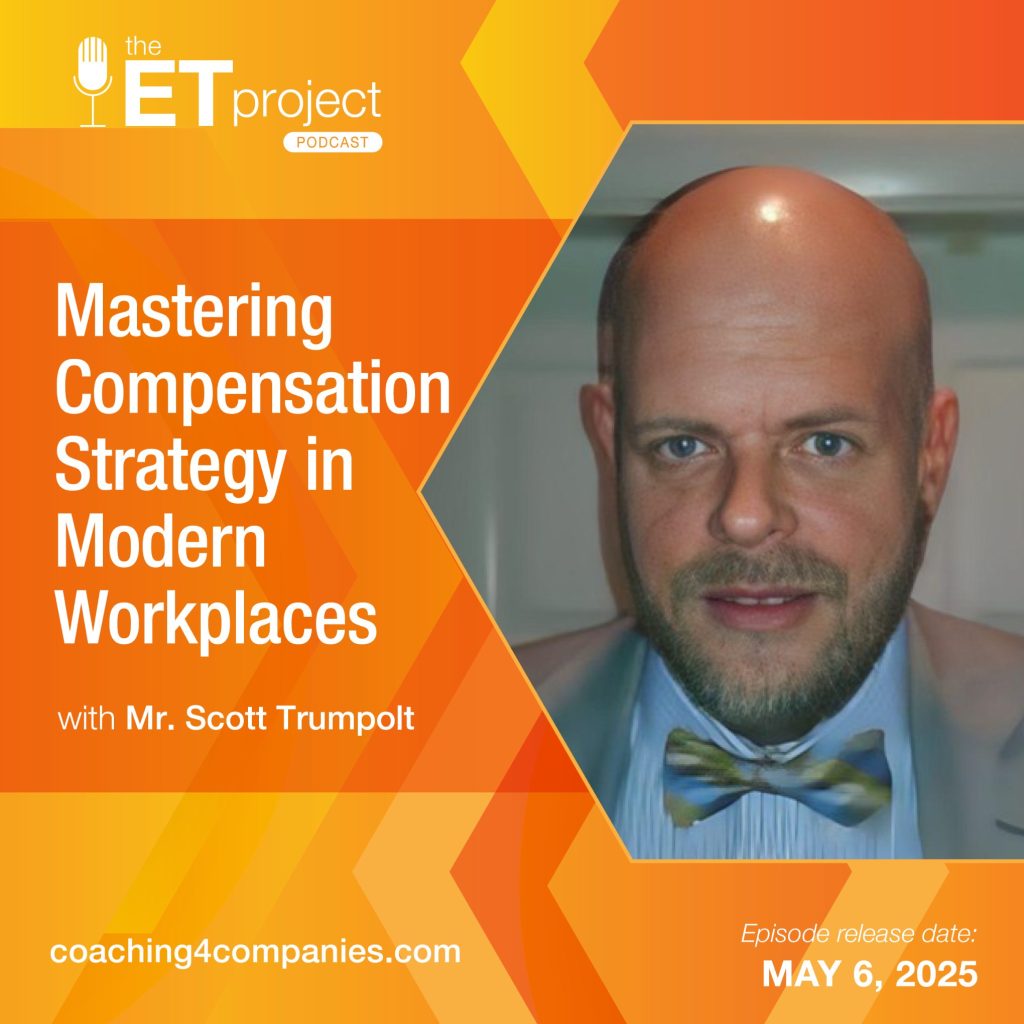
WAYNE BROWN: Hello, I’m your host Wayne Brown and welcome to The ET project. We’re delighted to be delivering this podcast for executive talent all over the world who we’re affectionately referring to as ‘Team ET.’ Today we’re back in Florida in the township of Coral Springs, which is a short drive north of Fort Lauderdale, and we’re here chatting with Mr. Scott Trumpolt. Scott’s career is defined by a seamless evolution from corporate leadership to independent consultancy, reflecting over 30 years of expertise in compensation planning, HR leadership, and reward strategies. For 18 years, Scott excelled in the corporate world, holding HR and compensation leadership roles across the United States and Germany. In 2012, he launched Trumpolt Compensation Design Solutions to provide bespoke solutions tailored to the unique needs of organizations worldwide. Scott’s corporate experience provided a solid foundation for mastering market-based pay structures, sales incentive plans, and job classification systems. Transitioning into independent consultancy, Scott has spent the past 12 years leveraging this expertise to deliver innovative client-focused strategies. This blend of corporate insight and entrepreneurial innovation allows him to navigate compensation challenges from both perspectives, creating high-impact solutions that drive organizational success. He’s a certified global remunerations professional, holds a master’s degree in human resource management, and has maintained an A+ Better Business Bureau rating, underscoring his commitment to excellence and client satisfaction. Team, whether you’re leading a group, a division, an entire corporation, or running a small startup, this conversation will offer you insights linking market-based pay to career architecture and how to integrate compensation strategies that drive employee engagement and career development. As we all know in today’s market, with such diversity of generations in our workforce, this topic has become one that’s essential to understand for all leaders. So do yourself a favor, listen in now and learn more.
INTRO: Welcome to the ET project, a podcast for those executive talents determined to release their true potential and create an impact. Join our veteran coach and mentor, Wayne Brown, as we unpack an exciting future together.
WAYNE BROWN: Welcome, team, to another episode of the ET project podcast. Today we’re going to be having a discussion around an extremely interesting topic, at least I’m guessing for the majority of us listening it’s a very personal interest topic, it’s the fascinating world of compensation. And when I talk compensation, I’m talking about your pay packet, the package, the salary, whatever it is that you’re reimbursed by or the commission you receive. So, it’s a critical piece of the puzzle, attracting, motivating, retaining top talent. And of course, that’s you, you, the leader in particular, that’s who we’re going to be focused on, whether it’s a start-up crafting creative equity packages or a global corporation, for that matter, building scalable pay structures. The way organizations approach rewards speaks volumes about the priority and the culture of that organization. And as industries and workforces evolve, so of course does the need for the strategy of the pay, the compensation, needs to evolve with that. And today we’re extremely fortunate to have as our guest, you heard me introduce Scott, Mr Scott Trumpolt, an expert in this field of compensation and packaging. Scott, welcome.
SCOTT TRUMPOLT: Thank you so much for having me. It’s a pleasure to be on the show today and to speak with you and your viewers.
WAYNE BROWN: You’ve been in the industry, particularly in the HR field for some 30 odd years.
SCOTT TRUMPOLT: Yeah.
WAYNE BROWN: You spent some time in Germany, as I have. Are you German by ancestry, like your family history from Germany?
SCOTT TRUMPOLT: Some. Like many Americans, I’m a mix, but yes, some. And I actually have visited in Germany, where I was in Germany was the Bund area, which is not where some of my ancestry comes from. It’s more from the eastern part of Germany.
WAYNE BROWN: About 12 years back or 13 years back now, I guess, you shifted away from a corporate environment into running your own business. What was the trigger for that? Was there any particular moment that you decided to do that?
SCOTT TRUMPOLT: Yeah, I hadn’t put a lot of thought into it as the years went by and I accumulated skills and experiences. I found that in my last stop, which was in Germany from a corporate perspective, I was working for the head office. And what I found was that as my career was going along, I was getting into higher and higher level roles, but more administrative, more people management. And I was getting away from the aspects that I really loved, which was the hands-on design work. And I really felt like if I continued on that path, my skills in that area, which is what I love to do, would kind of deteriorate. So that’s when I kind of made the decision to say that, well, I’ve been in corporate for 18 years now, and I’ve learned an awful lot, and I’d like to share it in a segmented, more precise way than I could get in the corporate world where I’m working on different aspects and really zero in on the idea of compensation design because compensation, one of the drivers also was the fact that compensation is very, and you alluded to this, compensation is kind of a black box. It’s in the shadows. It’s very personal. It’s very intimate. You’re dealing with people’s lives. That’s why compensation is part of human resources because it has that human element that’s very much part of it. It’s not accounting. It’s a bit different. And so, I really wanted to explore ways that I could link employee engagement, link compensation, that is, to the idea of employee engagement because when you have employees engaged, that yields better business results. So, I felt that the best capacity that I could have would be as an independent. And as you say, I’ve been doing that for about 13 years now, and that was the right move for me.
WAYNE BROWN: It’s a very interesting area, and I read somewhere you talk about, extending on what you just said, you talk about the hope that there becomes or there will be greater transparency in the packages and the compensation being put together. What exactly are you referring to when you talk about more transparency?
SCOTT TRUMPOLT: Part of it is that the more that you can relate to people what you do, the more they will understand the logic behind the decisions that are being made. They won’t always agree with those decisions, but it’s very important for people to understand why things are the way they are in compensation, how their compensation package is put together. So, the more you can elaborate on the market, for example, how you pay people and there’s a market for your job, there’s also a market for your level within your job, I think that transparency itself in that area can lead to greater employee engagement. And it’s how you discuss about it too, not directly about the pay, but how career development fits into that. So, when you can take the idea of market-based pay and linking it to career development, linking it to what the individual wants to work on, but also link it to the business need, when you do those kinds of things, you’re allowed to have more transparency. And rather than just talking directly about, okay, here’s your pay right now, that’s kind of a limiting discussion. So, the more you can put these pieces together, market-based pay linked to career development, linked to the business need, leads me to greater employee engagement levels, and we’ve seen this happen.
WAYNE BROWN: The whole concept of having that career path to be able to link the pay too in the first place is a step that many companies I imagine don’t have. I know there was something that I spent a lot of time discussing with different companies over the years about, is actually having that capacity or having that foresight to be able to say, okay, a person working in this field now would maybe move in this direction and have this career path. And I see a lot of companies don’t have that. And therefore, to be able to reach the point you just said would quite often be a challenge.
SCOTT TRUMPOLT: Yes. The thing is, it’s an aspirational goal, first of all. But keep in mind that you may see that in different countries like in the United States, we have things like you’ll see these listings, chosen best 100 companies to work for from an employee engagement perspective. Part of that is that these companies often do offer a career development visibility to their employees, which is especially important to more newer generations. And when you link that into the fact that there are now laws in the United States, in certain states, that there needs to be greater transparency, posting of pay ranges. But in and of itself, the posting of pay ranges is kind of, it’s nice but it’s really a dead end because all that says to the employee is, okay, this is what we’re going to pay you and they can look at this range. But they can’t connect further beyond that. So, career development, career architecture, as we often call it, is this idea that how do you grow from here? Do you have to move laterally to obtain skills in a related area to then move up higher into the organization? Or do we take what you’re doing right now and continue to expand your responsibilities into higher levels of that same job within the marketplace? Because there’s no such thing, for example, as an accountant. There is an entry-level accountant, there’s an intermediate level and a senior, and it’s not based on years of experience. That’s only a very small part of it. What it really is is how you’re dovetailing that into the business need and you’re growing that individual to take on greater and greater responsibilities. As you accumulate years of experience, the idea is oftentimes because of these experiences, you’re going to be able to expand the scope of what you do. Perhaps you get involved in project leadership. So, we’re not even talking necessarily about moving into a people leadership role. We’re talking about staying, for example, on an individual contributor path where you’re just working on larger and more complex projects because you’re ready to do that. And that is linked to greater pay opportunities. That’s when the pay comes in. So, the idea is we have to put all these other pieces in place to then grow your pay. But when we do that, that’s the kind of pay transparency I’m talking about.
WAYNE BROWN: Right. And that opens two questions in my mind. The first one is sort of what I was going to move into anyway. I can imagine over the journey, 30 years, you will have seen quite a lot of change in the HR role and the field of HR?
SCOTT TRUMPOLT: Yeah.
WAYNE BROWN: Have you seen a lot of change within that 30-year period?
SCOTT TRUMPOLT: Yes. Yes, I have. It has been an ongoing evolution, absolutely. And the thing that I mostly see is HR, Human Resources, striving more and more to become a strategic business partner. Now let’s face it, Human Resources is not a profit center. It doesn’t generate a profit or contribute directly, say, in sales or operations. So, the struggle, and I shouldn’t say so much the struggle, the challenge is to make yourself a strategic business partner. And one of the ways that I see things have changed is HR used to be primarily focused on things like compliance, which is still very important. I’m not saying these things are going away, but compliance with various employment laws, getting involved in performance management of employees, handling different types of personnel issues. But that’s very more on the tactical side. It’s important. But if you’re going to be a strategic business partner, and that really is the evolution that we’ve been seeing, is having Human Resources take a more proactive role and saying, we know that the way that Human Resources can contribute to the business bottom line is to improve employee engagement. We can measure through employee opinion surveys the levels of engagement of employees. So, what’s important in the employee engagement perspective? We know that it’s the immediate manager that the employee has, that’s the dynamic, that’s the most important relationship. So, if we can arm the managers with tools such as career architecture that’s linked to market-based pay and give them advice and training on how to meet these needs of their employees, then we are being more strategic.
SCOTT TRUMPOLT: We’re forward thinking, and we’re providing a service to our managers and business leaders in the area of employee engagement. So, employee engagement is the key. And what I’ve been seeing over the past number of years is more and more of an effort. More and more resources are being spent on information systems to support Human Resources so that they can do the analysis necessary to then help the business. It’s an ongoing challenge. Again, Human Resources is not directly involved in the profits, the generating of revenue for companies. And as such, it’s a little bit more difficult to get the resources that they need. But making that kind of connection helps a lot, and that’s the big difference that I’ve seen over my career from when I started and where it is now.
WAYNE BROWN: And that in itself is quite interesting because I can see a dynamic that has the potential of unfolding in that as HR does get more involved in the business, they become less for the people and more to satisfy the business. Do you find that total war, that tension between the two serving elements?
SCOTT TRUMPOLT: No, not really, because… it’s a good question, but I feel like we’re doing the service for the employees as well. I think it’s a balance because this is what employees want. Employees oftentimes, they will not leave a company… Believe it or not, pay is usually down the list in terms of why people leave. Unless there’s something glaring that the company is not recognizing in terms of market-based pay, it’s usually more driven around this need to connect, the connectivity to the company and how they can grow with that company and be beyond where they are today. So, if we’re promoting these kinds of programs to management, we’re helping management, yes, because we’re trying to strengthen our partnership with the business. But at the same time, we’re doing it with the idea that employees are our biggest asset and resources. So, we’re simply trying to meet that need, but do it in a way that makes sense for the business.
WAYNE BROWN: Mm-hmm. Let’s move into the theme of what we’re going to talk about, which is comparing a little bit the smaller enterprise, the small business, or the startups, so to speak, versus the larger corporations. And in particular, the difference in mindset to start with between people who work for that startup versus people who are entrenched, embedded in the larger corporations when it comes to expectation around their package. Do you see a huge difference or any difference at all?
SCOTT TRUMPOLT: A huge difference, a big difference. I worked in a startup myself for three and a half years. Even though my background is almost all compensation, I did take a job as a director of human resources because I was trained in all areas of human resources. It’s just that I specialized in compensation. But I worked for an IT information technology startup firm for about three and a half years. But in general, also, startups are a very intimate environment. When I started with this company, and it grew, of course, but when I started with this company, I think I was employee number 20 maybe. So, a very intimate environment, very much transparent. Employees have to wear many different hats. And also, there’s a sense of urgency because you’re just trying to survive. You’re trying to make the decisions that are going to get you to the next level of acceptance in the marketplace. So, it’s a very different mindset than a company that’s large and has been established. But at the same time, there are great opportunities in a startup.
SCOTT TRUMPOLT: For example, if you go into a large company, they may very much have a compensation philosophy in terms of how they pay their employees. And you may end up coming in there and suggesting some changes based on things that you see. And it can be very entrenched in terms of where they might want to make changes and where they may not want to make changes. And you might have to do quite a selling job to convince them that you need to make some changes in their approach of how they compensate employees. Whereas in a startup environment, they don’t really have a compensation philosophy yet. They perhaps have so much money that is being funneled into them by private investment, by funders. And they need to use that money to attract and retain the right people for the organization upfront to get them to the next level. But once they get to the next level, they might need a different philosophy for that next level. So, it’s very fluid, very fluid. And you really have to, in both cases, be a really good listener and understand, but also understand the difference in the dynamic of what I’ve just tried to explain in terms of a startup and a large company, those kinds of factors that I very briefly talked about. There’s more, but very briefly, those concepts play into what kind of approach you’re going to use compensation-wise. So, for example, I mentioned, to give something more specific, I mentioned in a startup that people wear a lot of different hats, including the CEO. So, if you’re developing a pay structure range, you might want to not focus on the individual job that they’re doing, but more the career level that they’re at. What is their overall function? Are they a professional? Okay. Are they a senior professional? Okay. Rather than this person is a payroll administrator, this person is a financial analyst. It’s more about the level that they’re at that we’re going to pay them at, not this very, very specific job because they might be wearing many different hats. Example, when I was working as the human resources director, I had to help out with the payroll, which is really a finance function. But so, again, the idea, just to give a little specifics there, is it’s more career-based in a startup, broad-based than it would be in a corporate, which is more segmented and very much specific to what the individual… because they’ve got a full infrastructure behind them. So, it’s different, that’s the biggest difference that I see.
WAYNE BROWN: Okay. I can imagine, for a startup, from an operations perspective, they’re trying to hit some targets for predominantly growth. And all businesses are about growth, but are some of the compensation elements of the package tied to remuneration for, if we grow to this size, then you’ll be rewarded to an extent. If we don’t achieve that, there may not be any compensation, I guess.
SCOTT TRUMPOLT: Oh, most certainly. Well, not any compensation, of course, because we do need to have a base pay package. But, for example, you just hit on an important element there with the idea that in a larger corporation, you might have an annual bonus that’s tied to annual financial results, and it might be very traditional. Whereas in a startup environment, you’re really trying to hit those certain goals as you go along throughout the year in the process. So, you may have a variable pay plan that might be more lucrative in terms of your base to variable pay mix. You might put more on the variable side to make it as attractive as possible, and then say on a quarterly basis, if we hit this, your payout frequency could be more immediate than it would be in a larger corporate environment. It may be very targeted, and it may be more lucrative because you’ve really got to hit these numbers in order to grow. Then, a few years down the road, when you become more established, it could change again. So very much where you are in your evolution as a company can make a very big difference in your variable pay plan especially. So, yes, it can be quite different.
WAYNE BROWN: I can imagine for the startup, as I came through my career, often we would talk about sales commissions and people coming in on a base level, and then they get a sales commission depending on how much they sell. I can imagine the startup concept somehow aligning with that versus the more market levels in a large corporation. Is that somehow correct?
SCOTT TRUMPOLT: Yeah, it certainly would be part of it. A lot of it is timed to the sales cycle. So, for example, I worked for a technology software development type firm and it took quite a while for them to have a product release. So, it wouldn’t make sense because there wouldn’t necessarily be revenue coming in. It wouldn’t make sense to put them on to aggressive of a variable pay because they’re spending a lot of their time developing the product. So that’s more of a feature of base pay in the area of software development because those folks, which were the backbone of the company, are not necessarily going to be selling the program that they’re creating. They’re doing the creating of the program. But over in the sales side, a lot of it may be while their product is not ready, they are still out there more on the business development side. Developing clients for down the road. So, we want to recognize that growth in the pipeline of potential customers. So that could factor in. So, all of these different things come into play. But yes, depending on the type of startup, as I said, the one I worked in was a little different. But you could have something that could very much equate to a sales plan. But again, in a sales plan, it’s also important, what is your role in that sales department? So, for example, the more you are responsible for directly generating revenue and the shorter your cycle is to achieve revenue, that’s going to factor into how much your variable pay is going to be. Whereas if you’re a manager of salespeople, you’re not directly making the sales. You’re managing the individuals that are making the sales. So, we’re going to incentivize you more on your performance collectively of all of your sales workforce, but that’s going to look different than the individual conversion. So, all these things come into play, whether it’s in startup mode or if it’s in like pure sales organization. All of these different things come into play and a lot of other factors. But the timing, the frequency of the payout, how often you pay during the year, what’s your fixed variable? And the great thing is, is that we have market data that I use a lot that can really help us break down. What should be that fixed variable pay split based upon these different factors? And you want to make it challenging but achievable. And that’s where the trick comes in. And that’s where we often struggle in the challenges, what is very challenging but still achievable to the organization? You don’t want to disincentivize with your compensation program, which can happen. So that’s the thing that I spend the most time thinking about.
WAYNE BROWN: I’ve often wondered, as I’ve worked with different companies, if we talk about larger corporations now and more of a traditional pay structure, how do you make the adjustment for, let’s say, different costs of living in different locations in the same role for trying to establish a standard pay structure, but, you know, there’s nuances.
SCOTT TRUMPOLT: Yeah
WAYNE BROWN: Is there compensation or is there a way of doing that calculation or do you rely on these market reports to help guide that process?
SCOTT TRUMPOLT: Well, that’s an excellent question. And that’s actually one of the easier things that we were able to do because as you state, in different parts of a country the cost of labor, which is what we use, not the cost of living, but the cost of labor in an area will vary and it can sometimes vary quite dramatically. So, for example, where I live in Florida it is pretty close to the national United States cost of labor average.
SCOTT TRUMPOLT: So, what I tend to do is I will build a pay structure based on the national average, but then what I do is I look individually at that city and I do a cost of labor analysis on that city using different salary rates to see how much of a difference is. So, for example, if we had an office in Los Angeles that was 15% higher than the United States national average, we would simply adjust the national structure, use the same structure for the national structure and just adjust it by 15%. And usually what I end up doing is I have the structure broken out into different 5% segments. So, all of these cities have been analyzed and they fall in 95% of the national average. And then these cities are at 110%. These are at 115%. So, there’s a separate tool that I use where I can evaluate every city and town pretty much that has any kind of industry. I can do a quick analysis and then say, “okay, this is our national structure, but this list of cities, you will use this modified structure.” And even within the same state sometimes, there are parts of Florida that are 10% lower than the national average or 5% lower than the national average. But mostly we’re around the national average in Florida. But again, New York City, San Francisco, a big difference. But it’s the same structure. It’s just we assess it, we do the cost of labor analysis, and then we just say that’s going to be used in that structure.
WAYNE BROWN: And then the following question that comes up to me from that is, how do you then deal with any disparity that occurs? Let’s say we transfer them from one location to another. And worst case scenario, I guess, or best case for the individual, we transfer from a high labor cost location to a low labor cost location. Do you adjust the salary down or does the person keep the salary at the same level? How do you deal with that?
SCOTT TRUMPOLT: That really depends on a case-by-case basis, really. Because, for example, is the person literally moving from one high cost of labor area to a lower cost of labor area and their job is not changing? I mean, usually there’s some kind of a job change necessary. I mean, otherwise they could just work remotely or whatever. But we usually won’t reduce the pay, but oftentimes what happens is that it’s a new, different kind of job. And so, we will do a market pay assessment and we will look at those different factors. There’s actually a specialization called mobility where we have different folks that will look at those cost of living, cost of labor factors. But again, it has to be within the philosophy of the company, which generally means if you’re going to work in this area, you’re going to get paid based on the cost of labor in that area. But again, a lot of different factors involved, is that job the exact same job or is it something different and we’re going to adjust something else? Maybe if there’s a hardship case, you might do something like some type of a retention bonus to offset some of it. So, we’ll try and do some things that are not necessarily related to fixed pay that keep things neutral as much as possible, that’s the best way I can answer it.
WAYNE BROWN: Yeah, no, it makes sense. And I can imagine there is, it’s never black and white. There’s always that gray element and you’re on a spectrum of possibilities. And to that point, I guess, when we then talk about startups, as you mentioned, the budget is quite often limited, but there’s high growth potential.
SCOTT TRUMPOLT: Yeah.
WAYNE BROWN: When you first start to work with a startup, regardless of the industry, where do you start from? How do you move in and start working with the operations or the CEO? How do you give them guidance?
SCOTT TRUMPOLT: Well, I have to ask some basic questions. What’s your vision? What’s your goals for the next couple of years? What type of people are you going to be hiring? What type of roles are you going to be hiring?
SCOTT TRUMPOLT: What type of individuals do you want to occupy those roles? Asking a lot of questions, because that’s directly going to translate into the type of compensation package that we’re going to offer. So, it really starts with me. I have to be listening and to be asking the right questions. That’s a lot of what a good consultant does, they ask the right questions and they are flexible enough, even within different startup environments, to ask questions that really get at the heart and the essence of the business model of that company, no two companies are the same. And the wonderful thing about compensation is that, and you’ve just touched on this, it’s very gray. There’s a lot to work in and that can be a good thing or a bad thing, but how I really look at it is I’m starting with a blank slate. I’m going to ask some very basic questions, but I’ve really got to get an understanding of what things may look like. Not that they’re going to have all the answers right off the top, but what the essential business need is, what they’re providing, and to build from there. And also, I tend to build things in a very robust fashion so that you may not need certain aspects of the compensation plan now, but you’re going to in a few years. One of the things that I pride myself on is I put structures in for companies and 10 years later, those structures are still going. So, it was a one-time investment and we just adjust that structure over time based upon market changes. But it’s the same basic structure because that structure was designed to grow with the company. And if they didn’t grow, it was good for what they were doing today, but if they did grow, there was flexibility, there was robustness in the structure built in that allowed it over time. So that’s a big part of taking the guesswork out, is to ask the right questions up front in a lot of different areas, some of which I mentioned the specifics of. And then to have a robust, flexible enough structure that can accommodate change as you go through the different cycles of your business.
WAYNE BROWN: Mm. Very important by the sound of it, I can imagine how critical that is. I was thinking while you were mentioning there, I know you’ve worked in many different countries as well outside of the US, how universal are the challenges that we’ve been talking about? Do all countries, regions experience similar challenges when it comes to compensation packages?
SCOTT TRUMPOLT: Yeah, similar challenges. So, for example, the nice thing is that from a career architecture standpoint, it is very much true that in most countries you can have like a global pay structure in terms of these different career architecture elements. They do have in different countries different levels for the same job. What you find that can be different oftentimes is the philosophy around pay that can be different. Variable pay in a lot of countries is simply treated as you’re going to get this variable pay. As opposed to you need to demonstrate these different aspects before you get this bonus more. It’s more part of your package, it’s not as variable variable as it might be in the United States, but there are differences too. For example, the pay budgets in some countries may be double what they are in the United States, but in a lot of countries it can be the same. So, it’s really all over the place. There are a lot of similarities, but when you’re working globally you have to understand, that’s why in… because I do work with other companies. In fact, to give you an example, I, with some modifications, I had developed a career architecture and pay structure in the United States and we took it over to their China office and implemented it there with some minor modifications. So that can give you a good idea of how there are a lot of similarities in the market, more similarities than differences, I would say.
WAYNE BROWN: Let’s say that I’m new to the company. I come along and I sit down in front of the HR team and I say, “I would like to understand my career options.” And you’re a big company, you’ve got career paths mapped out to most existing roles. And along comes AI, progressively, frequently, eliminating some of those future roles that I could go into. How will HR be able to cope with that dynamic and be able to offer those career or that career guidance and have those career pathways based on the likely changes that are coming?
SCOTT TRUMPOLT: The ultimate goal is we don’t want that person to be coming to us. We want them to be coming to their manager. We want to strengthen that dynamic and provide the manager with the tools. We’ll be there to support them, but that’s the relationship that we really want to emphasize. And I think also the manager is going to be in the best place to see how AI is going to possibly replace certain areas of what they do. So again, an individual comes into the organization, at least at that moment, their career is going to be mapped out for what they’re doing currently, not what they might be doing in the future. But I think by having the relationship directly with the manager, the manager is going to be in the best place to talk about what the business needs are and how AI is going to impact perhaps a couple of years from now. And it may be that one of the things that I talked about earlier is that while AI might eliminate one job that was next in the career level, the career architecture development of that employee, they may need to go laterally to another area that isn’t going to be impacted but is still in relation. It’s like if you look at a warehouse worker, okay? Working in warehouse, you may say, “well, what’s the career path for this individual?” It’s a very standard, very basic kind of job. Where can they grow from there? Well, actually, the growth is endless because warehousing is part of logistics. So, they could move into different areas of logistics. They could move into customs brokerage. They could move into these different areas and gain skills and experience. But they might have to move outside of that area and move laterally. So, I think that’s an important thing that needs to be understood. It’s not always… and this is where I’m trying to get to the head of your question, it’s not always about the next obvious step forward directly. Sometimes if AI is going to change certain jobs, you might have to move laterally to stay relevant with the company and then begin to grow again. So, I think if we have that dynamic strengthened between the immediate employee and their immediate manager, that is, that’s going to be the biggest help to navigate this uncertainty.
WAYNE BROWN: And to this extent, then, when we look at it from a compensation package point of view, with the likelihood of changes coming up in the different directions, are you seeing compensation packages that are linking re-skilling, up-skilling as part of the requirement of a person’s role and the compensation reflecting that willingness?
SCOTT TRUMPOLT: No, I don’t see a lot of that right now. It’s still pretty much, I’m just trying to be direct as I can, it’s still pretty much about getting that person in the door. Initially, what I’m hoping for is that that’s the next step because we’ve already… that’s what I’m trying to do with companies is build their career architecture so that when they get the employee in to the interview, they’re not even an employee yet. They can see, they can get the idea that, hey, we have a career architecture system, this is what we’re hiring you to do right now. But this is where possible movement… and transparency, we talked about this very earlier, it’s very important that once an employee is in the organization, we have tools that let them know that we have a career architecture in place. So, it’s on their company portals, they can see and they can make connections between what they’re doing and what they could be doing in the future.
SCOTT TRUMPOLT: So that’s a big part of it too. It’s not just this dynamic of the manager and the employee and human resources working in concert together. It’s also having training and visibility to this so that people… and employees have to take some of this responsibility onto themselves as well. But we need to give them tools, we need to give them tools to do that.
WAYNE BROWN: Where is the best place for people to connect with you if they want to engage with you or learn more about what you’re doing?
SCOTT TRUMPOLT: LinkedIn is great. LinkedIn is great because I have my profile out there. And hopefully that will be part of the video when this comes out or whatever that we put that as content. So that’s a great way to reach out to me. I’m also a member of my Better Business Bureau site of Southeast Florida and the Caribbean. And that’s great because that has a profile and it has recommendations, commendations, testimonials from customers. And so, people can actually see, okay, I have a project similar to that. Or maybe they weren’t thinking about that. And they can see the type of work I’ve done and the type of results I’ve had. So those are two good sources. I do have a website, it’s being redone right now and hopefully going to launch next month as well at ‘Trumpolt Compensation Design Solutions.’
WAYNE BROWN: Thanks for being a guest on the ET project, it has been a great conversation.
SCOTT TRUMPOLT: Oh, it has been my pleasure, Wayne.
OUTRO: Thank you for joining us on the ET project, a show for executive talent development, until next time, check out our site for free videos, eBooks, webinars, and blogs at ‘coaching4companies.com.’
[END OF TRANSCRIPT]