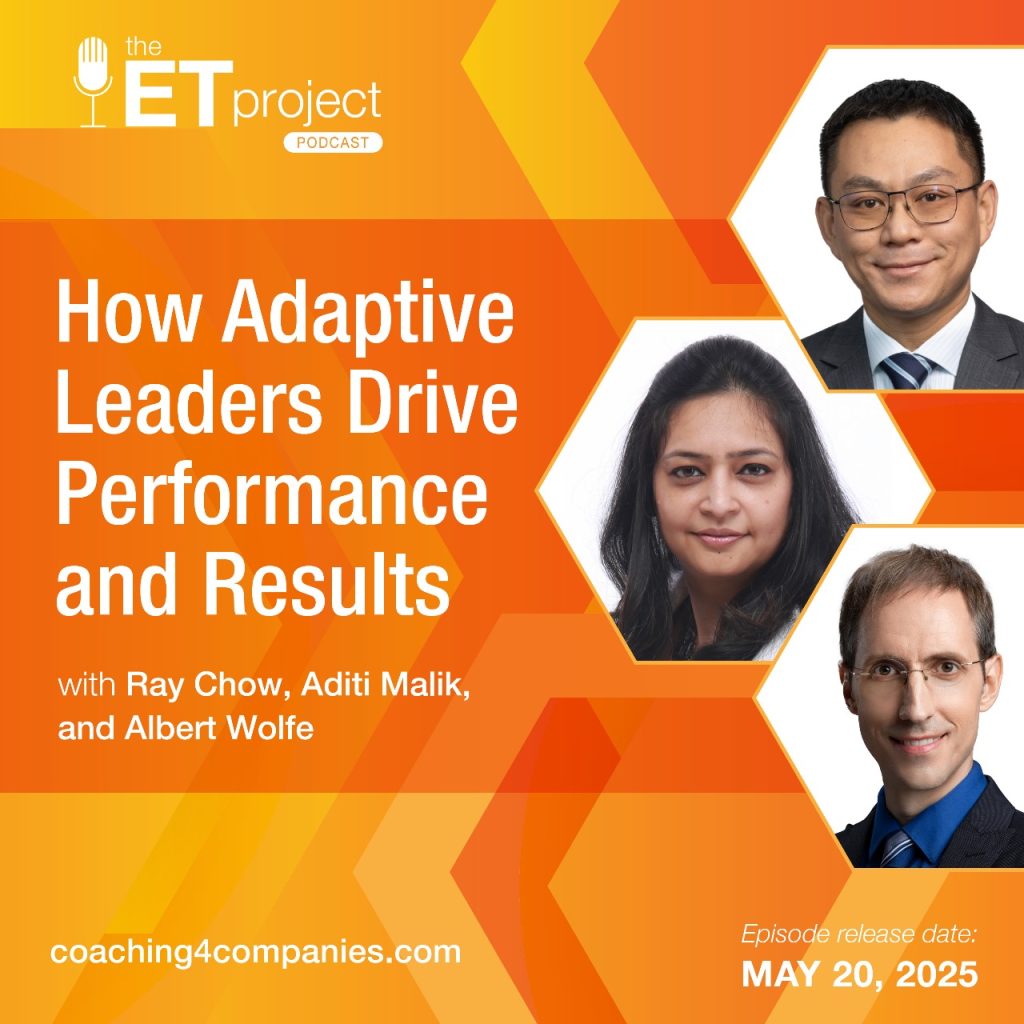
WAYNE BROWN: Hello, I’m your host, Wayne Brown, and welcome to the ET project. We’re delighted to be delivering this podcast for executive talent all over the world, whom we’re affectionately referring to as ‘Team ET.’ Today, we have something special, a panel discussion with several members of the global training and coaching company, Adaptive Leaders. Our panel guests include managing partner, Mr. Ray Chow, managing director for India, Aditi Malik, and executive coach and author of the book that we’re going to be discussing at length, Albert Wolfe. We’re coming together for this discussion on the subject of performance leadership, which is also the title of their newly released book. With the guidance from this insightful expert panel, you’ll learn why the focus on performance is central to driving engagement and talent retention, as well as achieving the results organizations are seeking. You’ll hear us speaking about the three Cs of Adaptive Leaders and learn about the acronym EMMA, a four-layered framework designed to provide a well-rounded approach to supercharging performance and leadership. Team, the book is filled with real-world case studies derived from working with clients across a multitude of industries worldwide. It’s laid out to create clarity and strengthen insights, and also offers readers the opportunity to download their own performance leadership dashboard as a usable template. This is a well-thought-through account of what delivers results in today’s workforce, and you’re sure to walk away with a wealth of learning for immediate application. We truly hope you enjoy this conversation.
INTRO: Welcome to the ET project, a podcast for those executive talents determined to release their true potential and create an impact. Join our veteran coach and mentor, Wayne Brown, as we unpack an exciting future together.
WAYNE BROWN: Hello, team. Welcome to today’s episode of the ET project. Today, we have a little bit of a different lineup. We’re having a panel discussion, and we’re going to be talking about leadership, in particular, performance leadership. Today, we have three experts joining us from the company Adaptive Leaders. This is a global coaching advisory firm, and they do a number of things, one of which is to help leaders and organizations thrive, I guess, right? Panel? In today’s crazy world. What I hope we’re going to unravel a little bit today is the whole concept of adaptive leadership, and we’ll definitely touch on the three things that you use as adaptive leader traits, if you like, courage, curiosity, and care, as well as unpack some of your transformative programs that I know you have. By the way, we didn’t mention before we hit record that I’ve had the honor or the pleasure of going through your developmental sprint with Ray, and very interesting, so we can talk a little bit about that. However, the star attraction to all of our listeners for our panel discussion today is going to be around the newly released book, which is ‘Performance Leadership: 4 Keys to Extraordinary Results.’ Panel, I’m going to start with ladies first and ask you to introduce yourselves just very briefly, if you don’t mind, for the audience, name, where you’re located, and maybe the question of what excites you the most about the work that you’re currently doing. So, Aditi, if you don’t mind.
ADITI MALIK: Thank you very much, Wayne. It’s such a pleasure to be with you, and of course, partnering with Albert and Ray on this conversation, I’m so excited. So, I’m based out of New Delhi, which is the northern part of India. To your question about why I do this work or what I find most exciting is the whole debate about leaders and leadership, which continues, and as times progress, we sort of keep going back to the basics and still sort of establishing what it really means to have leadership abilities and skills. And given the current times that we’re living in, I think there is so much scope to really raise the bar for people to understand their own leadership abilities. So, uncovering that with people and helping them to understand for themselves how they all can be great leaders, if only they just scratched the surface and find their own leadership abilities.
WAYNE BROWN: Excellent. Ray, I’ll ask you to step in. Albert is going to have the lion’s share of the conversation, so Albert, we’ll push you to the end of the conversation, the introduction, but Ray, if you don’t mind.
RAY CHOW: Sure. Thank you. Thank you, Wayne. And hello, everybody. My name is Ray Chow. I’m originally from Canada and I’ve been living in China, just primarily based in Shanghai for the last almost 10 years now.
[00:05:00]
RAY CHOW: You know, you ask what excites me about this kind of work, I think I would summarize it as just the privilege of being able to walk with our clients, walk with individuals and teams and help them see possibilities, often possibilities that they didn’t see in themselves. And so that’s super exciting. And as Aditi alluded too, during these times of change, I do turn something that seems like hard to something that’s hopeful and possible.
WAYNE BROWN: Very nice. Thank you. Albert, welcome to the show. Would you mind introducing who you are and where you are and what’s going on for you?
ALBERT WOLFE: Yeah, thanks, Wayne. Really privileged to be here. Really appreciate it. Originally from Southern California, I was born very near Disneyland, but I’ve been in China for the last almost 20 years down in Guangzhou, which is very near Hong Kong Disneyland, surprisingly. So, I sort of always caught in the orbit of some Disney Park. What’s exciting to me about working with Adaptive Leaders and all their clients is just the great people that I get to meet. We have a really special team. I’ve never been a part of a team quite like this. And that’ll come out a little bit if we ever dive into some of the way that we wrote the book was really unique and totally impossible without this specific team. But then all of the clients and prospective clients and connections of clients, there’s just a lot of really interesting, really great, really talented people that I wouldn’t have a chance to meet otherwise. And being on the podcast is an example of that.
WAYNE BROWN: My wife works at Disney, so we have a connection we didn’t know about. Very good. All right, team, well, thank you for the introduction. Let’s find out a little bit more about the company with Adaptive Leaders. If I’m not mistaken, it was formed around 2015.
RAY CHOW: That’s right, yes.
WAYNE BROWN: And Mike is now in the US, I think?
RAY CHOW: Mike is actually… today he’s in China, but he’s primarily back in the US to spend more time with his family and to open our US business but he comes back to Asia about once a month.
WAYNE BROWN: What is the company based about and what’s the mission and how has it evolved over the years?
RAY CHOW: We’ll dig into the idea of adaptive leadership more as we talk about the book, as we talk about some of the key concepts. But we really believe in the idea of the importance of being adaptive as a leader, that we adopted this and trademarked this as our company name. And so, while we come alongside of a range of industries and organizations and individual leaders that have different business or sometimes even personal goals, the core of it really comes down to helping them identify not only where they’re going, but what in and of themself, often because of positive experiences that got them to this point or got them to this new promotion, but may not necessarily get them to that next place. And so that idea of being able to put your finger on that and to overturn that limiting assumption or limiting factor is what really gets us excited. And so that’s at the core of what we do. It can often look like coaching. It could often look like leadership journey programs. So yeah, that’s the core of it.
WAYNE BROWN: You know, 2015, you now have spread quite globally from what I can see, the growth has been quite quick. How have you grown this quickly and is that something you intend to continue? Like, are you looking for global dominance, Ray, or what’s the point?
RAY CHOW: We like to talk about if we’re going to name ourself Adaptive and help our clients be adaptive, we need to be adaptive ourselves. And so usually this is a positive thing, but sometimes it could be frustrating to the team members that we’re finding ourselves literally adopting and changing every few months. So, the growth, you know, having team members in US, Canada, China, India, Japan, now Southeast Asia has just been very much organic, evolving with our clients and just meeting people, meeting people like yourself, meeting people like your listeners, and having really just qualified people wanting to join what we do because they believe in it.
[00:10:00]
RAY CHOW: So, it has been very much organic. All of our team members come out of industry or entrepreneurial experience, like the three of us on this call, 20-plus years of experience, and then really applying that, so just that combination between being a coach and being an advisor.
WAYNE BROWN: What you just said, Ray, is almost a definition of adaptive leadership.
ALBERT WOLFE: Wayne, maybe I can just add a little color to that just for the listeners.
WAYNE BROWN: Yeah.
ALBERT WOLFE: As a newer member of the team, I remember being invited by Ray to join several years ago just talk a little bit about that double-edged sword of naming ourselves Adaptive Leaders. So, basically, we’re helping people change faster. And so, the little mantra that I use, if I speak to a student group, for example, and they don’t know what adaptive leadership is, I have them all repeat after me, “what worked before isn’t going to work this time.” And it’s not a hundred percent true, obviously, it’s an oversimplification, but that’s really a challenge in being part of this team because everyone’s thinking like that. And so, whenever somebody brings an issue, you expect to be, you know, not maybe challenged directly, but there’s a sort of implied pressure. Are you just relying on the old way of doing it or do we need to try something different? And the other thing that’s really, really special about the team is, and we bring it to our work as well, is whatever the assumed timeline is, we challenge that too. I was talking with one of my coachees in a Fortune 100 company over there in the US preparing for a promotion. And he said, “I have 15 months until I’m ready to get promoted, I want to make sure I’m ready.” And I just asked a simple question, “what would it look like if that was faster than 15 months?” And it set off this domino effect that, I mean, he had to go talk to his wife about it. And it was this big thing that ended up with him coming back saying, “yeah, I think it can be like in six months or less.” And so, we’re just challenging the speed that we all assume things are supposed to happen. And it sort of happened with this book, in fact, that we’re going to talk about eventually. And so, it’s been very exciting, but it’s quite a… like, we’re all Disneyland people in the audience, buckle your seatbelt, this ride is taking off.
WAYNE BROWN: Very good. I’ve seen in many places in the book on your website, you talk about the three Cs, the leadership traits, if you like, to be an adaptive leader of courage, curiosity, and care. Where does this derive from?
RAY CHOW: One of our materials is, you know, it’s based on the last 10-plus years of being as an adaptive leadership team and in all of our coaches’ individual experience. And we asked ourselves, you know, if we were to try to characterize, what are the must have characteristics of an adaptive leader? And we really felt it boiled down to these three Cs, you know, curious, courageous, and caring. And just really, really briefly breaking that down, it’s that curiosity about self, about the context, about the world, that willingness to say, to ask the what if, the how might we questions. And that’s really that pushing yourself to, you know, I know on some of your other podcasts, you’ve talked Wayne about pushing yourself to that learning edge, that growth edge. And so that’s the curiosity must have. Of course, the courageous side is not just being curious about it or being reflective of that, but having the courage to take action, to take action to do something about it, to try something new. The care one is probably maybe for some of your listeners, maybe, “Oh, where does that come from?” But that’s both caring for those around you, but that’s self-care as well. And just trying to find that balance. And so, we have this conversation about, well, what happens, you know, for most of the leaders that we work with, the reality is they have a bit of all three of the Cs, maybe even strength in two of them. But even as I’m talking, maybe some of you are thinking, oh, if I had to pick one, one of them is a little bit not as prevalent or not as consistent. And what would that look like? And that’s where we’re just trying to start the conversation, give something sticky, easy to understand. But if you keep in mind these three Cs, I think you’re going to find pushing yourself to be a bit more adaptive.
[00:15:00]
WAYNE BROWN: Yeah. I love the curious where it’s something we try and encourage our daughter to be more curious. And I have three principles and the first one is curious listening. I had a guest on the show just the other day, who spoke about ‘curious reflection.’ And I said to her, “I’m stealing the phrase, I love the phrase, I’m going to add it to my repertoire.” In the 21st century later, it is probably more common, though, that would be my take.
RAY CHOW: Yeah.
WAYNE BROWN: One of the things that we speak about with our clients is that transition from 20th century to 21st century later, and one of the struggles I have is to be that caring, sharing transparent, vulnerable leader. And I do want to get into the book and I know Albert, you’re keen to do it. So, one more question before we jump into it in detail. You have a number of programs that I’ve observed, and I’ve even had the opportunity to participate in one of them. If people are interested in participating or finding out more about the programs you offer, what is the best location, who should they contact or how can they reach out to you?
RAY CHOW: Yeah, thanks, Wayne, I would say the best place to start is our website or our LinkedIn page. So,
www.adaptiveleaders.com
. And on there, you’ll see not just information about the book, but the ‘Adaptive Leader Journey Program.’ And so that’s a brand new 12-month long program, journey program. And maybe we’ll talk a little bit more about this in the podcast, but that’s really us putting together all the secret sauces and techniques to create the adaptive leader. And so that’s available to people as individuals as a small cohort to join others virtually or most of the time we’re bringing it out to companies.
WAYNE BROWN: Some time back, maybe six months or even 12 months back now, you brought into your curricula, the first 90 days, the Michael Watkins book and program, how is that going, by the way?
RAY CHOW: It’s going great. It has been great for our team. And we have a great partnership with Michael Watkins and his company, Genesis Group. Yeah, and so that’s one of our signature programs for more key executive transitions.
WAYNE BROWN: What’s the story behind bringing the book together?
ALBERT WOLFE: I’ll just very briefly, I’ll just say that ‘Performance Leadership’ has been one of our key programs for a while now. And so, the framework that’s described in the book has been a core offering of Adaptive Leaders and because of its extreme popularity and the very fast results that it gets, we decided it’s a little bit too good to sort of keep to our coaching rooms and we wanted to get it out to a broader audience. It’s very unusual for us, this is our first book. We don’t really write books. We’re a coaching team. So, it’s a very strange thing to do. And so, I was asked to basically kind of convert a program into a book and I describe it as feeling like converting a movie into a novel, you know, so the movie is over, you know, kind of linear, you know, you start and then you finish, that was the movie. But then to expand it into a book was a really interesting and exciting project and getting to really dive deep with Aditi on what does it really mean for India? And then some of our Chinese coaches, what does it really mean for China? And our US and Canada… You know, what does it mean in North America? And so really kind of unpacking it and making it bigger than the original program. And now it kind of feeds back in and it can help improve the program as well. So that’s the story in a nutshell.
WAYNE BROWN: When did you release?
ALBERT WOLFE: Just out, this month, earlier this month.
WAYNE BROWN: So, we already spoke briefly about the three Cs, but within the book, we talk about four key levers, might be the word, four key levers to performance leadership. How do we now merge these three Cs and these four key levers? Is there a direct correlation to the two or are they separate?
ALBERT WOLFE: I can tell Aditi has got something to… no? I was…
ADITI MALIK: I was actually going to talk about the three Cs for a little bit because that was an interesting question. And I’m sure we could then sort of steer that towards the four levers, which is EMMA.
[00:20:00]
ADITI MALIK: This happened just yesterday afternoon. So, I had a friend we were meeting for lunch and he asked me this question in the car and he says, “you work with so many people and corporates and leaders. Why do you think we’re having a leadership crisis in the world? What do you think is really happening over here?” And I said, “that’s such a brilliant question, nobody…” And a friend doesn’t normally ask this over lunch, right? So, I said, “okay, that’s a good question.” And I think my response really was the distinction between being a leader and leadership really, you know, so, the ability to understand what has happened in the world, as we’ve all sort of grown manifold, specifically in Asia and even more so in India. And I think being a leader has also become synonymized with holding a position. But what does it really mean to have leadership, right? And if I were to just pick up the C about curiosity, and I think that’s where the dichotomy sort of comes in because somebody is put into a position because of everything that they know and they bring to the table. And then we’re sort of asking them to say that curiosity is one of the key traits of leadership. And now people are not necessarily able to grapple with that, right? I’ve done this all these years, been there, done that. So why do I have to still be curious, be on that learning curve all the time? You know. So, I think that that curiosity in itself is really challenging people to think differently. And then you bring in the whole element of the other two Cs, which is about care and courage. And courage, again, can be misconstrued a lot of times, Wayne, as you would realize, right? Courage can also mean being brash. I was reading this very interesting piece yesterday, which said that there was a leader who was actually put into that position because he could take as many risks. But the more risks he took over a period of time, she started to become counterintuitive. So, you know, that courage also needs to be well thought through.
WAYNE BROWN: Mm-hmm.
ADITI MALIK: And then it’s about people eventually. Everything to do with leadership or being a leader is all about people. It is all about being human-centered. So, we can never lose sight of the people-centeredness. And you know, just to pick on what Ray said, it’s not just caring about the people around us, but also self-care, because I think we almost also start to think of ourselves as machines who can just keep churning out. So, machine learning, AI, everything has space, but we also have space for human beings. So, I think those three Cs fundamentally therefore become really important from a leadership perspective. Now, whether I hold the position or I don’t hold the position, still needs to feed into these three Cs. And if I do get into those positions, then I need to start focusing on performance leadership, right? As a leader, as somebody who is holding that position, how am I really encouraging people to perform? And as I was sort of reflecting and getting ready for this conversation today evening, and I was thinking, why do we always gravitate towards engagement and not so much about performance? Maybe is it a taboo? To say that, you know, we really want people to perform because it seems more transactional, more cut and dry. But when we talk about engagement, it sounds more people-oriented in that sense. So maybe that’s what’s happening. But a lot of our work and our discussions across with leaders in India specifically is really challenging that norm, right? Because everybody is saying, “well, we actually want people who are high performing, but what we want to spend energy on is just engaging them.” And a deep question, in fact, we had this event the week before last where we had some CHROs in the room and we actually asked them this, “what would make you happier? Would you want people who are performing and not engaged or people who are just engaged and not performing?” And everybody unanimously says, “we would want to have people who are performing.” And there’s therefore enough room for us to start focusing on that, to say that people do want to be the best versions of themselves. Now, are we really creating the spaces for them? And therefore, the three Cs very organically in my mind fit into the EMMA levers.
WAYNE BROWN: One of the things in the book that you allude to is the difference between performance leadership and performance management. And for me, one of the reasons why the word performance draws that connotation of that negativity is because of the performance management systems and the elements that we’ve all lived through in our careers.
[00:25:00]
WAYNE BROWN: Where we turn up every six months or 12 months and we’re appraised, we’re analyzed and we’re put through, in many cases, the wringers about our performance. And I think it has given it a negative connotation to some degree. So, I agree with you very much. Is there a definition to the term ‘Performance Leadership?’ Do you hold any explanation when somebody says, “what is this we’re talking about?”
ALBERT WOLFE: It’s a highly debated question. In fact, we’re working on a Chinese version of the book right now, and people can’t figure out how to translate that because they know all about performance management. There’s a set word for that. And in our minds, it’s the thing that you’re talking about. I’ve got a six-month evaluation, I’ve got an annual evaluation, I got my raise, I didn’t get my raise, I got fired, I didn’t get fired. But performance leadership is deliberately breaking the mold away from that. And even when I was interviewing people for the book, they were saying, “performance feels like numbers and leadership feels like people. And so how do you lead numbers like you lead people? What do you mean by that?” And so, the definition is kind of the book, but we could use the three Cs and the four levers, as you’re calling them, EMMA. One way you could think about it is this, EMMA is what you do, what you focus on. And the three Cs is how you do that, the manner in which you go about trying to improve performance. If you just go improve performance, but you don’t have curiosity, care, and courage, you might just make another performance management system and not have a performance leadership.
WAYNE BROWN: Aditi, you mentioned engagement, you were also talking about retention. And I know we spoke briefly about it before we started recording, but in the book, you sort of take the traditional approach and you speak about different companies like McKinsey and a number of other companies that put engagement at the front as the core driver. And then we have the ability to retain, and then we ask for performance. In your book, you’re flipping this on its head and you’re saying performance is really the core driver here. The other two happen, they can be a subset, but we put performance ahead of those two. I would love for you to speak more to that if you could please.
ALBERT WOLFE: Yeah, and I’d love to get… I haven’t actually had a chance to debrief with Aditi on this CHRO thing in India last week. That was like the theme of the talk, so I’d love to hear some of your take on that. Basically, we’re not trying to say that… and I’m just going to tell everybody, I hope it’s okay, Wayne. Wayne challenged our linear approach to this, which I love, because how could I be a curious, courageous, caring person and not love to be challenged on that? And so, you’re right, it’s not that simple. And the little diagram in the book, you can now, if you get the book, you can make a little circle and say, “they said, it’s not this simple,” but what we wanted to do is we wanted to highlight, you’ll notice one of the arrows is a different color. We wanted to highlight for emphasis where people tend to focus their attention more. And so, Gallup has all this data about engagement and engagement gets a lot of press. And then the hope is that it’ll drive retention. And as long as your people are engaged and not leaving, then they’ll have a chance to perform well. And it totally makes sense on an intuitive level. We just don’t think that that’s the best way to approach these three topics. We think that if you focus on performance first in the way that we’re, you know, the three Cs and EMMA, not just any old way, but in this way, then what you get is people’s performance improves. They feel better about their work. Why would I leave a job where I’m learning and growing and performing well? And oh, all of a sudden, they wake up one day and they realize they’ve been highly engaged for the past month. So, we’re not trying to say, even though it looks like we are from a linear diagram, that these things happen in this exact order and not a cycle. We’re just trying to shine more of a spotlight on the performance saying the other two kind of get dragged along in the wake of high performance. But again, I’d like to kick it over to Aditi in here. What were some of the findings from the CHRO summit that you had?
[00:30:00]
ADITI MALIK: Yeah, exactly to what you said, both Wayne and Albert, is I think the debate, you know, the moment you say you want to flip it, we tend to think that, “oh, so you’re telling me not to do any engagement initiatives and I should only focus on performance?” Well, that’s not what we’re saying. We’re not debunking any of those things really over here. What we’re saying is that there’s space and time. Where do we really want to shine the light is really on performance. And I often lean on this, and I’m sure Ray and Albert have heard this so many times from me, is leaning on Dan Pink’s work in terms of the research that he did at MIT. If it’s the same amount of work, you could keep giving people more and more reward thinking that they will be more engaged, but the productivity actually starts to fall. And that’s very telling of human behavior, because eventually we all want to be learning. We want to be able to do something more than what we’re doing currently. And therefore, from a leadership perspective, what is it that we’re doing that’s enabling people to do more and better, more effectively, more efficiently? Essentially that’s what we’re saying. And everything else will then become a subset of it. But if I only keep focusing on people being engaged, because I want them to feel good about coming to work, will that ensure performance? I think that’s really where the debate is. I’m going to take another example of Google. Every so often we talk about how Google has the best infrastructure, they brought in the whole cafeteria and the gaming area and everything. We all started to talk about that at a certain point in time. If I were to go back and reflect on it, I don’t think Google ever did it for engagement. They did that because they wanted to create space for people to be able to really tap into their potential and bring that to the work that they were doing. So, it was always really focused on bringing their best. So, if I were to reframe for a little bit performance, here is really bringing their best and making a difference to the organizations that they’re in. And they do that really effectively. So, the idea is really to create those spaces for them to make a difference. But it’s never really about saying, “oh, we’re just going to engage you and make you feel good.” I don’t think people really feel good about it. In fact, one of the CHROs at the summit had this very interesting observation. They’d apparently done a survey across the organization and they said, “the survey gives us two sets of people now. So, we have a set of people who are extremely high performers, but their engagement scores are very low. And then we had the other set of people who are highly engaged, but their performance scores are very low. So, we’re very confused about what we’re supposed to do now.” And the question we asked him was, “well, what would you want? Where would you want to spend your energy? What is it that you really want to be focusing on?” And that came the response, “oh, obviously, people who are performing.” And then how are we defining engagement as well? Right? And I think that’s still a deeper question. What does it really mean for people to be engaged? And I agree with Albert when he says that when people perform and they get those opportunities to shine, they do get more and more vested in their roles, in their jobs, in their organizations, which to me is engagement. So, I think some of these words tend to sort of lose their essence as well as we go along.
WAYNE BROWN: I love the conversation because I think our world that we live in today is so dynamic. And there are so many scenarios where people will say, “well, this is the way it has to be,” but somebody can equally on the other side say, “this is not the way it is” or “it’s not going to stay that way.” We haven’t jumped into EMMA…
ALBERT WOLFE: I wonder if I could just use your last comment as a springboard into EMMA?
WAYNE BROWN: Yeah, please.
ALBERT WOLFE: Because you’re highlighting how dynamic things are and what EMMA is. And just for our listeners who may not have read the book yet, these are the four things you need to focus on to improve performance. And they’re in order, but then you loop back around to E again at the end. So, E-M-M-A, expectations, motivations, measurements, and accountability. And basically, what we’re doing with this framework is we’re saying as the dynamic environment keeps changing and now that’s not working anymore, come back to EMMA. The answer to what are the expectations, what’s motivating people, what are we measuring, and how are we holding them accountability, they have to keep changing.
[00:35:00]
ALBERT WOLFE: But the question of what’s our E, what’s our M, what’s our M, what’s our A, that question is something you can hang your hat on. And I hope that that’s one of the encouragements from reading the book is, now, here’s something that doesn’t need to change every year, every month, maybe even every decade. Because these are the same things we all need to be communicating about and clarifying. One of the main messages of the book is, these have to be clarified explicitly because probably the really smart leaders that are reading this book, they didn’t need things that clear for them, they were able to figure it out, they were intuitive about it and they moved forward with nobody’s permission and they made huge breakthroughs. But when you’re leading a team, especially a multinational, cross-cultural team, the more clarity and explicit definition you can give those four things, the stronger your performance becomes.
WAYNE BROWN: In the book, you break the acronym in half and you say expectation, motivation is part of the setup and measurement and accountability is part of the follow-up. And I think that gives a very nice clarity about how you apply this particular model. It works nicely when you do look at it from those two perspectives. One is how you set things up and you gain that clarity, you get the focus and the attention and then you have to be able to measure and hold people accountable. And one of the interesting things that we find is, particularly with expectations, when you don’t have that clarity around expectation, we challenge people on what are you committing to? Once somebody in the organization committed, taking ownership, wanting to be held accountable. But when you don’t have the clarity around what’s expected of you, what? Are you crazy? Would you hold yourself committed too? And I think you really extract that nicely in the book. So, EMMA, again, it’s not step by step, right? Although it is, you follow it in order, but it is still a circular model.
ALBERT WOLFE: Yeah. The reason for that is you get all the way to accountability and really what you’re holding people accountable to are those expectations you set at the very beginning and the measurements are the tool to know if you’re holding people accountable accurately and the motivations are helping you know if this is even realistic for people to perform this well. And so, it’s a whole unit. Ray and I just ran a workshop about this, was it yesterday? What day is it? It was a few days ago. And one of the things we’ve noticed in workshops doing performance leadership is leaders they’ll know about EMMA ahead of time, word has gotten out or perhaps even when they signed up for it, they can see, we don’t keep it a secret, it’s expectations, motivations, measurements and accountability. They all come in really focused on one of them. I’m here today for measurements because we’re not measuring well or I’m here today to motivate my team. They’ve been with the company 20 years, they all know their jobs, they’re not motivated to do anything or whatever. It could be any of them. And then they all leave going, “okay, wait a minute, it’s a unit, it’s a set. We can’t just raise one without raising all of them.” Ray, what’s your take on that?
RAY CHOW: Yeah, no, totally. And I was going to mention whether if you, all of us are coaches on here and I guarantee you like when you’re working with clients and their teams, you’re covering different aspects of EMMA and you’re helping to say, well, in your one-on-ones and your goal setting, you need to align that and that brings transformation. Now in our program, our performance leadership program, we actually built a diagnostic tool rather than just guess, like do my direct reports do they understand what my expectations are of them? So, we actually ask them and we come and show the leader based on asking, surveying your team members, here’s your gap. Similarly with motivations, it’s really easy to understand the concept of, we will all be better leaders if we’re tapping into the motivations of our team, but do we actually know?
[00:40:00]
RAY CHOW: And so actually one of the things we want to highlight and Wayne, I’ll give you the link later, it’s that we actually, the motivations profile, it’s a very simple online tool that you can send to, you can fill it yourself, you can send to your direct reports. So don’t guess what your team members motivations are, send them this link and you’ll get a report and that’ll be a starting point for your conversations. We’ve made this free to everyone. I’ll send you that link and maybe you can put that on to… just offer that to your listeners. It has created some incredible conversations to say, “ah, that’s what your motivation is.”
ALBERT WOLFE: I remember when I was talking to Aditi, when we were in the book writing process, we were on a call with Aditi and I remember saying, you know, we’re thinking about just giving this motivations profile away. Remember the look on your face? Wow, I know a lot of people who would like to get their hands on that.
WAYNE BROWN: Yeah. Now, after you do the assessment, you get a report back, right? And it sort of gives you a profile if I understand correctly.
ALBERT WOLFE: Yeah. The motivations profile is one piece, but then the other, it’s almost kind of like a 360, but very, very brief and organized by EMMA so that the leader can see how… that’s anonymous. The motivations profile is the opposite of anonymous because everyone is motivated so differently. Leaders have to know what motivates person A is different than what motivates person B. Yeah, I try to manage all of my team the same way, and how do I do it? By what motivates me instead of what motivates them. And so, the motivations profile is very personalized, and people love it, it’s so exciting. Just to do it themselves. You ask them, “how many of these does your boss know for sure?” And they go, “well, maybe one out of five or two out of five.” And then we say, “why is that?” You often hear, “well, I didn’t even know until I sat down and did this.”
RAY CHOW: Maybe I’ll jump in with a tangible example, if I can, where we have a… one of our clients, one of our coachees is a very senior, a technology innovation guy at a top software company. We’ve been doing a really great job, getting a lot of recognition. And we were essentially, the company was really trying to figure out, okay, we can’t lose this person, it would be too costly to lose this person. Is it money? Is it promotion? Is it relocation? Is it recognition? And anyway, long story short, all he really wanted was to solve a bigger problem. He wanted a harder project. So that was his thing. And as soon as they gave him that, he was motivated and ready to go for the next two years.
WAYNE BROWN: Right. What I like about the book is throughout the book you have a lot of case studies, real cases where you bring situations like Ray just mentioned into the book. In this case, we’re talking about somebody’s intrinsic motivation being the challenge. One question that I haven’t seen and we haven’t touched on, technology and the onset of technology in business and in the way that we’re going to lead in the future, how does this impact performance leadership?
ADITI MALIK: Maybe I’ll just give it a very quick go. I think I alluded to it a little while back, Wayne, technology or no technology, the three Cs definitely define leadership, right?
WAYNE BROWN: Mm-hmm.
ADITI MALIK: And that really has to be the cornerstone of everything. So, if we really understand the three Cs and we’re able to become more intentional about it as we go along, we will be able to keep pace because how else are we going to be adaptive if, you know, how else will we always have an ear to the ground in terms of things that are happening? You know, there will be Black Swan events that will continue to happen, but the ability to navigate each of those events will need us to be continuously curious and courageous and take people along. So, I think the three Cs really to me is what’s always going to be the cornerstone.
ALBERT WOLFE: I think Aditi nailed it, and I’ll just zoom out to an even more macro level. With the increasing reliance and demand on technology and AI and all of that, people, leaders really need to lean into the humanity of their team and themselves.
[00:45:00]
ALBERT WOLFE: The original subtitle of this book, also a little reveal to the listeners was not ‘4 Keys to Extraordinary Results.’ It was ‘A Human-Centric Approach to Improving Performance’ because that’s really at the core of what we’re talking about. People need to be not just allowed to be humans, but really encouraged to be humans. And so, the differentiation of what is machinery, and I know technology can mean more than that, and what is human, I think the more clear people can be on that and the more they can rest comfortable in that distinction, the more they’re going to continue to be able to drive high performance, regardless of what’s happening with the technology.
WAYNE BROWN: A great spot to finish the book, ‘Performance Leadership.’ You’ll find it on Amazon, probably the best place to get it. A great conversation, thank you for being on the ET project. I really enjoyed the conversation.
ALBERT WOLFE: Thanks Wayne.
ADITI MALIK: Thanks.
OUTRO: Thank you for joining us on the ET project, a show for executive talent development, until next time, check out our site for free videos, eBooks, webinars, and blogs at ‘coaching4companies.com.’
[END OF TRANSCRIPT]