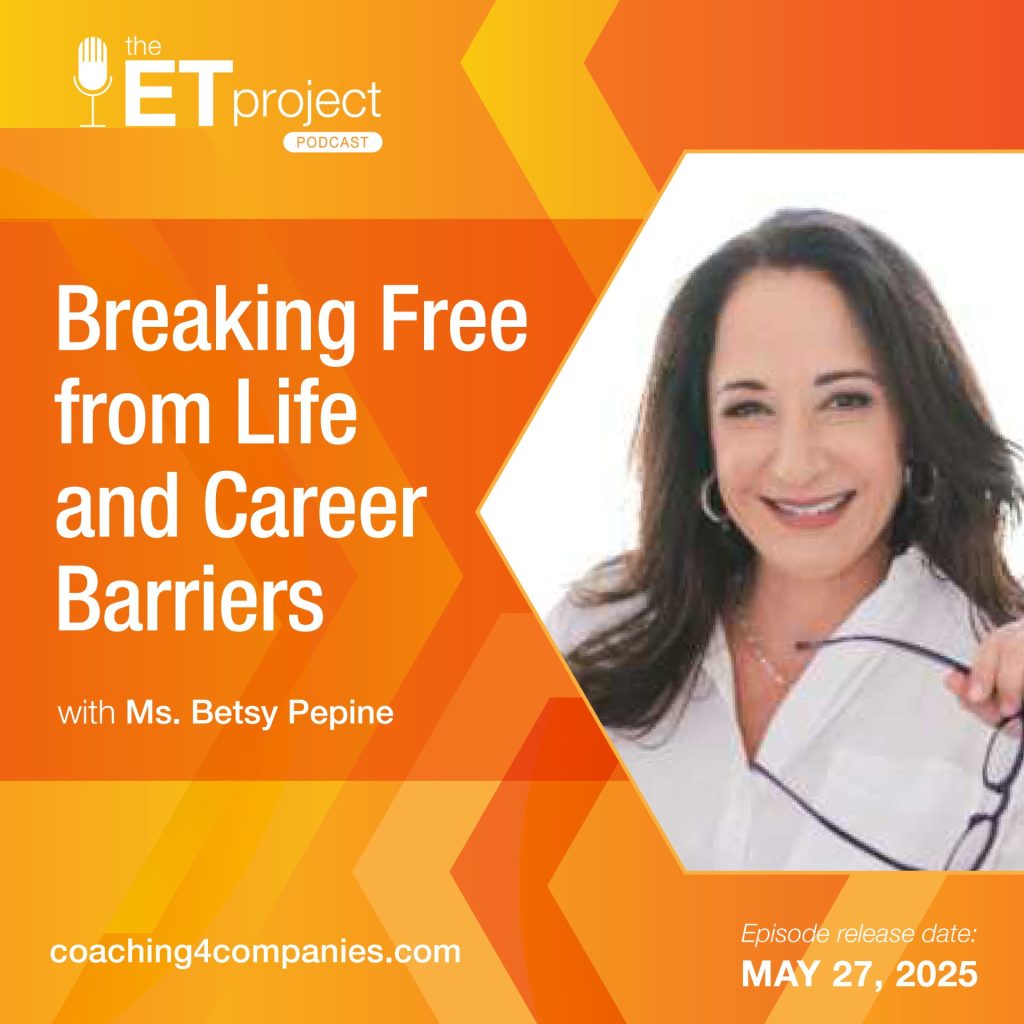
WAYNE BROWN: Hello, I’m your host Wayne Brown and welcome to the ET project. We’re delighted to be delivering this podcast for executive talent all over the world whom we’re affectionately referring to as ‘Team ET.’ Today, we’re back in Gainesville, Florida and catching up with best-selling author and serial entrepreneur, Betsy Pepine. Betsy has established herself in the real estate industry, owning a real estate brokerage, property management firm, title company, and real estate school. The Wall Street Journal has consistently recognized her real estate team as one of the top producing in the United States. Betsy’s brokerage Pepine Realty has been named as an Inc. 5000 fastest growing private company in the United States multiple times and has earned spots on the top 50 Florida companies to watch and Florida Trend best companies to work for lists. Betsy is endorsed by her mentor, real estate mogul and Shark Tank shark Barbara Corcoran, as well as leading media personalities Dave Ramsey and Glenn Beck. Passionate about helping at-risk families with children, Betsy founded Pepine Gives, a nonprofit foundation that helps families facing housing insecurity. Pepine Gives has partnered with Habitat for Humanity to build homes for cost-burdened families. Betsy is also a board member for several for-profit and non-profit companies. She has earned her economics degree from Duke University and an MBA from the Wharton School of Business at University of Pennsylvania. A significant portion of our conversation centers around Betsy’s 2024 book titled ‘Breaking Boxes: Dismantling the Metaphorical Boxes That Bind Us.’ Both the book and this episode are insightful and impactful and you’ll do yourself a huge favor by tuning in. If you take the time to read Betsy’s book, my belief is you’ll catch yourself pausing to reflect on just how much of your life you’ve been trapped within your own assumed limitations. So, with that, let’s get started.
INTRO: Welcome to The ET project, a podcast for those executive talents determined to release their true potential and create an impact. Join our veteran coach and mentor, Wayne Brown, as we unpack an exciting future together.
WAYNE BROWN: Have you ever met somebody who seems to do it all? And not only do it all, but do it with passion, with purpose, and with a lot of heart? Well, that’s how many people have described our guest, Betsy Pepine. She’s a top producing real estate broker, founder of not one, but five, maybe six, we’ll clarify that in a moment, thriving businesses, a best-selling author, and the driving force behind a non-profit that’s changing lives through home ownership. Beyond the accolades and the titles, Betsy is somebody who deeply believes in living authentically and helping others do the same. How do I know that? Well, I’ve had the opportunity to read Betsy’s book. It’s called ‘Breaking Boxes.’ It’s a powerful call to stepping outside the roles and expectations that confine us. And today, Betsy is going to help share her story and some of her insights and perhaps a little bit about the book. So, with that, Betsy, welcome to the ET project. Great to have you join us. Looking forward to our conversation.
BETSY PEPINE: Oh, happy to be here, Wayne. Thank you.
WAYNE BROWN: You’ve had such an impressive career, particularly across real estate, entrepreneurship, writing. How do you describe yourself when somebody says, “what is it you do, Betsy?”
BETSY PEPINE: When people ask me to describe myself, I actually don’t describe what I do. I say that I am a wanderer. I am just incessantly curious about everything. And that can be a positive, but it also can be a negative because I truly am just like a sponge and I want to learn and know about anything I encounter. But to make a living, I’m a serial entrepreneur in all things real estate.
WAYNE BROWN: You certainly have an impressive list of companies, particularly around that real estate in general.
BETSY PEPINE: Yeah
WAYNE BROWN: Five real estate businesses, was I correct?
BETSY PEPINE: Let’s see, I have a brokerage. So that was my first company. Then I opened a mortgage company because buyers, obviously most buyers need a mortgage. I started a property management company because at the time, sometimes, not all the time, sales and rentals are inversely proportional. So, it’s nice to have that. So, when the sales are, when it’s not a strong real estate market, it’s a strong rental market, sometimes that happens.
[00:05:00]
BETSY PEPINE: So, we created this property management company, which was great for owners as well as investors. And then I wanted a recruiting vehicle and also a way for our own agents to get their continuing education. And so, I started a real estate school. And then probably the thing that I’m most passionate about is the nonprofit, Pepine Gives, which is what you had suggested, really addresses the issue of affordable housing in North and Central Florida.
WAYNE BROWN: How did you transition from pharmaceutical to real estate?
BETSY PEPINE: Oh, yeah. So, like many folks, we get faced with some unexpected life events that cause us to pause. And so, in a very short period of time, I had been married and I found myself suddenly single with one and two-year-old daughters, and then I got laid off from a corporate job. We had a pharmaceutical drug that did not get FDA approval. So, they laid off the whole team because it didn’t look like we were going to get approval anytime soon. And having those two events happen in such a short period of time just really caused me to reflect on my life and think maybe the universe, God source is telling me a different path, maybe an order. And I just took the opportunity to pursue an interest that I’ve had for a long time. Never really thought I could make a career out of it. I thought of it was more as a hobby, investments and things like that. But I really said, “you know what, if not now, when?” And I took the leap and I kind of laid out a path. I gave myself two years. I had built up a financial nest egg. I mean, it wasn’t that large, to be honest. I live very conservatively. But I knew I could support me and the girls for two years. And I would know by then if it was for me or not. And I knew within six months that this was definitely the right career for me. And then it took about another six months to feel like, okay, now I can make a living that supports us comfortably. And then I just took it from there.
WAYNE BROWN: Hey, you’ve done an incredible job. You studied at Duke. You studied at Wharton. You have an economics, an MBA, an economics degree and an MBA. Were there any life lessons or professional lessons coming out of those two programs that sort of led you down this path, do you think?
BETSY PEPINE: Well, so backing up, the reason why I have an economics degree is because at the time, Duke did not have any other business majors. And so, I took a lot of business classes at their business school, but you couldn’t major in those things. And so, I never… I’ve always been fascinated by money and the role money plays in our lives. My mother said I came out of her womb making money. And I’ve always been fascinated by money. I’m not obsessed with money in the sense that I don’t have a luxurious lifestyle, but I’m very interested in and value what money does buy. And that what money buys is freedom and choice. And so that’s what has always fascinated me about money and then being able to create it out of nothing, truly, you know, the ability to create value within ourselves that somebody else perceives as valuable and willing to exchange their money for us. So that has been with me since I was very little. And I’ve always been fascinated by how that dynamic works. But that’s where the economics degree came in, I never had this thought that I was going to be an economist. And then at Wharton, I think one of the biggest lessons for me was just a very off chance. I took a class, oddly, you could get credit for this, but because I was pursuing a degree in marketing and healthcare management. But one of the classes being offered at the time was going into West Philadelphia, gutting row homes, rebuilding them from donated supplies and labor, and then selling. And I use air quotes in selling because we sold these homes to cost-burdened families in Philadelphia. And to be able to experience and see the impact that a house makes on the trajectory of these families never left me. It was so powerful to see what a house truly means to a family. And when you look at the data, how it impacts health outcomes, how it impacts educational levels, how it impacts income levels once those children graduate.
[00:10:00]
BETSY PEPINE: I mean, it impacts so many things. So that was one of the reasons I got into real estate and absolutely the reason I started the nonprofit. Another lesson, and oddly during… it was actually during that class, was the instructor, it was one of the days we had to work were Saturdays. And he would leave, the instructor would set us up and tell us what we were going to work on that day. And then he would leave and go get donuts and coffee. And so, he, you know, on one of these Saturdays, he did that. He came back an hour later, maybe an hour and a half later, he came up to the group with the coffee and donuts and he said something to the effect of, “guys, you have Betsy to thank for getting this work done while I was gone.” And I didn’t understand what he meant. I was too busy doing my work. I mean, I love, I truly love doing the work and seeing the impact. And I was confused. And he said, yeah, he said, “I only took 15 minutes to get the donuts and I spent the last hour watching you guys from the street.” He had parked down the road and he saw, I guess, people just not working because they knew he was gone and that he saw that I was working. But it struck me because I was probably 22 at the time, but just the message that there’s always somebody watching and make sure that you’re… I mean, I always try to behave even though no one is watching, but someone is always watching you and making sure that you’re comfortable with how you’re behaving, even if you think you’re not being watched. And for me, it wasn’t even a conscious thing because I truly love what I was doing. I was so excited about this class, but I guess others in the class were just trying to, it was an easy A class and I think people were just, you know, kind of slacking, but yeah. So, two good lessons from that class.
WAYNE BROWN: And a huge lesson for all listeners, particularly the leaders that are listening, that people are always watching. It’s a great lead into one aspect of the book, which was where you describe how your path was very structured and the expectation was that you follow in the footsteps of your father and become a doctor. Your sister became a doctor, but you opted to take a different path. What was the reason, the rationale at that moment for you to want to shift out of that, let’s say family direction?
BETSY PEPINE: Yeah, well, so you’re right. So not only was my dad a physician, my twin sister became one, my older sister became one, they married physicians. I mean, it is totally ingrained in our family. We grew up working in the hospital alongside my father, volunteering, and it just was when… I knew I didn’t want to be a physician when I went to college. We all went to the same college. We were all pre-med and I just knew that if I said yes to that, I was saying no to myself and understanding that I was going to live a life that every day I was going to wake up unhappy and I just couldn’t do that. And it was very difficult for me because, you know, I come from a very small and very loyal family and to break that expectation, I think in some families would have been fine, but in my family, it was as though I was telling them I was dropping out of school and wanted to, you know, be homeless. Like that’s kind of how they viewed it in terms of the decision. And they certainly didn’t agree with it. They said that I was lazy, that I didn’t want to, you know, go directly on to school, because their model also was… you know, most households you grow up and it’s, you know, what college are you going to or whatever, you know, there’s an expectation of college in many households, but in our household, it was always what graduate school were you going to, you know? So, and I wasn’t going directly to graduate school and that was just not a model that they were accustomed to, nor did they ever think that their child would opt out of that. And they made it very easy for me to say yes because they worked very hard, saved all their money so that they could put us through school and we didn’t have to take out loans. So it wasn’t, you know, they were willing to provide that opportunity and I was saying, “no, thank you.” That was difficult, but I just knew in my heart that I just couldn’t live a life like that and had to accept that. I did drop, you know, in terms of in their eyes, you know, I definitely lost status in the family by choosing that direction.
[00:15:00]
WAYNE BROWN: That’s a great segue into the book itself which is called ‘Breaking Boxes’ and that’s exactly what you were doing in that case. So, let’s talk a little bit about the book. You write it in a very unique way and you mentioned the reason to that in the book. It’s not written in a typical manner of we open and we close and we have a storyline in between. It’s a grouping of personal stories that sort of, we go on the journey with you. What was the inspiration in writing the book?
BETSY PEPINE: The inspiration for writing the book was, so I’m 56. When I was in my late 40s, I was recognizing that I was not happy and frustrated because on paper I felt like I had checked off all the boxes to be successful yet. And I had assumed that success equals happiness, but I was successful but not happy. And so, I went on a journey of uncovering where that source of discontentment lied. So that involved journaling, meditation, yoga, therapy, one-on-one therapy, bioenergetic work, EMDR. I was very open to so many different modalities to figure out why I was unhappy. And the common thread was this feeling of containment and being so frustrated, I felt like I couldn’t break out of these expectations, opinions, stereotypes of what either my family of origin had for me, my gender had for me, my industry told me I should be, you know, the roles that I played, like what the good daughter should be, what the good wife, the good mom, all these different labels that we see and just feeling so frustrated. And so, then when I started sharing my stories with others, they would share with me their stories, but they felt stuck and were… they didn’t know how to negotiate out of these, I call them boxes. Because to me, I see boxes every day in real estate. I understand their purpose of keeping us safe, providing structure, but then they’re also temporary, and we forget that, you know, we use, we should use them when we need them, but we should also discard them when they no longer have a service to us. And we forget that sometimes. And so, I wrote the book in the hopes that, you know, if I helped one person understand that they’re in a box, because the first step of getting out of a box is being aware that we’re even in one, and then understanding if we’re in a box, but we’re not choosing to exit it, and that box is not helpful, why is it, and how to identify what fear it is and help us negotiate out of that box. So that’s why I wrote the book. The structure of the book was, you know, I tried to make that also out of the box, you know, and I actually explained that in the book in terms of one of the first… one of my first writing pod critiques, I had to send in the table of contents and the table of contents was all in lowercase. I’m a brand-new writer and in the writing pod, I had very seasoned writers critiquing my work. And so, the first comment was they assumed that I didn’t know that the table of contents should be capitalized. And I’m an incessant reader and I absolutely knew that, but that’s what I wanted. I wanted the reader to pause and question, “oh, I wonder why she did that, that’s different,” but, “okay, it’s different, but it’s okay,” right? And so that’s kind of why in the whole structure of the book was kind of outside of what you typically see in a book to further convey the message of being outside the box.
WAYNE BROWN: It’s very nicely written, I have to say. You talk a lot about a little girl in the rain, and it’s a photo that you’ve had on the wall for much of your life. It’s a very powerful moment and I wonder if you could share a little bit about that storyline.
BETSY PEPINE: Yeah. During this time of reflection and figuring out why was I not happy, I had come across this picture, I think on the internet, and it just stopped me cold. And it’s a picture of this girl, she looks to be about the age of four and she’s in a bathing suit. She’s on her front lawn on lush green grass. Her arms and legs are splayed out as wide as can be. And she’s looking up with this smile of pure unbridled joy and rain is pouring down on her. And across her belly, it says, “remember her, she’s still there inside you, let’s go get her.”
[00:20:00]
BETSY PEPINE: And I love, I just… I mean, I literally got goosebumps. Something about that picture drew me in and I printed it out. I sent it off to an online company who printed it on canvas for me. I hung it in my office at home. I hung it in my office at work. It became my screensaver on my computer and my phone. I wanted that. And then about a year later, I’m in Florida. I live in Florida and we have hurricanes and we have to hunker down for hurricanes. And anytime we have a hurricane coming, I create a project. You know, because we’re going to… usually, the power goes out, you have a lot of downtime. And for this particular hurricane, I decided that I was going to transfer all these photos that I had accumulated in these photo boxes into photo albums. And so, the hurricane comes and, you know, sure enough, within a couple of hours, the power goes out. I light my candles. I pull out my photo boxes and I start putting these photos into my photo albums. And a couple of hours later I’m finished and I take these three empty photo boxes to the trash can and I put them in the trash can. But the last one that I put in, I noticed there’s something on the bottom of that photo box and I see it’s a photo. I pull it out, but I can’t see it because it’s now dark. And I take it over to my candle that I had lit. And I couldn’t believe it. I took that photo, ran with the photo, with the candle to my home office, put the candle next up to that canvas photo that I had framed about a year earlier. And I look back at the photo in my hand and it’s a photo of a little girl in her favorite one-piece red bathing suit. She’s in the Atlantic Ocean with her father who is standing three feet in front of her, who is taking her picture. And she’s trying to hug a wave that’s coming towards her and her face has this smile of pure unbridled joy. And on the bottom of that faded photo is my mother’s handwriting that says, “Betsy, aged four.” And I thought, oh my goodness, I was that girl, and that’s what I was so drawn to when I saw this picture of this girl on the internet. And somehow, I had just lost my way. And that became a guidepost for me on how I wanted to feel and where I wanted to return.
WAYNE BROWN: Incredible story. It also ties nicely into the whole concept that you’re very focused on, which is authenticity. Authenticity, perhaps over perfection. I read somewhere where you consider yourself a perfectionist, which you try and get out of all the time. How does that show up? Let’s come back to the business for a moment. How does perfectionism show up in your business versus you being authentic? What are the conflicts or the challenges that you face as a result?
BETSY PEPINE: Yeah. So, I mean, I really feel like I’ve grown in that area and it’s still I’m a work in progress, but before I felt like perfectionism stopped me, it delayed things. I wouldn’t try things until everything was figured out in my head or on paper. I mean, I love the quote, ‘good is better than perfect.’ So now I try to value progress. I don’t have to have it all figured out. I don’t have to see the end line. As long as I can see a couple of steps ahead of me, I can move in that direction. So that has helped me tremendously in my businesses. And in terms of authenticity, I do try very hard in my businesses. One of, I think the most powerful things we do in our company is every Tuesday, we have a company-wide meeting with all of our companies. They come together. And one of the segments of the meeting is sharing what we call lessons. We don’t believe in mistakes or failures, I believe everything is a lesson. And so, I am the first to share what lessons from the mistakes I’ve learned, that I’ve made in the last week with the entire company. And that encourages other people to share their lessons. And the reason why that’s so important is one, to show that it doesn’t matter who you are, we’re all human. We all are going to make mistakes. We’re going to make errors. Some of them are things that we absolutely, you know, being in the business for as long as we’ve been in, shouldn’t be making. So, it just shows we’re all human. But as importantly, it really helps people, it accelerates everybody’s learning curve because they all now have learned everything in that entire room. All of the lessons learned in that past week, they now… it’s as though they have experienced it.
[00:25:00]
BETSY PEPINE: And while they may make their own mistakes, they’re not going to make the ones that others have just shared with us. And so, it really does accelerate everybody’s growth and learning and progress. I also think it makes us more relatable as leaders. I think maybe… that wasn’t modeled for me. I’m, you know, I’m 56. I can say when I was in my 20s and 30s, early 30s, I never had a leader revealing their mistakes to me or even admitting that. That just creates, I think, a barrier. The more authentic we can be, I think the more trust people have of you. Because if you’re willing to be authentic with your own shortcomings, you know, people trust you. And I think it also creates more loyalty because you’re being vulnerable. And I think when you’re vulnerable, that creates a climate of trust. So, I just think it’s a wonderful way to model that for the folks that work for you.
WAYNE BROWN: You talk about the real estate school. And I’m wondering, how much do you talk about this concept within the school? Because I’ve been involved in real estate most of my life as well, not to the degree of you by any means. But how do you bring that context into the real estate school?
BETSY PEPINE: Well, in two ways. So, in the real estate school, we find a lot of people that are like myself, where it’s a career change. And it’s a big one. It’s very scary. Most people are leaving a stable job with a stable paycheck, with solid benefits, and going into a career that’s the opposite. So, for them, that’s definitely a shift. And so, part of it is sharing with them my story and giving them confidence that if this is truly what they want, it’s a viable path. The other way in terms of boxes, maybe a little bit more obvious, is that we definitely have rules around not putting people in boxes in terms of how we serve them. And we have to make sure we cannot discriminate in any way against the seven protected classes. And I tell the students this, I think it comes from, I’m not sure what group, probably NAR, the National Association of Realtors, but they hire these test people who will call your agents and try to trip them up. Try to get them to steer them into certain areas. Try to get them to discriminate against somebody who sounds like they may be from a different… this country, or may have this income level, or may have a handicap, whatever. And call them out and provide the necessary disciplinary action against them. So, we have to, like the example with the one that I learned at school, we always have to assume that somebody is watching, we shouldn’t do it anyway, but we should always assume that somebody is watching us or testing us to make sure that we’re not putting people in boxes. And at the same time, I give an example of something that happened to one of our agents. We had a… it’s not a protected class per se, but you get people who call you and let’s say they want… the average sale price in our county, let’s say is about $340,000. They have a $10,000 piece of land they want to sell in an area that’s two hours away, right? That’s hard to get an agent excited about it. But I tell them, “You treat every customer the same, that customer gets the same service as your million-dollar customer that lives a half a mile from you.” And one of my agents took that to heart and she took a listing like that. A brand-new agent, no experience at all. She closed the deal. I told the agent, “if you forget everything else at the closing, remember to ask this seller, does she have anything else to sell?” So, she closes the $10,000 transaction. She asks the seller, “do you have anything else to sell?” And she said, “yeah, I’ve got this little piece of property. Why don’t you come take a look at it?” My agent sends me the address. It’s a prime piece of commercial real estate behind our Hilton hotel worth $6 million. And my agent lists it and double sides it, which means she brings the buyer. So, she gets double the commission and she’s a brand-new agent. And the seller said to her, “I’m giving you this listing because nobody else would help me with my vacant land.”
[00:30:00]
WAYNE BROWN: It’s such a great segue. I wanted to talk a little bit about Pepine Gives, this is your not-for-profit. What led you to start this? And what’s the whole premise around this organization?
BETSY PEPINE: Yeah. So, the idea was started when I was in that class at Wharton and I got to experience working with cost-burdened families and then recognizing that I happened to live in the highest cost-burdened county in the state of Florida. So, cost-burdened, meaning the median income doesn’t equate to the median household price. And so, there’s a huge discrepancy and gap between the number of families that work but cannot afford a home, that was kind of the setting. But I’ve always had a service heart. My companies have always had that component in them. But I was finding that we were doing service very randomly and sporadically. So, we would volunteer a couple of hours here. We would give some money here. We would go paint stalls for horses, for blind horses. We would do animal rescue. We would feed the homeless. Just kind of all over the place. Several years ago, we as a company decided the whole point of service is to make an impact. So, we changed our core value from one of our core values from service to impact. And we formalized all of our service into this nonprofit called Pepine Gives and said, “how do we serve a segment of our population that will never use our services but still need a home?” And so, it was just a natural fit because everybody needs a home. The definition of a home is different for everybody, but everybody needs a home. And so, this is just a great symbiotic relationship serving people who need our product but can’t afford our services.
WAYNE BROWN: These are existing? You’re building new ones?
BETSY PEPINE: So, right now, we have a partnership with, and I don’t know if they have it in where you are in Shanghai, but we have a partnership with Habitat for Humanity. And it’s a nonprofit that builds homes from the ground up for cost-burdened families. So, we partner with them and we build houses for families. We have in our plans to expand that to doing also major repairs. So, some people, they’re still cost-burdened, but they’re living in homes that are not inhabitable. And how do we make them safer, cleaner, and more… increase the quality of life of those in those types of settings? So that is in the future plans.
WAYNE BROWN: You also mentor women, if I read correctly, that have recently been released from prison or from jail.
BETSY PEPINE: Mm-hmm
WAYNE BROWN: I can imagine the impact that has for you, what’s the cause that you’re looking to serve through targeting that group?
BETSY PEPINE: So, I help women prisoners in particular. I’ve always been passionate about helping women. So, in that capacity, it’s not so much about housing, but it’s something that I teach my agents and staff as well, which is how to manage your finances and live a debt-free life. It’s something that my parents modeled for me and I took for granted until I got to be an adult and realized how many people don’t have that skill set. It’s not something that they teach in school, unfortunately. And I think, especially from what I’ve learned and experienced with these women, it certainly wasn’t modeled in their homes, in some of their homes. They also are in a huge box to have that on your back and to overcome having been in prison. They face a lot of uphill challenges and so if I can be an encouragement to them, that’s why I do it. My whole purpose in life is to improve and empower the lives of others and so that just fits very nicely in my purpose. It doesn’t really fall into any of my business stuff, it’s more of a passion of mine.
WAYNE BROWN: Growing up outside your family and through your career, have you had mentors yourself, coaches?
BETSY PEPINE: I didn’t really have any, I mean, coaches, I was always on teams and so I always had true sports coaches and I did have my, now that you say that, I had a seventh-grade teacher who was definitely a mentor for me.
[00:35:00]
BETSY PEPINE: He just said certain things that still ring true to me. Like, I hear his voice. And also, one of my cross-country coaches, he was a mentor for me. I remember vividly in cross-country, he would always say, “you could always quit.” It’s like you’re running a hard workout or a race, he’d always say to our group, “you could always quit. You just can’t quit now.” You always had to set some goal ahead of you. Even if you’re doing a hard workout, you can’t quit when you think you want to quit, but you can say, “okay, I can quit when I get 500 yards from now, I can quit.” Because he knew by the time you got to there, you wouldn’t want to quit anymore. And it’s so true, anytime I feel myself wanting to quit something a little bit impulsively, his words stick into my head. So, those were my mentors growing up, nothing really strong. And then when I did get into real estate, I absolutely sought out mentors, whether it was through mastermind groups. We have EO here, we have Vistage, we have Strategic Coach, those are big kind of entrepreneurial mastermind groups across all different industries. I also got a real estate coach probably in year, maybe about ‘04 or ‘05. I’ve been in real estate 20 years, but in my fourth or fifth year, I got a real estate coach and have had one ever since, absolutely instrumental in my growth. And then I have informal mentors that I kind of look at from afar, they don’t know that they’re my mentor, but I watch what they do, I see what they read. Whatever aspect of my life I need a mentor in, whether it’s my career, my physical health, my spirituality, things like that, I have informal mentors as well. But I’m a huge, huge proponent of mentors and to be one as well.
WAYNE BROWN: Right. I call those people my adopted mentors.
BETSY PEPINE: Oh, I like that.
WAYNE BROWN: If we’re a listener and we’re feeling boxed in at the moment, what can we do? What steps can we take to help break free of this incessant feeling that most of us go through at some point?
BETSY PEPINE: Absolutely congratulate yourself in even identifying that you’re in a box because that’s the first step. And then what I have found very helpful is identifying why I’m stuck. What is keeping me in the box? So, it is serving me in some way. If we’re staying in a pattern that doesn’t seem to be working externally, there’s something keeping us there. So, what is that? And what I have found is usually a fear-based reaction. So, we fear something. It could be fear of failure. It could be fear of loss, loss of status, loss of social connection, loss of financial security, or it could just be a simple fear of change; those are all very common and real fears. And then identify which of those or combination of those you’re facing and then how do you address it? So, for fear of failure, for me, that was one when we talked about being the perfectionist, that was a huge fear of mine before I let that go. But I redefined it and I truly don’t believe failure exists in my world anymore because to me, failure is a box. It’s a label we choose to place on certain outcomes. But we choose that. We don’t need to choose that. And so, I say to myself, “okay, Betsy, what is the worst that can happen?” Worst case scenario, if I do X, right? Worst case scenario is the outcome is not what I had hoped. I have to pivot and I get to take a very important… I will have learned something very important that I get to take with me for the rest of my life, that’s worst-case scenario. And research has shown several times that worst case scenario happens 3% of the time. Three! So that’s ridiculous when you think about it. And I encourage people to write down your fear because when you write it down, it absolutely looks less dangerous and treacherous than when it’s mulling in your head, right? So that’s how I address fear of failure. Fear of change, that’s a big one; we like predictability. That I have found for myself, it’s a muscle. So, the more you expose yourself to change and unfamiliarity, unexpectedness, the easier that becomes and the less resistant you are to change because you’ve built up a muscle and you remember, it’s okay because I always turn it… everything turns out okay, right?
[00:40:00]
BETSY PEPINE: So, I try to make myself and put myself in uncomfortable situations on a daily basis. And it’s actually one of the habits that I track on a daily basis. So, it may just be as simple as the ice-cold shower I take every morning, that puts me in an incredible state of discomfort, but I know I’m building that muscle so that when I’m in a state of discomfort, I know I can calm my body down, I can calm my nervous system down. So, I would just encourage you to practice putting yourself in uncomfortable and new situations and you’ll find yourself being more comfortable with change. And then the last one, that fear of loss. You know, identify it, is it loss of status? Like I faced that with my family and I had to say to myself, “anytime it’s loss of status, that’s an ego-driven response.” And I don’t like my decisions to be based on ego. And so, I tell myself, “Betsy, put your ego on the shelf and move forward in the direction of your dreams.” That visual really helps me to get my ego out of the way and move on the path that I know I was meant to be on. If it’s a fear of loss of social connections, that’s a really real one. When you move out of a box, most likely you’re going to lose social connection because you’re going to make somebody uncomfortable. Whether your family, your friends, your colleagues, it feels threatening to them. They don’t know what to expect. You’re making them feel uncomfortable about themselves and something in their own lives, they are going to distance themselves from you. Understand that that’s going to happen. Also understand, and what has really helped me is that I used to think when a relationship ended, it was a failure. If it ended, it was failure. But I have a new view that relationships are meant to serve us, both parties, right? And they don’t end, they come to completion. And when they’re complete, both parties move on in different directions and that’s expected. It’s like pruning back a bush so that it can grow. So, you’re pruning back your relationships so that you can grow into your future self. And so, understanding that it’s normal and not unexpected helps. And then shore up those relationships that you’re going to need for that future version of yourself. Whether it’s those mentors, those mastermind groups, people that are going to support you in that future version. There’s always going to be people in front of you that want to support you so that you shore up those connections because you know you are going to leave some connections behind. And then the last one, fear of loss of financial security. You know, that’s a real one too, but fortunately now with the gig economy, the ability to work remotely, start a job from your home computer, you know, in your house. I think that one, most people have… understand that they can supplement their income as they’re transitioning out of a different career. So that’s how I would counsel somebody who is wondering, I feel stuck, how do I get out of being stuck?
WAYNE BROWN: Great advice and a great conversation Betsy. Where can people connect with you? Where can they find your book?
BETSY PEPINE: Sure, so I have a website, betsypepine.com, you can order the book there. You can also order it on all the major book retailers online, Amazon, Barnes & Noble, Books-A-Million. I also have a course that’s coming out that’s a complimentary, it’s ancillary exercises with the book. I’m also on all the social channels, my handle is @betsypepine, just my name.
WAYNE BROWN: A great conversation, I really enjoyed it. I encourage everyone to get out, get the book, it’s extremely insightful.
BETSY PEPINE: Thank you, Wayne.
OUTRO: Thank you for joining us on The ET project, a show for executive talent development. Until next time, check out our site for free videos, eBooks, webinars, and blogs at ‘coaching4companies.com.’
[END OF TRANSCRIPT]