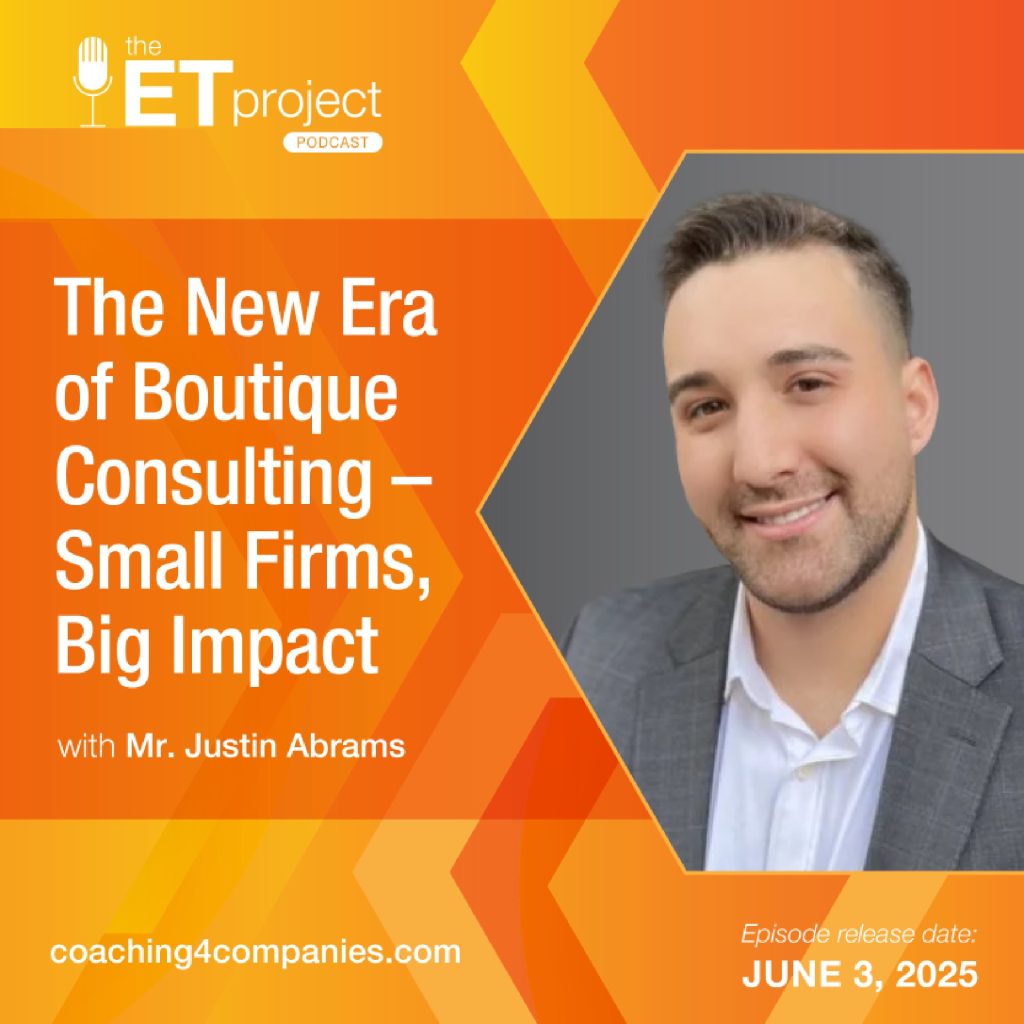
WAYNE BROWN: Hello, I’m your host Wayne Brown, and welcome to the ET Project. We’re delighted to be delivering this podcast for executive talent all over the world whom are affectionately referring to as ‘Team ET.’ Today we’re in Boston, Massachusetts and visiting Aryo Consulting Group’s founder and CEO, Justin Abrams. Originally started as McKinsey for small businesses, Justin believes small businesses deserve proper strategy, growth and excellence. His company, ACG, structures itself into three pillars of success – strategy, growth and optimization. With strategy, they bring you the research, data and principles that are typically provided by the large consulting firms, but at 1/100th of the price. Their ongoing consultations and relationships with owners and operators feel more like a therapy session than a business meeting. Their goal is to unmask the pain points in your organization. The growth pillar is focused on, well, growth. Eighty percent of small businesses suffer with lead generation, and nearly every customer they encounter has been burned by a marketing agency. Unlike most, they’ve developed a wholly organic lead generation strategy. The customer never pays a dollar to costly platforms like Google, Meta or TikTok. Instead, they utilize the power of organic strategies via Reddit, Facebook groups, UGC, Local SEO, email marketing, newsletters and podcasts before branching into more traditional outreach campaigns via email and calling. Lastly is the optimization pillar, this is for the clients who no longer worry about lead generation or the path forward. They’ve established a sophisticated business but are in need of a tune-up. ACG has been fortunate to win dozens of awards from Clutch’s top consulting firm 2024 to Upwork’s highest rated consulting firm with over 125 5-star reviews, as well as the top one percent expert vetted category. They’re proud to have helped more than 300 small businesses, as well as many large ones including Pfizer, Sony, Pella, Bayer, Merck, just to name a few. Team, we know many of you are budding entrepreneurs, thinking about or are already running a small business or a start-up. If so, then this conversation is one you shouldn’t miss.
INTRO: Welcome to the ET project, a podcast for those executive talents determined to release their true potential and create an impact. Join our veteran coach and mentor, Wayne Brown, as we unpack an exciting future together.
WAYNE BROWN: Hello, team. You know, there’s quite the revolution happening in the consulting world at the moment and it’s being led by small, agile firms that are delivering big league strategies at a very small fraction of the cost. I recently read that 70% of small businesses are saying that they’ve been burnt either by agencies or consultants who have over-promised or under-delivered, and then 84% of business leaders believe smaller consulting firms offer better value than the large caliber. Now, I can’t validate either of those statements. They sound impressive. Our guest will probably be able to speak more to it, but we’ll come to that in a moment. What we are seeing, however, in our neck of the woods is that the boutique consulting firms have grown at nearly twice the rate of the overall consulting market during the past five years. And they’re starting to outpace many of the largse players in areas like agility, customization, and of course, return on investment. So here today, joining us, who’s, by the way, one of these disruptors that I’m mentioning, Justin Abrams. Justin and his company have been on a mission, let’s say, to bring the McKinsey level of insights at a fraction of the price. And so far, they’ve worked with over 300 small businesses to help them scale. And they’ve used a mix of smart strategy, organic growth tactics, and hands-on execution. So we’re going to be talking with Justin about his journey and about the observations that he and his team have made and some of the challenges as well as the, let’s say, the wins that he has developed on the way. So Justin, welcome to the ET Project.
JUSTIN ABRAMS: Thank you for having me, Wayne. I’m excited to be here.
WAYNE BROWN: Where are you sitting at the moment?
[00:05:00]
JUSTIN ABRAMS: I am in Boston, but if you had asked me in the last, let’s say, 72 hours, it would have been London. So I am all over the place, but my home base is Boston.
WAYNE BROWN: Now, were you in London or business or pleasure?
JUSTIN ABRAMS: A little bit of both, but I did bring my wife along, so it was mostly pleasure.
WAYNE BROWN: Oh, so you can write some of that off on tax.
JUSTIN ABRAMS: Exactly.
WAYNE BROWN: Well, good to have you back anyway. Maybe you can start by just walking us through how you got started in consulting. Now, was there a pivotal moment in your life, in your career that sort of brought you into this world?
JUSTIN ABRAMS: Yeah, so my route is a bit all over the place, but I started, I actually was very early in consulting, just for like in educational business for a while, for a few years. Then I moved to some tech consulting, and then from there, I ended up in biotech. So I’ve kind of been all over the place. What I realized in biotech, it was much more about programs and systems because of drug trials are extremely complex and their margin of error is extremely, is very costly if you make a mistake. So I was there for a number of years, about four and a half years. And then during COVID, I really, the need for consulting and advice, really just a fancy way for saying advice to small businesses was quite high, particularly with just my friends and family who had small businesses. How do you go from having, let’s say, standard revenue all the way to losing 95% or more of your revenue during COVID? So I was just helping them on the side. I picked up some jobs through Upwork. I just signed up to do some Upwork and I really just wasn’t expecting the demand to be there. And then over time, I realized, like, you know, there’s a transitional period that needs to happen. Like it was very much a, you know, side hustle type of thing until a point where you reach where you’re like, “I actually think I can do this on my own.” Like I was never the entrepreneur from day one that was just, “I want to start this business. This is what it’s going to be.” It was more of a out of like discovery phase that I had never really thought of. And then after about, you know, six or nine months, maybe realized like, I should kind of go about this fully. And so that was really my journey into starting my own business.
WAYNE BROWN: What’s the name of the business, by the way?
JUSTIN ABRAMS: Yeah, it’s Aryo Consulting. You can say it like REO Speedwagon, but it’s spelled A-R-Y-O Consulting Group.
WAYNE BROWN: As you started, what were some of the challenges that you faced, if any, of course, as you were starting to make that transition?
JUSTIN ABRAMS: The biggest one is actually on the home front, right? You have to… it’s very similar to a stakeholder meeting, right? It’s like, you have these budgetary demands, you have costs, I mean, Boston is an extremely expensive place to live. So not just, you know, my wife, but also like my family are very much unexpecting of like this entrepreneur just like rip the Band-Aid off, they weren’t built like that. So convincing them, like, if you can sell your family and your wife and your friends on this idea, which of course not everyone is going to buy into, but you can start to create your elevator pitch properly. And that actually educates yourself quite a lot. And if you can sell them on that, then you can kind of sell anyone on working with you. So it’s a kind of an interesting way of growing as well. Because you never really think about… like, people think about the business entrepreneur, they think of the Elon Musk or the Steve Jobs, but they don’t really think about the people behind them. And in fact, you see quite a lot of divorces in, you know, the entrepreneur space. So I didn’t want that. So I wanted to really approach this entirely through the whole team of my family and friends.
WAYNE BROWN: Right. Did you ever reach that point where you started to doubt yourself or doubt the model?
JUSTIN ABRAMS: Sort of, a bit, there has definitely been changes. With consulting itself, you can be very niche, like you could be the best, you know, hyper niche consultant, which I know, you know, I have friends who are like, only the biotech logistics, packaging consultants.
[00:10:00]
JUSTIN ABRAMS: For me, like, I’ve always wanted to just be more broad, and just solve for revenue and operations. And so those themselves have a lot of changes. And what is going to work today might not work in a year or two. So I have to not only address like my clients, but also be bringing them new strategies that I’ve also tested, and I can justify to them.
WAYNE BROWN: Yeah, I fully understand where you’re coming from, Justin. So if you were to look back at that period, is there any lesson you would take out of it or in learning, you would take out of that period that you would tell your younger self to avoid or to be aware of?
JUSTIN ABRAMS: Honestly, I would probably tell myself to start a bit earlier. I think that, you know, just based on my background and everything, I think it’s important to take a risk, like starting a business is a huge risk, but the learning experience is you really can’t compare to it. So, you know, sure, I’ve made a million mistakes, I’m going to make a million more mistakes. But I don’t think that’s the thing that I would optimize for. Like, I think it’s easy to just say that as a… that’s not really the way, like how I learn. But I definitely, if I could do it again, I would just start earlier. I would start at maybe 25 and continue the side hustle because it’s not as risky, right? It’s like, you still have your income, but you have a few hours and then you realize, like, I don’t have a child, but they say like, once you have children, you realize like, your time kind of extends and extends and extends. You spend more time working and taking care of the child to which you never really thought of. So that’s probably the only thing I would go back to change.
WAYNE BROWN: I mean, you’ve been quite successful, 300-plus clients, you know, in this short period. What was the methodology do you think was most successful in finding the client? You mentioned Upwork at the beginning? Was that the primary source of your marketing or was there something specific?
JUSTIN ABRAMS: Yeah, honestly, I just was on Upwork and I just tried to do a really good job. And then over time, Upwork is nice because they give you a review, they allow you to get reviews, but they also tie that to earnings. You know, in theory, I could have just bought a bunch of reviews on Yelp or on Google or whatever. But on Upwork, you actually do have an idea of like this person spent X thousands of dollars, they’re giving a really heartfelt review. So that that like, does go a bit further. And especially in the internet today, it’s like, what’s really real, what’s not. And this has been really powerful. Beyond that, though, it’s really just been meeting clients through those clients, asking for introductions. You know, if I’m able to help one business, probably their community, their network also has someone, you know, friends, family that also has a business and is struggling. So that’s where I try to just you know, over-improve someone’s life and then have them share that with others.
WAYNE BROWN: And is that a very hands on approach that you take as a consultant? Like are you in the thick of it with the with the client, you know, working with them during the day type thing, or is it more of an advisory capacity?
JUSTIN ABRAMS: I am super in the weeds with them. If their problem is something that I don’t know the answer to, you might think like, “well, if I’m not an expert in it, I wouldn’t touch it,” which is true. I’m not the one that’s typically solving that specific issue. But even the… and what you’ll see in a lot of these like companies, especially international companies, they have like, kind of like their head consultant who dictates a lot of the processes, because there’s a lot of conversations and back and forth, and they, as the head of a company might not have the time. So to manage all that day to day stuff, and so, you know, I will procure the best tariff expert that I can find, after interviewing, you know, 10 or 20 people, we can find the best one that I think and I give them a few and that keeps their process super simple. Am I an expert in tariffs? No, but I have more time and I understand their demands quite well. And so, you know, it’s kind of like a high end HR person in some instances, but in many instances, it’s just like, how do we solve for revenue, growth, operations?
[00:15:00]
JUSTIN ABRAMS: Well, sometimes I will be the one to do it, sometimes we’ll have to outsource that and bring someone in. So it’s a little bit of both. But I try to be very close with the CEO, that’s really they don’t have the time to spread out.
WAYNE BROWN: Across, you know, all of the clients that you’ve worked with, are there a set of most common areas where small businesses are struggling?
JUSTIN ABRAMS: I think, leads will always be the biggest problem for a lot of businesses, I’d say 80% of businesses; they only care about sales and leads. Within that bucket, also quality of leads, because a lot of people are spending on ads, like let’s say Meta ads, and they’re getting low quality leads. So that’s a huge bug in most businesses. Within that other 20%, I’d say a good amount, maybe half, they actually have solved their lead problem, they’ve done a really, really good job. They have operational problems, they can’t satisfy the leads, the quality is really hard. You know, certainly in the last five or so years, it’s been hiring has been a bottleneck, especially in, you know, like the blue collar trades. This is assuming in America, but you know, all throughout the countries that we work with, hiring good quality people is always one of the biggest bottlenecks. And then the third column is probably more on the growth, like the growth beyond leads, right? How do you expand your business, if you’re doing five to $10 million a year? How do you get to 50 million? You know, you can 10x your lead gen strategy, but probably you’re just going to need to like, buy a business or massively expand the footprint. And so that’s something that, you know, even if you’re the most qualified business owner, who has grown your business from zero to $10 million, you don’t have an understanding of like, debt markets, you know, loans, how to grow the business beyond 10 million. So that that kind of last piece is also quite important for certain owners.
WAYNE BROWN: In terms of leads, how do you advise or come in and work with the clients to help them with leads? I know it’s very well-related to the industries they’re in, et cetera. But do you have a typical approach in helping the customer?
JUSTIN ABRAMS: Yeah, honestly, I have two very simple things that I can tell your listeners. The first one is, look at who the top people in your industry are, and just look at their sales funnel, and their strategy. If they’re running Meta ads, for example, Facebook and Instagram ads, you can just go on the ads library and take a look at them and what they’re doing. Of course, you can’t find the right targeting and all of that. But you can at least see, if they’re not running any ads on Meta, then maybe they’re doing it on Google, or maybe they’re doing it on TikTok or Snapchat. Like, there’s a library of all of these ads that you can find, maybe they’re running TV ads, like, just try and look at who is the top person and figure out like what they’re doing, and then just reverse engineer it. That’s the simplest way. And then, yeah, I mean, don’t like, you know, try and reinvent the wheel. If it’s working for the big guys, it’s probably going to work for you. And then the second thing is, look at the ads that you’re running currently, have they gone up in cost, which is probably the case that they’ve gone up at least double in the last few years. And all we’re going to start to do is think about how can we cut that cost by 50%. There’s a number of ways, like fancy, fancy ways that you can go, but just try and be very frugal in this. Like, we have people on our site, let’s say, how do we double those people on our site, just look and call or speaking with someone there’s, you know, there’s not so many, you know, crazy strategies, right? It’s like, you run a pop up, you run a chat bot, or like all of these things can be done. There’s ways to do them perfectly. But I think most business owners like are smart enough to at least get the ball rolling, and just trying to double that conversion rate on site.
WAYNE BROWN: How do you then work with people to help them convert those leads to grow the business? Like, do you work a lot on strategy? What’s the next step after you bring the potential customer to the point of… or to the table?
JUSTIN ABRAMS: Yeah, so a lot of people want to get in where we talk about quality of leads is really important. A lot of people online are like, “you need a killer offer.”
[00:20:00]
JUSTIN ABRAMS: And because of that, they optimize for the top of funnel leads coming in. But the quality of people is usually not that great. They’re looking for something free or they’re looking for a 50% discount. And now when you start to charge them full price, like then they churn after a month or two. So from the consultant’s perspective, they’re like, “look, I got you 100 leads.” But from the business owner’s perspective, they’re like, “well, sure, but my profit wasn’t very high, if at all. Maybe I gave them all away for basically cost.” So I try to solve more for the top of funnel, quality first. And it will tend to improve that fall on that middle of funnel and the ultimate end goal, which is can they convert other people? Is this problem so solved so well that they’re willing to tell all the people around them? But that itself can be a number of things. It could be the sales process. It could be the ads that you’re running. It could be the audience that you’re speaking to, even the channels that you’re running ads on. I can tell you, so many people are running Meta ads for local businesses. Probably not that wise. Like, I don’t understand why people are pushing that, but people don’t like scroll their Instagram and then say like, “oh, I definitely need to get a new HVAC unit.” People are pushing that, but it’s not going to work.
WAYNE BROWN: How do you differentiate yourself from your competitors?
JUSTIN ABRAMS: This is going to sound like super pompous, but I think the only way to do it is just you have to just be yourself, right? Like, I don’t try and sell my strategies or anything that we do that we’re so much better at or worse. All of that is up for debate. What I try to sell them is like, you get to work with me and my team. You can call me 24-7. You can work with me. And I will, as a business owner myself, I know that people are solving for, as we said before, like they’re just focusing on the wrong KPI. I want to focus on like, is your business truly… are you truly happy with the business growth? Like, sure, we can improve, we can 10x revenue, but your profit might stay 0% growth. So that’s not a good win, that’s a fake win. So how do I work with you? How do I get you a better system? How does your business grow? And then working on the goals is really important too. Like some people are 60 years old, they want to increase their profit a bit for a sale to just end their career. Other people are young and scrappy and they want to 10x their growth and they want to be the next on Fortune magazine guy. And that’s totally fine too. But kind of speaking with them and just saying, listen, I will work with you no matter what you want to go fast, I will go with you. But the differentiation is just, you can’t find anyone like me. You can find other people, they have other qualities that are better than me, but I’m just one of one and we mesh really well. So I think of it more like a friendship, like not everyone’s going to be friends with everyone.
WAYNE BROWN: But I think you’re touching on there why a lot of small businesses feel like they get burned by working with different consultancies because they’re not working with somebody who is authentic, who really is in it to see the right outcome. For a lot of these consultancies, and I’m not bad-mouthing the industry, but the reality is a lot of the consultancies are out there to make the money that they need to make to keep their doors open. And they have to do what they do. But I’m with you on that. One of the things I know you promote strongly is your pricing model. So what’s the whole mindset around how you price your services?
JUSTIN ABRAMS: Yeah, so the large consulting firms are extremely expensive, and they’re mainly focused on the top, let’s say, 500 businesses in the world. Their argument is that, yes, sure, we’re going to help grow your business, but you’re so large that even if you don’t see much change, it’s going to be a solid return on investment, and we don’t need to justify it too much. Whereas we… and we have worked with a lot of really large businesses, Fortune 100 businesses, but for the most part, small businesses don’t have that return on investment that’s just so easy for them to just sign the check and call it a day.
[00:25:00]
JUSTIN ABRAMS: So I like to think of us as bringing the top 1% of strategies that you’d find at a consulting firm for at least 99% less. It is so expensive to work with these large consulting firms. And honestly, the solving that they’re doing is for such large companies anyways, it doesn’t pair well with us, a medium to small business, right? It could be something like, “how does Coca Cola improve their brand recognition in a newer developing country?” That’s not what most of my clients have ever asked me for, maybe once or twice, but it’s not a very common request. It’s important for Coca Cola because they need to expand their footprint globally. But for most of our clients, it’s really just trying to improve their sales, improve their profitability. And once they have all of that, their operations and kind of that side of the business, you know, working in tandem with those parts.
WAYNE BROWN: So to that end, if business owners listening or leaders listening to our conversation, what should they be looking for in the consultants that they’re looking to hire? Is there any key things that they must have? Are there any red flags that they should be mindful of?
JUSTIN ABRAMS: Yeah, it’s tough because I get hired a lot after someone has gone with either someone really low cost or a really good salesperson who then hands it off to a team. And, you know, that team is a broader, really low cost, right? So someone is doing it at a really low cost. You know, I think the best way is just to say, one thing I will say is, with the large consulting firms is you can see that they’re there, they are working hard. They might not be doing the best job, they might be, but they’re there. They’re working crazy hours. It’s really hard to say, like, they’re not trying their hardest. They’re really working hard. So I would say just how close are you to finding this person? Can you actually speak with them? Are they available? Are they the ones doing the work? Are they feeling the pain? Are they solving the issue or is someone else who’s not really relevant doing the issue? That quite happens a lot in marketing agencies, consulting firms. And then the honesty, I don’t know if there’s a way to solve out for honesty. But, you know, I’m a pretty honest person. I can tell someone I do or I don’t know how to do something. A lot of the consulting firms are just going to say, “yeah, we do it all.” And they’re just hoping that you bite, that’s not something I can tell you. I mean, I can tell you right away, “I can do five things and then 500 things I can’t do, but I might know someone that’s a good fit.”
WAYNE BROWN: How do you deal with the client that engages you, but you get into the engagement and you find that they’re not really listening or they’re not really wanting to have that discussion, have that hard discussion in many cases and make the changes? How do you address that as the consultant?
JUSTIN ABRAMS: Yeah, it’s a tough one because I think of it a little bit like a gym trainer. So a lot of people will say that they want to lose weight or get fit, that’s extremely common, especially near the end of the year. But they show up maybe the first or second day, but then they get busy and they have work and their kids and then they don’t start showing up. It’s not the gym trainer’s fault, but in some ways it is because they have to at least try to encourage them to come over and over again. But it’s not obviously their fault. So I try to think about that through that lens of like, we need to meet consistently. I need to understand who are your stakeholders? Because oftentimes the CEO, I had a CEO one time said, someone asked him about politics in the company. And he said, he’s like, “from my side, there are no politics in the company, everything is perfect.” Like there’s no political fights and tension because he’s at the top. So there’s only infighting between other people. You have to understand, like the CEO is actually probably your biggest champion. The CFO or the chief marketing officer, maybe they start to feel the pressure that like, why is Justin coming in and fixing stuff that I’m doing?
[00:30:00]
JUSTIN ABRAMS: So first you have to figure out that layer of like secondary people and make sure that you’re not trying to steal their job or at least put on that thought to them, you’re not, you’re just really there to help them. And then the second thing is just making sure that you’re there every single day, every single week for a meeting, just to check in. And just, I always just try to mention, “what’s your goal? Oh, you told me your goal is to lose a hundred pounds this year. Okay, that’s fine. But why is it? Oh, because you want to see your children, you know, you have high blood pressure and you want to see your children have children. You want to see your grandchildren, right?” So it’s like kind of reminding them of that end goal. Like, “oh, you told me that you want to go from 10 million to a hundred million in five years. I just spoke with Wayne. He has a hundred-million dollar business. He was the one that showed up every day. You want to know the difference between the top 1% and the 0.1% of that group? It’s like just showing up and just always keeping that goal setting.” So it’s always an issue. People are so busy, right? But you have to do what you can to get them in the gym every day.
WAYNE BROWN: Yeah, we use the expression, always be contracting. So meaning always be circling back, just as you said, checking in. Are we still heading in the same direction? Are we still on the same page? Has anything changed? Are you happy with the progress? Do we need to pivot, et cetera, et cetera, to make sure that, you know, everybody is still on the same journey, so.
JUSTIN ABRAMS: Definitely
WAYNE BROWN: Yeah, very good. So looking into the future now, Justin, lots of changes in the world, geopolitical changes, technology changes, you mentioned biotech earlier. I mean, anything to do with technology is having a huge impact on the world of commerce. What’s the future look like in your eyes for you and the consulting industry?
JUSTIN ABRAMS: I think the quality is ever more so important of getting things you really have to hire for a team. You have to get the team really, really good because, you know, they used to say like technology would just allow you to leverage more, right? The faster processor allows you to do things better. The team with things like AI, I mean, it’s a clear 10x improvement if you can actually find the right people to utilize these tools properly. And so the world is moving so fast. Like in the past, we used to just be able to purchase CRM or purchase a technology upgrade and it was okay, like you just kind of kept going and going on. But now things are moving so fast, there’s new things every day. I think the future is going to be just focusing on the past, the present and the future all in one. You know, you have to put and dedicate a lot of time to the present, right? Your current clients, current processes, just improving, you know, like the Lean Six Sigma worlds. Then I want you to really look at the future by like, if you’re spending 1% of your day on the future, spend 2%. And then next month spend 4%. Because you’re seeing this in even like a Google search, like they’re not going to get beaten by a better searching competitor. They’re going to be losing to a wholly new way of people discovering things. Yeah. And so, you know, you can read like the Harvard, Clayton Christensen’s of the world, and like, they’re not losing in that traditional strategy of just like getting old and kind of getting beat by that that way. They’re getting it just by a whole new paradigm shift. So think through that. How is this going to change my business model? If people are discovering me on Google and now all of a sudden they’re finding me on ChatGPT, like, how is that ICP change? Is that younger? Is that older? Is that wealthier? Is that poor? Are they in the US? All that stuff is really important to think about. I think it’s really important to focus on the future more than ever before.
WAYNE BROWN: So in that essence then ensuring that you have that IT, if not you, but have somebody who is IT-literate to that degree, somebody who is in that strategy space, looking to the future and how does that impact the business? That’s also where we’re heading with our discussions with our clients. So I think we’re very much aligned in that regard. What about your own business? Any shift in the services or the markets or the innovation yourself?
JUSTIN ABRAMS: Yeah, I mean, definitely there has been a push on AI services and just people asking me about it. One thing I will say is the future of AI is still very hyped.
[00:35:00]
JUSTIN ABRAMS: It’s a big hype cycle. And you even saw a really large company, Klarna, which is, um, they’re like a credit provider similar to like Affirm, They went all in on AI. Like they were the most advanced, they were going to just cut everyone basically, and they’re taking steps back because they realized it’s just not… when you’re leveraging something that can do a hundred times or a thousand times what a human can do. Even a small half a percentage error, that starts to add up. And so what I feel like we’re seeing now is people are very interested in AI doing everything. And I’m like, “let’s be smart about this because,” you know, for a credit processor, like if you think about, let’s just say like if bankruptcies double now because this credit processor, you know, just push loans through, that’s a serious… like, a company is not able to do that. So what I try to think about is like, how can AI do the redundant things that I can guarantee it can do 99.999% and just enabling more humans with, again, high quality humans who are like, I think the future is going to be like quality control, like just constant quality control on these AI systems and having a human in the loop to make sure that those errors don’t affect your long-term future. Because anyone can come in, and years and years ago, like in the eighties, people like Carl Icahn would just come in, take a company in the US and just ship all the jobs to another country and cut the costs in half. There are some immediate short-term gains on the enterprise value, but there’s also a lot of losses, right? There’s a knowledge gap, there’s issues with communications. Today that’s basically happening with AI. People are like, “oh, I don’t need any humans anymore. I’m just going to cut my team and I’ll swap in AI.” And they’re realizing like, “oh, sure, short-term we grew, but we’re having the same problems and we can now take in a hundred X our customers, but now we have a bunch of angry customers.” So don’t be brash and think that you can just, you know, the AI is going to be here and it’s done. Like, no, it makes a lot of mistakes, it doesn’t think for itself and people are over-hyping what it can do because they have investors. So see through that pain and just don’t go crazy, just be slow and methodical about the AI.
WAYNE BROWN: Yeah. How will you maintain the… let’s say the personal type, the strong involvement as your business grows? Like this is one of the challenges that all small businesses have as they scale and they’ve been heavily involved in dealing with their clients. As they grow, they start to lose that personal service, personal touch for yourself as you get busier and busier, what’s your approach going to be?
JUSTIN ABRAMS: I think the pitch is going to have to change a bit where, you know, I hire someone who I really, really… I feel like is very similar to me. Um, you know, I was listening to, uh, MrBeast, like the largest YouTuber and he talks… because I was struggling with this question and he basically hires someone to shadow him constantly. Like, he’s like, I’m going to find someone who’s very similar to me and they’re just going to shadow me all throughout the day. And now I’m going to create over six months, like a carbon copy of myself. And I think I’m going to, and I already have started to do that more and more of like giving extremely hard tasks to my team, knowing full well, they’re not going to get it a hundred percent. But I can tell them, and I can walk them through how I solved this to the hundred percent that I’ve done, even if I’m not perfect, so that they can start to like duplicate me. And I want them to think obviously for themselves, but I also want them to think through like being the business owner and like what the quality is at our company. And I’m certainly, I know more than a new hire will, so I’m not trying to get them to be perfect, but over six months, I think they can really get there and certainly worked well for MrBeast and he’s really gone through like methodically how to do it. So, that’s kind of how I would do it.
WAYNE BROWN: Yeah, that’s great advice. So any closing comments in terms of budding entrepreneurs that are looking to start their own consultancy or whatever the practice might be. What’s a couple of tips you would leave with them based on your learning so far?
[00:40:00]
JUSTIN ABRAMS: I would just say like entrepreneurship is a journey that takes years and years to figure out and to understand. But that’s really what life is about is to be entrepreneurial, to make your own thing, to… I mean, you have only one life, so you can do all the reasons and the math and the justification. But you don’t have to be anything aggressive. Like you could create your own water bottle brand, just try it. I think it’s a really enticing bug once you get it and you start to realize like, “oh, I can do this more.” I was never like this Elon Musk, “oh, I’m going to change the world.” I didn’t have that thought, I still don’t. I just want to help people in my community to get a better deal because a lot of people are not getting great deals, they’re getting what they can get. And if you just help someone, you should be able to get some money off of that, that’s an inspiring thing. I wake up every morning, I know this is like super cliché and they say, “oh, he’s tap dancing to work.” Like Warren Buffett says this, but I don’t think of it like that. I’m just like, “I get to solve complex problems every day that other people don’t have the privilege to do because they’re not in those conversations.” And if you’re working a salary job, you’re probably not that close to the CEO or the CFO. It might, you know, you might go up every two years, you might get a pay raise and then there’s politics and politics and politics to get you up and up and up. And then all of a sudden you’re a shell of who you are. So I think it’s the freest form of work. I think it’s extremely hard and you will definitely not be working a nine to five, but you enjoy it. And I don’t think it’s easy to understand until you do it. So that’s what I would say.
WAYNE BROWN: Very nice. Very good advice. Thank you. Well, Justin, it has been a great conversation. All the best for everything going forward and I look forward to keeping contact.
JUSTIN ABRAMS: Thank you so much, Wayne. I appreciate it.
OUTRO: Thank you for joining us on the ET project, a show for executive talent development, until next time, check out our site for free videos, eBooks, webinars, and blogs at ‘coaching4companies.com.’
[END OF TRANSCRIPT]