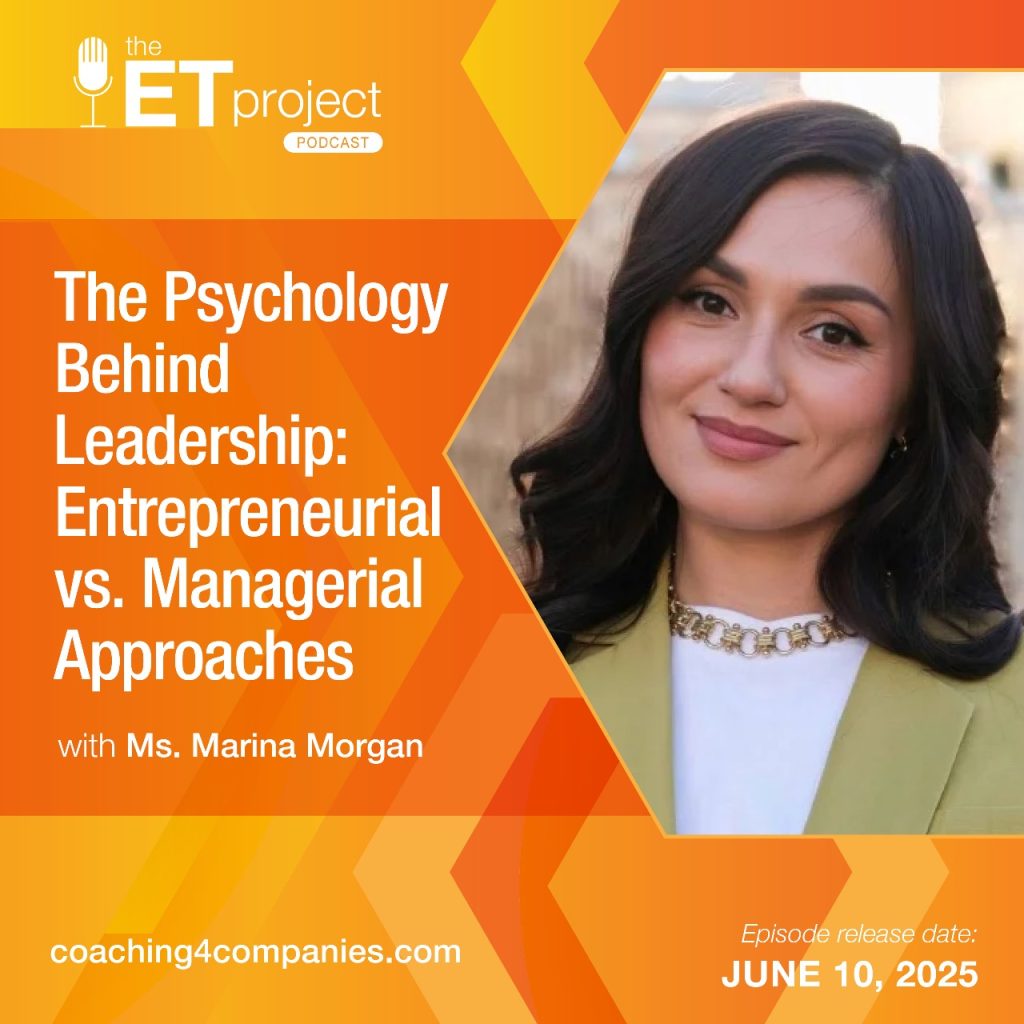
WAYNE BROWN: Hello, I’m your host, Wayne Brown, and welcome to the ET project. We’re delighted to be delivering this podcast for executive talent all over the world, whom we’re affectionately referring to as ‘Team ET’ Today, we’re heading to Silicon Valley and connecting with business psychologist, entrepreneur and speaker Marina Morgan. Marina is the founder of Morgan Impact, an organizational psychology agency, and with over 15 years of experience in both corporate and entrepreneurial environments, Marina specializes in combining psychological principles, neurophysiology and business strategies to help leaders and organizations thrive in today’s dynamic world. A Stanford alum, Marina has had the opportunity to collaborate with UC Berkeley and Econa on global research examining the influence of mental health on entrepreneurial success. This research has deeply informed her approach to leadership as well as business development. As an entrepreneur, Marina founded her first business at age 19 and has since advised over 50 companies across various sectors. Her entrepreneurial journey has centered around helping businesses innovate, adapt and thrive with a focus on unlocking resilience and driving sustainable growth. In her corporate leadership role, Marina managed and implemented large scale employee development strategies for organizations with up to 200,000 staff. Team, I’m sure you’ll hear Marina’s passion in her voice as she focuses on helping leaders just like you unlock their potential, build sustainable business models and foster environments that promote both success and well-being.
INTRO: Welcome to The ET project, a podcast for those executive talents determined to release their true potential and create an impact. Join our veteran coach and mentor, Wayne Brown, as we unpack an exciting future together.
WAYNE BROWN: Hello, team. You know, I recently read that 70% of AI projects, that 70% of all AI projects fail to move beyond the pilot phase. What’s the reason? Well, the reason is claimed not to be technology, but poor human alignment and leadership readiness. Now, I tried to validate the claim, I haven’t been successful yet, but it does get you thinking, in this crazy business ecosystem that we’re all caught up in, this complex adaptive changing environment, if this is even partially true, then we have a considerable problem. So, in this episode, with the help of our guest, Marina Morgan, we’re going to start by exploring leadership mindset, comparing the corporate manager against the entrepreneur, a little bit of a two and three battle, looking at why mindsets matter more than ever in our business world today and how we can or what we can do to bridge the gap between AI-driven innovation and the execution. So, I’m really excited to dive into the discussion with Marina. Marina, welcome to the ET project, wonderful to have you with us today.
MARINA MORGAN: Absolutely. Hello. I’m really happy to be here and thank you for having me today.
WAYNE BROWN: So down the road, The Morgan Impact, you’re an organizational psychologist, you’re an entrepreneur, you’re studying some neuroscience, what’s the reason that drew you into this field in the first place? How did you come to be doing what you’re doing today?
MARINA MORGAN: Briefly, I choose this focus of my education when I was in university, I mean, organizational psychology, because two reasons were for that. One of them is, I was always inspired by scale and managing some big system, some complicated task and now I know that that means that I have a little bit dopamine addiction, dopamine system, and I’m pretty sensitive to the dopamine rewarding more than probably the general population. We will speak about it because this is the part of entrepreneurial brain, the sensitiveness to rewarding and complicated tasks. So, in another thing, I honestly were pretty pragmatic at the period because I want to leave my house as soon as possible and become an independent person. And I thought that it probably will be the shortest way to be financially, I can say successful, but probably independent. And as I told, I always was inspired by it.
[00:05:00]
MARINA MORGAN: And my diploma was dedicated to the social psychological aspects of managing of the organization through the organizational culture. It was more than 50 years ago, 15, not 50, 15. And at that period, we only, in international environment, only started to speak about management through the organizational culture. And I found that it’s pretty interesting because organizational psychology, everything that people bring in any company, even if it’s only me and I don’t know, my cat, it is already an organization with some culture, even if you’re a sole entrepreneur. So, I found that pretty interesting and it can be very resultative and interesting using of this knowledge of the organizational psychology, how to manage company. And the very interesting fact that I found in my research at that time, that if your organizational culture is really strong and you’re using this understanding to manage your company, it can be something like self-managed system and you can measure it. What is the level of self-management in your system? And I think this has shaped my view and my approach for any organization that I worked during all my career because I’m thinking about the organization. It doesn’t matter, it’s profit, nonprofit, whatever it is, like about the whole life system. And if you’re an organizational psychologist, this is your client, not specific person inside of the business, but organization like a body, like a system. So, this is an answer. I want money and I really was very interested to do something big, challenging and with a result that I can measure and business is the best field where you can give this result or you’re an oriented person, so.
WAYNE BROWN: Very nice. And you have worked across multiple industries as well, if I’m correct, right? So, tech, pharma, media, telecom, is there a common thread in terms of the challenges that you see across those industries?
MARINA MORGAN: I combined periods of corporative career and some entrepreneurial periods in my life. My first job was the entrepreneurial experience, I opened my washing windows business and it was really easy money. And I still believe that if you need money and you are, for example, finding yourself in a new place, in new circumstances, it will be pretty easy to earn this money, just washing their windows in different houses because people typically need it and don’t want to do it by them on. Most part of my corporative career was in TMT industry, that’s mean technology, media and telecom. I started my company career with the chain of the cinema theaters, there I was the head of training and development department, that means that I worked with 70 cinema theaters all over the country and I was responsible for the skills of all our employees. I started with the guys who, you know, grilled the popcorn and to the C-level managers. And I worked in huge media companies that engage digital media, classic media, some cinema production, online cinema theater, also in the biggest telecom company and as an independent consultant with my agency, I worked absolutely different type of organization like retail, pharmaceuticals and answer to your question, honestly, every company and I was absolutely the same when I was in human resource department, when you hire in some consultant or some professionals or partner who will help you to achieve your goals, you are starting the conversation with we are pretty unique, you should understand it, we have a very, very unique situation and you should know how people is in whatever it is, they’re creative, they’re sensitive, can be tough, it depends on. But in reality, those systematical problems that typically organization are facing with, I can say that they are similar but they have this classic form that can be pretty same for different industries. And why I asked you about should I answer for your question about that period or this period, because at that period, I worked both in technological companies inside and outside and have an opportunity to work with a company from different industries, includes some manufacturing as I told you pharmaceuticals because my clients they also have some manufacturing. I really see this interesting gap between the integration of technological innovations and it was pretty easy to any technological companies, you can guess because technologies and innovation is something in the core of your business processes, your organizational culture, your communication, your management system.
[00:10:00]
MARINA MORGAN: And at the same time, more, I don’t want to say conservative, but let’s use this word to explain this period. It was probably 10, 15 years ago when this digitalization, it has some waves, it had some waves at the period. And all the industries were able to use the experience of the technological company about how you can better integrate this innovation to your company, what type of culture you should try to integrate because at that period, we already have a lot of information from Google, Netflix, Facebook, there are different types of organizational culture and you can try to find your own, you can base on this experience et cetera. So, of course, every industry has specific, it depends on the country, markets, professionals, mindset, products. But if you will try to see it with some math brain, because if you’re a psychologist, you learn mathematics during all the years of your education and it’s also shape your mindset because you see everything systematically, you probably will find some same trends about what’s going on, that an organization facing with the challenges, with the change, how it’s organized or some numbers if we can find that people pretty stressful in this environment and how it will influence for resultativeness of their work. Again, it will depends, but in general, you can see the same relations. And speaking about nowadays, we don’t have this privilege to wait for when the innovation wave come to our industry because everything that’s going on right now is artificial intelligence and probably you heard about it a lot and we discussed with you a lot. It’s like, I don’t know, LA, okay, it’s a bad example. I just wanted to say it’s something that’s happening in the same time everywhere and that’s why any industry, any organization, is it big or small, it doesn’t matter, you can’t avoid it. And as soon as you will start to integrate it, it will be better because we’re not speaking about will you be successful in the next several years? We’re speaking here about will you be exist in the next several years? If you will not be very, very familiar with what’s going on in the market because of artificial intelligence revolution, and if you will not integrate it, if you will not as a leader became a role model for your employees, it’s unavoidable as I told you. Specifically, if you’re working in the industry where people are more conservative, it’s complicated for them, they don’t understand, they fear. They don’t know from what point they can start. They probably agree with it, but how we can do it. And if you will try to avoid it as a leader, probably it will not be the resultative. And living here, I’m living in Silicon Valley, as you know, this is our normal life. I mean, everybody, everyone using it, all the people speak about it, but I have clients in different countries and it’s not the same situation everywhere like we have here. But I think that we can rely on this experience of technological innovative companies, Silicon Valley to understand how this industry will develop. As I know, you are in China, this is another important country in the artificial intelligence. Probably when OpenAI just was launched in the global market, I spoke with my clients and we discussed that right now this competition between China and United States will become a priority in fighting for the leadership in artificial intelligence and that’s what we see right now. And I really understand why, because a lot of things depend on it. And it will be interesting to know how it has changed in your infrastructure, in your country, if you are ready to share.
WAYNE BROWN: So, let’s take that lead in to the conversation and therefore look at the differences between leaders within that corporate space and leaders within the entrepreneurial space.
MARINA MORGAN: Okay.
WAYNE BROWN: And as I introduced at the beginning, talk about the mindset. So, if I’m a leader, and just my background, I’ve lived a parallel life. So, I’ve been an entrepreneur as well as a corporate leader most of my career. So, I was very fascinated by the difference that exists in mindset between the corporate manager and the entrepreneur. And I know you talk a lot about this. So, could you sort of introduce what are these differences, where do they stem from?
[00:15:00]
MARINA MORGAN: I just want to say that it will not be just my experience, I’m here basing on some kind of research. And on this year, I was probably one of the organizers of the research with the Berkeley University, where we’re trying to find the correlation between the entrepreneurial mindset and entrepreneurial mental health and the business successfulness and pretty soon it will be published already, but the result that we got is pretty impressive, so. And I’m working with the business owners and this is one of the reasons why I started to learn more about neurophysiological aspect, because understanding of the neurophysiological picture is the fastest way to provide this result of change when you understand what’s going on. So, let’s use the vocabulary that typically exists in the science research, like entrepreneurial and non-entrepreneurial brain. And I can say that this is a pretty good financed industry. I mean, the research in this field, and I think you can try to guess why, but right now we have more or less relevant research that demonstrate us that these differences exist. I just want to say that entrepreneurs can be different. And of course, C-level managers and professional professions who work in the companies, they can be pretty different. And here we will just speak about those differences that we find neurophysiologically. And again, you should know that this is just data. There are, of course, some excludes from these numbers. The one interesting fact, I’ve already shared it with you, that entrepreneurs typically have more sensitive dopamine system. What does it mean in practice? We are much more sensitive to the results and to this big picture.
WAYNE BROWN: Right
MARINA MORGAN: Because those level of inspiration that we feel typically and this level of enjoyment that you experienced when you are able to achieve this complicated goal, comparing with non-entrepreneurial nervous system and brain, it will be the difference. And that’s why this specific organization of dopamine system make entrepreneurs, they’re highly motivated, probably more responsible, open to the risks. And from another hand, you can sooner than average people find yourself in the burnout situation and you should just take care about yourself with this understanding how your brain is organized. That doesn’t mean that people who work in your company, even in your board, even your C-level team, that for example, if you are coming to them and say, “guys, I found the solution, we will do this, we will pivot, we need to go to the new market,” or something like that, if you will not face with the same level of inspiration, it doesn’t mean that your people don’t share your vision with you or something like that, sometimes it mean, of course, but in general, they probably are not so sensitive for this big picture. And if you dive a little bit deeper to the professional motivation, one of the most popular reasons of the burnouts and some kind of disappointment in your career is lack of this motivation when you don’t understand why you’re doing this job. And entrepreneurs and business owners, they experience specifically these feelings not so often because they don’t have a problem with the meaning of what I’m doing. And you again, should understand that it can mean very much to you, but it doesn’t mean that it should mean the same for your C-level managers or your employees, depends on. It is great if it is so. I’m speaking here, not the co-founders, I’m speaking on the managers. Another interesting aspect is more active prefrontal cortex, that means that entrepreneurs physically, it is easier for them to see different opportunities and to combine these opportunities just because your brain pretty active and working more active. Again, it doesn’t mean that you have high level of intelligence, you’re better or worse, we’re speaking about activity here. Another interesting fact that was found by the university this year, it was just a pilot research, but it’s already very interesting conclusion that entrepreneurs have more connection between different parts of the brain, nucleus accumbens and prefrontal cortex, I mean, pathos, that means that you as entrepreneur with brain like this, you are able to see much more ways how you can achieve your goal and how you can achieve the result that you want, just because you physically have more connection between these parts and one of the parts are responsible for analyzing of what’s going on outside and another part to adaptate your point of view, your values, your vision for these outside circumstances and to see the path is how you can achieve your goals.
[00:20:00]
MARINA MORGAN: And in some cases, non-entrepreneurs, they have 20 times less connection in these areas. This means that when you are providing your new vision, your idea for your team, you should just give them a time and understand that they need this time to develop this connection physically in their brain and to see the same picture that it’s very easy for you to see. And they can deny the first steps, those change that you provide, not because they don’t like it, just because it’s pretty stressful for all of us when you need to develop some new connection in the brain, because this is a big job. How can I say it? Through the survival program and through the resources, this is some kind of privilege to the creativity, education, and it’s not very important for our survival, what I’m trying to say here. If, for example, you are for a long time in a stressful situation and stressful circumstances, and you are not managing your stress as an adult person, because the world is the world. It exists like it exists. You’re unable to change it, probably if you are not some kind of the big country leader or something like that. But the main thing that you really can take under control and that you can manage is your condition, your stress response, your reaction to that, and developing your own nervous system and making it stronger, more resilient, et cetera. For most of us, if you are not in a good resource, you are for a long time in a stressful period, your organism exists in this survival regime and that mean that you’re not using your prefrontal cortex and this part of our brain that make us us. We are analyzing, we make some strategic planning using this part. We can educate, we can do a lot of different things. And if you’re in, as I told you, in this survival mode, you’re not only not using it, but if we will see in long distance, this part of the brain can become smaller if person for a long time lived with a high level of the cortisol. And what’s I’m trying to say, if you provide some change in your company or even in your life or in your team, you should take care about it. You should take care about it, you had enough resources for that, I mean, even physically, very simple. And it will be great probably just to share this information with your employee and to share with them what they can do to prepare themselves to this change, to make it less stressful for them with this very human-oriented understanding. And honestly, it’s not so difficult, you just need understand and the discipline. And it’s pretty easy, if you want to do something easily, you just need to develop your brain for this and physically create new brain for this activity. I mean, of course, metaphorically.
WAYNE BROWN: Just listening to your overview there, I was thinking back about my own career and the people that I engage with. I can visualize those two camps. The more traditional, let’s say, the person who is very process-oriented, very system-driven, tend to be set in their ways versus the person that comes along extremely innovative, creative, wanting to stretch the limits all the time. How much does this create or set up the potential for misunderstanding between the corporate leader in that traditional sense versus that entrepreneurial leader? I can imagine there’ll be some opportunity for the two different mindsets to misunderstand each other. Have you come across something like that?
MARINA MORGAN: It is a very interesting question. We’re speaking here about the cooperative leaders who are not the founders, not the business owners. They are just hired managers, right? So, I would like to say that on a C-level position, you can easily find pretty innovative people with some aspects of entrepreneurial brain, entrepreneurial, physiological-specific, let me say like this. And you always become a leader because of something, I mean, you have something. And there are different ways to become a leader. For example, if we’re speaking about the entrepreneurs, we don’t see some average number speaking about the empathy. We can find among the entrepreneurs people with a high level of empathy and people with their low level of empathy, like Elon Musk is a great example here, but not so many people in the middle of this line.
[00:25:00]
WAYNE BROWN: Right
MARINA MORGAN: And I think if we’re speaking about the leadership, we can also find very interesting aspects analyzing the people who are managing full time their organization. So, it’s difficult to add something for neurophysiological differences because I already briefly gave some view on it. But in general, it’s more from my experience, not some resource in the field. If you are a business owner and you, for some reason, probably they are your clients, you have a lot of conversation, negotiations and selling process with the C-level managers, what should I emphasize here? I think the corporative career is also, and this is one of priority in your corporative career, it’s about the development of long-term relationship inside of your industry, inside of your company, mostly inside of your company, if you are successful in it. And if you, like entrepreneur, never was a corporative leader, you’ll live in the paradigm that business product is the first, some results is the first. But comparison with a corporative environment, business is important, results is important. It’s absolutely okay. But also, long-term relationship and some kind of inside policy, they influence and they can influence, for example, for the successfulness of your connection. And the only one advice that I can give, for example, entrepreneur who are facing with clients like this, is to try to know as much as possible about what the real priority to this person with that you have the conversation. The better thing is to know or understand what is his or her motivation system. I mean, financially, not only financially, what is the KPI that’s important for this person that you develop the relationship and connection. Because there is no universal answer here, it’s very depends on. But speaking about the mindset difference, it’s already a thing that I can mention that probably people that work for a long time inside the companies, but please, I don’t want that we sound some kind of judgmental. I think that all the people, talented, we need them, we need people with different talents, different skills. And if an organization, everyone will be an entrepreneur, I think you can imagine what will happen there. But what I’m trying to say here that you just need to understand that not everyone will be such as open for any of your innovations, just because sometimes it’s much easier for you to see them and to see this future and to imagine how you will become the part of this future. And sometimes people need a time for it and you need to understand it. So probably this is the main thing. And we realized with one of my clients, we prepared a pretty long system of education, their sales team, who works in a big contract with big companies, pretty big, like more than 100,000 of employers. This was the size of the… some average size of the clients. And the main agenda that we developed was how you as a sales person, we’re selling very complex digitalized solution, includes physical infrastructure and some software systems. You should become a partner for your client. And you should, probably the closest role model is like McKinsey consultant or something like that, when you know a lot about what’s going on in the industry, inside the company, specifically some, you know, some relationship aspect. And this long-term relationship, it’s probably can be not very typical for all the entrepreneurs, because as I told you entrepreneurs, they really think very fast, they’re ready to change very fast. It doesn’t mean that they are ready to fire or hire whatever it is, but in average, you can find that it’s a little bit easier for entrepreneurs just start over a new relationship, like new businesses, like industries. And you don’t feel this motivation, how long-term relationship can be important, it doesn’t matter what the culture is, specifically if we speak about Asian culture, but I think you can share more here with us.
WAYNE BROWN: Well, we worked with a company recently, where they introduced entrepreneurship as one of their six values. The whole premise was that they were trying to get everyone to be more inspirational, creative, innovative. And some of the pushback that I heard as we were rolling this out was that that’s all well and good Wayne, but the culture doesn’t support me taking risks. It doesn’t support me being innovative, because if I fail, then I’ll lose my job.
[00:30:00]
WAYNE BROWN: And therefore, I’m not going to be innovative. I’m going to, you know, tie the party line, I’m going to follow the process, follow the systems and do what I’ve always done, because there’s just not the culture for me to be entrepreneurial. And I can really see that in many companies that we work with. So, I can also imagine that being a factor.
MARINA MORGAN: You’re absolutely right. You’re absolutely right. And another factor that you should keep in the mind that, and I don’t want to mention the name of the companies, but I think you will guess. As you can see right now, several companies strongly fighting for the leadership in AI market includes some big tech companies that all of us pretty well know.
WAYNE BROWN: Yeah
MARINA MORGAN: And let’s just imagine that you are a well-known company and your main product is the search system. And you have a competitor who trying to create new pattern of the searching of the information through the artificial intelligence. And if you want to be in this competition and you want to hold this leadership position, you should develop the same inside of your business, but it can kill your main product. And just let’s imagine that this is hundreds of thousand people in this company, some leaders, some C-level managers who already probably spend their 20 or 30 years, they’re wealthy, they’re powerful, they’re influential. How do you think? Does anybody want to kill the products that is your main source? And will it be some policies? And if you are middle-sized company or a small company founder, and you didn’t have an experience in corporate industry, it’s sometimes not very clear that there is some more reasons why your project can be not realized or realized was not just such a fast speed like as you wanted probably.
WAYNE BROWN: As you introduced earlier, we’re all involved in working with AI today. Companies everywhere are introducing AI technology, whether it’s in tools, whether it’s in the processes, whatever it is, the leader, whether you’re an entrepreneur or a corporate leader, needs to be at the forefront of rolling out these change initiatives. You’ve developed what’s called the AIQ framework. First of all, I get to explain what that is, but how does this help the leader to prepare themselves and to prepare their people for these change initiatives using technology?
MARINA MORGAN: Thank you so much for the opportunity to speak about it because I think it’s really very, very important. So, I didn’t develop it yet. Finally, we are working on it. My AIQ model is a framework that measuring their readiness, their team or company for AI integration through the people. I mean, right now, we already have a lot of different tools, how you can measure the readiness of the business to AI integration, includes infrastructure, business processes, budget, of course, strategic aspects. But as we can see right now, those experience of integration that some companies already in the middle of or some trend prognosis, funny numbers, 87% of the people who were in this research, they told that they are very familiar with AI technologies and they know how to use it, they know how to work. It’s very easy. But the tests shows that only 12% of the same population really know it. I mean, know the products, know how to use it, know all the options for that. So those prognoses that we have right now and also my experience here in the Valley or with my other clients, I can see that it can become the main obstacle. I mean, people readiness because right now it’s pretty expensive, but it will change not even year by year, quarter by quarter. Nvidia will create something new. China will bring some surprise to the international economy world or some genius from, I don’t know, Singapore, probably will create something interesting. I mean, it will become cheaper and cheaper. Right now, it’s pretty expensive for any business, but changing. So, the main thing that we can face with is the people readiness. And right now, we are deeply researching and collecting all the data that we have right now about people readiness, human readiness, team and artificial intelligence correlation integration just to create the model.
[00:35:00]
MARINA MORGAN: And what’s the idea of the product? Like a leader, you can just organize this short, very simple assessment and to get only one number that will describe your readiness for integration. The closest model is like NPS, where we can just answer for several questions about how am I acting, what I’m thinking and based on this, you can understand what’s going on in the example with NPS in the relationship with the clients. In my example, it’s about your real readiness for AI integration. How will you use this and what’s risk do you have like an organization? Right now, it’s combined several characters. First thing is, of course, your skills and your actual knowledge about what’s going on. It’s pretty easy. You’re just asking several questions or probably you’re given one task or depends on, it can be customized. The next aspect is adaptability. And here I’m based on also those neurophysiological research and knowledge which I’m using typically in my job. I mean, this understanding how neuroplasticity works, how do you feel when you’ve got new experience, when you educate. It’s mostly about how fast and how stressful it is for you to act successfully in new environments, absolutely new environment with new tools, new expectations, et cetera. Another aspect, of course, is some ethical parameters because different countries will develop their own ethical regulation and you just be familiar with it. Also, some collaboration skills because those things that we find right now in different research that your model of delegation and your way of collaboration is really have some similar with how you are integrating with artificial intelligence and you can make some good knowledge based on it. I mean, if, for example, you are really passionate about taking everything under your control, you have some limits. So, it depends. And one another fact that we’re planning to include in our model is the level of expectation because we find pretty interesting research. It was published just a couple of weeks ago that there is a correlation between the level of expectation and resultativeness. And if team has a low expectation, the results of integration will be higher. And when you have high expectation, the result will not be very good. So, it will be interesting to ask you, how do you think why it is so? Why their expectation have this influence for the resultativeness? If we’re speaking about AI, what do you think?
WAYNE BROWN: I would imagine the more we are presenting the situation through story and communicating it in a way that people can resonate, the more effective it’s going to be, the more ready people will be.
MARINA MORGAN: You are absolutely close to this understanding. So, I think it’s relevant for any change, include such a big and innovative change like artificial intelligence that when we are creating our expectation, we are not creating what we will achieve. We’re also creating some paths, how we will achieve this goal.
WAYNE BROWN: Yes
MARINA MORGAN: And the interesting moment that when you’re in the new reality, you didn’t have this experience and you’re not those type of person who already using this innovation or who exists in these new circumstances. And you can plan the strategies based on your personality that exists before this experience. And that’s how you will limit in it. I mean, it’s a little bit more complicated, but the main idea here is that greatest advice here is to be very open to it like a child. And also, you asked about the managers. We will have some extra blocks for the managers because this is a different thing. I think honestly that those expectations and requests from the market that leaders is facing right now, they are really impressive because you couldn’t be hierarchical. You should be very flexible, very innovative. You should absolutely forget about your previous understanding of strategic planning because it’s very difficult right now to plan for five years forward. Of course you can do it, but what’s the necessity? And those model that some of my clients and big companies right now is using is when you just have these dashboards with 24/7 renewal data and based on it, you just make some changes in your strategic agenda. I can’t say that this is strategy at all like it was at the beginning of my career.
[00:40:00]
MARINA MORGAN: Also, as I told you, like a leader, you should be the role model for your employees. And that’s why you should be very good in these technologies because how you can be role model if you don’t understand what’s going on there. And also, you should have a really high level of empathy at that period because you should deeply understand what’s going on with your team, how they feel about it, how will they use it, what can be stressful for them. And it’s not appropriate for all the cultures. My experience demonstrates that you can expect some innovations from the people based on some tough leadership or using some, I don’t know, fear, motivation. It’s more irrelevant for the United States. It’s probably from my last experience in Russia and some other countries. But yeah, of course, sometimes people really can do great things then they have a lot of adrenaline in their body. But for a long-term distance, it will not work, you should take care about the neocortex of your employees to make them more resilient because this is the long marathon without pause, without stops, and you should be there in it. At the same time, your competitors can use it and be very successful. It can happen very fast. That’s how I see it and my vision is that you are going through the pretty simple assessments. We can customize it or it can be available. I hope it can be available for free in the platform. And we will see. It depends on how my model will be developed. And then after you get the score, you can understand why you got the score, where are some pitfalls, where are the risks, and get some recommendations from us, education materials, personalized coaching, team coaching, depends on, or creating some more relevant for the target audience inside of your company educational program. Because right now, for example, I’m working with my client, he’s from the Bay and this is a technological team, less than 100 employees there. And they’re trying to create this new culture of using artificial intelligence. And we’re speaking here about developers. I mean, these people are pretty close to the technologists and they’re absolutely oriented in this world. But for some reason, not everything went like they had founder expected. And I suggested an idea, you know, most of the technological professionals love playing video games and I suggested an idea to create some pet project using all this artificial intelligence tools, create their video game for the team. I mean, scenario, characters, some weapons, map, whatever it is, and using artificial intelligence tools to create this world map. I don’t know, some moods of these characters. And the end of this story is to make some 3D video that will present the game. And you should do it only with the using of artificial intelligence tools. And as you can imagine, when you are reduced this level of stress and responsibility, when you need it for your work task, and just to play the game for your employees, emotion and the level of involvement, absolutely another.
WAYNE BROWN: Right
MARINA MORGAN: And I understand it sounds a little bit wild because all of us here, we’re business leaders, the one that people work for, but sometimes you need to breathe out a little bit and give people this time to adaptation and at the long distance, you will win. This is not universal recommendation, it doesn’t mean that everyone should try to play some video games, it was a solution that was suggested by me to a specific company with specific organizational culture, minds and blah, blah, blah. For another company, I probably will create something else, but that’s what my AIQ should make, give you very simple and clear picture of what’s going on, where is your risks through the people readiness for the AI, only this part and what you can do with it, pretty fast.
WAYNE BROWN: What is your timeline do you think before you’re ready to make this even like available to the world?
MARINA MORGAN: Honestly, I hope that we will publish a first version of the research model, at the end of the June, probably beginning of July, because we are already collected all the resources that exist. I know my modeling right now we’re just trying to use it up a little bit. And then it will be the main thing, you know, how to attract the data, when we ran this research with Berkeley, this is Berkeley, so not just me, like solo entrepreneur, like, you know, independent entrepreneur, it was not so easy to involve all the people that we need because we need entrepreneurs and here is the same.
[00:45:00]
MARINA MORGAN: And entrepreneurs is not those type of people who are ready to spend their time without clear understanding what will be my benefits from this. Ah, it sounds cool that probably more than a year later, I will find something, I don’t know, it’s sounds like a good deal. And this is one of the reasons because I need probably some marketing budget for that, just to involve people in it on an access for different entrepreneurial community and not only entrepreneurial, that way I’m speaking about entrepreneurs here, because if we want to collect some data, you should probably have leaders, employees in different levels from different companies, just to see it more or less relevant. So, there is a lot of work here, but I really love it.
WAYNE BROWN: Where can people connect with you? If I want to learn more about what you’re doing and particularly this tool, the AIQ?
MARINA MORGAN: Speaking about me, you can easily connect me on my website, themorganimpact.com, and request some strategic session where we can speak about what is going on right now, what is the challenges, what the change you want to provide and looking for some interesting solution. Also, you can find me in LinkedIn, Marina Morgan, San Francisco, The Morgan Impact is the name of my company, it will be great, you know, some sign that you choose the right Marina. And this is the easiest way to connect please in LinkedIn and my website, I will be happy.
WAYNE BROWN: Marina, it has been a fantastic conversation, great to really connect, and I certainly am looking forward to the release of the paper and all of the information that’s going to come with it. Thank you for the work you’re doing.
MARINA MORGAN: Thank you so much.
OUTRO: Thank you for joining us on the ET project, a show for executive talent development, until next time, check out our site for free videos, eBooks, webinars, and blogs at ‘coaching4companies.com.’
[END OF TRANSCRIPT]