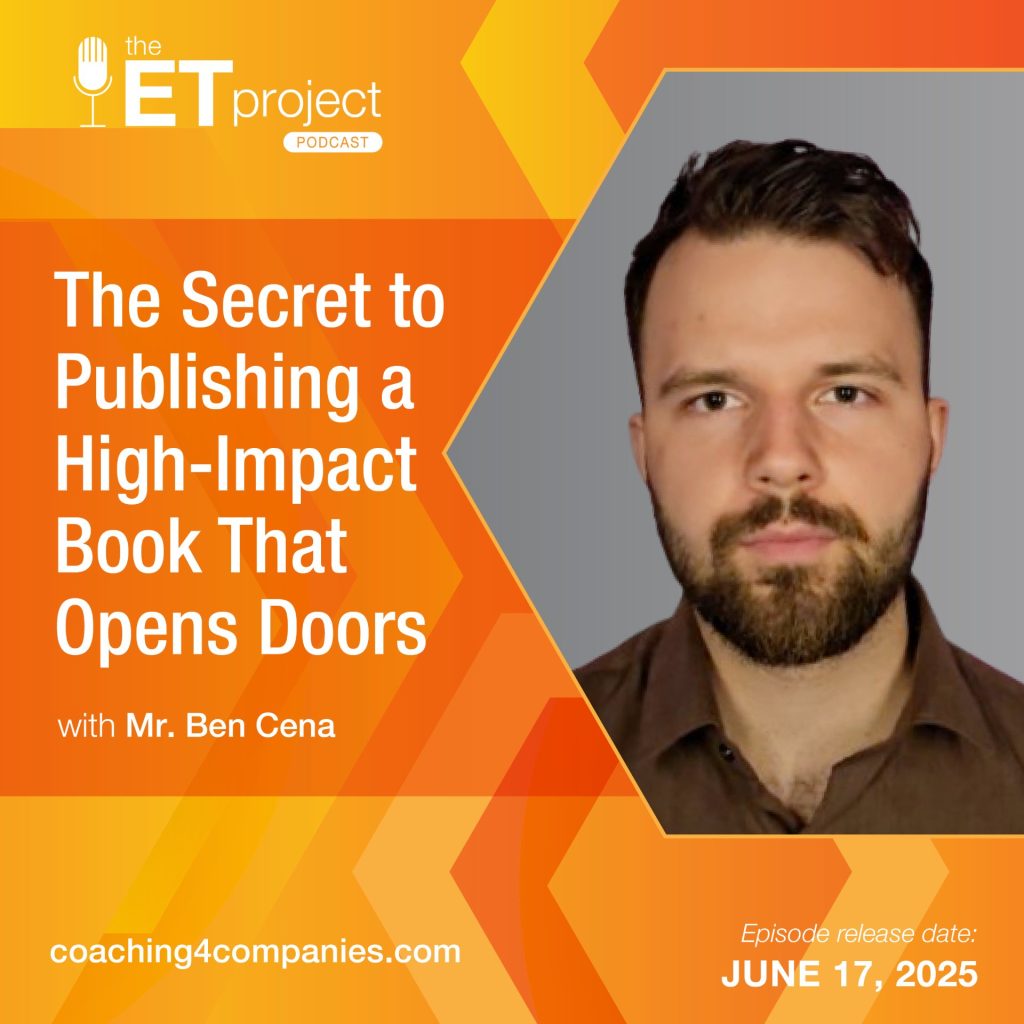
WAYNE BROWN: Hello, I’m your host Wayne Brown and welcome to the ET Project. We’re delighted to be delivering this podcast for executive talent all over the world, whom we are affectionately referring to as ‘Team ET.’ Today we were meant to be in Dubai, but we’ve been diverted to Lithuania so we could catch up with Ben Cena, co-founder and CEO of High Value Author. The company helps entrepreneurs and thought leaders gain market footholds through expertly crafted book writing, publishing and marketing. As Ben shares, every entrepreneur and leader has a unique story that deserves to be told. At High Value Author, they take that story and transform it into a powerful tool for authority building, lead generation and long-term business growth. Their mission is to make sure the client’s voice resonates far and wide. Books are an invaluable marketing asset for establishing credibility, building brand awareness and driving sales. According to Ben and the team at High Value Author, the foundation of any successful book lies in its content and the power of the main message. By providing clients with tailor-made content, High Value Author ensures that each book is primed for success from inception to publication. For authors who achieve best-seller status, the rewards are immeasurable. When paired with strategic marketing campaigns, a well-written book becomes a formidable engine for generating leads and boosting sales. With their unmatched expertise and commitment to excellence, clients can expect outstanding results and lasting return on investment. Team, with more and more corporate leaders moving into the entrepreneurial space, books have become a must-have in establishing your presence. So, tune in now to find out how you can turn your story into a literary masterpiece.
INTRO: Welcome to the ET project, a podcast for those executive talents determined to release their true potential and create an impact. Join our veteran coach and mentor, Wayne Brown, as we unpack an exciting future together.
WAYNE BROWN: Hello, team. Many of you know that I’m an avid reader, I love books, and perhaps some of you may even share a similar passion. Yet, how often do we pause and consider the author, as well as the journey that they’ve been on, the effort that they’ve made to feed our interests, and why they would hope to do so? What’s in it for them? Now, we know, of course, that if done well, a book becomes a powerful tool and it can serve each of us in many ways, whether we’re entrepreneurs or leaders. And during today’s episode, I’m really pleased to be joined by Ben Cena. Ben is the CEO of High Value Author, and we’re going to break down a few questions and explore some of the key areas around why we should write books. Why should a leader or an entrepreneur consider writing a book? What type of book would make the most impact for them or the most sense? How would they measure the success beyond the sale itself? And of course, the inevitable question that I’m sure everyone is thinking about at the moment, how is AI changing the publishing game in this case? And what does the future of that look like? So, whether you’re trying to build your legacy, whether you’re looking to boost your brand, I’m pretty sure that our conversation today is likely to change how you see authorship in general. With that, let’s get started, and we’ll welcome Ben to the show. Mr. Cena, welcome to the ET project.
BEN CENA: Wayne, thanks for having me.
WAYNE BROWN: Now, Ben, I think the first time we connected, you were sitting in Dubai. I believe you’ve hopped on a plane and you’ve flown home for a little while. What’s happening at the moment?
BEN CENA: Well, you know, I’m just enjoying life, no, I’m just joking because… now, Dubai is a great place, but I have to come back home from time to time. I know I miss the trees, I miss all these things. I think it’s important for us as entrepreneurs, we have to breathe sometimes, get out of our offices and things like that. So, I think it’s important to feel that, come back home from time to time as well. But, you know, busy, busy as always.
WAYNE BROWN: And where are you sitting at the moment?
BEN CENA: I’m in Lithuania, so in my chair in my office, you know, it doesn’t change much. You know, I couldn’t really tell, you know, if I’m in Dubai or here or in UK in London, you know, because the same chair, the same background, everything is the same. The moment I leave the front door, you know, exit, then the thing starts to change, then I know where I am or I check the time zone.
[00:05:00]
WAYNE BROWN: I’m sure. And I can imagine that each of those countries that you mentioned are very starkly different. So, I can imagine outside that it is quite contrasting. Why don’t we start off with getting you to share a little bit about your background and how you found your way in this whole world of book writing and publishing?
BEN CENA: Of course, of course. So, about six, seven years ago, no, it is 2025, six, seven years ago, my colleague introduced me to the publishing industry. It was called self-publishing at the time, the early days of self-publishing. And I never thought, actually, that I’m going to be in such a business, I hated reading, you know. I think that was because we were kind of conditioned in high school and even earlier that we have to read these fictional books, you know, all this boring stuff. You know, I didn’t really like them, I like watching movies, not really reading. But then I discovered the power of nonfiction, which is where I really am and knowledge and getting knowledge. You know, people are buying knowledge and people buy knowledge in the form of a book. People love books, you know, fascinating thing. So back in 2018, 2017, we decided to create a self-publishing business, a company we sold later for a small sum. And then we realized, and let’s say we, me and my business partner back in the day, that, okay, we can really self-publish so many great books why… Authors or wannabe authors, but why can’t we help them? There are so many books out there, millions, tens of millions at that time, now over 60 million books worldwide, and less than 100,000, which is less than 2% of all of those books, sell more than one copy a day. You know, this is a fascinating thing to know. And there are tools, there are ways to actually people… get readers to see those books and authors have no idea, right? So why don’t we help them? And that’s where we made a decision to creating High Value Author and really helping authors to get seen and use their books to their full potential beyond sales. We were talking about speaking, podcasts like we’re talking right now, right? Leveraging, getting connections in their industry, creating networks, all these kinds of things, because usually authors just put their stuff out there, think the hard work is done. You know, the moment they click that publishing button, “oh, I’m finished.” No, you’re not finished. No, it’s, you know, for most people, it’s not, job is not done, this was not the goal in the first place.
WAYNE BROWN: Right. It is a fascinating business and I’ve had the privilege to write a couple of books and the journey itself is very fascinating. What is it that High Value Author does as a business? How do you help the prospective authors along their journey? What services do you provide?
BEN CENA: Well, in the beginning, we were trying to help two kinds of authors. Authors who just have an idea or authors who already have something put together, meaning some sort of a manuscript, something written, a full draft, partial draft, now we are more focused on authors who just have an idea, right? It’s easier to work with them, but generally we help authors from the idea stage all the way to becoming a best seller on Amazon and getting in all the different media outlets, podcasts, et cetera. So, the whole journey of creating, publishing, marketing, so we can just sit back, revise, look at what’s happening and see if they’re happy with that. Most of our clients are entrepreneurs, people who really have great ideas, they know what they want, but they don’t have the time, right? So that’s where we come in.
WAYNE BROWN: Do you have a particular genre? Like I know you’re doing non-fiction, but is there a particular type of client that tends to gravitate towards your service?
BEN CENA: Yeah, it’s usually business. It’s usually business, a self-help combination. It’s usually a person who has some sort of experience, learned the lessons along the way, sometimes in a particular specific industry, sometimes more general, and they really want to share that experience, establish their expertise and build those networks.
[00:10:00]
BEN CENA: So, it really is more in business because people are more inclined to get it done. You know, because for most people, you know, in other categories, they don’t have this sense of urgency. They don’t have this thing where, “okay, I want to get this done this year,” they don’t have that. Some business people, they are more like, “okay, I want to get this done.”
WAYNE BROWN: So how long does it normally take from the beginning of the journey to the point of release?
BEN CENA: It’s usually anywhere between four and seven months. Now there are some people who are extremely responsive. You know, we can work fast, we love speed. You know, it’s usually much more productive and effective, but the general it is usually between timeline, between four and seven months is where, you know, there are some big projects, like big books, more in like science, a kind of category that we work for 12 months, but as a general rule, like four to seven months is, we could say the finish line becoming, not just publishing, but also becoming a best seller, for example.
WAYNE BROWN: Okay. What are the key phases on that journey? If we were to chunk it down, where do you start? And, you know, what are the boxes you tick as you go along the process?
BEN CENA: No, we always look in… because there are key phases for the client and there are the key phases for us, right? And they’re not always the same. But usually the key kind of points, the most important kind of steps of the journey are in the very beginning where we are crafting the title and the cover and creating the cover, that combination, that power duo, power couple is the most important thing, you know, beyond any marketing, you know, I always call it like a rock, you know, if you have really nice rock, round rock, you know, that’s a good cover and title combination, you can just push it, it rolls, right? And if you have a rocky rock, like with angles and stuff, you know, that’s what marketing is, you put in some marketing, it doesn’t roll, you know, you can’t push that kind of rock, so that combination is the key. And then there is finding the voice, the style, capturing the style of the author, that’s usually in the beginning phases of the writing process. And then of course, the publishing state where we get the book out there and get it to number one bestseller, probably these are the key points throughout the whole process.
WAYNE BROWN: Why would I as a leader, think about having a book, like what are some of the benefits that come as a consequence of having a bestseller?
BEN CENA: Well, it really depends because sometimes rarely, we have to kind of, in a nice way, fight with our clients because we want things the certain way, but not necessarily this is the best way in terms of what they want, right? For example, I want to get to this point, you know, and they say, okay, I wanted it to be this way, but that’s not the best path to get there, right? So sometimes if your goal is to, okay, I want to have a book that for this audience, here’s what I want to do with them. I want to leave a legacy behind in this kind of way. How do we do this? We give you a set of goals, okay, you probably should have a book and that’s where we come in. If your goal is to, for example, have a memoir, right? And it really depends because people are in different stages, some people think they want to have a book. Some people think they want to have this, like a marketing piece, right? Like a legacy piece. There are different reasons for having this, because before we start working with clients, we always have a very strict pre-qualification process, so we know, okay, we can ask them what exactly do they want? Not in terms of what kind of book they want, but why do we want this book? You know, what is the reason? You know, sometimes we have to get through all the smokes and mirrors, what is actually the reason for having this book, what is the actually the reason? Is it a financial reason, right? Do you want to make money? Right?
[00:15:00]
WAYNE BROWN: Right
BEN CENA: Is it a networking reason? Is it a legacy reason? No? And once those questions are answered, then we can say, “okay, you should have a book. You should have this kind of book. No? Does that make sense?” And then we come up to an agreement.
WAYNE BROWN: And I can imagine that could be quick or that could take some time, as you said, that the individual is not always essentially clear on that why, right? But essentially, you’re trying to get to the purpose, you’re trying to understand the goal and once you have that…
BEN CENA: The why has to be strong, you know, we have to dig deep and understand the why, you know, because it’s not a quick process, the process takes, as we talked four to seven months, you know, we want that motivation to keep climbing along the way rather than, okay, we lost motivational because it’s very hard to come back, you know, that’s why so many people have these little pieces and drafts, and then you ask question, when did you put this draft together? Like, seven years ago, five years ago, 10 years ago, you know? And now usually it’s more difficult to work with these people unless they have a strong sense of urgency, something is coming up, they have a big reason, otherwise that cycle just repeats, but you have to, you know, most people should have a book if you are an expert in your field and you don’t have a book, you know, you have to have some other very strong points to make a statement.
WAYNE BROWN: Now, do you offer ghost writing as part of the service or do you require the client should do the writing themself?
BEN CENA: No, no, no, no, no. Our shtick is that we help people throughout the whole process, them spending less than 30 hours throughout the whole seven months. So, we do everything from end to end and they can be involved as much or as little as they want. Ideally, you know, the more involved, the better the outcome is, not in terms of the quality but rather what they want and then there aren’t inconsistencies at the end where we say, okay, it was so amazing and now I want to add this change, that change, the other thing. But usually, you know, we do the whole thing from end to end.
WAYNE BROWN: That therefore includes any research that’s required or how do you cope with that type of situation where the book, because it’s non-fiction, so there’s a degree of factual content. How do you handle that?
BEN CENA: Well, it depends on the situation. So, each scenario is different, there are different scenarios. For example, sometimes we set up a case study deck, you know, the author imagines that he has so many examples from the past and so many stories, almost every single time we do something and we set up a portfolio of stories of voice recordings, you know, that helps so much with the outline and the whole flow of the book, right?
WAYNE BROWN: Mm-hmm
BEN CENA: So, there’s a lot of step-by-step fundamentals that we found our way and actually one of the keys are those voice recordings or even recordings like we are recording right now, that helps us to get to the essence of the entrepreneur and we work with 95% entrepreneurs and people who are watching this are probably entrepreneurs or they want to be. So that helps to get inside their minds. And we set it up in a way we help them to create a habit of moving around, driving in their car, recording all these things, and we manage to create this effortless process. So, I think this is why people work with us as well.
WAYNE BROWN: Right. And I can imagine at the beginning, you also do a lot of work on identifying, you know, what is the type of publication, is it going to be hard copy, soft copy, Kindle to use Amazon’s methodology? Are you going to make an audio book? Like there must be a lot of these types of pre-qualifying questions, are there?
BEN CENA: Rarely, rarely, because we almost always are in all four formats, meaning the eBook, the paperback, hardback, and audio book. In the rarest situations where the book is specific, scientific, technical, we don’t need, and we don’t want an audio book, it doesn’t make sense. Like a cookbook, right? It wouldn’t make sense.
[00:20:00]
BEN CENA: There are a few projects like that, that we take, we don’t really like them as much, but generally that’s not even a question because people love and people have their ways to consume content and consume books and read books. Some people love eBooks. I hate eBooks personally, right? I’ll say it upfront. I just hate eBooks, I don’t like them. I love physical books, they are all over the place. I love audiobooks, right? I don’t really care about if it’s paperback or hardback. Some people care. So, we just do all of them. It’s really not a discussion really. Maybe it used to be 20 years ago because there have been different structures, but now it’s pretty straightforward. We want to have them in all formats.
WAYNE BROWN: How do you measure success? Like the book and getting it out into the market is one key metric becoming number one, I guess is a metric in many cases, or is it very individual?
BEN CENA: It’s individual because we know right away in the very beginning, because when we are asking about what do you want to achieve with this book, you know, what potential does it have? Does it have the potential to sell tens, hundreds of thousands of copies? Right? In most scenarios, that is not true, right? But it has potential. It doesn’t mean it doesn’t have potential for making money, right? It doesn’t mean that, right? Because there are many ways to leverage your book, but you said it right then, one of the key metrics is having that book exactly the way you want actually, right? It’s not just becoming a number one. Number one, becoming number one is part of that. You know, you want to have this, you know, symbol. You want to know that you surpass the others in your category. Now that’s a big part of that. And you want to see that book alive. Now you don’t want that book just to die. And more important than that, you want to see positive feedback. People love to see positive feedback for their book, how great that book is, which is reviews, of course, other people’s feedback in terms of more verbal, these kinds of things. So, people measure it in different ways, but you know, we always make it very clear in the beginning.
WAYNE BROWN: Once we’ve gone and we’ve released the book, as you mentioned right at the beginning, that’s not the end of the journey. In many cases, the easier part has been done. And now the tough part begins. How do you then continue to promote and is there a typical life pain of a book?
BEN CENA: Well, there isn’t, right? We always try to work with topics that solve problems. And it’s a fundamental thing. There are some books that have, you know, it is that like that rock, you know, round rock, you can just keep pushing it, right? You just give it some fuel, you know, have a good track to put it, it just keeps rolling, that’s marketing, right? We do some email marketing. We have a really very good Amazon advertising team, you know, we really know how to push that book a lot ahead and get ahead with that book. Some books just don’t have that potential. And people have to understand, you know, if you’re going to have a book about aviation or you’re going to have a book about rocket ships, and I’m making an extreme example, there are examples in between, you know, there aren’t going to be tens of thousands of readers every single month or even every single year. We’ve always wanted to make sure that there is a problem in the marketplace. There is a specific audience for that book and that book can stay alive. Meaning people still care about it, that book still ranks and people are searching for a solution for that kind of problem. Some people are not really solving a particular problem. Those books, you know, they have a very short lifespan because people are not looking for that solution or that book isn’t really a solution. It’s just like, for example, like a memoir, rarely a memoir, unless it’s a very famous person solves a particular problem, but there are exceptions and those exceptions are very big, others are non-existent, those kind of books, once they reach a bestseller, usually they die in four or five, six months because they are not solving a problem and authors have to understand that.
[00:25:00]
BEN CENA: And we really have to think, what do you want your book to do? And then the angle changes because most authors, most experts in their field, they have the tools to solve problems. They have the potential to show their audience that I’m solving this kind of problem. Some of them, they just choose not to do that. And we can’t do anything about that us as a company.
WAYNE BROWN: Right. You know, I’ve been thinking about sequels and I have often wondered, is there a perfect timing between releasing book one, let’s say we’re doing a trilogy, book two, and then book three. I know it’s a very broad question and I’m guessing your answer is it depends, but is there a guideline? If somebody out there was thinking, okay, I know I’ve got three books in me. I want to write these three books. They’re all going to be sequential over what duration should I be targeting?
BEN CENA: Wayne, are you creating a trilogy or something? Okay. Let me answer your question. Yes, there is, the answer depends. Of course it depends, but you know, we can answer it depends on what. Right? Probably a few important questions that we have to answer. Question number one is what is the category of this book? As a more broad sense, is it fiction? Is it non-fiction? These kinds of things. Right? Is there a season for the book? Is there a particular season that this book is solving a more specific problem than not. Right? If there is a season, then you have to be aware of that season. And usually, we want to publish that book about a month or two before that season starts. Right? So, if you can do that on an annual basis and prepare for that season, usually, the season is annual, you should do that. If you cannot, then you do it every two years. If you have the capacity, the team, whatever you need to produce that book, solve that problem.
WAYNE BROWN: The season item we mentioned there is quite interesting. I had read about that before, but I’ve forgotten. So, for instance, my area that I focus on is small business. And so, if I write a book about how small businesses can succeed, to your point, if I’m writing something specific around the financial aspects in the book, maybe I’ll target around the tax time as a seasonal component. But I need to give that some consideration, is what you’re saying. Yeah?
BEN CENA: Yeah, absolutely. Probably you’re looking and to be more specific, you’re looking at two possibilities. You may be looking at the beginning of the year, around February. It’s a good timing, usually. Or you’re looking at the second part of the year, the end of August, September, where the things start to really ramp up for the Christmas season. And people just love gifting books. But I’ll give you another hint. For most people, for most listeners here, you shouldn’t care about the season. It doesn’t matter. You should publish your book. People get like, okay, I’m going to find a perfect time. No, that’s going to give you 20%, 30% boost. If you know how to leverage a 20% boost, kudos to you. That’s great. Most people have no idea how to do that. So, that season doesn’t matter. It’s just an excuse to delay something. For most of you guys out there, you should see, okay, do I have the time? How much time is it going to take? Do I have a strategy? Do I have the tools? Here’s the start. Here’s the finish time. Whenever it is, people should be more concerned about their own goals rather than the season, the year, the star signs, all these kind of things. We help, but to an extent.
WAYNE BROWN: Yeah, for sure, for sure. And one of the things I know, many novice writers, including myself, when I started, we totally underestimate the length of involvement during the editing phase or the length of time, the number of reviews, the process involved during that editing, whether it’s the initial copy, whether it’s the proofreading, whether it’s the set out, et cetera. There’s so much involved in that editing phase, is my experience. I don’t know how you see it, but what were your thoughts on that?
[00:30:00]
BEN CENA: Well, it truly depends how rough the draft was, right? How much revision you did during the writing phase. Did you just try to write as fast as you could? And then you just edit and edit and edit and edit. Or did you do more thinking in the beginning. It really depends, because some people want to get through it as fast as possible, that’s one of the ways to do it. What we like, we don’t like to do as much of fundamental editing. We would rather spend a bit more time on revising each milestone, each chapter, see if it drives a point home, if the language is right. And once you get to the editing, there are some structural changes here and there, but there aren’t too many, because at the end of the day, that is not going to be the factor that’s going to make or break the book. We are not competing here for the best written book. People usually don’t care about that. People love the professional angle of the book. It has to be high quality. Now, but people usually overestimate that part, and they just come up with their book title in the shower. Instead of spending a couple of weeks on the book title, and analyzing and thinking about their audience, these kinds of things. It’s much more difficult to stare at three words and think if they’re right, opposed to reread your whole thing, the whole manuscript time and time again, maybe I’m going to change this sentence. Nobody’s going to get to that sentence if they don’t like the title. Let’s worry about one thing at a time. Let’s understand the customer’s journey, the reader’s journey. Where it starts, where it’s the most important thing. Is it chapter one? Is the introduction where it is and where it ends? How do you keep the reader engaged? Is the reader going to be fascinated about all the nice things that you’re going to put in? Maybe. How many readers are you going to push from the book? That’s a more important question.
WAYNE BROWN: Hmm. Typically for a non-fiction book, is there a number of words that you would suggest for, I don’t know if you could even say the average non-fiction business book, but is there a target?
BEN CENA: Of course. Of course, there is a target. We always say as long as it has to be. I like this phrase, as long as it has to be. What does that mean? For most books, it means between 38,000 and 45,000 words. I don’t know why people like to measure that in pages. Most people do, right? That’s probably around 200 pages, 230. I didn’t write it in that ballpark. Business people, business readers tend to have a shorter attention span. They like to get the nuggets out. They don’t read the whole thing, some of them do. That’s not the most important thing. Value is most important. And there is one question that people always have to answer. This is where you stop writing. This is where you get rid of all the nonsense from the book. And that is, is this still relevant? Is this relevant? As long as it’s relevant, it should be in the book. The moment it’s not relevant anymore, or the bits and pieces that are not relevant, stop right there. Let’s not prolong the book just for the sake of prolonging it.
WAYNE BROWN: What about when it comes to graphics, diagrams? Are you a fan of that in business books? I’m sticking with the business focus, as a means of enriching the text? Or do you prefer less?
BEN CENA: It depends on the nature of the book. But for most business books, if it is a business book that is not on the technical side, if it is on the technical side, those things help. There should be visualizations, there should be those things, the key points, the graphics. Probably at least one graphic per chapter that illustrates the most important point, there should be things like that. For the business books that are more lesson-driven, self-help, a combination of business and self-help, those books really don’t need graphics. And sometimes there’s graphics that they don’t do anything. And again, we have to come back to that question, is it relevant? If the graphic is relevant, you can take a step further. Does it make it better? Does the graphic make it better? If it doesn’t make it better, you don’t do that, you don’t include that.
[00:35:00]
BEN CENA: It’s just like if I’m speaking, do additional words make my speech better? It doesn’t make it better, you just stop right there, you move to the next point. What do you want your audience… What does your audience want? What kind of result do they want? What do we want to hear? That’s the same thing with the book. And with the book, you have much more time and resources usually to take out the nonsense, take out all the things that don’t matter. When we are speaking, we don’t have that luxury, when we are writing, we do. So, let’s not add things that… Unless specific books, there are some picture books, there are some books that have that angle. For most business books, no. Most business books should have zero or close to zero graphics.
WAYNE BROWN: Okay, got it. So, let’s move into the challenging topic for many businesses around technology. I mean, there are so many tools. If we break down the whole process, we can list pages of different tools that we can use to support us during the process. So, we can go with the writing assistance, like the ChatGPT forms. If we’re talking about the editing, probably most common one, Grammarly or something like that, are they a benefit to the novice writer?
BEN CENA: We have to probably differentiate, right? We are talking about writers and authors, right? Because we are… when we are looking at tools and we have only one rule in our company because we want to use the best. We never use AI in the writing process, meaning we don’t use AI for writing. All the other tools, you know, it’s almost like you would use a shovel when there’s a tractor out there, right? It’s just like you always have a reason to use the shovel. You can do that, yes. But why wouldn’t you use these amazing formatting tools? Why wouldn’t you use amazing grammar correction tools? Of course, we have editors, but why wouldn’t you equip them with the best tools so we can make a decision? It becomes a decision-making rather than a manual labor waste of time, as I call it, right? And there’s a reason why I wouldn’t suggest authors to also use AI for writing is because it’s all about customer experience. And at the end of the day, what matters is customer’s feedback. The moment a reader has a sense, the text or anything that can be something AI, or something plagiarized, something not original, they lose all trust. They lose the whole, I’m excited kind of phase about the book, about reading the book. And we’re not willing to take that risk. We’re not willing to take that risk. We believe that the only thing, if it is authentic, it has to be the voice of the book. We can have many different AI voices, they can speak in different patterns. But at the end of the day, the fundamental part, the reason why people want a book is because they want that book to be a piece of them. And we don’t believe that, at least right now, maybe something is going to change in a decade or so, that something that is created by a machine can be a piece of you. It doesn’t mean it cannot get the job done, there is a difference. But at the end of the day, and what we learned throughout the years, feeling proud of your own work, having that sense of pride, which I believe in this case is a good thing, just reading through it, memorizing something, remembering something from the past, feeling the feelings and authenticity of it is extremely important. Outside of a manuscript, we use all the best tools possible. Research, title research, keyword research, all the different things we want to use the best but this is the only area where we don’t do it.
WAYNE BROWN: I understand. What’s on the horizon for High Value Author or yourself in particular? Anything coming up? Anything exciting you want to share with the listener?
[00:40:00]
BEN CENA: Not something in particular. We are, of course, helping people. We are helping more and more people every month. Probably we have our internal milestones. Of course, we want to reach and help a specific number of people. We have a goal of helping a million authors, a million people to become authors.
WAYNE BROWN: Wow
BEN CENA: This is a long-term play. So, we are working hard on creating systems and creating teams of people who can sustain that growth, maintain the uniqueness, maintain the personalization. Back in the day, I used to take every single conversation and we used to be a part of everything. Now, I don’t even know what’s happening sometimes. As long as good things are happening, I’m happy. Yeah, probably this is what it is. Of course, we’re adding something extra. You learn that some of our authors who become bestsellers, they are looking to speak, right? So, we are working with some speaking things that we are doing also. Once the book is out, these kind of things, sometimes we take it to the next level. But yeah, this is where we are going and hopefully we’re going to achieve some great things in the next two, three, five years. We’re here for the long run.
WAYNE BROWN: A very ambitious goal, but a very admirable title. So, wishing you well on that. Any specific advice for a listener out there who is thinking about writing a book, they haven’t taken the first step, they’re still on the sideline. Anything you would suggest to them that may help them move forward?
BEN CENA: I think that’s a very good question, Wayne. I think the reason why, and finding enough reasons why to take the next step is the first thing that they have to do, right? And they should do it just once. You shouldn’t come back to those reasons. You just sit down on a good day and just write down the reasons why. Not on a bad day, on a good day, right? Because life is about moving forward, not about moving backwards. And I am yet to meet a person, no matter what kind of investment they made, time or money or both or some additional things, who became an author and regrets becoming an author and getting that job done. And I think that statement in itself has enough power to motivate some of the people listening here to pull the trigger and say, “heck, at least I’m gonna try to do something. I’m gonna make something great. I’m gonna be proud of that thing and I’m gonna get it done.”
WAYNE BROWN: Well, to that point, Ben, where can people go and track you down if they’re looking to take that step? How can they work with you? Where is the best place to find you?
BEN CENA: Very simple, highvalueauthor.com or they can just find me, Ben Cena, on LinkedIn. They can send me a personal message if they want to or they can just go to the website and find one of the many buttons where they can click and they’re gonna speak to my team or myself sometimes.
WAYNE BROWN: A wonderful conversation. Thank you for that and thank you for being on the ET Project.
BEN CENA: Thank you, Wayne.
OUTRO: Thank you for joining us on the ET project, a show for executive talent development, until next time, check out our site for free videos, eBooks, webinars, and blogs at ‘coaching4companies.com.’
[END OF TRANSCRIPT]