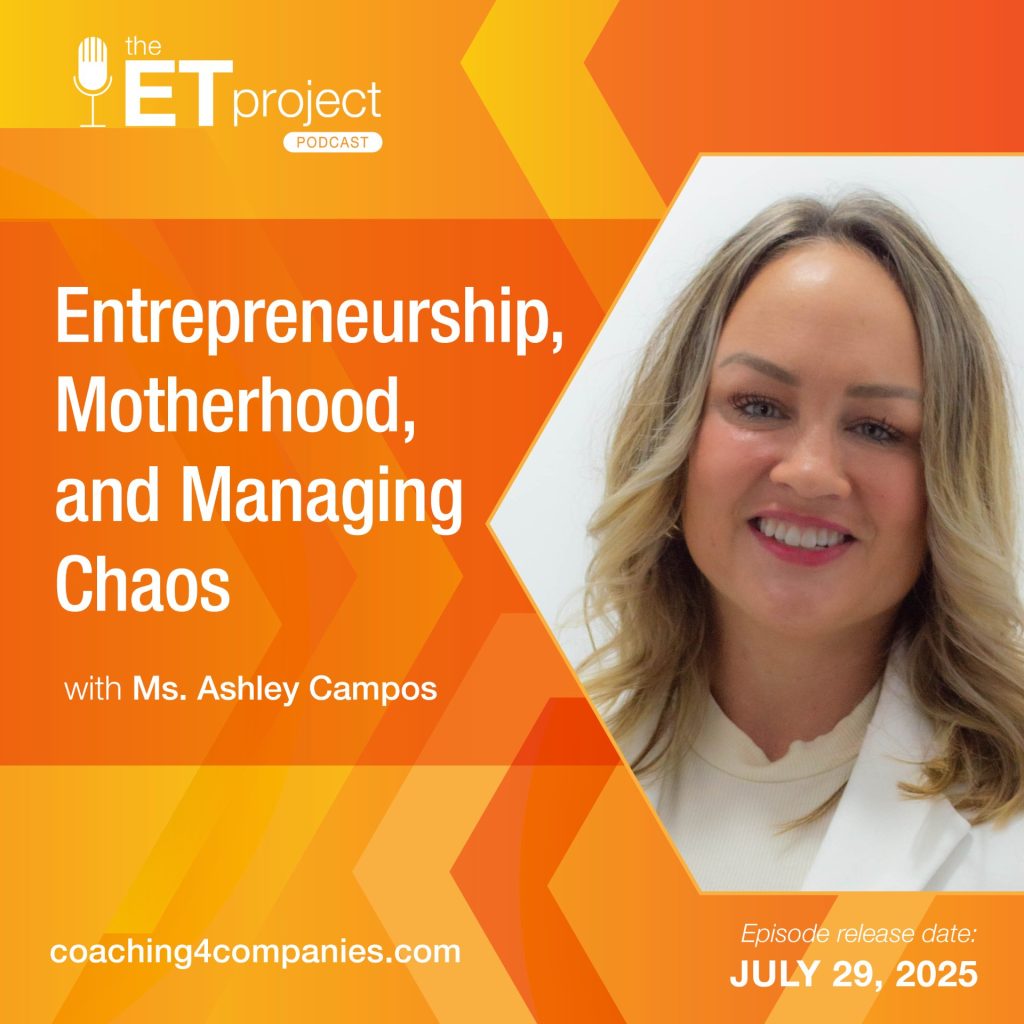
WAYNE BROWN: Hello, I’m your host, Wayne Brown, and welcome to the ET project. We’re delighted to be delivering this podcast for executive talent all over the world, whom we’re affectionately referring to as ‘Team ET.’ Today, we’ve traveled to Virginia in the US, and we’re catching up with company founder and CEO, Ashley Campos. Ashley is a fast-moving entrepreneur, mother of three, and the force behind two virtual assistant outsourcing companies, Falcon Virtual and Global Connect Solutions, as well as the co-founder of the logistics firm dlivrd. With more than 15 years’ experience in restaurants and logistics, she’s obsessed with making work better through smarter systems, stronger teams, and more meaningful connections. Whether Ashley is solving delivery challenges or helping founders scale with virtual talent, she brings clarity, energy, and just the right amount of chaos. Ashley specializes in building high-performing remote teams and crafting strategic solutions that help businesses scale, streamline operations, and enhance efficiency. She leads her virtual team of highly skilled professionals, providing executive support, business operations management, and customer experience solutions to help companies optimize resources and drive growth. In addition to this role, Ashley serves as the chief strategy officer at dlivrd, a technology-driven last-mile delivery platform where she focuses on strategic growth, operational efficiency, and industry partnerships, ensuring seamless logistics and top-tier service for restaurants and delivery partners. Her entrepreneurial passion is fueled through her remote teams that unlock efficiencies and design high-impact strategies. Ashley’s goal is to help businesses grow and operate at their full potential in an increasingly digital world. Team, if you’ve ever considered outsourcing some of your staffing needs, then Ashley’s insights and practical advice could be just what you need to take that next step. Have a listen and get ready to learn.
INTRO: Welcome to the ET project, a podcast for those executive talents determined to release their true potential and create an impact. Join our veteran coach and mentor, Wayne Brown, as we unpack an exciting future together.
WAYNE BROWN: Hello team, welcome to the show. Today, we’re talking about what it really takes to lead with both grit and grace, especially when you’re building companies, leading remote teams, as well as trying to raise a family. How do you stay grounded when the plate is so full? How do you grow as a leader while staying true to your values? And how can self-awareness and honest feedback actually make you stronger, not just at work, but also in life? So, joining us to share powerful insights from her own journey is entrepreneur, mom, strategic leader, Ashley Campos. Ashley, welcome to the ET project. Great to have you here.
ASHLEY CAMPOS: Thanks for having me.
WAYNE BROWN: Let’s start with what inspired you, why did you decide to become an entrepreneur and particularly in such fast-moving industries like fast food and logistics? What was the spark?
ASHLEY CAMPOS: I contributed to my first job out of college. You know, I always wanted to go to med school, that was what I went to my undergrad for. And while I was doing that, in the process of it, I got a job with a set of four entrepreneurs and they were in a recycling business and in a… like a dirty business, kind of taking cleanroom garments and taking them from clean industries and giving them to the oil industries. And I just had such a spark for listening to them talk and interact and how they live their life and them traveling. And I think it set off from there, I got a taste of traveling early with them to Europe and all over doing some sales activities. And from then on, it was just like, “what’s next? What can we do? What’s next?”
WAYNE BROWN: What is it you do today then? Have you transitioned from that starting point to something else or what are you doing today?
ASHLEY CAMPOS: A little bit of both. So, I still have daddled my toes in all of the logistics with a company that I’m a chief strategy officer at, and that is highly logistics and technology, but also transition that into a executive assistant or a BPO company that works with many other technology and logistics companies as well and restaurants. So, kind of taking my knowledge from all the pieces of the puzzle along the way and putting them together to create where we’re at today.
WAYNE BROWN: What often trips people up, I’ve found, is that transition into becoming a leader. Did you have any challenges yourself as you started your entrepreneurial journey on how to lead people?
[00:05:00]
ASHLEY CAMPOS: Yes. I remember the first time when I got promoted at my first job into being a leader, I had to make a transition from being a friend to being a boss, or a colleague but a friend, and to being a boss. And that was really difficult, and there were a lot of challenges along the way, and I think what I learned then that I’ve taken into today is just being really transparent and really honest when you give feedback because if you’re consistent with that, then people understand that when you have to give them something that they might not want to hear, that you’re doing it from a place of care versus just from a place of maybe badgering or something, from a negative space. So, I really did take that and hold onto it today, it’s one of my principles of just always being honest and giving hard feedback even when you don’t want to or the other person doesn’t want to hear it.
WAYNE BROWN: Right. How much does your leadership style come out of or lend itself to being a mother?
ASHLEY CAMPOS: I think that I don’t know what influenced what. I would say probably my leadership style probably influences me being a mom because some people would be like, “oh, you train your kids, they’re all doing stuff around the house like little employees of the household,” which they kind of are, but I’m super transparent with my kids too and I kind of like to set them up for success and then let them go, let them fail a little bit. I also think that if you’re not failing with what you’re doing, you might not be trying hard enough, but just kind of supporting them along that journey of growing up or, you know, in the workplace of growing into a better person in your current position. So, I’d say they’re pretty overlapping.
WAYNE BROWN: What was your turning point when you realized that you could be both committed to business as well as being present at home? Like as a leader, I know I find when I come home, it’s very difficult to shut off. But how do you juggle that? Would be a better question.
ASHLEY CAMPOS: It’s a struggle. It’s something I think about all the time. And I would say that I’m not perfect at it all the time. I think that, you know, when we go on vacations, I tend to work sometimes when they would like me to be more present. But over the years, I’ve tried to put that into sections. Like, I like to work, I like the way it feels when I can open up my computer. So, it’s not just a job, it’s part of who I am, like if I were to read a book for the day. So, I just try to compartmentalize it to different times of the day and also involve the kids in the business as well so they feel a part of it. And we also talk a lot about the fact that our work now that they’re older and they can understand that, they’re 16, 15 and 10, but I want them to understand that the hard work that we put into it is the reason why we can do these fun things or do these trips or they can play on soccer teams or they can go out with their friends, because that’s what enables us to do those things, it’s the money that comes from that and the freedom that I have.
WAYNE BROWN: Yeah, that’s such an important lesson, great that you have the opportunity to be able to do that. It sounds like there’s… you know, we’ve all heard the term, the work-life balance, it sounds like it’s more of an integration for you rather than trying to balance the two.
ASHLEY CAMPOS: That’s a perfect word for it. And it’s kind of funny that you even say that, integration, because next week we have a strategic offsite with leaders in our team. And I was looking at the agenda that I didn’t put together, but I was looking at the agenda and for day two, it says, “Ashley’s kids cook breakfast for the team.” So, like they don’t know about it yet, I got to tell them now that we’re talking about it, but it is totally an integration because people want them involved and they love to be involved, so, it works out really well.
WAYNE BROWN: Was there a moment that made you rethink this balance topic as an integration? Like was there a point where you said, I can’t just continue going down this path, I have to find a way of bringing it together?
ASHLEY CAMPOS: I think when my husband and I decided to have kids, one of our first conversations before Alex, my eldest, was even born is that we don’t want to change our lives for our kids, we want our kids to kind of fit in in our lives to grow together. But we never wanted to be those parents that had to say no because our kid had to be asleep at seven o’clock at night or, you know, one of those things. So, I think it has been something that we’ve been learning throughout our journey as parents and it has kind of happened naturally as we’ve just included them along the way with everything.
[00:10:00]
ASHLEY CAMPOS: And I think too, our kids have learned the lesson that adults, like if they want to do cool things, adults do cool things. And if they want to do cool things, they have to be responsible young adults when they’re there. So, they’ve learned how to behave so adults are okay with them coming along or being there because they’re not screaming and running around in the background.
WAYNE BROWN: Have your children given you any insights to things that you can bring into your business? I’m just thinking like at that age, I guess I have exposure to a whole raft of things that we as adults don’t necessarily think about. I guess there’s possibilities that they can even bring new ideas, fresh ideas into the business.
ASHLEY CAMPOS: I think where they are really thriving right now, which as we get older as adults, is a lot of on the marketing side, you know, they see some of these new trends and how to interact with new websites or the up-and-coming thing to reach their generation and they’ve definitely sparked some ideas or had said some things that I hadn’t thought about before as it pertains to marketing itself.
WAYNE BROWN: Yeah. I can imagine it’s huge value as they continue to get involved. Let’s talk a little bit about the businesses that you have today, the outsourcing businesses, the virtual assistants, there’s a lot of myths around the concept of outsourcing, in particular about how an equal is losing control, do you come across that fear much with new clients?
ASHLEY CAMPOS: I’ve struggled with that fear myself as I started to give away control to them. And I think it’s something as any entrepreneur, whether you’re outsourcing or you hire a new person in your office, you’re giving the same kind of control away, although it’s harder because you can’t see them and touch them and talk to them in person as much. But I think after you develop that trust, it takes a little bit of time and it takes a little bit of work, just like any relationship. But once you develop that trust, man, it’s much easier just to give stuff away because you know it’s going to get done. But you do have to get to that point and that took me a couple of years, even for myself. Like, we had our BPO company and they were doing customer service and marketing. But for me personally to have an executive assistant took me a long time to get to that point for myself, but now I love it, she protects my time so much with the things that she helps me with.
WAYNE BROWN: The whole topic of delegation really and the sort of being prepared to take that step or dip your toe in the water is often one of the hardest things we do as entrepreneurs and leaders, it’s an area that I struggle with as well. I’m confident that most people listening to our conversation probably have been through or are going through something similar at the moment. Any advice on that point, like how do you make that transition or how do you make this delegation process a little bit easier?
ASHLEY CAMPOS: Yes, I have a great piece of advice that I tell everybody because it’s what worked for me. I’m a very pen and paper person and I’ll write my to-do list. I’ll even write things that I just finished just to be able to cross it off and make myself feel better. You know, when you have a to-do list, there’s always things that transfer over from week to week or day to day and they don’t end up getting done. And there’s two reasons for that in my head, one, you don’t want to, because if it’s important enough you would make the time. Or two, it takes… like, well, you don’t want to or it’s not important, I guess for those two things.
WAYNE BROWN: Right.
ASHLEY CAMPOS: And that’s where I would start. I would say what are those things that have been on your to-do list for weeks or months and hand those off. Because then they at least get done and they’re obviously, you haven’t deemed them so important, but… so, if it messes up or it’s not exactly right how you want it from a control aspect, it’s okay because now it’s gotten done to, you know, 70, 80, 90% of what your expectation was. And it’s a great way to jump in a little bit, but not feel that you’re giving your most important task away.
WAYNE BROWN: Have you found that there is more acceptance today of using outsourcing to support particularly entrepreneurs?
ASHLEY CAMPOS: I do, I think it has become more of a comfortable topic, I think people are hearing about it more, so it’s not so taboo. And you mentioned Tim Ferriss, he is the reason why I started using a VA after reading that book.
[00:15:00]
ASHLEY CAMPOS: And it has been something that has changed my life, just reading that. And everything didn’t apply to it, but he talked about that and he talked about like virtual mailboxes and those were two things that I had no idea even existed. But I do think that people are coming to terms with it more and more. I think when we’re talking with new clients or potential new clients, I find there’s two different types of people; there’s people that I have to kind of coach along the way and they really want to do it, but they don’t know how. And you kind of need to set them up for success of like, this is a really easy way to get started. Or there’s the people that are like, “I’m at my wits’ end, just please help me,” because they’re exploding on growth and just really take that next step. But once they step into it, they’re like, “wow, I should have did this sooner.”
WAYNE BROWN: Yeah. And for the solopreneur, it’s always that cost element, right? The balance of doing it myself versus giving it to somebody else to do. I all of a sudden have a cost that I didn’t have prior to that, how do you deal with that argument or that concern?
ASHLEY CAMPOS: Well, I guess what’s the opportunity cost of not doing it and what could you be doing? How many more clients could you be reaching out to? I find for a lot of people that social media marketing is something that they struggle with because they don’t know how to do it. And a lot of the firms that do it are very expensive. But if you just have a VA that knows enough to be dangerous, to do a little bit of things, that’s a really great jumping off point. And that’s one of those things that never get done because you don’t know how and it’s kind of scary and it’s different. And what’s the opportunity cost of not doing that? Could you have had four or five new clients and then paid for your VA and another one after you jump in? But hopefully the solopreneurs are putting just enough money aside to say, “okay, let’s try it for four hours, five hours a week.” I have people that use us for 50 hours for a solo entrepreneur, for a personal VA for themselves. And I have people that just start with three hours a week and then end up like quickly ramping and that’s what… I like to do that, that’s such a compliment when somebody is like, “I just need two or three hours a week.” It’s like, sure you do. Okay, fine, we’ll start with that. And then by the end, they’re like, “when can they work full time for me?” And so, that’s really a fun growth for me to see just as an entrepreneur myself.
WAYNE BROWN: Right. And of course, that’s one of the big benefits of outsourcing is you do have that flexibility as opposed to having an internal permanent hire, you have that flexibility of how many hours the person is actually working for you. What’s a couple of things that help as a leader to make a virtual team successful?
ASHLEY CAMPOS: Number one thing I think is communication and communicate early and often, especially in the very beginning. Just like somebody who is new in the office, having some sort of onboarding, and it doesn’t have to be onboarding like a formal process, because some people would say, “I don’t know, I can’t start because I don’t have an onboarding.” It could be as simple as being on a Zoom all day with them. And so, you can give them a task and you guys can work virtually but together all day and have those conversations, because the more you communicate, the faster they’re going to learn what you need and be able to ask questions of you in the same way. So that’s the most important thing is communication, 100%.
WAYNE BROWN: Yeah. We were talking just before we started recording about the pros and cons of you as the entrepreneur finding that outsourcing party by yourself versus using services like you offer. I can imagine the value that comes out of using your services, that you do the screening, you have the team that work with you and you’re outsourcing to people that you believe are the right fit for the client, is that an accurate assessment?
ASHLEY CAMPOS: Yes. And I think too, a lot of times when I talk to a potential new person that’s going to use our service, obviously I need to find the right skillset for that person. But most of the time it’s about finding the right personality. I’ve even had VAs where I first started with mine in my own company, somebody needed to get, couldn’t use her VA anymore, but loved her. And I’m like, well, I’ll try it. She comes so highly recommended. I just liked working with her a lot, she just wasn’t my style, I am not a good teacher up front, I am very much, figure it out and then come to me with questions, versus me spending a lot of time upfront. And she needed that upfront time, whereas I didn’t want somebody who needed that.
[00:20:00]
ASHLEY CAMPOS: So, it didn’t work out. And there’s different personalities for different people of EAs. And even like for us, all of the people who we hire into our company, they go through a psychological test, like an evaluation, more of a personality kind of psychological test, but it lets us know just some key insights about what they’re going to be good at and what they won’t be good at. So, we use that when we pair them with potential clients.
WAYNE BROWN: Right. You touched on something there that I think is really critical and probably most people don’t give it enough consideration, that’s self-awareness. So, understanding yourself and the type of needs that you have from that individual is going to help that transition and smooth out the whole process and create the trust much quicker I can imagine.
ASHLEY CAMPOS: Yes. And it’s something that I’ve just been doing that or have learned and I’m comfortable doing it in the last couple of years, because you have to be comfortable with yourself being honest and putting your faults out there and your positives. I always tell the people who work with me, my EAs, I’m like, I don’t give a lot of praise, I’m really sorry, it’s not that I don’t think you’re doing a good job, but it’s something I’m working on, I’m not a… good job. But you’ll know because I’ll say little things along the way, but no straight-out praise all the time. Or I tell them if I’m bad at communicating or getting back to you, keep bothering me. Some people don’t want to bother you because you’re the boss, but I’m like, no, please ask me again, ask me again if you’re not getting the answers that you need. So those are kind of my first conversations when I have somebody new working with me. I tell them all the things that are bad about me and how to go about working with those things for them, because it’s going to make it easier for them and then easier for me.
WAYNE BROWN: Let’s talk more about this feedback topic, because it is such an important element and very much so with virtual teams. How do you approach feedback in general with your people?
ASHLEY CAMPOS: So, we have regular feedback loops. We have an HR department that does the kind of the normal quarterly reviews and feedback. We teach a lot, we spend a lot of time on leadership and almost just like Radical Candor and the reasons that why it’s important. And I think that when you make everybody comfortable with giving and receiving uncomfortable information, knowing it’s from a place of good, then it makes all of that easier. It’s easier to receive it and it’s easier to give it because nobody likes to hear or say things that are negative to someone else; it’s just uncomfortable in general.
WAYNE BROWN: I’m often curious, I mean, we deliver leadership training, we always talk about feedback. I often pause and ask myself the question, how do you monitor post feedback? Is there a mechanism in place where we have to be able to demonstrate that the feedback we’ve received, we’ve taken action on? What’s your approach with this?
ASHLEY CAMPOS: That’s a good question. I don’t think we have anything kind of formalized in regards to that. I think that once you give feedback, we do a lot of one-on-ones and it’s just kind of a continual topic on that journey of growth. And if you’re doing feedback often and early, then it just kind of naturally comes up. But I wouldn’t say that we have a particular system for it.
WAYNE BROWN: The reason the question sticks in my mind is I have a vivid memory, three decades back, that I went to a leadership training and it showed that from a brain perspective, my weakest area was interaction, engagement with others. I vividly remember my boss sitting down with me going through the report and giving me feedback that, “Wayne, you’re extremely gifted in these areas, but you are absolutely terrible in this area.” And it became almost an obsession with me to work on turning that around to the point where I go back sometimes and look at that transition and it really had a wonderful effect on me. Probably even my team would concur with that, that the transition from where I was to where I ended up because of that feedback was so powerful, and it then just triggered the thought, how do we make sure that there is some action coming out of that? So that’s part of the reason behind my question.
[00:25:00]
ASHLEY CAMPOS: That’s an interesting topic, too, because I’ve had a very similar experience to you with one of those tests, those profiles. Mine came back and it said, “you’re very argumentative.” And I actually went to my boss and I said, “this test is wrong, I am not argumentative.” And he is like, “Ashley, do you see what you’re doing right now? You’re arguing.” And I’m like, “oh, okay.” So, that was a very profound one for myself too that I think about often. But how you would formalize it to make sure that you’re following up, that’s a tough question and certainly something that we should all look at and think about.
WAYNE BROWN: Yeah. One of the issues with feedback, of course, for leaders is that they don’t like it, they don’t like receiving feedback in many cases, they prefer to avoid it and just hope that they do a good job. How do you as a leader embrace receiving feedback and building that trust that if people do give you feedback that there’s not the negative consequence?
ASHLEY CAMPOS: I think it’s about taking an inward look at yourself and being comfortable with hearing those bad things. And I’m very much that if I’m going to give it to people that they should be able to give it to me too and I should be able to accept it, although it’s very hard. And I ask a lot of questions; I ask a lot of whys. So, for me, when somebody is giving me feedback, I’m always asking, what happened to make you think that? And even if I don’t agree with the feedback, I think not arguing with it, but thinking about it from their perspective is something as leaders that we should do. I also think that some things that I like doing that have had some good results are skip-level meetings, if you have enough to have a skip-level of, say, if I had somebody that directly works for me, but then they have reports too, of talking to their reports as one person higher and then feeling kind of comfortable that they could share it and then delivering it both ways and people just delivering like a 360 kind of feedback loop, I like that as well.
WAYNE BROWN: Do you have your direct report in that discussion?
ASHLEY CAMPOS: No. So, it would be my direct report, I would be having a meeting with their direct reports about their leadership style, what they can do. And it’s usually done in a group, depending on dynamics or individually, if they don’t feel like they can speak freely. But then when I have the conversation with my direct report, it’s not as much of they like, Susie said this and John said this, it was, this is kind of the group feedback and let’s talk about how we can work towards it. So, then it’s harder to have animosity, at least unless you’re going to have animosity towards the whole team. And in that case, that’s probably not the right type of leader that you want in those positions to begin with.
WAYNE BROWN: Yeah. I was just talking with a guest last night, as it was, about psychological safety and the whole premise around building that environment where people feel safe enough to be open and honest. Is that something that you also work on to try and create?
ASHLEY CAMPOS: I do and it’s hard. And I wouldn’t say that we have a particular program or anything around it, but I always just try to not get angry when I hear this or I’m a very big on if you come and tell me a secret or something that you see happening in the company that maybe you shouldn’t be saying or feel like you’re tattletaling them, I’ll often bring up things without actually saying that someone told me but it was just the observation. So, they could see change but not where everybody thinks that there’s a whistleblower around.
WAYNE BROWN: What’s a mechanism that people can, that are super busy, they can incorporate into their daily routine to avoid the burnout that so many of us are experiencing?
ASHLEY CAMPOS: I think I lost you for a second on there, so I didn’t hear that last part of your question, I’m sorry.
WAYNE BROWN: No, my apologies. So, rather than ask you how do you cope with your busy schedule, let me rephrase the question a little bit so it’s a little bit more challenging for you. Is there a regular mechanism or a regular process that you have that enables you to cope with your routine? How do you avoid the burnout that so many leaders are experiencing at the moment?
ASHLEY CAMPOS: That’s a good question, and I wish I had a good answer for it that said, I always work out at 7 a.m. and it allows me to do this or, you know, anything like that.
[00:30:00]
ASHLEY CAMPOS: But I don’t know if I’m just abnormal, but I just like being busy. I find that I perform better when I am busy and a little bit stressed. And then I would say if I have any routine that helps me to deal with it, it would be either traveling or camping or doing something where after I do, I am starting to hit that burnout point that I take two or three days just to unwind and hang out with the family and really turn off everything. But it’s not something that I do, there’s no daily routine that I have to have to do. I wish I was better at it, I wish I woke up every day and worked out and ate a healthy breakfast and did all that but I feel like I’m too busy for that.
WAYNE BROWN: Is there anything that you used to beat yourself up when you were starting out as an entrepreneur or during that career, you used to beat yourself up over, but now you have accepted it as just part of the process. Is there anything that comes to mind?
ASHLEY CAMPOS: I think a lot of it for me is never feeling like I have done enough. There’s always something else to do and I never feel like I either did it well enough or I could have done better or could have given more effort. And I think that’s too as a mom also, business and as a mom, am I doing enough? Did I give them enough time? Did I answer the question thoroughly or did I blow them off because I was thinking about something else at the moment? And I just think you have to give yourself grace with a lot of it. You’re not going to be perfect and there are days tomorrow to get things done. My dad told me something about parenting that has stuck with me for a long time and he said, if you’re at least thinking about the fact that maybe you could have done it better, you’re doing a really good job because you’re thinking about it. And I kind of hold onto that a lot because a lot of people might not even think about trying to do something better, whether it’s in parenting or at work. And if you’re thinking about it, you’re probably on the right track.
WAYNE BROWN: Great advice. How do you cope with stress? We all have stresses in our life, whether it’s parenting, whether it’s just surviving the world or whether it’s professional. Do you have an outlet for stress?
ASHLEY CAMPOS: I love playing fetch in the backyard with my dogs. I like being outside a lot, just getting some fresh air. I like the disconnecting during camping or being outside, even if it’s just at the soccer games. And I like hanging out and doing fun things. I try to find that in my weekends I’m not slaving away at the computer all day, maybe in the morning or maybe at the end of the night, but I try to relax and go out and have a good time with my kids or with our friends and just try to balance it as much as I can.
WAYNE BROWN: Right. What about self-compassion? Is there an aspect of self-compassion that you bring into your leadership style?
ASHLEY CAMPOS: Probably not something that I think about all the time. Compassion isn’t a word that is very used in my vocabulary. So, I would say maybe not. But I think you do have to give yourself grace and know that you’re doing an okay job and be okay with it. I think I’m more compassionate towards others and I would give other people that advice too. Like, it’s okay, you’re trying your best for the most part. But no, that’s a good question of something I’d have to think about later.
WAYNE BROWN: If you look back over your career, is there one or two things that you wish you’d known earlier about leadership that would have helped you do anything differently?
ASHLEY CAMPOS: Yeah. I think if I look at my early days, and I’m going to go back to our restaurant, like my restaurant leadership time when I worked there or owned the restaurant, I would say that I wish that I would fire or get rid of people earlier to protect those people that were really doing a good job and coming to work every day. And I wouldn’t allow people that weren’t operating at the same level to bring those other people down and make their jobs harder every day. So, I wish I would have stepped in sooner. And I try to do that now when it’s like, why am I going to let somebody, because I’m afraid to either give them feedback or let them go, why am I going to let them hurt my top performers? I should be protecting them as much as possible to make their job as easy as possible and only raise the floor of the team that’s participating. So, I think I would do that a little bit differently now.
[00:35:00]
WAYNE BROWN: That’s a great point. Do you have any insight why people hesitate to do that? Because I think we all share that belief, we should as leaders make our team’s life as easy as possible, when we see a disruptor, we should act on it, but many of us don’t. What’s your feeling? Why do people hesitate?
ASHLEY CAMPOS: I think there’s probably two or three reasons why. I think, number one, it’s just uncomfortable, those conversations are uncomfortable and it’s easier to ignore it. And I think, two, usually in those situations, your top performers end up stepping up even more to compensate. And just like, you know, why is the busiest person always getting more work or not the busiest, but the best person always getting more work? Because you know that they can do it. And I think maybe the situation isn’t as dire because those top performers are stepping up. And I also think people have a degree of being scared of what happens if we let this person go, it’s going to be bad, the team is going to have so much more work. In my experience, maybe for a few days, but otherwise it’s much easier because that cancer or that disruptor that was in there is not there anymore. Now their jobs are just a tiny bit harder and maybe even easier than they were before because they were still picking up the slack and trying to do theirs with all of the negative energy that surrounded that person.
WAYNE BROWN: Right. If we have people listening today and they want to start building their own business or the systems or delegating more or any of the things we’ve spoken about, is there something that you suggest that they start to do that’s going to help them?
ASHLEY CAMPOS: I would say just to kind of sit down and reflect and make a list and kind of put a value on your time and really write down what are those high impact activities that you should be doing and how many activities are low impact that you are doing. And I think if most people wrote down what they’re doing every day and then circled or separated those into high-impact and low-impact, probably 80% of those things would be low-impact, where that’s a great place to start about how you can delegate those things out and then try to focus on that other 20% of high-impact items even more.
WAYNE BROWN: Great advice. Anything that’s on the horizon that you’re looking to do or you’re building more businesses, what does the future look like for you at the moment?
ASHLEY CAMPOS: Like just trying to grow our business even more and expand the services that we’re offering and expand the training that we offer our internal team. We’re really trying to ramp that up and to make it… everything that we want it to be, everything that we talked about today, it’s an idea. Some of it are ideas, some of it we put into practice, but all of it we can get better at. So, really just trying to amplify that and I think that if we do that, growth would come naturally for us because people just have good experiences.
WAYNE BROWN: If people listening want to connect with you or want to find out more about the business and the services you offer, where is the best place?
ASHLEY CAMPOS: They could find me on LinkedIn, Ashley Campos on LinkedIn or our website is gcshelps.com.
WAYNE BROWN: Ashley, a great conversation, always fascinating to hear people’s perspectives about how they’re coping and the journey they’ve been on.
ASHLEY CAMPOS: Thank you so much, I appreciate it. This was really great, I had a lot of fun.
OUTRO: Thank you for joining us on the ET project, a show for executive talent development, until next time, check out our site for free videos, eBooks, webinars, and blogs at ‘coaching4companies.com.’
[END OF TRANSCRIPT]